Mealybugs on Jade Pothos: Causes, Checks & Fixes
Quick answer
Mealybugs on Jade Pothos show up as white cottony masses packed into leaf axils, vine nodes, and new leaf folds, often with sticky honeydew on the leaves below. First step: isolate the plant, then dab every visible colony with a cotton swab dipped in 70% (or weaker) isopropyl alcohol, testing one leaf first. Re-check weekly and prune or discard badly infested vines rather than spraying everything on day one.
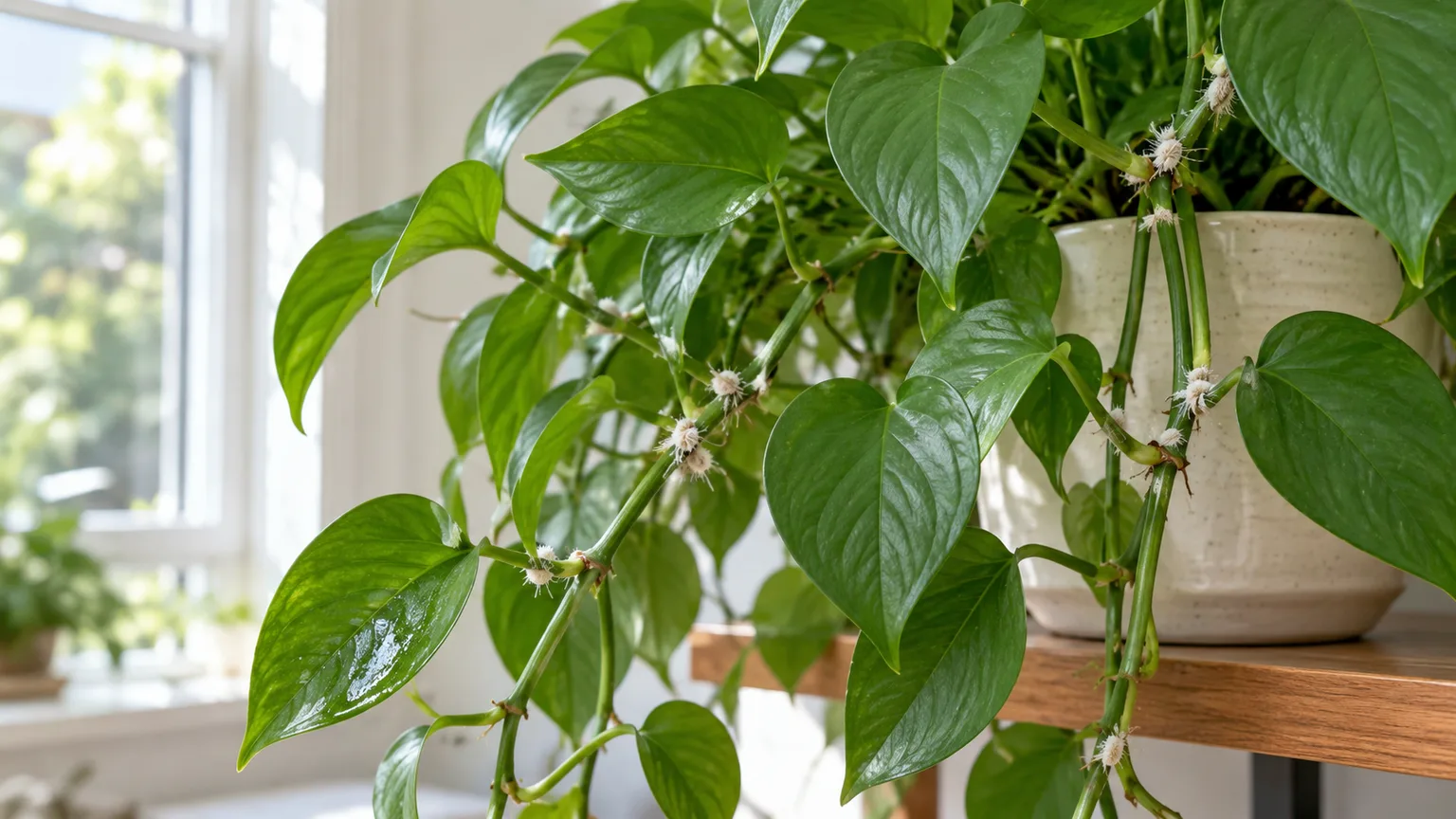
Mealybugs on Jade Pothos: Causes, Checks & Fixes
This guide covers mealybugs on Jade Pothos. See also the general Mealybugs guide, watering, and light pages for this plant.
Mealybugs on Jade Pothos: Causes, Checks & Fixes
Quick answer
Mealybugs on Jade Pothos look like tiny clumps of white cotton packed into the joints where each leaf stalk meets the vine, along trailing stems, and inside newly unfurling leaves. Leaves above a colony may yellow, stall, or drop, and leaves below turn sticky with honeydew that can grow black sooty mold. For how mealybugs feed and reproduce in general, see our mealybugs pest guide. On Jade Pothos, the pattern concentrates at vine nodes and leaf axils rather than spreading evenly across every leaf.
First step: isolate the plant so no vine touches its neighbors, then dab every visible white mass with a cotton swab dipped in 70% (or weaker) isopropyl alcohol. Test on one small leaf area first and watch for a day or two for burn, as UC IPM advises. Do not drench the plant, repot it, or fertilize it on day one — make this one targeted correction, then re-check weekly before deciding on stronger measures.
What mealybugs look like on Jade Pothos
On this plant, mealybugs are creatures of the joints. Jade Pothos grows as long trailing vines with a leaf at every node, and each node carries a petiole base, a leaf fold, and often a small aerial-root nub — a perfect sheltered run of hiding spots. University of Wisconsin horticulturists describe mealybugs on pothos as white, cottony masses, frequently in the leaf axils, on the lower surfaces of leaves and even on the roots. Part the vines and look closely at:
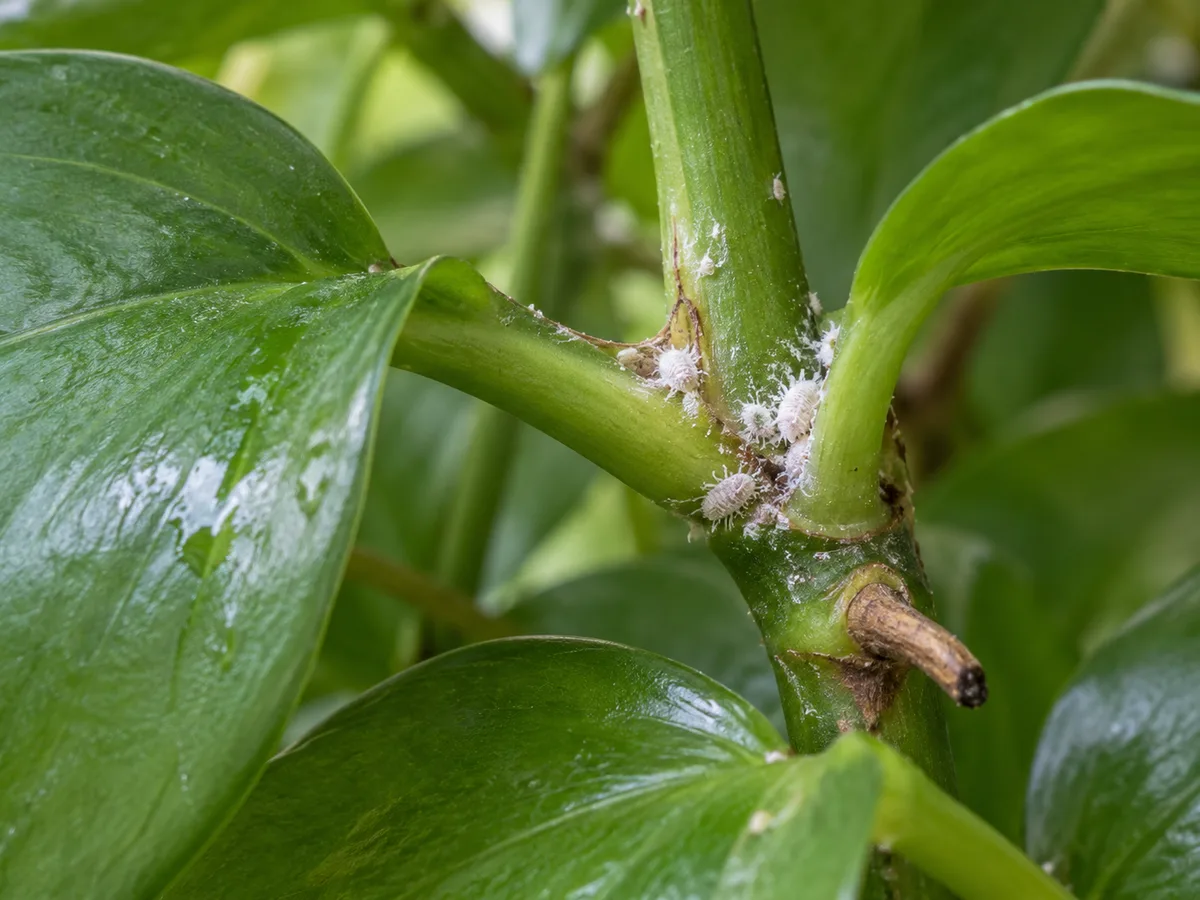
White cottony mealybug colonies tucked into Jade Pothos leaf axils and vine nodes — compare with the firm brown aerial-root nubs on the same vine.
- Leaf axils where each heart-shaped blade’s stalk meets the trailing stem — the number-one hideout
- Undersides of new and unfurling leaves, especially at the growing tip of each vine
- Nodes along bare vine sections, clustered around old leaf scars and aerial-root nubs
- Stems near the soil line, where vines are dense and airflow is lowest
- Leaf undersides and the pot rim below a colony, which feel sticky with honeydew
Individual insects are small — females are rounded, wingless, and about 1/16 inch long, pinkish and soft-bodied beneath their white waxy cotton. Because Jade is a solid deep-green cultivar, the white masses stand out more starkly than on marbled varieties like Marble Queen. Heavy feeding weakens and stunts plants, causing yellowing, defoliation, and wilting, so a vine that stops extending while its tip fills with cotton is a classic Jade Pothos presentation.
Why Jade Pothos gets mealybugs
Mealybugs are one of the most common insect pests infesting pothos in homes, and Jade’s own strengths create the opportunity. Its solid-green leaves photosynthesize efficiently, so it grows fast and throws long, overlapping vines — and mealybugs feed especially on stem tips, leaf junctures, and new growth. Every new node is both fresh food and fresh shelter.
Three conditions turn a passing mealybug into a colony on this plant:
- Vine-to-vine contact. Mealybugs crawl easily from one plant to another when leaves or branches overlap. A Jade Pothos trailing into a neighboring plant, or several vines piled on each other in a hanging basket, becomes a highway for crawlers.
- Soft, lush growth from excess nitrogen. Mealybugs favor succulent new tissue, so avoid over-fertilizing with excess nitrogen — a heavily fed Jade pushing soft pale growth is more inviting than a moderately fed one. This connects directly to your fertilizer routine; feeding cannot fix an infestation and usually feeds it.
- A newly introduced plant. Most indoor outbreaks start with a hitchhiker. Carefully inspect all new houseplants before introducing them to your home, and keep them separate for a week or so — this single habit prevents more Jade Pothos infestations than any spray.
Jade’s tolerance of lower light than variegated cultivars is not itself a cause, but a dim corner slows vine growth while colonies keep feeding, so damage looks worse faster. If your plant sits in weak light, review the Jade Pothos light guide alongside treatment — but fix the insects first, then the placement.
How to confirm the cause
Work vine by vine from the tips back to the pot. Hold each trailing stem up to good light, bend it gently to open the leaf axils, and check the newest two or three leaves on every vine first — crawlers settle on fresh growth. Confirm mealybugs (rather than dust, perlite splash, or harmless aerial-root tissue) with these checks:
- The smear test. Dab a suspect white mass with an alcohol-dipped swab. A mealybug colony smears dull pinkish-orange; dust and perlite just wipe away clean.
- The sticky-leaf test. Run a finger along lower leaves and the pot rim beneath a colony. Sticky honeydew that can grow black sooty mold points to sap-feeders like mealybugs, as UC IPM describes.
- The overlap trace. Note which vines touch other houseplants or pile onto each other — colonies cluster along those contact routes because crawlers walk across touching foliage.
- The root check (for puzzling wilt). If leaves yellow and wilt even though your watering matches the top-half-dry rule and drainage is fine, suspect root mealybugs: look for small white cottony masses around the drainage holes, then slide the root ball out to inspect the roots directly. Underground infestations are often confirmed only by removing the root ball.
If the white material is bark-colored bumps that do not smear, you are looking at scale instead — a different treatment path. Fine stippling with webbing on leaf undersides points to spider mites on Jade Pothos.
First fix for Jade Pothos: isolate and alcohol-swab
Do one thing first: isolate the plant and swab every visible colony. Move the pot away from all other plants so no vine touches a neighbor, then work along each vine dabbing each cottony mass with a cotton swab or cloth dipped in rubbing alcohol. This alcohol-swab method is most effective on large-leaved plants like pothos — Jade’s broad heart-shaped leaves give you a firm surface to press against, unlike fine-leafed plants where swabbing shreds foliage.
Test on a small area first and allow a day or two to confirm no leaf burn before treating the whole plant. Wear gloves: pothos sap may irritate skin, and you will be handling every vine. Snip off and bag any vine section so packed with cotton that you cannot find clean stem — pruning out heavily infested parts is a legitimate control step, and Jade back-buds readily from remaining nodes (see the pruning guide for where to cut).
Washing rarely eliminates all pests, so check the plant periodically and wash again or use other controls when more are noticed. Schedule that second look now — one week out — before you decide anything stronger is needed.
Step-by-step recovery
Follow this ladder in order, escalating only if live mealybugs persist at the weekly check:
- Repeat the swab round weekly. Eggs hidden in waxy threads survive the first pass and hatch over the following days, since females lay eggs inside protective masses of white cottony threads. Two to three weekly rounds catch each hatching wave.
- Blast hard-to-reach axils with water. For colonies wedged where swabs cannot reach, use a moderately strong spray of warm water to dislodge them, repeating every few days — a combination UC IPM recommends for exposed populations. Let the pot drain fully afterward so the soil does not stay soggy.
- Treat crawlers with soap or oil. Once only tiny mobile crawlers remain, coat them directly with insecticidal soap, horticultural oil, or neem oil. These less-toxic options work but must reach the insects hiding in tight spots and usually need several applications — the waxy adult coating shrugs off contact sprays.
- Rescue clean cuttings if the mother plant is overwhelmed. Pothos vines root in water within 3 to 4 weeks, and Wisconsin horticulturists note that for severe infestations it is often better to discard the plant and start over with clean plants or cuttings. Snip healthy-looking tip cuttings above the highest visible colony, swab each node clean, root them in fresh water away from the infested pot, and discard the badly infested mother plant rather than fighting a losing season-long battle. The propagation guide covers the node-cutting technique.
- Handle root mealybugs by replacement. Root infestations are particularly difficult to control, and discarding plus restarting is often the practical answer. Do not reuse the old mix.
Recovery timeline
Expect visible progress within two to three weekly rounds: fewer fresh cottony masses, no new sticky honeydew, and vine tips resuming extension. Full confidence takes longer — mealybug generations overlap indoors, so keep inspecting new leaf folds for four to six weeks after the last live insect you find.
Judge recovery the Jade Pothos way: new leaves unfurling clean at vine tips, existing green leaves staying firm rather than yellowing further (compare with the yellow leaves guide if decline continues after insects are gone), and no fresh honeydew on lower foliage. Yellowed or sooty leaves already damaged will not green up again — prune them once clean growth is clearly established. If colonies rebound at the same nodes after three thorough rounds, stop retreating the same vines and switch to the clean-cutting rescue above.
Lookalike symptoms on Jade Pothos
| What you see | More likely | How to tell |
|---|---|---|
| White cotton in axils + sticky leaves | Mealybugs (this page) | Smears pinkish-orange on an alcohol swab; honeydew below |
| Fine stippling + faint webbing under leaves | Spider mites | No cotton, no honeydew; damage looks dusty-speckled |
| Soft green/black clusters on new tips | Aphids | Insects visible and soft without waxy cotton; often farmed by ants |
| Brown immobile bumps on stems | Scale insects | Bumps scrape off like bark; no cottony threads |
| Yellow wilt despite correct watering + cotton at drainage holes | Root mealybugs | Confirmed only by unpotting and inspecting roots |
| Yellow lower leaves, no insects, wet heavy mix | Overwatering or root rot | Sour-smelling mix, mushy stems; check the watering guide |
| Brown firm nubs at nodes, no cotton or stickiness | Normal aerial roots | Pothos produces clasping roots from nodes for climbing — leave them alone |
Mistakes to avoid
- Spraying alcohol solution over the whole plant untested. Blanket spraying without a patch test risks leaf burn; dabbing individual colonies after a test is the safer sequence both extension sources describe.
- Stacking repot, prune, and spray on day one. A stressed Jade Pothos cannot show you which intervention worked. Swab first, reassess weekly, and repot only for confirmed root mealybugs or failing mix (see the repotting guide when it is genuinely warranted).
- Fertilizing a struggling plant. Extra nitrogen pushes exactly the soft growth mealybugs prefer — hold feed until vines are growing clean again.
- Treating one plant while vines still touch. Check every plant whose foliage overlaps the infested pothos; a single untreated neighbor re-seeds the colony through crawling nymphs.
- Reaching for broad-spectrum insecticides first. These are less effective against wax-coated adults and wipe out the predatory insects that help outdoors — reserve registered insecticides for severe cases and always follow the label.
Jade Pothos care cross-check
Mealybug pressure drops when the plant grows at a steady, moderate pace rather than flushing soft growth or stalling. Cross-check the routine while you treat:
- Light: medium indirect light keeps Jade compact and steadily growing; trailing vines in dim corners grow weak and show damage faster (light guide).
- Water: water only when the top half of the mix dries (roughly every 7–10 days in bright light, 14–21 in low light), using a well-aerated mix that dries between waterings — chronic wet feet cause yellowing that masks or mimics pest decline (watering guide).
- Soil and drainage: a well-drained potting medium in a pot with real drainage holes prevents the soggy conditions behind mold on soil and fungus gnats, which often coincide with stressed, pest-prone plants (soil guide).
- Feeding: monthly half-strength balanced feed in spring and summer only; skip winter and skip stressed plants entirely.
- Vine management: prune to keep vines a reasonable length and promote new growth — shorter, separated vines are simply easier to inspect than a tangled curtain.
Start from the Jade Pothos overview or the full problems hub if more than one symptom is present.
When to use this page vs other Jade Pothos guides
Use this page when you find white cottony masses, sticky honeydew, or confirmed mealybug colonies on vines, axils, or roots. Use the yellow leaves guide when leaves yellow with no insects, cotton, or stickiness — that points to water, light, or nutrition. Use the spider mites guide for stippled dusty leaves with webbing, the aphids guide for soft visible clusters on new tips, and the root rot guide for mushy stems and sour mix after overwatering. If growth simply stalls with no pests at all, the slow growth and not enough light pages cover that path.
How to prevent mealybugs next time
Prevention on a trailing pothos is mostly about quarantine and spacing. Inspect every new plant — under leaves, in new leaf folds, around growing tips — and hold it apart from your Jade for about a week before vines intermingle. Keep Jade’s own vines from tangling into neighboring pots, prune annually for airflow, and wipe leaves during routine care so early colonies cannot hide for months. Feed moderately, since lush over-fertilized foliage invites colonization. Finally, remember Jade Pothos is toxic if ingested because it contains calcium oxalate — handle infested vines with gloves and keep both the plant and any alcohol or soap treatments away from pets and children.
Related Jade Pothos guides
- Jade Pothos overview — full care baseline: light, water, soil, and feeding rhythm.
- Jade Pothos problems — hub for matching any symptom to the right fix.
- Yellow leaves on Jade Pothos — use when yellowing continues after insects are gone.
- Spider mites on Jade Pothos — use for stippled leaves with webbing instead of cotton.
- Aphids on Jade Pothos — use for soft clusters on new tips without waxy threads.
- Root rot on Jade Pothos — use for mushy stems and sour mix rather than insect colonies.
- Jade Pothos watering — the top-half-dry routine that keeps growth steady and diagnosable.