Low Humidity on Lithops: Causes, Checks & Fixes
Quick answer
Low humidity almost never harms Lithops: they are arid mesembs built for dry air. Wrinkling in a dry room usually means normal leaf splitting, a missed seasonal soak, or heat stress. First step: check the growth stage before adding water, and never fix it with a humidifier.
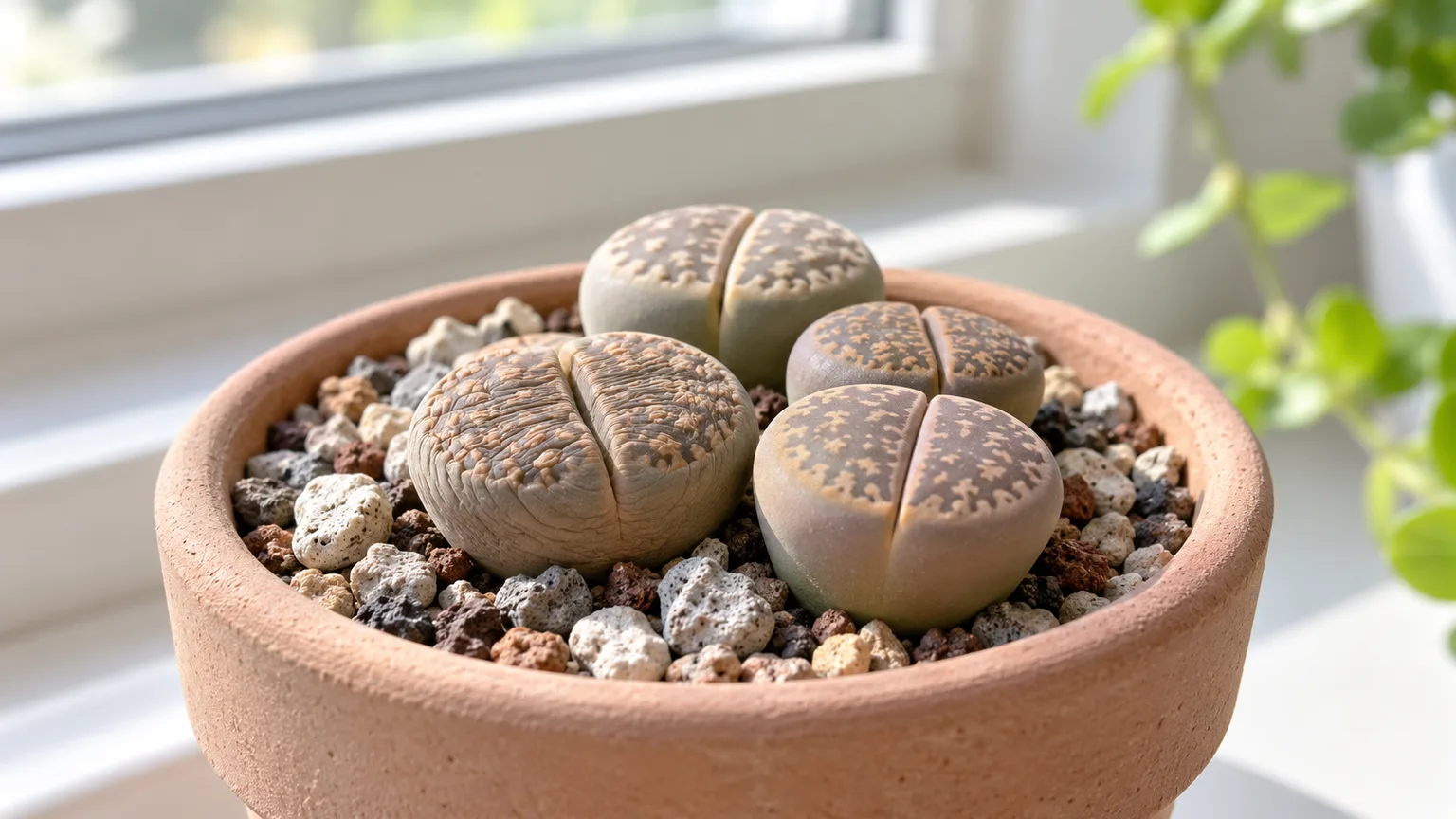
Low Humidity on Lithops: Causes, Checks & Fixes
This guide covers low humidity on Lithops. See also the general Low Humidity guide, watering, and light pages for this plant.
Low Humidity on Lithops: Causes, Checks & Fixes
Quick answer
Your Lithops looks wrinkled in dry indoor air and you are wondering whether it needs humidity. Here is the part that surprises most owners: Lithops are southern African mesembs native to arid rocky ground where dry air is normal, so low humidity by itself almost never damages them.
First step: check the growth stage, not the hygrometer. If the plant is splitting (a new pair pushing through the fissure while the old pair thins), do nothing — watering now is the classic killer. If splitting is finished and the gritty mix has been dry through the whole active window, give one deep seasonal soak. Never answer dry air with a humidifier or mister: excess air moisture invites fungal problems on a plant built for air below 50 percent humidity.
What dry air really looks like on a Lithops
On a tropical plant, dry air crisps thin leaf edges within days. A Lithops has no thin leaves — just two thick, stone-like bodies joined by a fissure, tipped with window cells that pipe light inside. That architecture loses water extremely slowly, which is why this plant can sit through months of dry air unchanged.
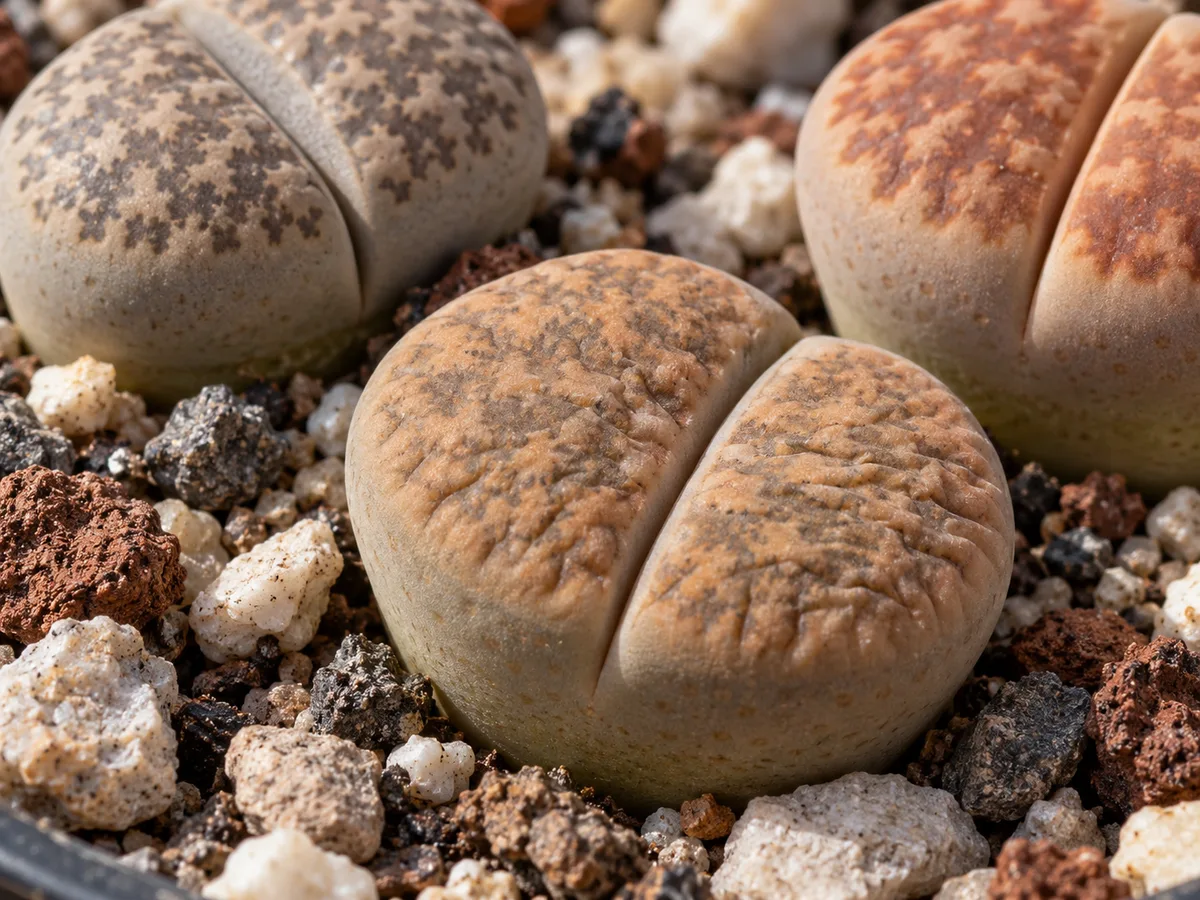
Macro check: fine, even wrinkling over firm bodies points to a missed seasonal drink or normal absorption; soft, glassy, or split tissue points to water damage, not dry air.
When room air truly runs ahead of the plant’s water reserves, the sign is subtle: fine, even wrinkling across the crown of otherwise firm bodies, with normal color and no spots, pests, or soft patches. For the general mechanics of how dry air pulls moisture from foliage, see our low humidity guide. On Lithops, that pattern almost always means the roots have nothing left to send upward — or the plant is deliberately moving water from the old pair into the new one — rather than the air itself attacking the leaves.
Why low humidity is rarely the real diagnosis
Three facts about this genus push dry air to the bottom of the suspect list. First, wild Lithops survive on under 20 inches of rain a year, and some populations get by on mist and fog — the plant is designed to harvest sparse moisture, not bathe in humid air. Second, growers consistently find that Lithops dislike the extra humidity tropical houseplants enjoy, tolerating damp air only in brief bursts. Third, the symptoms blamed on dry air — wrinkling, dullness, stalled growth — are exactly what the normal splitting cycle and a missed seasonal watering produce.
So treat “low humidity” on this page as a routing diagnosis: confirm the air is not the problem, then find which Lithops-specific rhythm actually explains the look. The usual answers live on sibling pages — underwatering when a seasonal soak was skipped, overwatering when kindness came at the wrong moment, or simple Etiolation-free dormancy on the problems hub.
The splitting-cycle check: read this before touching water
This is the section that would be nonsense on any other houseplant, and it decides everything. Every year each Lithops grows exactly one new leaf pair inside the old one. The old pair thins, wrinkles, and turns papery as its water moves into the replacement emerging through the fissure.
During this transfer, wrinkling is the treatment working, not a symptom. Watering while old leaves are still plump interrupts the handoff: the old pair stays fat, the new pair competes for the same space, and the crown stacks or rots. NC State Extension describes the rule plainly: during winter and early spring give no water at all while old leaves die and new leaves form in spring.
Confirm the stage with your eyes, not the calendar alone:
- Splitting in progress: fissure widening, a firm new pair visible inside, outer leaves thinning from the top down — withhold all water.
- Splitting finished: outer leaves fully papery husks, new pair exposed and firm — the plant may now drink in its active window.
- No splitting, firm but wrinkled new pair: a seasonal soak was likely missed — water once, deeply.
If you are unsure which stage you are seeing, compare against the watering guide before deciding, because a wrong-season drink kills more Lithops than any dry room ever has.
How to confirm thirst versus normal rest versus heat stress
Work this order on a firm, wrinkled plant:
- Fissure first. New growth inside means rest — no water regardless of room humidity.
- Squeeze gently at the sides. Firm and wrinkled means thirsty or absorbing; soft, translucent, or sour-smelling at the base means rot from past overwatering, and the fix is drying out, not humidity. NC State notes that overwatering shows as yellowing, mushy leaves, splitting, and root rot.
- Check the season and mix. A bone-dry gritty mix during the late-summer-to-fall active window supports one soak; the same dryness in winter rest means keep waiting.
- Check heat and light. A plant baking against hot glass or under a new grow light wrinkles from heat load even with correct watering — move it back before adding moisture. Our light guide covers safe brightness without scorch.
- Look for pests last. Spider mites and mealybugs stipple or cotton the crown rather than wrinkling whole bodies; rule them out with a loupe rather than assuming dry air.
First fix for a genuinely thirsty Lithops
When the checks above confirm a finished split, firm tissue, and a long-dry pot in the growing window, the fix is one deep seasonal drink — not humidity equipment.
Bottom-water or top-water slowly until it runs freely from drainage, then let the shallow pot drain completely and return the plant to bright air circulation. Kew places Lithops in Aizoaceae, the stone-plant family whose taproot demands that the mix dry fast after every drink, so never leave the pot sitting in a saucer. One soak is the whole intervention; judge it by the new pair firming over the next few days, not by the old husks, which stay papery by design. If firmness does not return after a correct soak, suspect root loss and read wilting before watering again.
Lookalikes: what else wrinkles, spots, or stalls a Lithops
| What you see | More likely page | Why it is not low humidity |
|---|---|---|
| Deep wrinkles, shriveled new pair, rock-dry mix in growing season | Underwatering | Roots are empty, not the air — one seasonal soak fixes it |
| Translucent, mushy, or burst bodies after watering | Overwatering | Too much water at the wrong stage; humidity gear makes it worse |
| Tan or bleached patches after a light change | Not enough light and light guide | Heat and photon load, not air moisture |
| Brown, dry crown tips with no softness | Brown tips | Localized tissue death from sun or past stress, not room humidity |
| No growth for a full year despite correct seasons | Slow growth | This genus is extremely slow; patience plus season-correct care |
Mistakes to avoid with dry air and Lithops
- Running a humidifier for the Lithops. Damp, still air around a mesemb crown encourages the very fungal issues dry-climate growers avoid — keep humidity tools pointed at tropicals, not this pot.
- Misting the bodies. Water sitting in the fissure is a rot invitation; Lithops take moisture through roots in season, not through crown showers.
- Watering on a schedule because the room feels dry. Room humidity and soil moisture are different things; a dry room with a correctly timed soak grows a firm plant.
- Repotting a wrinkled plant to “check roots.” Unpotting breaks fine roots and restarts establishment; only unpot when softness or smell already indicates rot.
- Fertilizing to perk it up. A stressed or resting Lithops needs no feed; fertilizer in mineral mix burns roots without fixing any moisture story.
Lithops care cross-check
Dry-air worries usually resolve once the base culture is right. Lithops want full sun for morning hours with some afternoon shelter, a very mineral, fast-draining mix — think pumice, coarse sand, and fine gravel with little organic matter — and water only inside active growth windows. RHS describes Lithops as small succulent perennials that demand exactly this sharp drainage and restraint. Experienced growers cut standard succulent mix half-and-half with extra pumice or turface, and go further toward straight mineral media in humid climates — a reminder that ambient moisture is something this plant tolerates, never something it requests. Keep the shallow pot breathable, review the overview for the annual rhythm, and let the fissure, not the hygrometer, schedule your watering.
How to prevent it next time
Prevention here means respecting the calendar, not managing the air. Mark the splitting phase each year and water nothing until husks finish; soak once, deeply, only inside the active window; keep winter completely dry. Site the pot where morning sun is strong but glass heat cannot cook it, and give it open air rather than a terrarium or humidity tray. Inspect weekly for firmness rather than surface looks — a firm, slightly wrinkled Lithops in dry air is a healthy plant minding its own business.
Related Lithops guides
- Lithops overview — start here for the annual splitting rhythm that explains most wrinkling.
- Watering — use when you need the seasonal soak-or-wait decision in detail.
- Underwatering — use when the split is done, the mix is exhausted, and one soak is due.
- Overwatering — use when bodies are soft, split, or translucent instead of just wrinkled.
- Light — use when bleaching or heat accompanies the wrinkles.
- Soil — use when the mix stays damp or lacks the mineral grit this genus needs.
- All Lithops problems — use when the pattern does not match dry air at all.
Related tool
Use the Humidity Calculator to confirm your room readings before changing anything — if the number is low but the plant is splitting or resting, the correct action is still to wait, not to humidify.