Wrong Soil Mix on Marigold: How to Diagnose and Fix It
Quick answer
If a Marigold's pot stays heavy and wet between waterings, or water pools on the surface, check the whole root zone before adding fertilizer or repotting. For a confirmed container mix failure, replace the dense mix in a pot with drainage holes and use fresh, well-draining potting mix. Rich soil can also produce plenty of foliage but fewer flowers, so do not diagnose a mix problem from one yellow leaf or a quiet bloom period alone.
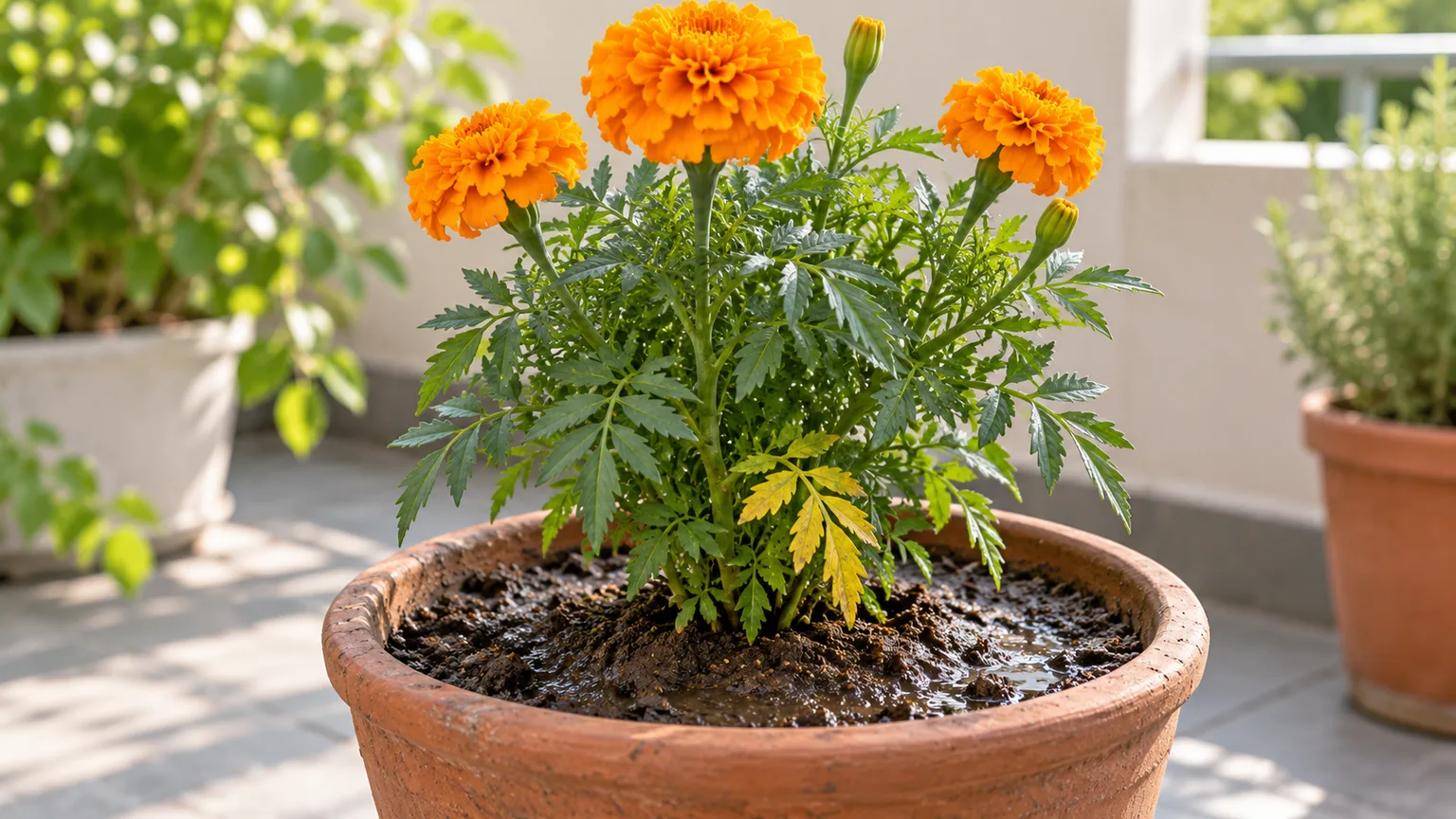
Wrong Soil Mix on Marigold: Drainage, pH & Fixes
This guide covers wrong soil mix on Marigold. See also the general Wrong Soil Mix guide, watering, and light pages for this plant.
Wrong Soil Mix on Marigold: Drainage, pH & Fixes
Quick answer
Wrong soil mix on Marigold is not one disease with one leaf pattern. It means the root zone is failing to manage water, air, or fertility for this warm-season annual. First check how the mix behaves after an ordinary watering. If the pot remains heavy and wet, water puddles instead of soaking in, or the mix has collapsed into dense clods, replace that confirmed failure with fresh container mix in a pot with drainage holes. Do not start by adding fertilizer or changing several parts of care at once.
For the general causes of soil mismatch, see the wrong soil mix symptom guide. Here, the useful distinction is what happens to an African Marigold, Tagetes erecta: a persistently wet root zone can lead to lower-leaf yellowing or weak growth, while overly rich soil may keep the plant leafy but reduce flowers. NC State Extension describes African Marigold as tolerating clay and dry soil but preferring evenly moist, well-drained soil, so neither waterlogged sludge nor a mix that repeatedly refuses water is a good target. The NC State plant profile gives that species-specific drainage guidance.
What wrong soil mix looks like on Marigold
A Marigold in unsuitable soil may yellow from the lower leaves upward, wilt even when the surface looks damp, grow slowly, or flower less than expected. Those signs are clues, not proof: a single old leaf can yellow normally, and weak flowering can come from shade or excess feeding rather than the mix. Look for a matching root-zone clue before changing soil.
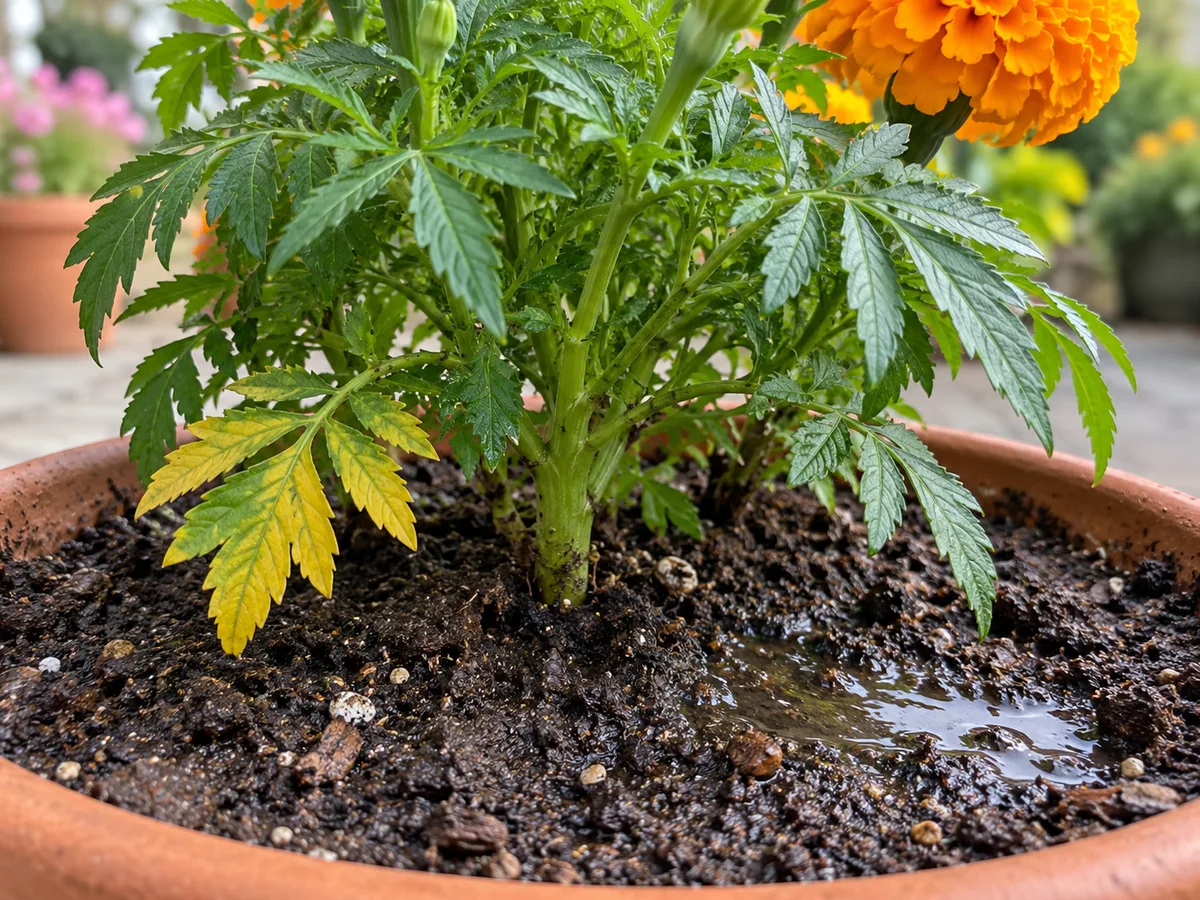
Water lingering on dense mix is a warning to check drainage at root depth; the surface alone does not confirm the cause.
In a container, watch whether irrigation enters the mix evenly or sits on top, then check whether the pot becomes lighter as it dries. A mix that stays cold and heavy for much longer than the plant’s usual rhythm can keep roots short of air. At the opposite extreme, old peat-based mix may shrink from the pot wall or let water run straight down the gap without wetting the center. After that fast runoff, the plant can still be dry inside.
In a garden bed, look for puddles after rain, a smeared or crusted surface, or soil that dries into hard plates. A bed can be too dense even when the Marigold survives in it. If the plant is green and firm but simply makes fewer flowers, inspect fertility and sunlight before blaming the soil texture.
Why African Marigold reacts to wet soil
African Marigold is grown as a tender annual, and its normal pattern is active summer growth followed by flowering until cold weather ends the season. Its soil should hold enough moisture for steady growth but drain between waterings. Wisconsin Horticulture’s pH and drainage guidance puts Marigold near pH 6 to 7, with moderate water and little fertilizer. Use that baseline rather than copying a tropical houseplant mix.
When container soil stays saturated, first check the drainage holes, pot size, and light. A small Marigold in a very large pot has more unused wet mix around its roots, and a shaded, cool location slows dry-down. These factors can make an ordinary bagged mix perform poorly even when its label sounds suitable. For the watering rhythm that matches the pot, use the Marigold watering guide and judge the soil itself instead of a fixed calendar.
NC State lists root and crown rots among the possible African Marigold diseases, while The Spruce links poor drainage to root rot. Those risks do not mean every yellow Marigold needs emergency repotting. If the crown is firm and the mix drains, first look at recent watering, weather, and light. If the base is soft or the roots smell sour, follow the separate Marigold root-rot diagnosis because the problem may have progressed beyond a simple mix correction.
Rich soil can make Marigold leaves outnumber flowers
Not every wrong mix stays wet. African Marigolds can grow well without highly enriched soil, and a heavy dose of compost or nitrogen-rich fertilizer can push foliage while reducing bloom display. The Spruce notes that rich soil reduces flowering in African Marigolds and recommends well-draining soil. This is a Marigold-specific diagnostic clue: a lush, dark-green plant with few flowers points toward fertility or light before it points toward a need for richer soil.
Before replacing the mix, review what was added at planting and how often the plant has been fed. Fresh manure, repeated high-nitrogen feeds, or a strongly enriched potting blend can all make a flowering annual too leafy. Pause extra feeding while you assess; do not try to correct a nutrient-rich mix by adding a second fertilizer with a different label. If the plant is also stretching toward a window or receives little direct sun, compare its placement with the Marigold light guide before changing its roots.
A pH problem is less likely than a drainage or fertility problem unless symptoms persist despite reasonable watering and feeding. Wisconsin Horticulture gives pH 6 to 7 as a useful Marigold range. If a soil test places the root zone well outside that range, use the Marigold soil-too-alkaline guide for that specific issue rather than adding lime or sulfur by guesswork.
Confirm the mix is the cause before disturbing roots
Start with one normal watering and observe the pot. If water beads or pools, press a finger into the mix an inch or two down after the surface has drained. Does that layer feel wet and pasty, or is the surface damp while the center remains dry? Lift the pot before and after watering if you can; a heavy pot that stays heavy suggests slow drying, while a very light pot with a dry center may indicate that water is bypassing the root ball. Water flow and pot weight together are more useful than leaf color alone.
Check the container’s bottom holes and the saucer or outer cachepot. Water must be able to leave the container. For container Marigolds, Bob Vila recommends drainage holes and fast-draining mix, since they do not tolerate soggy soil. If the plant is inside a decorative pot, take the nursery pot out after watering and empty standing runoff. Do not drill, repot, or add amendments until you know whether water is trapped by the container or by the mix itself.
Only slide the plant out when the evidence warrants it: mix that remains wet for days in warm bright conditions, persistent wilting despite damp soil, or a sour smell from the root ball. Look for roots that are firm and pale versus roots that are mushy, dark, or sloughing. If the roots are mostly firm, a mix problem may still be reversible. If the crown or most roots have softened, use the root-rot guidance rather than treating the issue as texture alone.
For Marigolds in beds, inspect a small area beside the plant instead of pulling it up. After a soaking rain, does water stand, or does the bed drain? Is the soil hard and cloddy, or does it crumble when moist? NC State notes that African Marigold tolerates clay, but prefers evenly moist, well-drained conditions. Clay tolerance means it can grow in some clay soils; it does not mean the plant will thrive where rainwater remains pooled around the crown.
The first fix for a confirmed container mix failure
If the Marigold’s container mix is clearly dense and staying wet, the first fix is to replace that failed mix in a pot with working drainage holes. Use a pot close to the existing root ball’s size; moving into a much larger container adds more damp soil than a one-season Marigold can use quickly. Bob Vila likewise recommends fast-draining potting soil and drainage holes for Marigolds grown in containers.
Choose a standard potting mix made for containers, then improve its structure with a modest amount of perlite if the current mix repeatedly holds too much water. The Marigold soil guide uses about 15% perlite by volume as a practical starting point. That is a baseline, not a magic ratio: a plastic pot on a shaded balcony may stay wet longer than a small terracotta pot in full sun. Avoid garden soil in a container, and do not use a rich manure-heavy mix to compensate for slow growth before you know whether the roots are healthy.
Ease the plant out while the root ball is slightly moist rather than bone dry or dripping. Loosen only mix that comes away readily; tugging every bit of soil from fine roots can add avoidable stress. If roots are firm, place the plant at its former depth in the refreshed mix and water it in once until excess drains. Do not also prune healthy stems, move it into harsh midday sun, or fertilize the same day. Keeping the other conditions steady makes it easier to see whether improved drainage helped.
If only the top surface has crusted but water reaches the center and exits through the base, a full repot may not be necessary. Remove a thin layer of crusted material, correct any excessive feeding, and observe the next watering cycle. If water runs down the pot wall without wetting the center, re-wet the mix slowly in several passes; if the root ball still repels water or has collapsed, replace it rather than repeatedly soaking the plant.
Correct a garden bed without uprooting a healthy annual
A Marigold planted in the ground does not need the same rescue as a container plant. Do not dig around an otherwise firm plant to mix amendments through its active roots. First stop adding extra water if the site is already wet, keep irrigation at the base, and allow the top of the bed to begin drying. If water remains pooled after rain or the soil forms a dense paste, mark that location as a drainage problem for the next planting.
For a future planting, choose an open, well-drained part of the bed or raise the planting area so excess water can leave. Work compost into poor soil in moderation; a fertile bed is not a reason to keep adding nitrogen. African Marigold can tolerate clay according to NC State, but the preferred condition remains evenly moist and well-drained. If the bed’s pH is the issue, test it before amending; do not guess from one yellow leaf.
If the current Marigold is close to the end of its annual season and remains upright, it may be more reasonable to let it finish than to expose it to a disruptive midseason move. Save the correction for the next sowing or transplant unless the crown is failing. For potting or moving a container plant, see the Marigold repotting guide; this article is about the soil mismatch, not routine transplant timing.
The annual life cycle changes the repair decision
African Marigolds are annuals, so most gardeners do not need to maintain the same plant in the same pot for years. NC State identifies Tagetes erecta as an annual, and The Spruce notes routine repotting is unnecessary because these plants finish at the end of their growing season. That short life changes the cost-benefit calculation: a timely mix replacement can be worthwhile while the plant is actively growing, but an elaborate rescue may not pay off when frost or natural decline is already near.
The mix also changes with the plant’s stage. Seeds do better in a light seed-starting medium than in a heavy container blend, while a transplanted Marigold needs a stable, free-draining finished mix around its established roots. If seedlings stall before planting out, check whether the starting medium is compacted or waterlogged, but do not transplant a tiny seedling repeatedly just to chase a perfect recipe. Once the plant has established, give it one suitable final container or bed and let the roots settle.
Do not carry a compacted, sour-smelling pot of spent Marigold soil into next season’s container without inspecting it. A seasonal refresh is often simpler than trying to rescue a degraded mix after it has repeatedly stayed wet. Where the previous plant had soft roots or a suspected disease, discard the old mix instead of reusing it for another susceptible plant; clean the container before filling it again.
Lookalikes that need a different correction
| What you notice | More likely explanation | Use this Marigold guide when… |
|---|---|---|
| Lower leaves yellow while the pot stays heavy and wet | Slow drainage or overwatering; soft roots point toward root rot | The root-zone pattern repeats after watering; compare with Marigold root rot if roots or the crown are soft. |
| Water runs down the pot sides while the center stays dry | Compacted or shrunken mix that no longer wets evenly | The soil structure itself is the issue; see compacted soil on Marigold for that narrower diagnosis. |
| White crust appears on the soil or pot rim with tip browning | Mineral or fertilizer salts rather than a simple texture mismatch | The crust is the main clue; use salt build-up on Marigold before adding any feed. |
| Persistent weak growth occurs despite reasonable moisture, and soil pH tests high | Alkalinity may be limiting nutrient availability | A test confirms high pH; use Marigold soil that is too alkaline. |
| Leaves wilt when the mix is dry, then perk after watering | Water deficit is more likely than the wrong mix | The pot dries normally but watering is late; compare with Marigold water stress. |
| Tall stems stretch and bloom sparsely in a shaded position | Too little light can mimic poor soil performance | Drainage is sound but the plant lacks direct sun; check the Marigold light guide. |
A soil change will not cure every case in the table. Match the diagnosis to the root-zone evidence, then follow one relevant correction rather than changing soil, water, light, and fertilizer together.
Recovery: what to watch after a mix change
After a container correction, watch the next watering cycle. Water should enter the root ball rather than sit on the surface, and excess should leave through the drainage holes. The pot should gradually become lighter as the mix dries. Do not water again just because the old schedule says it is time; use the Marigold watering guide to check the mix and pot in their new conditions.
Existing yellow leaves will not turn green again. Judge recovery by whether new leaves emerge normally, the plant holds itself upright, and fresh damage stops spreading. In a Marigold, resumed flower buds can take longer than the first improvement in the leaves because the plant needs to re-establish growth before spending energy on blooms. A plant that continues to collapse, develops a soft crown, or loses most roots after the mix drains may be too damaged to save.
Avoid feeding while the roots are settling into the corrected mix. If the plant is firm and begins making healthy new growth, resume only modest feeding if its soil or potting mix is low in nutrients. The Marigold is a low feeder; fresh, nutrient-rich soil plus repeated fertilizer can trade flowers for excess foliage. When the plant is nearing the end of its annual season, accept that older leaves and spent blooms will decline rather than trying to force fresh growth with fertilizer.
Mistakes that keep Marigold soil problems going
- Watering by weekday instead of by the pot. A balcony container, garden bed, and cool shaded pot do not dry at the same pace. Check the root zone before watering again.
- Adding amendments on top of a failed mix. A thin surface layer will not loosen dense soil around the roots. Confirm the problem before replacing the whole root zone.
- Jumping to a much larger pot. The spare mix around a small annual root ball can stay wet and delay dry-down. Keep the container close to the current root mass.
- Adding fertilizer to a plant with lush leaves and few blooms. African Marigold can flower poorly in overly rich conditions. Check light and feeding history first.
- Treating one yellow leaf as proof of root failure. Use leaf age, soil moisture, pot weight, drainage, and stem firmness together.
- Changing every care variable at once. If you repot, keep light and watering stable while the plant settles so you can tell whether the soil correction worked.
Prevent the same soil mismatch next season
For a container Marigold, start with a pot that has open drainage holes and a fresh, ordinary potting mix rather than garden soil. The Marigold soil guide gives the container blend and bed-preparation details. In a garden, choose a spot that does not stay waterlogged after rain. Wisconsin Horticulture places Marigold soil near pH 6 to 7 and describes the plants as low feeders, so test soil before trying to correct a suspected pH issue and use fertilizer conservatively.
Match the mix to the conditions around the pot. Containers can dry faster than in-ground plantings, so a sunny balcony pot may need a different check rhythm than a cool, partly shaded pot; Bob Vila notes that container Marigolds need more frequent irrigation. African Marigold performs best with ample direct sun, so use drainage and the plant’s actual dry-down to set watering rather than copying the frequency from another pot. If the plant is not flowering, check the Marigold care overview for its seasonal needs before blaming the mix alone.
At the end of the annual season, empty containers and remove exhausted roots before storing the pot. Reuse a pot only after cleaning it; begin the next Marigold in fresh mix if the old soil was compacted, salt-crusted, sour-smelling, or associated with root rot. That simple reset prevents last year’s drainage failure from becoming next season’s starting condition.
Related tool
Use the Plant Problem Diagnosis Tool to compare soil, watering, and light clues before changing a Marigold’s root zone.
Related Marigold guides
Use this page when water movement, compaction, or mix fertility is the suspected cause. The Marigold soil guide explains container blends and garden-bed preparation; the Marigold problems hub helps compare the full symptom cluster. If roots or the crown are soft, root rot is the narrower diagnosis. If the mix drains normally but a soil test is alkaline, use the dedicated alkaline-soil diagnosis instead.