Alkaline Soil on Marigolds: What to Check First
Quick answer
First test the soil around the marigold roots; pale leaves alone do not prove that the mix is too alkaline. African marigold can tolerate a range of soil pH, but a strongly alkaline result may reduce iron availability. Use the test result to decide whether a container needs fresh mix or a garden bed needs a local soil-test recommendation.
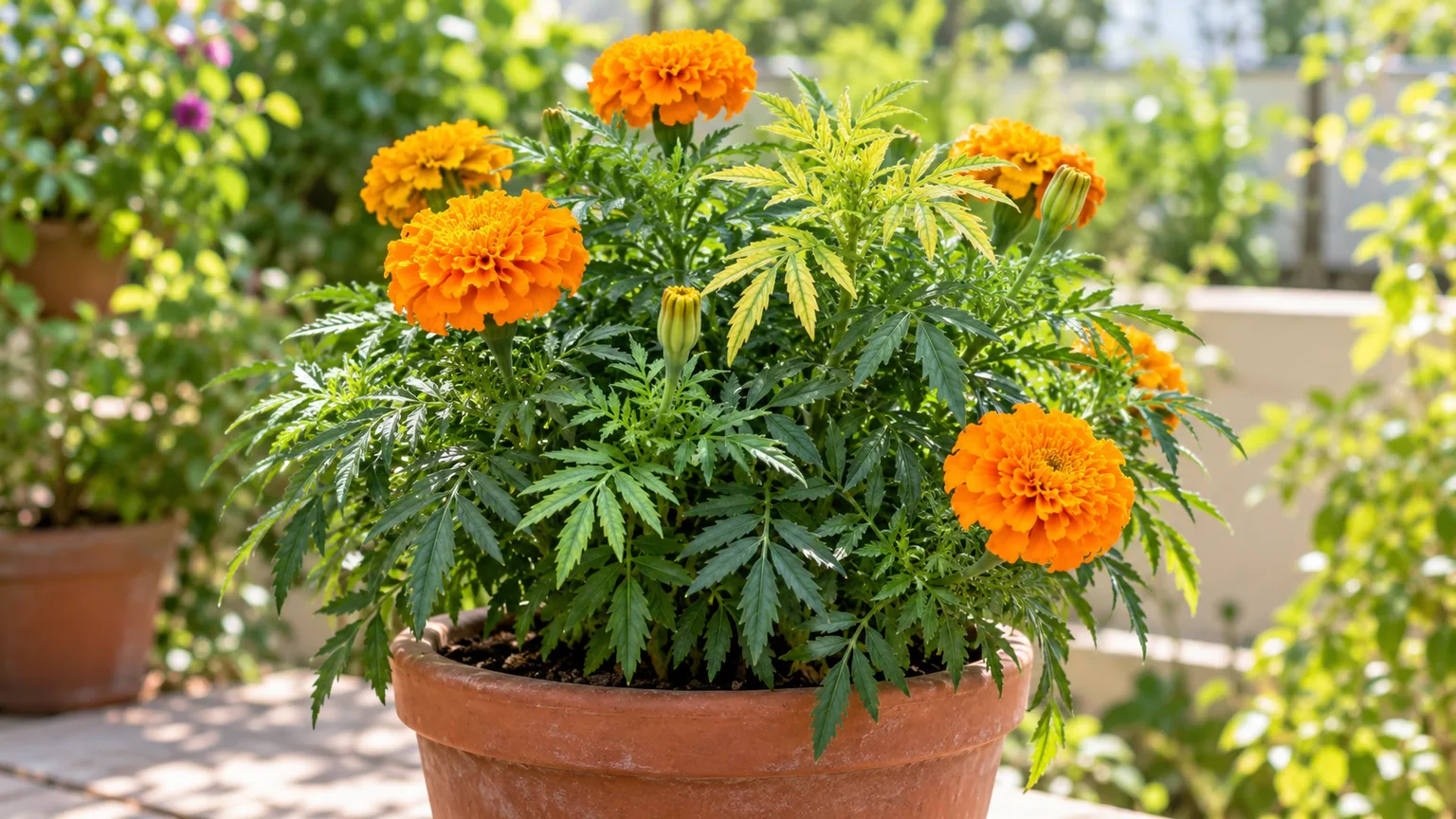
Soil Too Alkaline on Marigold: Causes, Checks & Fixes
This guide covers soil too alkaline on Marigold. See also the general Soil Too Alkaline guide, watering, and light pages for this plant.
Soil Too Alkaline on Marigold: Causes, Checks & Fixes
Quick answer
First test the soil around the marigold roots; pale leaves alone do not prove that the mix is too alkaline. African marigold (Tagetes erecta) can tolerate a range of soil pH, but a strongly alkaline result may reduce iron availability. Use the test result to decide whether a container needs fresh mix or a garden bed needs a local soil-test recommendation.
What alkaline-soil stress looks like on Marigold
Soil pH has no visible color or smell. When a high-pH root zone is involved, one possible clue is new marigold leaflets that turn pale between greener veins; severe chlorosis can spread or leave tissue scorched. This pattern is compatible with restricted iron availability, but it does not confirm the cause; Utah State University describes interveinal chlorosis.
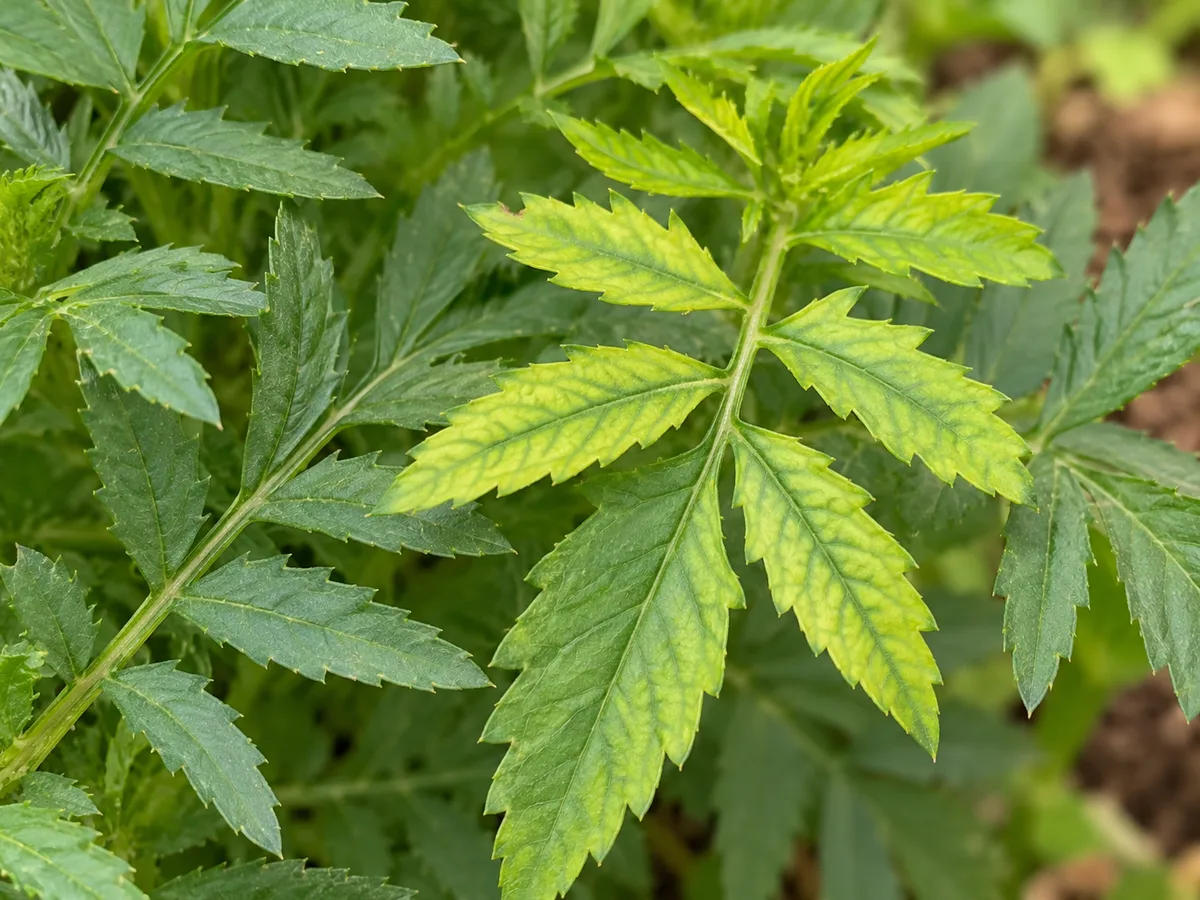
Pale tissue between greener veins can be a clue to iron chlorosis, but a soil test is needed before attributing it to high pH.
On African marigold, look at the newest divided leaves first and compare several shoots. A single old leaflet yellowing near the base is weaker evidence than repeated paling on fresh growth, especially if the plant is still pushing leaves and flowers.
Why African marigold can tolerate some alkalinity and still show chlorosis
The RHS profile describes African marigold as a bushy annual with divided, aromatic leaves, and lists Tagetes erecta for acidic, alkaline, or neutral soil. The Spruce guide gives a preferred pH range of 6.0–7.5. These references point to a practical distinction: a mildly alkaline reading does not automatically mean a marigold needs acidifying.
At higher pH, iron can become less available to roots even when the soil contains iron; Colorado State Extension explains that alkaline soil can convert iron into forms roots cannot absorb. The risk depends on the soil itself, drainage, and the plant’s ability to take up nutrients, so use the leaf pattern as a reason to test rather than as a diagnosis.
Marigold also needs full sun and well-drained soil to maintain active growth, as the RHS profile notes. If a pot stays wet or the mix is compacted, root conditions can contribute to iron chlorosis; Colorado State Extension lists wetness and compaction among complicating factors. Check the plant’s Marigold soil guide, watering guide, and light guide before changing its pH. For soil-pH mechanics beyond this plant-specific check, see our general soil-too-alkaline guide.
Check the Marigold root zone before treating
Start by separating a pH problem from lookalikes:
| What you see | What it suggests | Next check |
|---|---|---|
| New leaflets pale between greener veins, repeated across shoots | Possible iron chlorosis; high pH is one possible cause | Test the root-zone pH and ask the lab about nutrient results |
| Older leaves yellow evenly, including the veins | Nitrogen shortage or normal aging is more plausible than iron chlorosis on new growth; Colorado State Extension distinguishes these patterns | Compare with nitrogen deficiency on Marigold |
| The pattern does not match new leaflets paling between greener veins | Another nutrient issue may be involved | Compare with magnesium deficiency on Marigold |
| The pot remains heavy and wet, with weak growth or soft roots | Root stress can limit uptake regardless of pH | Check compacted soil or root rot |
| Pale growth follows a fresh bag of mix or fertilizer | Mix quality, salts, or fertilizer may be involved | Use the wrong-soil-mix guide or nutrient-lockout guide and test before adding nutrients |
For a container, test the potting mix around the marigold’s root zone, not dry residue from the surface. For a garden bed, collect a representative soil sample from the planting area and follow the local extension lab’s collection instructions. If a handheld meter gives a surprising reading, confirm it with a soil test; Epic Gardening’s soil-test advice also supports using a test to choose the amount of sulfur.
Record whether the newest leaflets, older leaves, or the whole plant are changing. Also note recent liming, compost or fertilizer additions, irrigation source, and how quickly the root zone dries. These observations help interpret a test; none of them alone establishes that the soil is alkaline.
First fix: get a reliable pH result
Before adding anything, test the soil or potting mix that actually surrounds the marigold’s roots. That is the first action because the RHS profile shows this species can grow across more than one pH class, and changing soil that is already suitable can create a new imbalance. Colorado State Extension’s soil-test guidance also puts pH testing before iron treatment.
If the result is only slightly above neutral and the marigold is producing healthy green leaves and flowers, leave the pH alone. If the test is clearly above the range recommended for the plant and the newest growth is chlorotic, use the lab’s interpretation to choose the next correction. The test should guide the treatment, not just label the soil.
Choose a correction that fits a container or garden bed
For a container-grown African marigold
If the mix tests unsuitable and the plant is otherwise stable, replace it with fresh, well-drained commercial potting mix rather than trying to acidify a small volume with a guessed dose of sulfur. The Spruce guide notes that African marigolds grow in standard commercial potting mix and are seasonal annuals, so a carefully handled move to fresh mix is a more measurable correction than repeatedly adding amendments.
Keep the root ball intact as much as possible and use a pot with open drainage. Do not wash the roots or add fertilizer at the same time unless the test identifies a separate need; the goal is to change the questionable root medium while keeping the rest of the plant’s routine steady.
For a Marigold planted in a bed
Follow the soil laboratory’s recommendation for that bed. Elemental sulfur can lower pH; Colorado State Extension confirms it as a soil acidifier. It works gradually as soil microbes convert it, and the amount needed varies with soil texture and chemistry; the Epic Gardening sulfur guide notes that pH adjustment can take months and overapplication can push soil too acidic. Do not scatter sulfur around an established marigold based on a generic rate.
If the report indicates calcareous soil or substantial free lime, a lasting pH reduction may be impractical. Colorado State Extension warns that free lime limits pH reduction and hard irrigation water can counter acidification. In that situation, use the test result to decide whether to grow the next marigold in a container with fresh mix or choose a planting area better suited to the crop.
Recovery in a seasonal Marigold
Existing pale leaflets may not return to a uniform green, even when the root-zone problem is corrected. As a practical inference from iron’s limited mobility and the tendency for chlorosis to show first on young growth, a treated marigold’s old leaflets may stay pale; Colorado State Extension describes the new-growth pattern. Watch the next leaves for more even color, normal leaflet expansion, and continued bud development instead of waiting for old foliage to become perfect.
A container correction can give the current annual a fresh root environment, but a garden-bed pH correction is not an overnight rescue. If the soil’s pH needs amendment, sulfur can take months to change it; do not keep adding material because the same old leaves remain pale. If the plant is near the end of its season, focus on maintaining stable moisture and saving seed only if the flowers mature normally.
Escalate the diagnosis if yellowing spreads rapidly, stems soften at the base, or the plant wilts while the soil remains wet. Those signs call for checking root or disease problems, not adding more acidifier; The Spruce guide notes that African marigolds can develop root rot in poorly drained soil. The Marigold problems hub can help route that symptom to the right guide.
Prevent the problem next Marigold season
For a bed, test the planting area before sowing or transplanting and avoid routine liming unless a test recommends it. For a pot, begin with fresh, moderately fertile, well-drained mix; use the Marigold overview to keep light, watering, and seasonal care in balance. Avoid changing fertilizer, watering, and soil chemistry together, because then you cannot tell which change helped.
If you apply sulfur to a bed, use the lab’s rate and retest before repeating it. That is especially important for an annual African marigold: an unnecessary pH change can outlast the plant’s season.
When to use this page vs other Marigold guides
Use this guide when a soil test shows high pH and the newest Marigold growth is pale or chlorotic. If the test is in range, start with the visible pattern instead: the wrong-soil-mix guide covers drainage and texture, while nutrient lockout covers unavailable nutrients from several possible causes. A confirmed salt or fertilizer problem belongs in the salt build-up guide or Marigold fertilizer guide.
Related tool
Use the Plant Problem Diagnosis Tool to compare the soil test with the leaf pattern before changing more than one growing condition.
Related Marigold guides
Use the Marigold soil guide for choosing a draining mix, the watering guide when the container stays wet or dries too quickly, and the Marigold problems hub when the symptoms do not fit a soil-pH pattern. The Marigold overview covers the plant’s seasonal care baseline.