Magnesium Deficiency on Marigold: Causes, Checks & Fixes
Quick answer
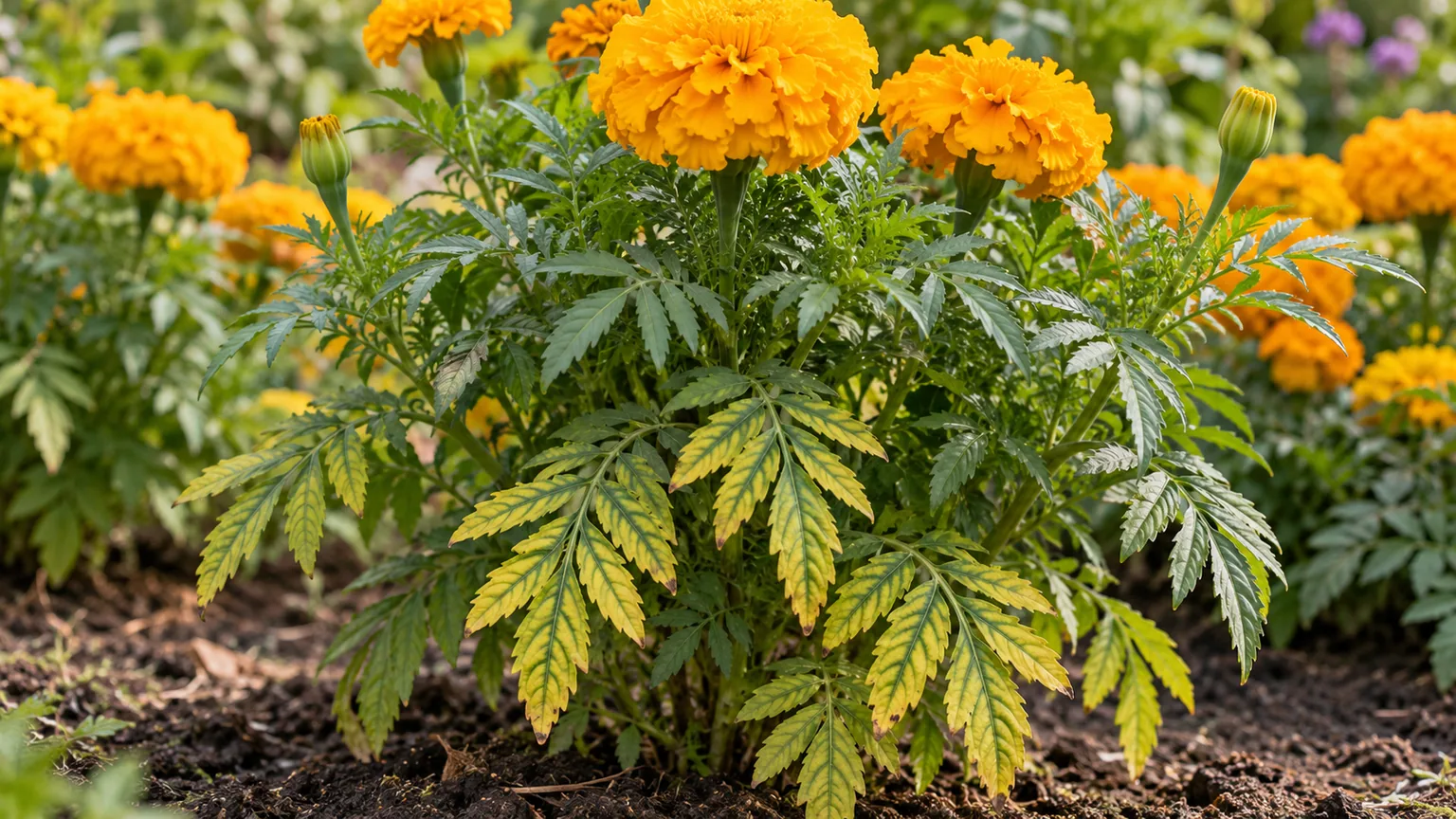
Magnesium deficiency on marigold shows as yellowing between still-green veins on the oldest, lowest leaves first, spreading upward while new growth stays greener. First step: confirm the old-leaf interveinal pattern and check that roots are firm and the pot drains freely, then apply one measured Epsom salt soil drench and judge recovery by new growth.
Magnesium Deficiency on Marigold: Causes, Checks & Fixes
This guide covers magnesium deficiency on Marigold. See also the general Magnesium Deficiency guide, watering, and light pages for this plant.
Magnesium Deficiency on Marigold: Causes, Checks & Fixes
Quick answer
Magnesium deficiency on marigold (Tagetes erecta, African marigold) shows as yellowing between still-green veins on the oldest, lowest leaves first, climbing upward over weeks while the newest leaves stay comparatively green. Magnesium is a mobile nutrient the plant relocates from mature foliage to new growth, so older leaves are affected first — the opposite of iron trouble, which strikes new leaves.
See our magnesium deficiency guide for how mobile-nutrient chlorosis works in general. On marigold, the pattern usually shows up during heavy bloom in tired container mix, because this fast annual flowers itself nearly to exhaustion in six to eight weeks from seed and drains small pots of available magnesium.
First step: confirm the bottom-up interveinal pattern, check that the mix drains and roots are firm, then give one measured Epsom salt soil drench. One targeted correction, then read the response in new growth.
When to use this page vs other Marigold guides
| Pattern | Read next |
|---|---|
| Older lower leaves yellow between green veins, veins stay greener | Magnesium deficiency (this page) |
| Older leaves uniformly pale all over, no green veins | Nitrogen deficiency |
| Scorched brown margins on older leaves, weak stems | Potassium deficiency |
| Newest leaves distorted or margin-burned, buds discolored | Calcium deficiency |
| Newest leaves yellow between veins while old leaves stay green | Watering and pH check under nutrient lockout |
| White crust on mix, burn appearing after feeding | Fertilizer burn or salt build-up |
| Pale all-over foliage in weak light with stretched stems | Pale leaves and not enough light |
| Gray fuzzy masses on wet flowers | Marigold disease guidance — Botrytis, not a nutrient gap |
| All-over wilt on wet mix with sour smell | Overwatering or root rot |
What magnesium deficiency looks like on Marigold
A healthy African marigold carries deeply divided aromatic leaves on upright bushy stems and opens large pompon heads on a relentless rhythm. When magnesium runs short, the lower canopy fades first: tissue between the veins turns yellow while the veins hold their green, giving older leaves a netted or marbled look. Leaf edges may bronze as the shortage advances, and badly affected lower leaves drop — while shoot tips keep pushing buds that look normal at first.
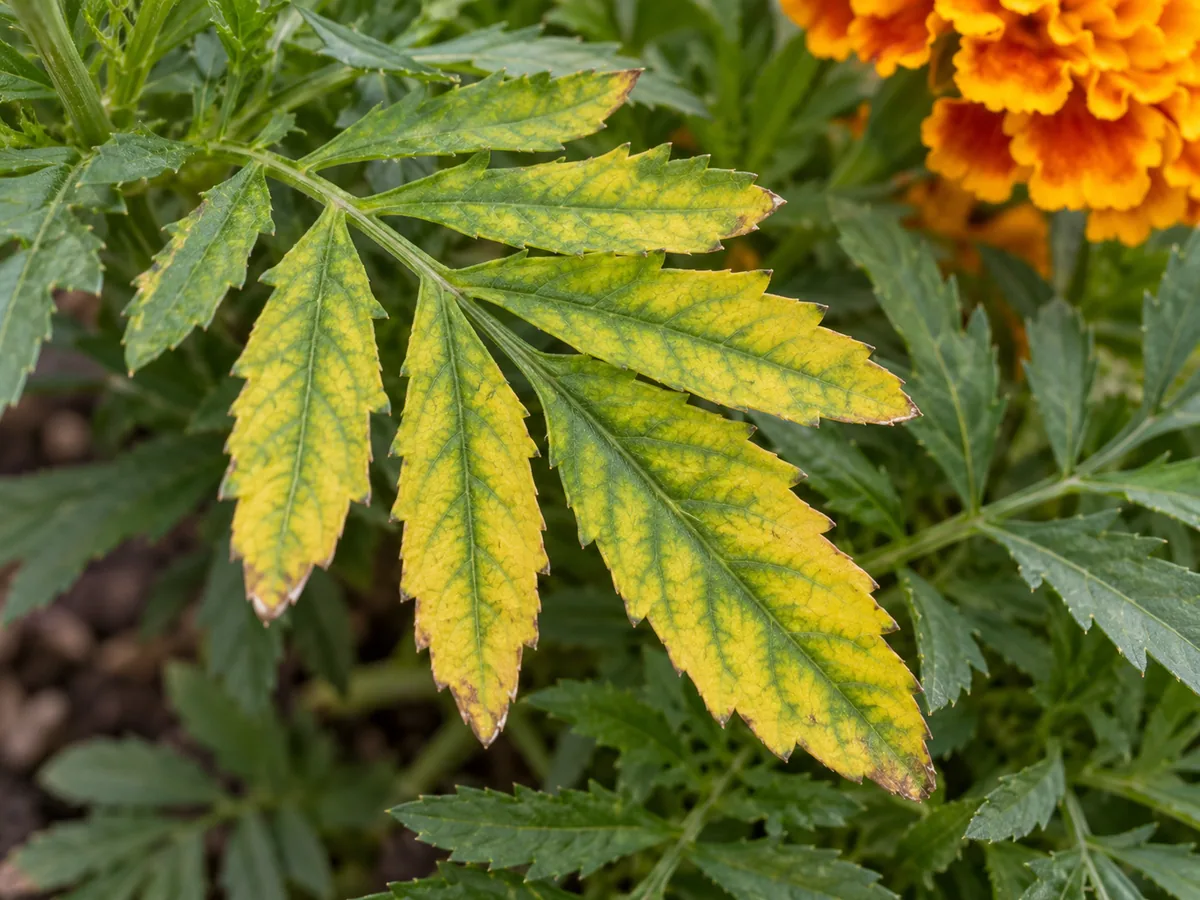
Interveinal yellowing on an older marigold leaf with veins staying greener — compare with clean new growth at the shoot tip on the same stem.
Typical signs:
- Yellowing between green veins starting on the lowest, oldest leaves
- The older-leaf interveinal pattern climbing to mid-stem foliage over one to three weeks
- Green veins with yellow panels between them, sometimes with bronzed margins late on
- Lower leaves dropping while new leaves emerge a normal green
- Smaller or paler flush of flowers as the canopy thins, since magnesium sits at the center of every chlorophyll molecule and photosynthesis fades with it
- A plant sitting in old, heavily flushed container mix, or one fed nothing but a magnesium-free bloom booster for weeks
Not magnesium deficiency:
- Uniform all-over paling of old leaves with no green-vein contrast — nitrogen deficiency or natural aging covered under yellow leaves
- Interveinal yellowing on the newest leaves while old leaves stay green — an iron or pH lockout pattern, not magnesium; work through nutrient lockout instead
- Brown crispy margins with no vein contrast after a heavy feed — fertilizer burn
- Gray fuzzy coating on wet flowers and target-like leaf blotches — Botrytis blight, a pathogen covered in Penn State’s marigold disease table
- Fine stippling with webbing on leaf undersides — spider mites, not a nutrient issue
- Sudden whole-plant wilt in wet mix — root rot
Why Marigold runs short of magnesium
Marigold is a fast-growing annual that blooms itself nearly to exhaustion in small containers. Every new bud and leaf draws magnesium, and the shallow fibrous root system of a potted plant has only a cupful of mix to draw from. In beds the soil bank is deeper; in a sun-baked pot watered daily, magnesium leaches out with every drench while flowering demand stays at full throttle. True shortage is therefore common late in the season — but uptake blocks that only look like shortage are just as frequent.
Marigold-specific causes:
- Bloom-season demand in small pots — Six to eight weeks from seed to flower means continuous bud production. A plant fed only water, or a bloom formula without secondary nutrients, empties the mix exactly when heads need it most. Compare feeding with the marigold fertilizer guide.
- Leaching from daily watering — Containers in full sun dry fast and get watered often. Each thorough soaking carries dissolved magnesium out of the drainage holes. Match rhythm to the marigold watering guide rather than watering on autopilot.
- Spent or carried-over mix — Marigolds are usually sown directly in their final pot or bed each season. Reused peat-heavy mix, or beds never amended, hold little magnesium by late summer. See the marigold soil guide.
- pH drift locking magnesium out — Marigold prefers pH 5.8–7.0. Strongly acidic mix reduces magnesium availability even when magnesium is present, a classic nutrient lockout pattern. When soil pH climbs too high or drops too low, nutrients precipitate into forms roots cannot absorb.
- Calcium and potassium competition — Heavy calcium in hard tap water or potassium-heavy bloom feeds competes with magnesium at root uptake sites. Plants pushed with high-potassium formulas while showing vein-contrast yellowing may need the potassium deficiency page ruled out first.
- Weak roots from chronic wetness — Fibrous marigold roots rot quickly in soggy mix, and damaged roots cannot absorb magnesium no matter how much is present. If the pot stays heavy for days, read root rot before adding any supplement.
Bloom-season hunger: the small-pot tell
Unlike leafy houseplants where a magnesium gap hides in foliage for months, marigold advertises it through its flowering engine. A plant that bloomed gloriously for weeks and then starts fading from the bottom up — older leaves netting yellow while buds keep opening, then buds shrinking — is the textbook spent-mix story. Check the calendar: if the plant has been in the same container mix for two months or more of active bloom, shortage outranks every exotic cause.
Deadhead spent heads promptly so energy goes to new buds, and note which buds suffer. Buds that keep opening cleanly while lower leaves yellow means the plant is cannibalizing old foliage to protect flowers — early-stage shortage, very fixable. Buds that shrink, pale, or stall alongside the yellowing mean the whole plant is running on empty (compare small flowers and faded flowers).
Cool soil and the shoulder seasons
Marigolds are often sown in September–October for winter flowering, which puts young plants in cooling soil exactly when they need steady uptake. Cold root zones absorb nutrients sluggishly, so a plant that looked perfect in warm weeks can develop bottom-up yellowing after a cool spell even though nothing in the pot changed. This is uptake failure, not empty mix — and it resolves as soil warms, provided drainage is sound.
The practical response is restraint: confirm the pattern, keep base watering even, and avoid piling on supplements a chilled root system cannot take up. If nights stay cool and the plant sits in heavy wet mix, the greater danger is crown and root rot, not starvation. Judge by pot weight and root firmness before reaching for the Epsom salt.
Base watering, overhead wetting, and lookalike damage
Marigold culture has one non-negotiable rule: water at the base, never overhead. Wet foliage and soaked flower heads invite the leaf spots and Botrytis blight detailed in Penn State’s marigold disease reference — blotched, fuzzy, or spotted damage that nervous growers sometimes mistake for a nutrient pattern. True magnesium chlorosis is dry, symmetrical yellowing between veins with no fuzz, no concentric rings, and no water-soaked patches.
Use this distinction at the hose: if the damage has spots, rings, or gray mold, it is disease and needs sanitation and dry foliage, not minerals. If the damage is clean interveinal yellowing climbing from the oldest leaves with dry tissue, stay on this page. Either way, keep water off leaves and buds from today on — overhead wetting helps no deficiency and feeds every pathogen.
How to confirm the cause
Work in this order so each check eliminates one confusion:
- Oldest-vs-newest map — Confirm interveinal yellowing sits on the lowest leaves while shoot tips stay greener. The old growth versus new growth rule settles magnesium against iron before anything else.
- Moisture and drainage check — Push a finger 3–5 cm into the mix. Evenly moist and free-draining supports a shortage diagnosis; heavy, soggy, or sour-smelling mix means roots first.
- Root slip-check — Ease the root ball out. White fibrous tips mean roots can still absorb; brown mushy roots mean rot protocol, not minerals.
- Feed and water audit — Months with no complete feed, magnesium-free bloom boosters only, daily heavy flushing, or very hard tap water all narrow the suspect list. Bring the fertilizer label.
- pH and salts — A simple probe or strip test plus a look for white crust separates lockout (nutrient lockout, salt build-up, soil too alkaline) from true shortage.
Confirmed diagnosis — Bottom-up interveinal yellowing with green veins, firm white roots, free-draining mix, a history of heavy bloom with weak feeding or heavy leaching, and pH inside or near 5.8–7.0. Suspected — A few older leaves yellowing right after a cool wet spell with otherwise clean growth; stabilize water and warmth and watch the next week before supplementing.
Correcting magnesium on Marigold
After confirming the pattern with firm roots and sound drainage:
- Give one measured Epsom salt soil drench — Dissolve one level tablespoon of plain, unscented Epsom salt (magnesium sulfate) per gallon of water and pour it through the pot as a normal base watering. Epsom salt is the standard direct magnesium correction because it dissolves fully and roots take it up fast.
- Feed complete, not single-nutrient, afterward — Resume a complete fertilizer that lists magnesium at label strength per the marigold fertilizer guide. One measured correction plus complete feeding beats repeated Epsom doses.
- Flush only if salts are the blocker — White crust or a history of heavy feeding means salt accumulation may be locking magnesium out; leach once with plain water per salt build-up, then resume feeding.
- Refresh exhausted mix — A root-bound annual in last season’s mix is better repotted into fresh moderately fertile mix per the marigold soil guide than endlessly amended.
- Watch only new tissue — Visible improvement lands within ten to twenty-one days; old yellowed leaves may never fully re-green.
What not to do
Do not drench a stressed marigold with extra fertilizer before checking roots and moisture — salts worsen lockout. Do not stack repotting, hard pruning, and feeding on the same day; read the response to one change at a time. Do not mist foliage to “help” — wet leaves invite leaf spot and Botrytis. Do not repeat Epsom doses weekly all season; excess magnesium competes with calcium uptake and trades one deficiency for another.
Recovery timeline
Yellowed older leaves stay yellow — marigold tissue does not repaint itself once chlorophyll is gone. Expect the upward climb to stall within ten to twenty-one days of one correct drench, with the next flush of leaves emerging clean green and buds sizing normally within three to four weeks at the height of bloom season.
Worry if yellowing keeps climbing through mid-stem leaves despite correction, new growth emerges pale, or the base softens — the last sign means crown or root rot has joined the picture. Late in the season, weigh effort against the calendar: a tired annual with weeks of good weather ahead is worth correcting, while one near its natural end may simply be finished.
How to prevent it next time
Sow or transplant into fresh, moderately fertile, well-draining mix each season — never reuse a depleted container mix for a hungry annual without amending it. Hold pH in the 5.8–7.0 band and feed a complete fertilizer that includes magnesium through bloom season instead of single-nutrient boosters. Water deeply at the base on a consistent rhythm, giving full sun with moving air so foliage dries fast, and space plants so beds breathe. Deadhead regularly and inspect lower leaves weekly; on a plant that flowers itself to exhaustion, the first netted-yellow old leaf is the cheapest warning you will get. Browse the full marigold problems hub whenever a new pattern appears so small issues stay small.
When to worry
Treat it as urgent when interveinal yellowing races through the mid canopy in days, buds stall or abort, or damage spreads while water, drainage, and pH are already correct — persistent spread means the plant cannot sustain its canopy. Also escalate when stems soften at the soil line, seedlings keel over in groups (damping-off), or mottling and streaking suggest virus (mosaic virus has no cure and calls for removal). A soil test through your local extension service settles stubborn cases faster than another round of guessing.
Related Marigold guides
- Marigold overview — full culture: sun, base watering, deadheading rhythm
- Marigold watering — base-watering rhythm that prevents both leaching and rot
- Marigold fertilizer — complete bloom-season feeding with secondary nutrients
- Marigold soil — fresh moderately fertile mix and the 5.8–7.0 pH band
- Marigold light — six-plus hours of direct sun for maximum flowering
- Nitrogen deficiency — uniform old-leaf paling without vein contrast
- Potassium deficiency — scorched older margins and weak stems
- Calcium deficiency — newest leaves and buds damaged first
- Nutrient lockout — pH and salt blocks that mimic shortage
- Yellow leaves — all-over yellowing differential on marigold
- Marigold problems hub — every diagnosed marigold issue in one place
Conclusion
Netted yellowing between green veins climbing from the oldest marigold leaves points to magnesium shortage in a hard-working annual — confirm the bottom-up pattern against iron and nitrogen lookalikes, check roots and drainage first, correct once with a measured Epsom salt drench plus complete feeding, and judge success by new leaves and buds, not by old foliage re-greening.
Related tool
Use the Fertilizer Dilution Calculator to narrow causes for magnesium deficiency on this plant before changing multiple variables at once.