Potassium Deficiency on Marigold: Causes, Checks & Fixes
Quick answer
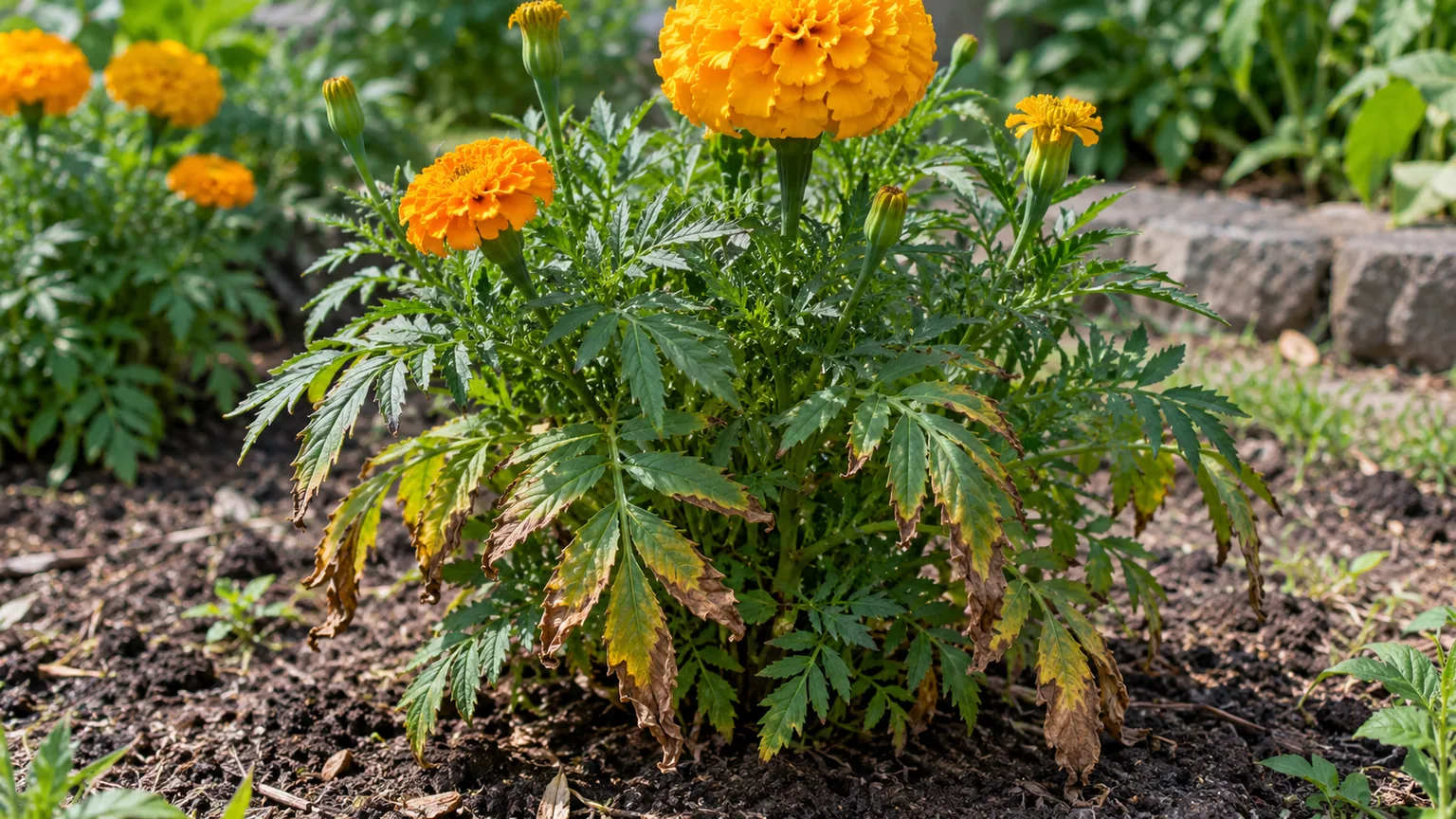
Potassium deficiency on marigold shows as yellowing then brown scorch along the margins of older lower leaves while new top growth stays greener, often with smaller or fewer flowers. First step: confirm edge burn on several older leaves, rule out salt crust and spider mites, then give one half-strength balanced liquid feed at the base.
Potassium Deficiency on Marigold: Causes, Checks & Fixes
This guide covers potassium deficiency on Marigold. See also the general Potassium Deficiency guide, watering, and light pages for this plant.
Potassium Deficiency on Marigold: Causes, Checks & Fixes
Quick answer
Potassium deficiency on marigold (Tagetes erecta) shows as yellowing that turns to brown scorch along the margins of older lower leaves while the newest top growth stays relatively green — often paired with buds that stall or open smaller than usual. Potassium is a mobile nutrient, so when soil reserves run low the plant pulls it from old foliage to protect active shoot tips and developing buds. For the general science of how potassium shortage develops in any plant, see our potassium deficiency guide. On marigold, the giveaway is edge burn climbing upward from the lowest pinnate leaves on a plant that is still trying to bloom.
First step: confirm marginal scorch on several older lower leaves, rule out salt crust and spider mites, then give one half-strength balanced liquid feed watered in at the base.
What potassium deficiency looks like on marigold
The lowest, oldest leaflets yellow first along their outer edges, and those edges crisp to tan or brown while the tissue near the central rib stays green longer. Older broadleaf foliage turns yellowish or brown at the tips and margins and between veins, with leaf edges that crinkle or curl — on marigold’s finely divided pinnate leaves this reads as browned saw-tooth edges on the bottom of the plant. Marginal browning and necrosis with interveinal yellowing progressing inward from the margins is the classic ornamental-plant signature, and marigold follows it closely.
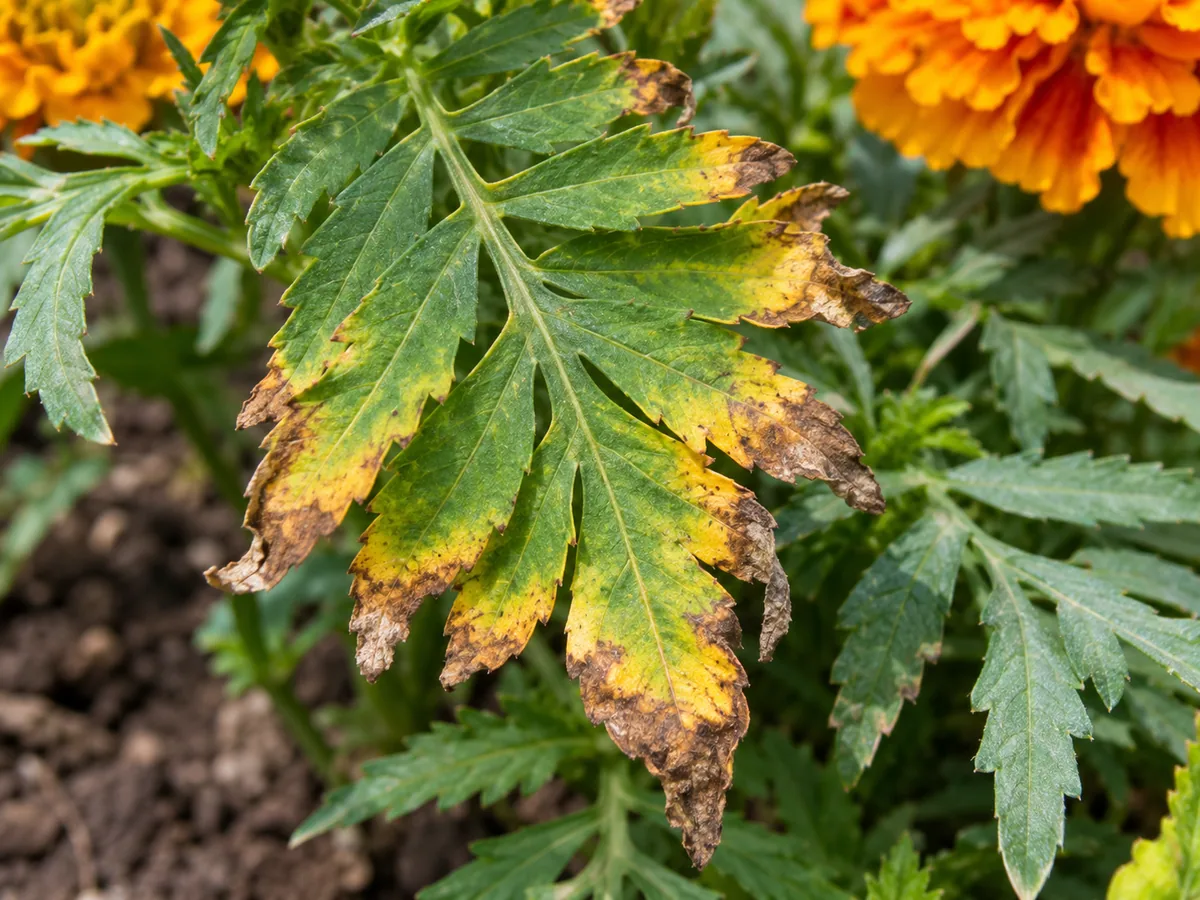
Close-up: browned margins on an older lower marigold leaflet with veins still green near the center while new top growth stays clean.
Because marigold is a fast annual that flowers six to eight weeks from seed, shortage also shows in the buds. Flowers may open smaller, paler, or fewer per plant, and deficient ornamentals produce smaller, fewer, less uniform flowers. In a controlled glasshouse trial on American marigold, plants grown without potassium were shorter than fully fed controls, confirming that K shortage measurably checks Tagetes erecta growth (Inkham et al., ISHS Acta Horticulturae). Weak, floppy stems that bend under the weight of their own blooms round out the picture, since potassium supports cell-wall strength and water regulation.
When to use this page vs other marigold guides
| Pattern | Read next |
|---|---|
| Brown edges on several older lower leaves, new top growth greener | Potassium deficiency (this page) |
| Uniform pale old leaves with stunted new shoots | Nitrogen deficiency |
| Yellow between veins while margins stay green | Magnesium deficiency |
| Brown edges appearing days after a heavy feed, white crust on mix | Fertilizer burn or salt build-up |
| Fine stippling plus webbing under leaves | Spider mites |
| Small pale blooms on an otherwise green plant | Faded flowers |
| Pale new leaves in alkaline or compacted mix | Nutrient lockout or soil too alkaline |
Why marigolds run short of potassium
Fast bloom drains the pot. Marigold compresses its whole life — roots, foliage, and a heavy load of blooms — into one season. Every new bud is a potassium sink, so a plant that bloomed gloriously in June can exhaust a small container’s reserves by August. This is the most common story behind mid-season edge scorch on patio pots.
Base watering leaches potassium out. Marigolds must be watered at the base, never overhead, and containers in full sun need water every few days in warm weather. That repeated through-flow washes mobile potassium out of peat- and sand-based mixes. Improper irrigation scheduling drives nutrient leaching, one of the common causes of potassium deficiency in container crops. A marigold in a small pot with a coarse sandy mix is the textbook setup for this.
Light feeders get underfed. Marigolds punish overfeeding — excess nitrogen produces leafy mounds with few blooms — so careful growers often feed sparingly. That instinct is correct, but a plant that receives no complete fertilizer all season eventually runs dry. Marigolds are light feeders where excess fertilizer pushes leaves instead of flowers, which is why the fix must be a balanced, restrained feed rather than a heavy dose.
pH and salts lock potassium out. Marigold takes up nutrients best around pH 5.8 to 7.0. In alkaline mixes potassium uptake stalls even when fertilizer is present — check soil too alkaline if scorch appears despite feeding. Accumulated fertilizer salts cause the same lockout from the other direction, so salt build-up and nutrient lockout are worth ruling out before adding more feed.
How to confirm it on your plant
Work from the bottom of the plant up, in this order:
- Map the damage. Check whether brown edges sit on the oldest lower leaves across several stems while shoot tips and buds look comparatively fresh. Damage limited to one sun-facing side suggests scorch; damage on new leaves first points away from potassium.
- Look under the leaves. Tap a suspect leaf over white paper. Fine moving specks or delicate webbing mean spider mites, which stipple and bronze marigold foliage in a way that mimics edge burn at a glance.
- Read the soil surface. A white crust, or a history of frequent liquid feeds without plain-water flushes, points to fertilizer burn or salt build-up rather than shortage.
- Check the root zone. Lift the pot — suspiciously light means chronic underwatering, which crisps edges on its own. If the mix smells sour or stays soggy, roots cannot take up potassium whatever the fertilizer label says; compare with root rot and poor drainage.
- Review feeding history. No complete feed since planting plus weeks of heavy blooming strongly supports deficiency. A recent heavy dose of high-nitrogen feed argues against it.
First fix for marigold
Give one half-strength balanced liquid feed, watered in at the base of a normally moist plant.
Pick a balanced complete fertilizer (roughly equal NPK, or one formulated for flowering annuals — not a high-nitrogen lawn product), dilute to half the label rate, and apply to mix that you watered plainly the day before. Feeding moist mix avoids root burn and carries potassium straight to the fibrous surface roots marigolds use most. Then stop: one correction lets you read the plant’s response instead of burying the signal under repeated doses. If a white salt crust was present, flush the pot with plain water first and wait several days before this feed.
Step-by-step recovery
- Deadhead spent blooms. Snip finished flowers back to the first healthy leaf joint. This is marigold-specific triage: open seed heads keep drawing potassium, and removing them redirects the fresh supply into new buds. See faded flowers for the deadheading rhythm.
- Hold steady on water. Keep the base-watering routine — check the top 3 to 5 cm and water when dry, per the marigold watering guide. Do not drown the pot to “wash in” the feed; soggy mix undoes the correction.
- Watch the next flush, not old burns. Scorched margins never re-green. Within two to four weeks, new leaves should unfurl with clean edges and buds should size up. Damaged lower leaves that keep declining can be pinched off once new growth looks sound.
- Resume light scheduled feeding. If new growth responds, move to a dilute balanced feed every three to four weeks through the bloom season, following the marigold fertilizer guide. A foliar potassium spray can give a quick temporary lift in severe cases (ICL notes foliar sprays buy time while root-zone levels recover), but root-zone feeding is the durable fix.
- Know when to replace. Marigold is a seasonal annual. A late-season plant with most of its canopy scorched and weeks left before frost gives a poor return on intensive treatment — sow or transplant a fresh plant instead of fighting for damaged foliage.
What not to do
- Do not apply a heavy full-strength or high-nitrogen feed to “catch up.” Excess nitrogen turns marigolds leafy and bloomless, and excess potassium itself antagonizes magnesium and calcium uptake.
- Do not feed a plant with white salt crust or soggy, sour mix. Flush salts or fix drainage first.
- Do not mist or overhead-water to deliver the feed. Wet marigold foliage invites botrytis grey mould on flowers and leaves; always feed at the base.
- Do not repot a blooming annual to fix a nutrient problem. Repotting mid-bloom sets flowering back further than the deficiency did.
Marigold care cross-check
Potassium trouble rarely travels alone, so verify the basics from the marigold overview: full sun of six or more hours daily, base watering that lets the top few centimetres dry, and a moderately fertile, well-draining mix detailed in the marigold soil guide. Keep pH in the 5.8 to 7.0 window — nutrient availability shifts with substrate pH, with roughly 6.0 to 6.5 optimal for potassium uptake — and test the mix if you garden in chalky or heavily limed soil. Crowded, shaded plants with damp foliage develop powdery mildew and mould that complicate any nutrient diagnosis, so give each plant airflow and sun. Browse the full marigold problems hub when more than one symptom overlaps.
How to prevent it next season
- Mix a slow-release fertilizer formulated for flowering annuals into the planting hole once at sowing or transplant time, rather than relying on rescue feeds later.
- Choose complete balanced feeds over high-nitrogen formulas all season. Penn State and Clemson guidance favors balanced or phosphorus-leaning feeds for marigolds, with a single slow-release application at planting.
- Refresh container mix each season instead of reusing depleted pots; compost-based mixes slump and lose structure over one marigold cycle.
- Deadhead weekly through peak bloom so potassium flows to new buds instead of ripening seed.
- In sandy beds or small pots, split the season’s feed into small monthly doses — heavy infrequent doses leach away between waterings.
Related marigold guides
- Marigold overview — placement, sun, and seasonal rhythm that all nutrient fixes depend on.
- Marigold fertilizer guide — the season-long feeding schedule that prevents repeat deficiencies; use when this page’s one-off correction works and you want a routine.
- Marigold watering guide — base-watering depth and frequency; use when pots dry unpredictably or leaching is suspected.
- Nitrogen deficiency — use when whole old leaves pale uniformly instead of browning at the edges.
- Magnesium deficiency — use when yellowing sits between the veins rather than along the margins.
- Faded flowers — use when blooms are the main complaint and foliage looks mostly sound.
- Yellow leaves — use when yellowing is widespread and the margin pattern is unclear.
Related tool
Use the Fertilizer Dilution Calculator to narrow causes for potassium deficiency on this plant before changing multiple variables at once.