Nitrogen Deficiency on Marigold: Causes, Checks & Fixes
Quick answer
Nitrogen shortage on marigold shows as even, pale yellowing that starts on the oldest lower leaves while new growth stays green but smaller. If the pot drains well and soil pH sits near 5.8 to 7.0, give one balanced liquid feed at the regular label rate and watch the next set of new leaves.
Nitrogen Deficiency on Marigold: Causes, Checks & Fixes
This guide covers nitrogen deficiency on Marigold. See also the general Nitrogen Deficiency guide, watering, and light pages for this plant.
Nitrogen Deficiency on Marigold: Causes, Checks & Fixes
Quick answer
On marigold, true nitrogen shortage reads as an even, pale wash that starts on the lowest leaves and climbs, while the top keeps growing — just smaller and paler than before, with fewer buds. If the pot drains freely and the mix is near pH 5.8 to 7.0, the first fix is a single balanced liquid feed at the regular label rate, watered in at the base. Then leave the plant alone and read the next flush of new leaves; they tell you whether hunger was really the problem.
For the general science of why mobile nutrients abandon old leaves first, see our nitrogen deficiency guide. Everything below is about how that pattern plays out specifically on Tagetes.
What nitrogen deficiency looks like on marigold
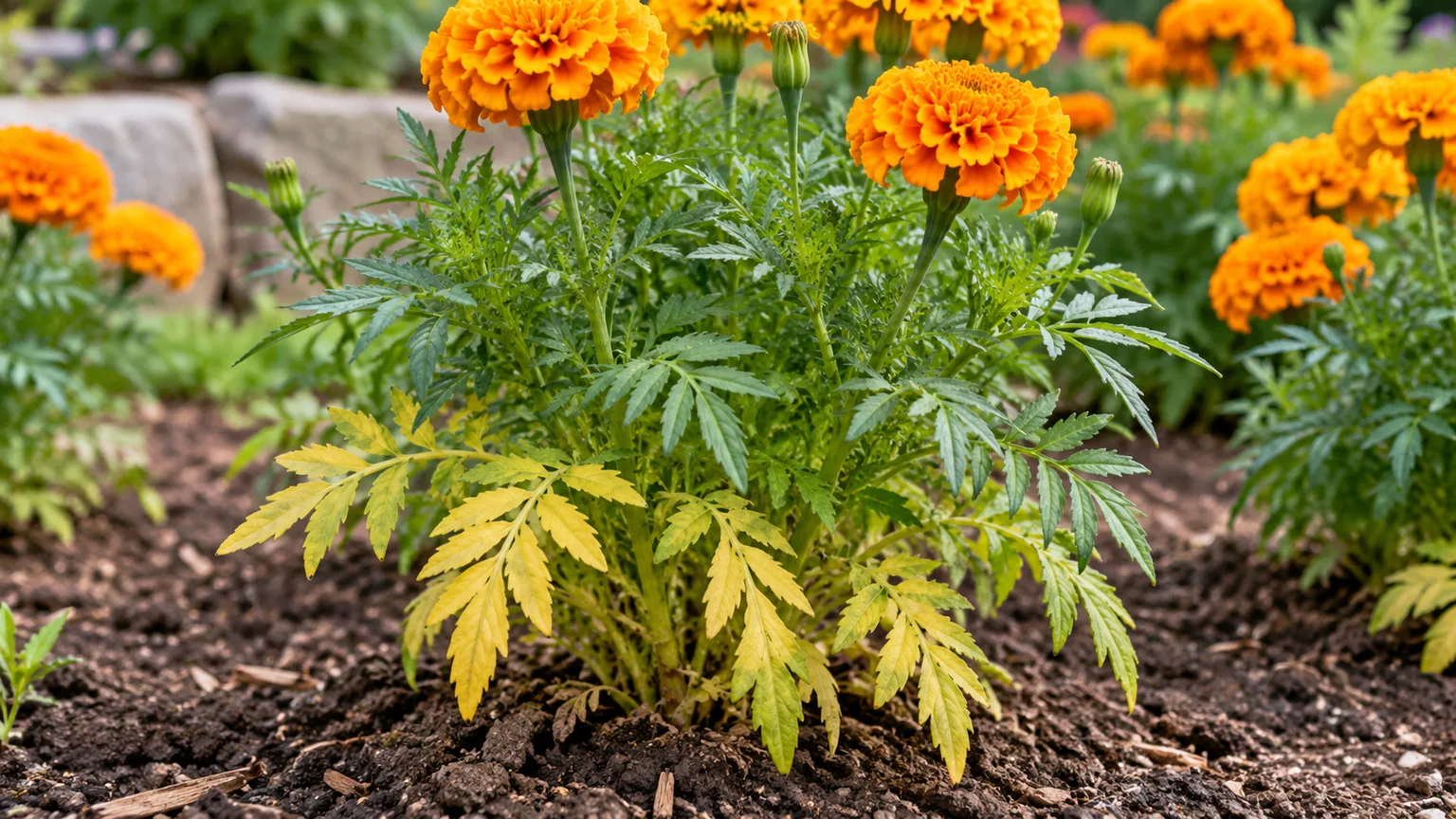
The signature is uniformity. Lower leaves fade to an even pale yellow-green without spots, crispy edges, or mosaic mottling, and older leaves may drop while the crown keeps pushing smaller new foliage. Because nitrogen is mobile inside the plant, older leaves are affected first, but the yellowing spreads to younger foliage as the shortage continues — a bottom-up ladder that is the single best visual clue.
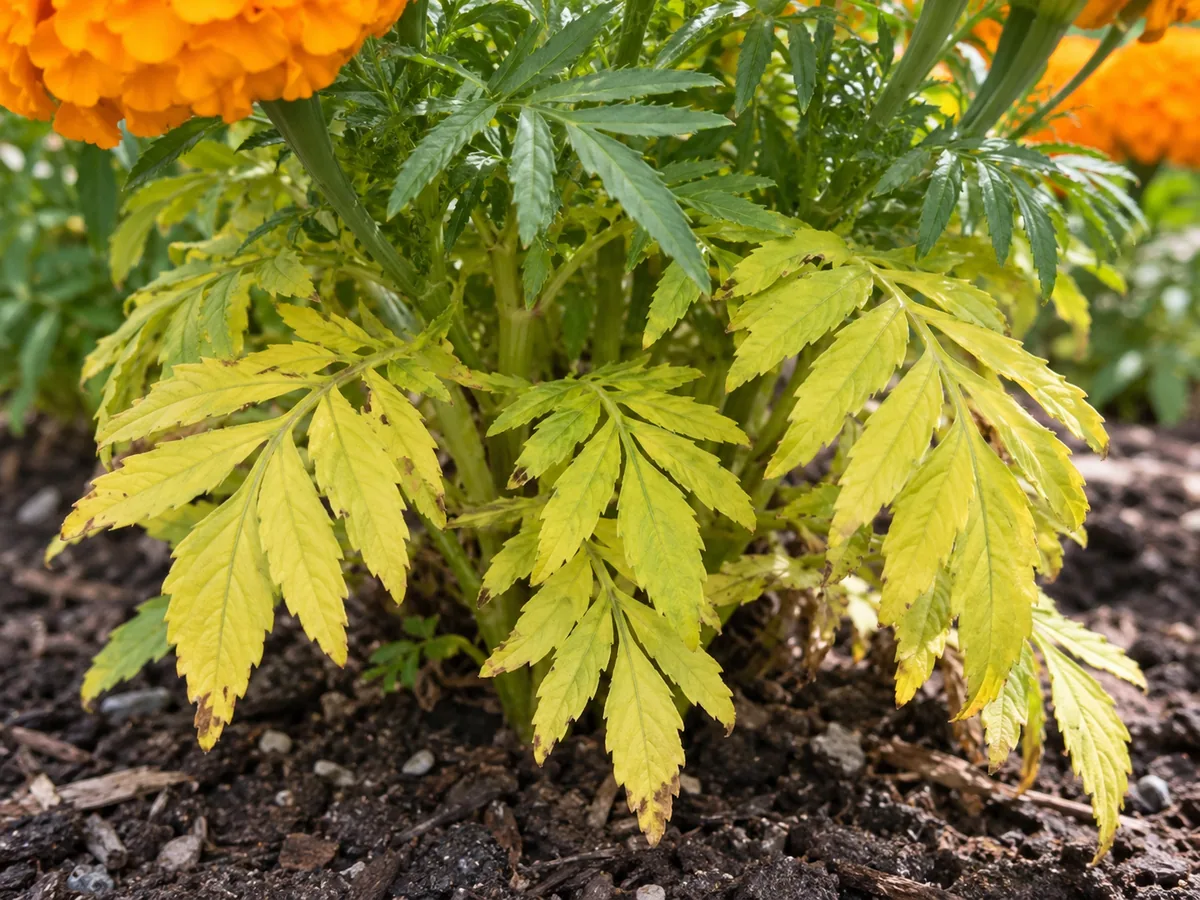
Nitrogen-deficient marigold foliage: even pale yellowing starting on the oldest lower leaves, with smaller new growth at the shoot tips.
On African marigolds (Tagetes erecta), the tall stems make the ladder obvious: a pale skirt of lower leaves under a greener but undersized top, often with bloom heads that run small. On French marigolds (Tagetes patula), compact plants can look washed-out all over sooner, because there is less stem between old and new growth. Either way, expect spindly, stunted plants with pale yellow leaves rather than dramatic collapse — hunger slows marigolds down before it kills them.
What it is not: bronze-speckled lower leaves (that points to iron and manganese toxicity when substrate pH sinks too low), purple-tinged lower leaves in cool weather (phosphorus), or yellow leaves on constantly soggy mix (oxygen-starved roots). Keep those separations in mind before reaching for fertilizer.
Why marigolds run short on nitrogen
Marigolds are fast, hungry annuals — most flower within 6 to 8 weeks from seed — and that sprint is funded almost entirely by the current pot of mix. Commercial growers hold marigolds at only 100 to 200 ppm nitrogen, and home plants in small containers exhaust that reserve quickly when they bloom hard. Nitrogen deficiency develops as an overall yellowing of the lower foliage whenever the fertilization rate runs too low for the plant’s growth rate.
Four marigold-specific drivers cover most cases:
- Bloom-load drain. Every flush of large double heads on an African marigold is built from the same nitrogen pool as the leaves. Plants that are never deadheaded keep pouring nutrients into aging seed heads instead of new buds — spent flowers should be promptly deadheaded — so heavy, untrimmed plants pale fastest.
- Leaching from summer watering. Marigolds in full sun can need water every 1 to 2 days in heat, and nitrogen is easily washed out of the soil by watering. Sandy, free-draining mixes (the 60/20/20 potting-soil, compost, and coarse-sand style blends marigolds like) shed nitrogen with every deep drink.
- The lean-mix advice backfiring. Marigolds genuinely want only moderately fertile mix, because surplus nitrogen makes leafy plants with few blooms. But some growers hear “don’t fertilize marigolds” and feed nothing all season — then wonder why the lower leaves bleach by midsummer. The target is light and steady, not zero.
- pH lockout masquerading as hunger. Marigolds want pH roughly 5.8 to 7.0, and grower guidance narrows the sweet spot to a substrate pH of 5.8 to 6.2. Above about 6.5, iron availability falls; far below 5.5, iron and manganese accumulate to toxic levels in lower leaves. Either extreme produces yellowing no amount of nitrogen will fix.
Crowding adds a final wrinkle: water stress and tight spacing can also result in lower leaf yellowing, so a packed flat of seedlings that pales at the bottom may need thinning and steadier water more than it needs fertilizer.
How to confirm the cause
Work through these checks in order. Stop at the first one that fails — that is your real diagnosis.
- Map the pattern. True deficiency starts on the oldest leaves and moves up, evenly, without spots or crisping. New leaves emerge smaller and paler; buds shrink or stall. If instead only the top is pale with green veins, or lower leaves show bronze speckling, you are looking at a different nutrient issue — see the lookalike table below.
- Audit the feed history. When was the last fertilizer, at what strength, and what NPK? A plant unfed for 6-plus weeks of active blooming is a strong hunger candidate. Nitrogen builds amino acids and proteins, so a fast-blooming annual simply cannot coast on an empty tank.
- Check pH before feeding. A cheap probe or strip reading of the root zone settles it: near 5.8 to 7.0 means added nitrogen can actually be absorbed; far outside means lockout. When in doubt about home-kit accuracy, a lab or extension service soil test gives a firmer answer than guessing with more fertilizer.
- Check drainage and roots. Tip the pot: heavy and sour-smelling with wet mix 3 cm down means roots are drowning, and drowned roots cannot take up nitrogen whatever the label promises. Fix the wet mix first.
- Review light and placement. Marigolds need full sun, which encourages blooms — around 6 hours of direct sun. A shaded plant grows pale and leggy from light starvation, and no feed compensates. Confirm sun before diagnosing hunger.
The first fix to try
Give the plant one balanced liquid feed at the regular label rate, watered in at the base — but only after the checks above confirm free drainage and roughly neutral pH. Mix to the label’s standard indoor or annual strength (never double), pour until light runoff, and empty the saucer. That is the whole first intervention: one measured meal, not a rescue program.
Why restrained: on marigolds, excess nitrogen in soil will cause plants to grow more foliage and fewer fruits or flowers, and home growers who overcorrect a pale plant often trade yellow leaves for a green, bloomless bush. Because this species also prefers base watering — overhead wetting invites grey mould on blooms — always feed through the soil, never as a foliar drench over the flowers.
Step-by-step recovery
After the first feed, follow this sequence over the next few weeks:
- Week 1: deadhead and observe. Snip spent blooms back to the first healthy leaf joint so the fresh nitrogen goes to new buds, not seed heads. Young plants can also be pinched back to promote bushy growth, which multiplies the flowering sites the feed supports.
- Weeks 2 to 3: feed lightly on schedule. Continue with a balanced or bloom-leaning liquid feed every 2 to 3 weeks at label strength through active flowering. Container plants watered daily leach nutrients fast, so small repeat doses beat one heavy correction.
- Watch the new leaves, not the old ones. Already-yellowed lower leaves will not re-green — the plant has already exported their nitrogen upward. Recovery reads as greener, full-sized new foliage and normal buds. If fresh growth also emerges pale, recheck pH and consider nutrient lockout on marigold rather than adding more feed.
- Keep sun and air steady. Hold the plant in full sun with low to moderate humidity and good airflow while it recovers; excess humidity around damaged foliage invites botrytis on the remaining blooms.
Most mild cases stabilize within two to three weeks — one or two normal new-leaf cycles. If nothing improves after a month of correct feeding, the cause was never simple hunger: test pH properly, inspect roots, or accept the annual arithmetic below.
Lookalike symptoms on marigold
| What you see | More likely | Where to go |
|---|---|---|
| Even pale yellow from bottom up, small new leaves | Nitrogen deficiency (this page) | Keep reading |
| Yellow between green veins, mainly new top leaves | Iron chlorosis at high pH | Soil too alkaline on marigold |
| Purple tinge on lower leaves, cool weather | Phosphorus shortage | Phosphorus-linked purple leaves on marigold |
| Yellow leaf edges with green centers, older leaves | Potassium or magnesium shortage | Potassium deficiency on marigold / magnesium deficiency on marigold |
| Yellow leaves despite recent feeding | pH lockout or salt buildup | Nutrient lockout on marigold / salt build-up on marigold |
| Yellow lower leaves on soggy, heavy mix | Overwatering / root stress | Yellow leaves on marigold and root rot on marigold |
| Whole plant pale, stalled, tiny blooms | General starvation or spent season | Slow growth on marigold |
| Scorch-yellow edges right after feeding | Fertilizer burn from overcorrection | Fertilizer burn on marigold |
General paleness that does not fit the bottom-up ladder belongs on pale leaves on marigold for the wider workup.
Mistakes to avoid
- Doubling the dose to “catch up.” A heavy nitrogen hit pushes soft leafy growth with few blooms and can burn roots — the exact tradeoff marigold growers are warned about. Label rate, repeated lightly, always beats one strong drench.
- Feeding a drowning plant. Fertilizer poured into sour, waterlogged mix cannot be absorbed and adds salt stress to suffocating roots. Drainage first, feed second.
- Fertilizing bone-dry mix at full strength. Water plainly first if the pot is parched, let it drain, then feed — salts on dry roots scorch.
- Stacking repot, prune, and feed on the same day. A stressed annual reads that as three shocks. Feed in place; save repotting for genuinely failed mix.
- Chasing pH with kitchen chemistry. Vinegar drenches and baking-soda swings overshoot badly in small pots. If pH is far off, repot into fresh appropriate mix instead of titrating blind.
Marigold care cross-check
Hunger rarely travels alone, so verify the basics in the marigold overview: full sun per the marigold light guide, base watering on the pot’s schedule per marigold watering, and moderately fertile, free-draining mix per marigold soil. Feeding cadence lives in the marigold fertilizer guide — align this page’s recovery feeds with that schedule so you do not drift into overfertilizing. Growers using organic fertilizers should note they release slowly as microbes convert them, so compost-fed plants need earlier, steadier applications than liquid-fed ones. And since marigolds resent rich mixes, avoid over-fertilizing with nitrogen as a standing rule once color returns.
How to prevent it next time
Prevention is a rhythm, not a product. Start seedlings or new transplants in moderately fertile mix, begin light balanced feeds once true leaves and buds show, and keep deadheading so each feed funds new flowers instead of seed. Because marigolds are seasonal — sow in autumn for winter bloom or late winter for summer crop, and flower themselves out within months — plan the feed arc across one season: steady light nutrition while blooming, then compost the plant instead of nursing a played-out annual through heroic rescue. Mulching beds with organic matter for a small, steady amount of nitrogen suits in-ground plantings that containers cannot copy.
When to use this page vs other marigold guides
- This page — even bottom-up yellowing with small new growth, confirmed drainable mix and sane pH, fixed by measured feeding.
- Marigold problems hub — browse all issues when the pattern does not match anything here.
- Pale leaves on marigold — general or top-down paleness that lacks the classic ladder.
- Nutrient lockout on marigold — yellowing persists despite feeding, or pH tests far off range.
- Wilting on marigold — limp collapse rather than color change; a water or root emergency, not hunger.