Calcium Deficiency on Marigold: Causes, Checks & Fixes
Quick answer
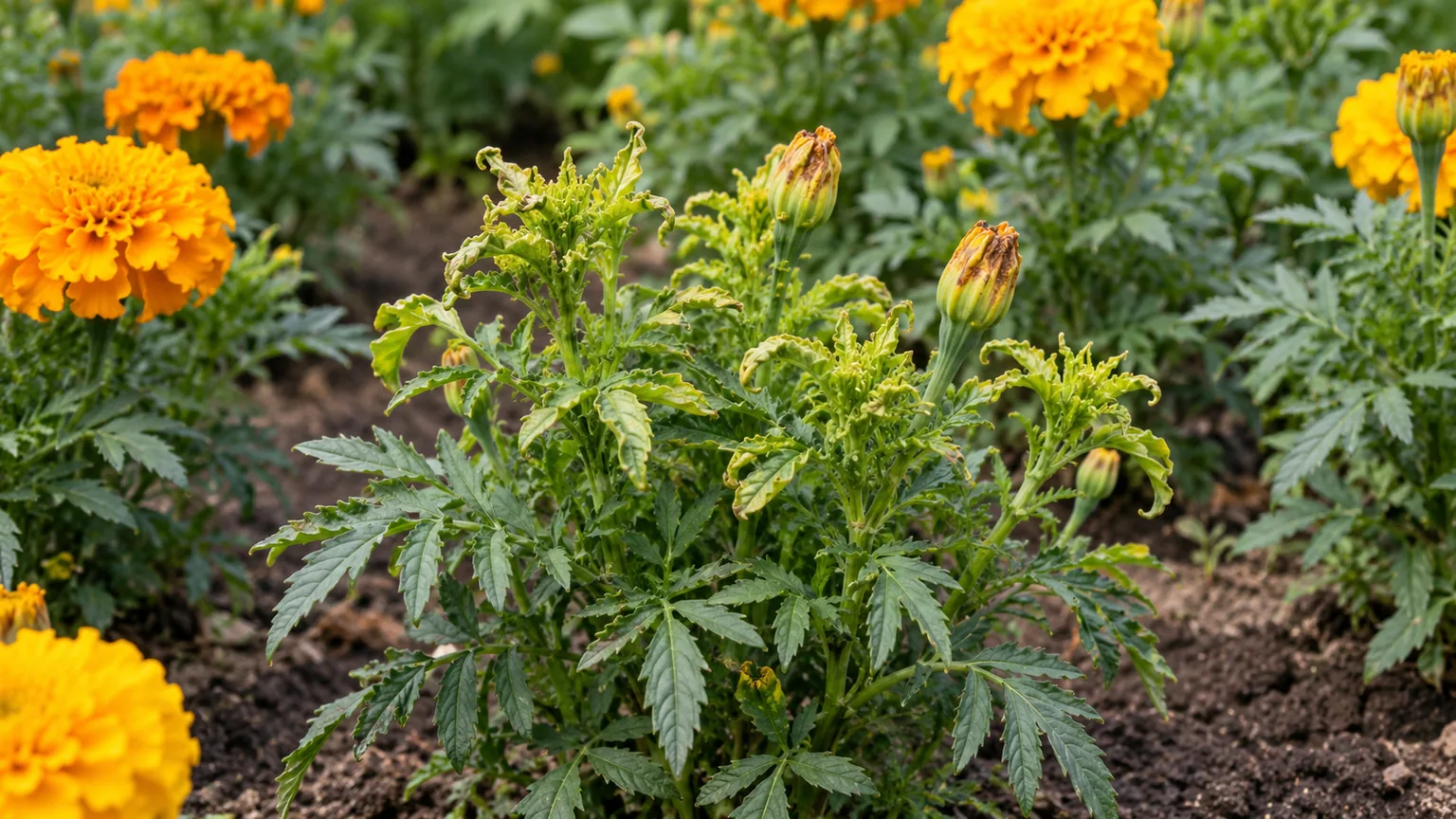
Calcium deficiency on marigold shows as distorted, undersized, or margin-burned newest leaves and discolored or stalling buds while older foliage stays relatively normal. First step: confirm the damage sits on new growth and buds, then give the pot one deep, even base watering so calcium can move with water to the growing tips.
Calcium Deficiency on Marigold: Causes, Checks & Fixes
This guide covers calcium deficiency on Marigold. See also the general Calcium Deficiency guide, watering, and light pages for this plant.
Calcium Deficiency on Marigold: Causes, Checks & Fixes
Quick answer
Calcium deficiency on marigold (Tagetes erecta, African marigold) shows as small, misshapen, or margin-burned newest leaves plus discolored or stalling buds while older lower foliage stays comparatively normal. Calcium is extremely immobile in plants, so the damage appears on young expanding tissue first — not on mature leaves the way nitrogen deficiency does.
See our calcium deficiency guide for how calcium delivery fails in general. On marigold, the pattern usually shows up at the shoot tips and the developing flower heads first, because this fast annual pushes new leaves and buds continuously during bloom season and each one needs calcium for rigid cell walls.
First step: give the pot one deep, even base watering so the whole root zone is uniformly moist, then watch the next flush of growth. Do not reach for fertilizer yet — uneven moisture alone can block calcium delivery.
When to use this page vs other Marigold guides
| Pattern | Read next |
|---|---|
| Newest leaves cupped, torn, or margin-burned; buds discolored | Calcium deficiency (this page) |
| Older lower leaves uniformly pale | Nitrogen deficiency |
| Older leaves yellow between veins | Magnesium deficiency |
| Scorched margins on older leaves, weak stems | Potassium deficiency |
| White crust on mix, burn after feeding | Fertilizer burn or salt build-up |
| Buds drop without discoloration | Bud drop |
| Gray mold on wet flowers | Botrytis check and disease table below |
| Soft stem base, collapsing seedlings | Damping-off or root rot |
| Mottled, streaked, stunted new growth | Mosaic virus |
| Whole plant wilts midday, recovers at night | Water stress and overwatering |
What calcium deficiency looks like on Marigold
A healthy African marigold pushes deeply divided aromatic leaves along upright bushy stems and opens large pompon heads on a fast rhythm — flowering starts roughly six to eight weeks from seed. When calcium delivery fails, the newest expanding leaves and the developing buds tell the story while the established canopy looks fine.
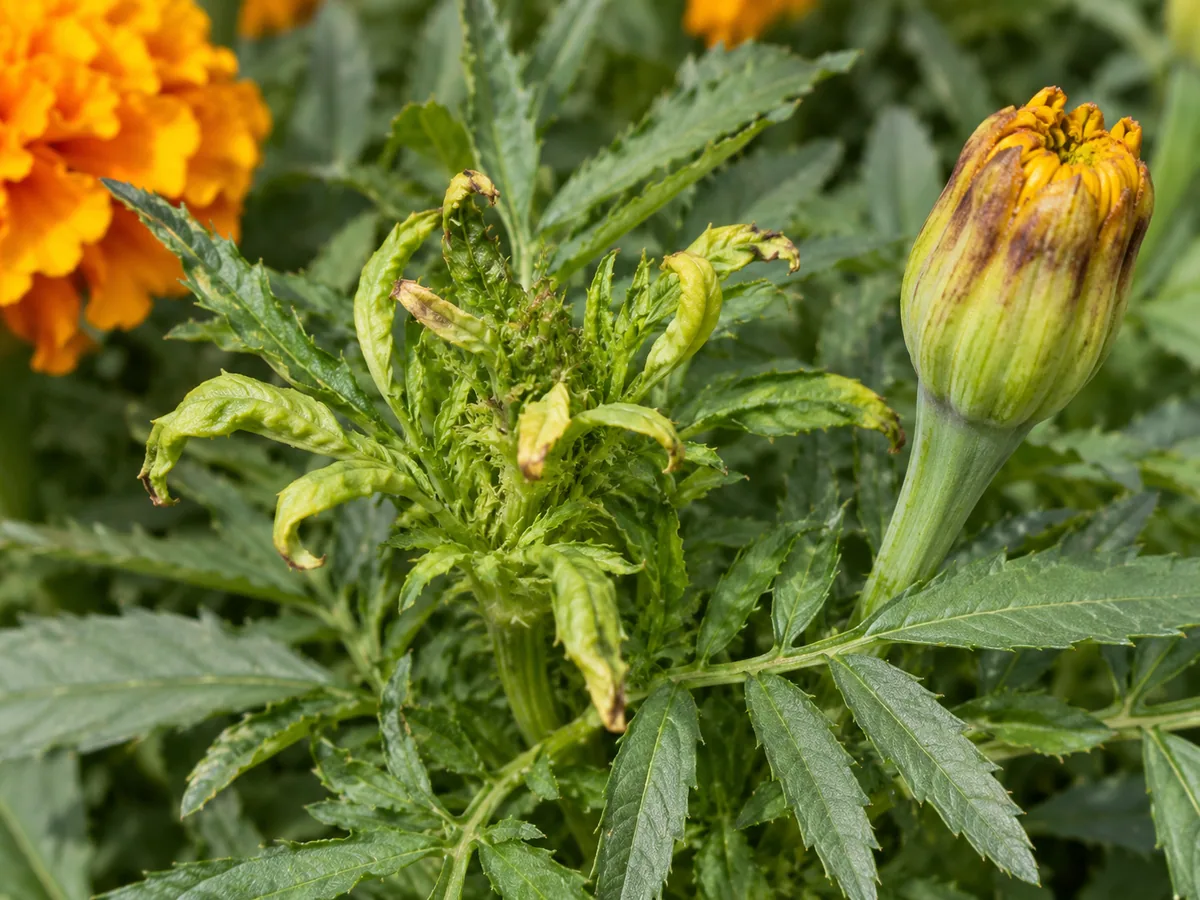
Distorted new marigold leaf with marginal browning beside a discolored bud — compare with clean older foliage lower on the same stem.
Typical signs:
- Newest leaves emerge small, narrow, hooked, or unevenly cupped instead of flat and finely divided
- Brown or tan dead spots along the margins of young leaves that spread inward
- Dark veins on necrotic young tissue, with leaves sometimes crinkled or torn as they expand
- Shoot tips stall, branch oddly, or die back while older stems look normal
- Buds discolor, open unevenly, or stall — researchers inducing deficiency in African marigold found symptomatic blooms carried only 0.09% calcium against 0.39% in healthy blooms
- Deficient mature leaves in the same trial held just 0.20% calcium versus 2.36% in healthy plants, far below the published survey range — a reminder that the whole plant runs short, but new tissue shows it first
- Weak, stubby root tips when you slip the plant from its pot, since root meristems also need calcium
Not calcium deficiency:
- Uniform yellowing starting on the oldest leaves — nitrogen deficiency or natural aging covered under yellow leaves
- Interveinal yellowing on older mid-stem leaves — magnesium deficiency
- Gray fuzzy masses on wet flowers — Botrytis flower blight (see Penn State’s marigold disease table), a pathogen rather than a nutrient gap
- Small dark circular spots with purple margins — bacterial leaf spot, which calls for destroying infected plants and keeping foliage dry per the same marigold disease reference
- Fine stippling plus webbing on leaf undersides — spider mites, not a nutrient issue
- All-over wilt on wet mix with a sour smell — overwatering or root rot
Why Marigold gets calcium deficiency
Marigold is a fast-growing annual with fibrous shallow roots that blooms itself nearly to exhaustion. That combination — rapid new tissue plus a small container root system — makes calcium delivery fragile. And delivery, not just supply, is usually the breaking point: calcium travels with water through the xylem to growing points, so anything interrupting steady uptake starves the tips first.
Marigold-specific causes:
- Boom-and-bust watering in small pots — Containers in full sun dry fast. Repeated swings from drought to saturation interrupt calcium transport, producing localized deficiency even when fertilization is sufficient. Match rhythm to the marigold watering guide rather than the calendar.
- Bloom-season demand outpacing supply — Six to eight weeks from seed to flower means new buds form constantly. A plant fed only with a low-calcium bloom booster, or never fed at all in the same mix, runs short exactly when buds need calcium most. Compare with the marigold fertilizer guide.
- Spent container mix — Marigolds are usually grown as annuals sown directly in their final pot or bed. A peat-heavy mix carried over, heavily flushed, or never amended loses available calcium over the season. See the marigold soil guide.
- pH drift locking calcium out — Marigold prefers pH 5.8–7.0. Strongly acidic mix reduces calcium availability even when calcium is present, a classic nutrient lockout pattern rather than true absence.
- Competing cations — Heavy doses of potassium, magnesium, or ammonium nitrogen compete with calcium uptake. Plants pushed with high-potassium bloom formulas while showing margin burn may need the potassium deficiency and fertilizer burn pages ruled out first.
- Still, humid air over wet foliage — Conditions that suppress transpiration, like high humidity with low air circulation, raise the risk of tipburn-type disorders. Marigolds crowded together under cover hold damp air around shoot tips — the same dampness that invites Botrytis on flowers.
- Damaged roots from chronic wetness — Fibrous marigold roots rot quickly in soggy mix, and dead root tips cannot transport calcium. If the pot stays heavy for days, read root rot before adding any supplement.
- Overhead watering habit — Hitting leaves and buds with the hose does nothing for calcium and keeps tissue wet enough for leaf spot and blight. Penn State’s marigold disease guidance stresses avoiding overhead irrigation; always water at the base.
Bud heads first: the bloom-season tell
Unlike leafy houseplants where calcium damage hides in foliage, marigold advertises trouble in its flower heads. Buds are calcium-hungry sinks, and the Cultivate25 induction work showed just how little calcium deficient blooms contain. Practically, this means a marigold whose buds brown at the edges, open lopsided, or stall half-formed while lower leaves stay green is a stronger calcium suspect than a plant with all-over yellowing.
Check buds in this order: squeeze one gently — firm but discolored points toward nutrition or environment, while soft and gray-fuzzy points toward Botrytis. Then look at the newest leaves on the same shoot. Bud plus new-leaf distortion together is the calcium signature; bud damage alone with clean new leaves leans toward moisture on flowers, thrips, or heat blast (compare bud drop and small flowers).
Deadhead spent and stalled heads promptly so the plant redirects energy to the next buds — but judge the fix only by newly forming heads, never by whether a damaged bloom reopens.
Fibrous roots and the base-watering rule
Marigold roots are fibrous, shallow, and wide-spreading rather than deep. They colonize the top of the pot first and suffer first when that layer alternates between dust-dry and waterlogged. Because calcium only reaches shoot tips through steady transpiration flow, the shallow root zone is where calcium deficiency is won or lost.
Water at the base until it drains freely, let the top 3–5 cm dry, then water again — the rhythm in the marigold watering guide. Mulch outdoor beds lightly to even out surface moisture. Indoors or on balconies, lift the pot: water when it feels clearly lighter, and never leave the saucer full. If the mix has compacted so water channels down the sides, address compacted soil before blaming nutrients.
Full-sun pots and the transpiration trap
Marigold demands six or more hours of direct sun for maximum flowering, and sun drives the transpiration stream that carries calcium upward. Two opposite traps follow: a sun-baked small pot that dries out by noon starves tips every afternoon, while a plant parked in humid still air transpires too weakly to deliver calcium even from moist mix.
Place pots where morning sun dries foliage quickly and air moves — spacing, not crowding, plus base watering keeps both calcium flowing and flowers dry. During heat waves, a coarse mulch and a slightly larger pot buffer the midday dry-down better than extra fertilizer; confirm against heat stress if whole heads scorch within hours. Plants stalled in weak light with stretched stems belong on the leggy growth and not enough light pages instead.
How to confirm the cause
Work in this order so a single check rules out the most common confusions:
- Newest-vs-oldest map — Confirm distortion, spots, or burn sit on the youngest leaves and buds while older foliage stays greener. Old-leaf-first yellowing is nitrogen or magnesium, not calcium.
- Moisture history — Was the pot erratic this month: wilted midday more than once, then soaked? Delivery failure is the likeliest cause on fast annuals.
- Root slip-check — Ease the root ball out. White fibrous tips mean roots can still transport; brown mushy roots mean rot protocol first.
- Feed and water audit — Soft or distilled water only, incomplete fertilizer, or heavy potassium feeds in the last month all narrow the suspect list. Bring the label of whatever you fed.
- pH and salts — A simple probe or strip test of the mix plus a look for white crust separates lockout (nutrient lockout, salt build-up) from true shortage.
Confirmed diagnosis — Successive new leaves and buds emerge distorted while older leaves stay normal, roots are white, watering was erratic or the mix is depleted, and pH sits off the 5.8–7.0 band or feed lacked calcium. Suspected — A single imperfect leaf flush after one dry weekend with otherwise clean growth; stabilize water and watch the next flush before supplementing.
Correcting calcium on Marigold
After the deep even base watering that serves as first aid, proceed only if the new-growth pattern holds:
- Stabilize the rhythm — Keep the base-watering cycle consistent for two weeks. Most mild cases on annuals trace to delivery, and steady moisture restores it without additives.
- Test, don’t guess — Check mix pH and look for salt crust. If pH reads below about 5.8, a measured lime adjustment per label both raises pH and supplies calcium; retest rather than repeating blindly.
- Use gypsum when pH is already fine — Gypsum supplies readily available calcium without driving pH higher, which suits marigolds already sitting in the 5.8–7.0 band. Side-dress lightly per label and water in.
- Complete the feed — Switch bloom-season feeding to a complete fertilizer that lists calcium, following the marigold fertilizer guide at label strength. One measured correction beats repeated scoops.
- Refresh exhausted mix — A root-bound annual in last season’s mix is better repotted into fresh moderately fertile mix per the marigold soil guide than endlessly amended.
Keep amendments off foliage and buds, wear gloves when handling dusty lime or gypsum, and keep the products away from pets — marigold itself is only mildly irritating, but concentrated minerals do not belong on leaves or within reach of curious animals.
What not to do
Do not drench a stressed marigold with extra fertilizer before checking roots and moisture — salts worsen lockout. Do not stack repotting, hard pruning, and feeding on the same day; read the response to one change at a time. Do not mist buds to “help” — wet heads invite Botrytis. And do not keep pouring water into a heavy, sour-smelling pot; that is a drainage emergency, not a deficiency.
Recovery timeline
Deformed leaves stay deformed and spent buds never reopen — marigold tissue does not remodel once hardened. Expect the next flush of leaves to open cleaner within two to three weeks of steady care, and new buds to color normally within three to four weeks at the height of bloom season.
Worry if three consecutive new leaves still emerge cupped and burned, shoot tips die back repeatedly, or the base softens — the last sign means crown or root rot has joined the picture. Late in the season, weigh effort against the calendar: a tired annual with months of good weather ahead is worth correcting, while one near its natural end may simply be finished.
How to prevent it next time
Sow or transplant into fresh, moderately fertile, well-draining mix each season — never reuse a depleted container mix for a hungry annual without amending it. Hold pH in the 5.8–7.0 band and feed complete fertilizer through bloom season instead of single-nutrient boosters. Water deeply at the base on a consistent rhythm, mulch outdoor beds, and space plants so morning air dries the foliage. Deadhead regularly and inspect shoot tips weekly; on a plant that flowers itself to exhaustion, the earliest cupped new leaf is the cheapest warning you will get. Browse the full marigold problems hub whenever a new pattern appears so small issues stay small.
When to worry
Treat it as urgent when growing points collapse, several new leaves in a row emerge deformed, or damage spreads while care is already correct — persistent tip death means the plant cannot build new tissue. Also escalate when stems soften at the soil line, seedlings keel over in groups (damping-off), or mottling and streaking suggest virus (mosaic virus has no cure and calls for removal). A soil test through your local extension service settles stubborn cases faster than another round of guessing.
Related Marigold guides
- Marigold overview
- Marigold watering
- Marigold fertilizer
- Marigold soil
- Marigold light
- Nitrogen deficiency
- Magnesium deficiency
- Potassium deficiency
- Nutrient lockout
- Bud drop
- Marigold problems hub
Conclusion
Cupped, torn, or margin-burned newest leaves plus discolored buds on an otherwise green marigold point to calcium delivery failure at the growing tips — confirm the new-vs-old pattern, even out deep base watering first, rule out rot, lockout, and flower blight, supply calcium only when the pattern fits, and judge success by the next flush of leaves and buds.
Related tool
Use the Fertilizer Dilution Calculator to narrow causes for calcium deficiency on this plant before changing multiple variables at once.