Okra Light Requirements for Strong Growth and Pods
Okra Light Requirements for Strong Growth and Pods
Okra Light Requirements for Strong Growth and Pods
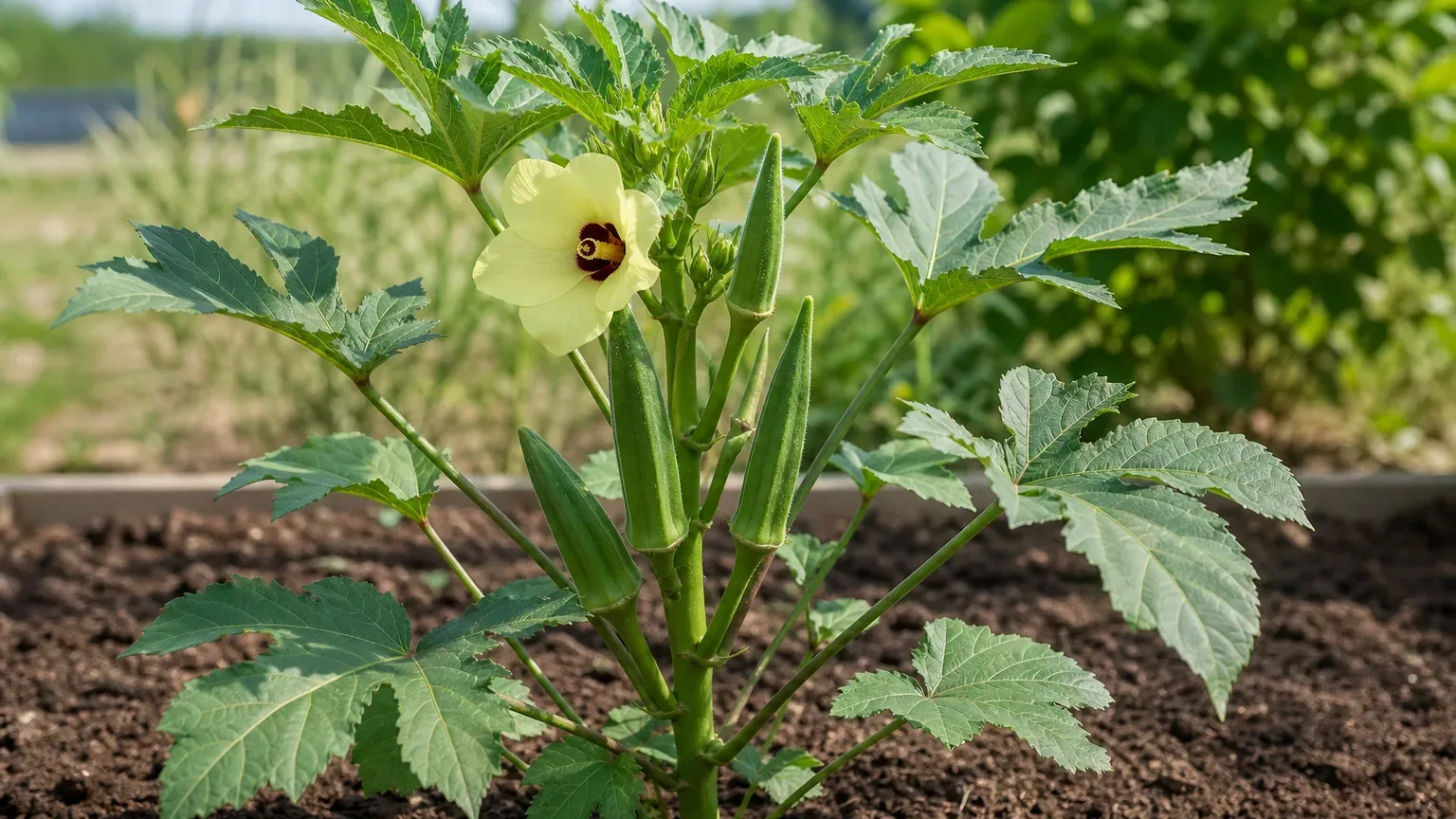
Okra is not a foliage plant that merely stays green in a bright room. It is a warm-season, flowering vegetable that must build enough energy to grow a tall canopy, open flowers, and develop repeated pods. The practical target is therefore an outdoor position with full sun and as much unobstructed sky as your space allows, not a decorative indoor corner.
For a useful home-garden benchmark, NC State Extension defines okra’s full-sun exposure as six or more hours of direct sunlight a day. That is a placement target rather than a promise that every plant receiving six hours will crop equally: cultivar, season, temperature, root space, moisture, and nutrition still matter. If you can choose between a half-shaded corner and an open terrace or bed, give the open position to okra.
How much light okra needs
Okra (Abelmoschus esculentus) needs full sun for strong growth and pod production. Oklahoma State University advises growing the crop where it receives full sunlight throughout the day, while the Royal Horticultural Society also lists the species’ position as full sun. These recommendations fit okra’s identity as a tender tropical or subtropical crop rather than a shade vegetable.
Use six hours of direct sun as a reasonable minimum screen for a site, then prefer the location with the longer, clearer view of the sky. A bright balcony that receives direct morning sun and strong open-sky light afterward can be workable. A balcony that gets a narrow beam for an hour but remains under a deep roof or behind another tower for the rest of the day is not equivalent.
Direct sun versus partial shade
Okra can remain alive and leafy in some partial shade, but survival is the wrong standard for a fruiting crop. An Indian Council of Agricultural Research–linked field study comparing shade, moderate light, and open sunlight found that okra’s overall growth and yield performed better in open field conditions. The same study observed longer shoots under shade or moderate light, a useful warning that extra height does not necessarily mean better performance.
Brief edge-of-day shade is different from losing the brightest middle portion of the day to a wall or tree canopy. Do not remove a healthy plant just because sunrise reaches it late or a railing casts moving shadows. Do reconsider the position when fixed shade covers most of the canopy for much of the day, especially after flowering should have begun.
Balcony, terrace, and ground positions compared
A plant in the ground and one in a container can receive the same sunlight, but their heat and water environments differ. Open ground buffers roots from sudden temperature changes and usually gives a large cultivar more room. A sunny balcony or terrace can provide excellent overhead light, yet the pot, parapet, and paving may become much hotter and dry faster than garden soil.
The Missouri Botanical Garden describes okra as an annual from tropical Africa and Asia and recommends full sun. That background supports an outdoor warm-season position, but it does not mean a newly purchased plant should be moved abruptly from a shaded nursery bench onto heat-reflecting concrete.
Choosing the brightest workable balcony position
First, look outward from leaf height. Choose the spot with the widest visible sky and the fewest hours blocked by roofs, awnings, grills covered with fabric, neighbouring buildings, or larger plants. In India, an east-facing open balcony may give useful morning sun with less late-day heat, while an unshaded south- or west-facing terrace may provide more intense exposure; actual obstruction matters more than the compass label.
Keep tall okra near the outer bright edge only if the container is stable and the plant is protected from unsafe falls or severe wind. Avoid pushing foliage against hot glass or a sun-heated metal railing. If the brightest location also bakes a small dark pot, shade the container wall or paving, not the leaves, and use the Okra watering guide to match irrigation checks to faster drying.
Placing okra in a garden bed
Put okra where trees, boundary walls, maize, climbers, and tall ornamentals will not take over its midday light later in the season. The University of Georgia’s home-garden guidance says okra does best in a full-sun area and suggests orienting rows to capture sunlight. In a small mixed bed, the simpler rule is to place okra where taller neighbours will not shade its canopy and where the okra itself will not block shorter vegetables.
Check future shade, not only conditions on planting day. Sun angle shifts through the season, trees leaf out, and a fast-growing vine can close an open gap. A phone photo taken from the same position in the morning, around midday, and later in the afternoon is often more revealing than guessing from one inspection.
Managing okra light during monsoon
Monsoon weather can bring repeated overcast periods, but cloud cover is not a reason to move okra into shelter where a roof reduces light even further. Keep the plant in the most open safe outdoor position. A cloudy sky still provides diffuse daylight from many directions, whereas a deep balcony recess blocks much of that sky.
Okra is widely grown as a hot-weather vegetable; Mississippi State University Extension describes it as a hot-weather crop that makes sizeable plants. During a dull, rainy stretch, you cannot manufacture clear sun outdoors. You can prevent other stresses—especially waterlogged roots, crowding, and permanent structural shade—from compounding the temporary reduction in light.
What to change during a cloudy spell
Do not compensate for cloudy weather with extra fertilizer. Nutrients cannot replace light, and wet soil plus unnecessary feeding adds another variable while growth is slower. Instead, remove movable shade screens, space containers so leaves do not overlap heavily, and check moisture before watering because rain and lower evaporative demand may keep the root zone wet longer.
Pause before diagnosing a problem from a few grey days. Watch the next flowers, new leaves, and pods across the changing weather. If weak growth continues after brighter conditions return, inspect root drainage, nutrition, pests, and cultivar timing through the Okra overview rather than blaming monsoon cloud alone.
Separate cloud cover from avoidable shade
Clouds are temporary and spread diffuse light; a concrete overhang, dense tree crown, or shade cloth removes light every day. Stand where the plant sits and look up. If most of the sky is hidden even when the weather clears, the main problem is the site, not the monsoon.
Move a container toward a safer open edge, trim only vegetation you are permitted to manage, or choose a sunnier bed for the next sowing. Do not repeatedly shuttle a tall, fruiting okra between drastically different positions each day. A stable bright site is easier to water and support than a plant that alternates between deep shade and sudden intense sun.
Acclimating seedlings and nursery plants to stronger sun
Okra wants full sun, but leaves formed under a nursery canopy or indoor seed light have not experienced the same intensity, heat, and wind as an exposed terrace. Introduce the stronger position gradually. Begin with a protected period of outdoor light, then increase direct exposure in steps while keeping the root ball evenly moist but not saturated.
Let the plant’s response set the pace rather than following a rigid universal calendar. Clean new growth and leaves that remain normally coloured indicate that the transition is working. Pale patches, papery tan areas, or crisp damage concentrated on the newly sun-facing side mean the increase was too abrupt; return to the last safe exposure and resume more slowly.
Acclimation does not mean keeping okra in shade permanently. The RHS growing guide says okra needs plenty of heat and sun. The goal is to reach that brighter growing position without sacrificing existing foliage in one sudden move.
Can grow lights replace outdoor sun for okra?
Grow lights are useful for starting seedlings when outdoor conditions are unsuitable, but a mature okra is a large, sun-demanding fruiting plant. A small desk lamp or distant household bulb may keep a seedling from sitting in darkness; it is not a realistic substitute for an open sunny balcony, terrace, greenhouse, or garden bed if the goal is a useful pod harvest.
If seedlings lean strongly toward a lamp, become thin between leaves, or crowd one another, improve fixture coverage and move them toward outdoor conditions when weather permits. Follow the fixture maker’s safe distance and heat guidance rather than copying one universal distance or daily-hour prescription. For a permanently windowless setup, the lighting and space needed to support mature okra are closer to a crop-growing installation than ordinary room lighting.
Signs okra is not getting enough light
Low light is best identified as a pattern, not from one leaf. Look for several of these together: stems stretching toward the open side, long gaps between leaves, a canopy leaning out from under a roof, slow flowering, few pods despite otherwise suitable warmth and care, and soil remaining wet longer after the plant was moved into shade.
Compare new growth before and after a placement change. Older leaves cannot shorten or straighten once light improves. Give the plant a stable brighter site, then judge the next section of stem, the next leaves, and subsequent flowering rather than expecting old stretched growth to reverse.
Tall leafy growth without useful pod production
Height alone does not prove that okra is receiving enough light. The tree-shade study from Northeast India found greater shoot length under shade and moderate light even though overall growth and yield were better in open conditions. A tall, lax plant reaching toward a balcony edge may therefore be asking for light, not celebrating ideal care.
Light is also not the only reason an okra plant may be leafy without pods. Excess nitrogen, immature plants, root restriction, heat or moisture stress, and flower loss can contribute. Improve an obviously shaded placement first, then use the Okra fertilizer guide and Okra soil guide to investigate the other controllable causes without changing everything at once.
Can okra get too much sun?
An established, well-watered okra in suitable warm-season conditions normally belongs in full sun. Apparent “too much sun” trouble on balconies often combines abrupt exposure, root-zone drying, and reflected heat. Suspect sun injury when pale, bleached, tan, or crisp patches appear mainly on the side that faced intense light soon after a move.
Do not respond by placing the plant in deep permanent shade. Protect a newly exposed plant during the harshest transition period, restore steady root moisture, and increase exposure more gradually. If only the pot overheats, insulate or shade the container and move it off heat-storing paving while leaving the canopy in good light.
How light changes watering and feeding
Bright, warm exposure usually makes a container lose water faster than a shaded recess, while cloudy or obstructed conditions can slow drying. Check the root zone rather than preserving the same calendar after a move. Okra still needs a draining medium; more sun just means moisture checks may need to happen more often.
Never use extra water as a direct cure for pale leaves without checking the soil. Sun injury, nutrient problems, and saturated roots can all produce discolouration. Likewise, do not feed a shaded okra more heavily in an attempt to force pods. Fix the energy source—light—then keep water and nutrition proportionate to actual growth.
When to use this page vs other Okra guides
- Start with the Okra overview when you need whole-plant context, cultivar size, warmth, harvest, and general setup.
- Use the Okra watering guide when sun, terrace heat, rain, or container size has changed how quickly the root zone dries.
- Use the Okra soil guide when a sunny plant remains weak because the bed or pot stays saturated or compacted.
- Use the Okra fertilizer guide when growth is pale, unbalanced, or very leafy after light and root conditions are corrected.
Related Okra guides
- Okra propagation — sow and establish new plants, then transition seedlings into outdoor light.
- Okra repotting — move a young plant into its final container without stacking root and light stress.
- Okra pruning — manage damaged or crowded growth without removing healthy sun-catching foliage unnecessarily.
- Okra overview — return to the complete bhindi growing guide and care cluster.
Conclusion
Okra light requirements are straightforward at the plant level and complicated only by real spaces: give Abelmoschus esculentus full sun, open sky, and an outdoor warm-season position, then adjust for walls, roofs, neighbouring plants, monsoon cloud, and container heat. Six or more hours of direct sun is a useful site screen, but the strongest choice is the safe location with the longest unobstructed light and the least persistent shade.
If your bhindi is tall, leaning, slow to flower, or producing poorly, map the shade across one day before adding water or fertilizer. Remove avoidable obstruction, acclimate shaded plants to stronger exposure in stages, and judge success from new growth. During monsoon, keep the plant open to diffuse sky, reduce only the stresses you can control, and let the weather change before making another major correction.