Brown Tips on Okra: Causes, Checks & Fixes
Quick answer
Brown tips on okra (Abelmoschus esculentus) usually stem from three distinct triggers: acute drought stress during hot afternoon transpiration, fertilizer salt accumulation in container soil, or mobile potassium deficiency on older lower leaves. First step: inspect soil moisture 5 cm below the surface and check whether browning is confined to older lower leaves or top sun-exposed foliage before adjusting feed or water.
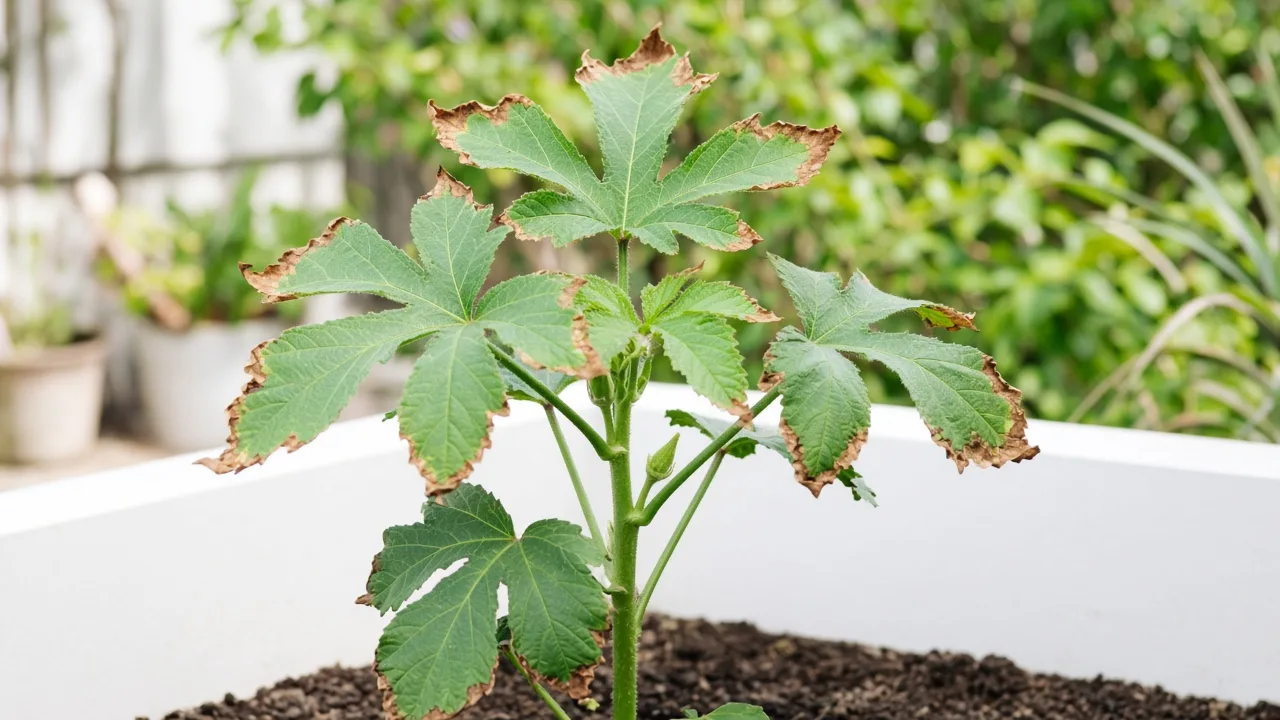
Brown Tips on Okra: Causes, Checks & Fixes
This guide covers brown tips on Okra. See also the general Brown Tips guide, watering, and light pages for this plant.
Brown Tips on Okra: Causes, Checks & Fixes
Quick answer
Brown tips on okra (Abelmoschus esculentus) mean the furthest vascular tips of the plant’s broad, palmately lobed leaves have dried out, collapsed, and turned brittle. For how environmental tip burn functions across plants in general, see our comprehensive brown tips guide. On okra, this symptom is almost never a random pathogen; it is primarily driven by three distinct mechanisms: transpiration deficit during intense heatwaves, soluble fertilizer salt accumulation in container potting media, or mobile potassium deficiency on older foliage during active pod fill.
First step: inspect the root zone 5 cm below the soil line and evaluate leaf position before changing water or fertilizer. If the potting mix is dry and light, a thorough deep soaking is needed. If the soil is moist and a white mineral crust rings the container rim, excess fertilizer salts must be leached out. If the browning is restricted to the margins of the lowest mature leaves while new pods are swelling, a potassium imbalance is the likely culprit.
When to use this page vs other Okra guides
Use this reference table to route directly to the most relevant guide for your plant’s symptom pattern:
| What you observe on your okra | Most likely cause | Recommended next guide |
|---|---|---|
| Crispy tan tips on lobe points, soil dry 5 cm down | Midday water deficit / under-hydration | Okra watering guide |
| Brown margins on older lower leaves, green veins | Mobile potassium deficiency during fruiting | Okra problems catalog |
| Browning tips with white salt crust on container soil | Mineral salt toxicity / over-fertilization | Okra soil guide |
| Scorched upper leaves facing intense afternoon glare | Excessive heat and solar radiation | Okra light guide |
| Soft, yellowing lower leaves with soggy, foul-smelling soil | Saturated media and root suffocation | Okra problems catalog |
| Overall care, cultivar spacing, and pod harvest methods | Baseline seasonal crop culture | Okra overview guide |
What brown tips look like on Okra
NC State Extension describes okra as a warm-season vegetable in the Malvaceae family that thrives in full sun, producing large, palmately lobed leaves covered with stiff, protective hairs. Because okra leaves are broad and deeply indented, water travels a long vascular path from the petiole to the outermost point of each serrated lobe. When stress strikes, these distal tips are the first tissues to suffer cellular dehydration.
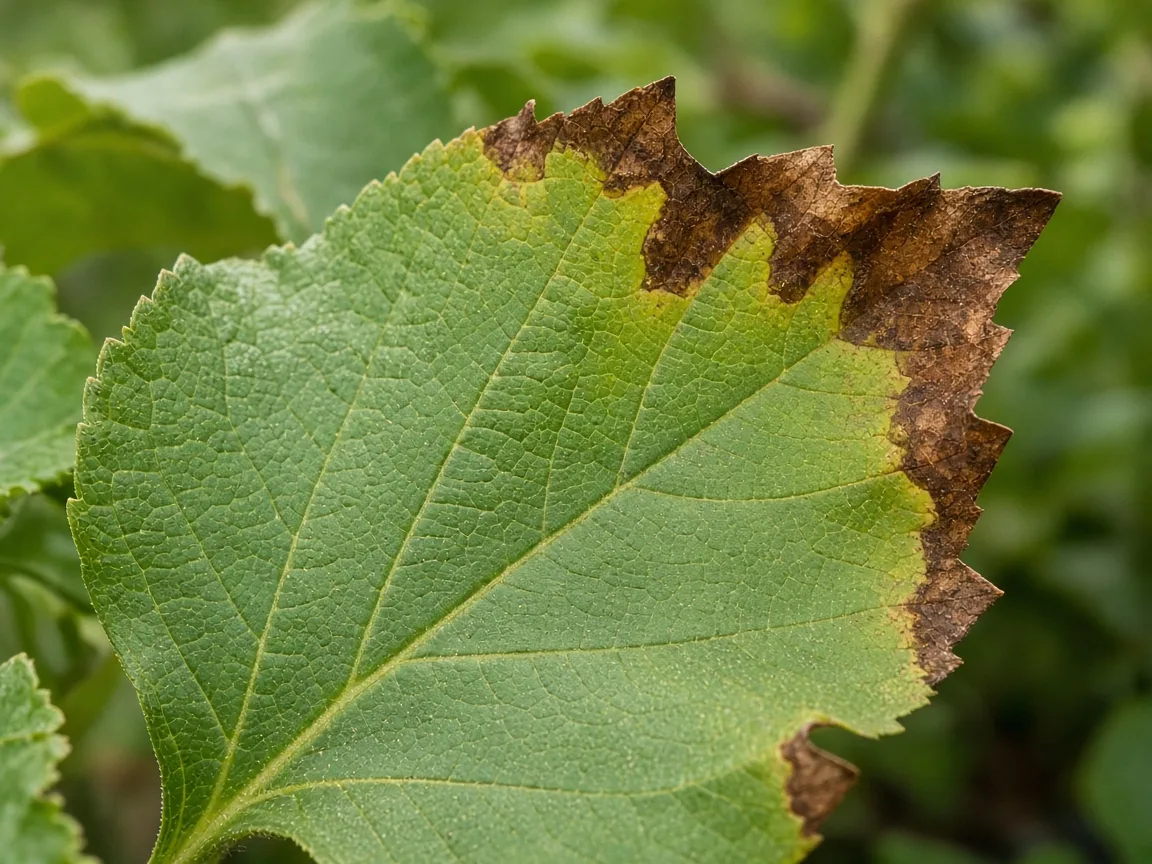
Marginal scorch and brown tips on an okra leaf lobe—crispy necrotic edges will not re-green; monitor new growth for recovery.
Depending on the underlying cause, brown tips manifest in distinct visual patterns:
- Environmental heat and drought scorch: Narrow tan to dark brown crispy margins outline the outermost points of the lobes on upper and middle leaves. Affected tissue feels brittle and papery to the touch, while the central leaf blade remains dark green.
- Potassium deficiency scorch: Symptoms begin on the oldest, lowest leaves as marginal chlorosis (yellowing) that quickly turns into a continuous dry, bronze-to-brown band along the leaf perimeter. The central lamina and primary veins retain their deep green color, creating a stark contrast.
- Fertilizer salt burn: Tips and serrated edges of both young and mature leaves turn light tan or scorched brown within 24 to 48 hours following a concentrated liquid fertilizer application. A white or yellowish crust is frequently visible on the soil surface or pot rim.
- Root saturation uptake failure: Distal lobe tips turn dull brown or grayish-black while the surrounding leaf tissue turns pale yellow, accompanied by sluggish growth and limp, waterlogged stems.
Why Okra gets brown tips
Okra is an exceptionally vigorous, sun-loving annual crop that develops a substantial vertical framework and a deep taproot within weeks of germination. However, its immense leaf surface area and continuous flower and pod development make it vulnerable to moisture and nutrient imbalances.
Missouri Botanical Garden explains that leaf scorch occurs when transpiration exceeds water uptake by the root system. On okra, several species-specific factors create this physiological bottleneck:
- Extreme transpiration rates under peak summer heat: Okra foliage contains numerous stomata adapted for rapid gas exchange during hot days. When summer temperatures climb past 35°C (95°F), atmospheric drying demand pulls water through the leaf canopy faster than the vascular xylem can supply the lobe tips.
- Container root volume restrictions: While in-ground okra can send taproots several feet into the subsoil to access moisture, container-grown plants are confined to a limited soil reservoir that dries out within hours under strong sun.
- Heavy nutrient turnover during pod set: Once flowering begins, developing pods act as powerful nutrient sinks, drawing mobile elements like potassium out of mature foliage.
- Substrate salt sensitivity: Synthetic fertilizers applied to dry container media concentrate rapidly, drawing moisture out of sensitive root hairs through reverse osmosis.
Container okra and fertilizer salt accumulation
Growing okra in containers—such as 5-gallon buckets, 30 cm pots, or fabric grow bags—is increasingly popular for patios and urban gardens. However, container culture is the primary breeding ground for fertilizer salt scorch.
Because okra is a heavy producer, growers often apply concentrated liquid plant food or synthetic granular fertilizers weekly. In hot summer weather, container potting mix evaporates moisture rapidly. As water transpires through the leaves and evaporates from the pot surface, unused mineral salts (such as nitrates, sulfates, and chlorides) remain behind, accumulating in the root zone.
When the concentration of soluble salts in the potting mix exceeds the internal salinity of the plant’s root cells, osmotic pressure reverses. Instead of roots absorbing moisture, the salty soil solution pulls water out of root tips, causing cellular collapse. The above-ground result is sudden, crispy brown tips across the serrated leaf margins.
To confirm salt accumulation, look for a white, powdery efflorescence on terracotta surfaces or a brittle crust on the top layer of potting soil. The immediate remedy is soil leaching: gently pour plain, room-temperature water through the container until 20% to 30% of the pot’s volume runs freely out of the drainage holes, washing away accumulated salts.
Potassium deficiency vs drought scorch on palmate lobed leaves
A frequent diagnostic mistake on okra is confusing potassium (K) deficiency with simple drought stress. Because both cause brown, crispy leaf margins, identifying the exact symptom locus is critical for correct treatment.
In plant physiology, potassium deficiency typically manifests as marginal chlorosis and browning on older leaves because potassium is a mobile nutrient within the plant. When the soil lacks sufficient available potassium, the okra plant extracts the element from its oldest, lowest leaves and redirects it upward to support newly forming flower buds and rapid pod expansion.
Here is how to differentiate the two issues on okra’s palmate foliage:
- Location on the plant: Potassium deficiency strictly targets the lowest, oldest lobed leaves first. Drought and heat scorch primarily damage upper and outer leaves exposed to direct sun and dry wind.
- Progression of symptoms: Potassium deficiency begins with a pale yellowish chlorosis along the leaf margins, followed days later by necrosis that moves inward between major veins while veins remain dark green. Heat scorch browns the tips abruptly without a prolonged chlorotic halo.
- Pod development impact: A potassium-starved okra plant produces shortened, stunted, or curved pods with poor fiber development, whereas a drought-stressed plant drops blossoms entirely.
University of Georgia Extension recommends a balanced 10-10-10 fertilizer to maintain adequate potassium levels in the root zone, cautioning against excessive nitrogen, which produces lush, vulnerable leaves at the expense of fruiting.
High-heat transpiration stress during flowering and pod development
Okra is renowned for its heat tolerance, originating in tropical Africa and Asia. Yet even heat-adapted vegetables have physical limits when atmospheric vapor pressure deficit (VPD) surges.
University of Florida IFAS notes that while okra is drought-tolerant, soil moisture is the primary limiting factor for pod production and vigorous vegetative health. During peak summer conditions, a mature okra plant bearing dozens of large leaves can lose several liters of water per day through foliar transpiration.
When high daytime temperatures are coupled with brisk winds or low humidity, the rate of water vapor evaporation from the broad leaf blades exceeds the hydraulic conductivity of the root system. Even if the soil contains moderate moisture, water cannot travel through the stems and petioles fast enough to replenish the farthest tips of each leaf lobe. As cellular turgor collapses at the perimeter, the delicate marginal cells dry out and turn papery brown.
This form of scorch is especially acute on container-grown okra positioned next to heat-reflecting masonry walls, concrete patios, or metal balcony railings. Grouping containers together, applying organic mulch, and irrigating deeply early in the morning help buffer foliage against extreme midday transpiration spikes.
How to confirm the cause
Before applying any treatments, work systematically through this diagnostic checklist to isolate the exact cause of brown tips on your okra:
- Check leaf age and distribution: Are the brown margins exclusively on the oldest leaves near the base of the main stalk? If yes, suspect potassium deficiency. Are they on the top leaves facing the afternoon sun? Suspect heat scorch. Are they uniformly distributed across all foliage? Suspect fertilizer salt burn or root uptake failure.
- Conduct the 5 cm soil moisture test: Push a wooden skewer or your finger 5 cm (2 inches) into the root zone. If the soil is dusty, powdery, and pulls away from the container sides, acute under-watering is confirmed.
- Inspect the container drainage and saucer: Lift the pot. If it feels heavy and water stands continuously in the catchment saucer, the root zone is waterlogged, suffocating roots and halting water transport.
- Examine the soil surface for salt crusts: Look for white, yellowish, or gray mineral buildup on the potting soil or container rim. Review recent feeding records: if you applied full-strength chemical fertilizer to dry soil, fertilizer burn is almost certain.
- Evaluate recent weather conditions: Review the last 48 hours of weather. Did temperatures exceed 35°C (95°F) with strong dry winds? Heat and wind scorch are immediate environmental responses.
Symptom comparison table
| Feature | Drought Scorch | Potassium Deficiency | Fertilizer Salt Burn | Waterlogged Root Rot |
|---|---|---|---|---|
| Affected Leaves | Upper, sun-facing leaves | Oldest, lowest leaves | All leaves, especially new tips | Lower leaves first, spreading up |
| Symptom Pattern | Crisp tan lobe tips | Yellow-to-brown margins, green veins | Sudden bleached/brown tips | Dull brown tips, yellow blades |
| Soil Condition | Bone-dry, lightweight pot | Normal moisture level | Dry or damp with surface crust | Chronically wet, heavy, sour smell |
| First Action | Deep, thorough watering | Apply balanced K fertilizer | Leach soil with plain water | Halt water, improve drainage |
First fix for Okra
Apply one targeted first fix based on your diagnosis, and allow the plant 5 to 7 days to stabilize before making further adjustments.
If drought or transpiration scorch is confirmed
Provide one deep, thorough root-zone soak immediately. Utah State University Extension advises applying 1.5 to 2 inches of water every 7 to 10 days for in-ground okra, and more frequent irrigation for containers. Apply water directly to the soil using a gentle hose wand, drip emitter, or watering can, ensuring moisture reaches the entire depth of the root ball until water flows from the drainage holes. Never spray the foliage in intense midday sun, as water droplets can magnify heat and wet leaves encourage fungal pathogens.
If fertilizer salt accumulation is confirmed
Leach the potting mix thoroughly with clean, unfertilized water. Take container okra to an outdoor drain area and slowly pour plain water through the mix equal to twice the container volume. Allow the excess water to drain away completely, and empty any saucers. Suspend all fertilizer applications for at least two weeks.
If potassium deficiency is confirmed
Side-dress the plant with an organic or balanced potassium source. Scratch 1 to 2 tablespoons of sulfate of potash, wood ash (in slightly acidic soils), or a balanced 10-10-10 vegetable fertilizer into the top 3 cm of soil around the drip line of the plant, avoiding direct contact with the stem. Water the amendment in thoroughly.
Optional cosmetic grooming
Dead, brown leaf margins cannot turn green again. You may use clean, sanitized garden shears to trim the crispy brown tips along the natural contour of the leaf lobes. However, leave any green tissue intact, as it continues to produce energy for expanding okra pods.
Step-by-step recovery
After executing the initial fix, guide your okra through a structured recovery cycle:
- Days 1 to 3 (Moisture Stabilization): Maintain consistent, even moisture in the root zone. Check the top 3 cm of mix daily. If growing in containers during summer, establish an early morning watering routine so the plant is fully hydrated before peak afternoon heat.
- Days 4 to 7 (Canopy Monitoring): Observe the newest emerging leaves at the top apex of the main stalk. In a recovering plant, new leaves will unfurl smooth, flexible, and completely free of brown borders or crispy tips.
- Weeks 2 to 3 (Nutrient and Pod Balance): If potassium deficiency was treated, older damaged leaves will retain their brown margins but the yellowing halo should stop expanding. Harvest pods every 2 to 3 days when they reach 5 to 8 cm (2 to 3 inches) long; regular harvesting reduces metabolic stress on the plant and encourages healthy continuous vegetative growth.
- Weeks 4 and Beyond (Long-term Care): Maintain a 5 cm layer of organic straw or bark mulch across the root zone to conserve soil moisture and moderate soil temperatures during peak summer.
Mistakes to avoid
- Drenching already waterlogged soil: If okra roots are suffocating in muddy, poorly draining soil, adding more water because the leaf tips are brown will accelerate root rot. Always verify dry soil before watering.
- Fertilizing a thirsty, stressed plant: Applying fertilizer to dry soil drastically increases salt concentration, severely burning root hairs. Always ensure the root zone is moist before feeding.
- Using high-nitrogen fertilizers: Excess nitrogen promotes explosive, tender foliage that transpires water rapidly and wilts easily, while simultaneously suppressing flower and pod formation.
- Relying on shallow overhead sprinkling: Light surface sprinkling moistens only the top centimeter of soil, leaving the deep taproot desiccated and encouraging shallow root growth.
- Stripping all leaves with brown tips: Removing every leaf with damaged margins shocks the plant, reduces photosynthetic capacity, and exposes developing pods to direct sunscald.
How to prevent brown tips on Okra
Long-term prevention requires aligning cultural practices with okra’s rapid growth habit:
- Adopt deep, measured watering: Deliver 1 to 1.5 inches of water weekly to garden beds, and inspect container okra daily in summer. Utilize drip irrigation or soaker hoses to keep moisture consistent without wetting the hairy foliage.
- Apply organic surface mulch: Spread a 5 to 7 cm layer of clean straw, pine straw, or shredded bark around the base of okra plants. Mulch dramatically reduces surface soil evaporation, keeps root zones cool, and prevents rapid wet-to-dry swings.
- Maintain balanced soil fertility: Follow soil test recommendations or apply a balanced 10-10-10 formula at planting, followed by moderate side-dressings during active pod production. Avoid sudden heavy applications of chemical fertilizers.
- Select adequately sized containers: Never grow full-sized okra cultivars in pots smaller than 5 gallons (roughly 30 cm diameter and depth). Dwarf cultivars such as ‘Annie Oakley II’ perform significantly better in containers than standard 2-meter varieties.
- Provide microclimate windbreaks: In windy, exposed rooftop or balcony gardens, position okra near windbreaks or arrange pots in clusters to increase local relative humidity and reduce desiccation.
When to worry
Low urgency: A few tan tips on the lowest mature leaves while new leaves emerge vibrant green, stems remain sturdy, and pods develop normally. This is common seasonal wear and tear that responds quickly to minor watering or feeding tweaks.
High urgency: Browning spreads across more than half the leaf canopy within several days, main stems become soft or shriveled near the base, upper growing tips droop and turn black, or newly formed pods turn yellow and drop prematurely. These symptoms indicate systemic root damage from either severe drought desiccation, toxic salt buildup, or advanced root rot, requiring immediate root-zone intervention.
Conclusion
Brown tips on okra are an environmental warning signal, not a fatal condition. Whether caused by intense midday transpiration, concentrated fertilizer salts in container media, or potassium reallocation during heavy pod set, Abelmoschus esculentus possesses remarkable resilience once root-zone balance is restored. By verifying moisture at depth, flushing excess salts, and maintaining steady hydration, you can protect the foliage and enjoy a continuous harvest of tender, high-quality pods all season long.
Related Okra guides
- Okra overview guide — complete botanical profile, cultivar selection, and harvesting advice.
- Okra watering guide — detailed schedules, moisture testing methods, and irrigation best practices.
- Okra light guide — managing full sun requirements, heat tolerance, and scorch prevention.
- Okra soil guide — ideal soil mixtures, drainage requirements, and pH management for beds and pots.
- Okra problems catalog — diagnostic directory for pests, wilting, and foliar disorders on okra.
Related tool
Use the Humidity Calculator to evaluate vapor pressure deficit and atmospheric drying demand around your okra plants during extreme summer heatwaves.