Underwatering on Okra: Taproot Drought Checks & Fixes
Quick answer
Underwatering on okra strikes during peak summer heat and active fruiting, causing limp foliage, blossom abortion, and tough, fibrous pods that fail the snap test. Okra relies on a deep primary taproot that shallow sprinkling cannot satisfy. First step: perform an immediate deep root-zone soak delivering 1.5 to 2 inches of water, harvest all existing pods to halt reproductive moisture drain, and lay a 3-inch organic mulch layer to retain soil moisture.
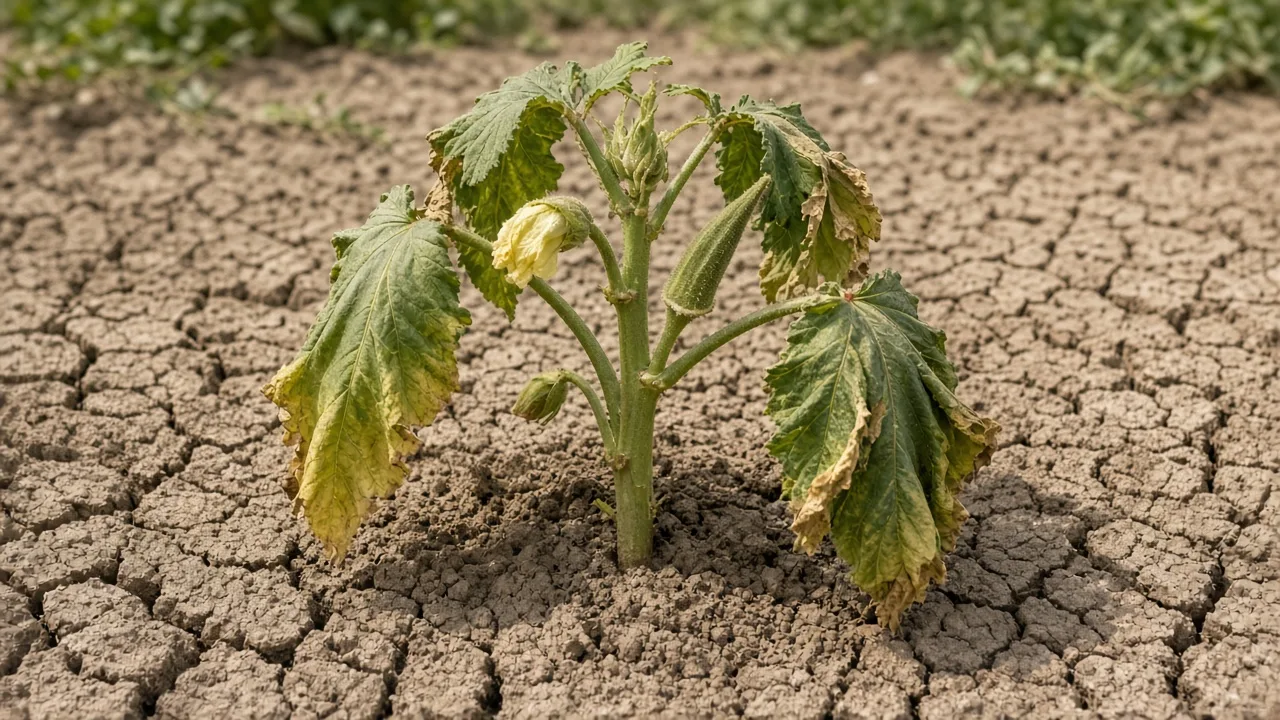
Underwatering on Okra: Causes, Checks & Fixes
This guide covers underwatering on Okra. See also the general Underwatering guide, watering, and light pages for this plant.
Underwatering on Okra: Causes, Checks & Fixes
Quick answer
Underwatering on Abelmoschus esculentus (okra) is a severe physiological stress that peaks during hot summer weather, precisely when the plant enters its heavy flowering and fruiting cycles. While okra is celebrated throughout warm climates for its impressive heat stamina, drought stress rapidly halts pod production, causes flower buds to abort, and forces developing pods to become woody, fibrous, and unpalatably stringy.
For how water deprivation impacts plant vascular systems across home gardens and landscapes in general, consult our comprehensive underwatering guide. On okra, chronic water deficit manifests primarily as persistent morning leaf wilting, blossom drop, lower leaf yellowing and shedding, and stunted, fibrous pods that bend like rubber rather than snapping cleanly.
First step: deliver an immediate slow, deep soak of 1.5 to 2 inches of water directly to the soil line around the taproot, strip off every existing pod on the plant to eliminate reproductive moisture demand, and apply a 3-inch organic mulch blanket across the bed. Do not apply synthetic fertilizers or rely on brief overhead sprinkling, which leaves the deep root zone bone-dry.
When to use this page vs other Okra guides
Okra can exhibit wilting and leaf discoloration from several distinct cultural, fungal, and pest pressures. Use the diagnostic matrix below to verify whether moisture deprivation is the genuine culprit before altering your irrigation regimen.
| Observed symptom pattern | Primary diagnosis | Key distinction | Guide to consult |
|---|---|---|---|
| Leaves limp at 7:00 AM; blossom drop; pods tough, fibrous, and stringy; dry soil | True underwatering | Morning wilt; parched subsoil below 4 inches; pods fail snap test | This guide |
| Leaves droop at 2:00 PM in 95°F+ sun but stand upright by 8:00 PM; moist soil | Midday heat flagging | Normal transpiration stress; plants fully recover overnight | Okra Light Guide |
| Lower leaves yellowing and dropping; soil heavy, wet, and sour; mushy root collar | Chronic overwatering | Saturated root zone; soft stem base; decaying lateral roots | Overwatering |
| Sudden whole-plant wilt on moist soil; dark vascular streaks inside cut lower stem | Vascular wilt (Fusarium / Verticillium) | Plant wilts despite damp soil; brown discoloration in stem xylem | Wilting |
| Stunted growth; patchy yellowing; midday wilt; knotty swellings on roots | Root-knot nematodes (Meloidogyne spp.) | Root system displays galls and knots; symptoms persist with water | Root rot |
| Lower foliage pale yellow between veins; soil moisture balanced; growth slow | Nitrogen or sulfur deficiency | Uniform chlorosis on older leaves without limp stems or pod stringiness | Yellow leaves |
| Overall growth halted; dark green compact foliage; cool spring soil temperatures | Cold soil stunting | Soil temperature below 65°F (18°C); healthy turgor but zero growth | Slow growth |
What underwatering looks like on Okra
Because okra is a fast-growing, heavy-transpiring annual vegetable, water stress progresses through a distinct sequence of visual symptoms as moisture depletes from the root zone.
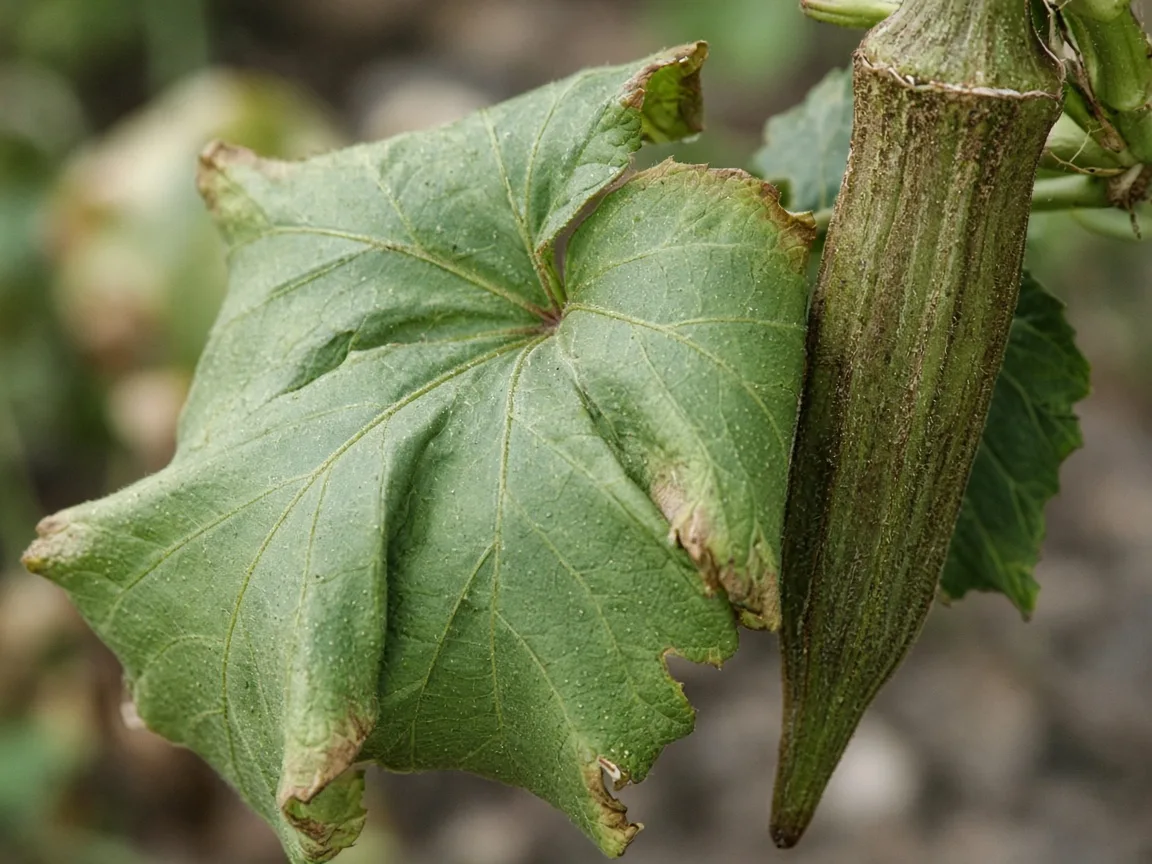
Severe drought stress on okra: loss of leaf turgor causing cupped, drooping foliage and stunted, tough pods with prominent fibrous ribs.
Foliage and stem indicators
- Loss of leaf turgor: Broad palmate leaves lose hydrostatic pressure, drooping downward along their petioles. The leaf margins curl inward or cup upward to minimize leaf surface exposure to direct solar radiation.
- Persistent morning wilt: Unlike temporary midday heat flagging, drought-stressed okra foliage remains limp and flaccid at dawn before the sun has heated the garden.
- Lower canopy chlorosis and shedding: The oldest leaves near the base of the main stalk turn pale yellow, dry to a crisp tan, and abscise prematurely, leaving the lower stem bare.
- Loss of petiole rigidity: Leaf stalks that are normally stiff, fibrous, and upright sag against the central stem.
- Stunted vertical elongation: The terminal leader stops pushing new internodes, giving the plant a squat, flattened crown.
Flowering and pod indicators
- Blossom and bud abortion: Tender cream-and-burgundy hibiscus-like flowers wilt before fully unfurling, and tiny flower buds turn yellow and drop off the nodes.
- Pod toughening and dwarfism: Immature pods stop expanding in diameter and length. Rather than growing plump and tender, they develop thick, prominent longitudinal ribs.
- Extreme pod stringiness: Developing pods rapidly accumulate structural fibers, turning woody and tough within 24 to 48 hours of flowering.
- Failure of the tip snap test: When you bend the distal tip of an immature pod, it bends flexibly like rubber or tears stringy fibers instead of snapping with a crisp, audible pop.
Soil and root indicators
- Soil pulled away from container walls or deep cracks opening across garden beds.
- Dry, dusty topsoil that resists water absorption (hydrophobic crusting).
- Root exploration tests reveal dry, powdery earth at a depth of 4 to 8 inches, right where okra’s lateral feeder roots reside.
Underwatering vs. lookalike symptoms on Okra
Misdiagnosing water stress can lead to disastrous care errors, such as drowning already waterlogged roots or failing to catch a lethal vascular disease.
| Stress factor | Foliar response | Pod condition | Soil moisture status | Confirmatory test |
|---|---|---|---|---|
| Underwatering | Limp, dull green, cupped; lower leaves yellow and drop | Small, stunted, woody, highly fibrous; fails snap test | Dry down to 4–8 inches; soil pulls from pot rim | Morning inspection confirms wilt; plant revives 6 hours after deep soak |
| Overwatering | Dull yellowing starting at bottom; soft, drooping foliage | Normal texture but slow growth; flower buds drop | Wet, soggy, heavy; foul anaerobic odor | Soil remains muddy 48 hours after watering; root tips dark and slippery |
| Heat flagging | Leaves droop between 1:00 PM and 4:00 PM; vibrant green | Plump, tender, snaps cleanly | Top 1–2 inches dry, but subsoil moist at 4 inches | Plants fully regain stiff turgor by nightfall without adding water |
| Fusarium wilt | One-sided wilting; leaves yellow, wither, and cling to stem | Pod development ceases completely | Moist to wet | Slice lower stem lengthwise: brown vascular ring confirms fungus |
| Nematode injury | Chronic midday wilting, pale yellow-green stunting | Sparse, poorly filled pods | Irrelevant (occurs in moist and dry soil) | Dig up plant: swollen galls and knotty beads along root branches |
Understanding the difference between daytime transpiration lag and true root-zone drought is critical. During periods of extreme heat, okra’s broad leaves transpire water faster than even healthy roots can pull it upward, causing temporary afternoon wilting. However, if the root zone has adequate moisture, the plant restores cell turgor as soon as the sun dips. If your okra is still drooping at daybreak, the root zone is severely depleted.
Why Okra gets underwatered: heat, transpiration, and rapid fruit set
Okra (Abelmoschus esculentus) is botanically adapted to tropical climates, which often leads gardeners into the trap of believing the crop requires minimal water. In reality, okra demands substantial, consistent moisture to sustain its rapid metabolic rate. Several environmental and physiological factors drive underwatering:
- Massive transpirational surface area: Mature okra plants reach 4 to 8 feet in height with extensive canopies of large, lobed leaves. In full sun conditions, a mature stand transpires gallons of water daily through its stomata.
- High-temperature vapor pressure deficit (VPD): As extension horticultural studies confirm, full sun in moist, well-drained high organic matter soil is essential for okra. However, when ambient temperatures climb above 90°F (32°C) combined with dry winds, high atmospheric demand pulls moisture out of the root zone at an astonishing rate.
- Aggressive reproductive sink demand: Once flowering commences, developing pods expand at a rate of 1 to 2 inches per day. Pod development is an intense physiological sink that requires continuous water flow to swell cells and prevent premature tissue hardening.
- Sandy, low-organic soils: Okra is frequently cultivated in sandy coastal plain soils that drain rapidly. Without organic amendments or mulch, irrigation water percolates through the profile within hours.
- Container constraints: Potted okra plants dry out with extreme speed. A vigorous okra plant in a 5- or 7-gallon container can completely exhaust available potting media moisture by midday, subjecting the root system to chronic daily drought stress.
Pod toughening, lignification, and the snap test: why drought makes okra stringy
The most economically and culinarily devastating consequence of underwatering okra is pod stringiness. Unlike fruiting crops where water stress primarily affects fruit size (such as tomatoes or peppers), drought fundamentally degrades the cellular texture of the okra pod.
Botanically, the okra pod is an elongated, multi-locular capsule lined with vascular bundles and structural ribs. Under normal irrigation, cell division and rapid cell elongation fill the pod walls with water, mucilage, and soluble fibers, keeping the pod crisp and succulent.
When drought stress occurs:
- Lignin and cellulose hyper-accumulation: Moisture deficits trigger early maturation pathways. The plant shifts resources from succulent pod expansion toward rapid seed coat development and fibrous pod fortification. Structural lignin and tough cellulose fibers are rapidly deposited along the five to eight longitudinal ribs of the pod.
- Loss of tender harvest window: Under consistent moisture, okra pods remain tender for 4 to 6 days after flowering. Under drought stress, that harvest window collapses to 24 to 48 hours. Pods as short as 2 inches become woody, fibrous, and completely inedible.
- The practical snap test: As agricultural guidance from Oregon State University Extension explains, okra pods should be harvested while still tender; pods with tips that bend between the fingers without breaking are too tough for table use. On a properly hydrated plant, bending the tip of a 3-inch pod results in a crisp, clean break. On an underwatered plant, the tip bends like stiff leather without snapping, indicating excessive fiber formation.
Once a pod becomes woody on the vine, no amount of subsequent watering will reverse the fibrous lignification of that specific pod. It must be cut off and composted to allow the plant to produce tender new growth.
The reproductive drought trap: flower bud abortion vs leaf shedding in Abelmoschus esculentus
When water becomes critically scarce in the root zone, Abelmoschus esculentus initiates an evolved survival protocol designed to protect its central apical meristem and root system at the expense of its current harvest.
Horticultural researchers at Virginia Tech note that while okra exhibits good drought tolerance, yield is severely reduced when plants are water-stressed during flowering. This yield loss occurs through a hormonal survival mechanism:
- Abscisic acid (ABA) surge: Drying roots synthesize ABA, which travels rapidly through the xylem into the upper canopy. ABA signals the guard cells of the stomata to close, halting transpiration and reducing carbon dioxide intake.
- Flower bud and blossom drop: Okra blossoms are delicate, large-petaled structures that consume significant moisture. To prevent catastrophic water loss, the plant triggers abscission zones at the pedicels of open flowers and emerging buds. The blossoms wither and drop before pollination can occur, causing a total cessation of fruit set.
- Programmed lower leaf senescence: If the drought continues, the plant begins remobilizing mobile nutrients (such as nitrogen and potassium) from its oldest bottom leaves to the upper growing tip. The lower leaves yellow, dry up, and drop from the stalk. By shedding its lower third of foliage, the plant dramatically shrinks its total transpirational surface area.
This survival strategy keeps the okra stalk alive through harsh weather, but it leaves the gardener with a defoliated, barren stem. Immediate deep rehydration is required to reverse the hormonal trigger and restart flowering.
Drip irrigation vs shallow overhead sprinkling: penetrating okra’s deep taproot zone
How you apply water to okra is just as important as how much you apply. Many home gardeners make the mistake of giving their okra patch a 5-minute daily sprinkle with a handheld hose or overhead oscillating sprinkler, only to wonder why their plants continue to wilt and drop pods.
As agronomic research from Clemson Cooperative Extension highlights, soaker hoses or drip irrigation work best for okra because pod set and pod development are critical moisture periods, and drip systems keep foliage dry while targeting the root zone.
The failure of shallow overhead watering
- The taproot mismatch: According to research from the University of Maryland Extension, okra develops a prominent, deep taproot system that anchors the plant and drives 2 to 3 feet down into the subsoil. A brief 5-minute overhead watering only moistens the top half-inch of soil. The moisture evaporates into hot summer air within two hours, never reaching the deep lateral roots that feed the plant.
- Disease facilitation: Okra foliage is susceptible to foliar fungal pathogens, particularly powdery mildew (Erysiphe spp.) and Cercospora leaf spot. Overhead watering wets the dense leaf canopy and splashes soil particles, creating a humid microclimate that encourages rapid spore germination.
- Evaporative waste: Sprinkling during warm daylight hours can result in 30% to 50% water loss from mid-air evaporation and wind drift before moisture ever contacts the soil.
The dominance of drip irrigation and soaker hoses
By contrast, drip irrigation systems deliver water directly to the root zone at a slow, controlled rate. A dedicated drip line or porous soaker hose running along the base of the okra row offers profound advantages:
- Water infiltrates deeply and evenly, creating a broad moisture bulb that penetrates 12 to 18 inches into the subsoil where okra’s taproot drinks.
- Foliage remains completely dry, drastically lowering the incidence of fungal leaf diseases.
- Water efficiency approaches 90%, conserving precious water resources during drought emergencies.
For comprehensive details on structuring optimal drainage and aeration to support this root depth, review our detailed guide on okra soil requirements.
Step-by-step diagnostic inspection
Before initiating treatment, follow this structured diagnostic sequence to determine the extent of moisture stress across your okra stand:
- Conduct the dawn turgor check: Inspect your okra plants between 6:30 AM and 7:30 AM before direct sunlight strikes the foliage. If leaves are crisp, rigid, and upright, afternoon wilting is mere heat flagging. If leaves are limp, curling, or drooping at dawn, true underwatering is confirmed.
- Perform the 6-inch soil probe: Insert a long wooden skewer, soil probe, or trowel 6 inches into the soil roughly 8 inches away from the base of the main stalk. Withdraw the probe. If the tip comes out dry and clean with no soil adhering to it, the critical root zone is depleted of plant-available water.
- Examine the flower nodes: Look at the leaf axils along the upper 12 inches of the main stem. Count how many flower buds have turned yellow, shriveled, or detached cleanly at the abscission ring. High bud abortion confirms acute reproductive moisture stress.
- Conduct the pod tip snap test: Select an immature pod between 2 and 3 inches long. Grasp the tip between your thumb and index finger and bend it horizontally. A crisp, snapping sound confirms healthy hydration; a rubbery bend without snapping confirms drought-induced lignification.
- Inspect the lower canopy: Check the lowest 3 to 5 nodes of the stalk. Note whether leaves have turned yellow, developed dry brown margins, or dropped to the ground.
- Check container weight (potted plants): Tilt or lift the container. An underwatered okra pot feels feather-light, and dry potting mix will visibly pull away from the interior plastic rim.
First fix for Okra
When underwatering is confirmed on your okra plants, implement this immediate, single-action corrective protocol:
Deliver an immediate, slow root-zone soak supplying 1.5 to 2 inches of water (approximately 1 to 1.5 gallons per square foot) directly to the soil base, cut off all existing pods currently on the plant regardless of size, and apply a 3-inch layer of organic mulch around each stalk.
This three-part emergency intervention stabilizes the crop rapidly:
- The deep, slow soak rehydrates the lower taproot zone and re-establishes capillary moisture without eroding surface soil.
- Stripping existing pods immediately removes the plant’s heaviest metabolic sink, directing all newly absorbed water into leaf turgor and terminal stem recovery rather than futile seed hardening.
- The 3-inch mulch layer shields the root zone from scorching sun, preventing rapid evaporative moisture loss.
Do not apply chemical fertilizers, do not spray foliage with a hose, and do not prune green leaves on day one. Stressed roots cannot handle fertilizer salts, and removing green tissue reduces the plant’s photosynthetic capacity.
Step-by-step recovery plan
Once the initial emergency soak is complete, follow this phased recovery program to bring your okra back into full pod production:
- Break surface soil hydrophobicity: If the soil has formed a hard, baked crust that repels water, gently scratch the surface with a hand cultivator to a depth of 1/2 inch before watering. Apply water in two stages: apply 1/2 gallon per plant to moisten the surface, wait 20 minutes for the crust to soften, and then apply the remaining full soak.
- Harvest and cull all pods: Cut off every pod with clean garden shears, including tiny 1-inch pods that have stalled. Do not leave fibrous pods on the plant; mature seeds produce hormonal signals that tell the plant its reproductive mission is complete, shutting down further flower bud initiation.
- Install deep drip irrigation or soaker hoses: Lay 1/2-inch drip tubing with 0.5- or 1.0-gallon-per-hour emitters spaced every 12 inches along the base of your okra row. Run the system for 60 to 90 minutes two to three times per week during peak summer weather, providing roughly 1 to 1.5 inches of total water weekly.
- Apply a 3-inch organic mulch blanket: Spread clean straw, untreated wood chips, shredded leaves, or mature compost across the entire bed, extending 18 inches beyond the plant drip line. Keep mulch 2 inches away from the direct stem collar to prevent fungal collar rot while sealing in root moisture.
- Increase container reservoir size (for potted okra): If your okra is growing in a small pot, move it into a container of at least 10 to 15 gallons, or place a saucer underneath temporarily to catch runoff for 30 minutes before discarding. For complete watering intervals across container sizes, review our comprehensive okra watering guide.
- Withhold fertilizer until active vegetative growth resumes: Keep chemical fertilizers away from drought-stressed roots for at least 7 to 10 days. Once new, crisp leaves emerge from the terminal crown and fresh flower buds appear, resume light feeding per our okra fertilizer guide.
- Maintain frequent harvest intervals: Once flowering restarts, extension specialists at UF/IFAS Extension emphasize harvesting every 2 to 3 days to encourage continuous flowering and pod production. Picking pods promptly prevents them from overmaturing and stressing the plant.
For complete cultural requirements to keep your crop thriving through maturity, read our full okra care overview.
Recovery timeline and monitoring
Okra responds to rehydration with remarkable speed thanks to its vigorous vascular system, but full reproductive recovery requires patience:
- Hours 4 to 12: The primary hydrostatic rebound occurs. Flaccid leaf petioles stiffen, and drooping palmate leaves stand upright. Cupped leaf margins begin to uncurl as cell turgor is restored.
- Days 1 to 3: Foliage regains vibrant green coloration. Severely scorched or yellowed lower leaves will not turn green; they will crisp and fall away naturally. The stem collar feels firm and solid.
- Days 4 to 7: The apical growing point resumes vertical elongation, producing fresh green growth. The soil beneath the mulch remains evenly cool and moist at a 4-inch depth.
- Days 8 to 14: New flower buds swell in the upper leaf axils. The first new cream-colored blossoms open cleanly without premature drop.
- Days 15 to 21: The first post-drought pods reach harvest size (2 to 3 inches). Conduct the tip snap test: the pod tip should snap cleanly with an audible pop and tender flesh.
Signs of genuine recovery
- Leaves remain stiff, broad, and upright through morning and early afternoon.
- Upper flower buds open into complete, healthy blossoms that successfully set fruit.
- Freshly harvested 3-inch pods snap effortlessly and show no fibrous stringiness when sliced.
- Soil probe checks reveal steady, cool moisture 6 inches below the surface.
Signs of worsening decline
- Foliage continues to wilt at 7:00 AM despite watering, indicating severe root rot from overcorrection or fungal vascular wilt.
- Main stem develops brown, shriveled, or hollow sections near the base.
- Terminal growing point blackens or dies back completely.
- If vascular wilt is confirmed by brown internal xylem rings, the plant cannot be saved and must be removed from the garden.
Mistakes to avoid
- Do not apply synthetic granular fertilizer to dry soil: Applying high-nitrogen fertilizer salts to drought-stressed plants causes chemical root burn and accelerates moisture loss through reverse osmosis.
- Do not rely on brief daily sprinkling: Sprinkling the garden for 5 minutes each evening moistens only the surface crust, wastes water through evaporation, and leaves the deep taproot desiccated.
- Do not leave woody, tough pods on the plant: Leaving mature, fibrous pods on an underwatered okra plant halts all future flower production by signaling seed completion. Always strip stalled pods immediately.
- Do not mist foliage in full midday sun: Misting hot leaves wastes water and does not alleviate root-zone drought; wet leaves under humid heat invite foliar leaf spot diseases.
- Do not overcorrect into waterlogged mud: Drenching heavy clay soil daily after drought can drown roots and trigger anaerobic root rot. Allow the top 2 inches of soil to dry slightly before the next deep soak; see our okra overwatering guide to avoid this trap.
- Do not prune healthy green leaves to “save water”: While yellowed, dead bottom leaves can be cleared away, cutting off green foliage reduces the plant’s capacity to photosynthesize and generate carbohydrates for root repair.
How to prevent underwatering next time
Preventing drought stress in okra requires setting up proactive cultural defenses before midsummer heat waves strike:
- Install an automated drip irrigation system: Lay drip tape or soaker lines under mulch connected to a hose timer. Program the timer to deliver deep soakings in the early morning hours (between 5:00 AM and 7:00 AM) to maximize water infiltration before the sun heats the soil.
- Apply generous organic mulch at planting: Apply 3 to 4 inches of clean straw, pine straw, or compost around okra rows once seedlings reach 6 inches in height. Mulch moderates soil temperature, suppresses weeds, and reduces soil moisture evaporation by up to 70%.
- Amend sandy soils with compost: Prior to planting, incorporate 2 to 3 inches of mature organic compost into the top 8 inches of garden soil. Organic matter dramatically enhances the moisture-holding capacity of sandy soils without sacrificing drainage.
- Select appropriately sized containers: When growing okra in pots, choose large containers of at least 10 to 15 gallons per plant, or use sub-irrigated self-watering planters equipped with bottom reservoirs.
- Monitor subsoil moisture weekly: Do not rely on visual surface inspections. Probe the soil 6 inches deep with a trowel once a week to verify moisture depth before the plant displays foliar wilt.
- Harvest every 2 to 3 days without fail: Regular harvesting prevents pods from drawing excessive moisture reserves and keeps plants in an active, balanced vegetative-reproductive state.
When to worry
Okra is a resilient crop, but certain symptoms indicate that drought stress has progressed into terminal damage or secondary disease:
- Stem shriveling or constriction at the soil line: Indicates that the plant’s vascular cambium has collapsed from fatal desiccation.
- Complete apical meristem dieback: If the topmost growing cluster blackens and withers, the main stalk cannot resume vertical growth. The plant will need to be pruned back to a healthy node (ratooned) to stimulate lateral branching.
- Unilateral leaf yellowing and wilt on wet soil: Signals that drought-damaged roots have been infected by Fusarium oxysporum or Verticillium vascular wilt pathogens.
For a full index of other physiological, insect, and disease challenges that affect this crop, visit our okra problems hub.
Related Okra guides
Deepen your knowledge of Abelmoschus esculentus cultivation and troubleshooting with our species-specific guides:
- Okra Care Overview — complete botanical, climatic, and seasonal guide for outdoor beds and containers.
- Okra Watering Guide — irrigation depth, seasonal schedules, and avoiding saturated root zones.
- Okra Soil Requirements — pH preferences, soil structure, and aeration amendments for healthy taproots.
- Okra Light Guide — optimizing sunlight and temperature conditions for rapid vegetative growth.
- Okra Overwatering Guide — recognizing early signs of saturated soil before root failure occurs.
- Okra Wilting Guide — separating drought stress from vascular wilt and root-knot nematode damage.
- Okra Yellow Leaves Guide — diagnosing nutritional chlorosis versus moisture-related leaf shedding.
- Okra Root Rot Guide — identifying and salvaging waterlogged, pathogen-infected okra roots.
- Okra Problems Hub — comprehensive diagnostic index for all okra symptoms, pests, and leaf disorders.
Conclusion
Underwatering on okra is a clear diagnostic indicator that the root zone has dried beyond the reach of the plant’s deep taproot during critical reproductive growth. While Abelmoschus esculentus possesses remarkable heat stamina, moisture deficits force the plant to abort flowers, shed lower leaves, and harden tender pods into unpalatably woody, fibrous capsules. By conducting a morning turgor inspection, testing subsoil moisture at a 6-inch depth, and performing the tip snap test, you can confirm water stress early. Delivering a slow, deep root-zone soak, stripping existing pods, and installing drip irrigation beneath an organic mulch blanket will promptly restore turgor and ensure a bountiful harvest of crisp, tender pods all summer long.
Related tool
Watering precision is the most critical factor in keeping okra pods tender and productive throughout summer heat. Calculate the ideal irrigation volume, container cadence, and seasonal moisture needs for your crop using our Plant Watering Calculator before adjusting your watering schedule.