Okra Care Guide: Sun, Soil, Water and Harvest
Abelmoschus esculentus
Grow okra or bhindi in full sun, warm well-drained soil, and steady moisture, then harvest cultivar-sized pods while they are young and tender.
Okra Care Guide: Sun, Soil, Water and Harvest
Start with wateringThe most common care mistake for OkraWatering guide → →Okra care essentials
Light
Water
Keep the root zone evenly moist but not saturated, especially while plants are flowering and forming pods. Water deeply when the soil surface begins to dry, directing water to the soil rather than routinely wetting the leaves.
Soil
Fertile, organic-matter-rich soil that holds useful moisture while draining freely. Okra tolerates a broad near-neutral range, approximately pH 6.0–8.0.
Humidity
Temperature
Fertilizer
About Okra
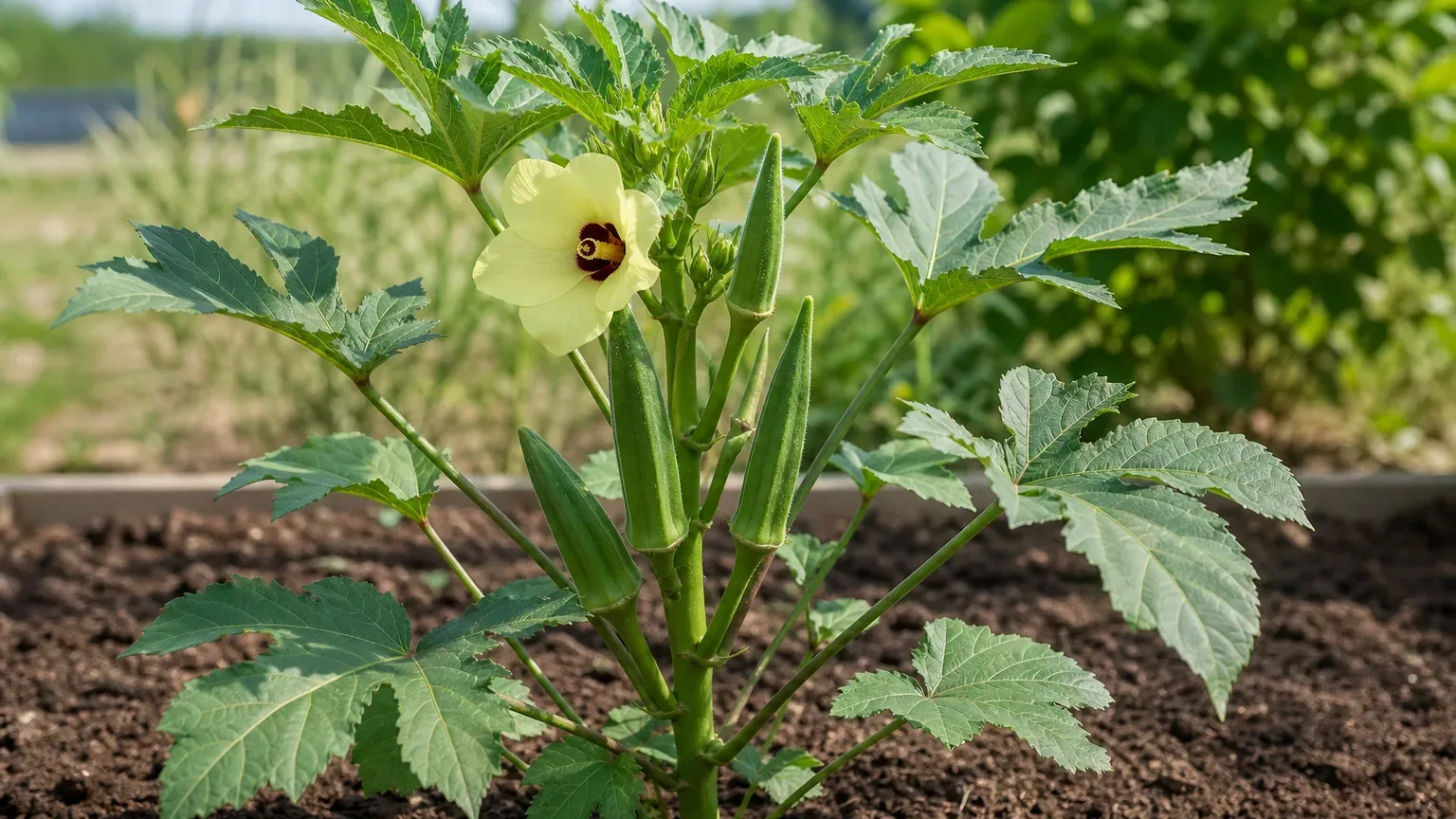
Okra is native to Tropical Africa and Asia, typically reaches About 0.9–1.8 m tall; mature height and spread vary substantially by cultivar and pruning indoors, with fast in warm soil and hot weather growth. Okra has a upright growth habit and part of the Malvaceae family. It is also known as Bhindi, Lady's Finger, and Gumbo.
| Detail | Information |
|---|---|
| Also known as | Bhindi, Lady's Finger, Gumbo |
| Native region | Tropical Africa and Asia |
| Mature size | About 0.9–1.8 m tall; mature height and spread vary substantially by cultivar and pruning |
| Growth rate | Fast in warm soil and hot weather |
| Growth habit | Upright |
| Scientific name | Abelmoschus esculentus |
| Family | Malvaceae |
Okra Care Guide: Sun, Soil, Water and Harvest
Okra, bhindi, lady’s finger and gumbo are common names for Abelmoschus esculentus, an upright member of the mallow family. Kew accepts the species name and describes it as an annual of seasonally dry tropical environments, which explains the basic rhythm of the crop: warmth starts growth, heat sustains it, and the plant is replaced after its productive season.
The care goal is not simply to keep a tall leafy plant alive. It is to build enough healthy growth to flower, keep roots evenly supplied with moisture, and remove pods while they are still young and tender. In much of India, that means a sunny bed, terrace, or open balcony is more useful than an indoor windowsill.
What kind of plant is okra?
Okra is a warm-season annual vegetable grown for immature seed pods. Its hibiscus-like flowers reveal its relationship to other mallows, while its erect habit places leaves, flowers, and pods progressively higher on a central stem and any side branches. NC State Extension lists it as an annual, an erect plant, and a seed-propagated crop.
Do not plan around one supposedly standard mature size. Extension descriptions range from roughly 0.9–1.5 m for many garden plants to much taller plants under long, hot seasons, and the University of Maryland Extension notes that some plants can reach 1.8–3 m. Cultivar, season length, spacing, soil fertility, and pruning all affect the result, so the seed packet is a better space guide than a generic height claim.
Okra care at a glance
Put okra where it receives full direct sun, and sow or transplant only when the soil is genuinely warm. Use fertile, organic-matter-rich soil that drains after irrigation, then keep the active root zone evenly moist through flowering and pod formation without allowing standing water.
Match spacing and container volume to the named cultivar. Feed according to a soil test where possible, because excessive nitrogen can produce a dramatic canopy at the expense of timely flowering and pods. Once harvest begins, inspect plants every day or two and cut tender pods before they become fibrous.
Warmth determines when okra starts growing
Okra tolerates summer heat better than cold soil. Clemson Extension gives 24–32°C as a productive temperature range and advises waiting for warm soil because cool conditions slow germination and increase seedling problems. This is why sowing too early can produce patchy emergence even when the seed itself is viable.
Treat local soil temperature and night warmth as the trigger rather than copying a calendar from another climate. If seeds sit without emerging during a cool spell, adding more water usually makes the seed zone wetter, not warmer. Wait, improve drainage if necessary, and resow when conditions support fast emergence.
Reading the season in India
India does not have one bhindi sowing month. In warm frost-free areas, more than one crop may be possible; in hot inland regions, severe dry heat can make irrigation demanding; and in monsoon climates, saturated soil and disease pressure can become the limiting factors. Choose a window that combines warm nights, useful sun, and manageable drainage rather than assuming maximum heat or maximum rain is automatically best.
For a terrace crop, remember that containers heat and dry faster than beds. In a humid rainy period, move pots where drainage holes cannot remain submerged and where foliage gets moving air. In a cool winter district, wait for a reliably warm period instead of trying to force a heat-loving annual through sluggish conditions.
Give okra full, direct sun
Okra is not an indoor foliage plant. Texas A&M AgriLife Extension states that good yields require full sunlight, fertile soil, and good drainage. Aim for at least six hours of unobstructed direct sun, with longer exposure preferable where heat and moisture can be managed.
Too little sun often appears as elongated, weaker growth, delayed flowering, and disappointing pod production rather than immediate leaf damage. A bright-looking balcony may still be too shaded if walls or buildings block direct rays for most of the day. Use the Okra light guide when placement is the main uncertainty.
Plan space around the cultivar
Read the cultivar description before planting. Compact selections can fit closer spacing and smaller gardens, while vigorous standard or long-season types need wider access for airflow and harvesting. Oklahoma State University Extension distinguishes dwarf, standard, and large types and changes both row and in-row spacing accordingly.
Spacing is not only about maximum yield per square metre. Crowded okra is harder to inspect, harder to harvest without brushing irritating foliage, and slower to dry after rain. Give yourself a path to reach every pod, especially if the crop will grow above shoulder height.
Growing okra in containers
Choose one plant per roomy container rather than several seedlings competing in a decorative pot. The RHS okra guide uses a container at least 30 cm wide and deep as a minimum; a larger, heavier pot is more forgiving for a tall cultivar because it holds moisture more steadily and resists toppling.
Use fresh potting mix with compost and coarse aeration material, and insist on open drainage holes. Place the seedling in its final container before roots become tightly circled because okra is usually raised as a seasonal crop, not repeatedly moved like a long-lived houseplant. The Okra repotting guide covers final-container timing and transplant stress in detail.
Use fertile soil that still drains freely
Okra performs well in fertile loam or sandy loam with useful organic matter, but drainage matters more than matching one exact texture. UGA Cooperative Extension describes a preference for well-drained, organic-matter-rich sandy soil and a mildly acidic pH range. Heavy soil can still work when amended thoughtfully or formed into raised beds so that irrigation and monsoon rain do not leave roots waterlogged.
For containers, do not fill pots with dense field soil. Blend quality potting mix with mature compost and a coarse drainage component, then water a test pot to confirm that excess exits promptly. Use the Okra soil guide for mix proportions, pH decisions, and fixes for slow drainage.
Keep moisture steady, not saturated
Established okra tolerates short dry periods, but drought tolerance is not the same as maximum pod production. Oklahoma State reports that supplemental irrigation supports better yield and emphasizes moisture during active summer flowering and fruiting. Water deeply when the surface starts to dry, then allow excess water to drain rather than giving shallow daily splashes.
In beds, mulch after the soil has warmed to reduce evaporation and soil splash. In pots, check with a finger below the surface and learn the lifted weight of a recently watered container; hot wind can shorten the interval sharply. The Okra watering guide gives the full decision process for heat, rain, beds, and containers.
Yellow lower leaves with persistently wet soil, stalled growth, or soft failing roots point toward excess moisture, not thirst. Wilting during the hottest hour can be temporary, but wilt that remains into evening with dry soil calls for a deep watering. Always check the root zone before reacting to the leaves.
Feed for pods rather than excess leaves
Compost and a soil-test-based fertilizer plan support steady growth, but more nitrogen is not automatically better. Clemson notes that excessive early nitrogen drives leafy growth instead of pods, while Oklahoma State warns that high nitrogen can delay flowering and fruit set. A large dark-green plant with few flowers may therefore need restraint, not another feed.
Mix mature compost into poor soil before planting and follow local soil-test recommendations for mineral fertilizer. In containers, use a labelled vegetable fertilizer at the stated rate rather than improvising concentrated doses. The Okra fertilizer guide explains timing, nutrient symptoms, and why feeding cannot correct shade or waterlogging.
Flowers, pods and the harvest rhythm
Each showy flower is followed quickly by a pod when pollination and growing conditions are suitable. Texas A&M notes that pods may be ready only three to four days after flowering and recommends picking every one to two days during strong production. This fast change is why an acceptable pod can become woody before the next weekend garden visit.
Use clean shears or a sharp knife to cut pods without tearing the stem. Frequent picking also removes overmature pods that would otherwise keep developing seed; Oklahoma State advises removing old pods because leaving them can reduce further flowering and fruiting. Harvesting is therefore part of crop care, not merely the reward at the end.
Test tenderness instead of trusting one pod length
Many guides recommend harvesting around 5–10 cm, but those figures describe common cultivars rather than a biological law. Clemson notes that round-podded varieties can remain tender at larger sizes, and Oklahoma State similarly recognizes long-podded types that stay usable beyond the standard market length. Pod colour also varies naturally among green, red, burgundy, pinkish, and pale cultivars.
Learn your own variety by cutting one developing pod every day or two. A tender pod slices easily with little resistance; a fibrous pod feels tougher and contains more developed seed. Use the seed description, days after flowering, and this knife test together instead of waiting for one universal length.
Common okra care mistakes
The first mistake is sowing into cool, wet soil, which delays emergence and exposes seedlings to rot. The second is accepting partial shade because the plant remains green; pod yield can stay poor even when foliage survives. The third is crowding several plants into one small pot without considering cultivar height or root volume.
Watering errors occur at both extremes. Repeated shallow sprinkling encourages a small surface root zone, while saturated soil restricts root health. Feeding heavily to “speed up” a shaded or waterlogged plant adds another stress and may further favour leaves over flowers.
The most visible harvest mistake is waiting for pods to look large and impressive. Mature pods may be useful for saved seed, but they are generally less tender for the kitchen. If you miss a picking, remove the tough pod and resume frequent checks rather than leaving it on the plant.
Skin irritation and pet caution
Okra stems, leaves, and pods can carry fine hairs that irritate sensitive skin. Mississippi State University Extension recommends long sleeves during harvest, and NC State also identifies the pod hairs as a contact irritant. Gloves, sleeves, and clean shears make repeated picking more comfortable.
The pods, flowers, and leaves are described as edible for people, but that does not establish the living plant as safe forage for every pet species. Keep pets away from the crop and any pesticide-treated material, and ask a veterinarian about significant ingestion or symptoms. Avoid calling okra universally “pet-safe” when species-specific veterinary evidence is absent.
When to use this page vs other Okra guides
Use this overview to decide whether your site, season, space, and harvest routine suit okra. For one care variable, move to the Okra light guide, Okra watering guide, or Okra soil guide instead of trying to diagnose every symptom from a general summary.
Use the Okra propagation guide for seed preparation and sowing, the Okra repotting guide for moving seedlings into a final container, and the Okra pruning guide for cultivar-aware cutting or late-season rejuvenation. Each guide narrows the decision to one job.
Related Okra guides
- Okra light — choose a site with enough direct sun for flowering and pods.
- Okra watering — adjust moisture checks for heat, rain, beds, and pots.
- Okra soil — build a fertile root zone that drains freely.
- Okra fertilizer — feed without pushing excessive leafy growth.
- Okra propagation — sow seed in warm conditions and manage seedlings.
- Okra repotting — move a young plant into its final container.
- Okra pruning — decide when cutting is useful and when it is not.
Conclusion
Successful okra care follows the plant’s warm-season rhythm. Give bhindi direct sun, warm soil, fertile but free-draining ground, and steady moisture during flowering and pod set. Match spacing and container size to the cultivar rather than an average plant, and keep nitrogen proportionate to actual need.
The harvest routine matters as much as the planting routine. Check flowering plants every day or two, cut pods while your cultivar is still tender, and remove overmature pods promptly. When warmth, sun, root-zone moisture, and young-pod harvest line up, Abelmoschus esculentus is a fast, productive seasonal crop rather than an oversized leafy plant with tough pods.
How to care for Okra?
When should you water Okra?
Keep the root zone evenly moist but not saturated, especially while plants are flowering and forming pods. Water deeply when the soil surface begins to dry, directing water to the soil rather than routinely wetting the leaves.
- Feel the soil near the root zone - Keep the root zone evenly moist but not saturated, especially while plants are flowering and forming pods.
- water deeply if the surface is drying while the soil below is no longer evenly moist - Water deeply when the soil surface begins to dry, directing water to the soil rather than routinely wetting the leaves.
- Drain excess water - Water deeply when the soil surface begins to dry, directing water to the soil rather than routinely wetting the leaves.
What soil works best for Okra?
Fertile, organic-matter-rich soil that holds useful moisture while draining freely. Okra tolerates a broad near-neutral range, approximately pH 6.0–8.0.
- 50% high-quality potting mix or loam - Fertile, organic-matter-rich soil that holds useful moisture while draining freely.
- 30% mature compost
- 20% perlite, pumice, or other coarse aeration material - Fertile, organic-matter-rich soil that holds useful moisture while draining freely.
Grower notes for Okra
Match the space to the cultivar
Okra is an upright, warm-season crop, but it does not have one fixed mature size. Many cultivars finish around 0.9–1.8 m tall, while cultivar, climate, spacing, and pruning can produce shorter or much taller plants. Check the seed packet before choosing a container or position, and place tall plants where they will not shade smaller vegetables.
Give bhindi real sun and heat
Choose an outdoor position with at least 6 hours of direct sun. Okra grows strongly once the soil and nights are warm, but cold soil slows germination and growth. Sow or transplant after frost risk has passed; this heat-tolerant crop is far better suited to a sunny terrace or vegetable bed than a decorative indoor position.
Keep moisture steady for pods
Established okra can tolerate some drought, but plants are generally more productive when the root zone remains evenly moist. Water deeply as the surface begins to dry and use mulch in beds to limit rapid swings. Avoid standing water: poorly drained soil can damage roots even though the leafy top may initially look vigorous.
Harvest pods young and often
The edible crop is the immature seed pod. Pick while pods are still tender, using the cultivar description and a simple bend or knife test rather than relying on one universal length. Once flowering starts, check plants frequently because pods mature quickly; regular picking also keeps the harvest focused on tender pods instead of fibrous, overmature ones.
Protect skin while picking
Fine hairs on okra stems, leaves, and pods can irritate sensitive skin. Wear gloves and long sleeves if handling causes itching, and use clean shears rather than pulling hard on fibrous stems. Pod color is not always a ripeness warning—green, red, and burgundy cultivars exist—so learn the expected appearance of the variety you planted.
Treat it as a seasonal crop
Okra is normally grown as an annual vegetable. Move a seedling into its final bed or roomy container before it becomes badly root-bound, then replace the plant after production declines rather than planning repeated houseplant-style repotting. In long hot seasons, a later sowing can be more practical than trying to keep an oversized old plant productive.
Is okra safe for pets?
Okra pods, leaves, and flowers are edible for people, but that does not establish the whole plant as safe forage for every pet species. Prevent routine chewing and ask a veterinarian about significant ingestion.
Authoritative horticultural sources describe okra's fruits, flowers, and leaves as edible for people and note that its fine plant hairs may irritate skin. Species-specific veterinary safety was not verified, so do not present the living plant as pet-safe forage.
Watering Okra
For Okra, feel the soil near the root zone; water deeply if the surface is drying while the soil below is no longer evenly moist and water check frequently in hot weather and water when the soil surface begins to dry. Increase watering during hot, dry weather and active pod production; reduce during rainy or cooler periods.
| Detail | Information |
|---|---|
| How often | Check frequently in hot weather and water when the soil surface begins to dry |
| How to check | Feel the soil near the root zone; water deeply if the surface is drying while the soil below is no longer evenly moist |
| Seasonal changes | Increase watering during hot, dry weather and active pod production; reduce during rainy or cooler periods |
Signs of overwatering
- persistently saturated soil
- yellowing lower leaves
- soft, dark, or failing roots
Signs of underwatering
- wilting that does not recover after the hottest part of the day
- dry soil pulling from the container edge
- flower or young pod drop during prolonged drought
Soil & potting for Okra
Use a mix of 50% high-quality potting mix or loam, 30% mature compost, 20% perlite, pumice, or other coarse aeration material for Okra. Moist but well drained; prolonged saturation can encourage root rot. Target soil pH around 6.0–8.0. Repot usually transplanted once into its final bed or a large container and replaced after the crop, ideally in warm season, after frost risk has passed and soil has warmed.
| Detail | Information |
|---|---|
| Recommended mix | 50% high-quality potting mix or loam, 30% mature compost, 20% perlite, pumice, or other coarse aeration material |
| Drainage | Moist but well drained; prolonged saturation can encourage root rot |
| Soil pH | 6.0–8.0 |
| Repotting frequency | Usually transplanted once into its final bed or a large container and replaced after the crop |
| Best season to repot | Warm season, after frost risk has passed and soil has warmed |
Signs it needs repotting
- seedling roots circle the nursery cell
- growth stalls in a small container
- the plant dries severely between waterings
Humidity & temperature for Okra
Fertilizer & pruning for Okra
Common problems on Okra
Yellow Leaves
MediumLikely cause: Common on this plant type; confirm with recent watering, light, and root checks.
Quick fix: Inspect the plant and correct the most likely care stressor before stacking treatments.
Full fix guide →Brown Tips
MediumLikely cause: Common on this plant type; confirm with recent watering, light, and root checks.
Quick fix: Inspect the plant and correct the most likely care stressor before stacking treatments.
Full fix guide →Root Rot
MediumLikely cause: Common on this plant type; confirm with recent watering, light, and root checks.
Quick fix: Inspect the plant and correct the most likely care stressor before stacking treatments.
Full fix guide →Overwatering
MediumLikely cause: Common on this plant type; confirm with recent watering, light, and root checks.
Quick fix: Inspect the plant and correct the most likely care stressor before stacking treatments.
Full fix guide →Underwatering
MediumLikely cause: Common on this plant type; confirm with recent watering, light, and root checks.
Quick fix: Inspect the plant and correct the most likely care stressor before stacking treatments.
Full fix guide →Spider Mites
MediumLikely cause: Common on this plant type; confirm with recent watering, light, and root checks.
Quick fix: Inspect the plant and correct the most likely care stressor before stacking treatments.
Full fix guide →Mealybugs
MediumLikely cause: Common on this plant type; confirm with recent watering, light, and root checks.
Quick fix: Inspect the plant and correct the most likely care stressor before stacking treatments.
Full fix guide →Aphids
MediumLikely cause: Common on this plant type; confirm with recent watering, light, and root checks.
Quick fix: Inspect the plant and correct the most likely care stressor before stacking treatments.
Full fix guide →Leggy Growth
MediumLikely cause: Common on this plant type; confirm with recent watering, light, and root checks.
Quick fix: Inspect the plant and correct the most likely care stressor before stacking treatments.
Full fix guide →Slow Growth
MediumLikely cause: Common on this plant type; confirm with recent watering, light, and root checks.
Quick fix: Inspect the plant and correct the most likely care stressor before stacking treatments.
Full fix guide →Wilting
MediumLikely cause: Common on this plant type; confirm with recent watering, light, and root checks.
Quick fix: Inspect the plant and correct the most likely care stressor before stacking treatments.
Full fix guide →Drooping Leaves
MediumLikely cause: Common on this plant type; confirm with recent watering, light, and root checks.
Quick fix: Inspect the plant and correct the most likely care stressor before stacking treatments.
Full fix guide →Low Humidity
MediumLikely cause: Common on this plant type; confirm with recent watering, light, and root checks.
Quick fix: Inspect the plant and correct the most likely care stressor before stacking treatments.
Full fix guide →Not Enough Light
MediumLikely cause: Common on this plant type; confirm with recent watering, light, and root checks.
Quick fix: Inspect the plant and correct the most likely care stressor before stacking treatments.
Full fix guide →Fungus Gnats
MediumLikely cause: Common on this plant type; confirm with recent watering, light, and root checks.
Quick fix: Inspect the plant and correct the most likely care stressor before stacking treatments.
Full fix guide →Mold on Soil
MediumLikely cause: Common on this plant type; confirm with recent watering, light, and root checks.
Quick fix: Inspect the plant and correct the most likely care stressor before stacking treatments.
Full fix guide →