Low Humidity on Okra: Causes, Checks & Fixes
Quick answer
Low humidity and high vapor pressure deficit (VPD) on okra cause rapid foliar transpiration that outpaces root water uptake, leading to upward leaf cupping, scorched margins, and the abortion of delicate flowers and young pods. While okra is remarkably heat-tolerant, sustained relative humidity below 35% combined with dry winds strips moisture faster than the taproot can replenish it. First step: erect a temporary windbreak to buffer arid airflow and spread a 3-inch layer of organic mulch around the root zone before increasing watering volume.
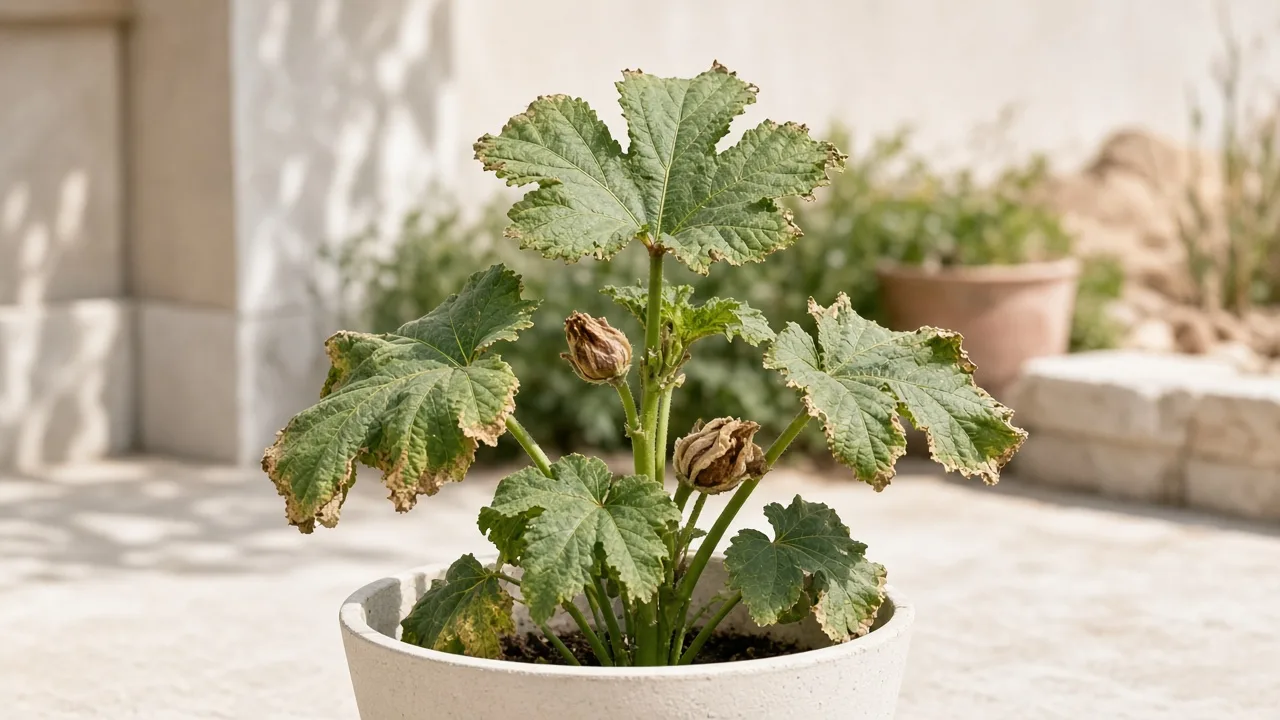
Low Humidity on Okra: Causes, Checks & Fixes
This guide covers low humidity on Okra. See also the general Low Humidity guide, watering, and light pages for this plant.
Low Humidity on Okra: Causes, Checks & Fixes
Quick answer
Okra (Abelmoschus esculentus) is celebrated for its remarkable tolerance to blistering summer heat, but growers often mistake heat tolerance for aridity tolerance. Okra evolved in seasonally warm, humid tropical zones. When relative humidity (RH) plummets below 35%—especially in arid continental climates, during windy desert heatwaves, or on breezy urban terraces—the plant suffers severe atmospheric drought.
For how low ambient moisture impairs leaf transpiration across garden crops in general, consult our low humidity hub. On okra specifically, intense vapor pressure deficit (VPD) drives transpiration rates far beyond what the taproot and xylem vessels can supply. The signature response is upward leaf curling, scorched papery margins, premature flower bud abortion, and small pod drop.
First step: establish an immediate windbreak on the windward side and blanket the root zone with 3 to 4 inches of organic mulch. Shielding okra from dry, moving air and insulating soil moisture halts acute transpiration spikes far more effectively than flooding an already damp root zone.
When to use this page vs other Okra guides
Atmospheric drought symptoms on okra frequently mimic other environmental stressors. Use this diagnostic routing table to verify your symptoms before applying corrections:
| Symptom Pattern | Primary Cause | Guide to Read |
|---|---|---|
| Upward curled leaf margins, papery tan edges, blossom drop during dry winds; root zone remains damp | High VPD / Atmospheric aridity | This guide |
| Whole plant wilting, dull gray-green limp foliage, bone-dry soil 3 inches down | Root-zone drought | Underwatering |
| Yellowing lower leaves, soft stems, sluggish growth in waterlogged, poorly drained soil | Oxygen deprivation / Root hypoxia | Overwatering or Soil Guide |
| Stippled yellow speckles, dusty webbing on leaf undersides during hot, dry spells | Mite infestation | Spider Mites |
| Crisp brown tips on lower foliage only, white crust on soil surface | Salt build-up / Fertilizer burn | Brown Tips |
| Sudden whole-plant collapse during hot midday despite wet soil, dark vascular discoloration | Fungal vascular wilt (Fusarium / Verticillium) | Wilting |
If your plant displays localized marginal scorch and flower abortion specifically during hot, arid, or windy conditions while root moisture is adequate, proceed with the low-humidity protocol below.
What low humidity looks like on Okra
Low humidity stress on okra is not a slow, mysterious fade; it manifests as distinct structural and reproductive failures.
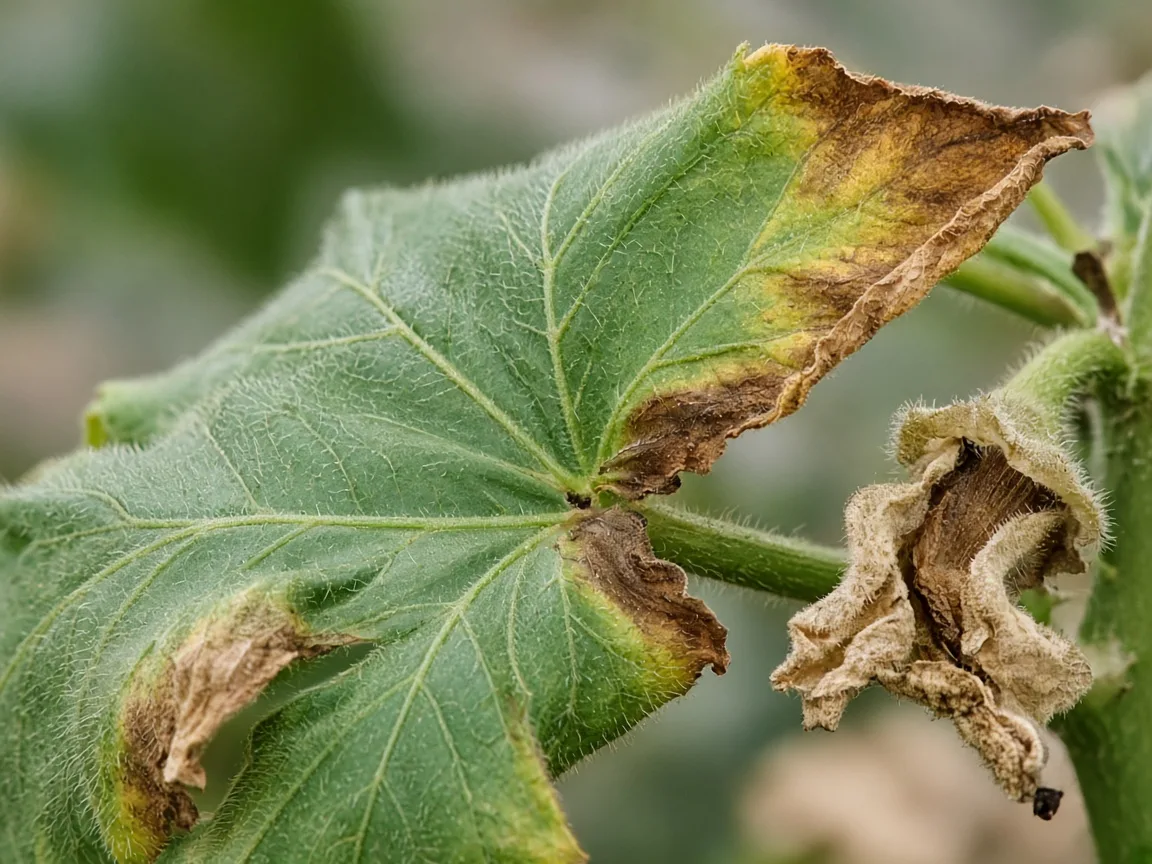
Low humidity damage on okra—intense atmospheric vapor pressure deficit causes upward curling, marginal leaf scorch, and aborted blossom buds.
Foliar symptoms
- Upward leaf curling (troughing): Okra’s broad, palmately lobed leaves curl their outer lobes upward toward the sky. This physiological defense minimizes leaf surface area directly exposed to desiccating wind and solar radiation.
- Marginal scorch and papery texture: The outermost margins and lobe serrations lose turgor first, drying into brittle, tan or straw-colored borders that crack when touched.
- Midday flagging: Leaves lose structural rigidity and droop noticeably between 11:00 AM and 3:00 PM, even when the potting mix or garden soil has ample moisture.
- Dull, thickened leaf blades: In sustained arid conditions, newly emerging foliage remains smaller, leathery, and dark green, often displaying puckered interveinal tissue.
Reproductive symptoms
- Blossom bud abortion: Unopened floral buds turn yellowish-brown at the base of the calyx, wither, and snap off at the pedicel before ever unfurling their yellow petals.
- Pollination failure and flower drop: Open blooms wilt within hours rather than lasting the full morning. Stigmas dry out before viable pollen tube growth occurs, causing the unfertilized flower to drop cleanly from the stalk.
- Pencil-pod shriveling: Immature pods that set immediately following bloom stop elongating at 1 to 2 inches, yellow, turn tough and fibrous, and drop off prematurely.
Malvaceae transpiration dynamics: high VPD vs taproot uptake
Understanding okra’s response to dry air requires examining its botanical physiology. NC State Extension notes that okra belongs to the Malvaceae family alongside cotton and hibiscus—plants characterized by expansive foliage, high stomatal densities, and rapid vegetative transpiration rates.
In balanced conditions (temperatures between 75°F and 90°F / 24°C–32°C and RH between 45% and 65%), the vapor pressure deficit between the internal spongy mesophyll of the leaf and the outdoor air creates a steady transpirational pull. This pull lifts water and dissolved nutrients from the deep central taproot up through the woody stem to the growing tip.
When air temperatures exceed 90°F (32°C) and relative humidity plummets below 30%, VPD exceeds 2.0 to 2.5 kPa. At this threshold, the atmosphere functions like a powerful physical sponge, sucking water vapor out through open stomata faster than root xylem can transport it upward. Even if the soil contains sufficient moisture, the plant’s vascular plumbing faces a hydraulic bottleneck.
To prevent catastrophic cavitation (air bubbles forming in the xylem), the okra plant initiates emergency stomatal closure. While this conserves cellular moisture, it stops the evaporative cooling process, causing leaf tissue temperatures to spike 5°F to 10°F above ambient air temperatures. The resulting cellular desiccation scorches the thinnest tissue—the leaf margins—turning them permanently crisp and tan.
Blossom and small pod abortion: the one-morning pollination trap
The reproductive cycle of okra is exceptionally vulnerable to atmospheric aridity. Okra flowers are ephemeral: each blossom opens at sunrise and remains receptive for only a single morning before closing by mid-afternoon.
For successful fertilization and pod set:
- The large showy bloom must maintain high cellular turgor to present its columnar reproductive organs.
- The five-lobed stigma must remain coated in a sticky, moist exudate to capture pollen grains deposited by foraging bees or gravity.
- Transferred pollen grains must hydrate and germinate, growing pollen tubes down the style into the ovary within a matter of hours.
When hot, dry air sweeps over the canopy, the delicate stigmatic fluid desiccates within minutes of the petals opening. Dry pollen grains fail to germinate. Under severe VPD stress, the plant releases ethylene and abscisic acid (ABA), creating an abscission layer at the base of the flower pedicel. Texas A&M AgriLife Extension reports that moisture stress during flowering causes bloom drop, stripping the plant of its upcoming harvest. Even pods that manage partial fertilization often abort shortly after petal drop or develop into crooked, woody nubs that are unpalatable.
Arid wind and balcony heat exposure: microclimate drivers
While field-grown okra can partially buffer ambient humidity through a dense canopy, containerized and terrace-grown okra experiences acute environmental aridity:
- The terrace thermal heat sink: Urban concrete balconies, masonry walls, and dark terrace tiles absorb radiant heat, releasing it as superheated dry thermal drafts. Relative humidity on an exposed balcony can easily sit 15% lower than garden-level humidity.
- Wind shear desiccation: Unobstructed wind strips away the boundary layer of moist air that naturally clings to leaf surfaces. Without this boundary layer, foliar transpiration accelerates uncontrollably.
- Container root temperature spikes: In containers under 10 gallons, arid heat bakes the pot walls, elevating root-zone temperatures above 95°F (35°C). At these temperatures, root hair respiration slows, further crippling the plant’s ability to take up water while the canopy transpires at maximum capacity.
Review your setup using our light guide and soil guide to ensure your container volume and positioning do not amplify atmospheric stress.
How to confirm low humidity on Okra
Do not assume dry air is the problem based solely on curled leaves. Perform this sequence of checks to confirm atmospheric aridity:
- The 3-inch soil core test: Push a wooden dowel or your finger 3 inches into the soil near the base. If the soil feels cool, dark, and damp while the foliage is curling upward and flagging, the problem is transpirational deficit (high VPD), not a dry root zone.
- The diurnal recovery check: Inspect the plant at 7:00 AM. If leaves that drooped and curled on yesterday’s hot afternoon are upright, turgid, and flat in the morning air, the issue is midday atmospheric stress rather than root disease or systemic drought.
- Inspect the blossom pedicel: Look closely at aborted flowers. A clean snap at the joint without fungal fuzz, bacterial slime, or insect chewing indicates physiological abortion driven by dry air and heat.
- Underside foliage inspection: Use a 10x hand lens on the undersides of curled leaves to rule out pests. Spider mites flourish in the identical hot, dry microclimates that trigger low humidity stress. Look for fine silk webbing and yellow speckling before proceeding.
First fix for Okra
Erect a temporary windbreak on the prevailing windward side and apply a 3-inch blanket of organic mulch over the root zone.
Do not begin by flooding the container or garden bed with extra water if the soil is already moist. Saturating an already damp root zone suffocates the taproot, turning transpirational stress into lethal root rot.
Immediate action steps
- Position a physical barrier: Place a panel of 30% to 40% agricultural shade cloth, burlap fabric, or a temporary trellis on the side facing drying winds. This slows moving air, preserving the boundary layer of moisture around the foliage.
- Apply organic mulch: Spread 3 to 4 inches of clean wheat straw, shredded hardwood bark, or chemical-free grass clippings over the soil surface, keeping mulch 2 inches away from the main woody stem. Mulch suppresses surface evaporation and keeps root temperatures cool.
- Cluster companion pots: If growing in containers on a terrace or patio, push pots together so their overlapping canopies form a collective humid microclimate.
Step-by-step environmental recovery
Once the immediate windbreak and mulch blanket are installed, implement this cultural recovery routine over the next two weeks:
1. Shift to deep early-morning drip irrigation
Watering must align with the plant’s transpirational cycle. Apply water between 5:30 AM and 7:30 AM directly at the soil line. University of Georgia Cooperative Extension recommends drip irrigation to deliver water evenly beneath mulch while keeping the plant canopy completely dry. Early morning irrigation charges the plant’s tissues and surrounding soil with maximum turgor before peak midday heat arrives. Oklahoma State University Extension emphasizes maintaining consistent root zone moisture through regular watering during summer production—providing roughly 1.5 inches of water every 10 days to sustain flower and pod development.
2. Shield container root systems
If growing in containers, insulate the root ball from thermal aridity:
- Slip the primary container inside a larger decorative pot (double-potting) with an air gap or packing straw between the walls.
- Wrap plastic or terracotta containers in burlap or reflective shade foil to deflect intense radiant heat.
- Elevate pots on pot feet to prevent direct conductive heat transfer from scorching terrace tiles.
3. Deploy canopy shade during peak heat spikes
If ambient temperatures exceed 95°F (35°C) alongside relative humidity below 25%, rig temporary 30% shade cloth 2 to 3 feet above the canopy. Diffusing midday sunlight lowers canopy leaf temperatures by 5°F to 8°F, drastically lowering the transpirational demand and preventing flower bud abscission.
4. Provide sacrificial windward plantings
For in-ground garden plots in windy arid plains, plant a windbreak row of tall, drought-hardy companion plants—such as sunflowers, pearl millet, or grain sorghum—on the south or west border. These living green screens absorb the brunt of drying winds and release localized transpiration moisture upwind of your okra patch.
Recovery timeline
Recovery on okra is swift once atmospheric transpiration stress is brought under control:
- Days 1–3: Midday foliar flagging ceases. Leaves remain turgid and upright through the afternoon behind the windbreak.
- Days 4–7: Existing scorched leaf margins remain permanently brown and dry, but curling relaxes on mature leaves. Fresh, supple foliage begins expanding from the apical tip without cup-shaped distortion.
- Days 8–14: Flower buds hold firmly on their pedicels without yellowing. Newly opened blossoms set pods successfully, and young green pods elongate rapidly at normal rates (1/2 to 1 inch per day in warm weather).
Judge recovery by the persistence of unopened blossom buds and the elongation of young pods, not by whether old scorched leaf margins heal.
What not to do
- Do not mist foliage with overhead sprayers at midday: Spraying water on leaves under blazing sun causes rapid droplet evaporation that fails to elevate ambient RH. It can cause thermal leaf scald, deposits mineral crusts on foliage, and encourages fungal leaf spot if foliage remains damp into the evening.
- Do not overwater saturated soil: Adding water to an already wet root zone because leaves are curled deprives roots of oxygen. Check the watering guide before adding water.
- Do not apply high-nitrogen fertilizers: Never fertilize an okra plant suffering from heat or aridity stress. High-nitrogen feeds stimulate tender, succulent vegetative growth with thin cuticles that lose water even faster and exacerbate flower drop.
- Do not strip every scorched leaf: Mature leaves with crispy edges still retain active chlorophyll in their green central blades. Leave them intact to fuel pod development unless they turn fully yellow or brown.
- Do not prune the main stem: Okra bears flowers and pods progressively higher along its central stalk. Pruning the leader halts pod production for weeks.
How to prevent low humidity stress next season
Preventing atmospheric drought on okra requires planning for microclimate moderation before summer heat peaks:
- Plant in wind-protected garden bays: Position your okra patch where fences, hedgerows, or outbuildings buffer prevailing summer winds, while preserving full sun exposure (at least 6 to 8 hours of direct light).
- Incorporate ample organic matter: Amend garden soil with 2 to 3 inches of compost prior to planting. High organic matter content increases soil water retention capacity without compromising drainage.
- Mulch early: Lay down organic straw mulch when seedlings reach 6 inches tall, before summer heat bakes the bare ground.
- Choose compact, stocky cultivars for terraces: Varieties like ‘Baby Bubba’, ‘Dwarf Green Long Pod’, or ‘Little Lucy’ feature shorter internodes and compact canopies that are easier to shelter from wind on exposed balconies than 8-foot heritage types. Royal Horticultural Society guidelines advise shielding plants from drying drafts to maintain the warmth and steady atmospheric moisture needed for reliable cropping.
Related Okra guides
Strengthen your overall growing strategy by reviewing our comprehensive species guides:
- Okra Care Overview — Complete cultural requirements, seasonal planting schedules, and harvest practices.
- Okra Watering Guide — Moisture balancing, root depth management, and irrigation techniques.
- Okra Light Requirements — Full sun needs, canopy orientation, and heatwave protection.
- Okra Soil & Mix Guide — Soil drainage, pH optimization, and organic matter management.
- Okra Problems Hub — Diagnostic directory for pest identification, disease control, and physiological disorders.
Related tool
Use our Humidity Calculator to compute local vapor pressure deficit (VPD) based on your current temperature and relative humidity readings before making major adjustments to your growing environment.