Drooping Leaves on Okra: Midday Wilt vs Root Checks
Quick answer
Drooping leaves on okra typically stem from one of three distinct causes: temporary midday heat wilt, severe taproot dehydration, or waterlogged soil suffocating roots. Check the plant at dusk: if leaves recover without irrigation, intense transpiration caused temporary midday wilt. If leaves remain limp and the top 3–4 inches of soil are parched, deliver a deep ground-level soak. If leaves droop in waterlogged, dense soil with yellowing lower foliage, cease watering immediately and inspect for root rot.
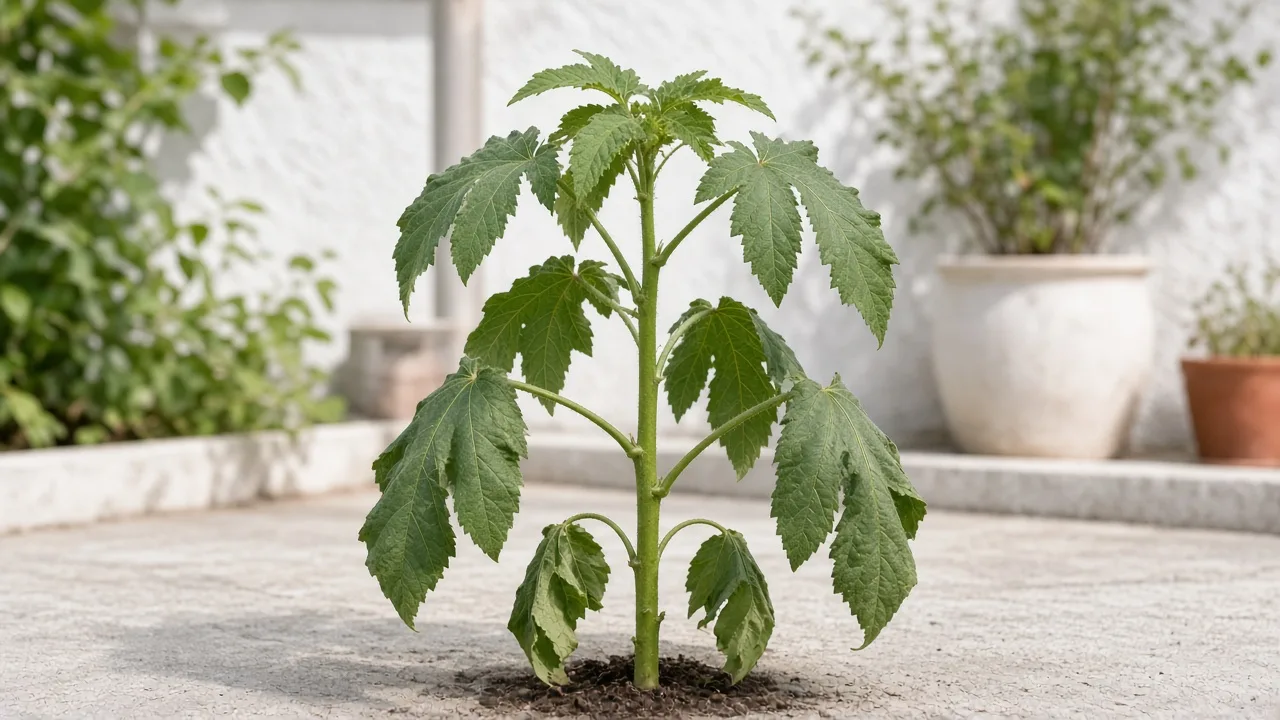
Drooping Leaves on Okra: Causes, Checks & Fixes
This guide covers drooping leaves on Okra. See also the general Drooping Leaves guide, watering, and light pages for this plant.
Drooping Leaves on Okra: Causes, Checks & Fixes
Quick answer
Picture a sunny afternoon in midsummer: your tall okra (Abelmoschus esculentus) has large, hand-shaped leaves hanging limp from their leaf stems. Before rushing out with a garden hose, pause and check the time. Okra possesses broad, lobed foliage with high surface area that transpires water rapidly under intense afternoon sunlight. When solar radiation peaks between noon and 3:00 PM, leaf moisture loss frequently outpaces root uptake, causing temporary physiological wilt even when soil moisture is completely adequate. If those same leaves straighten and regain firm turgor by dusk as the sun dips, your okra is simply managing heat load, and adding water will do more harm than good.
True distress occurs when drooping persists through the evening into early morning, or when leaves sag in soil that is already wet and muddy. Persistent morning limpness paired with dusty, parched soil indicates deep drought stress where the plant’s taproot has run out of moisture reserves. Conversely, limp leaves accompanied by saturated soil, yellowing lower foliage, or a sour smell indicate root suffocation and root rot. For general principles of plant hydration dynamics, see our drooping leaves guide. On okra, diagnosing drooping leaves requires observing dusk leaf recovery, testing moisture depth around the taproot, and evaluating irrigation delivery.
First step: Inspect the foliage at dusk or early morning. If leaves have naturally recovered their posture, do not irrigate. If leaves remain limp, probe the soil 3 to 4 inches deep to separate dehydration from root-zone saturation before taking corrective action.
When to use this page vs other Okra guides
Okra exhibits distinct leaf and stem responses depending on the underlying stressor. Use this diagnostic routing table to ensure you are treating the correct issue:
| Observed symptom pattern on Okra | Recommended guide |
|---|---|
| Broad leaves droop during hot afternoons but perk up by nightfall | Stay on this page (Physiological midday wilt) |
| Leaves remain limp day and night; soil is dry 3+ inches deep | Underwatering or follow drought recovery here |
| Leaves droop over saturated, boggy soil with yellowing lower leaves | Root rot or Overwatering |
| Sudden, irreversible daytime collapse of one side or whole plant with vascular stem browning | Wilting (Suspect Fusarium or Verticillium wilt) |
| Whole plant shows pale yellow foliage across all leaves without limpness | Yellow leaves |
| Complete care, spacing, and seasonal harvesting overview | Okra overview |
| Full index of okra diseases, pests, and cultural problems | Okra problems hub |
What drooping leaves look like on Okra
Healthy okra leaves are broad, palmately lobed with 5 to 7 distinct segments, held horizontally or tilted slightly upward on rigid, fibrous petioles that emerge from a sturdy central stalk. When turgor pressure drops, the change is immediately noticeable:
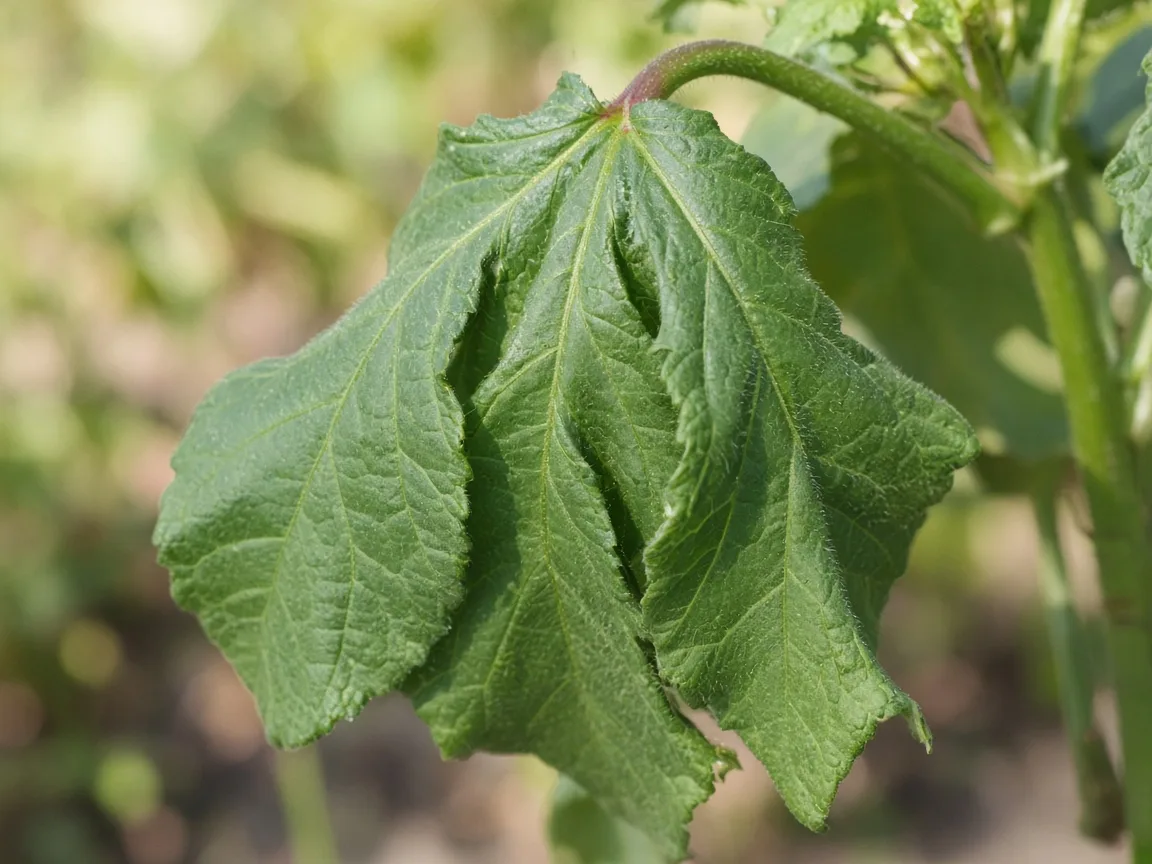
An okra leaf petiole sagging downward with limp lobes—observing whether foliage recovers by dusk distinguishes normal transpiration stress from true root-zone failure.
The loss of cellular pressure creates specific visual patterns across the plant:
- Petiole sag: The thick leaf stems bend downward at the node where they attach to the main trunk, causing entire leaf blades to droop vertically against the stalk.
- Lobe curling and cupping: The margins of individual leaf lobes curl slightly inward or roll downward as the leaf lamina loses internal moisture pressure.
- Softened, leathery texture: Instead of feeling crisp and rough with bristly hairs, the foliage feels limp, thin, and pliable to the touch.
- Top canopy vs lower canopy droop: In temporary midday heat stress, the newest, most exposed upper leaves show the most pronounced droop because they receive maximum direct solar irradiance. In chronic root failure or overwatering, the lowest, oldest leaves droop and turn chlorotic first before upper foliage collapses.
Observing the progression of the sag over a 12-hour cycle provides the definitive clue. A plant that wilts at 1:00 PM and stands rigid at 7:00 PM is coping with atmospheric heat; a plant that hangs limp at 7:00 AM is suffering from root-zone dysfunction.
Midday heat wilt vs persistent dehydration vs waterlogged soil
To resolve drooping leaves on okra effectively, you must understand the three distinct biological mechanisms that produce this symptom:
1. Midday temporary physiological wilt (normal heat response)
Okra is an exceptionally heat-tolerant, warm-season vegetable that thrives in daytime temperatures between 85°F and 95°F (29°C to 35°C). However, under intense direct sunlight, hot dry winds, or low relative humidity, the transpiration rate through its large leaves exceeds the maximum rate at which roots can extract and transport water up the vascular xylem. Stomatal conductance slows as guard cells lose turgor. This causes the leaves to sag temporarily. This drooping is actually protective: sagging leaves present less surface area perpendicular to the sun’s rays, reducing leaf temperature and slowing further moisture loss. As ambient temperatures drop in late afternoon and solar radiation wanes, water uptake catches up, refilling cellular vacuoles and restoring normal leaf posture by sunset.
2. Persistent dehydration (true drought stress)
When the soil lacks adequate moisture throughout the root zone, the plant cannot rehydrate even after the sun sets. The foliage remains limp, dull green or grayish, and may develop dry, papery edges if moisture is withheld for multiple days. The plant will begin dropping open blossoms and aborting small pods to conserve water. If left uncorrected, lower leaves turn brown and drop prematurely, and vegetative growth completely stalls.
3. Waterlogged soil and root rot (oxygen deprivation)
Roots require oxygen from soil pore spaces to generate the ATP necessary for active water and nutrient uptake. When soil remains saturated from overwatering, poor drainage, or heavy summer cloudbursts on compacted ground, roots drown in an anaerobic environment. As North Carolina State Extension highlights, poorly drained soil can lead to root rot on okra. Opportunistic soilborne water molds and fungi attack the suffocated feeder roots, causing them to decay into dark, mushy tissue. Because damaged roots cannot pump water upward, the leafy top canopy wilts and droops despite standing in wet soil—a confusing symptom that leads many inexperienced gardeners to add even more water, accelerating plant death.
Taproot water uptake dynamics in full summer heat
Okra does not possess the shallow, fibrous root ball typical of leafy greens or brassicas. Instead, Abelmoschus esculentus develops a commanding primary taproot that can bore 2 to 4 feet deep into the subsoil, accompanied by a network of lateral secondary roots concentrated in the top 8 to 12 inches of soil.
This deep rooting habit has profound implications for watering:
- The surface-sprinkling trap: Daily light sprinkling with a hose or oscillating sprinkler wets only the top half-inch of soil. Under summer sun, that surface moisture evaporates within an hour. The deep taproot down in the subsoil remains completely parched, leaving the plant chronically dehydrated despite daily watering.
- Root distribution and heat protection: While shallow lateral roots absorb surface nutrients, the deep taproot anchors the plant against wind and extracts moisture from deeper, cooler subsoil layers. Studies compiled in PubMed Central confirm that okra adapts stomatal conductance and root architecture to withstand seasonal heat and water deficits, relying heavily on deep root penetration.
- Container limitations: If growing okra in containers or raised beds with shallow soil depth, the taproot quickly hits the container bottom and circles. In pots smaller than 5 gallons (12 to 14 inches deep), the restricted root volume cannot hold enough moisture to support a mature, 5-foot fruiting plant on a 90°F day, leading to severe daily wilting.
Understanding this architecture makes the solution clear: irrigation must reach the bottom of the root zone, not just moisten the garden dust at the surface.
How to confirm the root-zone cause
Follow this step-by-step diagnostic sequence to identify the exact cause of drooping leaves in your okra patch:
- Conduct the dusk check: Visit the garden at twilight (around 7:00 PM to 8:00 PM) or early morning before direct sun hits the bed. If the foliage has naturally straightened and leaves are firm, the diagnosis is confirmed as midday physiological wilt. No emergency intervention is needed.
- Perform the 4-inch soil core test: If leaves are still drooping at dusk or dawn, push a wooden dowel, moisture meter, or your finger 3 to 4 inches deep into the soil halfway between the stem and the leaf drip line.
- If the soil feels bone dry, dusty, and warm at 3 inches deep, the diagnosis is drought dehydration.
- If the soil feels cool, muddy, or saturated, and clings heavily to your finger, the diagnosis is waterlogged soil and root suffocation.
- Inspect the stem collar at the soil line: Gently push back any surface mulch and inspect where the main green stalk enters the soil. A healthy okra stem is firm, tough, fibrous, and pale green or woody tan. If the stem base is soft, dark brown, water-soaked, or peeling, root and collar rot are active.
- Evaluate lower foliage for chlorosis: Dehydrated okra leaves droop uniformly and feel slightly papery. Overwatered okra leaves droop while feeling soft or slippery, often displaying yellow blotches that spread from the lower leaves upward.
- Rule out vascular fungal wilts: If only one lateral branch or half of the plant droops while the other half remains rigid, make a small thumbnail scratch on the lower bark. As the Connecticut Agricultural Experiment Station documents, Fusarium wilt causing yellowing and collapse produces distinctive dark brown staining in the internal vascular ring, distinguishing it from moisture-related drooping.
The first fix for drooping Okra
The correct first action depends entirely on the soil core test:
- For dehydrated, parched soil: Apply a single, slow, deep soil-level soak early in the morning. Deliver roughly 1 to 1.5 inches of water directly to the root zone using a soaker hose, drip emitter, or a gentle watering can directed at the base. Ensure the water slowly penetrates at least 8 to 12 inches deep rather than running off the dry crust.
- For waterlogged, saturated soil: Stop all watering immediately. Pull back dense mulch 3 to 4 inches away from the main stem to expose the wet soil surface to air and sun, allowing oxygen to re-enter the root zone. Do not fertilize, and do not attempt to dig up or transplant mature okra.
What to avoid first: Do not apply fertilizer to any drooping okra plant. If roots are damaged by rot, fertilizer salts will burn the remaining root hairs; if the plant is drought-stressed, fertilizer will induce a flush of vegetative growth that the depleted vascular system cannot support.
Deep irrigation scheduling and root-zone rehabilitation
To prevent recurring dehydration and eliminate midday stress, transition your garden to an intentional deep-watering schedule:
- Quantity and frequency: Okra requires consistent, deep irrigation during flowering and pod development. University of Georgia Extension recommends providing 1 to 1.5 inches of water every seven to 10 days during prolonged dry periods, adjusting for natural rainfall.
- Ground-level delivery: Always apply irrigation directly at the soil line using drip tape, soaker hoses, or a low-pressure hose wand. Avoid overhead sprinklers. Wetting okra foliage under hot sun promotes fungal spore germination, leading to powdery mildew and fungal leaf spots, while much of the overhead water evaporates before reaching the taproot.
- Morning timing: Schedule irrigation between 6:00 AM and 9:00 AM. Morning watering allows the soil column to absorb moisture before daytime temperatures soar, ensuring that roots have ample available water when peak midday transpiration begins. Any stray droplets that splash onto lower leaves will dry quickly in the morning breeze.
- Container watering adjustments: Potted okra plants require a different cadence. Because container potting mix has limited reservoir capacity, a large fruiting okra in a 5-to-10-gallon container may need thorough watering every 1 to 2 days during peak summer heat. Always water until excess flows freely from the drainage holes, and never let pots sit in standing saucers of water. For plant-specific watering calculations, review our okra watering guide.
Why mulching is essential for Okra root moisture
Mulch is not an optional aesthetic choice for okra; it is a critical horticultural tool for stabilizing root-zone moisture and temperature in full summer light:
- Conserving subsoil moisture: Intense summer sun rapidly bakes bare garden soil, causing high evaporation rates from the upper 4 inches where lateral feeder roots feed. University of Georgia Extension highlights that organic mulches help control weeds and conserve moisture effectively in home garden plantings.
- Buffering root-zone soil temperatures: Bare soil exposed to 90°F+ ambient heat can reach surface temperatures exceeding 120°F (49°C), damaging delicate root hairs. A 2- to 3-inch blanket of organic mulch keeps root-zone temperatures 10°F to 15°F cooler, reducing heat stress on the plant.
- Protecting sensitive taproots from cultivation injury: Okra roots are sensitive to mechanical disturbance. As Epic Gardening notes, okra establishes a single deep taproot that dislikes root disturbance. Pulling weeds with a hoe or deep cultivator within a foot of the stem tears shallow lateral roots, causing immediate leaf droop. Mulching suppresses weeds naturally without root-damaging cultivation.
- Best mulch materials: Spread a 2- to 3-inch layer of clean wheat straw, shredded leaves, untreated wood chips, or mature compost across the bed. Keep the mulch 2 inches away from the main stalk to prevent fungal moisture traps against the stem collar.
Lookalike symptoms and causes to rule out
Before treating drooping as a simple watering error, rule out these common lookalike issues on okra:
- Natural lower leaf senescence: As okra plants grow taller (often reaching 4 to 6 feet), the oldest leaves at the very base of the stalk receive less light and naturally turn yellow, droop, and drop off. If only the lowest 1 or 2 leaves are sagging while the rest of the canopy is vigorous, upright, and flowering, this is normal aging. Snip off the yellowing lower leaves with clean shears.
- Root-knot nematodes (Meloidogyne spp.): Okra is highly susceptible to root-knot nematodes in warm, sandy soils. Nematodes burrow into feeder roots, forming distinct round swellings or galls that disrupt water transport. Heavily infested plants will wilt severely every day even in moist soil and show stunted, pale growth. If suspected, inspect the root system of a culled plant for characteristic galls.
- Sap-sucking pests (aphids and spider mites): Severe colonies of spider mites or melon aphids cluster on the undersides of okra leaves, puncturing plant cells to feed on sap. This drain on cellular fluid causes leaves to cup, stipple with yellow speckles, and droop. Inspect the undersides of drooping leaves with a magnifying glass for webbing or tiny moving insects.
- Transplant shock: Okra seedlings transplanted from starter cells frequently droop for 3 to 7 days after planting. Because the taproot resents disturbance, always direct-sow seeds when possible or transplant peat pots while seedlings are very small (under 3 inches tall) without disturbing the root plug.
Mistakes to avoid with drooping Okra
- Do not pour cold water during peak afternoon heat: Dumping cold tap water onto sun-baked, overheated soil at 2:00 PM creates temperature shock for root tissues and generates a humid, sauna-like vapor around the base that encourages stem rot. If you confirm true drought wilt at midday, provide temporary shade with a light row cover and water deeply early the following morning.
- Do not water on a rigid daily schedule: Avoid giving your okra a light 5-minute splash every single day. Shallow, frequent watering prevents roots from driving deep and creates an unstable root system vulnerable to instant wilting. Always check moisture 3 inches down and water deeply and infrequently.
- Do not fertilize stressed, drooping plants: Adding high-nitrogen fertilizer or quick-release synthetic feeds to a struggling plant stresses damaged roots and worsens osmotic shock. Wait until the plant has fully recovered and resumed active vegetative growth before side-dressing.
- Do not plant in compacted, unamended heavy clay: Okra demands full sun in moist, well-drained fertile soils as emphasized by the Missouri Botanical Garden. Planting okra in dense, poorly draining clay that stays waterlogged after rain is a guaranteed recipe for chronic root rot and persistent drooping. Amend clay beds heavily with compost, coarse sand, or build raised beds to ensure free drainage. For soil mix specifications, consult our okra soil guide.
How to prevent drooping leaves next time
Preventing leaf droop on okra begins before seeds are even planted:
- Build loose, well-aerated soil: Before planting, work 2 to 3 inches of compost or well-rotted organic matter into the top 8 to 12 inches of garden soil. This creates a loamy structure that allows the taproot to drive deep without meeting hardpan while retaining useful moisture and draining excess water freely.
- Install drip irrigation early: Lay soaker hoses or drip irrigation lines along the planting rows before plants grow tall. This guarantees even, deep moisture delivery directly to the root zone throughout the heat of summer.
- Mulch early once soil warms: As soon as seedlings reach 6 to 8 inches in height and spring soil has warmed above 65°F (18°C), apply a 2- to 3-inch layer of clean organic mulch across the entire row.
- Space cultivars appropriately: Space okra plants 18 to 24 inches apart in rows 3 feet apart. Proper spacing ensures each plant has access to adequate soil moisture volume and root territory while providing excellent airflow through the mature canopy.
- Choose drought-resilient cultivars: Traditional varieties such as ‘Clemson Spineless’, ‘Burgundy’, and ‘Cajun Delight’ have proven track records of vigorous taproot establishment and heat resilience in high-temperature zones.
When to worry
Understanding the threshold between normal physiological adaptation and critical crop failure helps you take timely action:
- Harmless: Foliage sags slightly between 1:00 PM and 3:30 PM on bright days exceeding 90°F, but perks back up firmly by dusk. Flowering, pollination, and pod growth continue uninterrupted. No action needed.
- Requires intervention: Foliage remains limp at dawn; soil is parched 3 to 4 inches down; blossoms are dropping prematurely. Immediate deep morning irrigation and mulching required. The plant should stabilize within 12 to 24 hours after a deep soak.
- Severe / unrecoverable: Stems feel soft or display black lesions at the soil level; soil remains saturated and foul-smelling; leaves turn yellow and drop from the bottom up while the entire plant collapses permanently. If vascular wilts (Fusarium) or irreversible root rot have destroyed the taproot, affected plants cannot be saved and must be removed from the garden to prevent disease spread to neighboring plants.
Related Okra guides
- Okra overview — complete culture, sunlight, and pod harvesting guide
- Okra watering — irrigation depth, frequencies, and seasonal adjustments
- Okra light — managing full summer sun and heat exposure
- Okra soil — soil texture, drainage, and pH requirements
- Okra problems hub — full index of pests, leaf symptoms, and diseases
- Okra wilting — differential diagnosis for vascular wilt vs moisture stress
- Okra root rot — identifying and managing soilborne root rot pathogens
Conclusion
Drooping leaves on okra are fundamentally a hydraulic balance issue governed by the plant’s unique biology: broad, fast-transpiring leaves above ground and a powerful, moisture-seeking taproot below. Recognizing the critical difference between harmless midday heat wilt that rights itself by evening and true drought or waterlogged root suffocation prevents damaging knee-jerk watering reactions. By testing soil moisture 3 to 4 inches deep, delivering deep infrequent morning soakings, and protecting shallow feeder roots with organic mulch, you can maintain steady turgor pressure and ensure an abundant, tender okra harvest throughout the hottest weeks of summer.
Related tool
Use the Okra Watering Calculator to determine precise deep irrigation volume and watering intervals based on your garden soil texture, container size, and local summer temperatures.