Not Enough Light on Okra: Bloom Drop, Etiolation & Sunlight
Quick answer
Okra (Abelmoschus esculentus) is a high-light tropical annual requiring a minimum of 6 to 8+ hours of direct, unobstructed sunlight and a Daily Light Integral (DLI) above 25–30 mol/m²/day. Inadequate photons cause etiolation, delayed floral meristem induction, flower bud abortion (bloom drop), and stunted, woody pods. First step: eliminate overhead shading immediately by shifting container plants into uninterrupted southern or western exposure, or prune back overhanging tree branches before adjusting water or fertilizers.
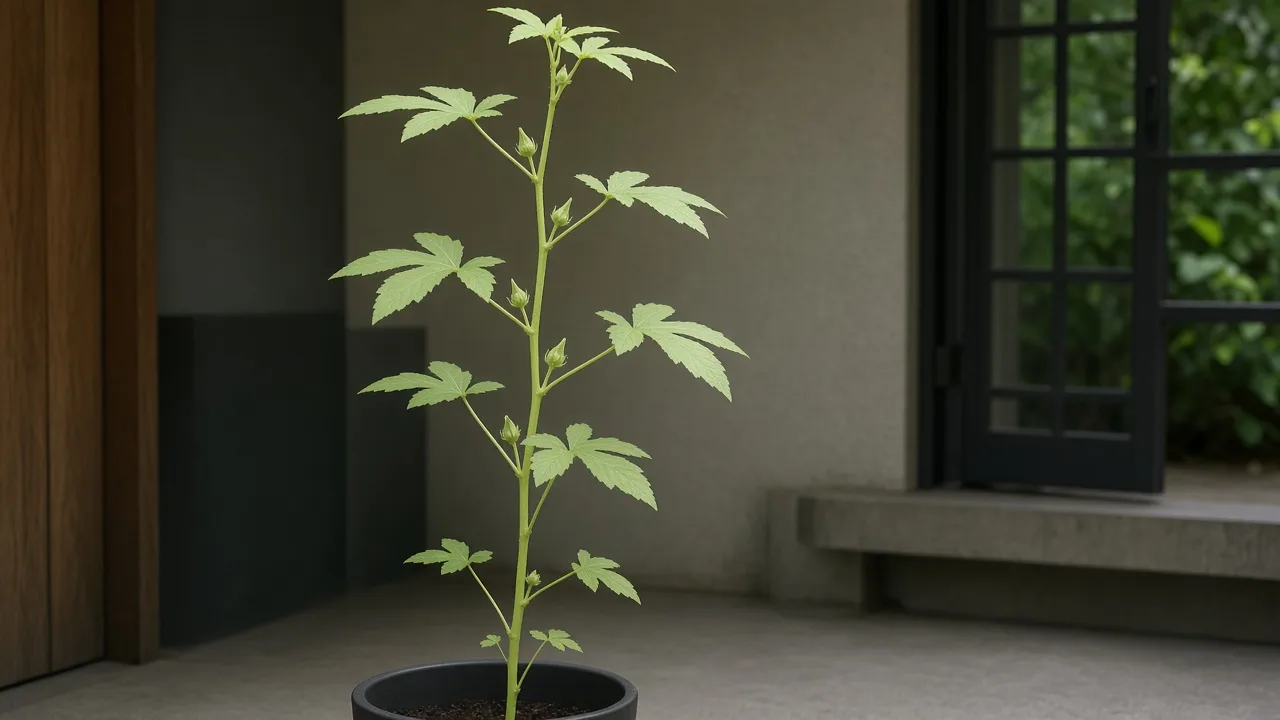
Not Enough Light on Okra: Causes, Checks & Fixes
This guide covers not enough light on Okra. See also the general Not Enough Light guide, watering, and light pages for this plant.
Not Enough Light on Okra: Causes, Checks & Fixes
Quick answer
Okra (Abelmoschus esculentus) is a sun-demanding, warm-season annual malvaceous crop native to tropical Africa and Asia. Unlike shade-tolerant leafy greens or ornamental foliage plants, okra possesses a very high photosynthetic light saturation point. It requires an absolute minimum of 6 to 8+ hours of direct, unfiltered sunlight daily, corresponding to a Daily Light Integral (DLI) exceeding 25–30 mol/m²/day.
For universal principles of light deprivation across plant species, consult our global not enough light hub. On okra, light starvation does not just cause mild stretching—it directly disrupts the hormonal signals governing axillary floral meristem induction, causing flower buds to yellow, wither, and drop before pollination, while leaving newly formed pods stunted, fibrous, and deformed.
First step: relocate potted okra immediately into an open, unobstructed position receiving all-day sun, or prune back overhanging tree branches and vines shading your garden beds. Do not apply nitrogen fertilizers or heavy irrigation cycles until light exposure is corrected.
When to use this page vs other Okra guides
Use this guide when your okra exhibits thin, stretching stalks, sparse flowering, bloom drop, or slow pod filling without mushy stems or pest colonies.
| Symptom Pattern | Primary Driver | Recommended Guide |
|---|---|---|
| Tall, stretched main stalk; long internodes; dropping unopened flower buds | Insufficient sunlight / photoperiod deficit | This guide |
| Yellowing lower leaves with soggy, slow-draining soil | Saturated root zone / anaerobic stress | Okra watering guide |
| Stunted plant with purple-tinged or pale veins despite full sun | Nutrient lockout or root compaction | Okra soil guide |
| Luxuriant dark green foliage, huge leaves, but zero flowers | Excessive nitrogen fertilization | Okra problems guide |
| General seasonal planning, cultivar choices, and outdoor site selection | Baseline crop setup | Okra care overview |
| Comprehensive photoperiod, seasonal sun angles, and balcony light physics | Detailed lighting guide | Okra light requirements |
What not enough light looks like on Okra
When okra receives insufficient solar radiation, its morphological architecture transforms rapidly. Under full sun, healthy okra develops a thick, fibrous, semi-woody central stem with closely spaced nodes (2 to 4 inches apart), deeply lobed palmate leaves, and prominent flower buds nestled in nearly every leaf axil.
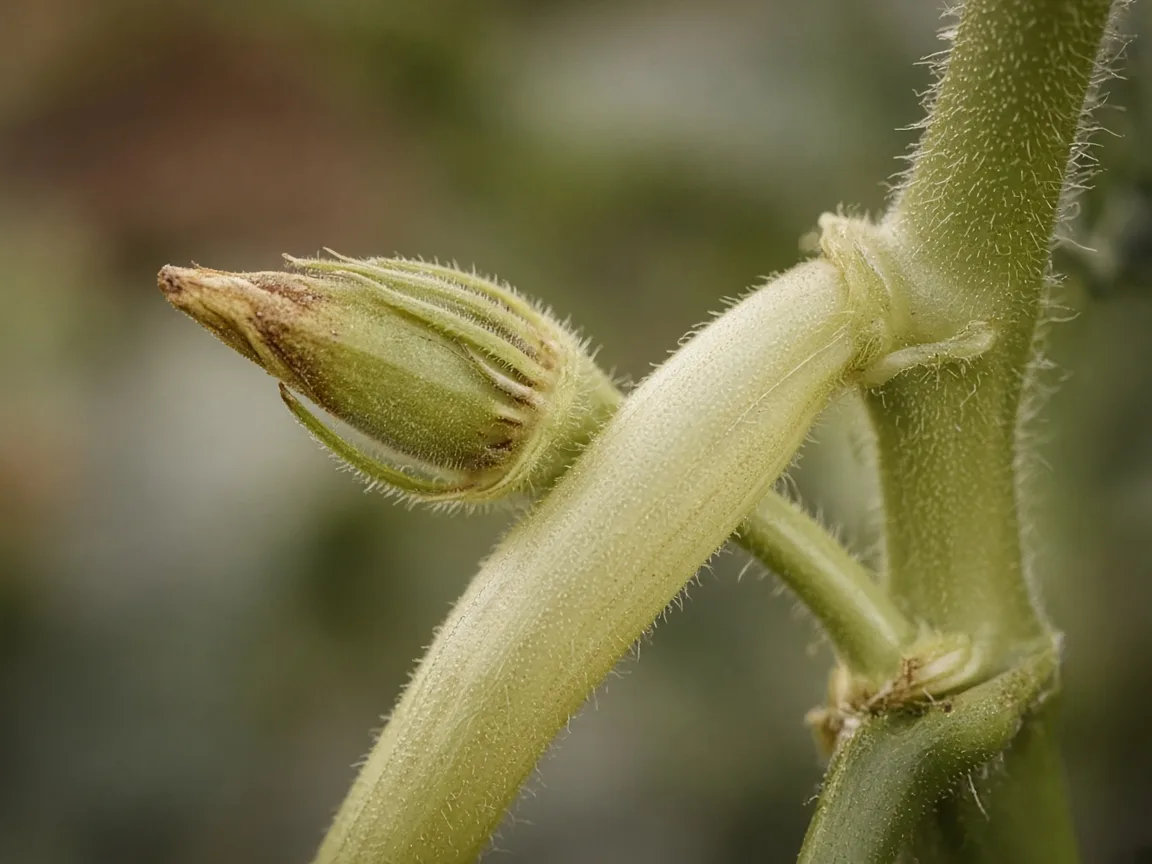
Macro view of shade stress on okra: an aborted floral bud in the leaf axil with pale, stretched stem tissue failing to support pod formation.
In shaded environments, the following species-specific symptoms emerge:
- Etiolated, spindly main stalks — Internodes stretch to 6–10 inches as the stem reaches toward overhead light gaps, creating weak, hollow-feeling stems incapable of supporting mature pod weight.
- Pale, enlarged, thin leaf blades — Okra attempts to maximize photon capture by producing broader, thinner leaves with reduced chlorophyll density, displaying a washed-out lime-green hue rather than deep emerald green.
- Suppressed flowering meristems — Flower buds fail to initiate in the leaf axils. Where buds do form, they remain tiny and yellow rather than expanding into 2- to 3-inch creamy hibiscus-like blossoms.
- Blossom drop (flower bud abortion) — Partially developed flower buds or newly opened corollas turn chlorotic at the pedicel connection and drop cleanly off the stem before fruit set occurs.
- Stunted, crooked, or woody pods — Any pods that successfully pollinate fail to elongate into tender, uniform fruit; instead, they remain dwarf, pale, and rapidly develop tough lignified fibers within days of emergence.
- Canopy leaning and lodging — Tall varieties tilt severely toward the brightest compass opening (typically south or west), making them prone to lodging (falling over) in mild winds.
Photoperiod demands and DLI requirements in Abelmoschus esculentus
To understand why okra collapses so rapidly in low light, consider its photosynthetic physiology. NC State Extension specifies that okra demands six or more hours of direct sunlight as an absolute baseline, while K-State Research and Extension warns that okra requires a minimum of 8 hours of light in order to perform well. Commercial recommendations from Oklahoma State University Extension emphasize planting okra where it receives full sunlight throughout the day.
In horticultural lighting terms, light quantity is measured as Daily Light Integral (DLI)—the number of moles of photons delivered per square meter per day. While low-light indoor foliage plants thrive at 4–8 mol/m²/day, fruiting warm-season crops like okra require 25 to 35+ mol/m²/day to support heavy pod production.
| Light Level (DLI) | Direct Sun Hours | Okra Physiological Response | Pod Yield Potential |
|---|---|---|---|
| < 12 mol/m²/day | < 4 hours | Severe etiolation; zero flowering; complete vegetative stalling | 0% (Crop failure) |
| 12–20 mol/m²/day | 4–6 hours | Tall, thin stems; frequent bloom drop; small, fibrous pods | 15–30% (Poor quality) |
| 20–28 mol/m²/day | 6–8 hours | Moderate branching; steady flowering; acceptable pod set | 65–80% (Acceptable) |
| > 28–35 mol/m²/day | 8–10+ hours | Thick, sturdy stalks; daily axillary blooms; tender, fast-filling pods | 100% (Maximum yield) |
When DLI drops below 20 mol/m²/day, okra enters a negative carbon balance during cloudy spells or afternoon shade. The plant consumes more carbohydrates through dark respiration than its shaded leaves produce during daylight hours, forcing it to sacrifice reproductive structures.
Why shade causes reduced flowering meristems and bloom drop
In Abelmoschus esculentus, flowering and fruiting follow an indeterminate vertical sequence: flowers appear singly in axils along the main stalk and primary branches, opening from lower nodes upward. Each flower requires a substantial, continuous stream of sucrose synthesized in nearby sun-bathed fan leaves.
A field trial published by the Indian Council of Agricultural Research (ICAR) examining tree-shade impacts confirmed that while shaded okra developed longer shoots (etiolation), its overall growth and yield performed better in open field conditions. Under persistent shade, two biochemical disruptions occur:
- Suppression of floral meristem differentiation: In high-light conditions, high sucrose levels and balanced phytochrome signalling activate flowering genes in axillary buds. Under low red-to-far-red light ratios (typical of shade cast by tree canopies or tall buildings), gibberellin synthesis spikes, forcing stem cell resources into rapid internode elongation at the expense of floral organogenesis.
- Abscission zone activation (bloom drop): Developing ovaries are the strongest metabolic sinks on the okra plant. If shaded leaves cannot deliver adequate photosynthate, the plant synthesizes ethylene at the pedicel abscission zone. This activates cellulase and pectinase enzymes, severing the vascular connection and causing the blossom to drop before or immediately after pollination.
Diagnostic inspection: confirming shade stress vs lookalikes
Before altering your growing environment, confirm that shade is the genuine culprit rather than a nutrient or moisture disorder:
- Conduct a direct sun audit — Observe your okra patch at 9:00 AM, 12:00 PM, 3:00 PM, and 5:00 PM on a clear day. Calculate the exact cumulative hours that direct sunbeams hit the foliage without obstruction from rooflines, eaves, boundary fences, or neighboring trees.
- Measure internode spacing — Measure the vertical stem distance between leaf petiole attachments. In full sun, internodes measure 1.5 to 3.5 inches; in shaded plants, internodes stretch to 5 to 9 inches.
- Examine the flower pedicel junction — If dropped flowers show clean, smooth abscission scars at the stem node without fungal fuzz, caterpillar chew marks, or aphid clusters, carbon starvation from light deficiency is the confirmed diagnosis.
- Inspect soil moisture retention — Shaded okra transpires far less water than sun-drenched plants. If soil remains saturated for 4–6 days after light watering, the root zone is transpiring at reduced capacity due to low photosynthetic demand. Cross-check your moisture patterns against our Okra watering guide.
Differentiating lookalike conditions
- Excess nitrogen vs shade: Both cause tall plants with reduced fruiting. However, high-nitrogen okra exhibits thick, brittle stems with dark, deep green, crumpled leaves. Shaded okra exhibits thin, flexible, pale lime-green stems with elongated internodes.
- High-temperature blossom drop vs shade drop: Okra loves heat; the Royal Horticultural Society notes that okra requires plenty of heat and sun. However, when temperatures exceed 100°F (38°C) accompanied by severe drought stress, pollen can become sterile, causing blossom drop even in full sun. In heat stress, leaves wilts and curl, whereas in shade stress, leaves remain turgid but pale.
- Root-knot nematodes: Stunted growth and yellowing can indicate nematodes. Uproot an unproductive plant; if roots show irregular swollen galls rather than a clean, deep taproot system, nematodes are present.
The first fix for Okra
The single most effective first fix is to eliminate photon starvation by relocating the plant or clearing the solar path.
For container-grown okra, immediately move the pot to an open south- or west-facing patio, terrace, or driveway receiving uninterrupted daylight. For garden-grown okra, prune back shading tree limbs, remove adjacent weedy hedges, or clear out companion plants that have outgrown and shaded the okra canopy.
Do not fertilize a shaded okra plant. Adding nitrogen to a light-deprived plant exacerbates etiolation, producing softer, weaker stems that collapse under wind stress. Correct the light first, allow the plant to rebuild its carbohydrate reserves, and hold supplemental feeding until new nodes show compact, vigorous development.
Optimal garden orientation and plant spacing
Proper garden layout prevents self-shading, ensuring that every okra leaf receives optimal direct beam solar radiation:
1. North-to-South row orientation
Always align okra rows along a North-South axis. As the sun tracks from east to west across the sky, a North-South orientation allows direct sunlight to penetrate the eastern side of the crop canopy in the morning and the western side in the afternoon. East-West rows, by contrast, result in the southern face of the row shading the northern face throughout midday, severely suppressing pod development on the shaded side.
2. Spacing to prevent intra-crop shading
Okra plants grow broad, horizontal palmate leaves that readily overlap and shade neighboring stems if crowded. Follow Oklahoma State University Extension recommendations:
- Dwarf cultivars (e.g., ‘Annie Oakley II’): Thin seedlings to 12–15 inches apart in the row, with rows spaced 36–42 inches apart.
- Standard and tall cultivars (e.g., ‘Clemson Spineless’, ‘Emerald’): Thin seedlings to 18–24 inches apart in the row, with rows spaced 48–60 inches apart.
3. Vertical tiering in mixed vegetable beds
Because okra reaches 4 to 7 feet tall, place okra on the northern or northeastern boundary of your garden plot. Placing tall okra on the southern edge will cast long shadows over companion vegetables like peppers, bush beans, or leafy greens.
Step-by-step recovery plan
Once the solar exposure is corrected, implement this targeted recovery sequence:
- Step 1: Re-establish full sun exposure (Days 1–3) — Ensure the plant receives 8+ hours of direct sun daily. If moving an indoor-started seedling or shaded nursery plant into harsh midday sun, acclimate it over 3 days (morning sun on day 1, morning through midday on day 2, full day on day 3) to prevent sun scorch on tender, shade-adapted leaves.
- Step 2: Calibrate watering to increased transpiration (Week 1) — In full sun, okra’s transpiration rate will double. Monitor the top 2 inches of soil daily. Water deeply when the top inch dries out, ensuring water drains freely away from the taproot. Consult our Okra soil guide to ensure proper aeration.
- Step 3: Staking etiolated stalks (Week 1) — Stems that stretched in low light cannot thicken retroactively. Insert a sturdy bamboo stake or metal t-post beside tall, floppy stems and secure the stalk loosely with soft garden twine to prevent wind snap.
- Step 4: Monitor the first recovery flush (Weeks 2–3) — Inspect the apical growing tip. New internodes should emerge markedly shorter (under 3 inches apart), with darker green foliage and visible flower buds forming at consecutive nodes.
- Step 5: Resume balanced feeding (Week 3 onward) — Once compact new growth and firm flower buds are verified, apply a balanced, low-nitrogen vegetable fertilizer (such as 5-10-10 or organic fish emulsion/bone meal blend) to support fruit enlargement.
Recovery timeline
| Timeline | Plant Progress | Corrective Action |
|---|---|---|
| Days 1–7 | Stems stop leaning; leaf orientation levels out toward overhead sun | Maintain consistent deep watering; do not fertilize |
| Weeks 2–3 | Apical tip produces tight, compact internodes with dark green pigmentation; floral buds form in axils | Secure stretched base to support stakes; monitor soil moisture |
| Weeks 3–4 | First viable hibiscus-like blooms open and retain petals; ovaries begin swelling into green pods | Apply balanced side-dress fertilizer; verify daily sun hours |
| Weeks 5–6 | Steady pod harvest begins; pods elongate to 3–4 inches while remaining tender and spineless | Harvest pods every 2 days to encourage continuous bud set |
Mistakes to avoid
- Applying nitrogen fertilizer to \u201cboost\u201d shaded plants: Excess nitrogen in low light forces rampant, weak vegetative stretch and guarantees zero pod set.
- Overwatering a shaded okra plant: Because shaded plants transpire minimally, frequent watering saturates the root zone, inviting fungal root rot. Check root health using our Okra problems guide.
- Topping (pruning) the main stalk too early: Do not cut the apical growing tip off an etiolated okra plant until new basal or axillary shoots have begun forming in full sun. Okra produces its primary pods on the main vertical axis.
- Ignoring changing seasonal shadow lines: A location that receives full sun in May may fall into deep shade by August as the solar elevation declines and deciduous trees leaf out fully.
- Attempting indoor windowsill pod production: Modern low-emissivity (low-E) glass filters out 30–50% of photosynthetically active radiation. Windowsills rarely provide the DLI necessary for pod formation.
How to prevent insufficient light in future seasons
- Map garden sunlight before sowing: Select planting sites in early spring using a solar path audit or light meter to confirm an unobstructed 8- to 10-hour direct light window.
- Thin seedlings early: Thin seedlings when they reach 3–4 inches tall to prevent competitive self-shading within the row.
- Prune lower canopy leaves after harvest: As you harvest mature pods from lower nodes, remove the corresponding lower fan leaves below the harvested zone. This improves airflow, reduces disease pressure, and allows sunlight to penetrate inner lateral branches.
- Select compact cultivars for tight spaces: In balconies or small urban plots, choose dwarf cultivars such as ‘Baby Bubba’ or ‘Annie Oakley II’, which maintain compact 3- to 4-foot canopies and tolerate confined sunny corners better than 8-foot heirloom varieties.
Related Okra guides
- Okra care overview — Complete cultural requirements, temperature thresholds, and seasonal planting calendars.
- Okra light requirements — Comprehensive guide to sun angles, balcony growing positions, and solar acclimation.
- Okra watering guide — Proper irrigation cadences and moisture management for container and bed-grown okra.
- Okra soil guide — Soil preparation, drainage requirements, and pH balance for productive crops.
- Okra problems hub — Diagnostic guide covering pests, nutrient deficiencies, and fungal diseases on okra.
Related tool
Use our Light Meter Calculator to calculate your garden or balcony’s exact Daily Light Integral (DLI) and verify whether your site delivers the 25–30+ mol/m²/day necessary for heavy okra pod production.