Brown Tips on Philodendron Burle Marx: Causes, Checks &
Quick answer
Brown tips on Philodendron Burle Marx most often come from dry indoor air, missed soak cycles in its wide creeping pot, or fertilizer salts on narrow glossy leaves. First step: push a finger 3–5 cm into the mix and lift the pot — if dry and light, water deeply once until drainage runs, then empty the saucer.
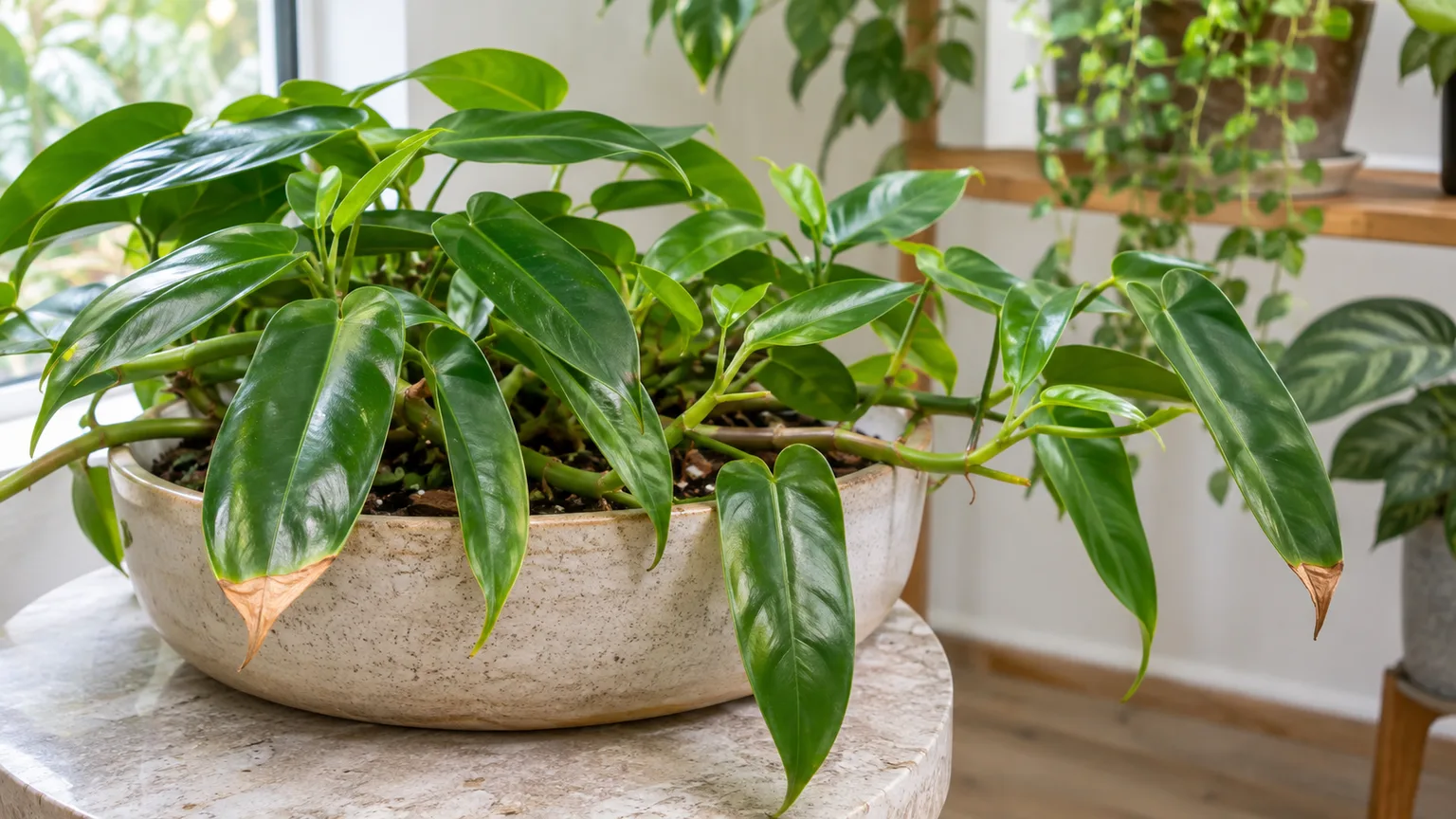
Brown Tips on Philodendron Burle Marx: Causes, Checks & Fixes
This guide covers brown tips on Philodendron Burle Marx. See also the general Brown Tips guide, watering, and light pages for this plant.
Brown Tips on Philodendron Burle Marx: Causes, Checks & Fixes
Quick answer
Brown tips on Philodendron Burle Marx are usually environmental, not a disease. The three drivers that cover most cases are dry indoor air, missed soak cycles in a wide creeping pot, and fertilizer salts left by heavy feeding or hard tap water. Burle Marx trails horizontally on long runners with narrow, glossy, elongated leaves, so the far tip of each blade dries out before anything else shows stress.
First step: push a finger 3–5 cm into the mix and lift the pot. If the mix feels dry at depth and the pot feels light, give one deep soak until water runs from the drainage holes, then empty the saucer. If you see white crust on the soil surface instead, skip the feed and flush the pot with plain water. For how tip burn works on houseplants in general, see our brown tips hub. On Burle Marx, read the wide pot and the runner layout before blaming the leaves — the center of a creeping pot often stays damp while the outer runners bake dry, so opposite ends of the same plant can need opposite treatment.
What brown tips look like on Burle Marx
Tip burn on Burle Marx has a recognizable signature once you separate it from whole-leaf yellowing or sun scorch. The narrow blades taper to a fine point, and damage starts exactly there.
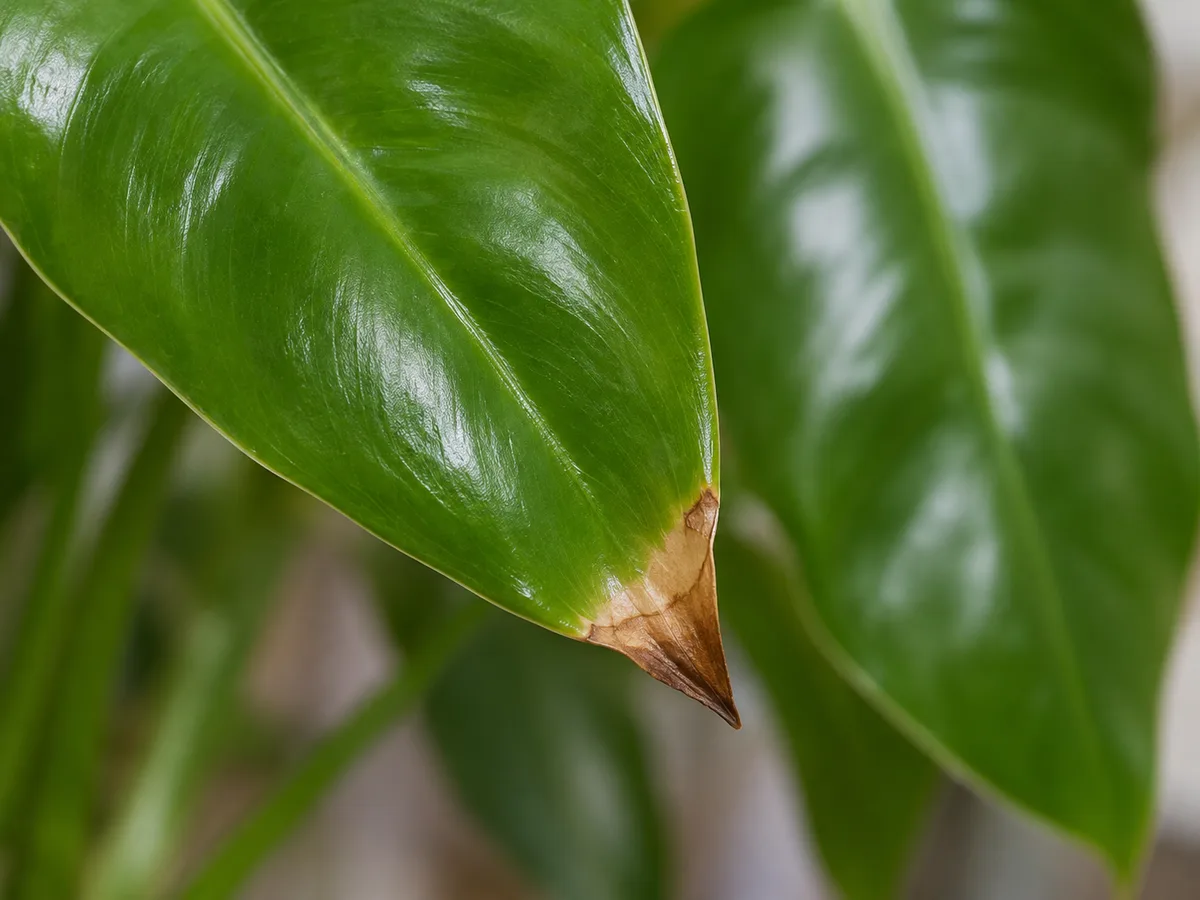
Tip burn stays dry and papery at the pointed leaf end while the remaining glossy blade stays firm and green.
Classic tip burn (dry air or missed watering):
- A narrow tan-to-dark-brown band at the very tip of an otherwise glossy green blade
- Papery, crisp texture while the rest of the leaf stays firm and shiny
- Often worse on older outer leaves along established runners while new runner tips still look clean
- No yellow halo spreading deep into the blade in the early stage
Salt-burn signature:
- Brown tips plus a white crust on the soil surface or pot rim
- Damage appearing within days of a full-strength feeding, especially in fall or winter
- Tips browning even though the mix feels evenly moist
What tip burn is not: uniform yellowing of lower leaves with wet soil (a watering-balance problem — see the watering guide), bleached patches only on the window-facing side (too much direct sun — see the light guide), or soft brown collapse of whole leaves with a sour-smelling pot (root trouble from chronic wetness). The RHS notes that brown tips or margins on houseplants may indicate under-watering or too dry an atmosphere, while browning in the middle of leaves more often follows overwatering — so tip-only damage narrows your suspects fast.
Why Burle Marx gets brown tips
Burle Marx descends from tropical aroids, a group the RHS describes as needing bright indirect light, temperatures above 15°C, and average humidity with the compost allowed to dry slightly between waterings. Like its relatives, it sits in the arum family, with soft herbaceous tissue that telegraphs air and water stress at the leaf margins. Three stresses converge on the same brown-tip symptom indoors.
Dry indoor air. Burle Marx prefers moderate humidity around 50–60%, and winter heating routinely drags homes well below that. Dry air pulls moisture from the thin leaf tips faster than the runners can resupply it. Philodendrons evolved in humid environments, and dry indoor air browns their leaf tips and edges first, especially near heaters and air-conditioner vents.
Uneven dry-downs. The RHS advises letting philodendron compost dry slightly between waterings — and Burle Marx punishes both directions. Swings between dust-dry and soaked concentrate damage at the tips, and the plant’s creeping layout makes swings likely: the middle of a wide pot can stay damp for days while the outer runners dry out. Tip burn on philodendrons commonly traces to low humidity, dry stress, fertilizer salt buildup, or roots not taking up water evenly.
Fertilizer salts and hard-water minerals. Monthly feeding at full label strength, feeding through fall and winter, or never flushing the pot leaves salts that accumulate at leaf margins. Excess fertiliser salts accumulate in potting mix and damage roots so the plant cannot absorb water, with leaf tips and edges browning first. Hard tap water adds the same minerals between feedings.
Creeping runners in wide pots: why outer leaves crisp first
This is the section that separates Burle Marx from upright philodendrons. Burle Marx advances along the soil surface or trails from a basket rather than climbing, so it belongs in a wide shallow pot — and that geometry creates a moisture gradient most owners never check. The center mass of mix under the mother crown holds water for days, while the thin layer under the outer runners dries fast.
The result: outer-runner leaves crisp at the tips from drought while the center looks fine, or the center rots at the soil line while the outer leaves look thirsty. One watering schedule cannot serve both zones unless you check both. Before every soak, press the mix 3–5 cm deep near the outer runners, not just beside the crown, and lift the pot to feel its weight. If the center is still damp but the edges are dry, water lightly around the runners rather than drenching the whole bowl. The soil guide covers the loose perlite-rich mix that keeps this gradient shallow, and the repotting guide explains why shallow wide containers suit creeping stems.
Glossy narrow blades: why the far tip burns first
Burle Marx leaves are long, narrow, and glossy — elegant, but hydraulically unforgiving. Each blade is a long pipeline, and the pointed tip sits farthest from the stem’s water supply, so any interruption in uptake (dry mix, salt-damaged roots, dry air pulling faster than roots deliver) shows at the tip first while the base still gleams.
The gloss itself is a diagnostic aid. Salt and mineral residue dulls the shine near margins before full browning, and dust films show clearly on the smooth surface — wipe leaves gently with a barely damp cloth when dusty so the plant transpires normally. Never apply leaf-shine products to “fix” dull tips; they coat the stomata on these smooth blades and can worsen the stress marks. If only the sun-facing leaves show bleached brown patches rather than tip bands, that is scorch through glass, not tip burn — shift the plant back from the window per the light guide.
How to confirm the cause
Work through these checks in order, changing one variable at a time so you can read the plant’s response over the next two to three weeks.
- Deep moisture plus pot weight — Push a finger or chopstick 3–5 cm into the mix near the outer runners and lift the pot. Dust-dry mix with a light pot means fix watering first; evenly moist mix with brown tips means look at air and salts instead. Match the rhythm in the watering guide: roughly every 7–10 days in summer and 10–14 days in winter, keyed to dry-down, not the calendar.
- Salt-crust scan — Look for white crust on the soil surface and pot rim and recall your last two feedings. Brown crispy edges with white crust appearing shortly after fertilizing are the classic sign of fertilizer burn, especially after feeding during slow winter growth.
- Humidity reading at leaf level — Place a hygrometer beside the foliage, not across the room. Sustained readings well below 50% with papery tips and otherwise normal soil strongly support dry air. Burle Marx targets moderate humidity around 50–60%.
- Draft and heat map — Feel for moving air from radiators, heating vents, and cold single-pane glass. Move the plant once, a few feet from the source, before buying hardware.
- Newest runner growth — The decisive test is the next leaf unfurling at a runner tip. Clean pointed ends on fresh leaves confirm your fix; repeated crisping on new tissue means another cause is still active.
First fix for Philodendron Burle Marx
Apply one correction matched to what you confirmed, then wait two to three weeks before touching anything else.
If the mix is dry 3–5 cm down and the pot feels light
Water deeply once with room-temperature water until it runs from the drainage holes, then empty the saucer or cachepot fully. Resume the normal dry-down rhythm — do not add extra drinks because tips look brown. The next one or two runner leaves will show the clearest response.
If white crust or heavy feeding preceded the tips
Flush the pot once with plain room-temperature water, pouring slowly until the drainage runs clear, then let it drain completely. Hold all fertilizer until new runner growth looks healthy for two weeks, then resume at half strength in spring and summer only. Flushing with plain water until drainage runs clear, ensuring free drainage, and feeding only in the growing season reverses salt buildup.
If the air is dry but soil and salts check out
Run a small room humidifier near the plant or set the pot on a pebble tray with water just below the stone surface. Grouping plants helps modestly, but a humidifier holds Burle Marx near its 50–60% target through heating season. Do not mist the narrow blades as your main fix — droplets bead, dry, and leave mineral spots on the gloss.
Cosmetic trim (after the fix is in place)
Snip dead tips with clean scissors, following the leaf’s natural taper. Brown tissue stays brown, so the goal is keeping future growth cleaner — trimming is appearance only. Wear gloves, since philodendron sap can irritate skin, and keep the plant out of reach of chewing pets.
Runner tips, not old leaves: how Burle Marx shows recovery
Burle Marx recovers at the creeping front, not on damaged blades. Old brown tips are permanent — judge everything by the runners.
- After a watering correction: the next one or two leaves unfurling at runner tips should open with clean pointed ends within two to four weeks.
- After a flush or humidity fix: margin crisping on new growth usually stabilizes within two to three weeks once salts leach and air holds near 50–60%.
- Older leaves: may keep brown tips indefinitely; remove a leaf only when more than half the blade is dead.
If three consecutive new leaves open clean, the problem is controlled — keep the routine through heating season. If fresh runner leaves still crisp, re-check the remaining suspects: salts you missed, a vent you overlooked, or roots failing under a soggy pot center. Because stem sections with nodes root readily in water or moss, a healthy runner tip can always become a backup plant if the mother crown is failing — take cuttings only from firm, healthy runners in spring.
Lookalike symptoms to rule out
| Pattern | Likely cause | First direction |
|---|---|---|
| Crispy tips only; firm runners; normal soil | Low humidity or dry stress | Humidifier plus steady dry-down checks |
| Tips plus white soil crust after feeding | Salt or fertilizer burn | Flush pot; dilute future feeds |
| Light pot, dry mix, slight limpness before crisping | Underwatering swings | Deep soak; check outer runners, not just crown |
| Yellow lower leaves, heavy wet pot, soft stems | Chronic wet mix and root stress | Stop watering; inspect roots and drainage |
| Bleached patches on window side only | Direct-sun scorch | Move back per the light guide |
| Whole-leaf brown collapse with sour soil smell | Advanced root failure | Unpot and inspect; healthy runners can be salvaged as cuttings |
Older leaves on healthy houseplants naturally brown and die back over time — a single brown-tipped elder leaf on an otherwise clean runner is aging, not an emergency.
What not to do
- Do not water more because tips are brown when the mix is already moist; a soggy pot center rots creeping stems at the soil line.
- Do not fertilize a stressed plant to “green up” the tips — salts worsen tip burn. Hold feeding until new runner growth looks healthy for two weeks.
- Do not repot on day one unless roots are mushy or the mix has collapsed. See the repotting guide after the plant stabilizes.
- Do not mist the blades as the main humidity fix — beaded water leaves mineral spots on the gloss and invites surface spotting.
- Do not trim every damaged leaf at once; the plant still photosynthesizes through partly green blades while runners push replacements.
How to prevent brown tips next time
- Water by dry-down, both zones. Check 3–5 cm deep near the outer runners and lift the pot; follow the watering guide rhythm rather than a fixed weekday.
- Keep the wide shallow pot. It suits the creeping habit and prevents the soggy-center failure mode — refresh the loose perlite-rich mix per the soil guide when it compacts.
- Feed lightly and seasonally. Monthly balanced liquid at half strength in spring and summer only; details live in the fertilizer guide. Never fertilize a dry plant — water first.
- Flush a few times a year with plain water until drainage runs clear, especially if your tap water is hard.
- Hold humidity near 50–60% through heating season with a humidifier or pebble tray.
- Inspect runner tips weekly so the next crisping leaf triggers a small tweak, not a rescue.
When to worry
Treat as urgent — same-day action — when brown damage spreads across several leaves within a week, stems soften or darken at the soil line, the mix smells sour, or outer runners collapse while the center stays wet. Those patterns point past cosmetic tip burn toward root failure, and healthy runner sections should be cut for propagation before the decay reaches them.
Lower urgency: a few papery tips on older outer leaves while runners stay firm, soil moisture is appropriate, and new runner tips keep emerging clean. Fix humidity and watering rhythm before escalating to anything drastic.
Conclusion
Brown tips on Philodendron Burle Marx look alarming on those glossy narrow blades, but they are usually the plant’s early-warning system for dry air, uneven dry-downs across a wide creeping pot, or salt buildup — not a death sentence. Check moisture at depth near the runners, scan for salt crust, and measure humidity at leaf level; apply one fix; then let the next runner leaves deliver the verdict. Old tips stay brown, but clean new growth with sharp pointed ends means you found the right lever.
When to use this page vs other Burle Marx guides
- Burle Marx watering guide — Use for routine moisture checks and seasonal rhythm before assuming tips are the main issue.
- Burle Marx problems hub — Browse all common issues on this species.
- Burle Marx overview — Care basics, creeping habit, and placement for wide pots and baskets.
- Burle Marx fertilizer guide — Feeding strength and schedule when salts are the suspect.
- Burle Marx soil guide — Mix and drainage when the pot center stays wet while runners dry.
Related Philodendron Burle Marx guides
- Philodendron Burle Marx overview
- Burle Marx watering
- Burle Marx light
- Burle Marx soil
- Burle Marx fertilizer
- Burle Marx repotting
- All Philodendron Burle Marx problems
Related tool
Use the Plant Problem Diagnosis Tool to narrow causes for brown tips on this plant before changing multiple variables at once.