Radish Light Needs: Full Sun Hours & Terrace Placement
Radish Light Needs: Full Sun Hours & Terrace Placement
Radish Light Needs: Full Sun Hours & Terrace Placement
Radish (Raphanus sativus) — mooli, daikon, and quick salad types — is judged by a taproot that can be ready in weeks when weather stays cool and bright. The lobed leaves look small, but they are the plant’s only way to fuel root swell. Without enough direct sun through the cool growing window, you get a leafy rosette and a disappointing root even when watering and soil look fine. Radish is not a deep-shade crop like spinach; it is a fast cool-season root vegetable that wants open sky for most of the day.
Start with the Radish overview for cultivar choice, sowing depth, and succession timing. This page covers how much sun radishes need, where to place beds and containers on terraces, when brief afternoon shade helps in heat, and the first fixes when tops run ahead of roots.
Radish light needs: the quick answer
Plan for six or more hours of direct sun on the radish row or container during active growth in cool weather. NC State Extension lists Raphanus sativus as full sun (six or more hours of direct sunlight daily) with partial shade (two to six hours of direct sun) tolerance. The same profile notes that in partial shade, at least four to five hours a day still works, but roots take longer to reach harvest size.
On an open Indian terrace, that usually means the brightest unobstructed strip, not a courtyard that only catches a midday slice. Measure light before you direct-sow; radish seedlings dislike root disturbance, so you cannot easily move a struggling row mid-season. See propagation for sow-in-place timing.
Why light drives radish root size
Radish stores crunch and mild heat in a taproot that swells only while temperatures stay in the cool band and moisture stays even. Leaves convert light into carbohydrates that move downward when the plant is not busy bolting. Hot, bright weather without enough water pushes stress chemistry that makes roots woody or overly pungent, even when sun hours are high.
Leaves feed a fast taproot below
Unlike vining crops that need sun on a tall canopy, radishes need steady light across a low rosette. Shaded plants often push large, dark green tops while underground growth stalls — a pattern growers blame on nitrogen when the real issue is dim placement. Heavy fertilizer can worsen leafy growth, but low light produces the same silhouette: plenty of foliage, thin or absent roots.
Cool-season timing changes how sun feels
RHS advises an open, sunny site, with light shade acceptable for salad radishes in midsummer and a cooler spot in light shade, out of midday sun during warm weather. Treat season and sun as one decision: sow in the cool window when long sun hours help roots fill fast, and use brief afternoon shade on containers only when heat plus radiation outpace the plant’s comfort zone — not as a permanent shady home.
How much sun radishes need each day
Six or more hours as the full-sun target
Full sun means unobstructed light long enough for a sharp hand shadow on soil from mid-morning through afternoon. Six hours is a workable minimum for round salad types; more clear-sky time in cool weather supports the three-to-six-week harvest rhythm many cultivars advertise. Planet Natural notes radishes need full sun — at least six hours of direct sunlight on most days and that too much shade shifts energy to leaves rather than roots.
The four-to-five-hour partial-shade floor
NC State Extension explicitly allows partial shade with at least four to five hours of direct sun, at the cost of slower root sizing. That matches the hub’s practical floor for terrace growers who cannot access all-day sun. You may still harvest small rounds if you sow thick, thin early, and accept a longer calendar — do not expect daikon to reach full length on a permanently dim balcony.
What deep shade does to harvest speed
Below roughly four hours of direct sun, radishes often survive but behave like a leaf crop. Kellogg Garden warns that too much shade forces more leaves than harvestable roots. If your site fails morning, midday, and late-afternoon checks, choose a brighter vegetable for that corner or use temporary grow-light support only for seedlings, not full root production indoors.
Measuring light before you direct-sow
Morning, noon, and afternoon shadow checks
On a clear day, ask three questions: Does sun hit the sowing row at 9 a.m.? Is midday light blocked by parapets, water tanks, or neem branches? Does late-afternoon sun still reach the bed? Radishes sit low; a wall that steals only afternoon light can still pull daily totals below six hours. Raised beds on rooftops often outperform ground courtyards because they sit above rim shadows — pair brightness with loose soil depth matched to cultivar.
Sharp shadow vs soft shadow
Hold your hand 30 cm above the sowing spot. A crisp-edged shadow counts as direct sun; a fuzzy shadow is bright indirect light and does not fully count toward the six-hour target. Log hours on a weekend before you commit seed; succession sowing only works if each batch gets similar brightness.
Best placement on beds, terraces, and balconies
Brightest open strip vs decorative corners
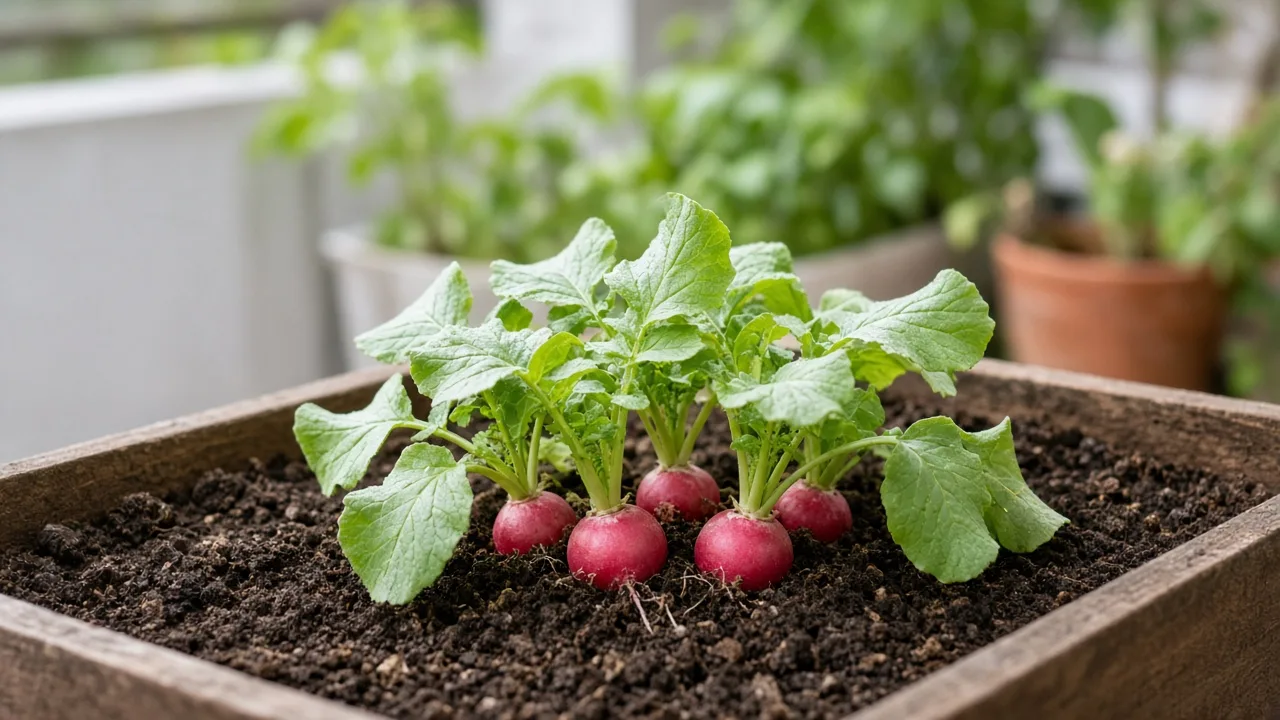
Container growers often tuck radishes into a shaded “green corner” that suits ferns, not root crops. Give radishes the same sun priority you would give tomatoes in winter — the brightest rail or bed edge. Round types need only 15–20 cm of depth, but they still need hours of sun on the leaves, not just warmth on the pot.
Neighboring crops and vertical shade
Togather Time Family reminds growers that taller vegetables can shade radishes if sown too close, producing all leaves and no roots. Plant radishes on the south or west side of taller cool-season crops only if those neighbors are still short at harvest time, or give radishes their own row where nothing casts a midday shadow.
Container and rooftop microclimates
Moving pots for heat vs brightness
In-ground radishes are fixed; containers can shift. During a late-spring heat spike, sliding a pot to afternoon shade can reduce soil heat when full terrace sun becomes stressful — mirroring RHS advice to avoid midday sun in warm weather. Move back to full morning-to-afternoon sun once temperatures drop; permanent afternoon shade is not the same as temporary heat relief.
Reflected heat from walls and paving
Bright light on white parapets, tin sheds, or dark paving raises root-zone temperature faster than open garden soil. You may see wilting midday even with six sun hours. In that case, shade cloth or a slightly eastern placement can protect roots without dropping below the four-hour minimum. Pair light changes with watering checks because brighter, hotter sites dry shallow mix quickly.
Seasonal light strategy for Indian and tropical growers
Rabi and early-spring sowing in open sun
For much of peninsular and northern India, cool dry sowing windows (roughly October–February depending on latitude) align with long, mild sun without brutal heat. Sow salad types in full open sun during that window so roots size before day length and warmth trigger bolting. Succession sow every two weeks in the same bright band rather than chasing shade.
Late-spring heat: midday shade without dimming the whole day
When daily highs climb past the cool-season comfort zone, bolting and woodiness follow heat, drought, and maturity more often than “too much light” alone. Kellogg Garden recommends early spring and fall plantings in hot regions, or part shade as temperatures climb. Read that as relief from combined heat and radiation, not permission to grow winter radishes in four hours of sun all season.
Monsoon cloud cover and stretched harvest windows
Heavy cloud during the monsoon cuts daily light integrals even when hours feel long. Roots may stall or split if moisture swings coincide with dim weather. Either sow before the cloudiest weeks, choose the brightest raised bed, or accept longer days-to-harvest and pull roots promptly when shoulders show — delayed harvest in weak light still turns pithy.
Salad radish vs daikon and mooli light needs
Shallow round types in bright cool weather
Cherry-sized salad radishes are bred for speed in full sun when soil stays cool and moist. They are the best choice for shallow containers on bright balconies. Less light slows every stage, so a cultivar advertised for 25 days may need 40 or more in partial shade.
Long roots still need bright sites
Daikon and mooli need deep, loose mix plus strong light on the foliage to feed a long taproot. Shade does not replace depth, and depth does not replace sun. Match soil volume and brightness together; a deep pot in a dim corner still yields forked or stunted roots.
Grow lights for germination and short indoor bridges
Radish is a direct-sow outdoor crop for serious root harvests. A bright windowsill or full-spectrum LED for 12–14 hours daily can start seedlings if outdoor nights are still cool but you lack terrace access yet. Planet Natural groups radishes with spring and autumn full-to-partial sun crops that tolerate light frosts — once hardened, move plants to outdoor full sun rather than trying to finish daikon entirely indoors.
Do not confuse radish sprouts (grown for greens in indirect light) with root radishes; sprouting jars need airflow and rinsing, not six hours of terrace sun. This page targets taproot harvests for kitchen gardens.
Warning signs of too little or too much light
All tops, no shoulder at the soil line
Large, healthy leaves with no visible root shoulder at the soil surface after the expected harvest window usually mean insufficient direct sun, overcrowding, or both. Thin to the spacing on your seed packet and reassess daily sun hours before you sow the next batch in the same spot.
Bolting, woodiness, and heat stress confusion
Flower stalks, hairy roots, and bitter flavor often trace to heat and age, not excess light alone. NC State Extension notes roots turn woody with age, hot weather, and bolting. If plants bolt while still in full cool-season sun, switch to a cooler sowing date or heat-tolerant cultivars rather than moving into deeper shade.
Pale, stretched seedlings on a bright windowsill may be reaching for light before outdoor hardening — add brighter LEDs or move outdoors sooner with gradual exposure.
Light, watering, and soil as one system
Brighter sites pull water from shallow container mix faster than shaded ones. When you move a pot into more sun, increase watering checks the same week. Dim, cool, wet corners — common on north-facing balconies — raise damping-off risk for thick sowings; fix airflow and light together, not water alone.
Even moisture still matters in full sun: split roots and pith often follow irrigation swings amplified by heat on radiant terraces. Light sets the pace; water keeps texture mild.
When to use this page vs other Radish guides
Use this page when you are choosing or troubleshooting a growing site — terrace strip, balcony pot, or bed edge — before sowing or when roots fail to size. For irrigation rhythm, see watering. For mix depth and drainage, see soil and repotting (container depth and refresh). For succession sowing and thinning, see propagation. For feeding once light supports growth, see fertilizer.
Related Radish guides
- Radish overview — cool-season framework, cultivar types, and harvest timing
- Radish watering — even moisture when bright sun dries shallow mix
- Radish soil — loose depth so sun-fed tops can fill straight roots
- Radish propagation — direct sow in the brightest practical spot
- Radish fertilizer — light feeding once light and moisture support growth
Conclusion
Radishes reward cool weather plus long, direct sun on a sowing site you will not need to move. Aim for six or more hours of unobstructed light during the cool growing window, treat four to five hours as a slower partial-shade floor, and use brief afternoon shade on hot containers only as heat relief — not as a full-time location. Run the morning–noon–afternoon shadow test before you sow, keep tall neighbors from stealing midday sun, and read leafy tops without shoulders as a placement problem on the next batch. When roots size steadily toward harvest in mild weather, your light and season match Raphanus sativus biology; when foliage runs wild underground stays thin, chase sun before you change anything else.