Overwatering on Scindapsus Pictus: Causes, Checks & Fixes
Quick answer
Overwatering on Scindapsus Pictus shows as yellow lower leaves, limp trailing vines, and mushy stems while soil stays wet. Stop watering immediately, move to brighter indirect light, and let the top half of the mix dry before the next drink.
Overwatering on Scindapsus Pictus: Causes, Checks & Fixes
This guide covers overwatering on Scindapsus Pictus. See also the general Overwatering guide, watering, and light pages for this plant.
Overwatering on Scindapsus Pictus: Causes, Checks & Fixes
Quick answer
Overwatering is the most common care mistake on satin pothos (Scindapsus pictus). This trailing Araceae vine native to Southeast Asia tolerates missed water better than roots sitting in stale wet mix-but chronic saturation quickly damages the root system.
First fix: stop watering and let the top half of the mix dry completely before you do anything else. When the pot feels heavy, lower leaves turn yellow, and satin-textured vines go limp despite wet soil, that pause buys time to confirm whether stems are still firm or already soft at the soil line.
This page is the rescue guide for wet-soil symptoms-confirmation checks, dry-down protocol, trim-and-repot escalation, and recovery timelines. For everyday watering rhythm and seasonal intervals, use the Scindapsus Pictus watering guide instead.
What overwatering looks like on Scindapsus Pictus
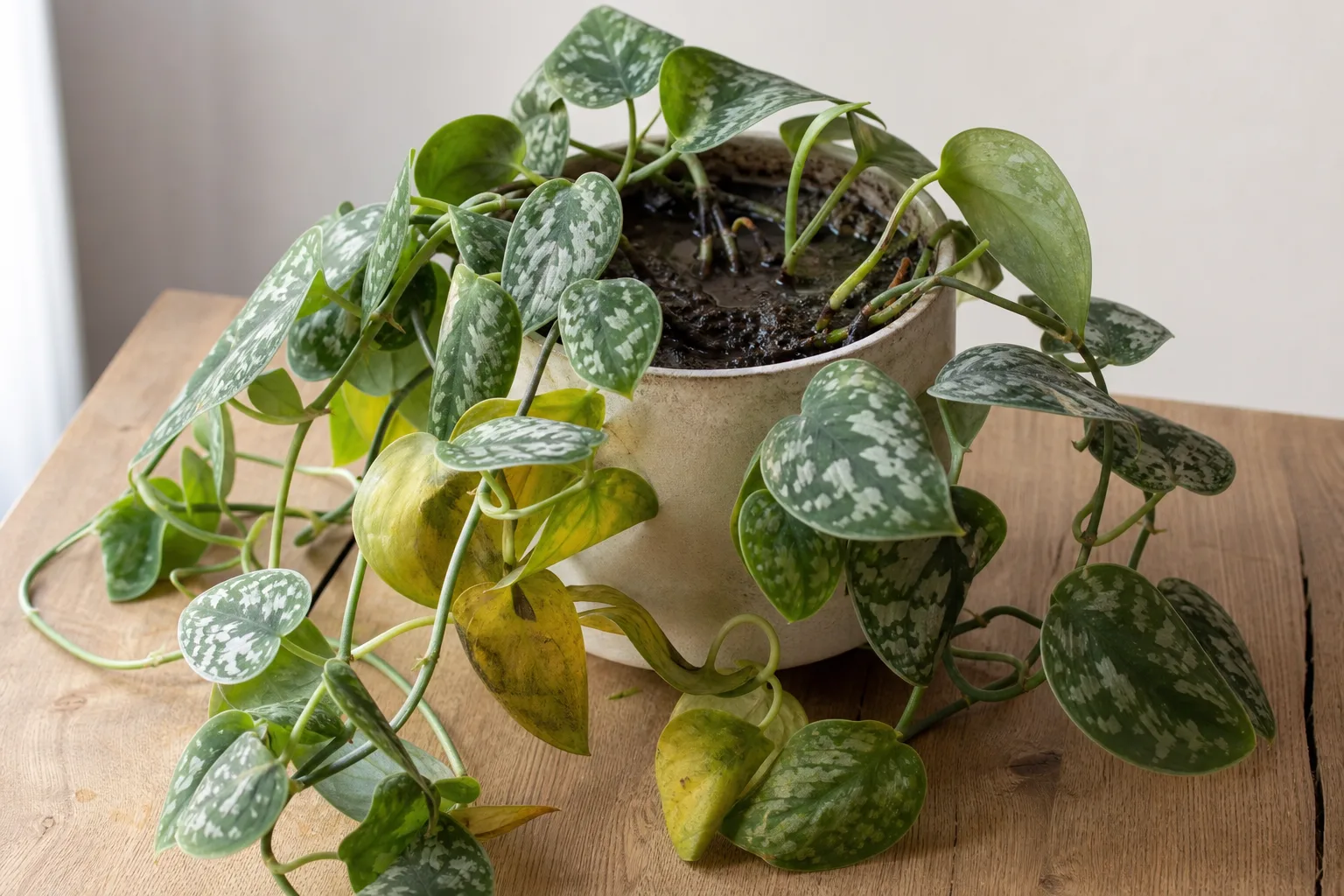
Yellow lower satin leaves and limp vines on wet soil

Overwatering symptoms on Scindapsus Pictus - compare with healthy tissue on the same plant.
Overwatering and underwatering both cause drooping on trailing aroids, so read the soil and stem base-not just leaf posture. The matte satin surface on Scindapsus pictus leaves can mask early turgor loss; vines may look only slightly soft until lower foliage yellows, which is why pot weight and soil depth matter more than leaf droop alone.
Typical overwatering pattern:
- Yellow leaves starting on the oldest, lowest leaves along the vine
- Limp, soft-feeling satin foliage even though soil is wet to the touch
- Pot that feels unusually heavy days after watering
- Soil surface that stays dark and cool; sometimes green algae or white mold
- Soft, darkening tissue at stem nodes near the soil line in advanced cases
- Small fungus gnats hovering above the pot when mix stays constantly moist
- Sour or musty smell when you lift the plant from its pot
Healthy comparison:
- Firm green stems from soil line to growing tips
- Silver variegation crisp on matte green leaves
- Mix that dries in the top half within about 7–10 days during active indoor growth
- Lower leaves may age out and yellow one at a time on an otherwise firm plant-that is normal senescence, not overwatering
Yellow on wet soil is the key split from drought stress. Underwatered Scindapsus Pictus curls leaves inward, feels light in the hand, and has dusty dry mix pulling from the pot rim.
The wet-soil wilt trap
Damaged or oxygen-starved roots cannot move water upward-a pattern often called wet-soil wilt. The vine looks thirsty, so owners water again even though roots that cannot absorb oxygen are surrounded by waterlogged soil. On satin pothos, heart-shaped silver-blotched leaves droop in a way that mimics thirst, which makes this trap especially common.
Overwatering vs. lookalikes on Scindapsus Pictus
| Symptom pattern | Most likely cause | Pot / soil cue | Read next |
|---|---|---|---|
| Heavy pot, top half wet for days, lower yellow satin leaves, limp vines despite damp mix | Overwatering (this page) | Soggy but not yet sour; stems still firm when checked | Stay here |
| Light pot, dry throughout, inward leaf curl, fast perk-up after soak | Underwatering | Dry at 4–5 cm; recovery within 24 hours of water | Underwatering guide |
| Sour smell, dark mushy roots, soft stems at soil line | Root rot | Wet, anaerobic mix; roots soft and brown | Root rot guide |
| Widespread yellowing on wet soil without firm-stem recovery | Yellow leaves triage | Pattern and variegation dulling matter | Yellow leaves guide |
| Small flies on constantly moist surface | Fungus gnats | Mix never dries between drinks | Fungus gnats guide |
| Leggy vines, pale small leaves, slow dry-down in dim corner | Not enough light | Soil moisture normal but pot stays wet longer | Light guide |
| One or two oldest leaves yellow on firm stems, normal dry-down | Normal leaf aging | Top half dries on schedule | No rescue needed |
If you are unsure between mild overwatering and active rot, unpot gently before the next watering.
Why Scindapsus Pictus gets overwatered
Scindapsus Pictus-sold as satin pothos, silver pothos, or silk pothos-is often grouped with pothos in care guides, but it is slightly less forgiving of wet feet. All common cultivars (Argyraeus, Exotica, and similar silver-splashed forms) share the same root-zone risk; Exotica’s larger leaves may transpire a bit faster in bright light, but none tolerate saturated mix.
Several factors stack on this species:
Calendar watering instead of soil checks. Watering every Sunday regardless of pot dryness ignores how light, season, and pot size change dry-down speed. A trailing basket in a dim hallway may stay wet for two weeks while the same mix in a bright east window dries in five days.
Low light slows water use. Scindapsus Pictus needs bright indirect light. In shade, photosynthesis and transpiration drop, so the same watering volume that worked in summer keeps roots saturated through winter.
Oversized or non-draining pots. A large decorative cachepot without a drainage hole traps runoff. An oversized container holds excess moisture around a small root ball-common on newly purchased trailing plants where the vine length outpaces root mass.
Heavy peat without perlite. Dense organic mix holds water like a sponge. Without perlite or bark, the top may look dry while the center stays soggy for days.
Winter rhythm unchanged. Cooler rooms and shorter days reduce growth. Continuing summer watering frequency into winter is a reliable path to yellow lower leaves on this plant.
How to confirm the cause
Work through these checks before repotting or trimming:
- Pot weight - Lift the container. A heavy pot days after watering confirms excess moisture. A feather-light pot suggests drought instead.
- Moisture at depth - Stick your finger or a dry skewer 4–5 cm into the mix. If it comes out wet or clumped while leaves are yellowing, overwatering is likely.
- Stem firmness - Pinch stems at the soil line and at a mid-vine node. Firm green tissue supports recovery. Mushy, collapsing tissue means rot may already be present.
- Drainage check - Confirm the pot has open drainage holes and is not sealed inside a decorative outer pot holding standing water.
- Light audit - Note placement. A plant in a north-facing room or far from windows uses water slowly; adjust expectations before blaming the plant.
- Recent care history - Repotting into heavy mix, a gift from someone who watered daily, or a cold drafty spot after a warm summer can all shift the balance toward saturation.
If soil is wet, stems are firm, and only a few lower leaves have yellowed, treat as early overwatering-dry-down and light adjustment may be enough. If soil smells sour or stems are soft, unpot and inspect roots before watering again.
First fix for Scindapsus Pictus
Mild cases: stop watering and improve light
Stop all watering and move the plant to brighter indirect light so the mix can dry.
This is the one action that helps most early cases. Do not pour more water because leaves look limp-that worsens root oxygen loss when soil is already saturated. Do not fertilize, mist heavily, or repot on day one unless stems are mushy.
Place the pot where it gets medium to bright indirect light but not hot direct sun. Better light increases water use through the leaves and helps the root zone dry evenly. Tilt the pot slightly and empty any saucer or cachepot reservoir.
Wait until the top half of the soil is dry throughout-test with a finger or skewer, not just the surface crust. On a typical indoor Scindapsus Pictus in a 15–18 cm pot, that may take one to two weeks depending on how oversaturated the mix was.
When the dry-down test passes and stems still feel firm, water once thoroughly until excess drains from the bottom, then discard runoff immediately. Resume the normal rule from the watering guide: water only when the top half dries again.
Moderate cases: inspect roots, trim rot, repot
If stems are soft at the base or dry-down alone does not stop decline, escalate to the step-by-step recovery below or the full root rot on Scindapsus Pictus protocol.
Step-by-step recovery
If early dry-down is not enough-or stems are soft at the base-escalate in this order:
- Unpot gently - Slide the plant out and shake away wet soil so you can see root color and smell the mix. Healthy roots are firm and white or tan. Brown, translucent, or mushy roots confirm damage-root rot may occur in poorly drained or wet soils on this species.
- Trim rotted tissue - Cut mushy roots and any soft stem back to firm green with clean scissors. Scindapsus pictus is toxic to cats and dogs; wear gloves when handling cut tissue and wash hands after pruning. Let cut surfaces air-dry for several hours on a paper towel.
- Repot into airy mix - Use fresh potting soil amended with perlite in a container only slightly larger than the remaining root mass, with a drainage hole. Do not jump to a huge pot because the vine is long.
- First post-trim watering - Wait until the top half of the new mix dries before the first cautious drink. The root system is smaller and needs less volume.
- Remove spent leaves - Yellow or brown lower leaves will not re-green. Snip them off once the plant is stable to redirect energy to new growth.
- Address fungus gnats if present - Let the surface dry between waterings and consider yellow sticky traps. Gnat larvae thrive in constantly wet mix; drying breaks their cycle-see fungus gnats on Scindapsus Pictus for full protocol.
- Salvage cuttings if needed - If the base is too far gone but upper nodes are firm, take stem cuttings with at least one node and root them in water or moist perlite while you attempt to save the parent. Keep trimmings away from pets because sap can irritate mouths.
Isolate a repotted plant from other houseplants until you know rot is not spreading and new growth appears.
Recovery timeline
Minor overwatering with firm stems often shows improvement within two to three weeks after the first proper dry-down and corrected light. Lower yellow leaves may drop, but new silver-marked leaves at the tips confirm the plant is stabilizing.
Example recovery arc: A trailing basket in a dim hallway watered every Sunday stayed heavy for ten days; lower satin leaves yellowed while soil at 4–5 cm remained damp. After stopping water, moving to bright indirect light, and waiting twelve days for the top half to dry, one new silver-marked leaf unfurled at the tip within three weeks-old yellow foliage did not re-green, but firm stems and predictable dry-down confirmed stabilization.
Moderate root trimming and repotting typically need four to six weeks before you see consistent new vine extension. Judge success by firm stems, fresh leaf unfurling, and soil that dries predictably in the top half-not by old yellow foliage re-greening.
Severe rot with most roots removed may take a full growing season to rebuild, or the parent may fail while stem cuttings root in four to six weeks. Scindapsus Pictus propagates readily from healthy nodes, which is a practical backup when the root ball is mostly gone.
Mistakes to avoid
Do not keep watering because limp leaves look thirsty when soil is already wet-that is the classic overwatering trap on aroids.
Do not repot into a much larger pot to “give roots room.” Extra soil holds extra water around a damaged root ball.
Do not rely on moisture meters alone without finger checks; dense peat can read inconsistently at different depths.
Do not place a recovering plant in direct sun to “dry it out faster.” Scindapsus Pictus scorches in harsh sun; bright indirect light is the correct drying aid.
Do not fertilize until new growth resumes on a stable watering rhythm. Salt load on compromised roots adds stress.
Do not assume all yellow leaves mean overwatering without checking soil moisture first-dry soil with curl means the opposite fix on the underwatering guide.
How to prevent overwatering next time
Build a rhythm around the pot, not the calendar. Check the top half of soil weekly and water only when that zone is dry. In typical indoor conditions that often means every 7–10 days during active growth and every 14 days or longer in winter-but your room’s light and humidity set the real schedule. The watering guide covers seasonal intervals in detail.
Use well-draining mix with perlite and a pot with a drainage hole sized to the root ball, not the vine length. Empty saucers within 30 minutes of every watering.
Keep medium to bright indirect light so the plant uses water steadily. If you move the pot to a dimmer spot, reduce watering before yellow leaves appear.
Reduce volume and frequency when indoor temperatures drop or growth slows. Reduce watering over winter when growth slows-a satin pothos in a cool room can sit nearly dormant while soil stays wet for weeks if you do not adjust.
Watch for fungus gnats as an early warning-persistent gnats often mean the mix never dries enough between drinks.
When to worry
| Situation | Action |
|---|---|
| Top half dries, stems firm, yellowing slows | Continue dry-down; resume careful watering per watering guide |
| Sour smell, some mushy roots, stems still firm | Trim, repot airy mix, monitor weekly |
| Soft crown at soil line, widespread collapse, mostly mushy roots | Full root rot triage now |
| Fungus gnats during wet recovery | Dry surface between drinks; follow fungus gnats protocol |
A plant with mostly mushy roots and a soft base may not be saveable as a whole specimen. Take firm stem cuttings immediately before tissue declines further.
Non-urgent: one or two yellow lower leaves on firm stems after a single overwatering event. Dry-down and corrected habits usually suffice.
Related Scindapsus Pictus guides
- Scindapsus Pictus overview - species hub, pothos naming mix-up, and care basics
- Scindapsus Pictus watering - prevention hub with top-half dry-down rhythm and seasonal intervals
- Root rot on Scindapsus Pictus - trim-and-repot when inspection confirms decay
- Underwatering on Scindapsus Pictus - dry-pot lookalike with curled satin leaves
- Yellow leaves on Scindapsus Pictus - pattern triage when yellowing spreads on wet soil
- Fungus gnats on Scindapsus Pictus - wet-mix early warning
- Not enough light on Scindapsus Pictus - slow dry-down in dim corners
- Scindapsus Pictus light - placement to hold silver variegation
Conclusion
Use this page to rescue a satin pothos sitting in wet soil-confirm with pot weight and stem firmness, dry down before you repot, and escalate to root rot triage only when inspection confirms mushy tissue. For everyday watering rhythm after recovery, follow the watering guide. Crisp new silver-marked leaves within a few weeks-not old blades re-greening-mean your vine is stabilizing.