Underwatering on Scindapsus Pictus: Causes, Checks & Fixes
Quick answer
Underwatering on Scindapsus Pictus shows as inward-curling satin leaves, limp trailing vines, and bone-dry soil that may pull from the pot rim. First step: water thoroughly until excess drains, then resume when the top half of soil dries.
Underwatering on Scindapsus Pictus: Causes, Checks & Fixes
This guide covers underwatering on Scindapsus Pictus. See also the general Underwatering guide, watering, and light pages for this plant.
Underwatering on Scindapsus Pictus: Causes, Checks & Fixes
Quick answer
Underwatering is less common on Scindapsus Pictus than overwatering, but it still happens-especially on hanging baskets, small pots in bright windows, or plants you have been watering cautiously after a past rot scare. This trailing aroid with heart-shaped satin leaves curls foliage inward when roots run dry too long. Soil may shrink from the pot edge, the container feels feather-light, and vines hang limp even though stems stay firm.
First step: water thoroughly until excess drains from the bottom, then discard saucer water. Do not give occasional sips. A proper soak rehydrates the root ball; surface splashes on hydrophobic dry mix often fail to reach roots. Vines usually perk within 24 hours if drought has not killed fine root hairs. Resume your normal rhythm-water when the top half of soil dries-not on a fixed weekly calendar.
Why Scindapsus Pictus gets underwatered
Scindapsus Pictus tolerates brief dry spells better than constant sogginess, which makes underwatering easy to underestimate. Growers who recently lost a plant to root rot often swing too far the other direction, waiting until leaves curl before watering at all. That cycle-long drought, emergency soak, long drought again-stresses roots and fine root hairs more than steady partial dry-downs.
Several setup factors speed drying on this plant:
- Small pots and hanging baskets - Trailing vines in 10–15 cm pots can lose moisture in a few days under bright indirect light. A satin pothos on a warm east window dries faster than the same plant on a shaded interior shelf.
- Bright light and warm rooms - Higher light and temperatures increase transpiration. The plant uses water faster even though its care label says “forgiving.”
- Root-bound conditions - A crowded root ball fills the pot with roots and little water-holding mix. Pots that dried in two days when you bought the plant may dry in one day a year later.
- Hydrophobic peat-heavy mix - When potting soil stays dry too long, it repels water. The surface looks briefly damp after a quick pour while the center stays dusty-dry inside.
- Seasonal habit without seasonal adjustment - You may water less in winter correctly, then forget to increase checks when spring growth resumes and the pot starts drying twice as fast.
- Travel and neglect - Two weeks without water in summer can push a small basket into severe drought. Larger floor pots survive longer but still curl when the top half has been dry for too long.
Unlike succulents, Scindapsus Pictus is a tropical aroid that expects periodic moisture in well-drained mix-not permanent drought. It will survive missed waterings, but repeated dry cycles yellow and drop older leaves and stall new silver-marked growth.
What underwatering looks like on Scindapsus Pictus
Learn the pattern on this species before you treat every limp vine the same way.

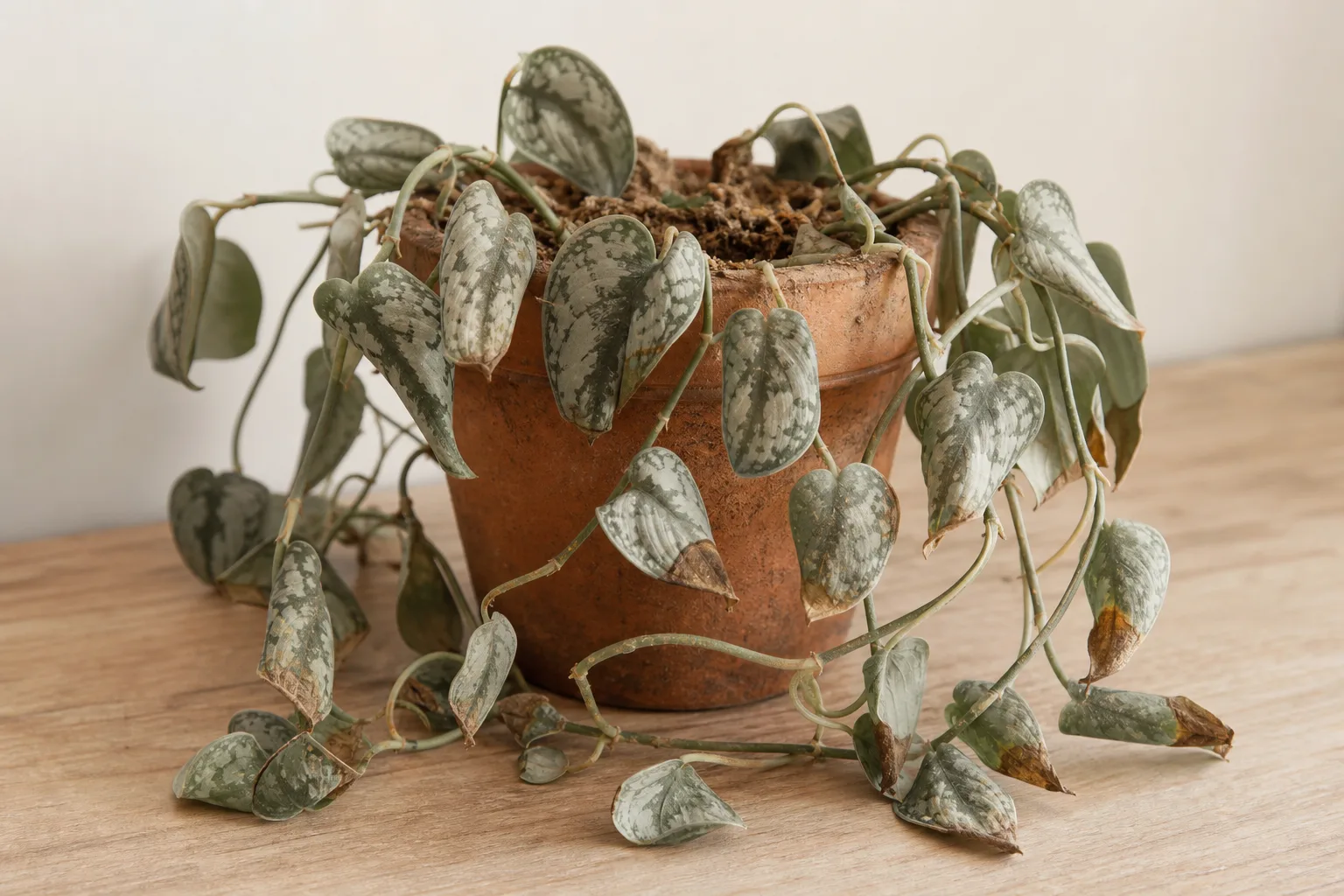
Underwatering symptoms on Scindapsus Pictus - compare with healthy tissue on the same plant.
Typical underwatering signs:
- Inward leaf curl - Heart-shaped leaves roll lengthwise toward the midrib, reducing surface area to conserve water. Silver variegation looks dull or slightly folded rather than flat and satin-smooth.
- Limp trailing vines - Stems may hang softly while still feeling firm-not mushy. This is different from overwatering collapse, where wet soil and soft crown tissue often appear together.
- Dry soil throughout - The top half of the mix is dusty-dry. Soil may pull away from the pot wall, leaving a gap you can see or feel along the rim.
- Very light pot weight - Lift the container. A thoroughly dry satin pothos feels noticeably lighter than one with evenly moist mix.
- Thin or crispy leaf edges - Older leaves may brown at margins after repeated dry cycles. The tissue is dead and will not re-green.
- Slow growth or smaller new leaves - Chronic drought produces tight, smaller leaves along extending vines compared with well-watered plants.
What underwatering usually does not include:
- Yellow lower leaves on wet soil (classic overwatering on this plant)
- Sour-smelling mix or mushy stems at the soil line
- Black or brown soft roots when you inspect
- Uniform stickiness or visible pest clusters on leaf undersides
The NC State Extension profile for this species pairs curling leaves with underwatering and yellow leaves with overwatering-a useful split when you are standing over a stressed plant unsure which direction you missed.
How to confirm underwatering
Work through these checks in order before you pour:
- Pot weight - Pick up the container. A light pot with limp vines strongly suggests drought. A heavy pot with limp vines suggests overwatering or root damage instead.
- Moisture at depth - Stick your finger or a dry skewer 4–5 cm into the mix. Bone-dry at that depth confirms the plant has gone too long without water. Surface dust alone is not enough-probe deeper.
- Soil shrinkage - Look for a gap between mix and pot wall. Dry peat pulls inward, and water runs down that channel without soaking the root ball.
- Stem firmness - Pinch stems near the soil line. Firm tissue with dry soil fits underwatering. Soft, discolored tissue with damp soil fits rot.
- Leaf pattern - Inward curl on multiple leaves along trailing vines, without widespread yellowing on wet soil, points to drought.
- The perk test - If you are unsure and stems are firm, give one thorough watering and recheck in 12–24 hours. Underwatered Scindapsus Pictus typically re-turgid within a day. No improvement with wet soil means look elsewhere-roots, light, or pests.
If soil is wet and stems are soft, do not keep watering. That is not underwatering.
First fix for Scindapsus Pictus
Water thoroughly until excess runs from the drainage hole, then empty the saucer.
Place the pot in a sink or shower. Water slowly across the surface until you see steady drainage. Wait one minute, then water again so the entire root ball wets-not just the top crust. For hanging baskets, water until drips fall consistently from the bottom.
If water runs straight through a gap along the pot wall, the mix has likely gone hydrophobic. Bottom-water for 30–45 minutes: set the pot in a tray of water until the surface darkens, then lift and let excess drain. You can also poke a few shallow holes in the dry crust with a chopstick before top-watering to break surface tension.
Do not fertilize a drought-stressed plant. Do not repot on day one unless the mix is so degraded it cannot hold moisture at all. Do not mist leaves instead of soaking roots-misting raises humidity briefly but does not replace soil moisture.
Step-by-step recovery
After the initial thorough soak:
- Wait 12–24 hours - Check whether curled leaves flatten and vines stiffen. Mild drought usually shows improvement quickly.
- Repeat slow watering if needed - Hydrophobic mix sometimes needs two sessions in one week before the center stays evenly moist.
- Trim only fully crispy leaves - Brown dead edges will not recover. Remove them for appearance once the plant is stable, not before it rehydrates.
- Move to appropriate light if placement was wrong - Bright indirect light helps the plant use water predictably. Direct hot sun on a drought-stressed vine can worsen curl even after watering.
- Inspect roots only if no perk-up - If vines stay limp after two thorough soaks 48 hours apart, slide the plant out. Healthy roots are firm and white or tan. Shriveled dry roots suggest prolonged drought; mushy brown roots suggest rot from a prior overwatering episode.
- Resume normal rhythm - Water when the top half of soil dries. For many indoor plants that means roughly every 7–10 days in active growth and every 14 days or longer in winter-but your pot’s dry-down speed is the real schedule.
If severe drought damaged most fine roots, take healthy stem cuttings with nodes while you stabilize the parent. Scindapsus Pictus roots readily from cuttings if the main plant recovers slowly.
Recovery timeline
Mild underwatering often shows visible perk-up within 12–24 hours of a proper soak. Leaf curl relaxes first; older crispy margins stay brown permanently.
Moderate drought-where soil was dry for one to two weeks-may take two to three days before new growth looks normal. Expect some older leaves to yellow and drop as the plant sheds tissue it cannot support.
Severe prolonged drought with root damage can take one to three weeks before steady new leaves unfurl along vines. Judge success by firm stems and fresh silver-marked growth, not by old damaged foliage.
Lookalike symptoms to rule out
Overwatering and root rot - Limp vines with wet heavy soil, yellow lower leaves, and mushy stems. Roots may rot in poorly drained soils on this species. Curl can appear here too when roots fail, but soil moisture tells them apart. Dry soil plus firm stems means drought; wet soil plus soft stems means stop watering and inspect roots.
Low humidity - Dry air browns leaf tips and margins without always curling entire leaves inward. Humidity stress often hits older leaf edges while soil moisture is adequate. Grouping plants or raising ambient humidity helps tips; it does not replace a dry root zone.
Too much direct sun - Scindapsus Pictus prefers bright indirect light. Hot direct rays can curl or scorch leaves even when soil moisture is fine. Check whether the plant was recently moved to a harsh window.
Spider mites - Fine stippling, webbing, and dusty leaf undersides-not typically inward curl from dry soil alone. Confirm with a white paper tap test under leaves.
Normal slight curl on new leaves - Newly unfurling leaves sometimes look curled before opening flat. That is growth, not drought. Worry when mature leaves along established vines curl inward and the pot is light.
Mistakes to avoid
Do not assume every limp Scindapsus Pictus needs water-check soil first. Improper watering is among the most common causes of unhealthy houseplants, and overwatering kills more of these plants than underwatering.
Do not give small sips on a schedule. Shallow watering wets the top inch while roots deeper in the pot stay dry, especially in root-bound or hydrophobic mix.
Do not wait for leaves to curl severely before every watering. Curl is a late signal. Learn your pot’s dry-down time and water when the top half dries.
Do not confuse underwatering with overwatering and keep pouring. Yellow leaves on wet soil need drying, not another soak.
Do not fertilize to ” perk up” a dry plant. Rehydrate first.
Do not repot into a much larger pot hoping it holds more water. Oversized pots stay wet too long around small root balls and invite rot on this aroid.
How to prevent underwatering next time
Build a check habit, not a calendar habit:
- Probe weekly - Touch the top 4–5 cm of mix or lift the pot. Water when that zone is dry, even if that means twice in one week during a heat wave or skipping two weeks in dim winter.
- Match pot to plant - When roots fill the container and the pot dries in one to two days, plan a spring repot into fresh well-draining mix with perlite-not a huge jump in size.
- Refresh old mix - Peat-heavy soil that has dried repeatedly may need replacement so it absorbs water evenly again.
- Adjust for placement - Hanging baskets near HVAC vents, sunny sills, and small terracotta pots all dry faster than a shaded shelf plant in glazed ceramic.
- Use cachepots correctly - If the plant sits inside a decorative outer pot, remove it to water, soak thoroughly, and never let the inner pot sit in standing runoff.
Pair this rhythm with bright indirect light and airy mix. Scindapsus Pictus performs best when the upper half of the root zone dries between thorough soaks in moist, well-drained potting soil-not when it lives in permanent drought or constant wetness.
When to worry
Most underwatered Scindapsus Pictus recover with one or two proper soaks. Escalate when:
- Soil has been completely dry for many weeks and vines feel brittle or shriveled
- Many leaves drop at once after rehydration
- Stems stay limp after two thorough waterings 48 hours apart
- Roots are mostly shriveled, brown, and dead when you inspect
- New growth stays stalled for more than three weeks despite correct moisture
At that point, propagate firm stem cuttings and treat the parent as a long recovery project-or replace it if stems have desiccated completely. This plant is resilient, but fine roots cannot regenerate overnight after months of neglect.
Related Scindapsus Pictus guides
- Scindapsus Pictus overview
- Scindapsus Pictus watering
- Scindapsus Pictus light
- Overwatering on Scindapsus Pictus
- Drooping Leaves on Scindapsus Pictus
- Wilting on Scindapsus Pictus
- Root Rot on Scindapsus Pictus
- All Scindapsus Pictus problems
Conclusion
Use this page to confirm underwatering on Scindapsus Pictus by pattern and pot checks-not by treating every houseplant the same. When symptoms overlap with sibling pages, follow the linked guide for the matching cause before stacking fertilizer, repotting, or pesticide.