Pale Leaves on Spider Plant: Causes, Checks & Fixes
Quick answer
Pale leaves on spider plant look washed-out, dull yellow-green, or faded across arching strap blades—often with weak variegation stripes and slow spiderette production. First step: inspect the newest crown leaf and run a midday shadow test at the pot; uniform fade with faint shadow means move to bright indirect light before changing water or feed.
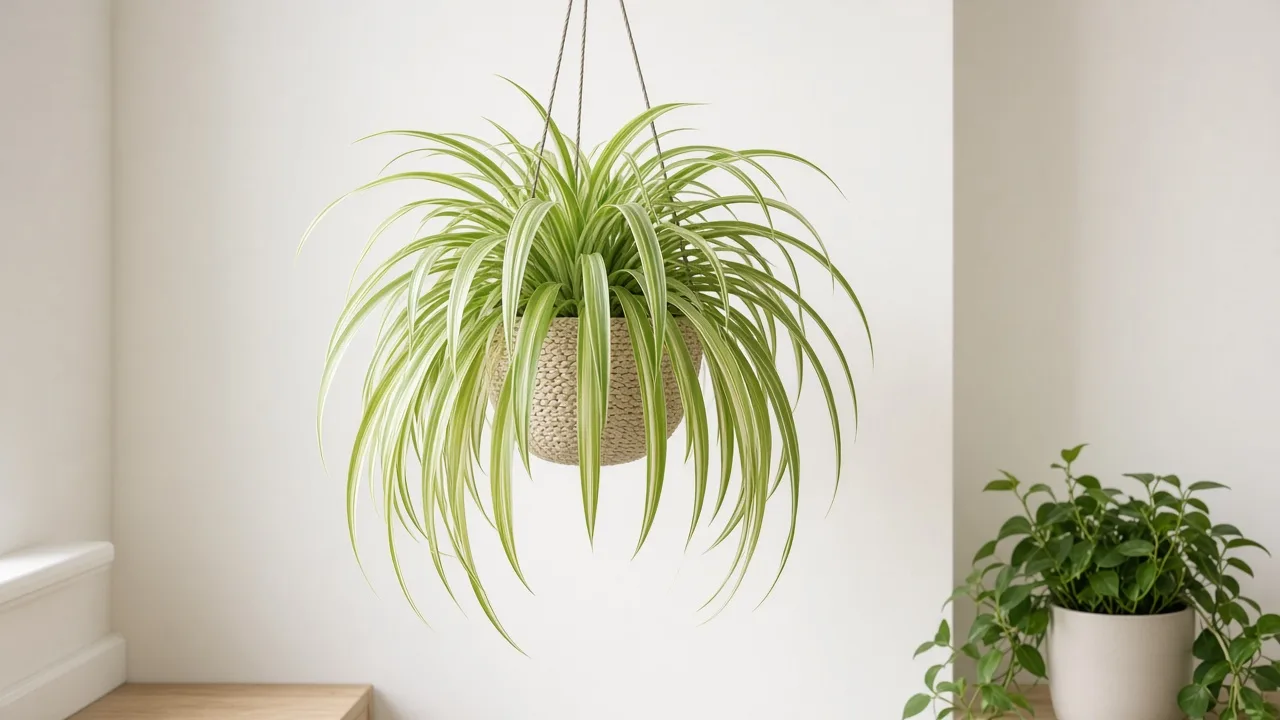
Pale Leaves on Spider Plant: Causes, Checks & Fixes
This guide covers pale leaves on Spider Plant. See also the general Pale Leaves guide, watering, and light pages for this plant.
Pale Leaves on Spider Plant: Causes, Checks & Fixes
Quick answer
Pale leaves on spider plant (Chlorophytum comosum) look washed-out, dull yellow-green, or faded instead of the crisp green-and-white arching blades a well-lit basket shows. For general chlorosis mechanics, see our pale leaves guide. On spider plant, uniform fade across many strap leaves—especially when white or cream variegation stripes wash toward solid green—is the signature low-light pattern.
First step: inspect the newest arching leaf at the crown center and run a midday shadow test at the pot. If color is faded and the shadow on foliage is faint or absent, move the basket to bright indirect light before you change watering or feed. If pale lower leaves sit on mix wet 5 cm down for many days, stop watering and check tuberous roots instead.
NC State Extension notes that spider plant prefers medium light yet tolerates deep shade, and RHS guidance adds that in low light growth slows and leaves may lose variegation. Survival in a dim hall is not the same as thriving—pale foliage is how the plant tells you photosynthesis is falling behind.
When to use this page vs other Spider Plant guides
| Pattern | Read next |
|---|---|
| Uniform washed-out green, faded stripes, dim room | Pale leaves (this page) |
| Long bare stolons, few spiderettes, stretched runners | Not enough light |
| Soft yellow lower leaves on heavy wet pot | Yellow leaves or overwatering |
| New crown blade yellow with green veins | Iron deficiency |
| Fine speckles and webbing on undersides | Spider mites |
| Crispy brown tips without overall washout | Brown tips — fluoride or salts |
| Leggy spacing as the main complaint | Leggy growth |
What pale leaves look like on Spider Plant
Healthy spider plant forms a fountain of arching linear strap leaves from a central tuft, often with white or cream stripes on variegated cultivars. Pale foliage breaks that pattern in recognizable ways depending on cause.
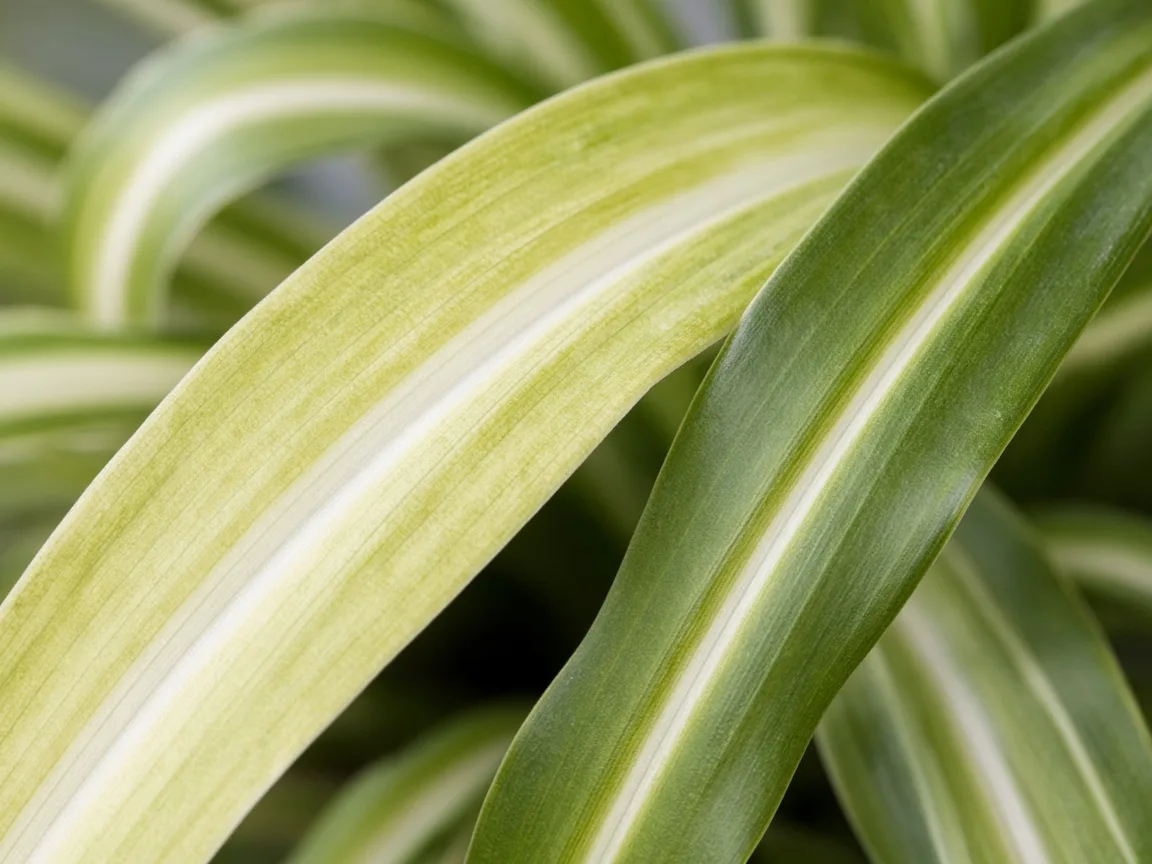
Pale leaf symptoms on Spider Plant - compare faded strap blade with healthier green tissue on the same plant.
Low-light chlorosis (most common indoors)
- Uniform washed-out yellow-green across several arching blades—not isolated spots
- Variegation stripes fade on ‘Vittatum’ and ‘Variegatum’—white or cream sectors wash toward plain green before solid-green plants look obviously stressed
- New crown leaves open smaller and thinner than mature blades a few nodes back on the same rosette
- Few or no spiderettes on stolons, or long bare runners reaching toward the brightest wall
- Soil stays damp at the surface for two weeks or more because the plant uses little water in shade
Root-stress pale (wet mix)
- Lower arching leaves fade yellow-green while mix stays damp 5 cm down for 10+ days
- Stems stay firm at first, but growth stalls; sometimes paired with yellowing
- Upper crown tips may also pale if tuberous root uptake is failing—not just natural lower-leaf aging
- Pot feels heavy; fungus gnats may hover when soil never dries
Drought pale (underwatering lookalike)
- Dull, slightly gray-green blades that feel limp and papery, not crisp
- Mix is bone-dry 5 cm down; hanging basket feels very light
- RHS notes that pale dull foliage can indicate the plant needs water and often revives quickly after a thorough drink—unlike chronic low-light fade that does not perk up after watering alone
Nutrient chlorosis (last diagnosis)
- Interveinal yellowing on the newest crown leaf with veins staying darker green — iron deficiency
- Oldest lower blades pale first in bright light with firm roots — nitrogen deficiency
- Never assume deficiency in a dim corner—fix placement and moisture before any feed
Pest stippling (looks pale from a distance)
- Fine yellow speckles scattered across strap leaf surface with possible webbing on undersides
- Pattern is stippled, not evenly washed-out green
- Common in dry winter rooms—confirm with spider mites on spider plant before treating light
Cultivar baseline (not a problem)
- Solid-green Chlorophytum comosum should look medium to deep green in good light—uniform pale washout is still a stress signal
- ‘Lemon’ and other pale cultivars are naturally lighter chartreuse—that is healthy pigment, not chlorosis
- Worry when a cultivar that used to open vivid striped blades starts producing smaller, duller, thinner new leaves
Why arching spider plant fades before it yellows
Spider plant earns its beginner-friendly reputation because it tolerates deep shade while many houseplants would stall. Indoors, a basket in a dim hallway still grows toward photons—but with less chlorophyll per strap leaf. The plant opens smaller, paler blades rather than stopping growth entirely.
That is why pale leaves often appear before widespread yellow leaves. Metabolism slows in weak light, so owners who water on a summer calendar keep mix damp while the plant uses little water. The compound trap—pale crown tips plus wet soil—is a common path to root rot on spider plant even when you are not obviously overwatering.
Variegation and the light budget
White and cream sectors on variegated spider plants contain no chlorophyll. Plant Care Today notes that brighter indirect light produces more pronounced variegation in striped varieties—the plant prioritizes photosynthetic green tissue in new growth when the photon budget is low. A ‘Vittatum’ reverting to plain green in a north room is a light problem, not a separate disease.
Tuberous roots and slow dry-down in shade
Spider plant stores water in fleshy tuberous roots. In dim corners the plant draws little moisture, so the top of the mix can look acceptable while the root zone stays damp too long. Pale yellow-green lower leaves on chronically wet soil can look like chlorosis from deficiency when the real issue is oxygen loss at tubers—see overwatering if the pot feels heavy and sour.
Stolon and spiderette stall as a pale-light signal
NC State explains that stolons and plantlets develop when the mother plant receives short days and long uninterrupted nights for at least three weeks. Chronic under-lighting still shows up earlier as faded blades and bare searching stolons before offsets appear. A mature, well-lit spider plant with pale foliage but strong stripe contrast on new growth is a different puzzle than a dim basket that has not pushed a spiderette in months—pair this page with not enough light when stolon stretch is the main symptom.
How to confirm the cause
Work through these checks in order:
- Crown new-growth color — Pale small arching leaf at the center tuft with faded stripes = low light. Rich green with tight spacing = light is probably fine.
- Midday shadow test at the pot — A soft defined shadow on foliage means moderate light; faint or absent shadow means too dim for healthy color on most cultivars per University of Maryland Extension lighting guidance.
- Cultivar check — Is this naturally pale ‘Lemon’? Are stripes reverting to all-green on ‘Vittatum’? Match expectations to type.
- Soil moisture at 5 cm — Wet and heavy with pale limp lowers = root stress. Appropriately dry with pale fade = light.
- Vein pattern on newest leaf — Green veins with yellow tissue between them = iron, not simple low light.
- Leaf undersides — Speckling and webbing = pests, not uniform chlorosis.
- Pot weight after watering — Light, dry, limp = drought pale. Heavy, wet, pale = moisture failure.
If you move to brighter indirect light for two weeks and the next two crown leaves open greener with stronger variegation, light was the primary issue.
First fix for Spider Plant
Move the pot to bright indirect light—near an east window, or set back from south or west glass where harsh midday sun will not scorch the blades. Rotate the hanging basket a quarter-turn each week so all sides of the arching fountain receive similar intensity.
That single change is the right first fix when:
- Many blades look uniformly washed-out
- Variegation has faded toward solid green
- New crown leaves are smaller than older ones
- The room shadow test reads faint
Do not repot, fertilize, or soak the plant on day one. Better light unlocks normal water use so your existing watering rhythm starts working again.
If light is already adequate
When the shadow test passes but pale foliage persists:
- Wet heavy pot — Stop watering until the top 5 cm dries; check tuber firmness before the next soak. See overwatering.
- Bone-dry limp blades — Water thoroughly until excess drains, then empty the saucer. See underwatering.
- Green-veined yellow new crown leaf — Address root zone and chelated iron per iron deficiency.
- Speckled pattern — Isolate and rinse undersides before any spray; see spider mites.
Step-by-step recovery
- Week 1 — Improve light or correct moisture only. No fertilizer, no repot unless tubers are mushy.
- Week 2 — Watch the next crown leaf unfurl. Greener tissue with sharper stripes confirms the right branch.
- Week 3–4 — Trim fully bleached old blades if they spoil the look; they will not re-green.
- Month 2 — On mature plants in good light, stolons may resume spiderette production if photoperiod and pot size allow per NC State offset guidance.
- Ongoing — Match watering to how fast this specific pot dries in its new spot, not a calendar from the old corner.
Recovery timeline
Mild low-light fade often stabilizes within two to four weeks after brighter placement—the timeline of two or three new crown leaves. Root-stress pale on wet mix may take four to six weeks once dry-down is consistent and damaged tubers are removed if needed.
Judge recovery by:
- New crown leaves opening greener with stronger variegation
- Firmer arching blades that do not wilt between normal waterings
- Stable pot weight on your usual dry-down cycle
- Stopped spread of washout to additional blades
Existing pale strap leaves rarely return to their original depth of color. That is normal—not a sign the fix failed.
Lookalike symptoms
| What you see | Likely cause | Page |
|---|---|---|
| Uniform dull yellow-green, faded stripes | Low light | This page / not enough light |
| Soft yellow lowers on wet mix | Overwatering / root stress | Yellow leaves |
| Yellow new leaf, green veins | Iron chlorosis | Iron deficiency |
| Speckles + webbing | Spider mites | Spider mites |
| Bleached patches on sun-facing blades | Too much direct sun | Move away from glass; not classic pale chlorosis |
| One old base blade fading | Normal aging | No action if rest of plant is firm |
Mistakes to avoid
- Fertilizing a dim, pale basket — Spider plant in low light uses few nutrients; feed can burn roots on a plant not actively growing.
- Soaking to “green up” pale leaves — If soil is already wet, more water deepens tuber stress and worsens fade toward yellow.
- Assuming pale means hungry — RHS notes yellowing is usually lack of light rather than nutrient deficiency; move the plant before reaching for fertilizer.
- Repotting on day one — Unnecessary unless tubers are soft or the mix is failing; light or moisture correction comes first.
- Ignoring variegation loss — Stripe fade on ‘Vittatum’ is an early warning before stolons stop entirely.
How to prevent pale leaves next time
Place the parent plant in bright indirect light, rotate hanging baskets weekly, and water when the top 5 cm of mix is dry—roughly every 7–10 days in active growth for most homes. Variegated cultivars need brighter filtered light than solid-green forms to hold stripe contrast.
Refresh depleted potting mix at repotting every one to two years, and feed lightly during spring and summer per the fertilizer guide only after light and moisture are stable. In winter, expect slightly paler new growth when window intensity drops—move closer to glass or add supplemental light rather than increasing water.
Related Spider Plant guides
- Spider Plant overview — full care hub and growth expectations
- Problems hub — all symptom guides for this species
- Not enough light — when stolon stretch and missing spiderettes are the main issue
- Leggy growth — long bare runners with wide gaps
- Slow growth — stalled rosette when pale color is mild
Use this page when overall blade color looks washed-out or variegation has faded across the arching fountain. Use sibling guides when one symptom—yellowing, pests, brown tips, or stretch—clearly dominates the pattern.