Tomato Pruning: Determinate vs Indeterminate Guide
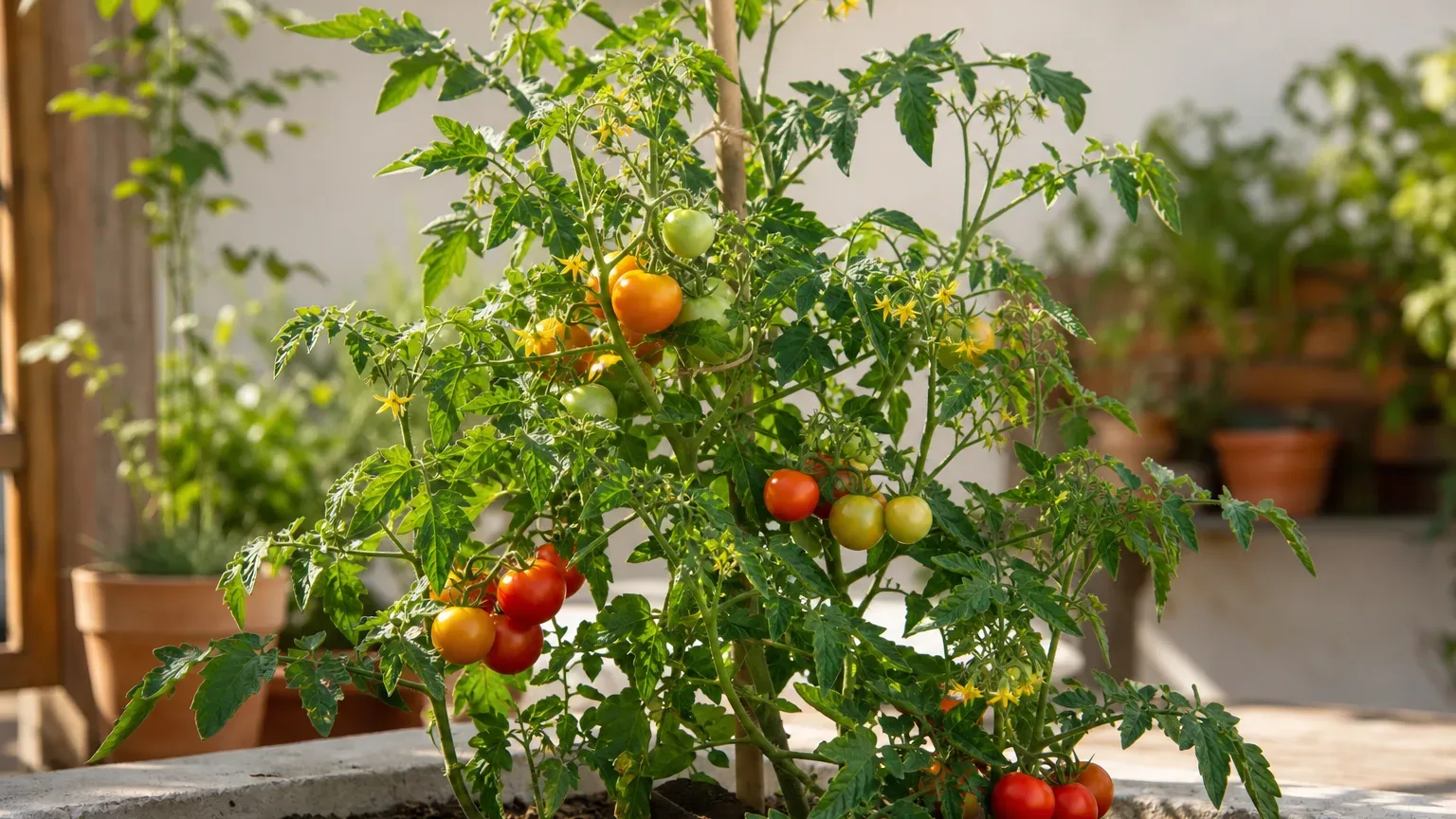
Tomato Pruning Guide: Determinate vs Indeterminate Plants
Tomato Pruning Guide: Determinate vs Indeterminate Plants
First, remove one dead, broken, or clearly diseased leaf or stem if one is present. Then stop and identify whether your tomato is determinate or indeterminate before touching healthy suckers. That single distinction prevents the most common mistake: stripping productive growth from a compact plant because every tomato was treated like a staked vine.
Reviewed by LeafyPixels Review Board · Author: sai-ananth
Quick answer
Tomatoes do not all need the same pruning. Determinate tomatoes form compact plants whose stems end in flower clusters and whose crop ripens in a relatively concentrated period; indeterminate tomatoes keep extending and setting fruit while conditions remain suitable. NC State Extension describes these as distinctly different growth habits, so the cultivar label—not a universal “remove every sucker” rule—should control your approach.
For a determinate tomato, limit pruning to damaged or diseased growth, leaves touching the soil, and perhaps one early cleanup of low shoots if the label or support method calls for it. For a supported indeterminate tomato, you may train one to three main stems by removing selected small suckers. You may also leave the plant largely unpruned in a roomy cage; NC State notes that caged plants are normally not pruned, with shoots guided upward instead.
Decide what kind of tomato you have
Check the seed packet, nursery tag, or cultivar listing before making structural cuts. A determinate plant reaches a cultivar-defined size and sets flower clusters at stem tips. Removing many of those shoots removes part of its finite flowering framework. An indeterminate plant keeps producing new stem length, leaf axils, and flower clusters, making selective training possible across a longer season.
Do not guess from current height alone. A young indeterminate plant may still look compact, while dwarf and patio cultivars can have growth patterns that do not fit a simple tall-versus-short test. If the label is missing, preserve healthy shoots until flowering pattern and continued tip growth make the habit clearer. The Tomato overview explains how cultivar habit also changes spacing and support.
| Plant and support | Routine pruning approach | Main risk |
|---|---|---|
| Determinate in a cage | Keep healthy suckers; remove damaged, diseased, or soil-contact leaves | Removing future flower clusters and reducing yield |
| Indeterminate in a roomy cage | Minimal pruning; tuck stems inward and tie as needed | Dense foliage if spacing and airflow are poor |
| Indeterminate on a stake or narrow trellis | Select one to three leaders; remove competing small suckers selectively | Over-pruning and exposing fruit to sun |
| Unknown growth habit | Cleanup only until identified | Making an irreversible cut based on a guess |
What a tomato sucker is—and why it is not automatically waste
A sucker is a shoot that forms in the leaf axil, the angle between a main stem and a leaf stalk. Left in place, it can become another full stem with leaves, flowers, and fruit. NC State’s home-garden guidance confirms that indeterminate suckers become larger fruiting stems, which is why “sucker” should not be read as “useless.”
Removing a sucker trades potential fruiting area for a simpler canopy. That can be worthwhile on an indeterminate plant tied to a narrow stake, where several unrestricted leaders become difficult to support. It may be unnecessary in a broad cage, and it is usually counterproductive when applied repeatedly to a determinate plant.
When to prune tomatoes
Make optional training cuts only when the plant is actively growing, adequately watered, and already attached to a suitable support. Begin after you can identify the main stem and the first small axillary shoots; do not strip a newly transplanted seedling while it is still establishing. In warm, frost-free climates, use the same growth-stage cues rather than a calendar month.
Work when foliage is dry. Remove a clearly diseased leaf promptly, but postpone cosmetic or training cuts during severe wilt, heat stress, recent transplant shock, or an unresolved root problem. Stabilize moisture using the Tomato watering guide before reducing healthy leaf area.
Toward the end of a short growing season, some growers top an indeterminate vine to redirect remaining growth toward existing fruit. This is climate- and harvest-window dependent, not routine midseason pruning. Do not top a determinate plant whose growing tips already terminate naturally in flower clusters.
Inspect before the first cut
Stand back and trace each stem from the soil line to its growing tip. Identify the main leader, leaf stalks, flower clusters, and axillary shoots. A flower truss emerges directly from the stem and carries buds or fruit; it is not a sucker and should not be cut during routine training.
Check five things:
- Growth habit: determinate, indeterminate, dwarf, patio, or unknown.
- Support: cage, stake, trellis, or unsupported. Utah State Extension notes that semi-determinate and indeterminate types need more support and vine management.
- Plant condition: firm new growth and stable moisture, not ongoing wilt or broad yellowing.
- Fruit exposure: enough leaves must remain to shade developing tomatoes.
- Disease pattern: spotted or yellow leaves may reflect a disease or watering issue that pruning alone cannot solve.
If long, weak stems are reaching from a dim balcony, correct Tomato light and support before trying to prune the plant compact. Cutting does not replace the direct sun needed for sturdy regrowth.
Tools and sanitation
Pinch a very small, soft sucker with clean fingers if it releases without tearing the main stem. Use sharp scissors or bypass pruners for thicker shoots, broken stems, and diseased leaves. Wipe or dip cutting surfaces using an extension-recommended disinfecting method; Iowa State Extension lists 70% isopropyl alcohol as an effective option for pruning shears.
Sanitize before starting and again after cutting suspicious tissue. Put diseased trimmings in a bag instead of leaving them under the plant. Tomato leaves and stems contain toxic alkaloids, and NC State identifies them as problematic if eaten, so keep fresh cuttings away from children and pets and wash your hands after handling.
How to prune a determinate tomato
Treat a determinate tomato as a fruiting bush, not a vine to reduce to one leader. Keep its healthy suckers because they help form the plant’s limited crop-bearing canopy. NC State describes determinate types as “self-pruning” because stems terminate in fruit clusters and advises that any early pruning be limited; later pruning reduces plant size.
- Remove a dead, broken, or clearly diseased leaf first.
- Cut only leaves that rest on soil or block safe access for watering and support.
- Preserve healthy axillary shoots and every flower cluster.
- Guide the bush inside its cage or add ties before considering more foliage removal.
- Reassess after several days rather than thinning the whole interior at once.
Do not “open the center” until it resembles a skeletal ornamental shrub. Tomato foliage powers fruit growth and protects fruit from intense sun. If a branch is heavy, support it; weight alone is not a reason to remove a productive stem.
How to prune a supported indeterminate tomato
Selective pruning makes the most sense when an indeterminate tomato is trained vertically in limited space. UF/IFAS recommends removing the first few side branches and retaining two to three main stems for its supported indeterminate system. That is one workable training plan, not proof that every sucker on every plant must go.
- Choose the strongest upright main stem.
- If the support has room, retain one or two vigorous low suckers as additional leaders.
- Locate unwanted suckers in leaf axils while they are still small.
- Pinch or cut each unwanted sucker at its base without nicking the main stem or leaf stalk.
- Tie retained leaders loosely below a leaf or fruit cluster, leaving room for stem thickening.
- Stop after a few cuts and check that the canopy still shades developing fruit.
Large suckers are already functioning stems. Removing several at once creates large wounds and discards productive leaves, so it can be safer to support them or shorten the training plan rather than chase an idealized single-stem shape.
Low leaves, diseased leaves, and damaged stems
Remove leaves that lie on the soil because splash and crowding keep them wet and place foliage close to contaminated debris. Cut the leaf stalk near its attachment without slicing into the main stem. As the plant grows, a modest clear space below the lowest fruit cluster can improve access and airflow, but there is no benefit in progressively baring the entire lower stem.
For leaf spots, remove only affected leaves that can be taken without severely thinning the plant, sanitize tools, and address watering, spacing, and diagnosis. Pruning cannot cure a systemic wilt or virus. If an entire stem is split beyond support, cut back to a healthy junction with a clean tool; if it is merely bent but still connected, splinting and tying may save more canopy than removal.
How much foliage to keep
Use canopy function rather than a fixed percentage. A productive tomato needs enough healthy leaf area to photosynthesize, cool the plant, and shade fruit. Utah State Extension notes that good leaf cover helps reduce sunscald risk, while severe root or vine pruning can contribute to fruit cracking.
On determinate plants, keep almost all healthy foliage and suckers. On indeterminate plants, remove only enough competing growth to fit the chosen stake or trellis. If fruit suddenly becomes exposed to harsh afternoon sun, stop pruning and use the remaining foliage or temporary shade as protection.
Aftercare and signs of recovery
Return the plant to its normal sunny position and keep soil moisture even; do not compensate for pruning with extra fertilizer or daily watering. Follow the Tomato fertilizer guide only when feeding is actually due. Avoid repotting on the same day unless a failing container or root emergency makes it unavoidable.
Light pruning should not create a dramatic recovery period. A healthy plant continues extending retained leaders, holding flowers, and keeping remaining leaves firm. Pause further cuts if you see persistent wilt, rapid yellowing, stem darkening below a cut, flower drop, or newly exposed fruit bleaching in the sun.
Healthy removed shoots can sometimes be rooted, but only if they are pest- and disease-free. Use the Tomato propagation guide for the full method rather than placing diseased pruning waste in water.
Common tomato pruning mistakes
- Removing every sucker from a determinate tomato.
- Confusing a flower cluster with an axillary shoot.
- Turning a caged plant into a single bare stem without a reason.
- Removing large, fruiting side stems late in development.
- Stripping leaves that shade green fruit during hot weather.
- Pruning wilted plants before correcting moisture or root stress.
- Making cuts with dirty or crushing tools.
- Expecting pruning to cure infection, poor light, or unsuitable soil.
The practical test is simple: every healthy cut should serve the selected support and growth habit. If you cannot name that purpose, leave the shoot and reassess later.
Related Tomato guides
- Tomato overview — identify growth habit and whole-plant needs before choosing a training system.
- Tomato light — correct weak, stretched growth before trying to prune it compact.
- Tomato watering — stabilize moisture before and after cutting.
- Tomato soil — support healthy roots and steady regrowth.
- Tomato fertilizer — avoid feeding as an automatic response to pruning.
- Tomato propagation — reuse only healthy, suitable shoots.
- Tomato repotting — plan container changes separately from routine pruning.
Conclusion
Tomato pruning starts with identification, not sucker removal. Preserve the compact, finite fruiting framework of determinate cultivars; selectively train indeterminate cultivars only when their support and available space justify it. Make the first cut on dead, broken, or diseased growth, keep enough leaf cover to power and shade the crop, and stop cutting when the plant’s structure already fits its support.