Tomato Light Guide: Sun, Shade and Grow Lights
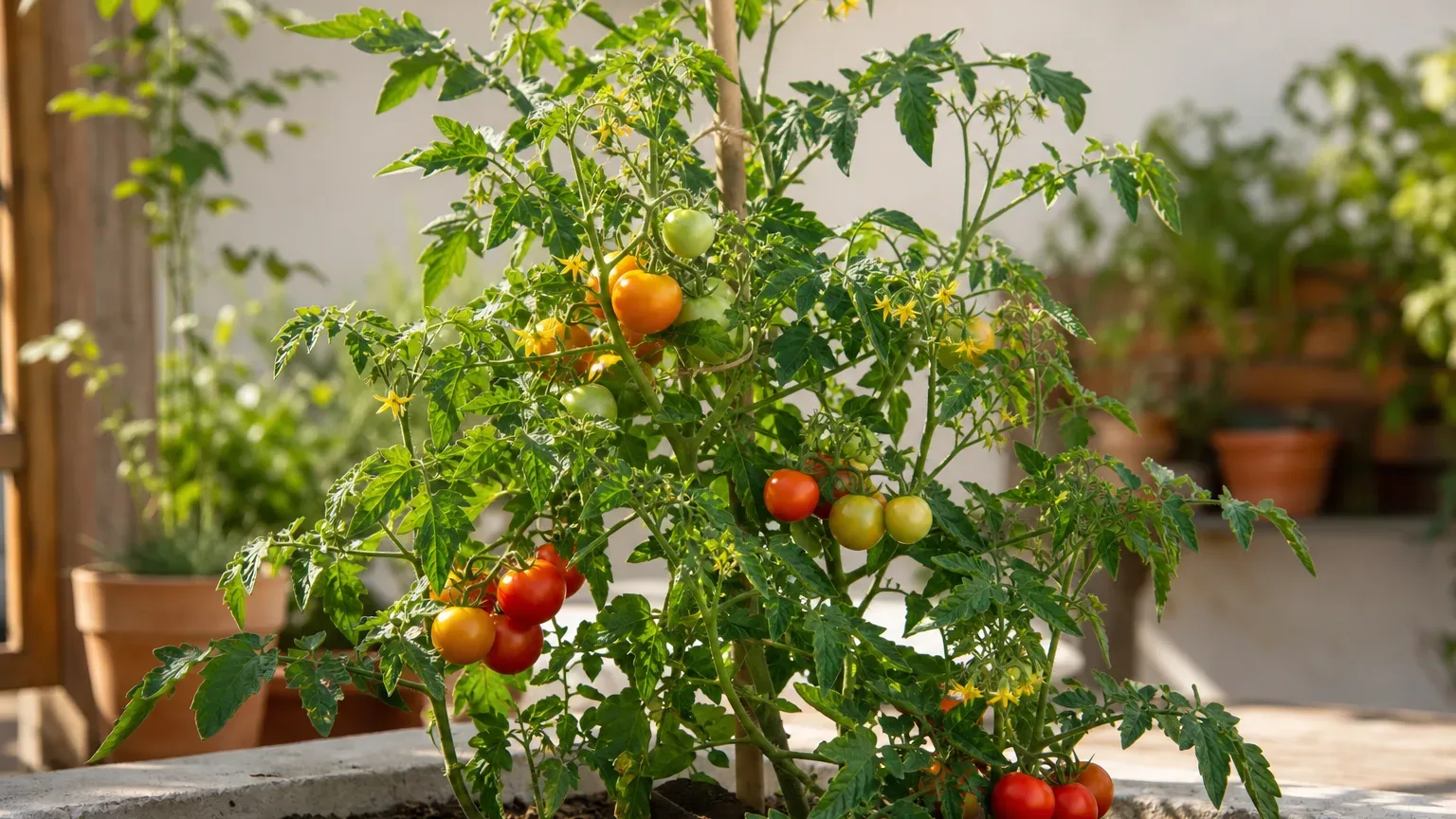
Tomato Light Guide: Sun, Shade and Grow Lights
Tomato Light Guide: Sun, Shade and Grow Lights
A tomato can stay green in bright shade and still receive too little energy to build a sturdy, productive crop. Solanum lycopersicum is a full-sun fruiting plant, so the useful question is not whether the balcony looks bright. It is how much unobstructed direct sun reaches the leaves, how that exposure changes through the season, and whether heat around the pot becomes damaging.
For most growers, the first action is simple: watch the proposed position for one clear day and record when direct sun actually touches it. Then repeat the check a few weeks later if a neighbouring building, balcony slab, tree, or seasonal sun angle may change the result.
The quick answer: tomatoes are a full-sun crop
Give a tomato the sunniest practical outdoor position. NC State classifies tomato light as full sun, meaning six or more hours of direct sunlight, while Alabama Cooperative Extension uses a practical target of six to eight hours of full sun. More exposure is not automatically better when a pot is baking against concrete, but deep shade is not an equivalent growing condition.
Six hours is a useful baseline, not a guarantee of fruit. Cloud cover, season, cultivar, canopy crowding, temperature, root health, and nutrition all affect the outcome. A plant receiving strong morning-to-midday sun may outperform one counted as “sunny” because it gets brief, broken patches late in the day.
Count usable direct sun, not daylight
Direct sun means a clear-edged shadow falls from the leaves. Bright open shade, light through a sheer curtain, and reflected brightness from a white wall may help a little, but they do not count the same as sun falling directly on the canopy.
Start a note at sunrise and check the plant every hour until sunset. Record direct sun, bright shade, and full shade separately; a phone photo from the same position makes changes easy to compare. If the plant receives only a few hours of direct sun, expect slower growth and fewer flowers rather than assuming extra fertilizer will compensate.
A window is another boundary. Even a sunny indoor pane can reduce and limit the angle of incoming light, while roof overhangs and insect screens reduce the useful exposure further. A tomato seedling may survive there, but a mature fruiting plant usually needs an unusually open sunny window or substantial supplemental lighting.
Map the sun on a balcony or terrace
On an Indian balcony, compass direction is only a starting clue. The balcony above, a side wall, water tank, parapet, nearby tower, or tree can remove more light than orientation alone predicts. Place the pot where the entire canopy, not just the top shoot, receives the longest continuous sun.
Leave enough space between plants that one tomato does not shade the next. Indeterminate vines can be trained vertically to use a narrow footprint, but their expanding leaves still need light and airflow; a crowded green wall may look vigorous while the lower canopy weakens.
East-, south- and west-facing positions
An open east-facing balcony often gives useful morning sun with a lower afternoon heat load. A south-facing position can be excellent where no roof slab or neighbouring building blocks the sun, although the seasonal path changes how deeply light enters. A west-facing balcony may be very bright but can combine strong late sun with heat stored in masonry.
Do not reject or accept a site by direction alone. A clear east balcony can be more useful than a south balcony boxed in by towers, and an open terrace may need heat management even though its light supply is ample. The Royal Horticultural Society similarly recommends a warm, sunny, sheltered outdoor position for tomatoes.
Morning sun versus afternoon sun
Tomatoes can use morning or afternoon sun. Morning exposure is often easier to manage in a hot climate because leaves begin photosynthesising before the pot and surrounding walls have accumulated their maximum heat. It also allows dew or incidental leaf wetness to dry earlier.
Afternoon sun is not inherently harmful. The problem is the package of intense radiation, hot wind, dry potting mix, and reflected heat that can occur on an exposed terrace or west wall. If a well-watered plant repeatedly collapses only during the hottest part of the day and recovers by evening, inspect root-zone heat and moisture before concluding that tomatoes prefer shade.
Separate strong light from dangerous heat
Light drives growth, while excessive temperature can disrupt flowering and water balance. Utah State Extension notes that tomato flowers are sensitive during development and early fruit set and that high temperatures under covers can cause fruit abortion. Moving a plant into heavy shade may cool it but can also reduce the energy available for the next flowers.
Manage heat at its source. Water according to the root ball, mulch an in-ground bed, keep a dark container from sitting against a radiating wall, and provide air movement around the canopy. A second outer pot, pale pot cover, or temporary barrier that shades the container can reduce root heating without shading all the leaves.
Heat-related blossom drop cannot be diagnosed from fallen flowers alone. Dry roots, excess nitrogen, poor pollination, and broader plant stress can look similar, so use the Tomato watering guide and Tomato fertilizer guide before adding feed or permanently reducing light.
When temporary shade helps tomatoes
Use temporary shade when there is clear evidence of severe heat load: leaves remain stressed despite a moist, freely draining root ball, exposed fruit is bleaching, or the container and wall become extremely hot. Aim first to soften the harshest late-afternoon period while preserving morning and midday light.
Shade cloth should sit above or to the hot side of the plant with airflow around it, not wrap the canopy. Start with light protection and observe the new growth; dense permanent shade can trade a heat problem for weak stems and poor flowering.
Fruit sunscald is not the same as a tomato plant receiving “too much sun.” Utah State describes sunscald when fruit is exposed during hot, dry weather and notes that good leaf cover and shading can reduce the disorder. Avoid stripping healthy leaves from around developing fruit, especially before a heat spell; the Tomato pruning guide explains how growth habit changes pruning decisions.
Give seedlings a bright start
Tomato seedlings reveal weak light quickly. Stems stretch, lean toward the source, and develop long gaps between leaves because the plant is trying to reach stronger exposure. Clemson Extension warns that low light produces tall, spindly tomato transplants.
Move seedlings into strong light as soon as they emerge, but do not transfer tender indoor foliage straight into a full day of outdoor sun. Harden plants gradually by increasing outdoor exposure over several days, beginning in protected bright conditions. This acclimation reduces abrupt scorch and wind damage without teaching the plant to live in shade.
Keep trays rotated if window light comes mainly from one side. A sturdier seedling also needs appropriate temperature, spacing, and air movement, so do not interpret every stretched stem as a light-only failure; the Tomato propagation guide covers germination and transplant handling.
Using grow lights for tomato plants
Grow lights are most practical for seedlings and young transplants. Utah State gives an example of fluorescent lights positioned close to transplants and run for 14 to 16 hours per day, but fixture type and output vary too much to copy a distance blindly. Follow the lamp maker’s crop guidance and raise the fixture as the canopy grows.
Judge the setup by coverage and plant response. Light should reach the whole tray evenly; seedlings at the edge should not lean inward, and leaf tips should not bleach or curl from a hot, close fixture. Give plants a dark period rather than running lights continuously.
Fruiting a mature tomato entirely under lights is possible only with considerably more intensity and coverage than a small seed-starting lamp provides. Before buying equipment, compare the fixture’s flowering-crop coverage with the mature spread of the cultivar and account for heat, power use, support, and ventilation. For most homes, outdoor sun plus a light for seed starting is the simpler arrangement.
Signs a tomato is not getting enough light
A low-light tomato usually shows a pattern, not one diagnostic leaf. Look for a thin leaning stem, long spaces between leaves, pale or undersized new growth, sparse flowering, and slow drying of the pot because the canopy is using less water. A mature plant may produce foliage while setting little fruit if the site is bright but rarely sunny.
First, measure direct sun again; seasonal obstruction often explains a change. Then move the plant toward more light gradually, open spacing around it, and turn a container only as needed for balanced exposure. Do not answer weak growth with high-nitrogen fertilizer, which may increase soft foliage without correcting the energy shortage.
Yellow lower leaves alone do not prove low light. Saturated soil, nutrient problems, disease, and normal ageing can produce similar symptoms, so check drainage and roots through the Tomato soil guide before making a diagnosis.
Signs of abrupt or excessive sun exposure
Leaves moved suddenly from indoor or nursery shade into strong sun can develop pale tan or whitish damaged patches on the most exposed surfaces. The injury does not turn green again, but healthy new leaves can replace it if the growing point and roots remain sound.
Move a newly scorched plant out of the harshest exposure temporarily, keep the root zone evenly moist rather than saturated, and increase sun again in stages. Do not remove every marked leaf at once; partly green leaves still contribute energy and can shade developing fruit.
Brown, crisp edges are not specific to sun. Drought, hot wind, salt accumulation, root injury, and fertilizer burn can overlap, so check when the soil dried, what was recently applied, and whether damage is limited to the sun-facing side.
Adjust light through Indian seasons
In much of India, the most productive tomato period is the locally mild season, not necessarily the longest or brightest days. Winter sun can be comfortable but lower in the sky; a balcony roof or neighbouring building may block it even if the same site receives sun in summer. Re-map the exposure when the season changes.
During pre-monsoon heat, preserve useful morning light while protecting the container and, only when needed, softening extreme late sun. During monsoon cloud and rain, remove unnecessary shade cloth, widen spacing, and prioritise drainage and airflow; weak light plus wet foliage is a different problem from summer heat.
Regional calendars matter. A hill climate, dry inland terrace, humid coast, and high-rise balcony do not share one sowing month or shade rule. Choose a locally suitable tomato season and cultivar, then use observed sun and plant response rather than a national calendar.
Cultivar and container choices for limited sun
No tomato cultivar turns deep shade into full sun. Compact determinate, dwarf, or patio cultivars can fit a small balcony and keep more of the canopy near the available light, while a vigorous indeterminate vine may quickly grow into shade above or beside the opening.
Small-fruited cultivars are often practical where the season or space is constrained, but fruit size does not predict vine size. Read the mature-height and growth-habit label before planting; NC State distinguishes compact determinate plants from indeterminate vines that continue growing and need substantial support.
Use a stable container that gives roots enough volume and drainage. A tiny pot can wilt and overheat so quickly that a sunny site appears to be the problem; consult the Tomato repotting guide before shifting an established crop.
Troubleshoot flowers and fruit before moving the plant
If the plant is tall, soft, and sparsely flowering, insufficient light is plausible. If it is compact and leafy with few flowers, review nitrogen feeding as well. If it flowers but drops blossoms during a run of hot nights or very hot days, temperature may be the stronger limitation than sunlight.
Green fruit does not need to sit in direct sun to ripen on the plant; leaves supply the crop, and the canopy protects fruit from sunscald. The RHS notes that light is not necessary for harvested green tomatoes to ripen, so exposing fruit by heavy pruning is not a reliable shortcut.
Change one factor at a time. Record sun, temperature pattern, soil moisture, and recent feeding for several days, then correct the clearest constraint. Moving the plant, fertilising it, pruning it, and changing watering simultaneously makes the result impossible to interpret.
When to use this page vs other Tomato guides
Use this page to choose a position, count direct sun, manage temporary shade, set up seedling lights, and distinguish light shortage from heat load. Start with the Tomato overview if the cultivar’s growth habit, container, support, and basic care are still unclear.
For a dry or wilting root ball, use the watering guide. For compacted mix, drainage, or root-zone questions, use the soil guide. Use the fertilizer guide when foliage is lush or pale despite adequate sun, and the pruning guide before removing leaves around fruit.
Related Tomato guides
- Tomato watering — adjust moisture for sunny pots, heat, and cloudy wet periods.
- Tomato soil — build a root zone that drains while supporting a full-sun crop.
- Tomato fertilizer — separate nutrient problems from low-light growth.
- Tomato propagation — manage seedling light, hardening off, and transplant timing.
- Tomato repotting — choose a final container that does not overheat or dry immediately.
- Tomato pruning — preserve useful canopy while training the cultivar.
Conclusion
Tomatoes need an outdoor full-sun position, with roughly six or more hours of usable direct light as a practical baseline. On an Indian balcony or terrace, measure that exposure instead of trusting orientation, preserve morning and midday sun, and manage hot walls and containers before resorting to heavy shade.
When growth is weak, diagnose the whole pattern. Low light stretches stems and suppresses flowering; heat, dry roots, excess feeding, and abrupt exposure create different clues. A measured sun map and one careful adjustment will tell you more than moving the pot repeatedly.