Drooping Leaves on Whale Fin Snake Plant: Causes & Fixes
Quick answer
Drooping on a Whale Fin Snake Plant is usually a root-zone signal: a heavy wet pot with a soft leaf base points to rhizome rot from overwatering, while a light dry pot with a wrinkled but firm paddle points to drought. First step: grip the paddle base and lift the pot — check anchoring and deep moisture before you water, stake, or unpot.
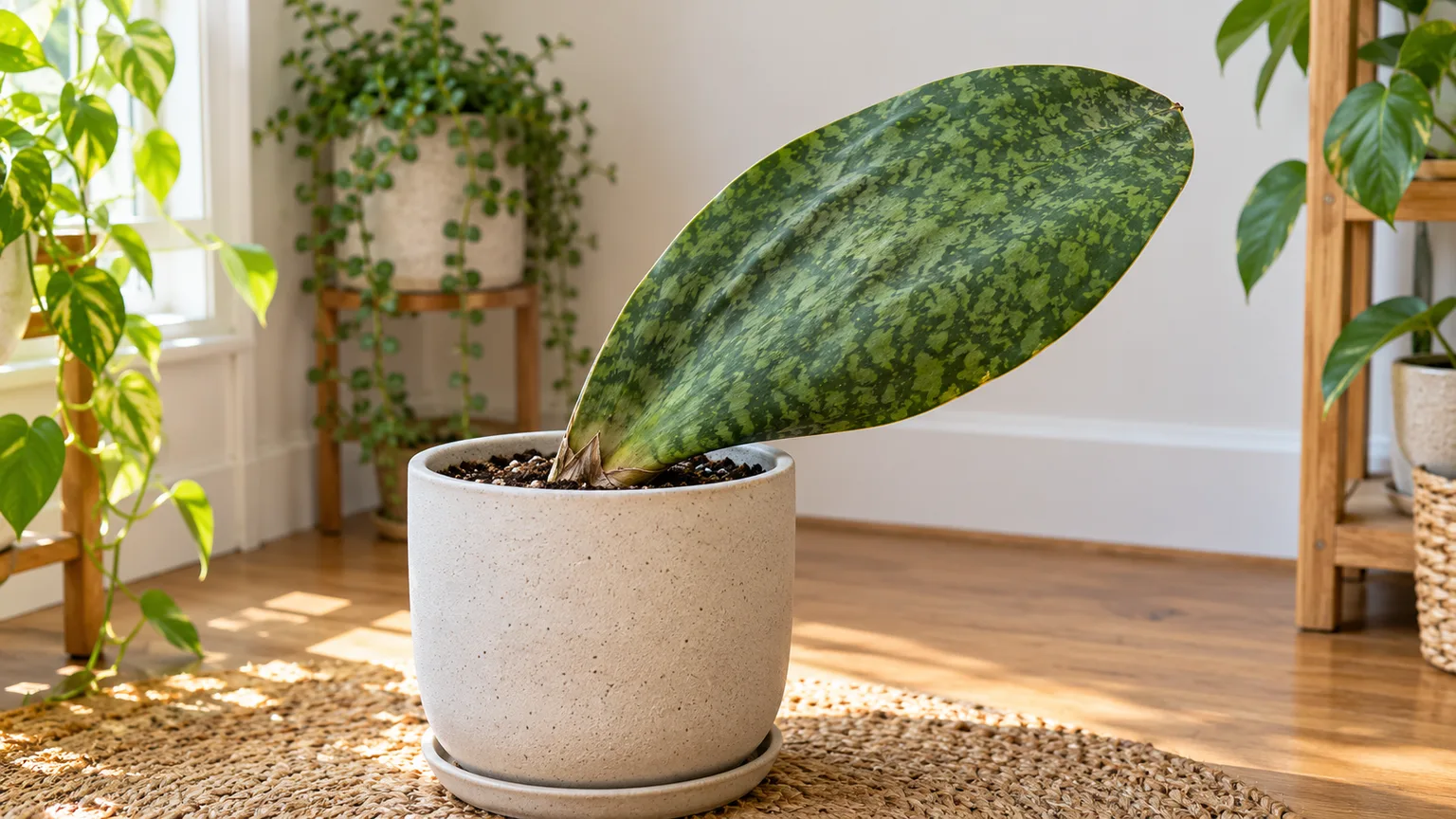
Drooping Leaves on Whale Fin Snake Plant: Causes, Checks & Fixes
This guide covers drooping leaves on Whale Fin Snake Plant. See also the general Drooping Leaves guide, watering, and light pages for this plant.
Drooping Leaves on Whale Fin Snake Plant: Causes, Checks & Fixes
Quick answer
A Whale Fin Snake Plant (Dracaena masoniana) droops when its thick underground rhizome can no longer anchor and supply its enormous paddle leaf — most often because the mix stayed wet too long, not because the plant is thirsty. Each paddle is a water reservoir up to 3–4 ft long, so this species needs even longer dry spells than standard snake plants, and a leaning paddle on damp soil is a rot warning, not a watering reminder.
For how turgor loss works on houseplants in general, see our drooping leaves hub. On Whale Fin, grip the paddle base and lift the pot before you change anything.
First step: grip the paddle near the soil line and lift the pot — a wobbly base in heavy damp mix means stop watering and inspect the rhizome; a firm base in a light dry pot means one deep drink.
When to use this page vs other Whale Fin guides
This page covers gradual paddle lean, flop, or sag developing over days to weeks. Use sibling guides when the pattern differs:
| Pattern | Read next |
|---|---|
| Gradual lean or sag; base may be soft or firm | Stay here |
| Heavy wet pot with mushy base and foul smell | Root Rot on Whale Fin Snake Plant |
| Light dry pot with wrinkled, puckered paddle | Underwatering on Whale Fin Snake Plant |
| Soggy mix with yellow soft leaves after frequent drinks | Overwatering on Whale Fin Snake Plant |
| Rapid whole-plant collapse within hours | Wilting on Whale Fin Snake Plant |
| Pale stretched growth toward the window | Not Enough Light on Whale Fin Snake Plant |
What drooping leaves look like on Whale Fin Snake Plant
A healthy Whale Fin holds its broad paddle upright and rigid, waxy and slightly cupped. Droop on this plant is unmistakable because there is usually just one giant leaf doing all the showing:
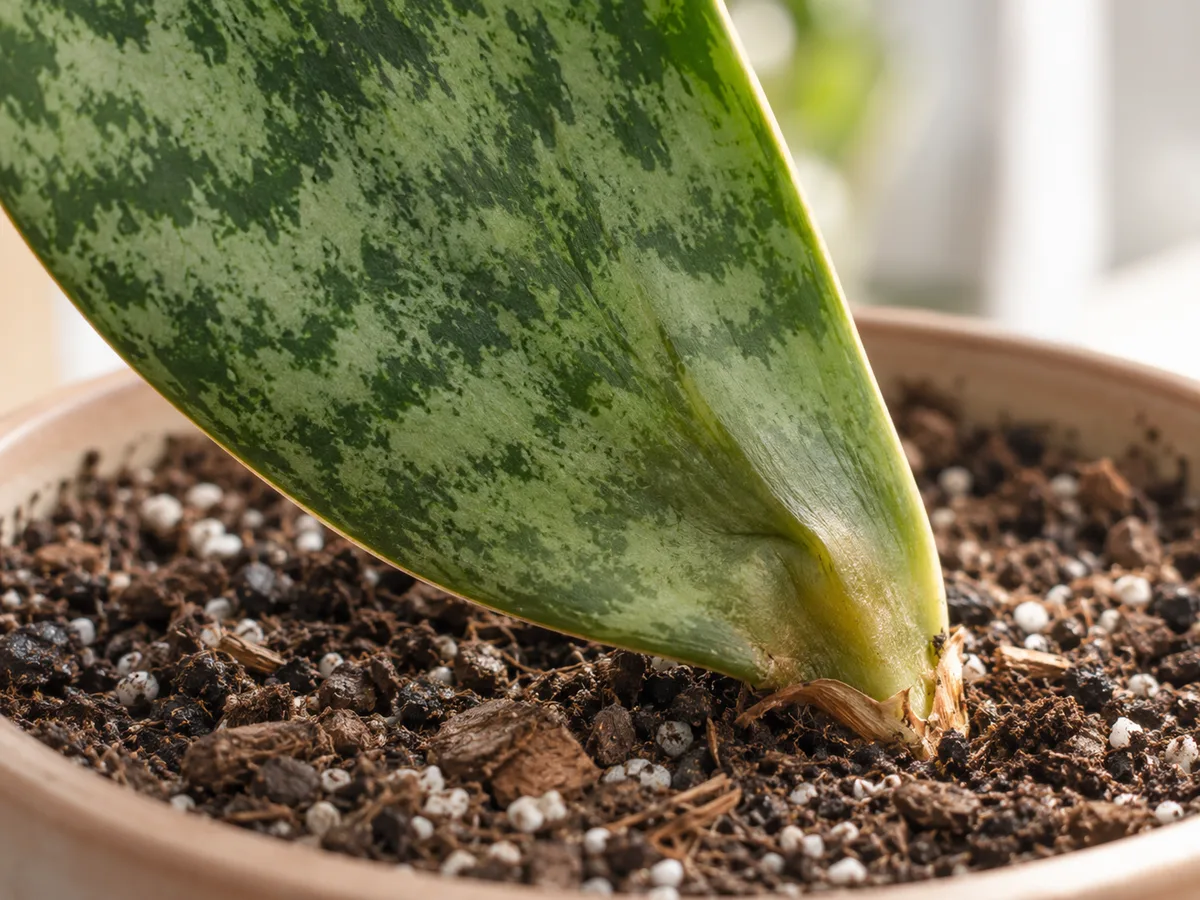
Leaning Whale Fin paddle with soft base tissue — compare firmness at the soil line with the blade above.
- The paddle tilts or flops sideways instead of standing vertical, sometimes resting against the pot rim
- The leaf base near the soil feels soft, spongy, or wobbly when rocked gently — the classic rot signature
- In drought droop, the paddle stays anchored but looks wrinkled or puckered with dull, less waxy skin
- Overwatered paddles may yellow from the base upward, sometimes with dark sunken patches where tissue has died
- Because one paddle can weigh a lot, the lean often looks dramatic even when the rhizome damage is still small
Normal vs. alarming:
- A slight tilt toward the window on an otherwise rigid paddle is phototropism, not droop — rotate the pot a quarter turn at each watering
- One older outer paddle leaning on a multi-paddle clump while pups stay firm is usually age, not crisis
- A single paddle that keeps leaning further over several days, especially with damp soil, needs a root-zone check now
Why Whale Fin paddles droop
Overwatering on Whale Fin Snake Plant and rhizome rot (most common)
Whale Fin stores water in both its paddle and its thick rhizome, so it tolerates drought far better than wet feet. NC State Extension warns that root rot and black spot follow overwatering on this species and stresses allowing the growing medium to dry out between waterings. The RHS likewise calls overwatering a common cause of poor health in sansevierias because roots rot in compost that stays damp.
When the rhizome decays, it cannot anchor a 3-ft paddle. The leaf flops even though the soil feels wet — rotted roots cannot move water upward, so the plant looks thirsty while it is actually drowning. Mushy weak leaves on consistently wet soil mean root rot is likely, with black slimy foul-smelling roots confirming it.
Common triggers on Whale Fin:
- Watering on a calendar instead of waiting for bone-dry mix throughout the pot
- Dense peat-heavy soil with no perlite, coarse sand, or grit
- A pot without drainage holes, or a saucer and cachepot left full after watering
- An oversized pot whose extra soil stays wet for weeks around a slow-growing rhizome
- Winter watering at summer frequency while the plant barely grows
Underwatering on Whale Fin Snake Plant after a long drought (less common but real)
Masoniana is very drought tolerant, so simple thirst takes weeks of neglect to show. Eventually the paddle spends its stored water: the blade wrinkles or puckers, loses its waxy sheen, and may tilt as internal pressure drops. Unlike rot, the base stays firm and the pot feels very light.
Underwatering droop almost always follows a bone-dry pot plus a firmly anchored paddle — check both before assuming thirst.
Low light plus a top-heavy paddle
Whale Fin prefers bright indirect light and tolerates low light, but dim corners weaken it over months. Growth slows, new tissue stays soft, and the massive paddle outgrows what feeble roots can hold upright. The RHS notes that snake plant leaves kept in particularly low light may flop even without rot. If your paddle leans toward the nearest window while the mix cycles normally, light — not water — is the weak link. Review the Whale Fin Snake Plant light guide before changing anything else.
Cold drafts and winter chill
Whale Fin grows best around 65–85°F (18–29°C) with humidity of at least 50%, and NC State advises avoiding temperatures below 55°F (13°C) and cold drafts. Chill plus wet soil is a fast track to rot: cold slows water use while damage spreads. A paddle that starts leaning after a move near a drafty winter window deserves a temperature check alongside the moisture check.
Repotting wobble and top-heavy pots
A freshly divided pup or a single paddle in a too-large pot can lean simply because nothing anchors it yet. Shallow planting, loose gritty mix, and a tall paddle form a lever that tips before roots establish. This is mechanical, not disease — the base stays firm and the mix dries normally. Pot choice matters here; see the Whale Fin Snake Plant soil guide for a mix that grips the rhizome.
How to confirm the cause
Work through these checks in order — most Whale Fin droop is diagnosed without unpotting:
- Paddle-base rock test — Grip the paddle an inch above the soil and rock gently. Firm and anchored points away from rot; soft, spongy, or wobbling tissue means root damage until proven otherwise. The RHS uses the same logic in reverse: a rosette firmly anchored without wobbling shows a plant is well-rooted and unlikely to be suffering root rot.
- Pot weight — Lift the container. Heavy and damp suggests overwatering; very light suggests drought.
- Full-depth moisture probe — Push a finger or dry skewer to the bottom third of the pot. Whale Fin needs bone-dry mix throughout; a dry surface over wet depths still means do-not-water. BHG recommends the finger test 1–2 inches deep for standard snake plants — go deeper for a deep masoniana pot.
- Paddle skin read — Wrinkled or puckered but firm means the reservoir is empty (drought). Yellow, translucent, or dark-sunken patches spreading from the base mean tissue death (rot).
- Smell — Sour or fermented odor from drainage holes points to anaerobic rotting mix.
- Rhizome inspection — If the base is soft and soil is wet, unpot within a day. Healthy rhizomes are firm and pale; rot is brown, mushy, and collapses under thumb pressure.
- Pattern and timing — Did the lean follow a heavy watering stretch, a month without water, a move to a dark corner, or a cold snap?
Wilted leaves can mean soil is too dry or too wet because rotting roots cannot take up water — which is exactly why steps 1–3 must come before any treatment.
First fix for Whale Fin Snake Plant
Match one action to what the rock test and pot weight told you.
If the base wobbles or feels soft in damp mix: Do not water, do not stake it and hope. Move the plant to bright indirect light, empty the saucer, and unpot within 24 hours to see the rhizome. Staking a rotted paddle hides the only symptom that matters.
If the base is firm in a light, dry pot: Water once deeply until a little runs from the drainage holes, drain fully, and leave it alone. Do not water again until the mix is bone-dry throughout — for many homes that means waiting weeks.
Do not fertilize, repot into fresh wet mix, or prune the paddle on day one. One correct move first, then read the response.
Step-by-step recovery
Path A — Overwatering and rhizome rot
- Unpot and shake away all wet mix from the rhizome and roots.
- Trim every soft, brown, or foul-smelling root and rhizome section with clean scissors, cutting back to firm pale tissue.
- Let trimmed surfaces air-dry on a towel for several hours so cuts callus.
- Repot the firm remainder in dry gritty mix — cactus compost with roughly 30% perlite plus coarse sand, matching NC State’s recommended mix of perlite, coarse sand, and organic matter — in a snug terracotta pot with open drainage.
- Wait at least one to two weeks before the first post-rescue drink, then water sparingly.
- If the main paddle’s base is fully rotted but the upper blade is firm, a healthy leaf section can root as a cutting — slow, but it preserves the plant. See Root Rot on Whale Fin Snake Plant for the full salvage sequence.
Path B — Underwatering
- Water thoroughly until runoff, making sure the whole root ball rewets — gritty mix that went hydrophobic may need a 20-minute bottom soak, then complete draining.
- Return the plant to bright indirect light per the Whale Fin Snake Plant watering guide.
- Expect the paddle skin to smooth out within a week; full rigidity can take one to two weeks.
- Resume the bone-dry rhythm: every 2–4 weeks in summer, every 4–6 weeks in winter.
Path C — Mechanical lean (firm base, normal moisture)
- Seat the rhizome slightly deeper in fresh gritty mix and firm it in so the paddle stands without help.
- Use a temporary bamboo cane and soft tie — not wire through the leaf — until roots grip, usually four to eight weeks.
- Rotate the pot a quarter turn at each watering so growth stays symmetrical.
- If the lean is light-seeking, move the plant closer to bright indirect light rather than staking harder.
Recovery timeline
| Situation | What to expect |
|---|---|
| Mild drought droop | Paddle skin smooths in 3–7 days; rigidity returns in 1–2 weeks |
| Corrected overwatering, rhizome still firm | Lean stops worsening within days; new pups in 6–12 weeks |
| Rhizome surgery with partial loss | Slow recovery over 2–4 months; one pup at a time is normal for this slow species |
| Base fully mushy, no firm tissue left | Plant unlikely to recover — salvage firm leaf cuttings instead |
Judge recovery by firm new pups at the soil line, not by the old paddle returning to vertical. A rotted-then-rescued paddle often keeps its lean permanently.
Lookalike symptoms
- Wilting on Whale Fin Snake Plant — sudden whole-plant collapse within hours; droop here is gradual over days to weeks
- Natural phototropic tilt — rigid paddle angles toward light with firm base and normal soil cycling; rotate, don’t treat
- Sun scorch — dry brown crispy patches on the sun-facing side after a move to direct sun; base stays firm and anchored
- Old-leaf yellowing — lowest leaf on a multi-paddle clump yellows slowly while pups stay upright; normal senescence
- Brown tips from salt buildup — dry crispy margins with a firm upright paddle; a watering-quality issue, not structural failure
Mistakes to avoid
- Watering because the paddle looks limp without checking whether the soil is already wet — the classic Whale Fin killer
- Staking a soft-based paddle instead of inspecting the rhizome, which hides spreading rot
- Repotting into a much larger pot “to help it recover” — extra soil holds extra water around a weak root system
- Fertilizing during acute stress; this slow grower needs at most spring and midsummer feeding when healthy
- Cutting off the whole paddle on day one before confirming whether the base tissue is alive
- Misting the blade instead of fixing root-zone moisture — surface water never restores turgor
How to prevent drooping next time
- Water only when mix is bone-dry to the bottom: roughly every 2–4 weeks in summer, every 4–6 weeks in winter
- Use free-draining cactus compost with added grit in terracotta with open drainage holes; empty saucers and cachepots after every drink
- Give bright indirect light so the heavy paddle grows rigid — dim corners plus wet mix is the rot setup
- Keep temperatures above 55°F (13°C) and away from cold drafts in winter
- Size pots to the rhizome, not the paddle — NC State advises repotting only when roots grow out of the drainage holes
- Check the paddle base monthly; catching softness early is a trim job, catching it late is a rescue job
When to worry
Treat as urgent when:
- The paddle base feels soft, oozing, or smells sour
- The lean worsens daily on a heavy wet pot
- Yellowing or dark patches spread upward from the base
- Soil has stayed wet more than 10 days with no recent watering
You can wait and observe when the base is firm, the pot is appropriately dry, only the blade angle changed, and the plant recently had a normal single watering. If every bit of rhizome is mushy after inspection, recovery is unlikely — root any firm upper-leaf sections as cuttings instead.
Conclusion
Drooping on a Whale Fin Snake Plant looks dramatic because the whole show is one giant paddle, but the diagnosis is simple once you read the base and the pot. A wobbly soft base in damp mix demands a dry rescue and rhizome triage; a firm wrinkled paddle in a light pot needs one deep drink and patience. Get that distinction right first, and most Whale Fins recover without a pile of extra interventions.
Related Whale Fin Snake Plant guides
- Whale Fin Snake Plant overview — paddle size, growth speed, and placement basics
- Whale Fin Snake Plant problems — full symptom index when droop overlaps other issues
- Whale Fin Snake Plant watering — bone-dry rhythm after droop stabilizes
- Whale Fin Snake Plant light — brightness that keeps heavy paddles rigid
- Whale Fin Snake Plant soil — gritty mixes that grip the rhizome
- Overwatering on Whale Fin Snake Plant — wet heavy pot with yellow soft leaves
- Underwatering on Whale Fin Snake Plant — light pot with wrinkled firm paddle
- Root Rot on Whale Fin Snake Plant — mushy base with foul-smelling roots
- Wilting on Whale Fin Snake Plant — rapid whole-plant collapse instead of gradual lean
Related tool
Use the Plant Problem Diagnosis Tool to narrow causes for drooping leaves on this plant before changing multiple variables at once.