Root Rot on Whale Fin Snake Plant: Causes, Checks & Fixes
Quick answer
Root rot on Whale Fin Snake Plant starts below the soil when the thick rhizome sits wet too long, and the paddle base turns soft, wobbly, or sour-smelling. First step: stop watering, tip out any water in the saucer or cachepot, and press the paddle base to decide between a dry-down and an unpot rescue.
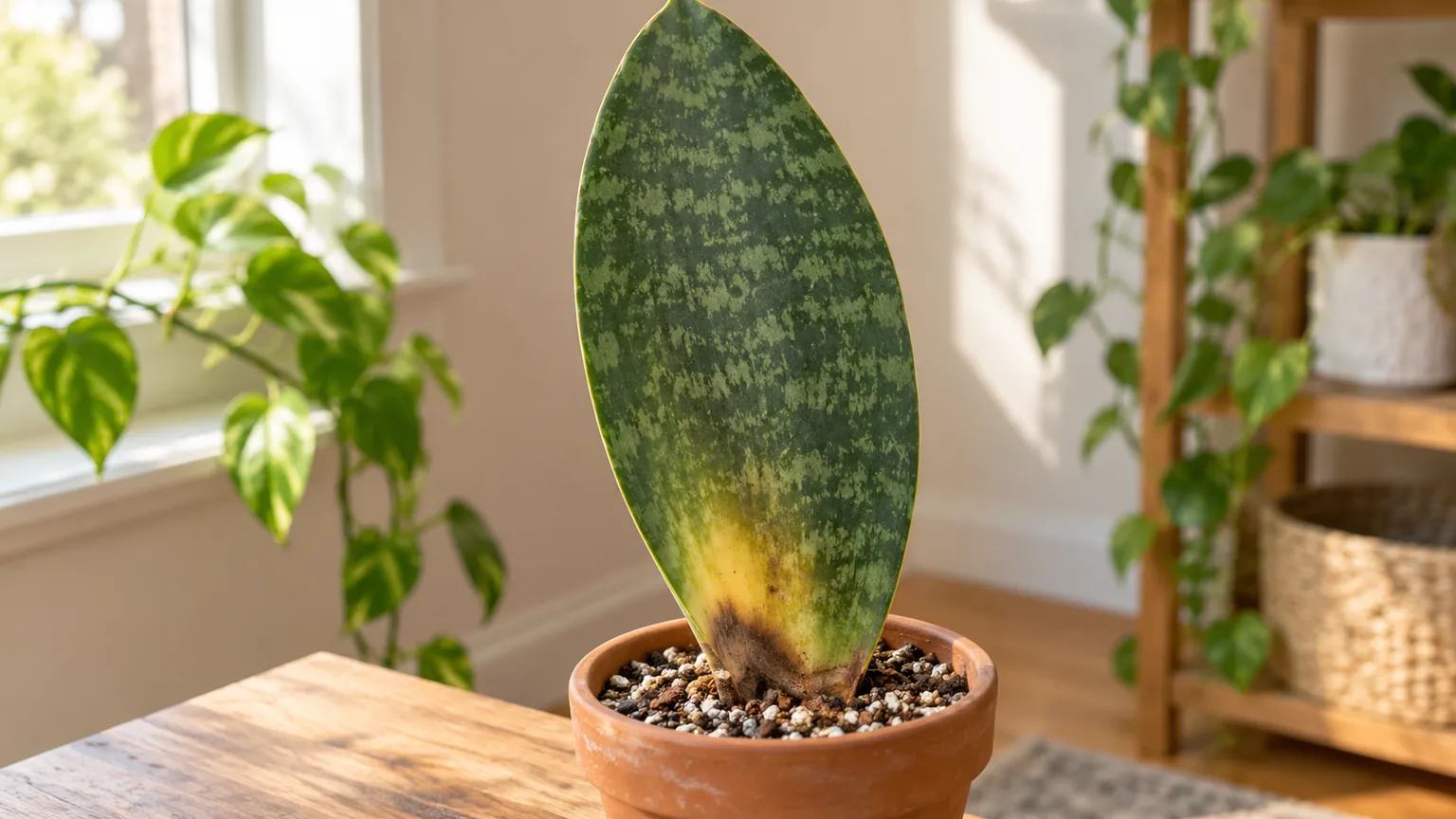
Root Rot on Whale Fin Snake Plant: Causes, Checks & Fixes
This guide covers root rot on Whale Fin Snake Plant. See also the general Root Rot guide, watering, and light pages for this plant.
Root Rot on Whale Fin Snake Plant: Causes, Checks & Fixes
Quick answer
Root rot on Whale Fin Snake Plant begins in the thick underground rhizome after the mix stays wet too long, and the first above-ground sign is usually a soft or wobbly paddle base rather than a leaf spot. Whale Fin (Dracaena masoniana) is a rhizomatous perennial from the Democratic Republic of the Congo that NC State calls very drought tolerant, so its roots are built for dry spells, not for sitting in damp compost.
First step: stop watering, tip out any water sitting in the saucer or cachepot, and press the paddle gently at the soil line. A firm base means a supervised dry-down may be enough. A soft, loose, or sour-smelling base means the rhizome is already decaying and you need to unpot. For how wet-soil root damage works across all houseplants, see our root rot hub, then use this page for what is specific to Whale Fin.
When to use this page vs other Whale Fin Snake Plant guides
This page is for decaying roots and rhizome — soft bases, sour soil, wobbling paddles. If the damage looks different, start with the closer match below, or browse the Whale Fin Snake Plant problems hub and the plant overview.
| What you see | Read next |
|---|---|
| Heavy pot, base still firm, paddle yellowing from the bottom up | Stay here, then compare with the overwatering guide |
| Wrinkled, puckered paddle and a feather-light pot | The underwatering guide — thirst, not rot |
| Yellow paddle, firm base, pot drying normally | The yellow leaves guide |
| Paddle flopping while still green | The wilting or drooping leaves guides |
| White or green crust on the soil, no softness | The mold on soil guide |
| Tiny insects in the soil of a wet pot | The fungus gnats guide |
What root rot looks like on Whale Fin Snake Plant
A healthy Whale Fin paddle is thick, stiff, and rigidly upright, anchored by a firm underground rhizome with pale, wiry roots. Rot breaks that anchoring first, which is why the earliest signs are felt at the soil line rather than seen on the leaf face.
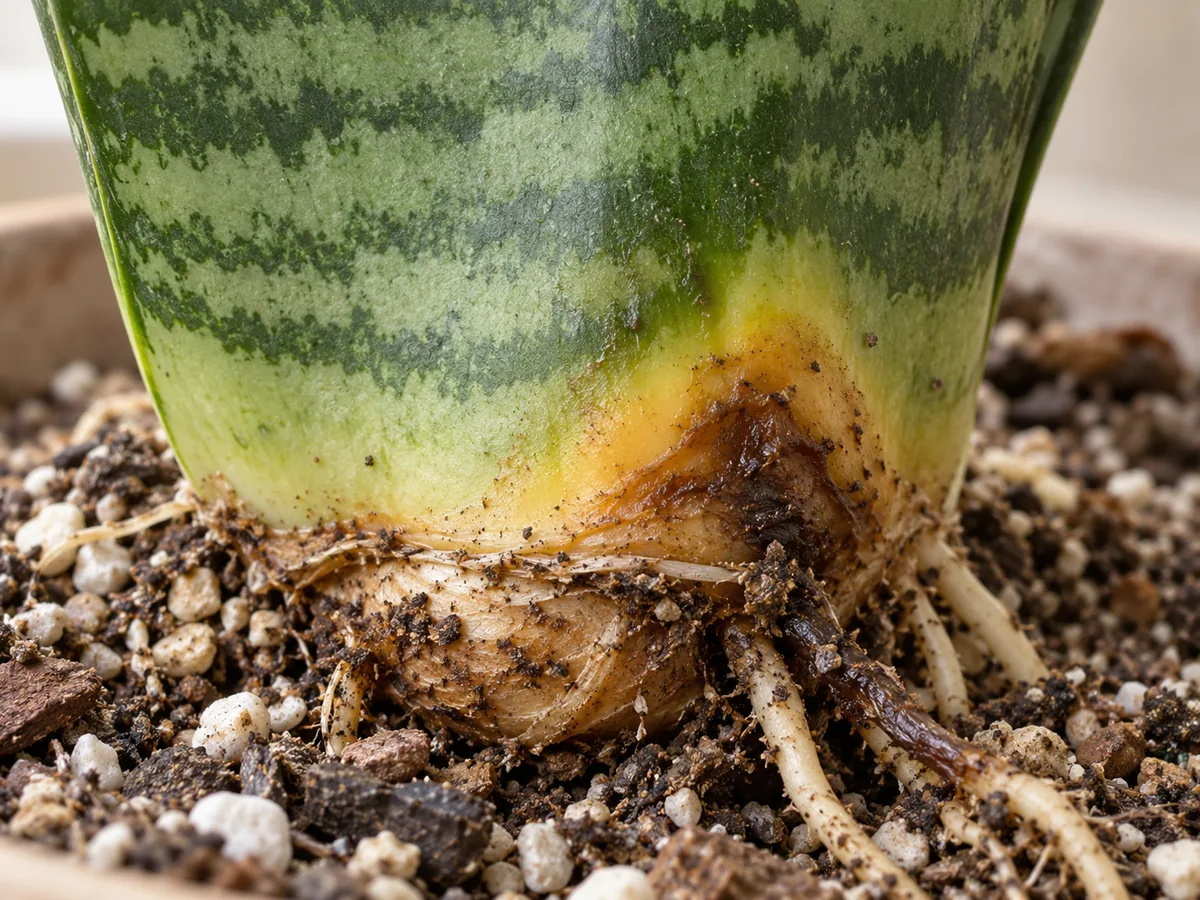
Soft, darkened tissue where the paddle meets the mix. Compare the failing base with the firm green blade above it.
- The paddle wobbles. A healthy Whale Fin sits rock-solid in its pot. A paddle that rocks or leans with a light touch has lost root anchoring, and the RHS notes that a whole plant leaning over calls for a root rot check.
- The base turns soft or translucent. Squeeze gently at the soil line, including the purple-banded sheath below the surface. Firm is good. Slick, mushy, or glassy-looking tissue means decay has travelled up from the rhizome into the leaf.
- Yellow climbs from the bottom. The paddle fades from dark green to pale yellow-green starting at the base, often within days once the rhizome fails.
- The soil smells sour or swampy. Healthy mix smells earthy. A rotten-egg or stagnant odor from the drainage hole means oxygen-starved, decaying roots.
- The pot stays heavy. A pot that never lightens between waterings is holding water the plant is not using, and UGA Extension warns the roots will rot in soggy soil.
- New growth stalls or emerges pale. Because NC State rates the growth rate as slow, a missing spring spear on its own proves little — but a soft spear or a pup that collapses is a red flag.
Why Whale Fin Snake Plant gets root rot
One paddle, one rhizome, no backup
Whale Fin grows from a thick underground rhizome, and a young plant often consists of a single enormous paddle on a single rhizome section. NC State describes paddle leaves 3–4 ft long and 8–10 in wide, and each one is a water reservoir. That reservoir is the trap: the leaf looks fine for weeks while the rhizome below is already failing, because the paddle keeps drawing on stored water. A clumping snake plant can sacrifice an outer leaf; a one-paddle Whale Fin cannot.
A dry-habitat root system in a wet pot
NC State calls this species very drought tolerant and advises growers to allow the growing medium to dry out between waterings, warning that root rot can occur from overwatering. The RHS is blunter: overwatering and standing in water is usually the main issue for sansevierias, potentially leading to root rot. Waterlogged mix pushes air out of the pore spaces, and most plant roots cannot tolerate saturated soil — they suffocate, then fungi finish the job.
Dim light stretches every watering into weeks
Whale Fin tolerates low light, so it often ends up in corners where a pot dries glacially slowly. A summer watering rhythm carried into winter is the classic failure: the plant barely drinks from October onward while the owner keeps pouring. Penn State Extension notes these plants can be killed by overwatering yet survive a month of neglect without damage. If your pot never seems to dry, read the light guide alongside this page.
Pots and mixes that hold water against the rhizome
Three container mistakes cause most Whale Fin rot: a pot with no drainage hole, a cachepot that is never emptied, and dense peat-heavy compost. The RHS recommends a free-draining, peat-free cactus compost, and Penn State suggests a cactus potting mix or one with perlite. An oversized pot is equally dangerous, because spare compost stays damp — the RHS advises a pot only slightly larger than the previous one for exactly this reason.
How to confirm the cause
Work through these in order. Change nothing until you have read all of them.
- Press the paddle base. Squeeze gently at the soil line and around the purple-banded sheath. Firm means the rhizome is still holding. Soft, slick, or translucent means rot has reached the leaf.
- Lift the pot. A pot that stays heavy for more than a week or two after watering is not drying. Compare against the watering guide rhythm of drying all the way through.
- Skewer test. Push a wooden skewer to the bottom of the pot. Damp, dark, or soil-streaked means the root zone is wet; clean and dry means it is not.
- Smell the drainage hole. Sour or swampy confirms decaying roots even before you unpot.
- Wobble test. Rock the paddle lightly. Rock-solid is reassuring; a loose, pivoting paddle has lost its root anchoring.
- Rule out thirst. A wrinkled, puckered paddle in a feather-light pot with a firm base is drought, not rot — see the difference in the lookalike table below.
- Unpot as the final check. Slide the plant out and inspect the rhizome and roots. Healthy tissue is firm and pale to orange-brown; rot is dark brown to black, mushy, and foul-smelling. Cut into a suspect rhizome section — firm white or greenish flesh inside is alive.
Lookalike symptoms
| Pattern | Likely cause |
|---|---|
| Wrinkled paddle, feather-light pot, firm base | Thirst — see the underwatering guide |
| Bleached papery patch on the glass-facing side, pot drying normally | Sun scorch, not rot |
| Pale soft patches after a cold night near glass or a vent | Cold damage |
| Crispy brown tips with no softness or smell | Salt or dryness — see the brown tips guide |
| Sticky residue, cottony tufts, or raised bumps at the base | Pests, not rot |
| Whole paddle leaning with a wet pot and sour soil | Rhizome rot — stay on this page |
The first fix to try
Stop watering and empty every reservoir. Tip out the saucer and lift the nursery pot out of any cachepot so air reaches the drainage holes. The RHS says to pour away water that drains into the saucer so the plant never sits in water. Penn State’s rule is simpler still: water only when it is dry.
Then branch on what the paddle base told you:
- Base firm, no smell, skewer damp: supervised dry-down. Keep the plant where it is, re-test with the skewer every few days, and do not water until it comes out clean from the bottom. If the base stays firm and the pot lightens, resume with the dry-down rhythm in the watering guide.
- Base soft, wobbly, sour, or yellowing fast: skip the dry-down and go straight to the rhizome rescue below. Waiting only lets decay travel further up the only paddle you have.
Step-by-step rhizome rescue
Work cleanly and wear gloves — NC State notes the sap may cause skin irritation.
- Unpot and rinse. Slide the plant out, shake off the old mix, and rinse the rhizome and roots under room-temperature water so you can see every lesion.
- Cut back to firm tissue. With a sterilized blade, remove all dark, mushy roots and slice away soft rhizome sections until every cut face shows firm, pale flesh. The RHS dividing guidance says to discard any damaged or dead sections and repot only healthy ones. Gardening Know How recommends trimming mushy roots with clean scissors and repotting in fresh mix.
- Let the cuts dry. Lay the trimmed plant in open air for several hours or overnight so cut surfaces callus. Potting a fresh wound into damp mix invites reinfection.
- Repot small and gritty. Use a clean pot with drainage holes, only just big enough for the remaining roots, filled with a free-draining, peat-free cactus compost or a cactus potting mix or one with perlite. See the soil guide for the exact blend.
- Hold water for about a week. Then water lightly and return to the skewer-tested rhythm.
- Save a backup leaf section. If the rhizome is a total loss but part of the paddle is still firm, cut a healthy blade section and root it as a leaf cutting — NC State lists propagation by division or leaf cuttings for this species. It takes months on a slow grower, but it preserves the plant.
Recovery timeline
Rotted tissue never heals — judge recovery by what is new, not what is old. The yellow band on the paddle will not re-green, and trimmed roots do not regrow overnight. Gardening Know How cautions to expect recovery to take some time as roots regrow.
Because Whale Fin grows slowly, the honest timeline is months: first the base stays firm and the yellow stops advancing, then the pot starts drying on a normal rhythm, then a new spear or pup emerges. A quiet plant that holds a firm base through one full dry-down cycle is succeeding, even with no visible growth yet.
Mistakes to avoid
- Watering “to be safe” while you wait. Every extra drink extends the rot deeper into the rhizome.
- Repotting into a much bigger pot. Spare compost stays wet and restarts the cycle; match the pot to the roots you have left, using the repotting guide for sizing.
- Feeding a rotting plant. Fertilizer cannot fix dead roots and burns the few living ones — see the fertilizer guide only after new growth appears.
- Cutting off the whole paddle early. On a one-leaf plant that removes the only engine; leave firm green blade in place while the base holds.
- Sealing cuts with kitchen remedies. Cinnamon and peroxide pastes do not substitute for cutting fully back to firm tissue and letting it air-dry.
- Moving it into hot direct sun to “dry the soil.” A flat paddle scorches fast; bright indirect light dries the pot without cooking the leaf.
How to prevent root rot next time
Pot for drainage first. Choose containers with drainage holes, favor porous terracotta, and pick a heavy pot to prevent toppling since tall paddles get top-heavy when dry. Fill with the gritty blend from the soil guide — cactus mix cut with around 30 percent perlite plus coarse sand.
Water by skewer, not by calendar: push a wooden skewer to the bottom and water only when it comes out clean and dry. Cut back sharply in autumn and winter, keep the plant in bright indirect light per the light guide, and empty the saucer after every watering. Check the paddle base monthly when you check for pests.
Pet households: Dracaena is toxic to cats and dogs because of its saponins, so bin every trimming instead of leaving cut rhizome or leaf pieces where animals can reach them.
When to worry
- The paddle base turns soft, slick, or translucent.
- The paddle wobbles loosely or leans as a whole.
- Sour or swampy smell rises from the drainage hole.
- Yellow climbs visibly up the paddle within days.
- A new spear emerges pale or collapses while the mix stays wet.
- The rhizome is mush all the way through with no firm tissue left — at that point the plant is not saveable, but a firm blade section may still root as a cutting.
A firm base in a pot that lightens on schedule is low urgency even if one old leaf looks tired. Give it a dry-down and watch.
Related Whale Fin Snake Plant guides
- Whale Fin Snake Plant overview — start here for identification and basic care.
- Watering — how to set a full-depth dry-down rhythm once roots are stable.
- Soil — gritty mix recipes that drain fast enough for a rhizome plant.
- Light — how much window light keeps the pot drying on schedule.
- Repotting — when and how to move up a pot size without overpotting.
- All Whale Fin Snake Plant problems — the full list of issues on this plant.
Conclusion
Root rot on Whale Fin Snake Plant is a root-zone problem wearing a leaf disguise. Press the paddle base, weigh the pot, and smell the drainage hole before you touch anything. If the base is firm, stop watering and let the pot dry completely; if it is soft, unpot, cut back to firm rhizome, and restart in gritty mix. Judge success by a firm base and a new spear — slow, but certain.
Related tool
Use the Root Rot Risk Checker to narrow causes for root rot on this plant before changing multiple variables at once.