Spider Mites on Whale Fin Snake Plant: Causes, Checks &
Quick answer
Spider mites on a Whale Fin Snake Plant show up as fine pale stippling on the broad paddle, a dull dusty cast, and thin silk near the leaf base, usually in hot, dry, dusty rooms. First step: confirm live mites with a white-paper test, then rinse and wipe both faces of the paddle before reaching for any spray.
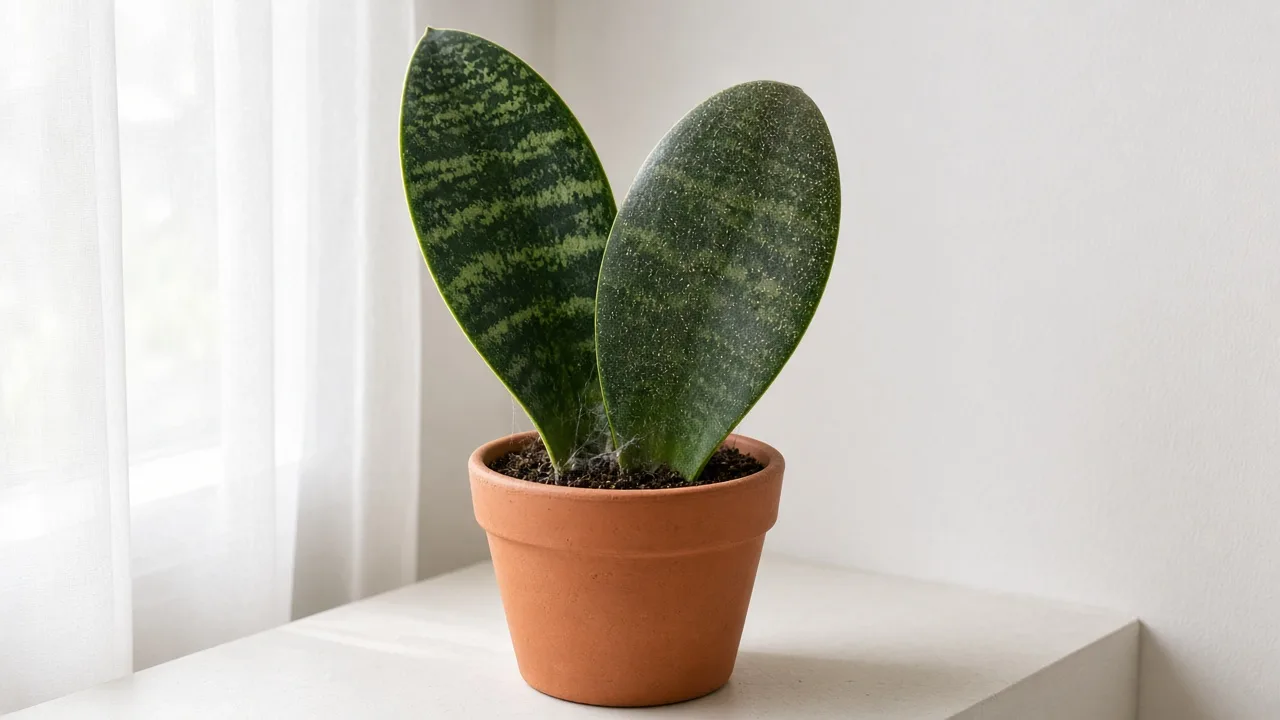
Spider Mites on Whale Fin Snake Plant: Causes, Checks & Fixes
This guide covers spider mites on Whale Fin Snake Plant. See also the general Spider Mites guide, watering, and light pages for this plant.
Spider Mites on Whale Fin Snake Plant: Causes, Checks & Fixes
Quick answer
A Whale Fin Snake Plant (Dracaena masoniana) has a thick, stiff, waxy paddle that looks pest-proof, but NC State Extension still lists spider mites among the pests to monitor on it. If your paddle has a fine scatter of pale dots, a dull dusty cast, or thread-like silk near the base, mites are the first thing to rule in or out.
First step: confirm live mites, then rinse and wipe both faces of the paddle. Hold white paper under the leaf, tap it, and watch for specks that crawl. Do not water the pot, repot, or spray anything on day one. A thorough physical wash removes mites and eggs without adding a second problem for a plant that hates wet soil. For the general biology of this pest across houseplants, see our spider mites guide.
What spider mites look like on a Whale Fin paddle
A healthy Whale Fin leaf is dark green, glossy-waxy, and mottled with broad patches of lighter green. Mite damage sits on top of that pattern as something different: tiny, sharply defined pale dots that read as a fine speckle, sometimes with a flat, dusty or slightly bronzed look across the area.
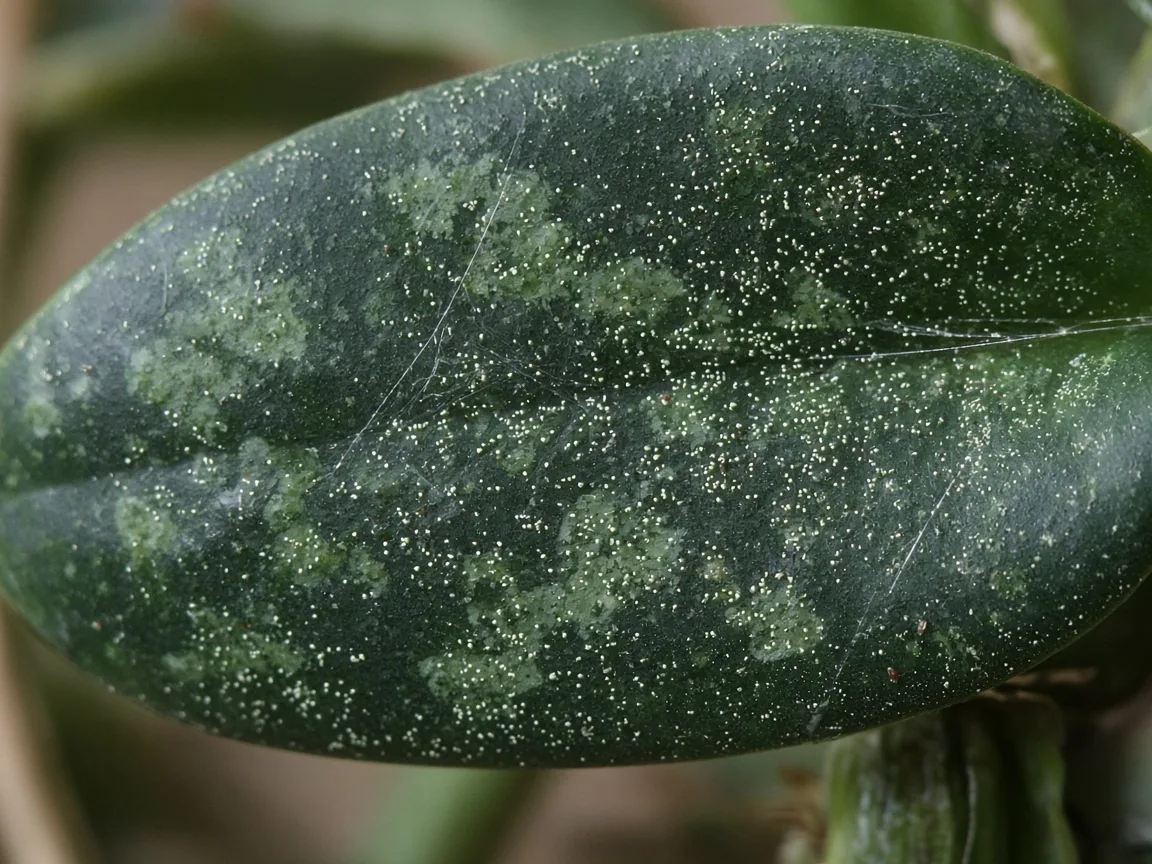
Pinpoint pale stippling scattered across the dark paddle, with fine silk near the leaf edge. The broad lighter patches are the leaf’s natural mottling, not damage.
On thin-leaved houseplants, mite damage turns leaves yellow or bronze fairly quickly. A thick paddle stores water and hides early feeding, so the first sign is often just a duller sheen, followed by speckling that you notice at an angle in side light. Silk is a late sign. Colorado State University Extension notes that dracaenas are among the common hosts, and it describes early injury as white flecks near the leaf underside before general graying or bronzing sets in.
Why Whale Fin gets spider mites
Mites do not need a weak plant, they need a warm, dry, dusty setting and a leaf they can feed on undisturbed. UC IPM describes damage as most severe in hot, dusty conditions and on water-stressed plants, and Colorado State adds that houseplants in very hot, dry spots are the ones that get mites. Three things about a Whale Fin make that setup common:
- A huge flat surface that collects dust. A single paddle can be up to 3 to 4 ft long and 8 to 10 inches wide, per NC State. Dust sits on the face for months because nobody wipes it, and dust is part of what mites like.
- A spot next to heat or glass. Whale Fin wants bright indirect light, so it often lives near a sunny window or radiator. Hot, dry air in winter is when mite numbers build, and the soil can be perfectly dry for good reasons while the air around the leaf is simply too dry.
- Long gaps between close looks. Whale Fin is slow and low-fuss, so it can go weeks without anyone inspecting the leaf base. A colony that starts there can reach silk before it is noticed.
New plants are the usual entry point. Mites crawl short distances or ride air currents, and Colorado State notes that houseplant infestations often arrive on plants kept outdoors or bought from a greenhouse.
Where mites hide on a Whale Fin
This is the plant-specific part of the inspection. A Whale Fin does not have dozens of small leaves to scan, so the places mites can hide are few, and you can check all of them in two minutes.
- The base crease. Where the paddle emerges from the purple-banded sheath at soil level, the leaf folds against its neighbor. Silk and eggs gather here first.
- The underside of the paddle. Mites live in colonies mostly on the undersides, per UC IPM. Tilt the pot rather than bending the leaf, because a thick paddle can crack.
- Between overlapping leaves or pups. A mature clump has paddles pressed together, and the contact points are shielded from the air.
- The upper face. Check last. Stippling shows here once the colony has been feeding for a while.
A caution on rinsing: the same crease that shelters mites also holds water. When you wash the plant, tilt it so water runs off the blade instead of pooling at the crown where the paddle meets the sheath.
Confirm it is mites before you treat
Run these three checks in order:
- White-paper test. UC IPM recommends shaking mites off the leaf onto a white sheet of paper, where they will move around rapidly once disturbed. Tap the leaf over the paper rather than the plant itself.
- Magnifier look. Mites are barely visible to the naked eye, so use a 10x hand lens on the base crease and the underside. Look for tiny moving dots, round translucent eggs, and thread-like silk.
- Pattern check. Stippling that is spread across the face with silk nearby is mites. A single oval scar, a brown scorch patch, or white fluff is something else.
Lookalikes on a Whale Fin
| What you see | Likely cause | Key check |
|---|---|---|
| Pinpoint pale dots, dull sheen, silk at base | Spider mites | Moving specks on the white-paper test |
| Broad light-green patches in a fixed pattern | Normal leaf mottling | Same pattern on every leaf, no dots or silk |
| Larger silvery patches with tiny dark specks | Thrips, which NC State also lists on this plant | Wounds are larger and more silvery than mite flecks, per Colorado State |
| White cottony tufts in the crease | Mealybugs | Fluff, not fine silk, and no moving specks on paper |
| Wrinkled, puckered paddle with a dry pot | Underwatering | Pot is light and the leaf is wrinkled but has no dots |
| Brown crispy patches on the sun-facing side | Sun scorch | NC State warns direct sunlight can scorch the leaves |
| Mushy leaf base and sour smell | Root rot | A soft base is not a mite symptom |
Treat this as a confirmed diagnosis only when you have seen live mites, eggs, or silk. Stippling alone, with no specks on paper and no silk, is a suspected diagnosis. Dust, sun scorch, and old mottling can all fool a quick look.
The first fix: rinse and wipe the paddle
Move the plant away from everything else you grow, then wash the whole leaf. Carry the pot to a sink or shower, tilt it so water does not pool at the crown, and run lukewarm water over both faces of each paddle and the underside. Follow with a soft, damp cloth, wiping from base to tip. Colorado State describes washing with a jet of water as one of the most effective controls, since it forces off mites and eggs, and says that repeating it over several weeks can bring numbers down to low levels. Epic Gardening also advises wiping dust off leaves regularly to make the surface less hospitable.
Let the paddle drip dry in bright indirect light, away from the heater, and then leave the soil alone. A mite problem is not a reason to water.
If mites come back: soap or oil as the second step
Re-check with the white-paper test two days after the wash. If you still find live mites, move to a spray. Colorado State says horticultural oils are probably the most effective spray on houseplants and that insecticidal soaps are marginally effective, so it is worth choosing a labeled product over a household one. Utah State University Extension advises applying soap or oil at dusk, two or three times, five to seven days apart.
Test first: Colorado State’s soap guidance says to test on a small area a day or two before a full treatment because some plants are sensitive. It also warns that homemade soap mixtures are not consistently formulated or tested, and that repeat applications may be needed at four to seven day intervals for spider mites. Do not spray a dry, stressed plant or a hot room. UC IPM says not to spray when plants are water-stressed or it is very hot, and Epic Gardening puts oils on hold above 90 F.
Spray the base crease and underside, not just the face, and keep the soil as dry as you can. This guide stops at household options. If three rounds fail, contact your local extension office for identification help before escalating.
Whale Fin care cross-check
A mite problem pushes people to overcorrect, so keep these points straight:
- Watering. Whale Fin should dry out completely between drinks. Keep that rhythm. The risk on the other side is a plant left bone dry for months, which stresses it and invites mites, so match the pot to the Whale Fin watering guide and keep wrinkling in check using the underwatering guide.
- Humidity. NC State lists humidity of at least 50%, and heated rooms in winter commonly run drier than that. Use a room humidifier or move the plant away from the vent, but do not mist into the crease at the base.
- Light. Bright indirect light keeps the plant firm and makes damage easy to spot. See the Whale Fin light guide before moving it, because a sudden shift to harsh sun can scorch the paddle and give you a second symptom to read.
- Fertilizer. Do not feed a plant to push it past mites. Fix the pest first, then return to your normal schedule.
Recovery timeline
Spider mites are fast, with a life cycle that can finish in one to two weeks, per Colorado State, and a female can lay roughly five eggs a day. That is why a single wipe is not a cure. Plan for three to four weeks of weekly checks before calling it done.
- Days 1 to 3: Silk and live specks drop sharply after the wash. Re-test with paper.
- Weeks 1 to 2: No fresh stippling should appear on previously clean areas. If you used a spray, apply the follow-up round on schedule.
- Weeks 3 to 4: Clean paper tests and no new silk at the base mean the colony is gone.
Old stippling stays. Whale Fin grows slowly and may add only a few new paddles in a season, so judge recovery by what stops happening, not by new growth. A paddle that stays free of fresh dots and silk is the evidence.
If silk keeps returning or the paddle is heavily webbed after repeated treatment, Colorado State’s advice is that heavily infested plants should be disposed of whenever possible. With a slow, hard-to-replace plant, quarantine any pups and keep their care separate before deciding.
Mistakes to avoid
- Watering to fix leaf damage. Dry soil is correct for this plant, and wet soil leads to rot, which is the bigger killer.
- Misting the crown. Water that sits where the paddle meets the sheath can hurt more than it helps.
- Spraying in a hot room or full sun. Oils and soaps can burn leaves in heat, per the extension guidance above.
- Trimming the paddle. Cutting a damaged tip leaves a permanent scar and does not remove mites from the base.
- Treating without confirming. Check for live mites first, since stippling alone can come from older damage.
- Leaving sprayed leaves in reach of pets. ASPCA lists dracaena as toxic to cats and dogs, so keep treated plants out of reach until the leaf is dry.
How to prevent it next time
Wipe the paddle every few weeks, which doubles as an inspection. Quarantine new plants for two weeks and check the base crease before placing them near the Whale Fin. Keep the plant out of direct heater airflow, hold the dry-down routine steady, and look at the base of every paddle once a month, more often in winter when indoor air is driest. Dust on a paddle is a sign you are overdue.
When to use this page vs other Whale Fin guides
- Use this page when you can see pale speckling, silk, or moving dots on the leaf.
- Use Whale Fin yellow leaves when the paddle is changing color without speckling or silk.
- Use brown tips guide when the damage is crispy tips or edges.
- Use low-humidity guide when the air is the main concern and no pest is present.
- Use mealybugs guide when you find white, cottony clusters instead of fine silk.
Related Whale Fin Snake Plant guides
- Whale Fin Snake Plant overview - baseline care and what a healthy paddle looks like.
- Whale Fin watering - how long the mix should stay dry between drinks.
- Whale Fin light - placement that avoids both scorch and weak growth.
- Whale Fin soil - the gritty mix that keeps the rhizome safe.
- All Whale Fin problems - every common issue on this plant.
Related tool
Use the Pest Identifier Tool to narrow causes for spider mites on this plant before changing multiple variables at once.