Not Enough Light on Whale Fin Snake Plant: Causes, Checks &
Quick answer
A Whale Fin Snake Plant in too little light keeps its paddle but loses firmness, fades its banding, and stops producing new leaves or pups. First step: move the pot to your brightest indirect spot, such as an east window or a few feet back from south glass, and change nothing else for two weeks.
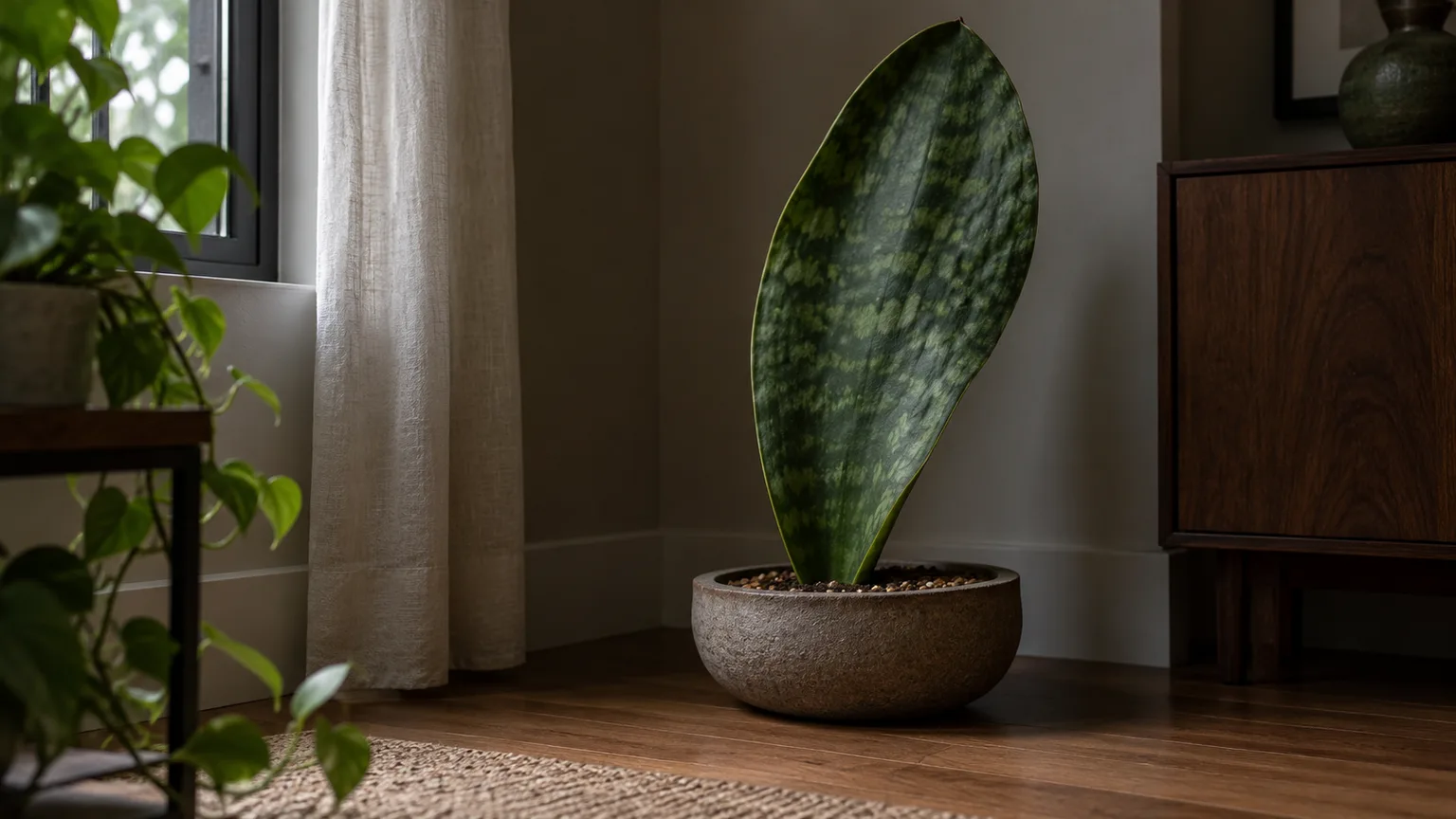
Not Enough Light on Whale Fin Snake Plant: Causes, Checks & Fixes
This guide covers not enough light on Whale Fin Snake Plant. See also the general Not Enough Light guide, watering, and light pages for this plant.
Not Enough Light on Whale Fin Snake Plant: Causes, Checks & Fixes
Quick answer
The Whale Fin Snake Plant is Dracaena masoniana, a rhizomatous plant from the seasonally dry tropics grown for enormous paddle-shaped leaves. It prefers bright, indirect light yet tolerates low light far longer than most houseplants, which is exactly why owners miss the problem. The paddle stays green for months while quietly drawing down stored water, then puckers, fades, and stalls.
First step: move the pot to your brightest indirect spot today, such as an east window or a few feet back from a south window, and change nothing else for two weeks. For how dim conditions stall houseplants in general, see the not enough light hub. On Whale Fin, the pattern usually shows up as a soft, puckered paddle with faded banding and soil that never dries, not as classic leggy stems.
What not enough light looks like on Whale Fin Snake Plant
Low light on this plant does not look like a stretching pothos. A Whale Fin often arrives as a single enormous leaf, so there are no internodes to elongate. Instead the whole light budget lands on one blade, and the symptoms stay on that blade.
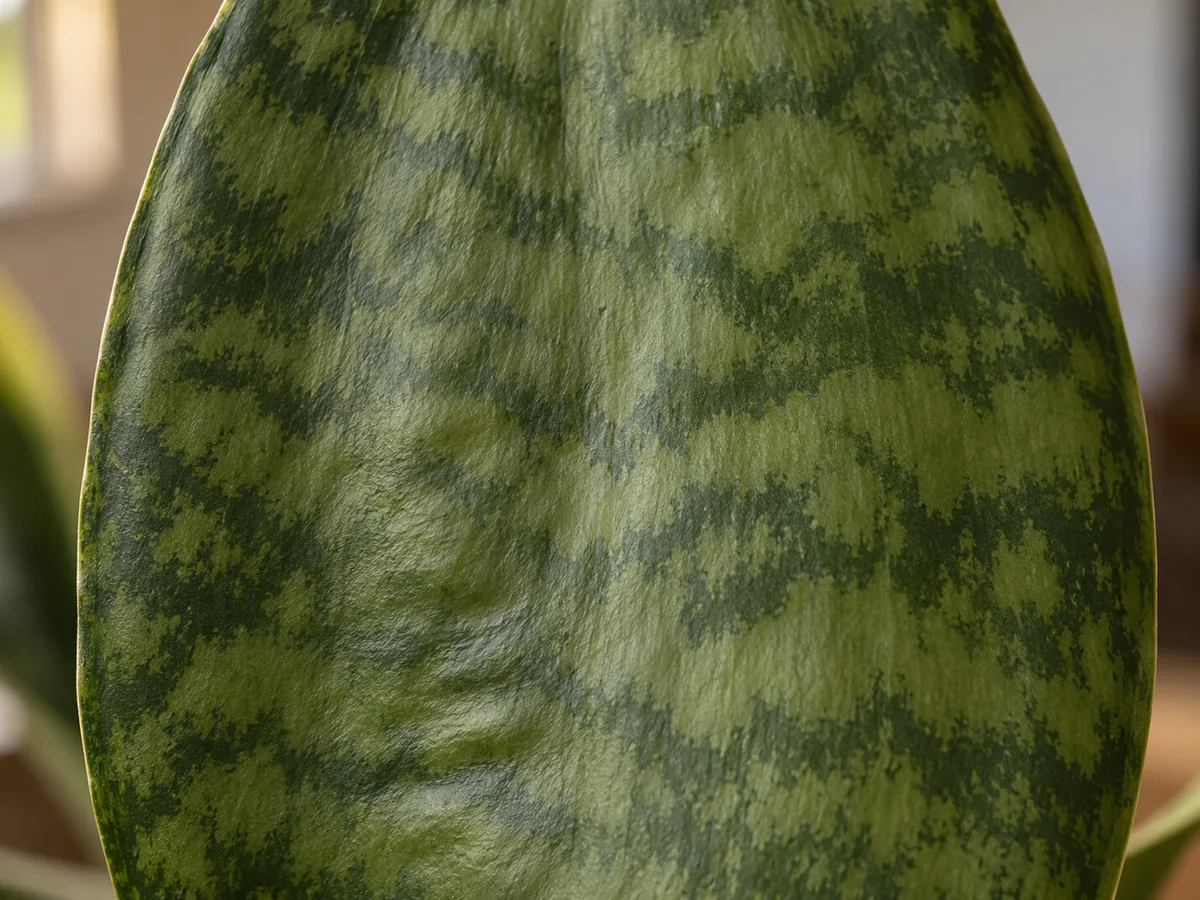
A Whale Fin paddle in prolonged dim light: faded mottling, a duller surface, and slight puckering. Compare it with a firm, sharply banded paddle on a plant in bright indirect light.
Typical signs, roughly in the order they appear:
- Puckering or loss of waxy stiffness across the broad blade, especially along the midrib
- Faded banding where dark green mottling and light green spots wash toward a flat, dull green
- A one-sided lean as the heavy paddle tilts toward the nearest window
- No new leaf spear or pup at the base for a year or more, even through spring and summer
- Soil that stays wet for weeks because the plant barely uses water in dim conditions
A plant can sit in this state looking like a statue for a long time. Survival is not thriving. The paddle is spending stored reserves it cannot replace, which is why whale fin light problems hide longer than sunburn and surprise owners who swear they barely water.
Why a single-paddle plant stalls in dim rooms
Standard snake plant advice assumes many upright leaves sharing the photosynthetic work. Whale Fin breaks that assumption because the entire plant is often one monolithic paddle measuring 3–4 ft long and 8–10 in wide at maturity. Less leaf area per plant means each square inch works harder, so marginal light shows first as subtle puckering across the wide blade rather than the slow fade you might miss on narrow leaves.
Growth habit makes the stall worse. RHS describes sansevierias as long-lived but relatively slow-growing, and whale fin is slower than most: bright indirect light serves this variety well, but since it is not as fast-growing as other snake plant types, holding back light stalls it further. You will not get much growth in low light, and a Whale Fin kept dim can sit a year or more without a new leaf.
Common triggers in real homes include placement chosen for decor rather than photons, the winter daylight drop in a spot that felt adequate in June, dirty or tinted glass cutting intensity unnoticed, and overcorrecting from sunburn fear by pulling the plant far too far back after one scorch event. The light guide for Whale Fin Snake Plant covers window-by-window placement in more detail.
The wet-soil trap: why dim light rots whale fin roots
This is the section that matters most, because low light rarely kills a whale fin directly. It kills through water. Without enough light to drive transpiration, water use drops sharply on a plant that already needs infrequent watering. The top inch may look dry while the center of the pot stays moist for weeks, and the thick rhizome sits in airless mix.
NC State Extension advises allowing the growing medium to dry out between waterings and lists root rot from overwatering among the main threats. The same watering rhythm that worked on a bright windowsill will overwater the same plant in a dim corner, because the root zone never dries. Fixing water alone without improving light treats the symptom, not the throttle. If the base feels soft, the mix smells sour, or yellowing spreads while the pot stays heavy, stop treating this as a light problem and read overwatering and root rot first. The watering guide explains the bone-dry check that prevents this overlap.
How to confirm the cause
Work through these checks before changing fertilizer or pot size:
- Window distance and direction. Can the paddle surface see sky, or only a wall? Within a few feet of an east window counts as bright indirect; a deep interior corner reads as low light even when the room looks lit to your eyes.
- Paddle firmness. Press the blade gently. Stiff and waxy points to adequate energy reserves, while flex, puckering, or slight softness points to a plant drawing down storage.
- Banding contrast. Compare the mottling with photos from when you bought the plant. Fading on the whole blade over months fits chronic dim light.
- New growth at the base. Part the top of the mix at the soil line and look for a pointed spear or pup. None for a full growing season in a dim spot confirms a stall rather than a rest.
- Soil dry-down speed. Lift the pot and push a finger deep into the mix. Damp for three weeks or more without recent watering means light is slowing water use, so recheck your rhythm in the watering guide.
- Two-week trial move. Shift the plant to your brightest indirect location without changing water or feed. A paddle that firms up and soil that starts drying on rhythm confirm light was the limiter.
Suspected, not confirmed: slow growth alone through winter can include a normal seasonal rest. Confirmed: puckering plus faded banding plus wet-staying soil that all improve after the trial move.
First fix for Whale Fin Snake Plant
Move the plant into stronger indirect light and leave everything else alone. RHS notes that sansevierias like a bright, lightly shaded position and that midday summer sun can scorch the leaves, so avoid unfiltered south or west glass in direct afternoon sun. NC State lists partial shade with 2–6 hours of direct sun outdoors but warns plainly that direct sunlight can scorch the broad paddle leaves.
Keep watering on its normal infrequent rhythm for the first two weeks so you isolate the light change. Do not fertilize, repot, or prune at the same time, because then you cannot tell which change worked. If the pot is oversized or the mix has stayed wet for weeks, the first fix changes: stop watering and work through the root checks before you improve the light.
Because the paddle is top-heavy and acts like a sail near glass, set the pot on a stable, wide base and rotate a quarter turn every two to three weeks if growth tilts toward the window.
Step-by-step recovery
After the first move:
- Acclimate gradually if the jump is big. A plant grown under store fluorescents and placed against south glass in July can develop permanent bleached patches within days. Move in stages over one to two weeks, watching the sun-facing third of the blade.
- Add a grow light if no window suffices. A full-spectrum white LED 12 to 18 inches above the tallest point of the paddle, run twelve to fourteen hours daily on a timer, carries the plant through north-facing winters. Windowless rooms and deep interior offices need this rather than hope.
- Dust the paddle. Dust on a broad leaf gets in the way of photosynthesis, and a single large paddle has little spare surface to lose. A damp cloth also lets you check the leaf base for mealybugs.
- Recheck watering as dry-down changes. Brighter light increases dry-down rate even if nothing else changed. Water only once the mix is bone dry deep in the pot, and extend intervals again if you move the plant back for winter.
- Feed lightly and only after light is fixed. RHS suggests monthly liquid feed from April to September, but the gentler whale fin schedule of one or two dilute feeds a year with none in winter suits this slow plant. Details are in the fertilizer guide.
- Repot only if the container is wrong. Missouri Botanical Garden recommends shallow clay pots because the roots are not deep and the large leaf makes the pot top-heavy. See repotting and the soil guide if drainage stays suspect.
Lookalike symptoms to rule out
| What you see | Points toward | Next step |
|---|---|---|
| Firm paddle, no new leaf, dim spot, dry mix | Light stall | Brighter indirect trial; see slow growth |
| Thin, stretched, floppy new growth leaning hard | Etiolation overlap | See leggy growth |
| Wrinkled paddle, very light pot, dry mix throughout | Prolonged dryness | See underwatering |
| Soft base, wet mix for weeks, spreading yellow | Wet roots, not just dim light | See overwatering and root rot |
| Bleached white patches after a sudden bright move | Sunburn from skipping acclimation | Pull back to filtered light; damage is permanent |
| Uniform yellowing starting on lower leaves with damp soil | Overwatering or natural aging | See yellow leaves |
Recovery timeline and what recovers
Existing paddle tissue will not change shape, regain lost banding contrast, or smooth out deep puckering. Old scorch or fade is history. Recovery means a new leaf spear or pup appears at the base, firm and correctly colored. Expect that on the scale of a growing season, not weeks: a dim-held Whale Fin can take a year or more to show a new leaf.
Signs of improvement: the paddle firms up, banding stops fading, and the mix starts drying on a predictable rhythm. Signs of trouble: softening at the base, spreading yellow, or a sour smell from the pot. Those mean you should stop treating this as a light problem and move to the root checks.
What not to do
Do not fertilize a dim, stalled Whale Fin hoping to push growth. Salts stress roots that are already struggling in wet mix, and nutrients cannot substitute for photons. Do not repot into a larger container on day one; extra wet mix in low light makes rot more likely, and RHS says sansevierias only need repotting once roots and leaves have completely filled the container. Do not jump straight into harsh direct midday sun to fix months of shade; scorch on a single display paddle is permanent. And do not water on a fixed calendar without checking the pot, because low light slows everything down.
How to prevent it next time
- Place the plant in bright indirect light from the start rather than waiting for it to stall
- Move it closer to glass in winter when the sun angle drops, and back off harsh afternoon beams in midsummer
- Dust the paddle every few weeks so the single blade intercepts light evenly
- Match watering to dry-down speed in the current light, cutting back sharply from fall through winter as Missouri Botanical Garden advises
- Keep it above 10°C (50°F) and away from cold glass and heaters
- Start a grow light before short days trigger another stall, not after
If an overall care reference helps, start with the Whale Fin Snake Plant overview and the light guide. Propagation by division also needs a healthy, established rhizome, so wait until growth is steady before dividing pups.
When to use this page vs other Whale Fin Snake Plant guides
- Leggy growth: when new growth is thin and stretched rather than simply absent.
- Slow growth: when the question is whether stalled growth is normal for this slow plant.
- Yellow leaves: when color change is the main symptom, not dim placement.
- Overwatering: when the mix stays wet and the base is soft, regardless of light.
- Whale Fin Snake Plant problems hub: to browse all issues for this plant.