Leggy Growth on Whale Fin Snake Plant: Causes, Checks &
Quick answer
Leggy growth on Whale Fin Snake Plant shows up as a new paddle that stays narrow, pale, and leaning instead of broadening into a stiff mottled blade. First step: move the plant to bright indirect light a few feet from an east window or back from south glass, and change nothing else until the next spear emerges.
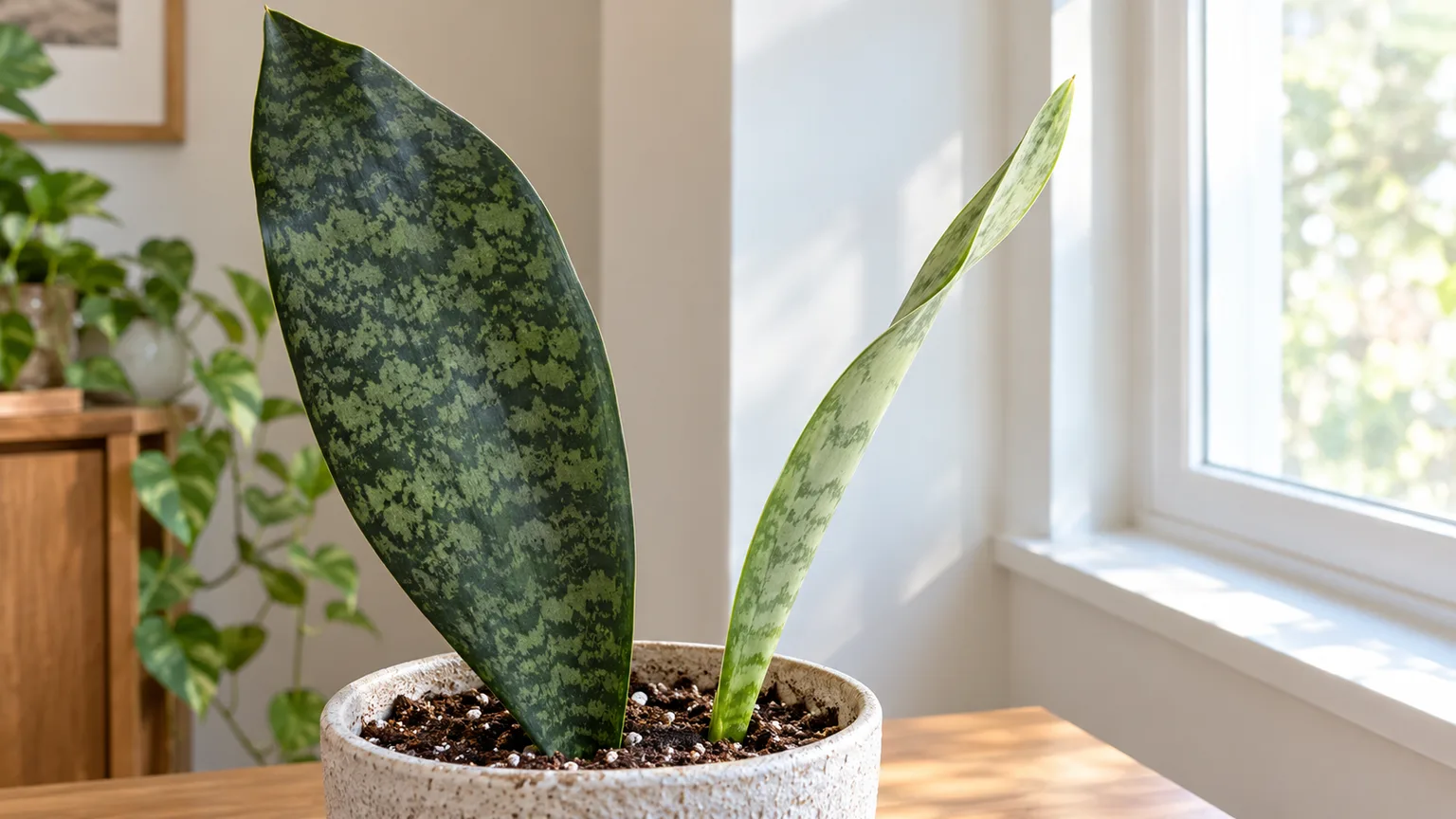
Leggy Growth on Whale Fin Snake Plant: Causes, Checks & Fixes
This guide covers leggy growth on Whale Fin Snake Plant. See also the general Leggy Growth guide, watering, and light pages for this plant.
Leggy Growth on Whale Fin Snake Plant: Causes, Checks & Fixes
Quick answer
Leggy growth on Whale Fin Snake Plant means the newest paddle is coming in narrow, pale, and leaning instead of broadening into the stiff, dark-mottled blade this plant is grown for. Because Whale Fin usually carries only one or two paddles, one stretched leaf changes the whole look of the plant. First step: move the pot to bright indirect light — a few feet from an east window or set back from south or west glass — and change nothing else until you see how the next spear develops.
Whale Fin (Dracaena masoniana) is a rhizomatous herbaceous perennial from tropical Central Africa that stores water in each massive paddle, so it grows slowly and forgives missed waterings far more easily than it forgives a dark corner. For how stretchy growth works across all houseplants, see our leggy growth guide. This page covers what is specific to Whale Fin: telling a normal unfurling spear from true legginess, and fixing it without scorching a broad flat leaf.
When to use this page vs other Whale Fin Snake Plant guides
This page is for new growth that is stretched, narrow, pale, or leaning toward the light. If the leaf is changing a different way, start with the closer match below, or browse the Whale Fin Snake Plant problems hub and the plant overview.
| What you see | Read next |
|---|---|
| New spear narrow and pale, leaning at the window, base firm | Stay here, then check the light guide for placement |
| Dark green but no new growth for a year or more | The slow growth guide |
| Paddle base soft, translucent, or sour-smelling | The root rot guide, not a light fix |
| Wrinkled paddle in a feather-light pot | The underwatering guide |
| Bleached papery patch on the glass side after a move | Sun scorch — see the light guide before moving it again |
| Sticky residue, cottony clusters, or stippled fading | Pest guides starting with mealybugs or spider mites |
What leggy growth looks like on Whale Fin Snake Plant
A healthy Whale Fin paddle is thick, stiff, and waxy, dark green mottled with light green spots, and mature blades reach several feet long and up to 10 inches wide. Legginess breaks that pattern in ways that are easy to misread, because every new spear starts narrow before it broadens.
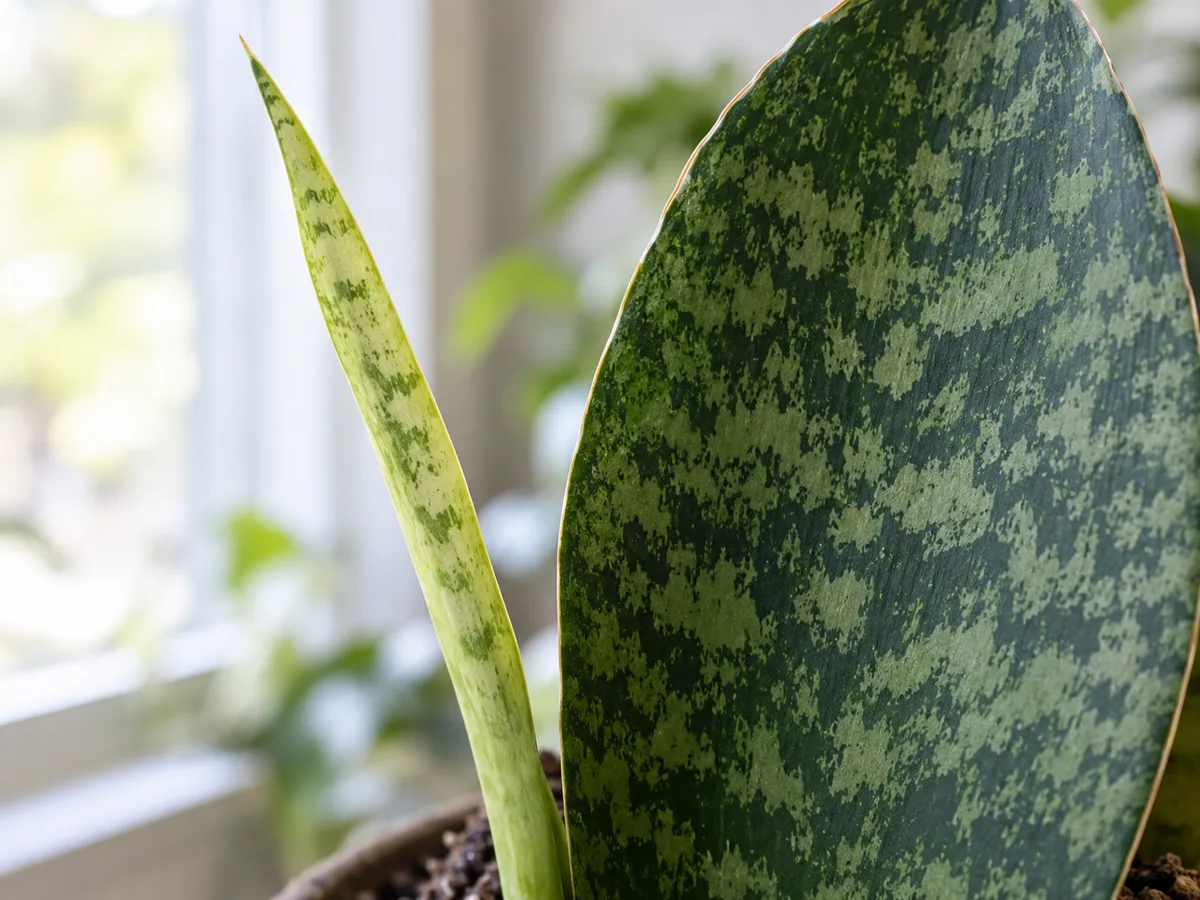
Narrow, pale new paddle leaning toward the window next to the older broad mottled blade. Compare blade width, color, and stance — not just height.
- True legginess: the new blade stays much narrower than the older paddle, looks washed out or yellowish-green with weak mottling, and leans or flops instead of standing upright.
- Normal unfurling: a fresh spear emerges rolled and narrow, then widens, darkens, and stiffens over several weeks. Give it time before judging.
- One-sided lean: the whole plant tilts toward the window while blade width and color stay fairly normal. The light level may be fine; the distribution is not.
- Soft-base flop that mimics legginess: the paddle leans because its base is mushy, often with a heavy pot and sour soil. That is root trouble, and more light will not fix it.
Why Whale Fin Snake Plant gets leggy growth
Chronic dim placement
NC State notes this species prefers bright, indirect light while tolerating low light, and tolerance is exactly the trap: the plant survives in a dim corner but stretches its new blade toward what little light arrives. The RHS makes the mechanism visible, noting that sansevierias in shade grow taller leaves, while those in sun may remain more compact. On Whale Fin the extra height comes at the cost of blade width, stiffness, and mottling, so the paddle reads as floppy rather than statuesque.
A broad flat paddle makes the problem worse than on narrow-leaf snake plants, because a single blade has to hold itself upright with no fan of sister leaves for support. If your plant lives several feet from the nearest window or behind a sheer curtain plus furniture, dim light is the leading suspect. Compare notes with the light guide and the not enough light guide for this plant.
Pot never turned
A Whale Fin in decent light can still look leggy on one side if the pot never moves. Growth bends toward the window over months, and because this plant grows slowly, the lean creeps up unnoticed until the paddle tilts hard. The RHS answers this directly with a standing habit: every time you water, turn the pot by a quarter to prevent leaning toward the light. Tie rotation to watering day so it actually happens.
Autumn and winter light drop
A plant that grew compact all summer can start stretching in November without moving an inch — the days shortened, not the plant. Lower intensity plus shorter duration pushes the same etiolation response as a dim room. Seasonal legginess pairs badly with winter overwatering, since the plant also draws on stored water and the RHS notes sansevierias barely need any water in winter. If the pot stays wet for weeks in low winter light, read the watering guide alongside this page.
Fertilizer pushing soft growth in dim light
Whale Fin has a small appetite, and Penn State Extension recommends feeding snake plants at half strength during the growing season. Extra nitrogen in weak light grows fast, soft, bendy tissue that cannot hold itself up — lush-looking at first, then floppy. If a flush of unusually tall soft leaves followed a feeding, suspect the fertilizer schedule rather than the window. Flushing the pot through until water drains freely leaches the excess salts, after which feeding stops until the plant is growing firmly in good light again.
Crowded pups competing for overhead light
Whale Fin spreads by pups from its underground rhizome, and a pot left undivided fills with blades competing for the same shaft of overhead light. Inner pups stretch upward to clear their neighbors, and the pot takes on a chaotic splayed look even where window light is adequate. NC State lists propagation by division or leaf cuttings for this species, and dividing a crowded clump in spring gives each paddle unobstructed access to light. Full timing and mix details sit in the repotting guide.
How to confirm the cause
Work through these in order and change nothing until all five are done.
- Compare blade widths. Hold the newest blade against the oldest paddle. A mature Whale Fin blade reaches up to 10 inches wide and 4 feet long per Penn State Extension. A new leaf at half that width or less, still narrow after a month of unfurling, is leggy; a widening, darkening spear is just young.
- Run the shadow test at midday. Hold your hand about a foot above the leaves. A crisp defined shadow means workable light; a faint blur means the spot is dim enough to stretch growth. The test comes from experienced snake-plant growers who use a clear defined shadow as the pass mark for compact foliage.
- Press the paddle base. Squeeze gently at the soil line. Firm means the lean is a light problem. Soft, slick, or translucent means rhizome rot, and roots rot in soggy soil — switch to the root rot guide instead of adding light.
- Read the lean. Uniform stretch on all sides is overall dim light or a seasonal drop. Lean to one side with normal color is a rotation problem. Sudden floppy growth right after feeding is overfertilizing.
- Check the pot for crowding. Multiple blades jammed together with pups pushing at the rim point to competition, especially if outer leaves look fine and only inner ones stretch.
Lookalike symptoms
| Pattern | Likely cause |
|---|---|
| Narrow spear that keeps widening and darkening over weeks | Normal unfurling, not legginess — wait |
| Lean with soft base and heavy sour pot | Rhizome rot; see the root rot guide and the overwatering guide |
| Wrinkled paddle, feather-light pot | Thirst, not light; see the underwatering guide |
| Bleached thin patch only on the glass side | Sun scorch from too abrupt a move into direct sun |
| No new growth at all, blades firm and dark | Stalled plant; see the slow growth guide |
| Yellow stippling with webbing or cottony clusters | Pests draining the leaf, not stretch |
The first fix to try
Move it into brighter indirect light. Pick a spot a few feet from an east window, or several feet back from south or west glass — NC State describes the target as partial shade, meaning direct sun only part of the day, roughly two to six hours. Do this one thing, then leave the plant alone. Do not feed it, repot it, and prune it in the same week.
Two cautions come with the move. First, never slide a dim-grown paddle straight into hot afternoon sun: NC State warns that direct sunlight can scorch the leaves, and a broad flat blade burns fast. Second, keep the new spot off cold glass and away from winter draughts.
If the light is genuinely poor
A full-spectrum LED grow light compensates well — growers report good results with the lamp 12 to 24 inches above the foliage for roughly half the day. New spears that emerge under it come in stiff and upright.
Once the cause is confirmed
- One-sided lean: rotate a quarter turn at each watering and hold the brighter position.
- Overfertilized: flush the pot, let it dry fully, and feed only lightly next spring.
- Crowded pups: divide in spring so each fan gets overhead light.
- Stretched blades: prune the worst offenders at the base. Penn State advises removing a damaged snake-plant leaf by cutting it off at the soil level with a clean blade. Wear gloves, since the RHS notes sansevieria sap is a skin irritant, and prune sparingly — on a one-paddle plant every cut removes a large share of its food factory. Details live in the pruning guide.
Recovery timeline
Stretched tissue never fills back out. The existing narrow paddle keeps its shape for life, and recovery is judged entirely by what emerges next. Because NC State rates this species as slow growing, the confirming spear can take months to appear — a quiet plant is not a failed fix.
Keep the partly pale paddle while its base stays firm, since its green areas still photosynthesize and Whale Fin has few leaves to spare. A gritty fast-draining mix from the soil guide keeps the dry-down rhythm predictable while you wait, and cuttings from any removed paddle can be rooted as backups following the propagation guide.
Mistakes to avoid
- Shoving it into direct sun to “fix” it fast. A dim-grown paddle scorches within days; brightness first, gentle morning sun only.
- Feeding a stretched plant. Fertilizer in weak light grows more floppy tissue, not firmer paddles. Check the fertilizer guide before resuming.
- Pruning every stretched leaf at once. On a one- or two-paddle plant that removes nearly all photosynthesis. Take the worst blade first and reassess.
- Repotting into a much bigger pot. Extra mix holds extra water, and wet roots mimic and worsen the flop.
- Watering on a calendar through winter. Short days plus wet mix is how legginess becomes rot.
How to prevent leggy growth next time
Audit the light twice a year — once in early autumn and once in early spring — because a spot that worked in July fails by November. Rotate the pot a quarter turn at every watering. Feed lightly in spring and summer only, at half strength, and skip winter feeding entirely. Keep the plant where the midday hand shadow stays crisp, and divide pups before the pot turns into a thicket.
Pet households: Dracaena is toxic to cats and dogs through its saponins, so bin pruned paddle sections instead of leaving them where animals chew, and keep floor-level paddles out of reach.
When to worry
- The paddle base turns soft, slick, or translucent.
- The soil smells sour after you have stopped watering.
- The plant wobbles or the paddle loosens at the rhizome.
- A leaning paddle keeps falling further within days.
- The pot is so top-heavy the plant tips — Penn State suggests choosing a heavy pot for the taller varieties precisely because leaf weight topples dry plants.
A slow pale stretch on a firm base is low urgency. Soft tissue at the soil line is the line between a light problem and a plant that may not be saveable.
Related Whale Fin Snake Plant guides
- Whale Fin Snake Plant overview — start here for identification and basic care rhythm.
- Light — how much window light keeps paddles wide and the pot drying on schedule.
- Not enough light — the dim-room companion to this page; read when the whole plant stalls, not just the new blade.
- Watering — set a dry-down rhythm so winter wetness does not turn legginess into rot.
- Soil — gritty fast-draining mixes that keep the rhizome breathing.
- All Whale Fin Snake Plant problems — the full issue list when symptoms overlap.
Conclusion
Leggy growth on Whale Fin Snake Plant is almost always a light story told one paddle at a time: a dim corner, a pot never turned, a winter drop, or fertilizer pushing soft tissue the light cannot support. Compare the new blade to the old paddle, press the base to rule out rot, and move the plant to brighter indirect light as the single first step. The stretched blade will not reshape itself, so judge success by the next spear — broader, darker, and standing upright.
Related tool
Use the Leggy Growth Diagnosis Tool to narrow causes for leggy growth on this plant before changing multiple variables at once.