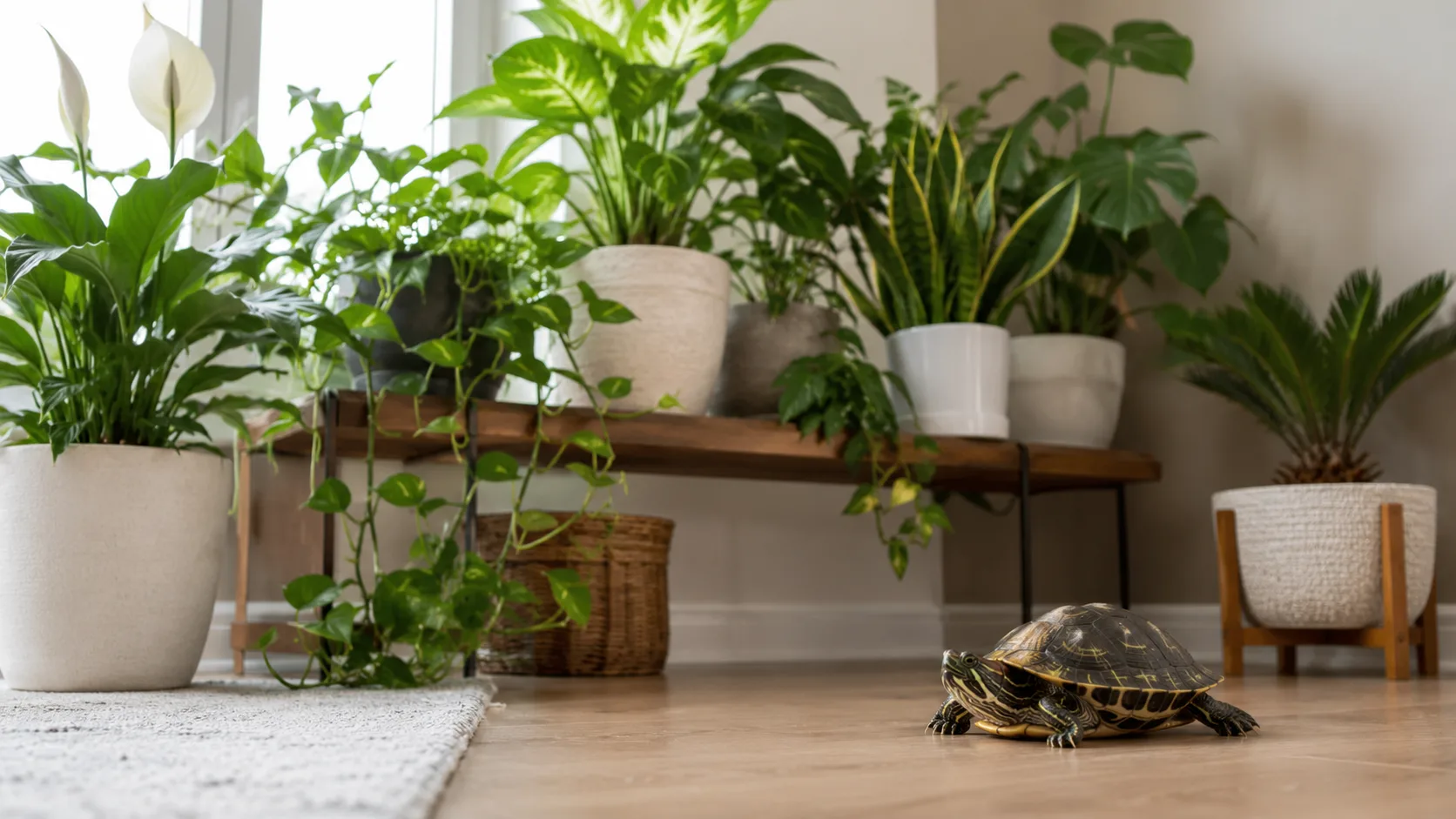
Turtle safety is not only about what goes inside the tank. Semi-aquatic turtles climb basking platforms, stretch their necks over tank rims, and roam during cleaning or supervised floor time. A pothos on the shelf above the aquarium, philodendron trailing from a bookcase, or peace lily beside an indoor pond becomes reachable the moment a turtle extends its neck or escapes during maintenance.
The ASPCA classifies many common houseplants as toxic to cats, dogs, and/or horses because of insoluble calcium oxalates, saponins, and related compounds. For turtles—aquatic, semi-aquatic, and terrestrial—those same ornamentals should be treated as off-limits enrichment, not as tank-adjacent décor. This guide ranks eight ASPCA-verified toxic species by how often they appear near turtle setups. For verified safer options, see Plants Safe for Turtles.
The eight plants to remove first from turtle-access spaces are pothos, philodendron, peace lily, dieffenbachia, ZZ plant, English ivy, aloe vera, and anthurium.
Why Tank-Side Plants Are a Different Risk Category
Aquatic setup advice often focuses on submerged plants. This page addresses terrestrial ornamentals kept near enclosures— a blind spot in many turtle care guides. Pothos is sometimes misrecommended online as a “nitrate sponge” in turtle tanks; the ASPCA nonetheless lists golden pothos as toxic to cats and dogs with oxalate oral irritation signs. (ASPCA golden pothos) Trailing stems in filter sumps or basking areas put leaves within neck reach.
Editor note (basking setups): The most frequent exposure pattern in home turtle rooms is a pothos or philodendron on a shelf directly above the basking lamp—leaves warm, soften, and drop onto the platform. Relocating that shelf plant prevents more incidents than upgrading tank cover mesh alone.
When to Call a Reptile Veterinarian
Contact your reptile veterinarian if a turtle samples a known toxic plant and shows:
- Loss of appetite for more than 24–48 hours (species-dependent)
- Lethargy or abnormal basking (too much or too little)
- Oral bubbling, swelling, or repeated mouth rubbing
- Vomiting or regurgitation (where species-appropriate sign)
- Abnormal stool or constipation
Save plant material for ID. ASPCA Animal Poison Control at 888-426-4435 supports plant identification questions (fee may apply).
Quick Pick: Remove These First
Remove oxalate aroids first: pothos, philodendron, peace lily, dieffenbachia, ZZ plant, anthurium—all on ASPCA toxic plant lists. (ASPCA oxalate houseplants)
Relocate English ivy from pond edges and tank-room shelves; ASPCA lists English ivy toxic to cats and dogs.
Move aloe vera away from basking windowsills shared with turtle tables; ASPCA lists aloe toxic to cats and dogs.
How We Selected These Eight
Criteria:
- ASPCA toxic listing for the species
- Enclosure-adjacent prevalence — plants turtle keepers place on tank stands and pond ledges
- Reach geometry — trailing stems and overhangs within neck stretch
- LeafyPixels inventory — identification hubs for each species
We do not catalog every aquatic plant species; focus is ornamental houseplants near setups.
Toxic Plant Comparison Table (Turtle Access)
Pothos
Safety status: Toxic — ASPCA golden pothos. (ASPCA golden pothos)
Exposure route: Shelf overhang, sump trailing, dropped leaves on basking platform
Do not use pothos as tank-adjacent “air purifier” foliage without accepting ASPCA-documented oxalate toxicity. Neck-stretching red-eared sliders and similar species reach farther than owners expect.
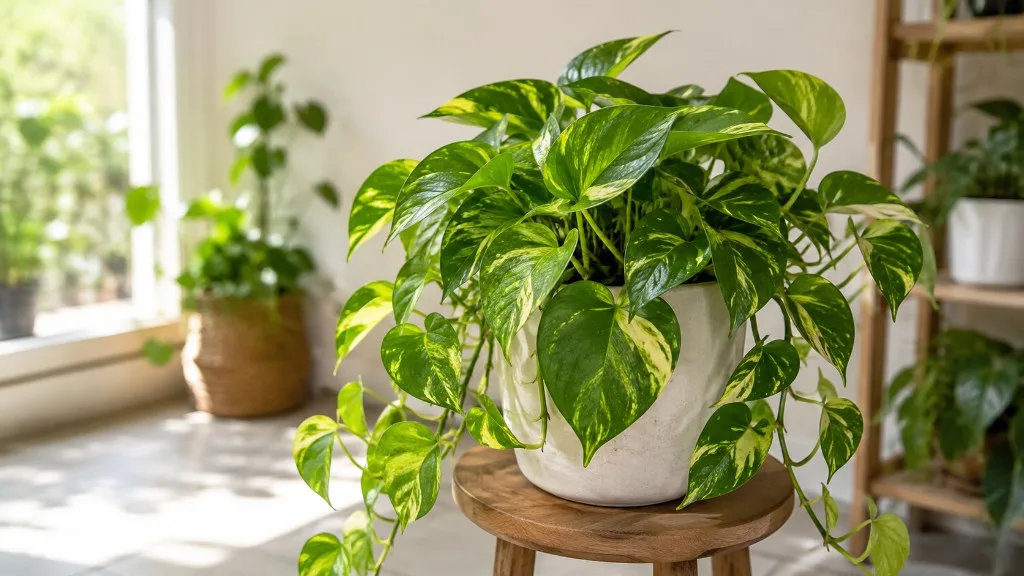
Safety note: Filter-sump pothos roots do not neutralize leaf toxicity above the waterline.
Action: Remove from tank room entirely or relocate to a closed human office.
Useful care guides (for ID):
Philodendron
Safety status: Toxic — ASPCA philodendron. (ASPCA philodendron)
Exposure route: Moss poles on tank stands, vines touching lamp cords turtles climb
Philodendron stems soften in warm basking air and drop leaves onto platforms.
Safety note: Check for rooted cuttings in open-top enclosures after maintenance.
Action: Separate plant room from turtle room.
Useful care guides (for ID):
Peace Lily
Safety status: Toxic — ASPCA peace lily. (ASPCA peace lily)
Exposure route: Humid turtle rooms where peace lilies thrive on floor pots
High-humidity turtle rooms tempt owners to add peace lilies for aesthetics—ASPCA lists them as oxalate-toxic aroids, not safe pond companions.
Safety note: Not a true lily; still toxic per ASPCA.
Action: Use verified turtle-safe humidity plants from the safe list instead.
Useful care guides (for ID):
Dieffenbachia
Safety status: Toxic — ASPCA dieffenbachia. (ASPCA dieffenbachia)
Exposure route: Large floor specimens beside multi-tank racks
Broad dieffenbachia leaves overhang low basking tables. Intense oral irritation per ASPCA can suppress feeding.
Safety note: Wear gloves when pruning; dispose of leaves before turtles roam during tank cleaning.
Action: Remove from turtle-keeping rooms.
Useful care guides (for ID):
ZZ Plant
Safety status: Toxic — ASPCA ZZ plant. (ASPCA ZZ plant)
Exposure route: Low-light side tables at tank stand height
ZZ plant tolerates the dim corners turtle rooms often have—making it a common but unsafe shelf companion.
Safety note: Waxy leaves still get sampled by curious chelonians.
Action: Move to non-turtle areas.
Useful care guides (for ID):
English Ivy
Safety status: Toxic — ASPCA English ivy. (ASPCA English ivy)
Exposure route: Trailing over indoor pond edges
Ivy softens pond hardscape but drops leaves into water and onto basking rocks. ASPCA saponin toxicity applies.
Safety note: Do not confuse with turtle-safe aquatic species—this is terrestrial ivy.
Action: Remove from pond-adjacent planters.
Useful care guides (for ID):
Aloe Vera
Safety status: Toxic — ASPCA aloe. (ASPCA aloe)
Exposure route: Sunny window ledges shared with turtle basking tables
Basking lamps and aloe both want bright windows—collision of needs creates exposure risk.
Safety note: Gel for human use ≠ safe turtle forage.
Action: Separate basking zone from aloe ledge by room or barrier.
Useful care guides (for ID):
Anthurium
Safety status: Toxic — ASPCA flamingo flower. (ASPCA flamingo flower)
Exposure route: Temporary gift plants in turtle rooms
Anthurium spathes attract investigation during supervised floor roaming.
Safety note: “Flamingo lily” labels still mean Anthurium.
Action: Relocate gifts before returning turtles to floor time.
Useful care guides (for ID):
Audit Turtle Access Routes
Trace every path from water to plant:
- Shelf height above basking platform (measure neck stretch)
- Tank stand trailing vines
- Pond rim planters
- Floor roaming during maintenance
- Filter sumps with emergent stems
- Warm leaves dropping under basking lamps
Verified safe options live on plants safe for turtles—not on unverified décor.
Common Mistakes
Planting pothos in the filter for aesthetics. ASPCA toxicity still applies to emergent leaves.
Assuming tank lid prevents all exposure. Neck stretch and climbing defeat partial covers.
Mistaking online “naturalistic” setup photos for safety guides.
Leaving gift plants in the turtle room after events.
Delaying vet calls when a turtle stops basking or eating after sampling foliage.
Conclusion
Turtle plant safety extends beyond the waterline. Pothos and philodendron top the removal list because trailing growth overhangs basking zones in most home setups. Peace lily, dieffenbachia, ZZ plant, English ivy, aloe vera, and anthurium carry ASPCA toxic listings and should leave turtle rooms, pond edges, and tank stands.
Audit shelf height above your basking platform today— that single sight line prevents more exposures than adding another tank accessory. Contact your reptile veterinarian or ASPCA Animal Poison Control at 888-426-4435 if sampling occurs and behavior or appetite changes.
For verified alternatives, start with plants safe for turtles and keep all ASPCA-toxic ornamentals in human-only spaces.