6 Small Space Gardening Trends for 2025
Explore six small space gardening trends for 2025, with practical advice for balconies, patios, tiny yards, containers, pollinators, roses, and edible gardens.
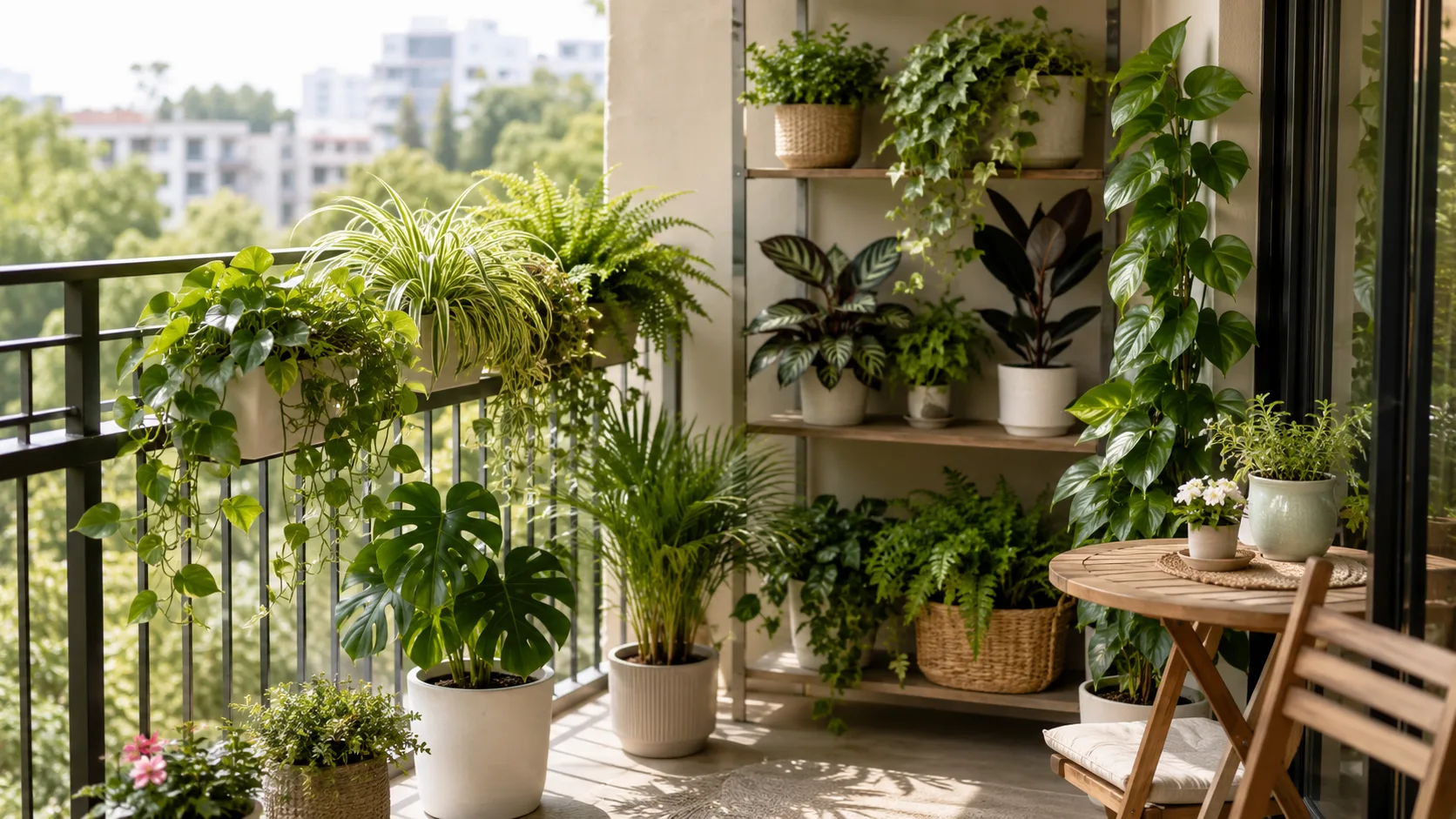
Small gardens are moving away from the idea that more plants automatically create more beauty. The strongest small-space designs now use a clear focal point, a few repeatable materials, and plants chosen for the exact conditions of a balcony, patio, courtyard, or narrow bed.
The six trends below are useful because they solve real constraints. Native plantings make a tiny patch more ecologically valuable, large containers make watering less frantic, standard roses add height without a wide hedge, and potagers turn limited ground into something both productive and decorative. Treat the trend as a starting point, though—not a shopping list. The right choice depends on sun, wind, water access, winter temperatures, building rules, and how often you can actually garden.
What makes a small-space trend worth copying?
A trend earns its place when it improves at least two of these three things: use of space, ease of care, or the experience of being in the garden. A beautiful feature that blocks a walkway, dries out every afternoon, or needs weekly reshaping is not a good small-space solution for a busy gardener.
Start by watching the site for one full day. Note the hours of direct sun, the hottest wall or paving, the direction of wind, where rain lands, and the route you use to carry a watering can. On a balcony, also check the building’s rules and the structure’s load limits before adding saturated soil, masonry pots, raised beds, or several large containers.
The best designs create layers without crowding: something low, something mid-height, and one vertical or overhead element. They also leave enough air around leaves, enough room to reach the pot, and a clear place to stand. That small amount of empty space is what lets the planting look intentional rather than merely full.
Trend 1: Pocket native plantings replace empty lawn
A small wildflower meadow does not need to be a field. In a city yard, it can be a 3-by-6-foot bed, a sunny strip beside a path, a window box, or a large container planted with regionally appropriate flowers. The National Park Service’s ecoregional planting cards use a garden about 3 feet by 6 feet as a small, practical scale for a native pollinator planting, with plant choices adapted to local regions. The National Park Service explains how its small pollinator cards work.
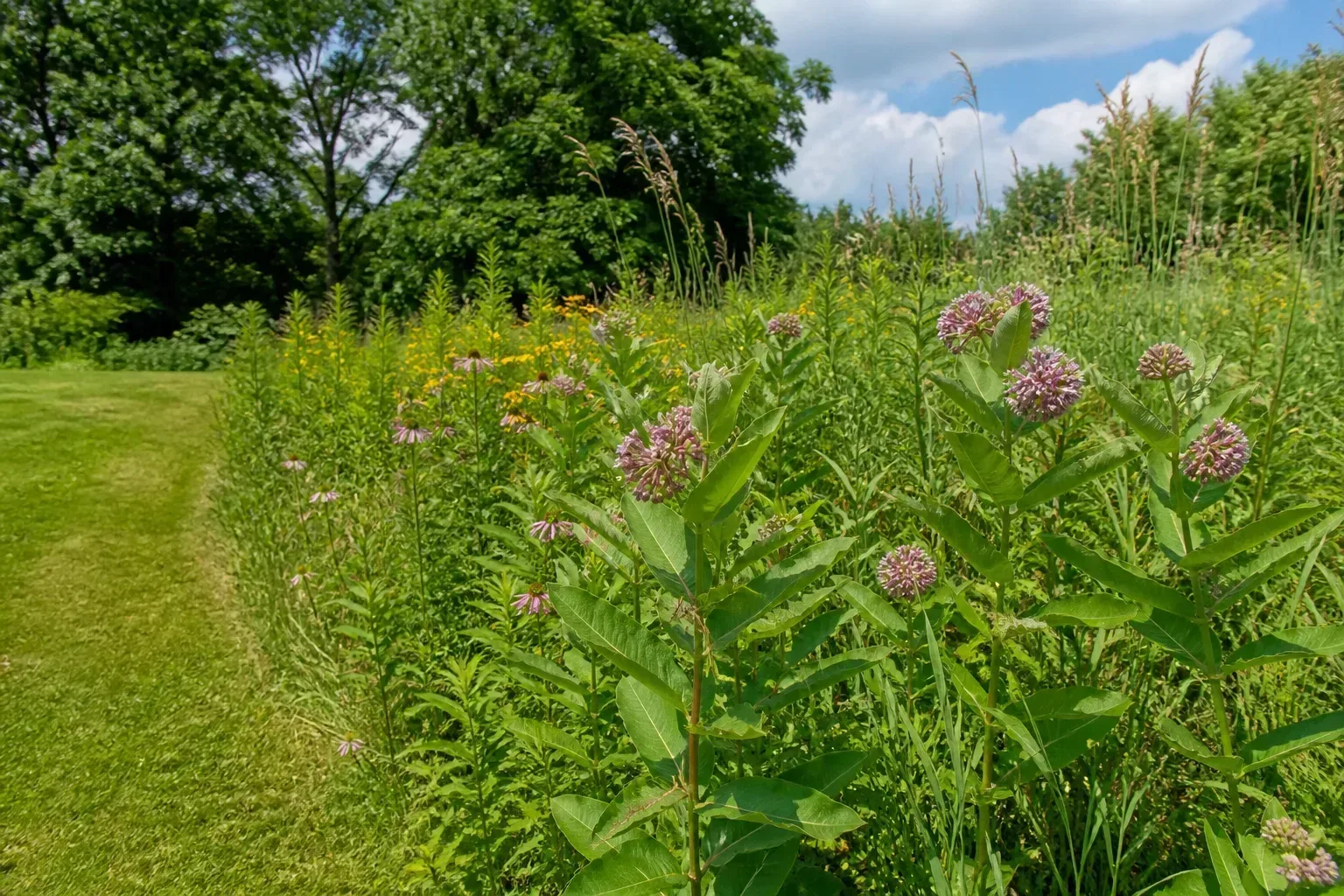
The important word is native, not simply “wild-looking.” A packet that produces a fast flush of color may contain species that are poorly adapted to your region, bloom for only a few weeks, or behave aggressively once established. Ask a local extension service, native plant society, or reputable nursery for plants that belong in your ecoregion, and verify whether “native” refers to your state, your county, or a much wider area.
Design a tiny pollinator patch that earns its footprint
Use three design rules. First, choose a sunny position whenever possible; most flowering plants need strong light to produce a useful display. Second, combine different flower shapes and heights rather than planting one carpet of identical blooms. Third, select species with overlapping bloom periods so the patch offers flowers through more than one part of the growing season.
Clumps are easier for pollinators to find than isolated single plants, and they are easier for you to water and weed. The National Park Service also recommends flowers that bloom at different times, plus shallow water with partly submerged stones if you add a drinking station. Its backyard pollinator guidance covers food, water, shelter, nesting sites, and pesticide caution.
For a very small bed, try a simple composition: one low-growing edging plant, two or three flowering perennials suited to the region, and one airy annual or grass-like accent. Leave a narrow maintenance path or stepping stone so you do not compact the bed while deadheading. Avoid covering every inch with mulch; some ground-nesting bees need small areas of bare, well-drained soil.
The Royal Horticultural Society’s pollinator research likewise emphasizes that even patios, containers, and window boxes can contribute when they contain suitable flowers. The RHS plants-for-pollinators guidance is a useful reminder that a small garden can be intentional habitat rather than a miniature version of a large estate border.
Know when a wildflower meadow is the wrong choice
Do not sow a meadow mix where you need a tidy, low-height surface, where irrigation runoff would carry seed into a sensitive natural area, or where the planting would block a sightline, drain, or shared walkway. A shaded courtyard may be better served by foliage and spring bulbs than by forcing sun-loving meadow flowers to stretch and flop.
You also need a maintenance plan. “Low maintenance” does not mean “no maintenance”: young plantings need watering, weeds must be distinguished from seedlings, and many meadows look untidy before they look established. If you cannot identify the plants in the mix, buy a small set of known plants instead. That costs more at the start but sharply reduces the risk of filling a limited space with the wrong species.
Trend 2: Gardens borrow the language of outdoor rooms
Small gardens are increasingly being finished like rooms. A single solar lantern, cafe-light strand, small statue, weathered gate, or narrow bench can give a compact planting a destination and a sense of scale. The goal is not to decorate every corner; it is to create one visual stop that makes the garden feel inhabited.
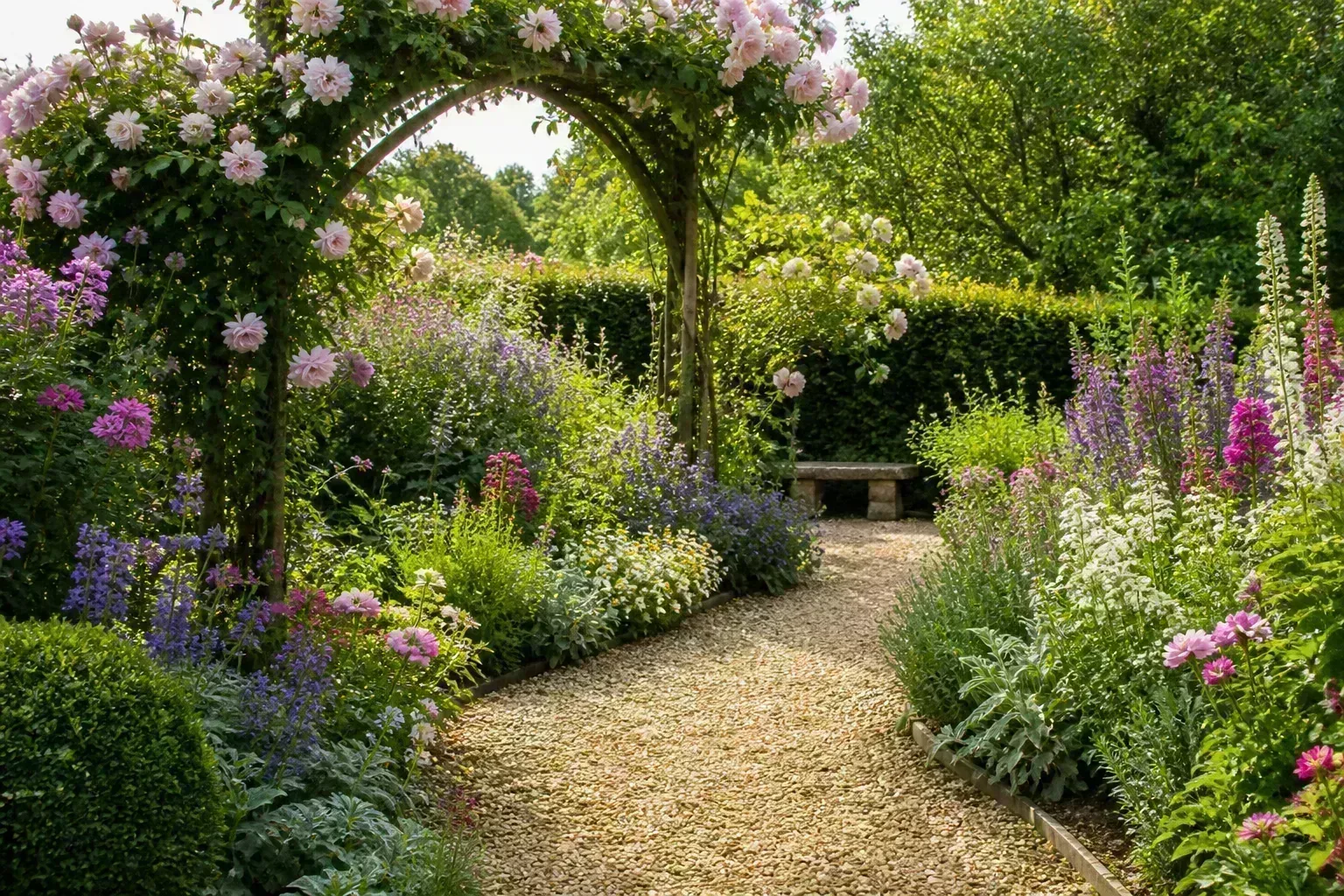
Think in terms of arrival, pause, and exit. Place the object where it can be seen from a window or at the end of a short path, keep the middle of the circulation route open, and repeat one material—such as terracotta, black metal, timber, or stone—once or twice elsewhere. Repetition makes a small space feel designed; a collection of unrelated accents makes it feel busy.
Use lighting and objects as structure, not clutter
Choose outdoor-rated lights, keep cords and fixtures away from standing water, and shield bright sources so they do not glare into a neighbor’s home. Solar lights are convenient, but their performance depends on a genuinely sunny charging position; a shaded balcony may need a different solution. Avoid placing a heavy statue or water feature on a balcony without confirming the load and surface protection.
Decor should also work during the day. A narrow trellis can frame a view and support a climber, a bench can hide an unattractive wall while providing a place to inspect plants, and a shallow birdbath can give a pollinator patch a useful water source if it is kept clean. A novelty object with no relationship to the planting usually feels smaller, not larger, because it breaks the visual rhythm.
Trend 3: English-inspired charm gets smaller and sharper
The small version of an English-inspired garden is not a pile of roses and random cottage flowers. It is a controlled framework—clipped edges, repeated pots, a path or threshold, and a relaxed mix of flowers allowed to soften the geometry. That contrast between order and looseness is what creates charm in a tight footprint.
Miniature boxwood or another locally suitable clipped evergreen can mark the edge of a bed, but use it only where you can provide the light and maintenance it needs. A pair of matching plants at a doorway often has more impact than a continuous hedge. In a hot or disease-prone location, substitute another compact evergreen or a clipped herb with a similar shape rather than treating boxwood as mandatory.
Create repetition with clipped edges and loose flowers
Pick one dominant color family and repeat it in three places: a flower, a pot, and a small furnishing detail. Then add texture rather than another color explosion. Fine foliage, upright stems, rounded leaves, and open flower heads create depth even when the palette is restrained.
Keep tall plants toward the back or beside a wall, and reserve the front edge for plants that stay low enough to preserve the path. In a narrow border, stagger the repetition instead of making two rigid rows. The result reads as abundant from the viewing angle but remains reachable from one side.
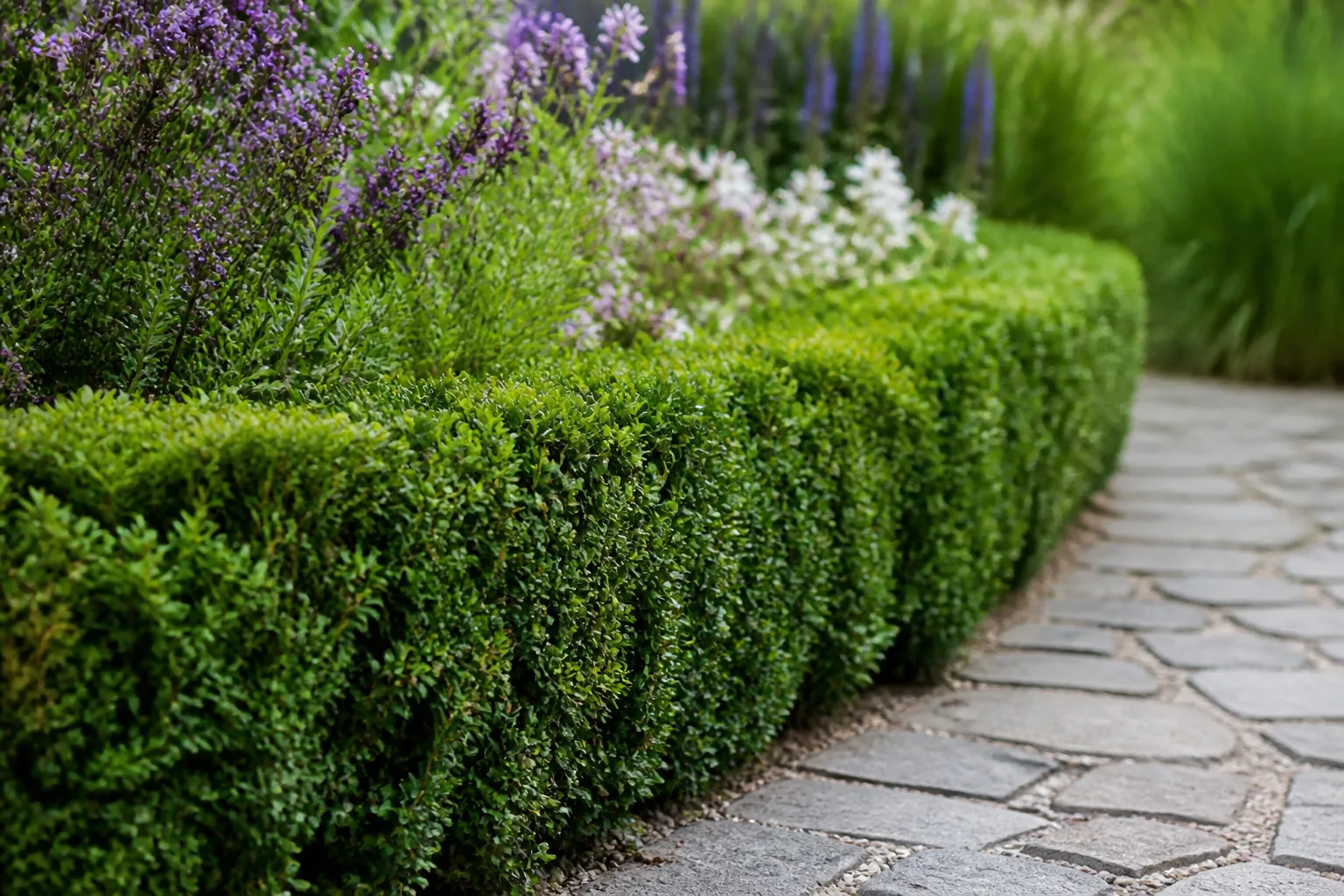
This style is also a good place to use containers as movable punctuation. A pot can mark the corner of a patio in summer, shift away from a door during a gathering, and move into a sheltered position before a freeze. Just remember that a container placed directly on paving can stain or trap moisture; use pot feet or a suitable saucer and keep drainage holes open.
Trend 4: Standard and lollipop roses bring vertical focus
A standard rose—often marketed as a tree or lollipop rose—has a tall bare stem with a rounded flowering head above it. That form adds eye-level color and a strong vertical accent without occupying the width of a conventional shrub rose. The RHS describes standard roses as suitable for containers, but it also stresses that they need a sheltered, sunny position and a stake because a flowering head is top-heavy.
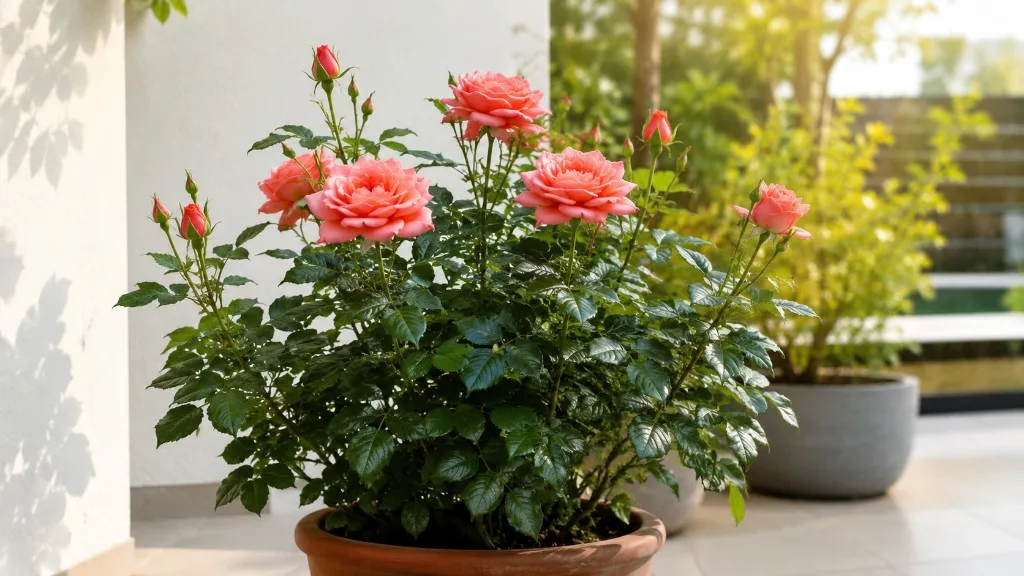
The form is especially effective at a gate, beside a seating area, or at both ends of a short view. It is less successful on an exposed high balcony, in a windy alley, or where a falling pot would create a hazard. A lollipop rose is a focal point, not a way to create a low-maintenance hedge.
Choose the rose and container as a single system
Start with the cultivar, not the pot. Patio and miniature roses are the most straightforward choices for containers; less vigorous groundcover and climbing roses can work in larger, deeper containers. According to the RHS guide, patio and miniature types suit pots roughly 23–35 cm deep, while more vigorous compact groundcover and climbers need about 30–45 cm of depth. Read the RHS guidance on roses in containers and check the nursery’s mature size before buying.
Choose a container with drainage holes, enough width and depth for the mature root system, and a stable base that will not tip when the canopy is wet. Position it before filling because a large pot becomes surprisingly heavy. Use a quality container mix, water thoroughly when the root zone begins to dry, and feed only according to the product label and the rose’s growth season.
Roses want at least half a day of sun, but the container itself can benefit from some afternoon protection so the root zone does not bake. Keep foliage from pressing against a hot wall, inspect for black spot or mildew, and prune to the cultivar’s instructions rather than shearing the head into an unnaturally tight ball. In cold regions, the roots of a container rose are more exposed than roots in the ground. Move the pot to a sheltered wall, raise it so drainage remains open, and insulate the container while keeping the holes clear; David Austin Roses offers practical winter steps for roses in pots.
Trend 5: Maximal minimalism favors fewer, larger plants
“Maximal minimalism” sounds contradictory, but the design rule is simple: use fewer specimens, give each one room to look substantial, and vary foliage texture and color. Three large containers with a clear relationship often look richer than fifteen small pots scattered around the edge.
Large containers also have a horticultural advantage. They hold a bigger root zone, dry more slowly than tiny pots, and can support a plant with stronger structure. The RHS notes that large containers make striking displays and are easier to look after, while still emphasizing drainage and regular watering. Its container-growing guide explains the practical benefits and limits of container scale.
Make large containers succeed on patios and balconies
Use the largest pot you can safely manage, not the largest one you can carry into a shop. On a balcony, distribute weight rather than concentrating several saturated planters along one edge, and never assume a planter’s dry weight is its total load. On a patio or deck, protect the surface, leave a gap for airflow, and make sure runoff will not stain a wall or drip onto the space below.
Group plants by water and light needs. A sun-loving rosemary and a moisture-hungry annual may look good together on day one but will fight over watering by midseason. Choose one focal plant, one supporting texture, and—if the container is wide enough—one trailing or low plant that will not smother the center.
Water deeply enough to wet the whole root zone, then allow the mix to reach the plant’s preferred dryness before watering again. Feel the mix, lift the pot when possible, and adjust for wind, heat, pot material, and plant size. BBC Gardeners’ World Magazine’s container-care advice is useful here because it treats container care as an observation task rather than a fixed calendar.
Trend 6: Potagers merge food production with ornamental design
A potager is a deliberately designed kitchen garden that combines vegetables, fruits, herbs, flowers, paths, and supports. It is not just a vegetable patch with a few marigolds tucked into the corners. In a small space, the potager makes every planting choice do more than one job: basil supplies food and foliage, a trellis produces height and shade, and flowers support beneficial insects while making the bed worth looking at.
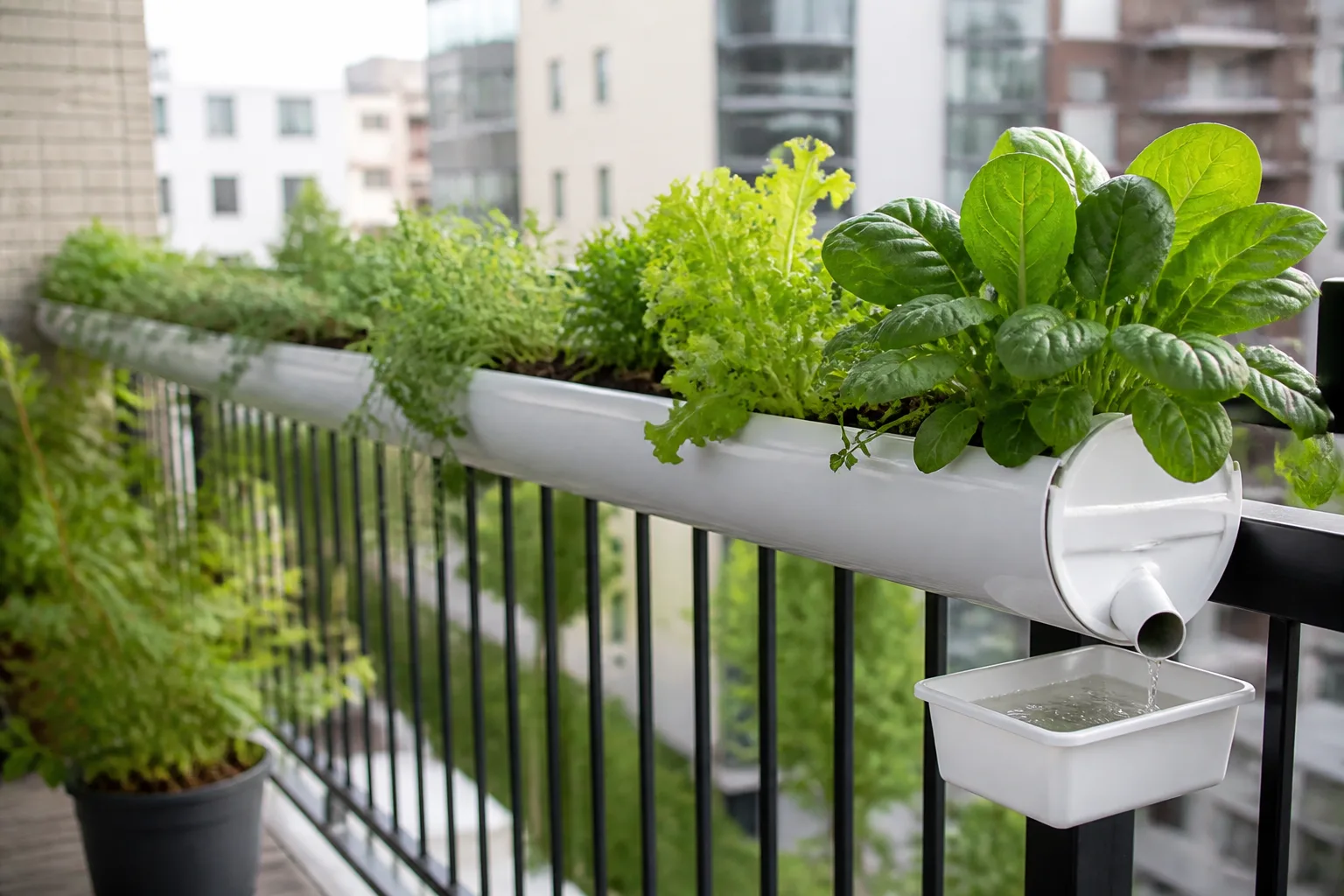
The most successful small potagers are designed around access. Put the herbs you harvest most often closest to the kitchen or door, keep thirsty crops near the water source, and use narrow beds that you can reach without stepping into the soil. A small raised bed, two trough planters, or a row of containers can all function as a potager if the layout is intentional.
Build a tiny edible garden around access and succession
Begin with crops that give repeated harvests: cut-and-come-again greens, herbs, compact peppers, bush beans, or a cherry tomato suited to your growing season. Add one vertical crop only after you know where its support will stand. Pole beans, cucumbers, and indeterminate tomatoes can turn a small garden into a wall of foliage if the support is too weak or the plant is allowed to sprawl.
Use succession planting instead of trying to grow everything at once. When a lettuce crop finishes, replace it with a warm-season herb or a fall green; when a pea or bean crop declines, use the support for a late-season climber if your climate allows. Fine Gardening’s guide to container vegetable gardening reinforces the value of matching the crop to the container and planning for support, drainage, and harvest access.
Flowers belong where they can be seen and reached, not only where there is leftover soil. Use a narrow edge of edible flowers, a pot of thyme or rosemary, or a small patch of regionally suitable blooms beside the vegetables. Keep mint and other vigorous spreaders in their own containers; Savvy Gardening’s patio vegetable guidance also recommends starting with a manageable number of pots and adding support for plants that need it.
Choose the trend that matches your actual site
The fashionable choice is rarely the best first choice. Match the trend to the limiting factor you cannot change, then use the style to make that solution attractive.
A quick decision guide for balconies, patios, yards, and beds
| If your space has… | Start with… | Be careful about… |
|---|---|---|
| A sunny balcony with a nearby water source | One large container, a small edible potager, or a standard rose | Wind, railing loads, runoff, and pots that become too heavy to move |
| A shaded balcony or courtyard | Outdoor-room details, foliage layers, and shade-tolerant containers | Buying sun-loving wildflower or rose mixes that stretch and disappoint |
| A sunny patch of lawn you rarely use | A pocket native planting or pollinator bed | Regional fit, seedling identification, and the transition period while it fills in |
| A narrow patio beside a door | Clipped structure, one focal pot, and a movable container group | Blocking the route, staining paving, and overdecorating the entry |
| A small ground bed near the kitchen | A potager with herbs, greens, and one vertical support | Planting more crops than you can harvest or reach |
| A cold climate with seasonal storage space | Portable roses and larger containers | Winter root exposure, frozen wet mix, and insufficient shelter |
Use only one major focal trend at first. A pollinator bed plus a small bench can feel complete; a pollinator bed, clipped hedge, lollipop rose, string lights, raised bed, and statue may be technically possible but visually exhausting. Add the second layer after you have lived with the first for a month.
Small-space mistakes that make trendy gardens harder to live with
The most common mistake is buying for the mature photograph instead of the mature plant. Read the eventual height, spread, root behavior, sun requirement, and winter hardiness before you buy. A plant described as “compact” may still be too vigorous for a balcony pot or too thirsty for a hot wall.
The second mistake is treating drainage as a decorative detail. Every outdoor container needs a clear route for excess water, and a saucer should catch runoff without leaving the pot permanently submerged. Do not seal drainage holes with a solid layer of rocks, and do not place a pot where its outlet will empty onto a neighbor’s balcony or a foundation wall.
The third is assuming that small means low effort. Small containers dry quickly, crowded plants develop poor airflow, and a tiny bed can become impossible to weed once its paths disappear. Build in access, choose plants with similar needs, and keep one empty or flexible container for seasonal changes.
Finally, avoid copying a region-free plant palette. A rose, boxwood, wildflower, and potager crop all respond to climate, disease pressure, and local pests. Use trusted local guidance for the final cultivar and native-plant decisions, especially when a trend is being imported from a different country or hardiness zone.
A practical 2025 planting plan you can start this week
On day one, measure the space, count hours of direct sun, and mark the path of water from hose or tap to plant. Remove only the lawn or clutter that your chosen design needs; keeping one open area makes the finished garden easier to use and gives the planting room to read.
On day two, choose one visual anchor: a large pot, a standard rose, a trellis, a clipped evergreen, or a small focal object. Set it in place empty and view it from the house, the entrance, and the place where you sit. If it looks misplaced without plants, it will not be rescued by more plants.
On day three, buy the soil, containers, supports, and plants together. Confirm that each plant matches the site and that every container has drainage. For a pollinator planting, use regional sources and stagger bloom times; for a potager, choose only as many crops as you can harvest; for roses, buy the pot and stake before the plant arrives.
During the first two weeks, water according to root-zone moisture and weather, not the trend’s marketing copy. Watch for wind rock, leaf scorch, runoff, pests, and plants that are shading their neighbors. A small garden gives you fast feedback, so edit quickly: move a pot, thin a crowded planting, or replace a poor fit before the problem becomes expensive.
Conclusion: edit first, then add the trend
The best small space gardening trends of 2025 are not really about novelty. They are about making a limited place feel generous by giving it structure, habitat, food, height, or a reason to pause.
Choose the trend that solves your site’s biggest constraint. Use a pocket native planting when a small sunny patch can support regional flowers, a potager when harvest access matters, a large container when you need impact with fewer plants, and a standard rose only when you can provide sun, stability, water, and shelter. Add lighting or clipped structure after the practical foundation works. In a small garden, thoughtful editing is what makes every inch count.



