Adenium (Desert Rose) Care Guide: Light, Water, Soil
Desert rose care that prevents soft-caudex rot: light, mineral mix, dormancy dry rules, fertilizer timing, and pet-safe handling.
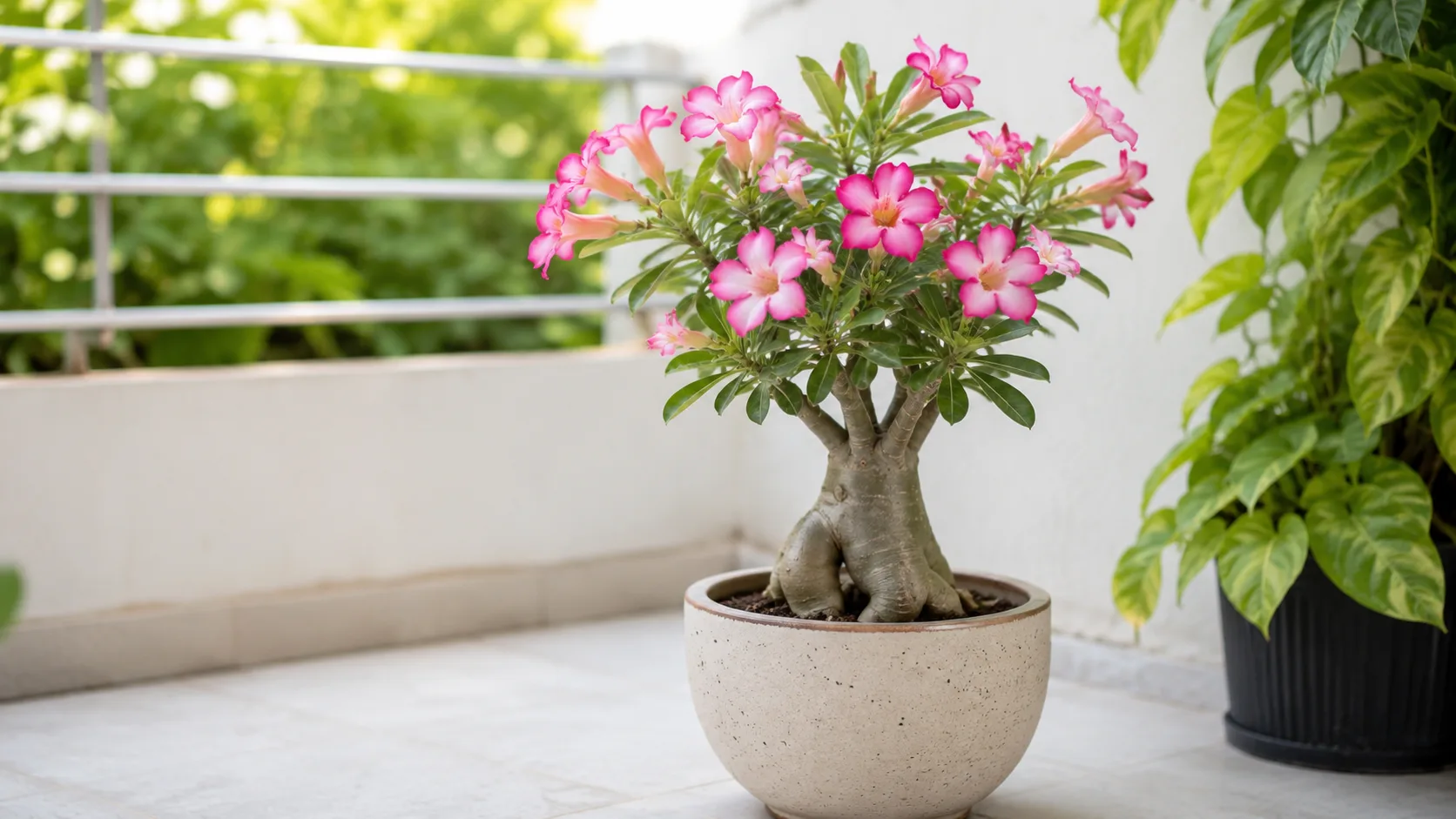
Adenium — sold as desert rose — is not a “bright room” houseplant that likes weekly tropical watering. The swollen base is a caudex, a living water reserve. That reserve lets the plant ride out dry heat, then hides early rot while you keep watering on a calendar through cool nights. Reliable adenium care is a short list done consistently: direct sun for flowering, a mineral-heavy mix that empties fast, soak-and-dry watering in active growth, and near-dry roots through cool dormancy.
If you remember one failure mode, make it this: cool weather plus wet roots. Soft caudex tissue with soggy mix is an emergency, not thirst. Firm, leafless plants in dry mix through winter are often resting — not dying.
Written by Sai Ananth (B.Pharmacy, Andhra University; LeafyPixels lead writer) and reviewed by the LeafyPixels Review Board.
Who Wrote This Guide and How We Reviewed It
This page was researched and written by Sai Ananth, whose pharmacy background shapes how LeafyPixels handles toxicity wording, and whose indoor growing practice focuses on real apartment and patio constraints rather than greenhouse idealizations. Editorial review sits with the LeafyPixels Review Board, which cross-checks care thresholds against extension and botanical-garden sources before publication.
How this guide was built (adenium-specific):
- Compared UF/IFAS light and winter-rest guidance with University of Arizona Cooperative Extension and Arizona-Sonora Desert Museum dry rules around 50°F (10°C) nights.
- Mapped NC State, Missouri Botanical Garden, and RHS container notes onto indoor window and movable-patio setups.
- Reconciled “warm apartment still leafy” edge cases with desert-garden advice that assumes a true cool dormant storage period.
- Pulled practical dry-down and soft-caudex triage language from LeafyPixels adenium plant-care topic pages, then labeled those notes as synthesis — not invented diary fiction.
- Fact-checked toxicity against ASPCA cardiac-glycoside listings and handling notes from RHS/NC State.
We did not invent personal grow logs. Where you see “on-site notes,” they summarize patterns already documented in our adenium watering, soil, and problem pages under named conditions (pot size, AC rooms, patio heat).
The #1 Failure Mode: Cool Weather Plus Wet Roots
Most beginner desert roses die the same way: the plant drops leaves in autumn, the grower waters “to help it through stress,” nights cool below about 50°F, and the caudex softens from the inside. Arizona-Sonora Desert Museum guidance is blunt: water infrequently in cooler weather, and do not water at all when nights stay consistently below 50°F; withhold water completely when the plant is dormant and leafless, even for months. (Arizona-Sonora Desert Museum) University of Arizona Cooperative Extension aligns the stop point: continue watering and feeding only until nights drop below about 50°F, then hold water and move the plant to sheltered storage. (University of Arizona Cooperative Extension)
UF/IFAS adds the seasonal rest frame: during cold winter months, withhold water and let adenium rest 3–4 months; leaf and flower drop are part of the natural cycle — plants must not freeze. (UF/IFAS EP474)
Five safe moves when nights cool:
- Stop calendar watering; check depth moisture and caudex firmness first.
- Keep the pot above freezing in a bright or at least frost-free place.
- Empty saucers — never leave runoff under a cold plant.
- Treat soft + wet as rot triage, not thirst.
- Resume water only after nights stay above about 50°F and new growth appears.
Hub deep-dives can wait. Get this combination right first.
What Makes Adenium Different
Most popular houseplants want even moisture and bright indirect light. Adenium evolved for arid and seasonally dry regions of sub-Saharan Africa and the Arabian Peninsula, so its biology runs the other direction. NC State Extension describes desert rose as a succulent perennial in the dogbane family (Apocynaceae) that wants full sun, cactus-style potting mix, several drainage holes, dry intervals between drinks, and reduced water while dormant after you bring it indoors near 55°F (13°C). (NC State Extension)
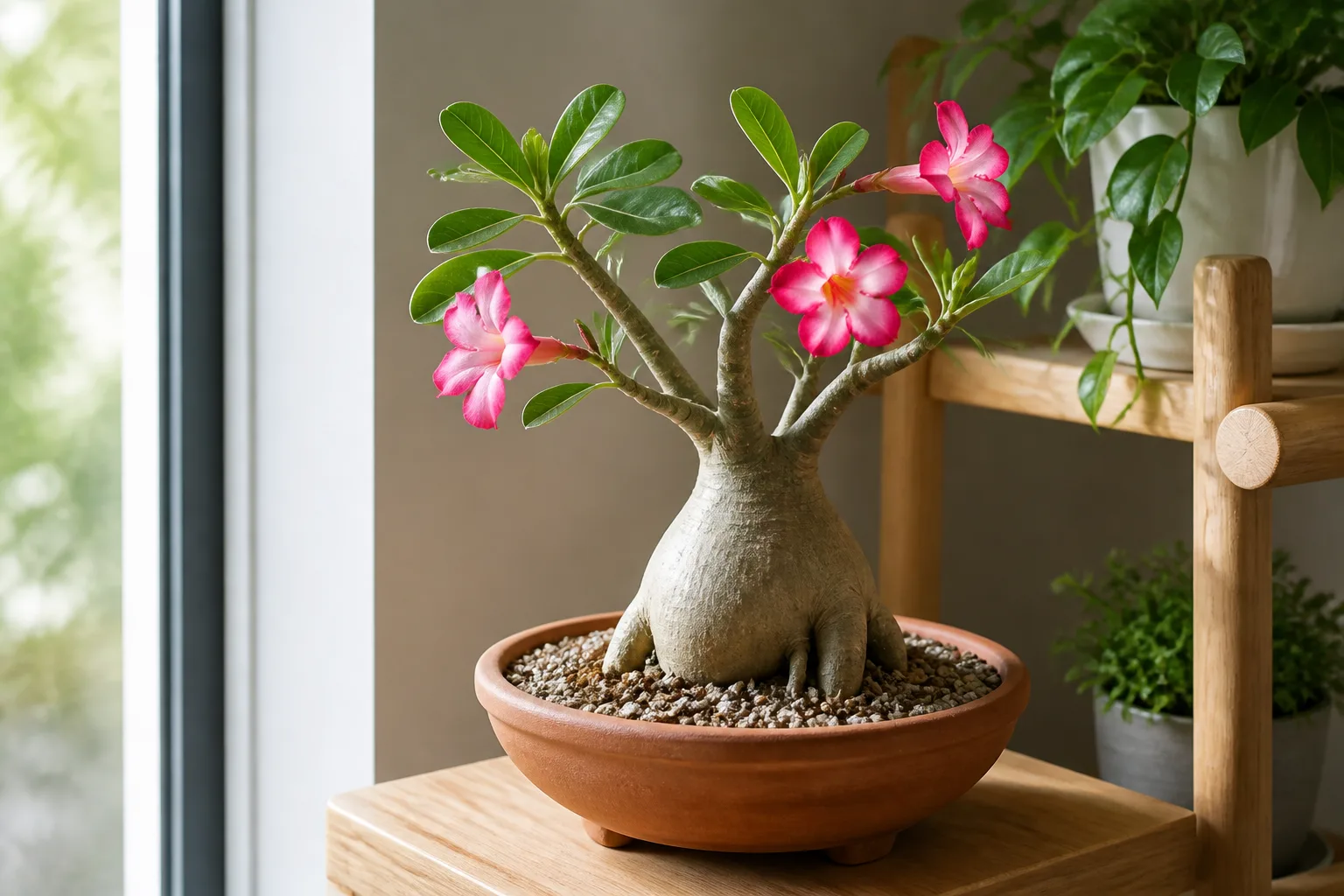
Missouri Botanical Garden lists full sun, dry-to-medium water, and container culture outdoors in summer with an indoor cool-season rest north of tropical zones. (Missouri Botanical Garden) That profile creates two beginner mismatches: placing adenium in a “bright room” that never puts actual sun on the leaves, and watering like a tropical while nights cool and leaves drop.
The Caudex as a Water Reserve
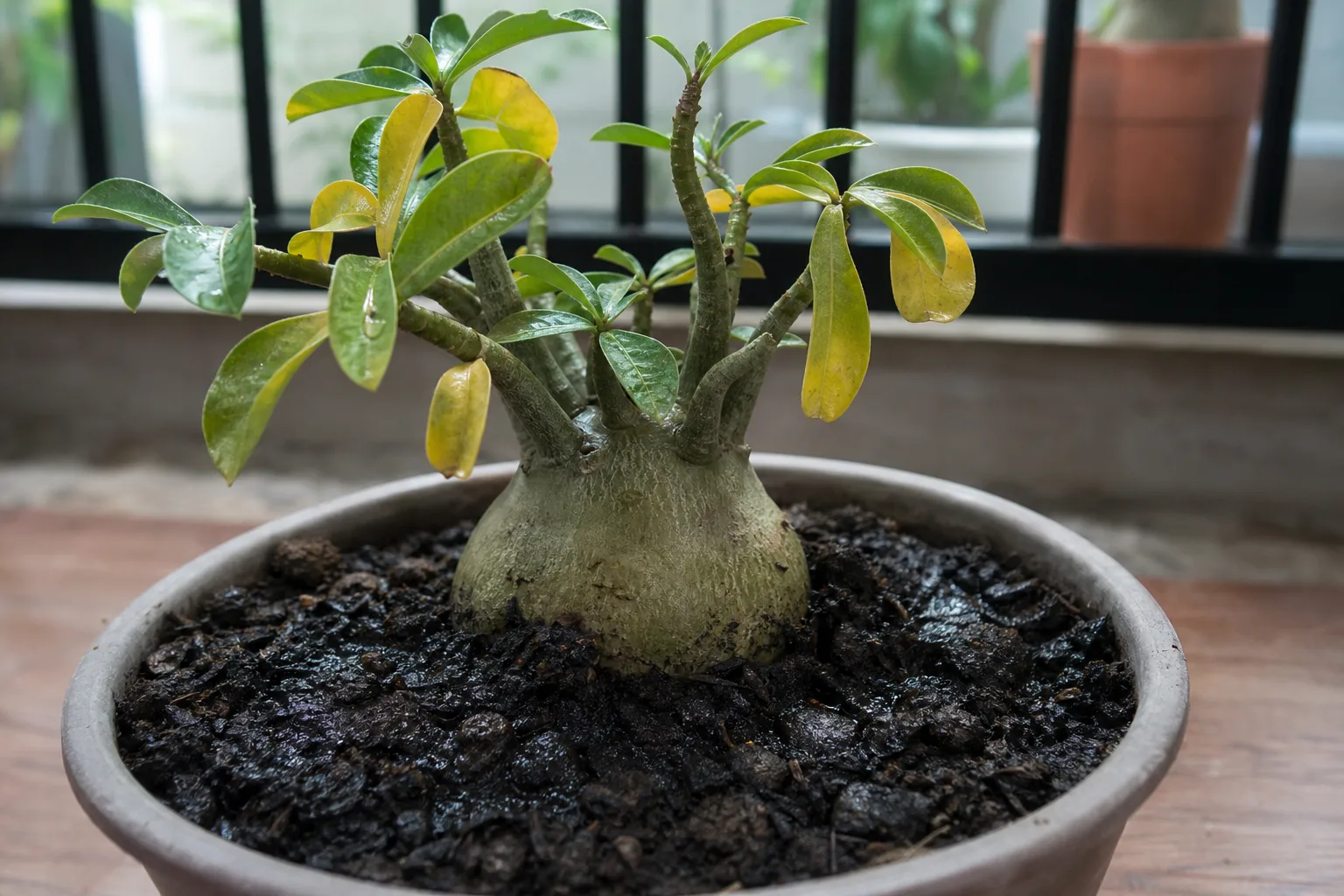
The caudex is the thickened stem base that stores water and energy. Desert Botanical Garden notes adeniums store water in branches, roots, and that swollen trunk, which is why they suit containers when drainage is excellent. (Desert Botanical Garden) A firm, plump caudex usually means reserves are intact. Mild wrinkling on a still-firm plant with bone-dry mix during cool rest is often normal draw-down, not an emergency drink signal.
A soft, spongy, or foul-smelling caudex with wet soil is different. Soft tissue plus moisture usually points to root or stem rot, not thirst. Adding water then accelerates collapse.
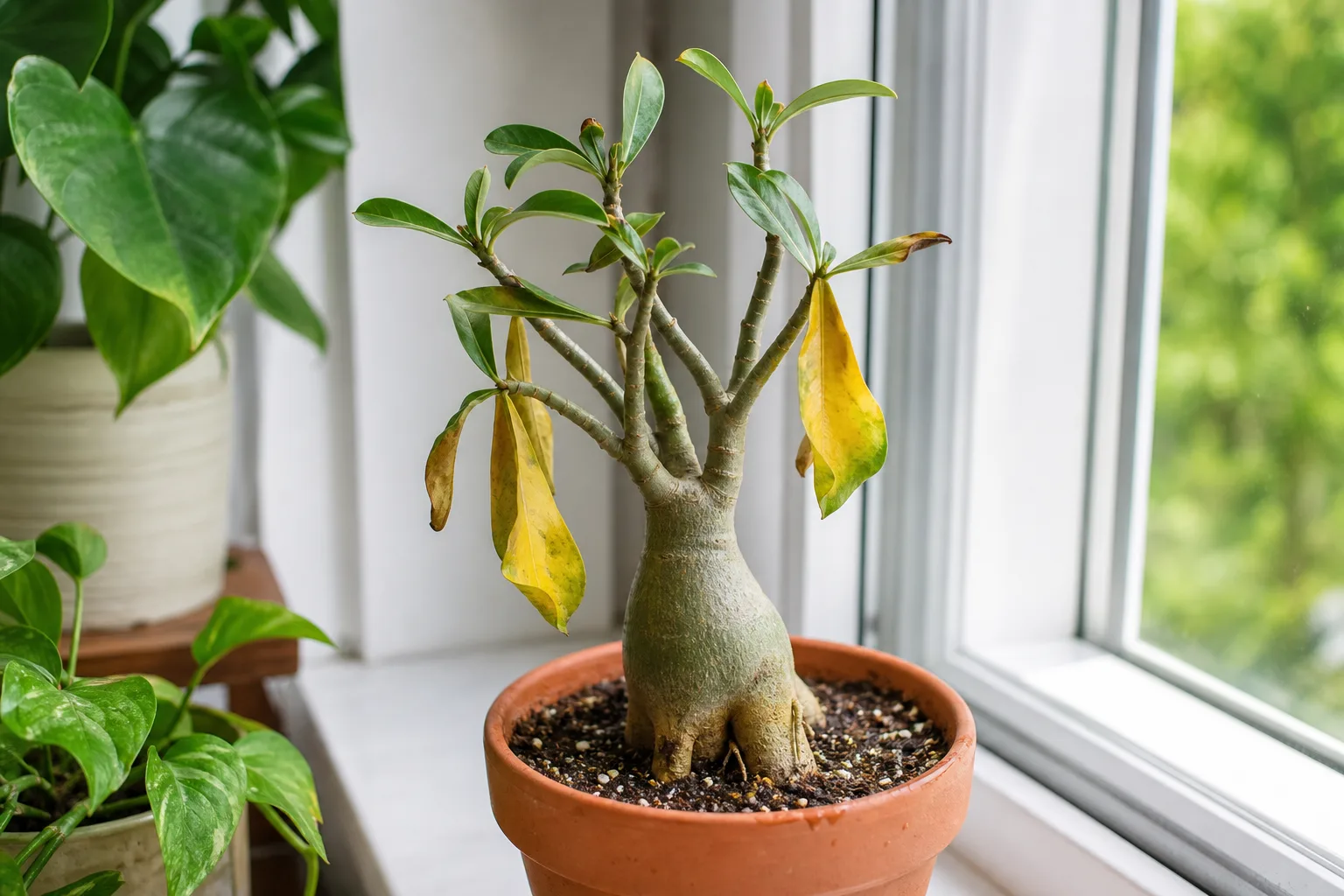
On-site plant-care notes (synthesis): Across LeafyPixels adenium watering and rot pages, the reliable triage is context, not appearance alone — firm + dry + leafless in winter reads as dormancy; soft + wet reads as emergency. Squeeze gently, smell the mix, and check depth moisture before you decide the plant is “dehydrated.”
Cultivars, Grafted Plants, and Shared Care Rules
Retail tags may say desert rose, impala lily, mock azalea, or Sabi star. The species most people grow is Adenium obesum. UF/IFAS notes hybrids with single, double, or triple flowers in red, white, pink, and yellow, and cultivars such as ‘Blooming Fool’ used in their foliage guidance. (UF/IFAS EP474) University of Arizona Cooperative Extension adds that most non-specialty nursery plants are A. obesum or hybrids with that species, and that double-flowered forms are increasingly common. (University of Arizona Cooperative Extension)
Many nursery plants are grafted: a named flowering scion on vigorous rootstock. Shoots from below the graft union are rootstock suckers — remove them so they do not overtake the cultivar. Seed-grown plants often build a more natural caudex over time, but flower color is less predictable. Care fundamentals — sun, drainage, dry winters — stay the same either way. Wear gloves when pruning; milky sap is part of the plant’s defense.
Light for Blooms: Six Hours of Direct Sun
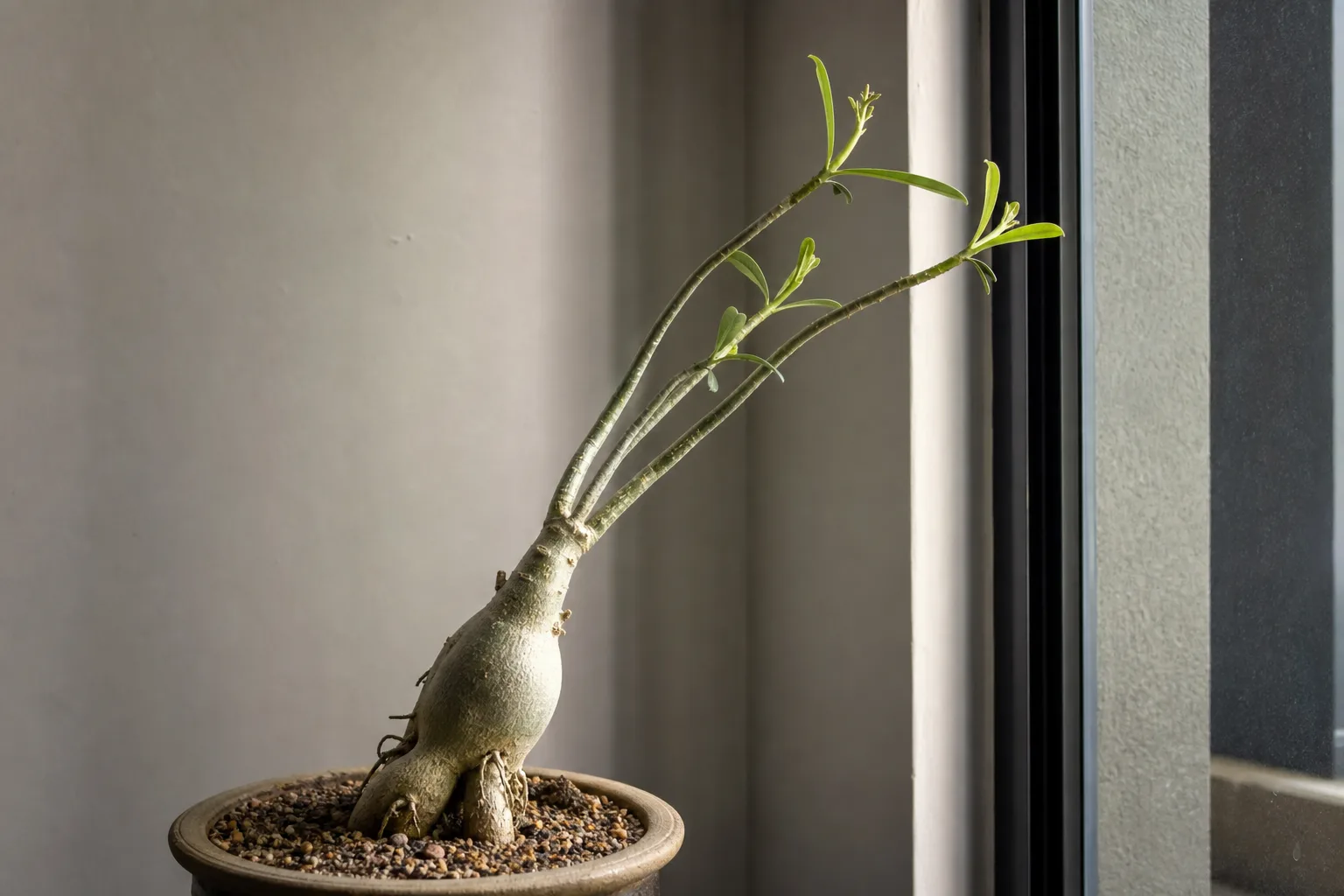
If you remember one light rule, make it this: adenium is a full-sun flowering succulent, not a mid-room foliage plant. UF/IFAS is explicit: station adenium in high light, six hours or more per day, to maintain summer flowering, and note that it will not flower under low light. (UF/IFAS EP474) UF/IFAS Gardening Solutions repeats the same six-hour threshold for profuse bloom and warns that temperatures below about 40°F push most growers toward movable containers. (UF/IFAS Gardening Solutions)
Count hours when sun actually hits foliage. A plant three feet back from a south window may live for months and still stretch, pale, and refuse buds. Compact new growth, shorter internodes, and summer flowering are your success metrics. Fertilizer cannot replace missing photons.
Indoor Windows vs Outdoor Summer Placement
| Setting | What works | What fails |
|---|---|---|
| Indoors | Unobstructed south/west window; pot close to glass; strong full-spectrum grow light 12–14 hours if blooming is the goal | “Bright” mid-room ambient light; north windows without supplemental light |
| Outdoors (after frost risk) | Full morning sun; filtered afternoon in extreme heat; 7–14 day acclimation from indoor storage | Sudden move from dark garage to hard afternoon sun (scorch on retained leaves) |
The RHS recommends growing under glass in peat-free loam-based compost with added sharp sand, in full light with shade from the hottest sun — intensity first, heat management second. (RHS) Desert Botanical Garden notes that retained winter leaves can scorch and drop after a sudden outdoor move even if the plant later recovers — acclimate over 7–14 days. (Desert Botanical Garden) For placement diagrams and stretch diagnostics, use the dedicated Adenium light guide and not enough light page.
On-site observation (labeled synthesis): LeafyPixels light and watering notes consistently show that indoor plants under AC dry slower than patio plants in the same pot size — so outdoor summer soak frequencies are an upper bound, not a weekly indoor rule.
Watering Without Rot
Adenium watering fails when people copy weekly tropical routines. In peak heat with grit and sun, the plant can take generous soaks. In cool dormancy, the same soak is how a sculptural caudex turns to mush. University of Arizona Cooperative Extension summarizes outdoor peak-growth practice as thorough watering that drains quickly, with small pots in summer heat sometimes needing water several times a week — then a hard stop once nights stay below about 50°F. (University of Arizona Cooperative Extension) Desert Botanical Garden notes that a plant in a pot 12 inches or larger in peak sun may need deep soaks at least twice a week, while smaller pots may need water three to four times a week — always with full drain-through. (Desert Botanical Garden)
Active-Growth Checks and Soak-and-Dry
Before every drink, run three checks:
- Is the mix dry 5–7 cm (2–3 inches) deep, not just on the crust?
- Does the caudex feel firm, not soft or spongy?
- Are nights warm enough that water will not sit cold around roots?
If any answer is no, wait — or inspect for rot if softness pairs with wet soil. When you do water, soak until runoff exits the drainage holes, then empty the saucer. Do not leave the pot standing in a decorative cachepot of leftover water.
On-site plant-care notes: In AC apartments documented across our adenium watering guidance, the same 6-inch terracotta pot that dries in two to three days on a hot patio often needs 10–14+ days between soaks indoors. Stretch intervals if a skewer still shows moisture after two days. Shallow bonsai bowls dry the surface fast but hold less oxygen buffer when cool — treat cool-season wet soil there as higher risk.
Dormancy Dry Rules and Warm-Apartment Edge Cases
| Signal | Likely meaning | Action |
|---|---|---|
| Leaves yellow/fall; caudex firm; mix dry; cool nights | Normal dormancy rest | Keep mostly dry; protect from freeze |
| Leaves fall; caudex soft; mix wet or sour | Rot, not dormancy | Stop water; unpot; triage roots |
| Warm apartment (>~70°F nights); plant stays leafy under lights | “False growth” / incomplete rest | Either force cooler dry rest, or water sparingly only after full dry-down — never invent winter weekly watering |
| Young plant shrivels hard in warm dry storage | Possible need for light monthly dampening | Dampen upper inch only if firm tissue + bone-dry mix (DBG young-plant caveat) |
UF/IFAS: withhold water in cold winter rest for 3–4 months. (UF/IFAS EP474) ASDM: no water when nights stay below 50°F; withhold completely when leafless/dormant. (Arizona-Sonora Desert Museum) DBG: young plants in warm storage may get a light monthly dampening if they shrivel; large specimens usually need none — and any plant overwintering below 50°F nights must stay dry regardless of size. (Desert Botanical Garden)
Warm apartments complicate the script. If nights stay high and you keep watering, weak out-of-season growth can appear. Either force a drier rest in a cooler bright room, or accept lighter growth and keep the mix drying fully between modest drinks. Never invent a “winter weekly watering” habit because the plant still looks green under grow lights.
Soil, Pot Material, and Mix Longevity
Drainage is not a preference for desert rose — it is the control system that makes summer watering safe. NC State’s basic recipe is potting soil appropriate for cacti and succulents in a pot with several drainage holes, with wet soils producing rots. (NC State Extension) Missouri Botanical Garden similarly calls for a loose, sandy or gravelly, well-drained container mix in full sun. (Missouri Botanical Garden)
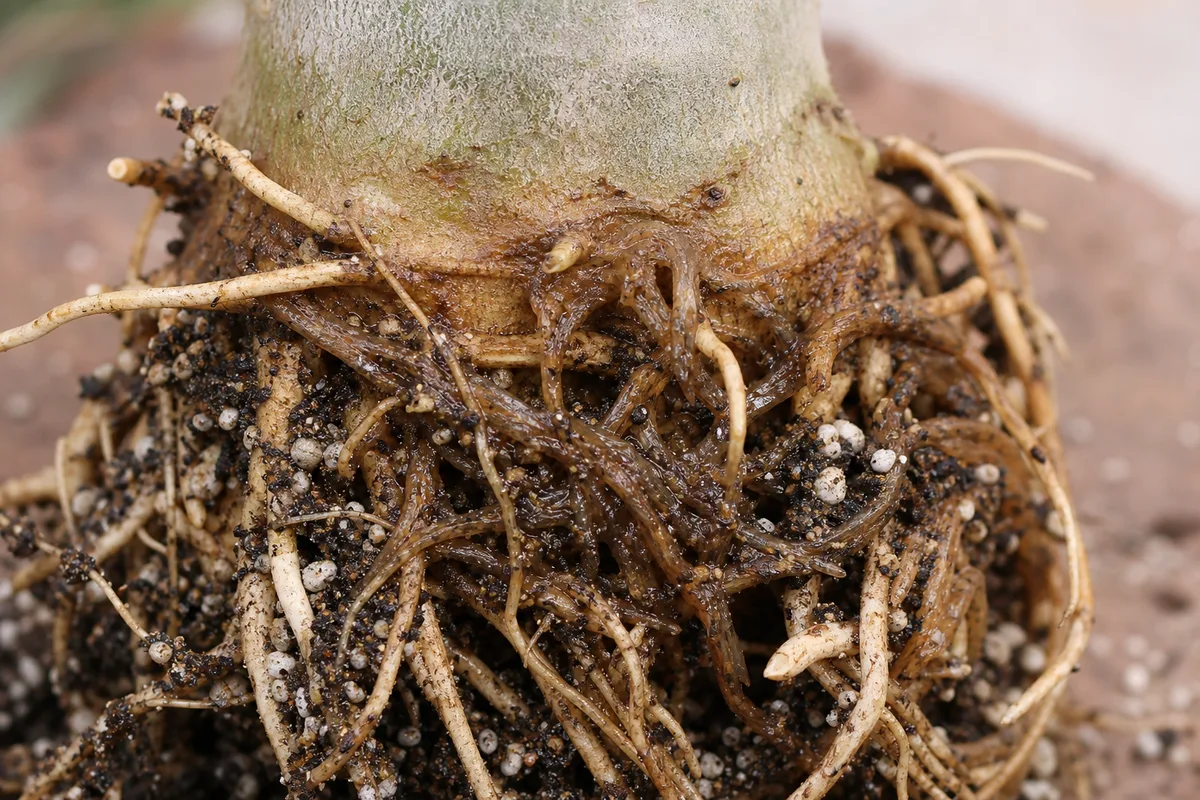
University of Arizona Cooperative Extension warns that bagged houseplant mixes — even labeled cactus soil — are often too organic to be the sole long-term medium. Organic fractions oxidize and collapse into finer, water-holding particles after a couple of years. Grower practice favored in the same bulletin leans mostly inorganic, often with coarse pumice as a major ingredient. (University of Arizona Cooperative Extension)
A practical home starting ratio from Arizona-Sonora Desert Museum is 1–2 parts pumice or perlite to 1 part humus-based potting mix. (Arizona-Sonora Desert Museum) Desert Botanical Garden suggests combining quality potting soil with equal parts pumice or small gravel, or using commercial cactus blends when they drain fast. (Desert Botanical Garden) In humid rooms, push the mineral share higher.
On-site synthesis: LeafyPixels soil notes for adenium emphasize that a mix that “worked” for two summers can still fail in year three when peat collapses — refresh mineral content on a 2–3 year repot cycle rather than blaming watering alone. DIY ratios and caudex planting depth live on the Adenium soil guide.
Terracotta vs Plastic Dry-Down
| Pot type | Dry-down behavior | Watering discipline |
|---|---|---|
| Terracotta / clay | Breathes; dries faster | Safer default for beginners and AC rooms |
| Plastic / glazed | Holds moisture longer | Strict depth checks; easy to overwater in cool weather |
| Oversized “overpot” | Deep wet column around small root mass | Avoid — step up only one size |
UA Extension notes terracotta is ideal because porous sides help soil dry, and warns against overpotting and saucers that hold a water layer. (University of Arizona Cooperative Extension) Elevate pots so holes are not sealed against a flat surface. Blocked holes and perched water map to poor drainage and no drainage hole.
Temperature, Fertilizer, and Seasonal Rhythm
Adenium prefers heat. UF/IFAS lists a preference around 75–95°F, chill tolerance with leaf yellowing between roughly 55–35°F, and no freeze tolerance. Outdoor year-round planting is framed for about USDA Zones 10B–12. (UF/IFAS EP474) NC State and Missouri both point to bringing containers indoors near 55°F. (NC State Extension) (Missouri Botanical Garden)
A simple seasonal rhythm works for most container growers: spring warm-up and gradual watering as new growth appears; summer sun, soak-and-dry, and light feeding; fall taper as nights drop; winter dry rest above freezing. Resume water only when nights stay above about 50°F and growth resumes — see repotting for warm-season timing if roots need room.
In-Season Feeding Schedule and Stop Dates
Feed only in active growth. Desert Botanical Garden recommends half-strength general fertilizer monthly for mature plants in season, with lighter, more frequent feeding for young plants, and notes that lower nitrogen with higher phosphorus and potassium supports even growth and bloom. (Desert Botanical Garden) University of Arizona Cooperative Extension similarly prefers fertilizer low in nitrogen, moderate in phosphorus, highest in potassium, applied at quarter to half label strength during the growing season. (University of Arizona Cooperative Extension) UF/IFAS indoor guidance lists a low dose of liquid fertilizer weekly in the summer growing season when the plant is actively using it. (UF/IFAS EP474)
Practical stop-date logic: Stop fertilizing when growth slows and nights cool toward the 50°F watering cutoff. Never use fertilizer to “wake” a plant sitting in wet winter soil. Salt crust, tip burn, and overfeeding symptoms belong on the fertilizer and fertilizer burn pages.
Pruning / graft-sucker checklist (on-page): In early summer growth, tip-prune to encourage branching; remove rootstock shoots below the graft union promptly; avoid cutting below the graft on grafted plants; wear gloves and keep sap off skin and eyes. Deeper shaping lives on the pruning and propagation hubs.
Toxicity and Safe Handling
Desert rose is not a pet-safe windowsill plant. The ASPCA lists Adenium obesum as toxic to dogs, cats, and horses, with cardiac glycosides as the toxic principle and clinical signs that can include vomiting, diarrhea, anorexia, depression, irregular heartbeat, and death. (ASPCA) NC State notes milky poisonous sap and flags the plant as a problem for cats, dogs, and horses. (NC State Extension) The RHS also lists the plant as harmful if eaten and advises protective gloves when handling. (RHS)
Wear gloves for pruning or grafting work, keep sap off skin and eyes, wash tools, and keep pots out of reach of chewing pets and curious children. If a pet chews any part of the plant, contact a veterinarian or ASPCA Animal Poison Control at (888) 426-4435 promptly.
Outdoors, UF/IFAS Gardening Solutions notes scale and oleander caterpillars as family-related risks on desert rose — useful for patio growers even outside Florida, because related pests travel with nursery stock and warm-climate plantings. (UF/IFAS Gardening Solutions)
Diagnose Common Problems
Start diagnosis with soil moisture and caudex firmness before spraying anything.
| Problem | Look for | First fix |
|---|---|---|
| Soft caudex / crown collapse | Soft tissue + wet or sour mix | Stop water; unpot; trim mush; fresh grit — root rot, crown rot, overwatering |
| Yellow leaves / leaf drop | Cool season + firm dry caudex | Likely dormancy — keep dry; leaf drop, yellow leaves |
| No flowers | Stretch, pale leaves, <6 hours direct sun | Fix light before raising fertilizer — no flowers |
| Sunburn after storage | Bleached/papery patches after sudden outdoor move | Acclimate next time — sunburn |
| Pests | Mealybugs indoors; mites/aphids outdoors; scale; oleander caterpillars | ID first, then treat while fixing culture — mealybugs, caterpillars |
UF/IFAS lists mealybugs indoors and mites or aphids outdoors; NC State also flags aphids, scales, mealybugs, fungal leaf spot, and wet-soil rots. (UF/IFAS EP474) (NC State Extension)
Quick Seasonal Checklist
Spring: Move toward stronger light after frost risk; water sparingly until nights stay above ~50°F and new leaves appear; begin light feeding once growth is steady; prune and remove graft suckers.
Summer: Six-plus hours of direct sun when flowering is the goal; soak-and-dry on depth checks; mineral mix + open drainage; watch pests on soft growth.
Fall: Taper water as nights drop; stop fertilizer as growth slows; prepare frost-free storage.
Winter: Keep dry when nights are below ~50°F or the plant is leafless/dormant; protect from freeze; do not water a soft wet caudex “to revive it.”
Emergency stops: Soft caudex + wet soil → stop water and inspect. No flowers → fix light first. Mix stays wet for days indoors → improve grit, pot porosity, or light before adding more water.
Related Adenium Guides
Use this page for the full desert-rose care framework. Use the canonical Adenium care hub when you need deeper topic depth or a symptom-first fix:
- Light — window placement, outdoor acclimation, grow lights
- Watering — depth checks, pot-size intervals, dormancy exceptions
- Soil — mineral ratios, drainage tests, pot choice
- Fertilizer — in-season feeding detail
- Repotting — warm-season timing and caudex exposure
- Propagation and pruning — cuttings, grafts, sucker removal
- How to water indoor plants the right way — general soak-and-dry mindset that transfers to caudiciforms
Conclusion
Reliable adenium care is less about daily attention and more about matching a desert rhythm. Give desert rose strong direct light when you want flowers, plant it in mineral-heavy mix that drains in minutes, water deeply only after the root zone and caudex say yes, and keep roots nearly dry through cool dormancy.
Stop watering if: nights stay below about 50°F, the plant is leafless and dormant, the caudex is soft with wet soil, or the skewer still shows moisture at depth. Resume watering when: nights stay warmer, new growth appears, and the mix is dry through the check depth. Respect the toxicity of the sap around pets and children, and treat a soft wet caudex as an emergency instead of a thirst cue.