How to Grow and Care for Sweetgum Trees
A practical guide to sweetgum tree care, from choosing Rotundiloba to managing roots, fall fruit, chlorosis, pests, and establishment stress.
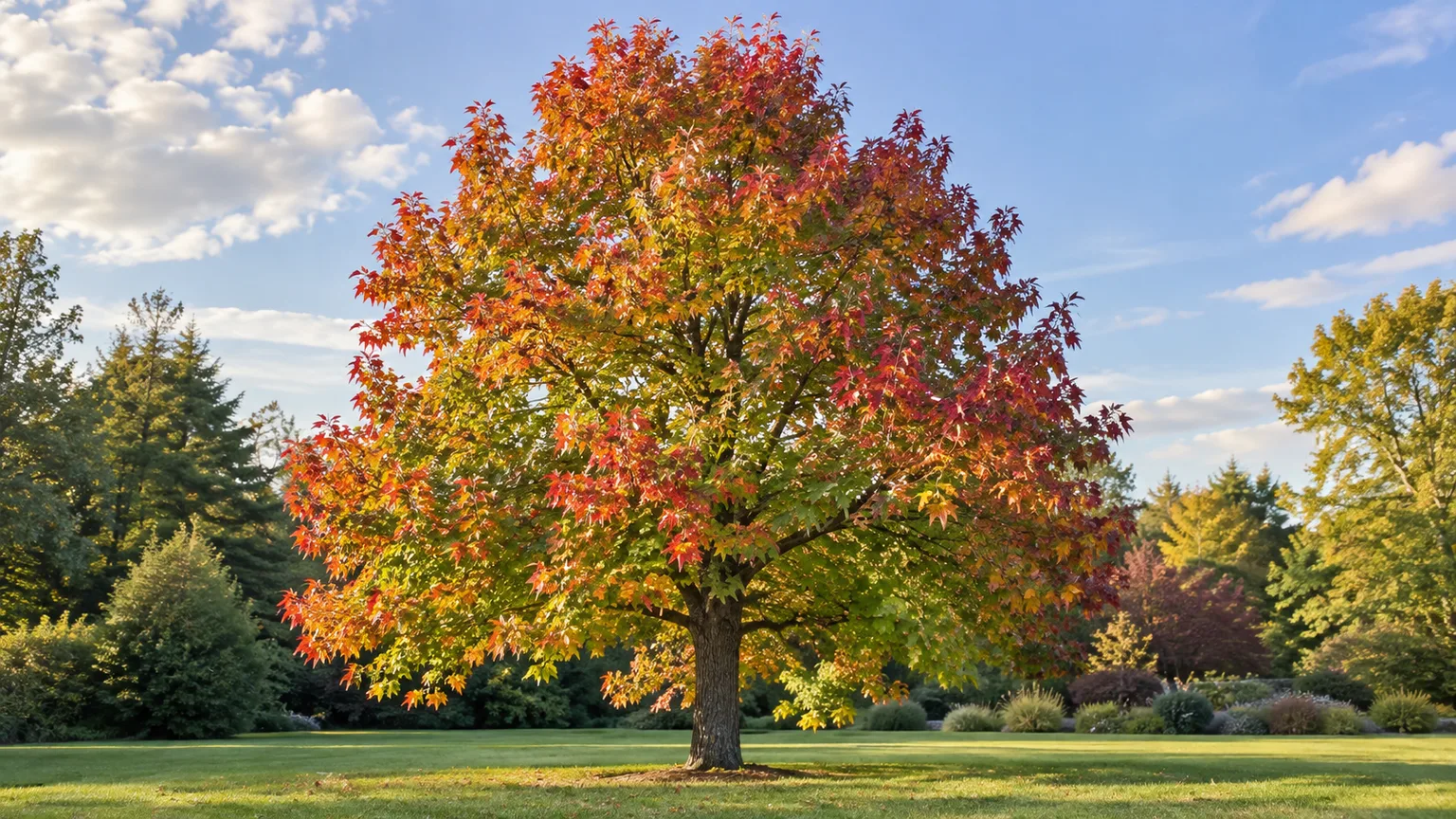
American sweetgum (Liquidambar styraciflua) earns its place in a landscape with star-shaped leaves, a strong pyramidal silhouette, corky bark on mature branches, and unusually long-lasting fall color. It also earns a reputation for hard, spiny “gumballs” that roll onto paths and can make a small yard feel like the wrong site for a large tree.
The central sweetgum tree care rule is simple: choose the location before you choose the tree. Give it full sun, deep soil that stays reasonably moist without remaining waterlogged, and generous room for roots and canopy. If the only available spot is beside a sidewalk, patio, driveway, foundation, or children’s play area, select a different tree—or look for a cultivar with reduced fruit and a narrower habit.
Is Sweetgum Right for Your Yard?
Sweetgum is a large deciduous tree, not a patio accent that can be corrected later with aggressive pruning. Depending on species, cultivar, climate, and soil, a mature tree commonly reaches roughly 50 to 75 feet tall and 30 to 50 feet wide, with some trees becoming larger on favorable sites. The Virginia Cooperative Extension profile lists a 50-foot example and emphasizes that the tree is slow to establish because of its fleshy root system.
That size can be a benefit on a large property. A well-sited sweetgum becomes a high-canopy shade tree, gives birds and small mammals food and cover, and creates a fall display that can move through yellow, orange, red, and purple rather than turning one flat color all at once. The USDA Forest Service account describes the species as a native tree of the eastern and south-central United States that is especially associated with moist bottomland soils.
The drawbacks are equally practical. Surface roots can interfere with mowing or lift paving when the tree is given a restricted root zone, and the fruit is most troublesome on hard surfaces where it can be stepped on or rolled underfoot. Sweetgum also reacts poorly to repeated drought, root disturbance, and construction near the trunk. It is a good tree when the site can absorb those realities; it is a poor tree when the site is expected to contain them.
Make the site decision before you buy
Walk the future canopy and root zone before bringing home a sapling. Mark the nearest sidewalk, curb, driveway, patio, septic area, foundation, play surface, and any place where people regularly walk; then ask whether the mature tree will still have open soil and overhead space after the canopy expands.
As a conservative starting point, keep the trunk at least 8 to 10 feet from curbs and sidewalks, and increase that distance when the soil is shallow, compacted, or the hardscape is especially important. UF/IFAS sweetgum guidance notes that the root system is often shallow in moist native habitats but can also form deeper vertical roots in well-drained soils. The practical takeaway is not that every root runs at the surface; it is that a small planting cutout is an unreliable long-term root zone.
Choose an open lawn, woodland edge, park-like area, or large rain-garden margin rather than a narrow foundation bed. A site that is moist in spring but not permanently stagnant is usually easier to manage than a shallow, droughty island surrounded by pavement. If you cannot provide both soil volume and distance from foot traffic, admire sweetgum in a larger landscape and plant a smaller, better-matched tree at home.
Sweetgum at a Glance
| Care factor | Practical target |
|---|---|
| Botanical name | Liquidambar styraciflua |
| Type | Large deciduous shade and specimen tree |
| Mature size | Commonly about 50–75 feet tall; width varies by cultivar and site |
| Light | Full sun is best; partial shade is tolerated by some plants |
| Soil | Deep, moist, well-drained loam, clay, or sandy soil; slightly acidic to neutral is safest |
| Water | Even moisture during establishment; moderate drought tolerance only after a strong root system develops |
| Hardiness | Commonly listed for USDA Zones 5–9, with cultivar and local-provenance differences |
| Fall interest | Yellow, orange, red, purple, and burgundy foliage; gray furrowed bark and corky ridges |
| Fruit | Spiny brown capsules on the species; reduced or absent on selected fruitless cultivars |
| Main site risk | Surface roots and fruit near paving or busy foot traffic |
These are planning ranges, not guarantees. A tree in deep bottomland soil can behave differently from one in compacted fill, and a cold-edge planting can perform differently from the same cultivar in a warmer zone. The Morton Arboretum profile is useful for this reason: it pairs the species’ large size and full-sun preference with cautions about messy fruit, marginal hardiness, and slow establishment.
Choose the Species or a Fruitless Cultivar
The straight species is the classic American sweetgum with pointed leaf lobes and abundant fruit. That fruit is not a disease or a sign that the tree is stressed; it is part of the tree’s normal reproductive cycle. Seeds can feed birds, squirrels, and other wildlife, but the same capsules are a maintenance problem when they land on a path.
Cultivars let you choose among fruit production, mature shape, fall color, and cold tolerance. ‘Moraine’ is often selected where extra cold hardiness matters, ‘Slender Silhouette’ is useful when a narrow columnar form fits the site, and other selections emphasize red or burgundy fall color. Availability and performance vary by region, so treat the nursery tag as a starting point and ask which selections have proved durable locally.
What ‘Rotundiloba’ changes—and what it does not
Liquidambar styraciflua ‘Rotundiloba’ is the best-known fruitless sweetgum for homeowners who want the foliage without the regular crop of spiny capsules. NC State Extension describes its rounded leaf lobes, pyramidal habit, fall color, and rare fruit production. “Fruitless” should be read as normally fruitless, not as a legal or biological guarantee that no capsule will ever appear.
Watch for occasional branches with pointed species-like leaves. These are reversions or rootstock growth, depending on how the tree was produced; remove suspect shoots while they are small, and have an arborist identify a large branch before cutting it. A fruitless cultivar also does not erase the tree’s eventual size, shade, water needs, or root-zone requirements. It solves the fruit problem better than it solves a cramped site.
| If your priority is… | Start by evaluating… |
|---|---|
| Maximum classic fall color on a large property | The straight species or a locally proven fall-color cultivar |
| Less fruit on a residential lawn | ‘Rotundiloba’, while accepting occasional fruit and full mature size |
| A narrow vertical silhouette | ‘Slender Silhouette’ or another locally available columnar selection |
| Cold-edge reliability | A cultivar and nursery source proven in your local climate |
| A small yard | A different species; even a narrow sweetgum remains a large tree |
Plant Sweetgum Without Root Trouble
Spring is a dependable planting window in most of the species’ range because the tree has a long growing season to begin root recovery. A container-grown young tree is usually easier to establish than a large field-dug specimen, and smaller trees often recover from transplanting more predictably than oversized stock.
A reliable planting sequence
- Check the root ball and trunk flare. Choose a tree with a sound trunk, evenly distributed branches, and roots that are not circling densely. Find where the trunk widens into the roots; that flare should end up level with or slightly above the surrounding soil.
- Dig wide, not needlessly deep. Loosen a broad area so new roots can move outward. The hole should be no deeper than the root ball, because a settling tree planted too low can suffocate roots and bury the flare.
- Remove only defective circling roots. Do not shred a healthy root ball. If a container tree has a few woody roots circling the outside, tease or cut only the problem roots with clean tools.
- Backfill with the soil you removed. In an appropriate site, native soil helps the roots transition into the surrounding ground. Do not create a rich, soft pocket that keeps the root ball wet while roots refuse to cross into compacted soil.
- Water the whole root zone slowly. Settle air pockets with water rather than packing the soil hard around the trunk. The goal is contact between roots and soil, not a bathtub around the stem.
- Mulch broadly and shallowly. Apply a 2- to 3-inch layer of organic mulch over the root zone, tapering it away from the trunk. “Volcano” mulch that touches bark stays wet, hides defects, and can encourage decay.
- Stake only if the site requires it. A flexible young tree that can move slightly in the wind usually develops a better trunk than one tied rigidly for a full season. Stake temporarily when the root ball is unstable or the site is very windy, and remove the ties once the tree holds itself upright.
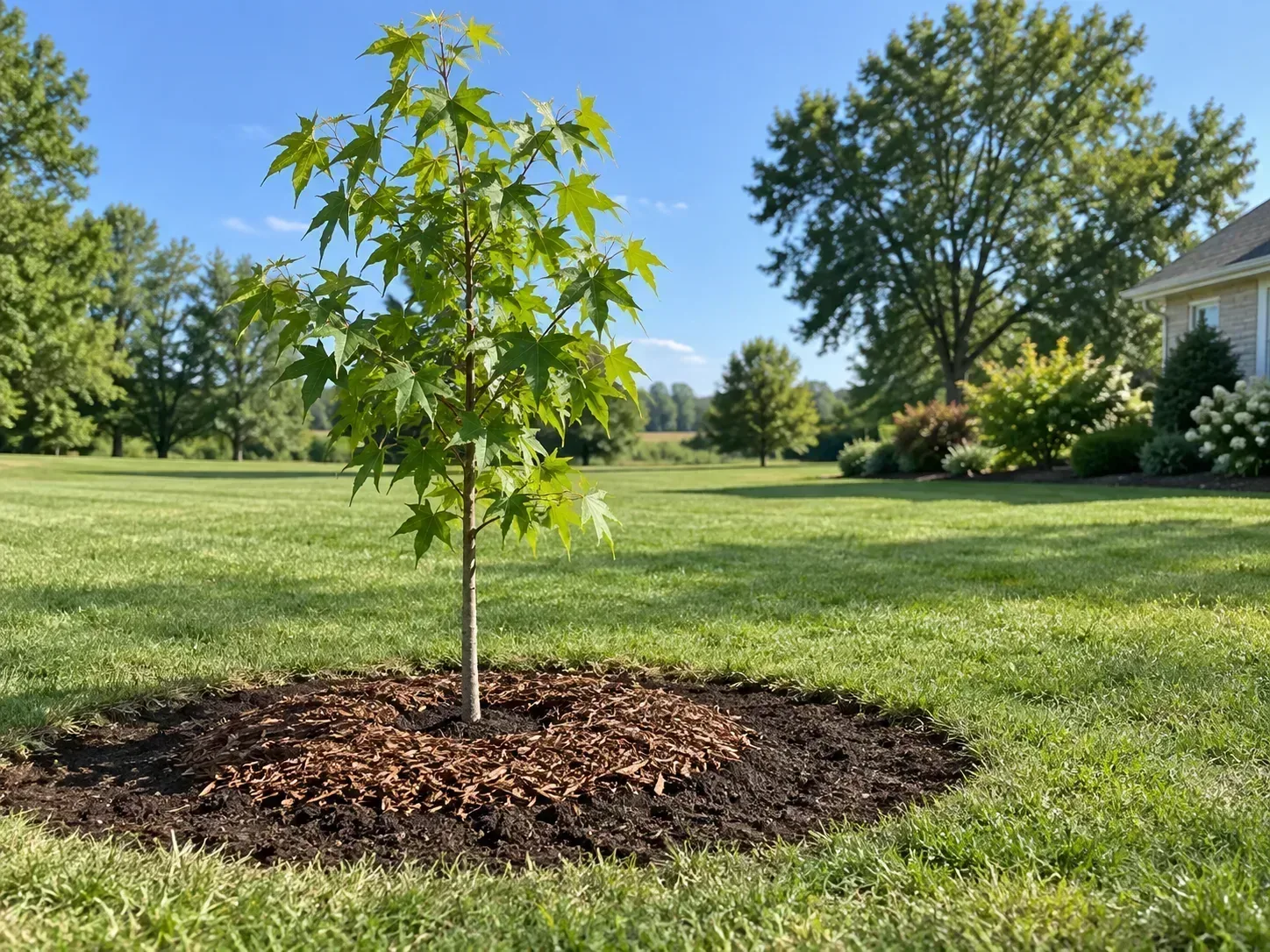
The first year is about root recovery, not speed. Avoid trenching, grading, piling soil, driving over the root zone, or storing materials beneath the canopy. Construction damage can show up later as thinning or crown dieback, which makes the tree look diseased even though the original injury was physical.
Get Light, Soil, and Drainage Right
Give sweetgum full sun when you want dense growth and dependable fall color. Partial shade is possible in some climates, but a tree competing with taller plants for light may grow more slowly and develop a less balanced crown. Do not choose a shaded site simply because the young sapling looks attractive there; judge the light that will reach the mature canopy.
The most forgiving soil is deep, moisture-retentive, and well drained. Sweetgum can grow in clay, loam, and sandy soils when the site supplies enough moisture and root volume, but shallow droughty soil is a poor match. A soil that stays wet for days after ordinary rain is a different problem from a soil that drains steadily; test drainage before planting by filling a hole with water and watching whether it empties within a reasonable time.
Soil pH deserves more attention than a generic “well-drained soil” label. Sweetgum performs best in acidic to neutral conditions; Virginia Tech lists a preferred pH range below neutral and identifies iron chlorosis as a common problem when pH rises above about 7.0. Do not dump sulfur or acidifying fertilizer into the planting hole based on a yellow leaf alone. Test the soil first, then correct the measured problem gradually.
Prevent alkaline-soil chlorosis
Iron chlorosis often appears as yellow leaf tissue with greener veins, especially on newer leaves. In a high-pH soil, the tree may contain iron but be unable to take it up efficiently. UF/IFAS and Virginia Tech both flag alkaline soil as a sweetgum weakness.
Start with a laboratory soil test that reports pH and, when available, soluble salts and nutrient levels. If the pH is high because of native soil or calcareous fill, the durable answer may be a more suitable tree rather than years of amendments. Foliar iron or a labeled chelated-iron treatment can improve appearance temporarily, but it does not change the chemistry of a root zone that continuously locks out iron.
Water During Establishment and Drought
Water a newly planted sweetgum deeply enough to moisten the root ball and surrounding soil, then let the surface begin to dry before watering again. Frequency depends on temperature, rainfall, soil texture, root-ball size, and mulch; a calendar interval is less reliable than checking the soil several inches down.
During the first growing season, inspect the root zone two or three times per week during hot or dry weather. Water slowly at the edge of the root ball and slightly beyond it, where new roots are moving, rather than sprinkling only the trunk. As the tree grows, extend the wetted area and taper frequency when roots begin to explore the surrounding soil.
Deep watering does not mean flooding the tree once a month. It means applying enough water to wet the full root zone without allowing runoff, then giving the soil time to exchange air between irrigations. Heavy clay may need a slower application in two passes; sand may need shorter intervals because it cannot store as much water.
Once established, sweetgum tolerates moderate dry periods better than a young tree, but drought tolerance is often overstated. The species is naturally associated with moist soils, and USDA Forest Service information describes its strongest growth on moist alluvial sites. During an extended drought, water the root zone before the canopy shows severe wilt, and prioritize trees exposed to construction, reflected heat, or shallow soil.
Do not compensate for drought stress with fertilizer. Salt buildup and tender, forced growth can make a stressed tree less resilient. Restore moisture, protect the root zone from traffic, and look for the cause before adding nutrients.
Fertilize Only When the Tree Shows a Need
Sweetgum is not a houseplant that needs routine feeding every few weeks. A young tree planted into reasonably fertile soil can usually spend its first seasons building roots without extra fertilizer. Overfertilizing may push soft shoots, worsen salt stress, or distract from the real problem when soil pH, drought, compaction, or root damage is limiting growth.
Use a soil test and the tree’s growth pattern to decide. Pale new leaves with green veins point toward a pH or iron-availability issue, while uniformly pale older foliage can have a different cause. A thin canopy after trenching is not a fertilizer deficiency until the root damage has been assessed.
If the test shows a nutrient shortage, use a slow-release product labeled for trees and follow the label rate. Spread it over the root zone rather than piling it against the trunk, and avoid applying nitrogen late in the season in climates where tender late growth could meet an early freeze. Compost used as a thin surface mulch can improve soil structure over time, but it is not a substitute for a diagnosis.
Prune for Structure, Not Size
Young sweetgums benefit from inspection more than from annual shearing. Remove dead, broken, crossing, or badly attached branches, and preserve a strong central leader when the cultivar’s natural form calls for one. Make cuts just outside the branch collar, without leaving long stubs and without cutting flush against the trunk.
Winter or the dormant season is a workable pruning window for structural corrections, although the exact timing can vary with climate and the reason for the cut. Remove small defects before they become large wounds, and hire a qualified arborist for high branches, storm damage, utility clearance, or a mature tree near a structure.
Cuts to avoid
Never top a sweetgum to keep it small or to stop fruiting. Topping creates poorly attached shoots, large wounds, and an unsafe structure; it also does not provide a dependable long-term solution to gumballs. If the tree is too large for the site, pruning cannot turn it into the right tree. Consult an arborist about risk assessment and removal when the planting decision itself was wrong.
Do not remove major surface roots simply because they are visible. Cutting structural roots can destabilize the tree and invite decay, while covering them deeply can suffocate them. Improve the site around roots with mulch, not repeated excavation or a new layer of soil.
Manage Sweetgum Balls Without Damaging the Tree
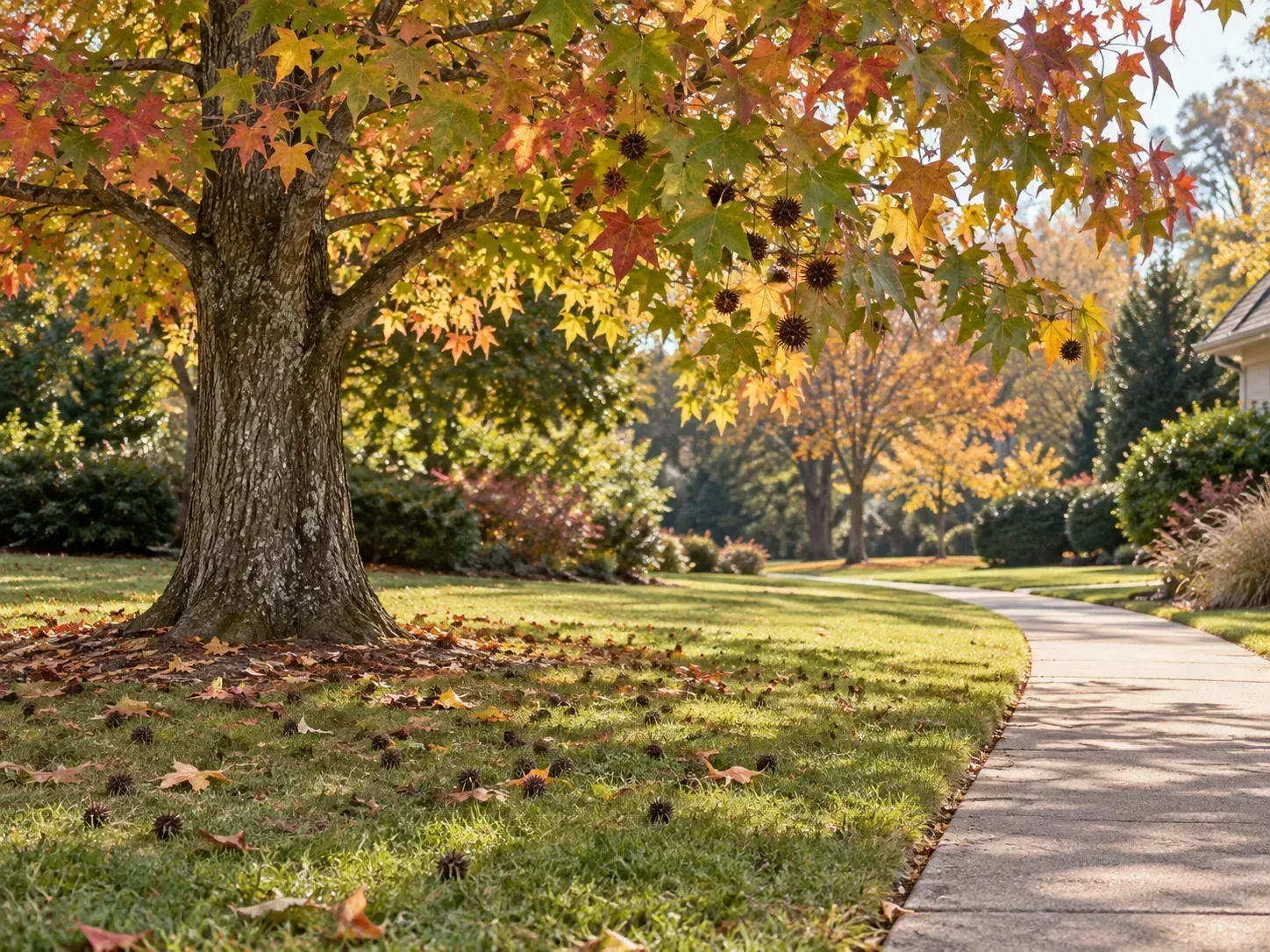
The species’ fruit ripens from green to brown in late summer and fall, and the woody capsules can remain on the tree into winter. On grass, a light scattering may be tolerable; on a patio or sidewalk, the same fruit becomes a slipping and cleanup problem. Morton Arboretum’s sweet-gum profile describes the capsules as roughly 1 to 1½ inches across and especially messy near paved areas.
The best management starts before planting: choose an open lawn or naturalized area where the fruit is not underfoot. For an existing tree, rake or vacuum the lawn during the drop period, collect heavy accumulations before mowing, and keep the area beneath the canopy mulched if turf is difficult to maintain. Wear sturdy gloves when handling large quantities, and do not place spiny fruit where children or pets will treat it as a toy.
‘Rotundiloba’ is the better selection when fruit is the deciding objection, but inspect the plant over time. A few capsules do not mean the cultivar has failed; it may be an occasional fruiting event or a reversion. Fruit-control injections and growth regulators are not a universal homeowner fix, and treatment timing, tree size, product labeling, and local professional requirements matter. Never improvise a chemical treatment on a mature tree.
Sweetgum balls are not edible. They can be collected for crafts or left in a wildlife-friendly area, but do not present them as food for people. The University of Arkansas Extension discussion explains that mature capsules contain many seeds and should be gathered before they dry fully if propagation is the goal.
Propagate by Seed or Cutting
Seed propagation is the practical home method for the species, but it is a project rather than a shortcut to a mature shade tree. Gather brown capsules before they become completely dry and open, let them finish drying over paper, and separate the dark winged seeds from empty or pale ones. The Arkansas Extension guidance recommends a cool, moist refrigerator period of about three months before planting.
After stratification, sow the seeds shallowly in a clean, well-drained medium and keep them evenly moist. Protect the container from drying and from rodents, then grow the seedlings on until they have a sturdy root system. Expect variation in vigor, form, fall color, and fruiting because a seedling is genetically different from its parent.
Do not grow a named cultivar such as ‘Rotundiloba’ from a gumball and expect a clone. Seed from that tree will not reliably reproduce its rounded leaves or fruitless behavior. Named selections are normally maintained by nursery propagation methods such as grafting, so buy the cultivar from a reputable nursery when its specific traits matter.
Cuttings are possible but less dependable for home propagation, especially compared with easier shrubs and perennials. If you try a softwood cutting, take it during active growth, use clean tools, a sterile airy medium, bright indirect light, and consistently high humidity without saturating the stem base. Rooting hormone can help, but it cannot overcome a cutting taken at the wrong maturity or a medium that remains waterlogged.
Prepare for Fall and Winter
Sweetgum’s best display arrives after summer, when the star-shaped leaves shift through warm colors. Color intensity varies with cultivar, temperature, light, and tree health, so do not fertilize or water excessively in an attempt to force red leaves. A tree with a stable root zone and adequate sunlight is more likely to color well than a stressed tree being pushed toward a show.
In late fall, rake fruit and leaves from hardscape before they become slippery. Leave some clean leaf litter in a naturalized area if it does not mat against the trunk or smother turf you need to keep healthy. Maintain the mulch ring through winter, but do not pile it against bark.
Sweetgum is commonly grown in Zones 5–9, but the cold edge is not a guarantee for every cultivar or nursery source. Morton Arboretum notes that local provenance matters in colder regions, while NC State lists ‘Rotundiloba’ across a somewhat narrower regional range. Choose a tree proven in your climate, plant in spring at the cold edge, and protect a young trunk from mower and animal damage.
Winter is also a useful time to inspect branch attachments and plan structural pruning. Do not prune simply because the tree is dormant; make a cut because a specific branch is dead, damaged, crossing, weakly attached, or interfering with a necessary clearance.
Troubleshoot Pests, Leaf Spot, and Decline
Sweetgum is generally not a high-maintenance pest tree, but scale insects, leaf miners, webworms, bagworms, and occasional caterpillars can appear. A few insects or a small web does not automatically justify spraying a whole mature canopy. Identify the pest, assess the amount of damage, and consider whether beneficial insects or seasonal leaf drop will solve the problem without intervention.
Leaf spot can create dark or irregular lesions and premature leaf drop. Improve airflow, avoid wetting foliage late in the day, irrigate at soil level, and remove heavily diseased fallen leaves when sanitation is practical. UF/IFAS notes that leaf spots may occur without becoming a serious threat to the tree; distinguish a cosmetic late-season problem from a canopy that is defoliating repeatedly or declining branch by branch.
Iron chlorosis is a different pattern: newer leaves may be yellow while veins stay green, especially when soil pH is high. Drought stress may produce wilt, marginal scorch, premature color, or dieback, while root or construction injury can cause thinning that does not respond to fertilizer. A soil test, root-zone history, and seasonal timing are more useful than diagnosing from one leaf.
Read symptoms in context
Use this sequence before reaching for a product:
- Check the pattern. Is the problem on new leaves, old leaves, one branch, or the whole canopy?
- Check the soil. Is the root zone dry, saturated, compacted, or recently buried?
- Check the site history. Were roots cut, a trench dug, soil graded, pavement added, or herbicides used?
- Check the season. Late-summer spots and autumn color are not the same as spring chlorosis or drought dieback.
- Check the trunk and flare. Look for buried bark, cracks, wounds, girdling ties, or mulch touching the trunk.
- Escalate when needed. For rapid decline, large dead limbs, cracks, suspected root damage, or a tree near people and structures, call a certified arborist or local extension diagnostic service.
Avoid planting a replacement tree before you understand why the first one failed. If the soil is alkaline, the root zone is restricted, or the site is repeatedly droughty, another sweetgum may repeat the same problem. A cultivar can change fruit or shape, but it cannot rewrite the physical limits of the property.
Conclusion
Sweetgum tree care is mostly a placement and establishment exercise. Give Liquidambar styraciflua a large open site, full sun, deep moisture-retentive soil, and time to build roots; water young trees by checking the root zone, protect the soil from compaction, and prune only for sound structure.
Choose the straight species when wildlife value and classic fruit are acceptable, or consider ‘Rotundiloba’ when you want the foliage with far less cleanup. Neither option belongs beside a narrow sidewalk or in a small foundation bed. When the location fits the tree, sweetgum repays the space with shade, distinctive bark, and one of the most varied fall displays a deciduous tree can offer.