How to Grow and Care for a Banana Tree
Learn how to grow and care for a banana tree with practical advice on cultivars, sun, watering, soil, feeding, pruning, containers, winter, and fruit.

Banana plants reward the right setup with enormous leaves, fast growth, and—if the cultivar and climate cooperate—hands of fruit. They are also commonly misunderstood: a banana is a herbaceous perennial, not a woody tree. What looks like a trunk is a pseudostem made from tightly wrapped leaf sheaths, and the plant’s real long-term engine is the underground rhizome.
That anatomy explains nearly every good care decision. A pseudostem fruits once and then dies, while the rhizome sends up replacement shoots. The plant wants abundant moisture and nutrients, but its roots fail in stagnant water. It enjoys heat and light, but wind can shred or topple the foliage. Use the plan below to match your banana to its job—fruit, tropical foliage, or a container specimen—before you reach for fertilizer.
Decide What You Want From a Banana Plant
Start with the outcome, because “banana tree” can mean several very different plants. If you want edible dessert fruit, buy a named fruiting cultivar from a reputable nursery and give it a long, warm growing season. If you mainly want a tropical-looking plant for a patio or border, an ornamental species may be the better choice and may tolerate a different winter routine.
Bananas grow as a mat: one or more pseudostems connected to a rhizome and fibrous roots. A mature plant can carry stems at different ages, so a productive clump is not one tree but a small succession system. One stem may be flowering, one may be halfway grown, and one or two young suckers can be preparing the next crop.
Your first decision is therefore simple: choose fruit, foliage, or flexibility. Fruit requires more sun, heat, time, feeding, and space than a summer foliage display. A potted banana can look spectacular indoors while producing no fruit at all, particularly if it is moved into weak winter light or cut to the ground every autumn.
Choose a Banana Type That Fits Your Climate
Most cultivated bananas descend from Musa acuminata, Musa balbisiana, or hybrids between them. That background matters because cultivars differ in height, fruit quality, cold response, disease resistance, and whether their fruit is worth eating. UF/IFAS Extension describes bananas and plantains as a diverse group rather than one uniform crop, with harvest time from a sucker varying widely with cultivar, temperature, moisture, and cultural care (UF/IFAS Extension).
For a warm, frost-free garden, look for a fruiting type suited to your region, such as a Dwarf Cavendish, Grand Nain, or a locally proven hybrid. The cultivar overview from Epic Gardening is useful for comparing fruiting and ornamental choices, but local performance still matters more than a mail-order description. Dwarf forms are easier to shelter and harvest, but “dwarf” does not mean small: a vigorous plant still needs room for broad leaves, a spreading mat, and a heavy bunch. A seller’s hardiness claim is only a starting point; ask whether the plant fruits reliably in your specific climate, not merely whether the rhizome survives.
Fruiting bananas versus ornamental bananas
Fruiting cultivars such as Dwarf Cavendish, Grand Nain, and Blue Java need the same core conditions—sun, warmth, moisture, drainage, and nutrients—but their payoff is different. A plant that stays green through winter in a warm zone can produce a bunch; one that freezes back each year may spend its entire short season rebuilding leaves instead.
Ornamental bananas are still worthwhile. Red-leaved forms, flowering bananas, and compact types can deliver color and structure even when fruit is seedy, dry, or absent. Treat fruit descriptions from sellers cautiously: a banana can technically produce edible fruit that is not pleasant fresh, and a plant sold as “cold hardy” may be cold hardy only at the rhizome, not at the leaf canopy or fruiting stage.
Why Musa basjoo is different
Japanese or hardy banana, Musa basjoo, is the useful exception for gardeners in colder regions. NC State Extension lists it as a fast-growing herbaceous perennial with large leaves, summer flowers, small inedible fruits, and rhizomes that can survive very cold conditions when properly protected; above-ground growth dies back in colder zones (NC State Extension Gardener Plant Toolbox).
That makes M. basjoo a foliage plant with a tropical silhouette, not a reliable route to dessert bananas. Choose it when spring regrowth and winter protection fit your goal. Choose a fruiting cultivar in a pot when you want to move the plant into shelter, and choose neither if you cannot provide enough light or a safe place for a large, heavy container.
Find the Warmest, Brightest Wind-Sheltered Site
Give an outdoor banana the brightest practical position: ideally six or more hours of direct sun, with some afternoon shade acceptable where extreme heat scorches leaves. Full sun helps a fruiting plant build the leaf area it needs for a bunch, while light shade may slow growth and delay fruit development. Indoors, place the plant at the brightest south- or west-facing window available, or add a grow light when winter daylight is weak.
Heat is as important as the calendar. UF/IFAS reports best shoot growth around 78–82°F (26–28°C), while growth slows below 60°F (16°C) and stops around 50°F (10°C) (UF/IFAS Extension). Chilling can interfere with flowering and fruit development even before a frost kills leaves, so a warm wall, protected courtyard, or sunny balcony can outperform an exposed but technically warmer location.
Shelter the plant from prevailing wind without trapping it in stagnant, wet air. Banana leaves act like sails; gusts tear the blades, distort new growth, and can topple tall pseudostems. Plant near a wall, hedge, or fence that blocks the strongest wind while preserving sun, and keep the mat away from windows, paths, roof runoff, and power lines. Do not plant where a lawn mower or string trimmer can strike the pseudostem.
Plant in Soil That Holds Moisture Without Staying Wet
The ideal banana soil is deep, rich in organic matter, and quick enough to drain after heavy rain. UF/IFAS gives a useful target of roughly pH 5.5–7.0 for many home landscapes, but drainage is more important than chasing a perfect number (UF/IFAS Extension). A banana in heavy clay that stays saturated can fail even when its leaves look thirsty.
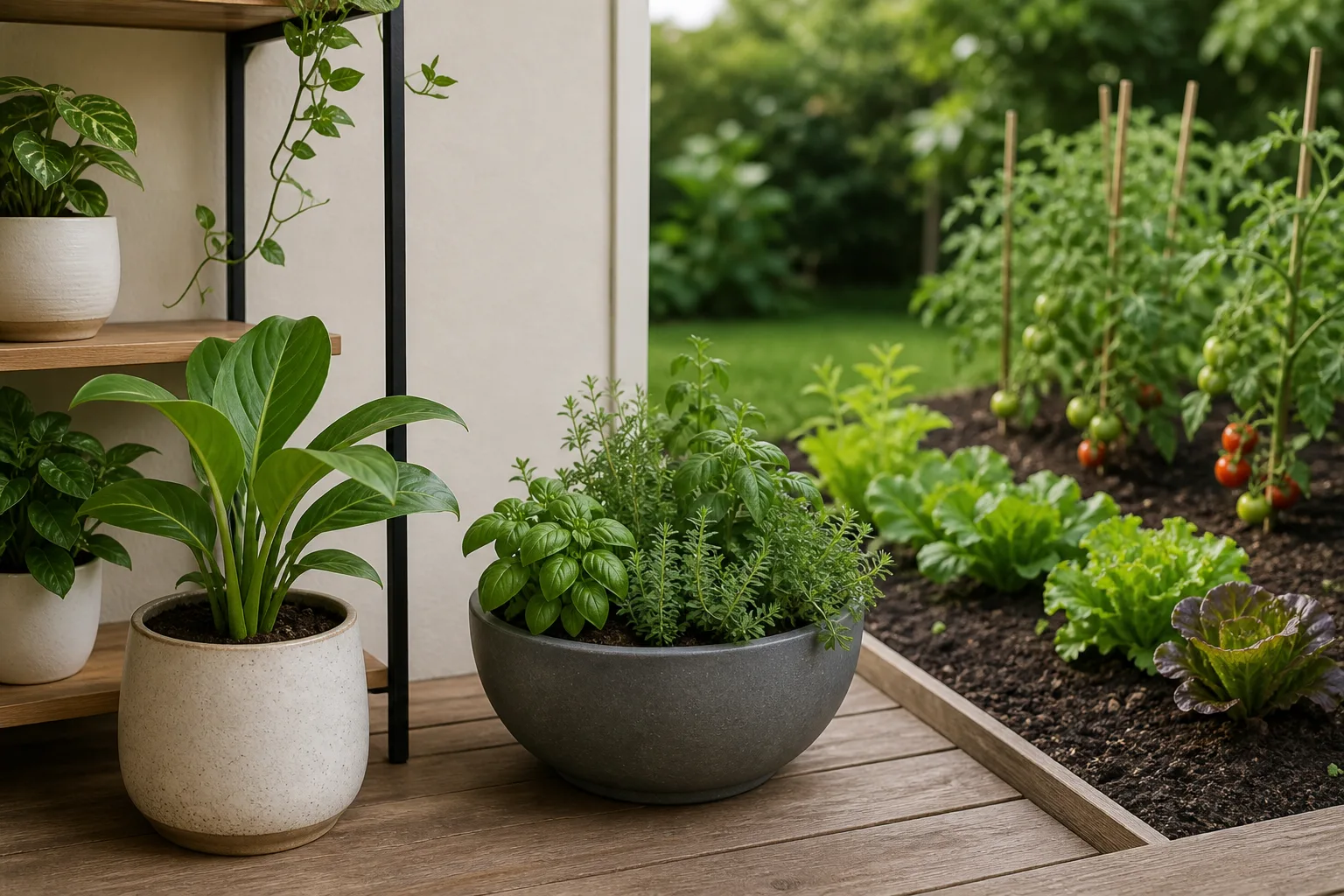
For containers, use a high-quality potting mix rather than garden soil. A container mix provides more predictable air space and drainage; garden soil compacts around roots and can remain waterlogged in a pot. For in-ground planting, improve the broad planting area with finished compost or other organic matter, but do not create a small pocket of rich, poorly draining soil that acts like a bowl.
In-ground planting steps
- Test the drainage first. Dig a hole, fill it with water, and watch whether it empties reasonably rather than remaining full for hours. If the site floods or stays wet after normal rain, choose a raised mound or a different location.
- Clear competing grass and roots. Bananas need water and nutrients for rapid growth. Keep a generous weed-free ring around the mat and avoid placing it inside a lawn’s high-frequency irrigation pattern.
- Set the plant at the correct depth. The top of the original root ball should sit level with or slightly above surrounding soil. Burying the pseudostem invites rot; planting too high can expose roots and destabilize the plant.
- Backfill with the native soil you removed. Mix in compost across the planting area, not as a concentrated layer under the root ball. Water slowly to settle air pockets.
- Mulch without touching the pseudostem. Apply roughly 2–6 inches of organic mulch over the root zone, keeping a small gap around the base. Mulch conserves moisture and moderates temperature, but a wet collar against the stem can encourage decay.
- Secure the first season. A young plant may need a loose, biodegradable tie and a stake in a windy site. Inspect ties as the pseudostem expands and remove them once the plant is stable.
Build a Watering Rhythm by Season
Bananas are thirsty, but “water frequently” is not permission to keep the root zone saturated. Water deeply when the upper soil begins to dry, then let excess drain. In hot, bright weather a plant in the ground may need irrigation several times a week; a small container may need checking daily. In cool weather or weak indoor light, the same plant may use much less.
UF/IFAS estimates roughly 4–6 inches of water per month for normal growth and production, or about 1–1.5 inches per week when rainfall is not supplying it (UF/IFAS Extension). Use that as a landscape planning benchmark, not a rigid schedule. Sandy soil, wind, container size, mulch, humidity, and root health can move the actual interval dramatically.
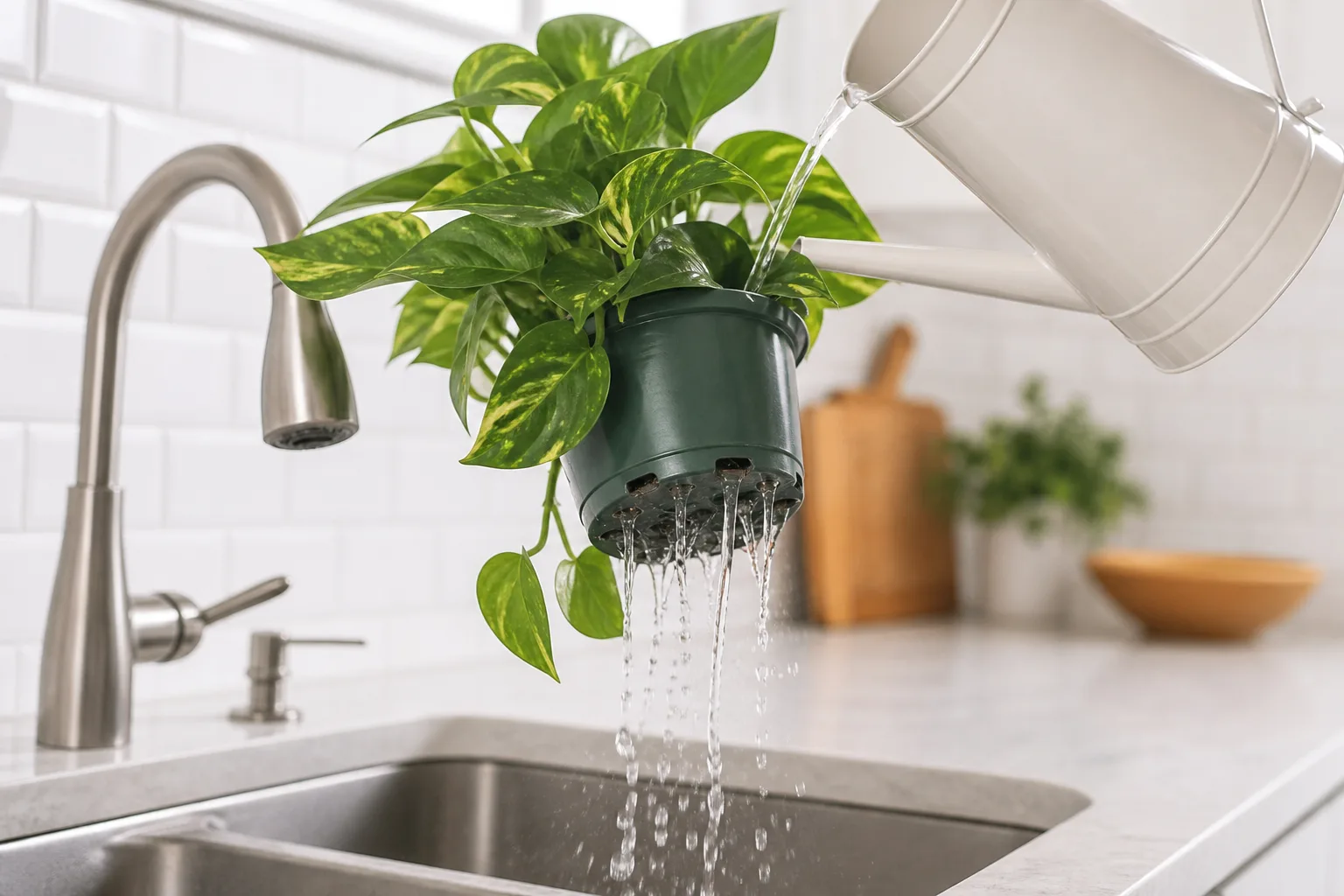
Check moisture at root depth with a finger, wooden skewer, or moisture meter, then water the whole root ball rather than sprinkling only the surface. For a container, pour until water exits the drainage holes and empty the saucer. If the mix is still wet several days later, increase drainage and light before increasing water.
Leaves that fold, lose color, or die prematurely can signal drought, but similar yellowing can come from roots starved of oxygen. Check the soil before reacting. If the plant is wet and declining, pause irrigation, move container plants into brighter airflow, and inspect roots at the next repot rather than adding more water because the leaves look limp.
Feed for Leaf and Bunch Growth
Bananas are heavy feeders because they build a large canopy quickly and, when fruiting, support a substantial bunch. Feed actively growing outdoor plants regularly with a complete fertilizer according to the label, and favor a formulation that supplies meaningful potassium rather than relying on a high-nitrogen product that produces soft leaves with little structural support.
UF/IFAS uses a high-potash approach for Florida landscapes and notes that feeding needs vary with soil fertility, plant age, and the number of pseudostems in the mat (UF/IFAS Extension). That variability is why a single universal scoop is poor advice. A young plant in rich ground does not need the same dose as a large, fruiting mat in sandy soil.
Apply fertilizer to moist soil, spread it around the root zone, and keep granules off the pseudostem. Add compost as a surface amendment when growth resumes, but do not bury fresh organic material against the base. If leaf edges brown after repeated feeding, salt accumulation or dry roots may be involved; pause fertilizer, water thoroughly if drainage is good, and resume at a lower label rate only after the plant stabilizes.
Container bananas generally need more attentive feeding than in-ground plants because each watering can leach nutrients from a small root zone. Use a balanced liquid feed at the label rate or a controlled-release product designed for container plants. Reduce or stop routine feeding when the plant is cold, very dim, or barely growing; fertilizer cannot compensate for insufficient light.
Manage the Mat: Stems, Suckers, and Pruning
Pruning a banana is mostly mat management, not shaping a tree. A pseudostem produces fruit once. After harvest, cut the spent stem down and let the replacement sucker carry the next cycle. Removing every sucker leaves the rhizome without a succession plan; allowing a thicket of them creates competition for light, water, and nutrients.
For a fruiting mat, a practical structure is one flowering or fruiting stem, one half-grown replacement, and one or two young suckers. Remove damaged leaves when they are fully dead, and cut leaves that rub against a developing bunch. Avoid stripping healthy green leaves simply because they are large; they are the solar panels paying for growth and fruit.
Which sucker to keep
Keep a vigorous sword sucker when possible. It has narrower, more upright leaves and a stronger connection to the rhizome, while a water sucker has broad leaves and is often more weakly attached. A healthy sword sucker with roots is a better replacement or propagation candidate than a thin, floppy shoot.
Cut unwanted pups at ground level with a clean, sharp tool. In an established outdoor mat, persistent regrowth may require removing the underground bud, but dig cautiously and do not damage the rhizome or neighboring replacement stem. Disinfect tools between plants when disease is possible, and never cut a suspected diseased mat and then move directly to a healthy one.
Grow a Banana Tree in a Container
Container culture is the most flexible option outside warm growing zones, but it is not a way to make a tropical plant low-maintenance. Choose a heavy pot with generous drainage holes; a large fruiting banana may ultimately need a container in the 15-gallon range or larger, while a compact ornamental can start smaller and move up as roots fill the mix.
Use a loose, moisture-retentive potting mix that still drains quickly. Set the plant at the same depth it occupied in the nursery pot, water it in fully, and place it where wind cannot tip the canopy. A saucer is useful indoors only if it is emptied after watering; standing water under the pot is a root problem, not a humidity strategy.
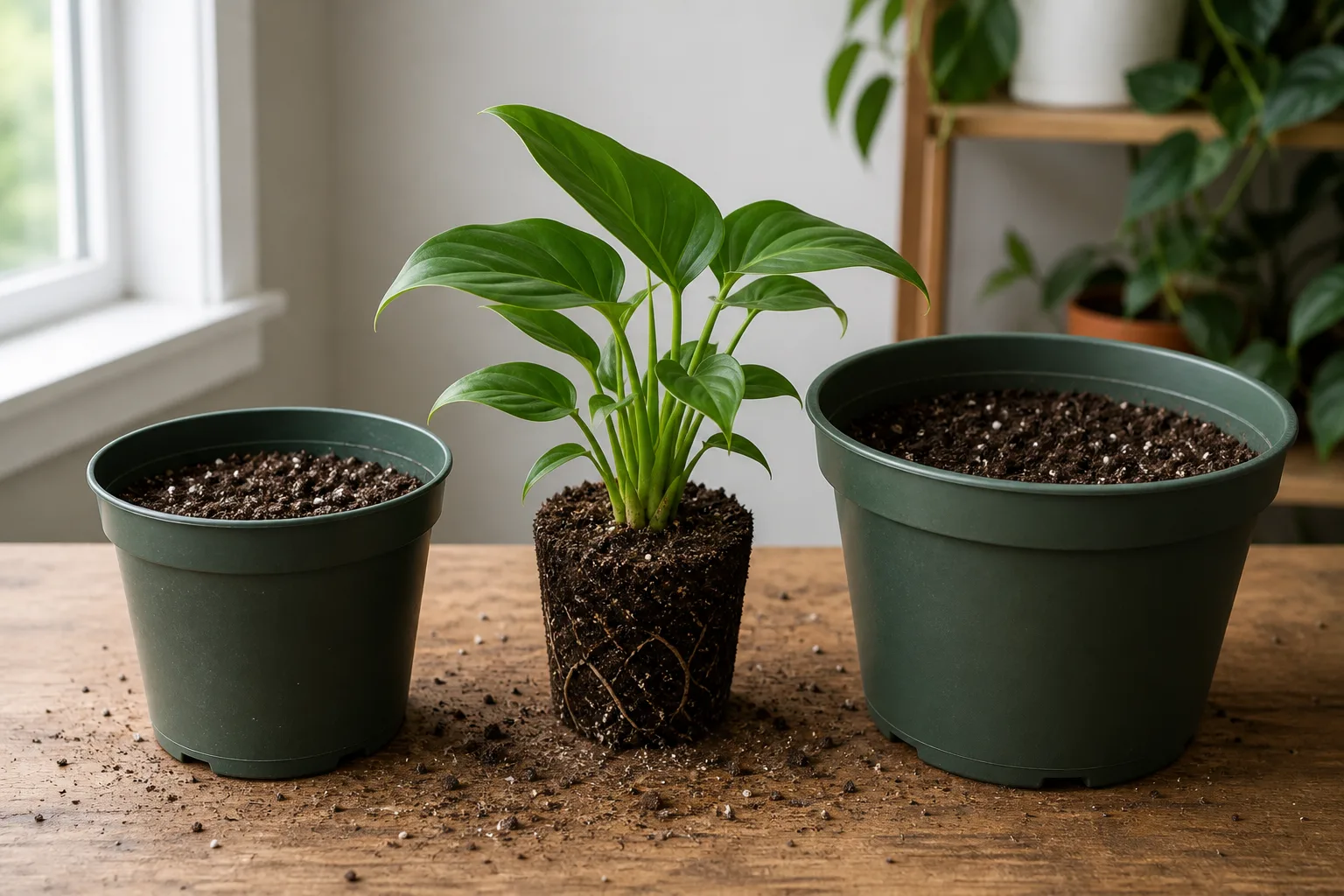
Repot when roots circle densely, water runs straight through the dry root ball, growth stalls during the warm season, or the pot becomes unstable. Move up one practical size rather than placing a small root ball in an enormous wet reservoir. If roots are brown, soft, or foul-smelling, remove the damaged tissue and correct drainage before feeding.
Move container bananas indoors safely
Move a tender container banana before frost and before repeated cold nights slow it into a stressed, wet-rooted plant. Bring it in earlier if the forecast threatens a sudden drop; waiting for visible damage makes acclimation harder. A cold-sensitive fruiting cultivar and a Musa basjoo rhizome do not have the same winter needs, so identify the plant before deciding whether to preserve leaves or simply protect the base.
Inspect leaf undersides, stems, the pot rim, drainage holes, and soil surface for aphids, scale, mealybugs, mites, and hitchhiking eggs. Rinse tolerant foliage, isolate the plant from your collection, and repeat inspections. Then transition it into the brightest indoor location you can provide, keeping leaves away from cold glass, heaters, and dry forced-air vents.
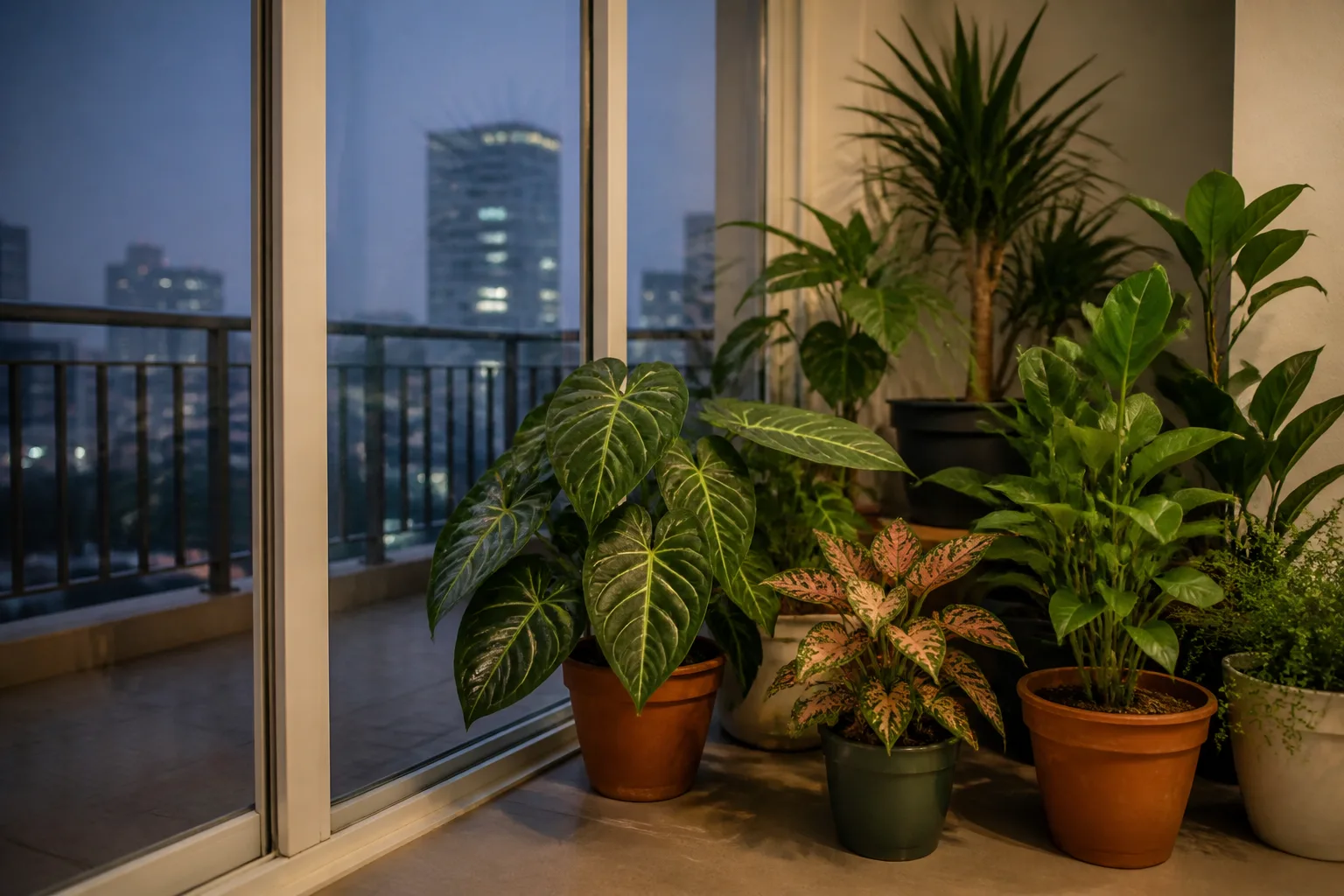
Indoor winter care is a light-and-water balancing act. A plant that receives much less light will use less water, even if the room is warm. Practical container guidance from Trees.com also stresses warmth, direct light, moist-but-not-saturated soil, and wind protection. Check the mix before each watering, rotate the pot for even growth, and accept slower leaf production rather than trying to force summer growth with extra fertilizer. If the plant is too large for the available light, overwintering a healthy sucker may be more realistic than keeping a stressed giant.
Propagate from a Healthy Sucker
Division is the dependable home method for preserving a banana cultivar. Wait until the sucker is large enough to have its own roots—often at least about 12 inches tall—and choose one that is vigorous, correctly identified, and free from suspicious lesions or rot.
Water the parent plant the day before if the soil is dry, then use a clean, sharp spade to separate the sucker with a piece of rhizome and as many roots as possible. If the cut surface is wet or ragged, let it air-dry briefly in a shaded, clean place before potting. Plant at the original depth in fresh mix, water it in, and keep it evenly moist while new roots establish.
Do not propagate from a plant with unexplained wilt, a collapsing base, or a spreading leaf disease. UF/IFAS emphasizes disease-free planting material and sanitation because pests and soilborne diseases can travel in suckers, rhizomes, tools, pots, and growing media (UF/IFAS Extension). Tissue-cultured plants can be a good clean start when available, but a healthy, well-rooted sword sucker is usually the practical home-garden choice.
Encourage Flowers and Harvest at the Right Stage
Fruiting is a long-season project, not a sign that the plant is “easy” or “hard” in isolation. UF/IFAS reports that a sucker may take roughly 9–20 months to reach harvest, and that fruit development after shooting can take about 80–180 days depending on cultivar, temperature, moisture, and care (UF/IFAS Extension). A plant that freezes to the ground each year may never accumulate enough uninterrupted growth to flower.
When a bunch forms, support the pseudostem if the weight or wind makes it lean. Harvest edible bananas when the fingers are full-sized and the edges have begun to round, usually while the fruit is still green. Cutting the bunch early enough to finish ripening in a cool, shaded place can protect it from birds, storms, and wildlife; do not refrigerate unripe fruit because chilling can interfere with ripening and flavor.
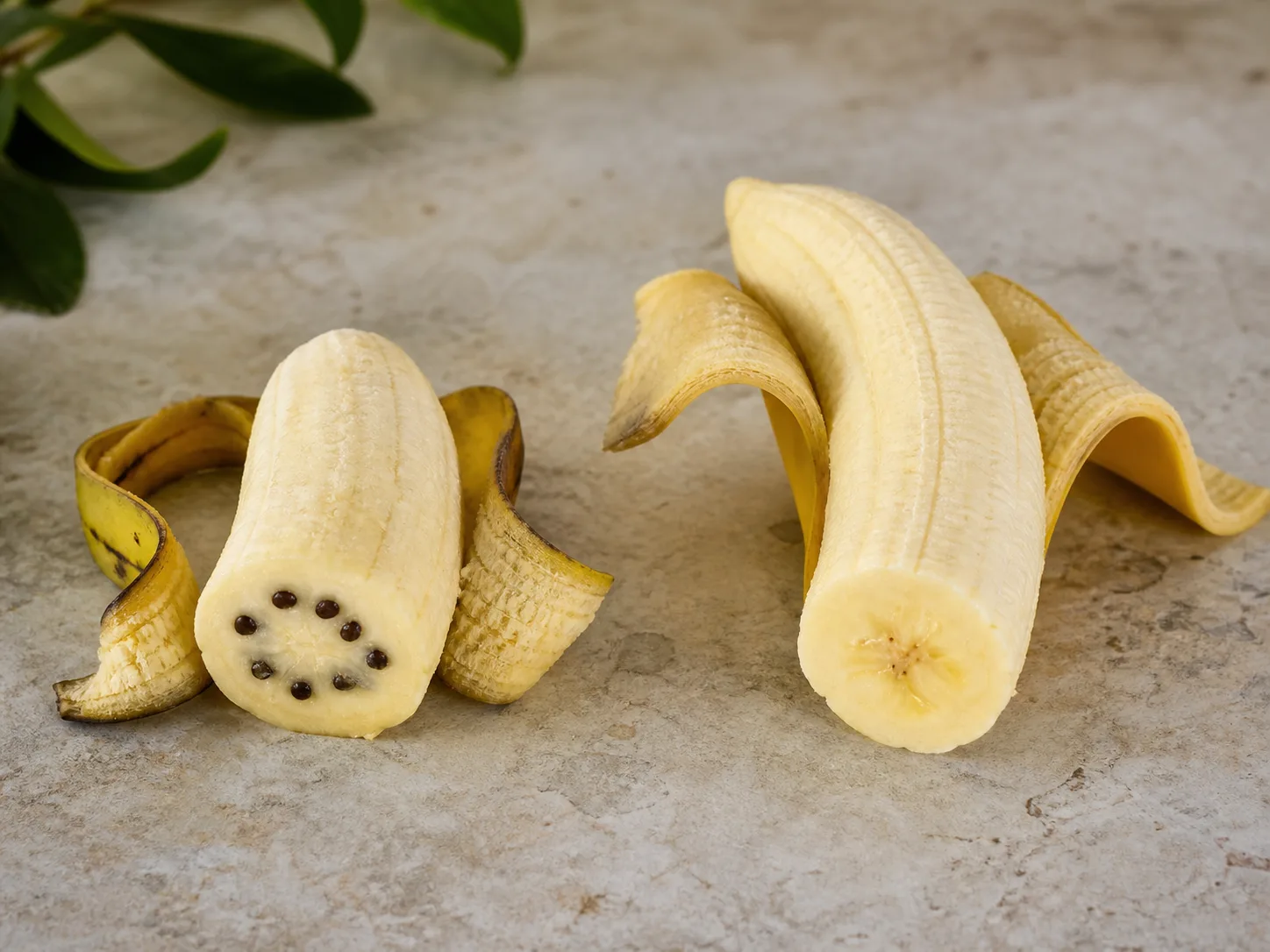
After harvest, remove the spent pseudostem and select the replacement sucker. Bananas in stores are usually seedless because cultivated clones produce fruit without mature seeds. Wild or seeded bananas are a different propagation project; the existing LeafyPixels guide on whether bananas have seeds explains why a grocery-store fruit is not a sensible seed source.
Troubleshoot Banana Leaves and Common Pests
Diagnose from the pattern, not one symptom. Start with four checks: feel the soil, inspect the newest growth, look under leaves for insects, and check recent weather. Then consider whether the plant was moved, repotted, fertilized, frozen, flooded, or exposed to wind in the last few weeks.
Yellow, folded, or brown leaves
Folded leaves, pale color, and crispy older leaves point first toward drought, heat, wind, or an underdeveloped root system. Water deeply if the root zone is dry, add mulch in the ground, and protect the canopy from desiccating wind. If the soil is already wet, do not water again; inspect drainage and roots instead.
General yellowing with slow growth can mean chronically wet soil, poor drainage, nutrient shortage, or insufficient light. A banana kept in a dark room can look hungry even when fertilizer is present. Move it toward brighter light gradually, let the mix drain, and feed only once active growth and healthy roots return.
Brown leaf margins may follow salt buildup, dry air, drought, fertilizer burn, or physical shredding. Banana leaves naturally split in wind, so a few tears are not automatically a disease. If browning advances with spots or halos, isolate the plant, remove heavily affected leaves with sanitized tools, and seek local extension advice before spraying.
Water-soaked, collapsed foliage after cold is freeze or chilling injury, not thirst. Protect the rhizome and wait for warm growth; cutting every damaged leaf immediately can remove tissue that is still helping the plant recover. A plant killed to ground level may resprout from its rhizome, but fruiting will be delayed.
Aphids, mites, mealybugs, and weevils
Indoors, inspect for aphids on tender tips, mealybugs as white cottony clusters, scale as fixed bumps, and spider mites as stippling or fine webbing. Isolate the plant, wash accessible foliage, and use a product labeled for the plant and pest. Follow the label and repeat only as directed; stronger homemade mixtures can burn banana leaves.
Outdoors, the banana weevil and nematodes are more serious than a few chewing insects. Wilting, weak growth, unexplained toppling, tunnels or ooze near the base, and declining roots deserve attention to planting-material quality and sanitation. Remove and dispose of severely affected plant tissue, avoid moving soil or suckers from a suspect mat, and contact a local extension service for current diagnosis and control options—especially for Fusarium wilt or Sigatoka-like leaf spotting, where cultivar resistance and clean stock matter more than a casual spray.
Conclusion
The reliable banana-tree routine is a sequence: choose a cultivar for your climate and purpose, give it bright light and wind shelter, plant it in rich soil that drains, water by root-zone moisture, feed during active growth, and manage the mat so replacement suckers are not competing with the fruiting stem. In a container, keep the plant mobile but respect its size, inspect it before bringing it indoors, and reduce watering when winter light drops.
If edible fruit is the goal, measure success by uninterrupted warmth and a named fruiting cultivar—not by whether a plant survives a freeze. If tropical foliage is the goal, Musa basjoo or an ornamental banana may be a better fit. Either way, healthy roots, a protected site, and a deliberate sucker plan will do more for the plant than any single fertilizer or watering trick.