How to Grow Common Bamboo: Care and Planting Guide
See how to grow common bamboo in warm gardens, from planting and division to cold limits, mature size, pests, and the local rules to check before you plant.
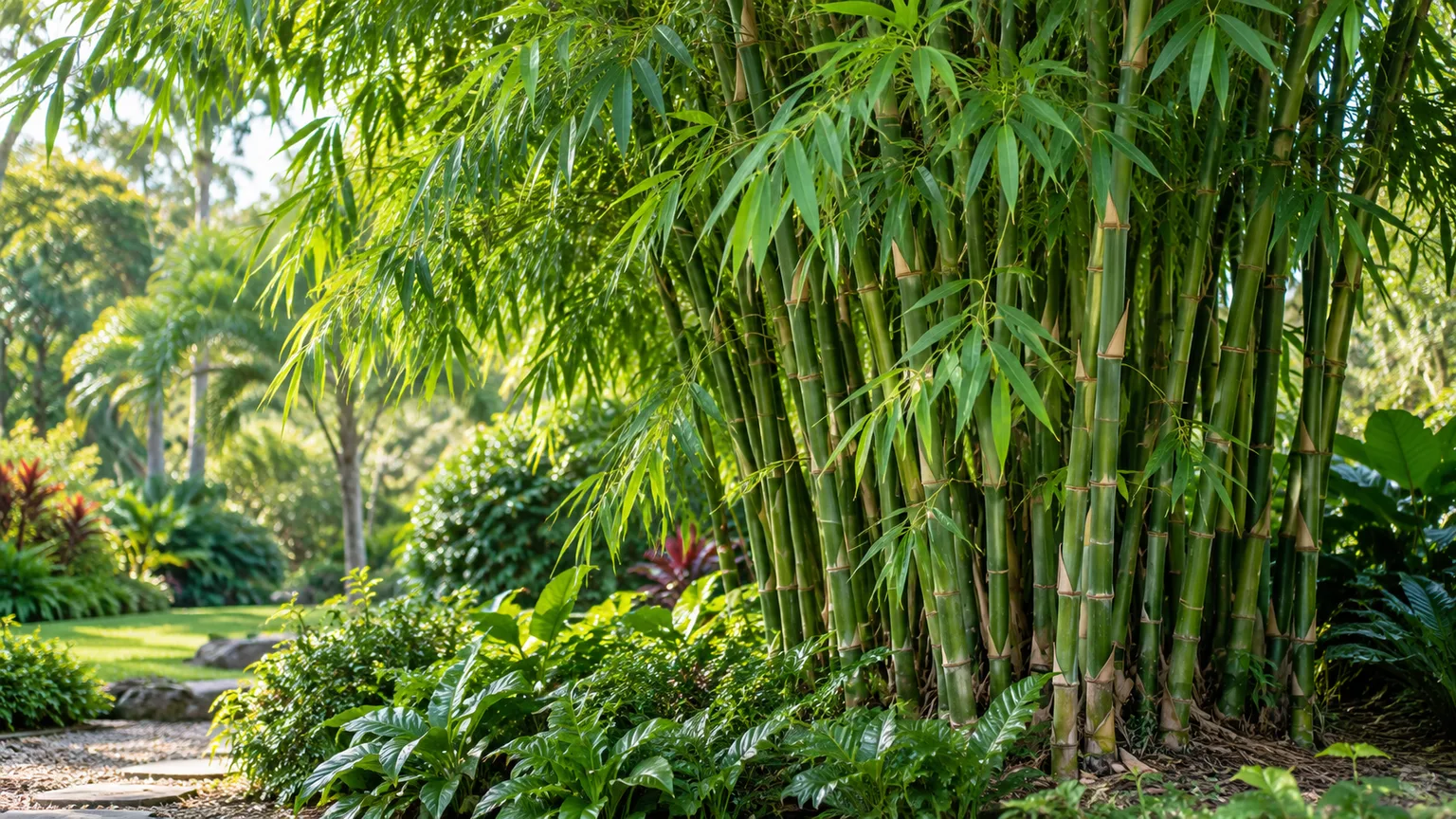
Common bamboo is a tropical to subtropical woody grass prized for tall green canes, rustling foliage, and fast seasonal growth. Its scientific name is Bambusa vulgaris, an accepted species native from Assam across parts of southern China and Indochina; it is now cultivated widely in warm regions. Before buying one, check two things: whether your winters suit it and whether your garden can accommodate a very large clump. The Kew Plants of the World Online profile places the species primarily in a wet tropical biome and describes it as a giant bamboo.
Its most useful selling point and its biggest planning risk are connected: common bamboo can build a tall, substantial screen, but it does not stay small because you prune it. It is not a compact indoor plant, a narrow hedge by default, or an effortless fit for a small suburban bed. Give it warmth, moisture with good drainage, and enough room for the clump to mature—or choose a smaller bamboo that suits your site better.
Is Common Bamboo the Right Bamboo for Your Site?
Common bamboo is worth considering where winters are mild, summer moisture is available, and a large evergreen screen or specimen is genuinely useful. A generous garden, farm boundary, or landscape with a broad buffer is a better match than a narrow foundation strip or a tight space beside a neighbor. The Royal Horticultural Society species profile calls B. vulgaris a giant species and cautions that it is not suited to an average-sized garden; it lists a mature spread exceeding 8 meters (about 26 feet) in favorable conditions.
The species is sold in several forms. The typical green-caned plant can be confused at retail with striped golden forms, often labeled ‘Vittata’ or ‘Striata’; ‘Wamin’ is sold for its swollen nodes and more compact appearance. UF/IFAS Extension’s profile of the striped ‘Vittata’ cultivar describes one warm-climate example. Cultivar names and common names can vary between sellers, so confirm the botanical label rather than buying a plant simply marked “golden bamboo.” A plant that looks compact in a pot may still become a large outdoor clump after years in warm ground.
Think through the mature height, width, and aboveground clearance before planting. Allow access around the plant for pruning and inspection, keep it away from overhead wires and buried services, and do not use it where its eventual canopy would shade a neighbor’s windows or block a path. If the site is small, cold, or difficult to inspect, a smaller, locally recommended bamboo is usually the lower-risk choice.
Clumping vs. Running: What “Clumping” Means
Bambusa vulgaris is clump-forming, not a typical running bamboo. A clumping rhizome grows a relatively short distance before turning upward to produce a new shoot; a running bamboo sends longer horizontal rhizomes that can create shoots much farther from the original planting. The University of Connecticut Extension’s bamboo overview explains this difference in how new culms arise, while a University of Hawai‘i CTAHR fact sheet for B. vulgaris describes the species as a clump bamboo with short rhizomes.
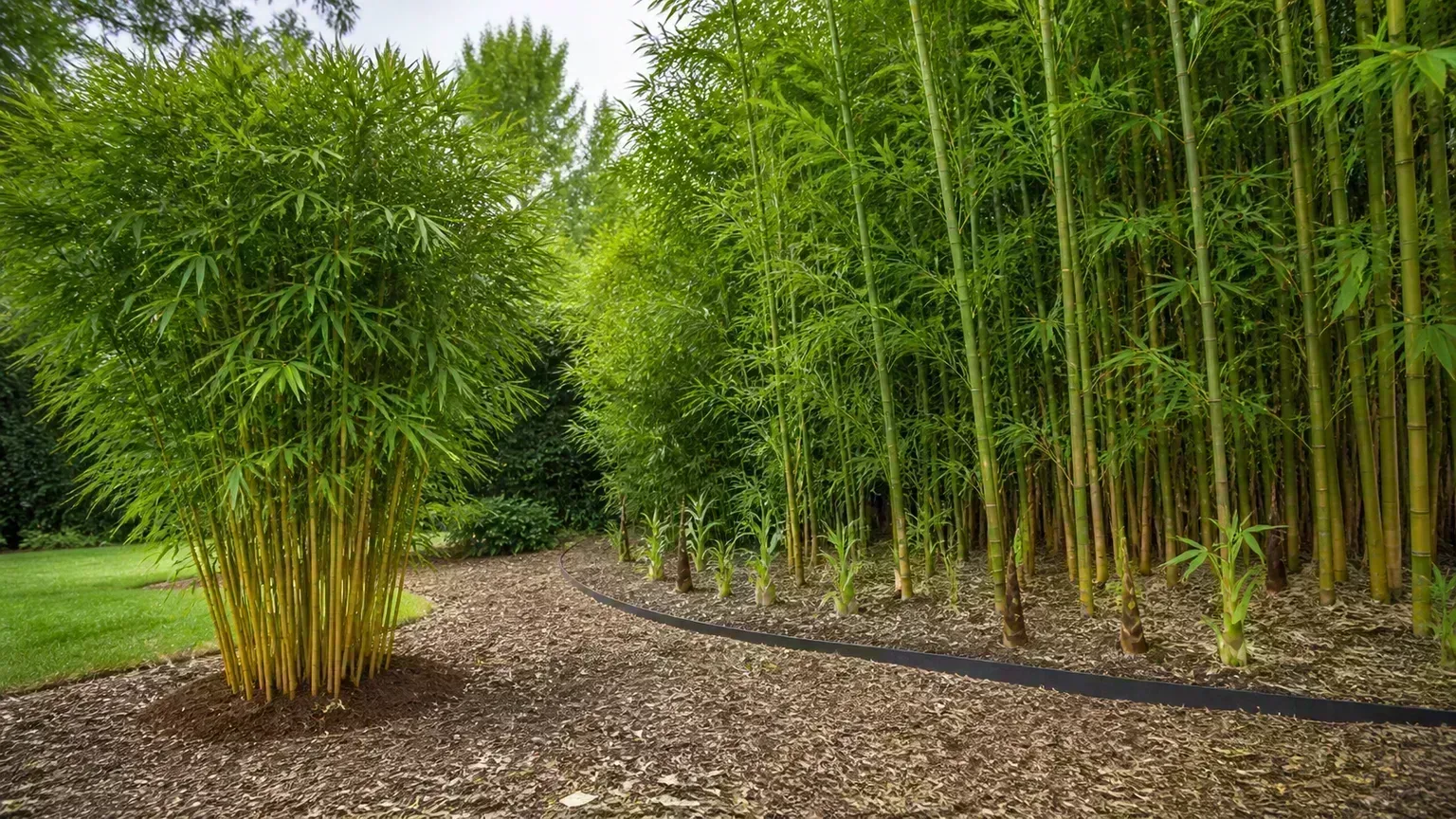
That distinction matters, but “clumping” does not mean “never spreads,” “cannot become a thicket,” or “safe in any location.” The rhizomes still expand the footprint over time, and a vigorous tropical plant can become difficult to manage simply because its clump is so large. The RHS notes that clump-forming bamboos can grow into large plants and may spread in favorable conditions. Hawai‘i’s university field guide says common bamboo does not spread aggressively there, but also warns it could become a problem at old home sites in forests. Both observations can be true: habit and ecological effect depend on the species, local conditions, and where it is planted.
| Growth habit | How shoots appear | Practical meaning |
|---|---|---|
| Clumping, including Bambusa | New culms emerge close to the existing clump as short rhizomes turn upward | The plant expands around its base, but may still become broad and crowded |
| Running, including many Phyllostachys | Long rhizomes travel outward and can send up distant shoots | A much higher escape risk; containment and frequent perimeter checks are central |
A “non-invasive” nursery label is not a maintenance plan. Identify the species, estimate the mature footprint, and check local ecological guidance before treating any bamboo as suitable.
Mature Size, Climate, and Cold Limits
Published size estimates vary because cultivars, rainfall, soil, and growing season vary. The RHS species profile gives common bamboo a height above 12 meters (about 39 feet) and a spread wider than 8 meters; Kew describes forms reaching 16 meters or more, and Singapore’s NParks Flora & Fauna Web records large clumps reaching 20 meters. These are potential sizes, not guarantees for every garden, but they are a better planning reference than a small nursery specimen.
The species favors tropical or subtropical conditions. UF/IFAS Extension’s profile for the striped cultivar B. vulgaris ‘Vittata’ lists a height around 50 feet, a width around 20 feet, and hardiness zones 9a–11. Those are cultivar- and region-specific figures, not a universal hardiness rating for all common bamboo. The RHS profile lists the species as H1C in its UK system, meaning it is best grown outdoors only in summer there and needs protection from cold the rest of the year. Different hardiness systems cannot be translated one-to-one, so use your local extension service or specialist nursery for the exact cultivar and climate.
In a frost-prone garden, expect leaf or cane damage and possible dieback after cold snaps; a brief survival does not mean the species will thrive or reach its advertised size. A large greenhouse may keep a young plant alive in a cool region, but an ordinary home is unlikely to provide enough light and space for a giant bamboo. If cold winters are normal where you live, selecting a cold-hardy species is more realistic than trying to overwinter full-size B. vulgaris.
Choose a Site with Enough Light and Room
Choose an open position in full sun or partial shade, protected from the strongest drying winds. In a very hot climate, light afternoon shade can reduce leaf stress, but deep shade tends to slow growth and make a tall screen less dense. Common bamboo can eventually be much wider than a person expects from a single nursery pot, so measure the available footprint and leave working room beyond the clump’s expected edge.
Look up as well as down. Mature culms may reach roof or wire height, while the rhizome and root zone can conflict with paving, drainage lines, irrigation, foundations, or other plantings. Do not put a tall bamboo where it could obscure sightlines at a driveway or where you would have to trespass to maintain the far side. If the only available spot is a few feet wide, the location is wrong even if light and soil are ideal.
For a screen, decide what should remain visible and how far away the planting sits from the boundary. A clump planted hard against a fence is difficult to inspect and thin; a walkway around it is more useful than a narrow inaccessible gap. Take a photograph from the windows and paths the screen is meant to protect. That makes it easier to judge whether a broad, arched mass of foliage is a good fit or whether a narrower hedge would do the job better.
Prepare Soil and Plant at the Right Depth
Common bamboo prefers fertile, humus-rich soil that holds moisture but drains after rain. It can grow in several soil textures, but neither a permanently waterlogged planting hole nor a hot, bone-dry sandy strip is a good root environment. The RHS species profile recommends moist but well-drained soil and sun or partial shade in a sheltered position.
Do not try to fix poor drainage by adding a small pocket of potting mix or compost to the hole; water can collect at the boundary between that pocket and compacted soil. Improve a wider area with finished compost if the soil is poor, and correct standing-water problems before planting. A soil test can help identify pH or nutrient limitations, but common bamboo is more likely to struggle in a saturated or extremely dry root zone than because the pH number is not exact.
Ground Planting: Set the Root Ball, Not the Cane, Below Grade
Spring is a practical planting window in climates with a cool season because the plant has time to establish roots before winter. In warm climates, plant during a mild spell when irrigation is available and avoid the hottest, driest period. The RHS bamboo growing guide and the Old Farmer’s Almanac bamboo guide, written by Master Gardener Andy Wilcox, both recommend preparing a hole about twice the width of the root ball and watering it in thoroughly.
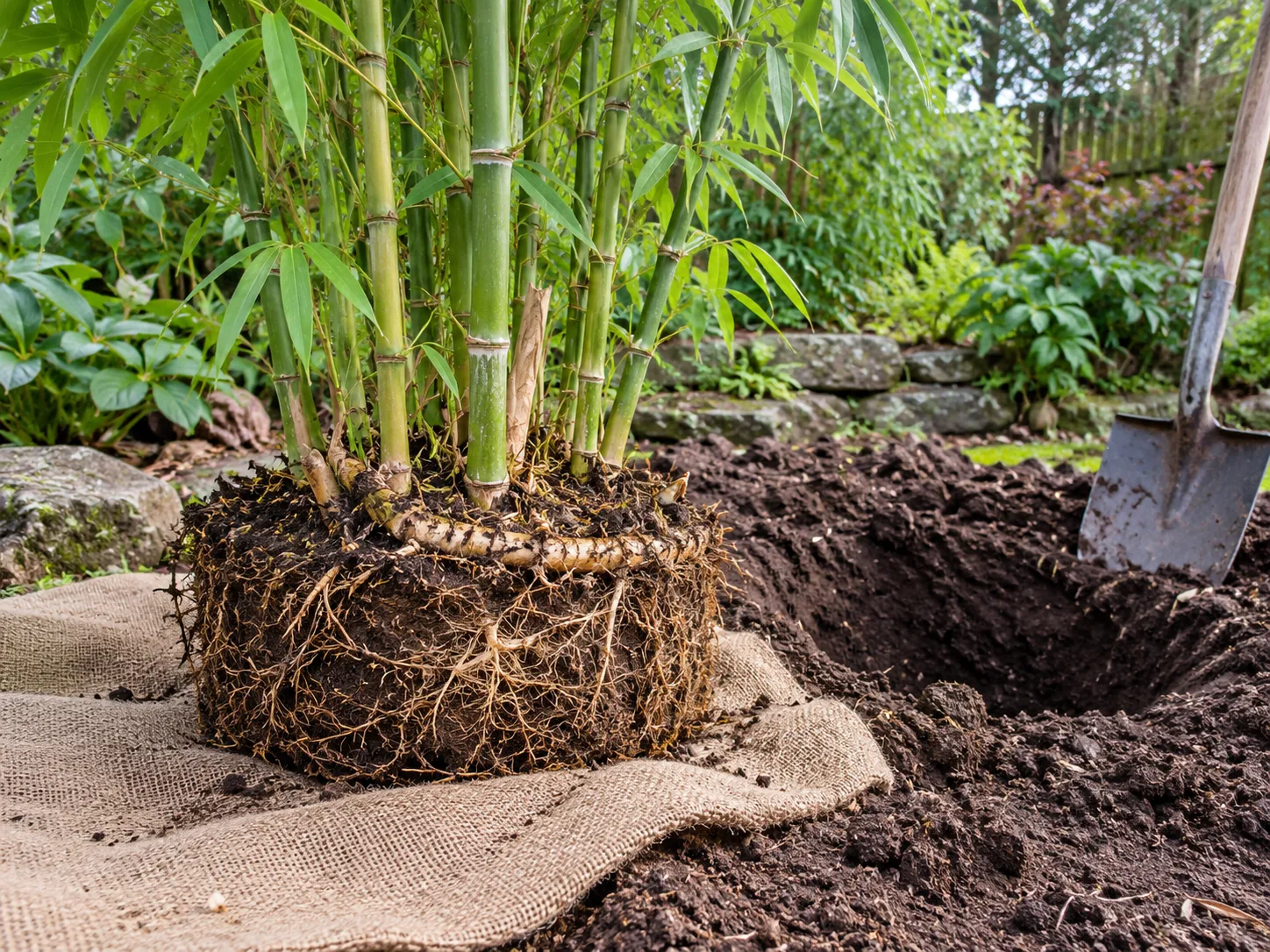
Water the nursery plant before lifting it from its pot, then loosen any circling roots around the outside of the root ball without tearing the whole mass apart. Set the plant at about its original growing depth, with the rhizome covered but the bases of the culms not buried deeply. Backfill with the excavated soil, firm gently to remove large air pockets, and water slowly until the root zone is evenly moist.
Finish with a 2- to 3-inch layer of organic mulch to reduce evaporation and weed competition. Keep mulch a few inches from the culms so the bases do not stay wet, and avoid covering any barrier edge you need to inspect. Follow the plant through its first growing season: a recently planted root ball can dry out while the surrounding soil still feels damp, so check both rather than watering on a fixed calendar.
Container Growing: A Long-Term Compromise, Not a Permanent Guarantee
A pot can be useful for a young specimen, a warm conservatory, or a large patio where the plant can be checked and divided. It is a less convincing long-term solution for full-size common bamboo. The RHS bamboo growing guide container advice is aimed at smaller bamboos and recommends a large container at least 45 centimeters (18 inches) across and deep, plus repotting or division every few years. B. vulgaris can grow far beyond the scale of a typical patio pot.
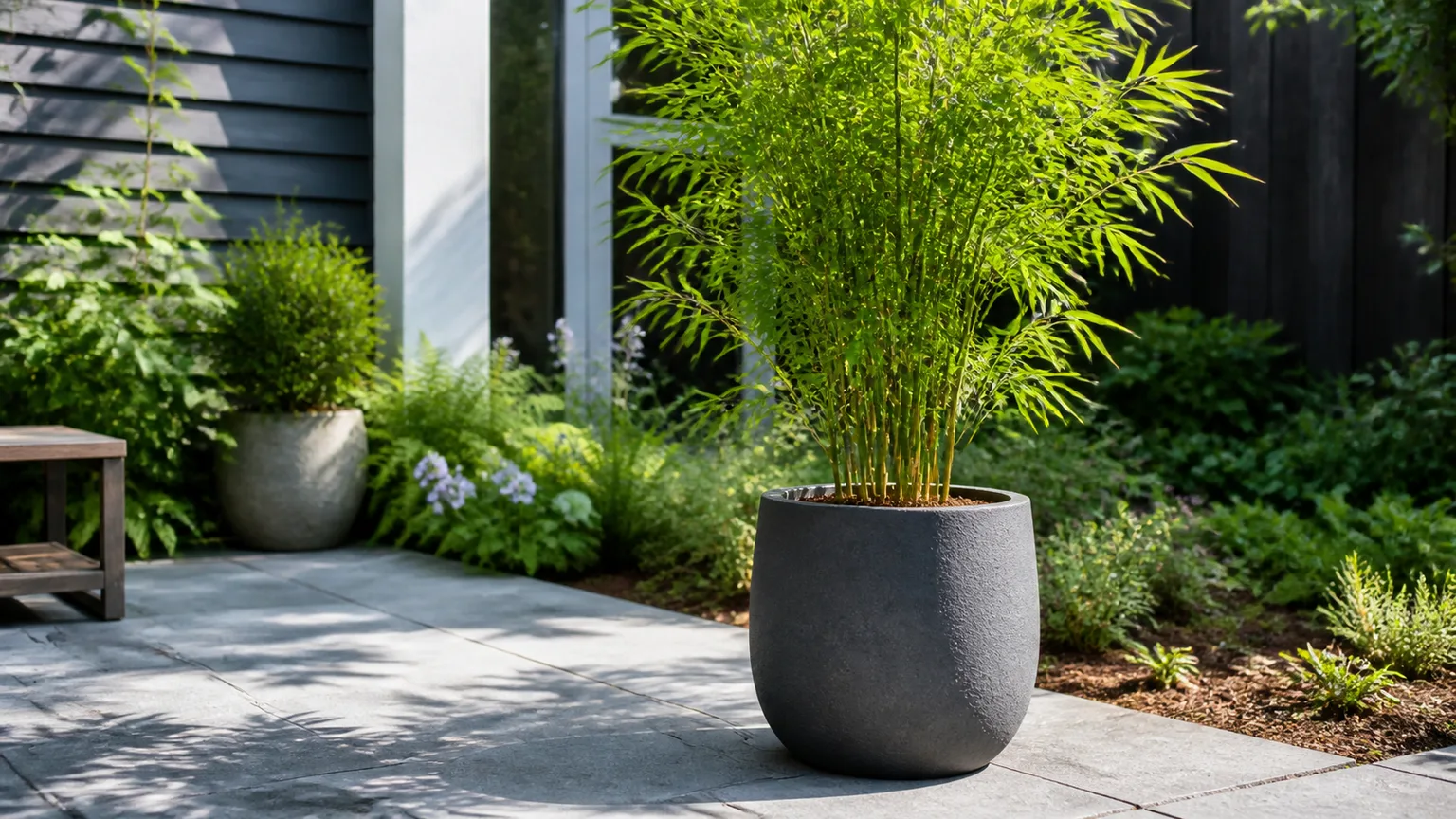
If you use a container, start with a broad, heavy vessel with large drainage holes and enough soil volume to resist tipping as the canes grow. Use a free-draining, loam-based mix, water before the root ball dries through, and inspect the drainage holes and pot walls. Divide or repot before the root mass becomes a solid, congested block; waiting until it is too heavy to move turns routine maintenance into a major job.
Keep the pot on a hard surface with access around its base. A container placed directly on soil, set inside an unlined decorative planter, cracked by roots, or left with open drainage holes in contact with the ground can allow roots to escape. A container reduces available root space while it remains intact and isolated; it should not be described as a foolproof way to contain an oversized bamboo.
Water for Establishment, Then Follow Soil Moisture
Keep newly planted common bamboo evenly moist while it establishes. Water deeply enough to wet the root ball and the surrounding soil, then wait until the upper layer begins to dry before watering again. The interval depends on heat, rain, wind, drainage, and soil texture: sandy soil may need more frequent checks than heavier loam, while a container can dry quickly on a sunny patio.
Once established, the plant can tolerate some short dry periods, but prolonged drought may roll or yellow leaves, reduce shoot growth, and thin the canopy. The RHS bamboo growing guide recommends watering newly planted and established bamboos during dry summer spells and watering container bamboos more regularly because they dry faster. Gardening Know How similarly emphasizes deep watering during establishment and allowing the fallen leaves to protect soil moisture.
Use the plant and soil together as your cue. Check moisture several inches below the surface near the root ball, not just the mulch; if the soil remains wet or smells sour, pause watering and improve drainage. If leaf edges curl during hot weather and the soil is dry, water slowly at the root zone. Avoid frequent shallow sprinkling, which wets the surface but may leave the main roots dry.
Feed Lightly and Let Leaf Litter Work
Do not force fast growth with repeated heavy doses of nitrogen. In fertile soil, common bamboo can produce strong growth without intensive feeding, while excess fertilizer can push soft shoots or contribute to nutrient runoff. If soil is poor, top-dress with finished compost or apply a balanced granular feed in spring according to its label. Container plants lose nutrients with repeated watering and may need a liquid feed during active growth, but use a conservative label rate rather than guessing.
Leave a light layer of fallen bamboo leaves around the planting when it is safe to do so. The RHS bamboo growing guide notes that bamboo foliage contains silica the plant can reuse, and the leaves also help cover soil and reduce evaporation. Rake them away from barrier lips, drains, walkways, and culm bases where buildup could hide rhizomes, hold excess moisture, or make inspections harder.
Feed only after checking light, water, and drainage if growth is weak. A newly planted clump may spend a season establishing roots before it produces much top growth; adding more fertilizer will not repair cold damage or soggy soil. For a container, refresh or divide the root mass when it becomes crowded rather than trying to compensate for depleted mix with ever-stronger feed.
Prune for Access, Appearance, and Safety
Pruning is mainly a way to keep the clump healthy and the canes visible; it does not turn a giant species into a dwarf. In spring, remove dead, broken, leaning, or weak culms at ground level with sharp loppers or a pruning saw. Thin a congested interior gradually so air and light can move through the stand, and keep enough healthy stems to maintain the look and privacy you want.
If you want to expose decorative green or striped canes, cut some lower branches close to the culm without damaging the main stem. You can also shorten individual canes for clearance, but a cut culm will not resume upward growth from that cut point; new height comes from new shoots. Avoid shearing every cane to one flat level unless a formal shape is the goal.
Wear eye protection, gloves, and sturdy footwear when working among mature culms. The canes can be heavy, and dry branch stubs can be sharp. Keep debris away from drains and paths, and inspect for wildlife nesting in dense growth before clearing a large clump. If the plant is already tangled with wires, structures, or neighboring vegetation, bring in a qualified local tree or bamboo contractor rather than cutting blindly.
Use It as a Screen Only After Planning the Footprint
Common bamboo can create privacy, wind filtering, and a strong architectural feature in a climate where it thrives. The trade-off is scale: a large clump occupies substantial ground, shades nearby beds, drops foliage, and needs access for thinning. A screen that works in a broad landscape can overwhelm a townhouse yard or a narrow strip between buildings.
Set the goal before spacing plants. One specimen may eventually make a broad screen, while a row of several mature clumps can close off a large area and make maintenance awkward. Do not plant a dense line close to a fence and assume culm pruning will control its underground growth; aboveground height and rhizome expansion are different maintenance tasks.
Common bamboo is also grown in warm regions for erosion control and useful canes. Those uses are more appropriate where the species is locally accepted, space is ample, and the planting can be monitored. Avoid using it beside natural areas, waterways, or conservation land without local guidance. A plant that stabilizes soil at one managed site can still be a poor choice elsewhere if it escapes cultivation or is difficult to remove.
Propagate Common Bamboo by Division
Division is the most practical way to make another plant that retains the parent’s cultivar traits. The RHS bamboo growing guide recommends lifting and dividing bamboo in mid-spring, using younger rhizomes toward the edge of the clump. UF/IFAS Extension also lists division as a propagation method for the striped B. vulgaris cultivar ‘Vittata’.
Prepare the new planting hole or pot first so the division’s roots do not dry in the sun. Water the parent clump the day before if the soil is dry, then expose a healthy outer section with a spade. Choose a piece with living rhizome, fine roots, and at least one sound shoot or viable bud; a bare cane separated from the root system is not the same as a rooted division.
Cut through the connecting rhizome with a sharp spade, loppers, or a pruning saw, keeping as much fine root as possible. Lift the section, trim only damaged roots, and replant promptly at the same depth. Water it in thoroughly and keep the root zone moist while it establishes, especially during hot or windy weather. A smaller division may lose some foliage or stall temporarily after transplanting; give it consistent care before assuming it has failed.
Do not divide a mature clump casually. The dense root ball can be heavy and difficult to cut, and digging beside a large plant may damage buried utilities or nearby paving. For an established specimen, work in manageable outer sections, use appropriate protective equipment, and get help if the clump is too large to lift safely.
Why Culm Cuttings Are Less Predictable
Stem and branch cuttings are possible, but success depends on method, cultivar, warmth, humidity, and how quickly a cutting loses moisture. The Royal Botanic Garden Edinburgh’s Sibbaldia journal published a short horticulture note on planting pieces of B. vulgaris stem directly into a display-glasshouse bed, which shows that species-specific cutting methods can work in expert-controlled conditions. That is not a guarantee that an arbitrary piece of cane stuck into garden soil will root.
If you want to experiment, follow a method published for B. vulgaris or ask a specialist bamboo nursery for its cultivar-specific protocol. Keep the cutting warm and humid without leaving it in stagnant, saturated media, and expect failures. For a dependable home-garden plant, division with attached rhizome and roots is the better first choice.
Protect It from Cold and Wind
A sheltered location reduces cold, wind, and sudden moisture stress. In subtropical regions, a wall or evergreen planting can block drying winds without forcing the bamboo into deep shade. In cold regions, aboveground leaves and canes may be damaged even if a root mass survives; an isolated container is especially vulnerable because its roots cool faster than roots in the ground.
For a potted plant, move it to the most protected bright location available before hard freezes, keep the growing mix from drying out, and insulate the container if it must remain outside. Do not assume a frost cloth can make a tropical giant suitable for a climate with prolonged freezes. The UF/IFAS cultivar profile for ‘Vittata’ and the RHS’s more restrictive UK hardiness rating illustrate why a local cultivar-specific recommendation is more useful than a single zone number copied across regions.
Avoid late-season fertilizer that encourages tender growth before cold weather. After a cold snap, wait until the extent of damage is clear before removing green canes. Cut dead material back to healthy tissue or to the base, and water only when the root zone needs it; cold-damaged foliage does not mean the roots are thirsty.
Diagnose Yellow Leaves, Poor Growth, and Pests
A few yellowing leaves are not automatically a disease. Bamboo sheds older foliage, and seasonal leaf turnover can leave scattered yellow leaves beneath an otherwise healthy canopy. Look at the pattern: widespread yellowing after dry weather suggests water stress, while yellow leaves paired with constantly wet soil point toward poor drainage or root stress.
Check whether new shoots are thin, weak, or absent. A plant in too much shade may make less vigorous growth; a newly divided plant may pause while rebuilding roots; a mature, crowded clump may need old culms thinned. A soil test can help if poor growth persists after correcting light, moisture, and root crowding, but do not apply fertilizer first and diagnose later.
Inspect the undersides of leaves and the joints of culms for scale, aphids, or mites. UF/IFAS Extension lists scale, mites, and aphids among pests to watch on ‘Vittata’, while describing serious pest and disease issues as minimal. Remove dead hollow canes and badly affected debris, improve airflow, and identify the pest before considering a treatment. Use only a product labeled for the plant and pest in your location, following the label exactly.
One safety point matters if shoots are being harvested for food: an ornamental bamboo label is not a food-safety check. Food Standards Australia New Zealand notes that fresh bamboo shoots contain cyanogenic glycosides and require preparation and cooking; only a small number of bamboo species are used as food. Do not taste raw shoots or treat this guide as confirmation that a shoot is safe to eat.
Invasiveness, Barriers, and Local Rules
There is no single invasive-status answer that applies to every location. Common bamboo is generally less likely to travel far by rhizome than a running species, but a large clump can still occupy more area than expected, create dense growth, and become costly to remove. “Clumping” describes how the rhizomes grow; it is not a legal category, ecological verdict, or guarantee that the plant will stay inside a small bed.
The UF/IFAS Assessment currently describes B. vulgaris in Florida as not documented as a problem species, and a UF/IFAS Extension horticulture agent discusses its use as a landscape clumper there. Hawai‘i’s CTAHR field guide likewise says it does not spread aggressively, while noting possible problems around old home sites in forests. These are regional observations, not a blanket clearance for every state, island, habitat, or cultivar. Before you plant, check your state or country’s invasive-plant list, municipal ordinances, nursery restrictions, and local extension advice for the exact botanical name.
Some rules target a particular growth type rather than the whole bamboo family. For example, UConn Extension points Connecticut residents to laws regulating running Phyllostachys bamboo; that example should not be misread as a law covering every species of bamboo. Ask the authority that enforces planting or nuisance-plant rules where you live, especially if the garden borders a natural area or another property.
A barrier is an aid to management, not a promise of containment. For common bamboo, do not install an expensive barrier simply because a generic bamboo article says all bamboo needs one; first confirm the species and local recommendation. If a qualified local source advises a barrier for your site, choose a system designed for rhizomes, install it with secure seams and an inspectable edge, and keep the area around it clear enough to see new growth. The RHS bamboo-control guidance and extension sources describe barriers as one way to manage bamboo growth, but barriers can be bypassed, damaged, or hidden by soil and mulch, so inspect them regularly.
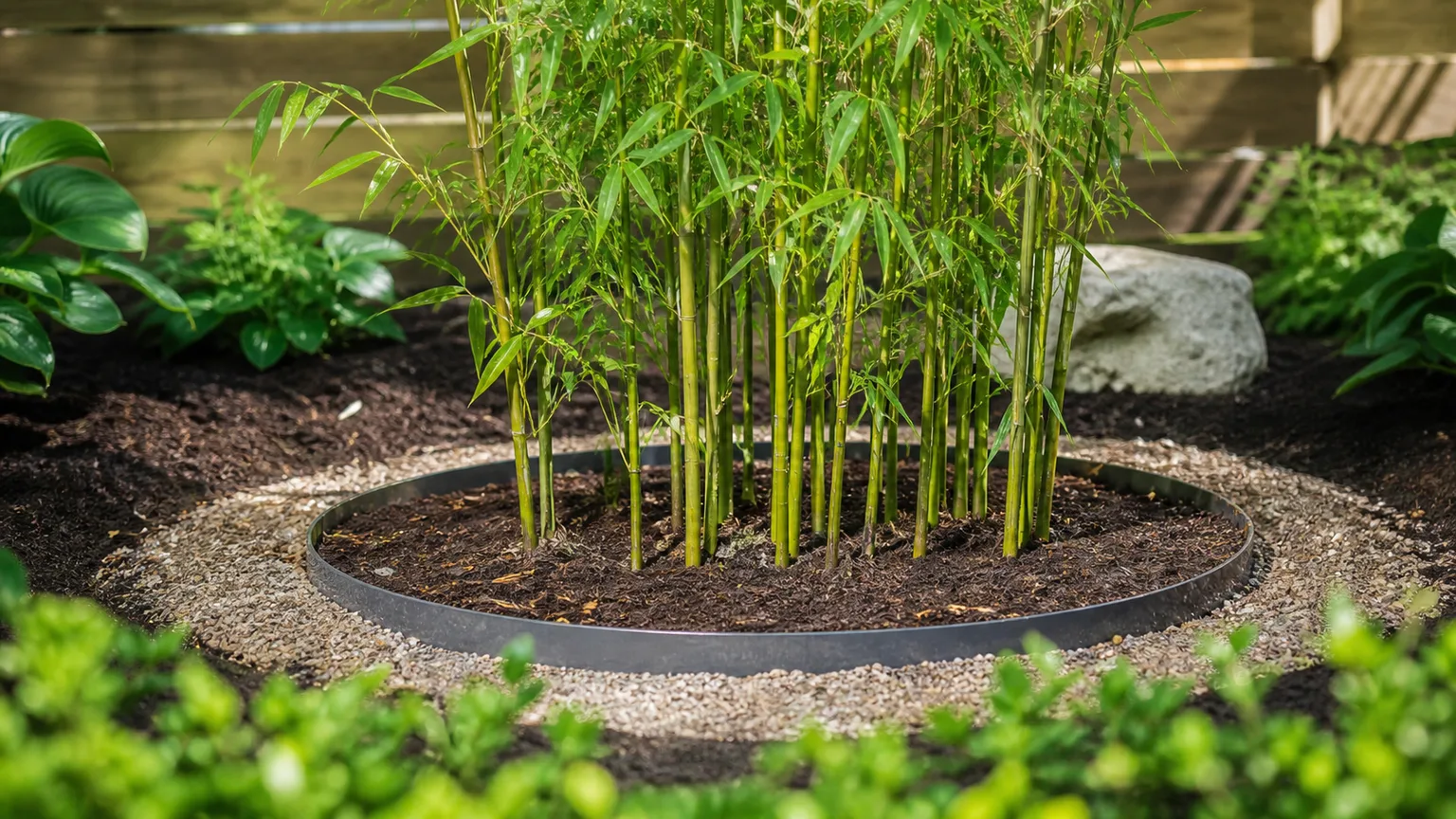
If an unwanted shoot appears beyond a clump, trace it to the rhizome and remove the connected section when practical rather than mowing indefinitely without checking its source. If the planting has spread into neighboring land, a forest edge, or a structure, do not rototill it or assume one digging session will remove every viable rhizome. Contact your local extension office, land manager, or qualified bamboo-removal professional for a site-specific control plan.
Conclusion
Common bamboo can be a striking, useful plant when the climate is warm and the garden has room for a potentially enormous clump. Give it moist but well-drained soil, sun or light shade, steady water while it establishes, and selective pruning to keep the canes accessible. Plan its full footprint before planting, because pruning the stems does not make the root system or mature clump small.
Treat “clumping” as a useful description of growth habit, not a guarantee of no spread or universal permission to plant. Confirm your cultivar, check regional rules, and choose a different bamboo if the site is too cold, too narrow, or too close to property you cannot inspect. If the site works, division is the most reliable way to propagate it and regular perimeter checks keep small maintenance tasks from becoming a removal project.



