5 Summer Garden Pests and How to Protect Your Plants
Learn what five common summer garden pests look like, when to act, and how to use water, row covers, beneficial insects, and targeted treatments wisely.
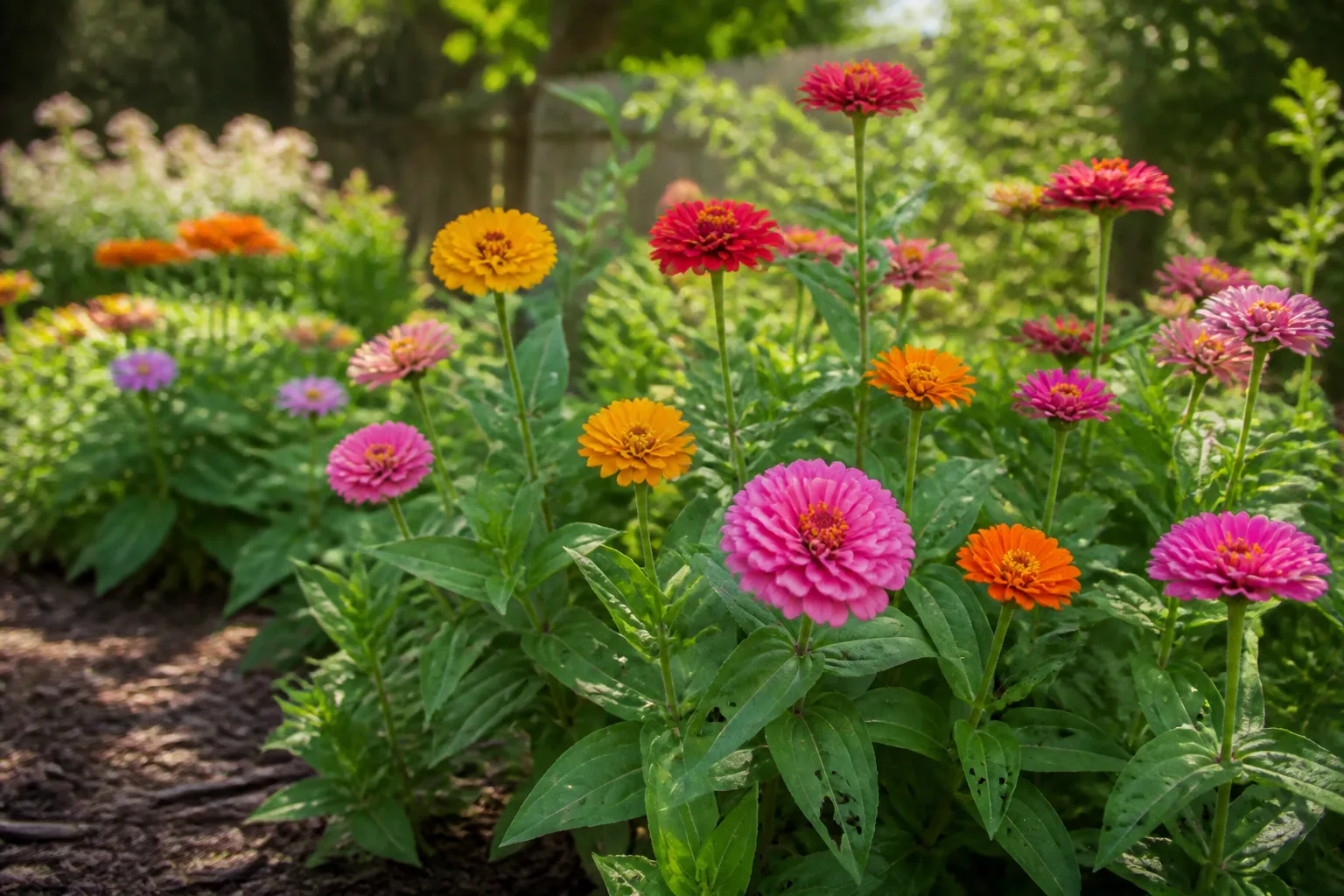
The fastest way to lose a summer garden is to treat every chewed leaf as a reason to spray. Aphids, whiteflies, spider mites, caterpillars, and Japanese beetles do not damage plants in the same way, and a control that makes sense for one can waste time—or make another problem worse.
The better sequence is monitor, identify, assess, intervene, and evaluate. That is the core of integrated pest management (IPM), an approach that aims to keep pests below an unacceptable damage level rather than sterilize the yard. NC State Extension’s IPM handbook emphasizes that healthy plants, early detection, natural enemies, mechanical controls, and carefully selected pesticides all have a place.
Use this guide as a field check, not a promise that any pest can be permanently eliminated. Weather, plant species, region, and whether you are protecting a seedling, a food crop, a rose, or a mature shrub all change the right decision.
Start With the Damage Pattern, Not the Spray
Before you buy a treatment, take a close look at the plant and the surrounding soil. The first clue is often the pattern of injury rather than the insect itself: sticky honeydew points toward sap-feeders, fine pale stippling suggests mites, ragged holes suggest chewing larvae, and leaves reduced to veins suggest beetles.
| What you see | Most likely match | First move | Do not assume |
|---|---|---|---|
| Clusters on new growth, curled leaves, sticky residue | Aphids | Rinse sturdy plants; check for ants and beneficial larvae | Every aphid colony needs insecticide |
| Adults fly up when foliage is disturbed; pale or sticky leaves | Whiteflies | Inspect leaf undersides; use yellow cards to monitor | A yellow card alone will clear a heavy infestation |
| Fine stippling, bronzing, or silk webbing | Spider mites | Confirm with a hand lens or white-paper test; rinse undersides | Drought damage and mite damage are mutually exclusive |
| Ragged holes, missing leaves, or dark frass | Caterpillars | Find the larva and look for parasitoid cocoons | Every caterpillar is a crop pest |
| Metallic green-and-copper adults; skeletonized leaves | Japanese beetles | Hand-pick in cool conditions; protect high-value plants | Treating lawn grubs will stop adult beetles immediately |
A 10-Minute Scouting Check
Walk the garden with a hand lens, a notebook or phone camera, and a white sheet of paper. Check the newest growth first, then turn over several leaves on each side of the plant; aphids, whitefly nymphs, spider mites, and eggs are easy to miss from above. WVU Extension’s seasonal pest calendar also recommends watching crops and ornamentals as warm-weather pests become active, rather than waiting until damage is severe.
Record the plant, location, date, weather, and what you actually found. Note whether the damage is increasing, whether the plant is still producing healthy new growth, and whether natural enemies are present. A photograph of the insect on the plant is more useful than a photograph of a damaged leaf alone when you need an extension office or nursery professional to confirm the diagnosis.
Look for the small details that change the decision: sticky honeydew below a colony, black sooty mold, whiteflies that scatter when touched, moving specks on paper, green frass under a leaf, silk tents, white parasitoid cocoons on a hornworm, or C-shaped grubs in turf soil. If you cannot find the suspected pest, check irrigation, fertilizer, sun exposure, herbicide drift, disease symptoms, and physical damage before escalating.
When Damage Crosses Your Action Threshold
An action threshold is the point where the damage, not merely the insect count, justifies intervention. A few aphids on a mature shrub may be acceptable while a small colony on a squash seedling can matter because young plants have less foliage and some aphids can transmit viruses before a spray can catch up.
Act sooner when a seedling is being stunted, new growth is repeatedly distorted, a vegetable crop is losing marketable foliage or fruit, a plant is being defoliated faster than it can replace leaves, or the pest is moving through a high-value planting. If a healthy established plant is growing normally and natural enemies are already reducing the pest, monitoring may be the most responsible choice.
This distinction protects your garden twice. It prevents needless pesticide exposure and preserves the predators and parasitoids that can stop a population after the first flush of pests. It also keeps you from waiting too long when an insect’s life cycle or a plant’s growth stage makes later control much harder.
1. Aphids: Clusters on Tender Growth and Sticky Leaves
Aphids are small, soft-bodied, pear-shaped insects that gather on new stems, leaf undersides, flower buds, and other tender growth. They may be green, yellow, black, brown, red, or covered in a waxy coating, so color alone is not a reliable identification. A colony often includes wingless adults and smaller nymphs, and crowded colonies can produce winged forms that move to fresh plants.
Identify Aphids and Work From Water to Targeted Treatment
Aphid feeding can curl or distort new leaves, stunt shoots, and leave honeydew on foliage below the colony. Sooty mold may grow on that sticky residue, and ants may climb the plant to collect honeydew and protect the aphids from predators. Light to moderate feeding usually does not kill an established plant, but a heavy colony on seedlings, young shoots, or susceptible vegetables deserves closer attention. UC IPM’s aphid guidance notes that many plants tolerate low numbers and that aphid populations can also fall when natural enemies arrive or hot weather limits them.
Start with a firm stream of water on a sturdy plant, directing it at the undersides and tender tips early in the day so the foliage dries quickly. Many dislodged aphids do not find their way back, and the spray also removes honeydew. Prune a heavily infested shoot when the colony is localized, bag the debris, and check nearby plants rather than moving the cut stem through the garden.
Then inspect for lady beetle larvae, lacewing larvae, syrphid larvae, and brown, swollen “mummified” aphids that have been parasitized. Do not mistake a spiny lady beetle larva for another pest. If ants are shepherding aphids up a shrub or tree, reduce the ant route with appropriate ground bait or a physical trunk barrier used according to its label; managing ants can give natural enemies a chance to work.
If water and pruning are not enough, choose a product labeled for aphids and the specific plant. Insecticidal soaps and horticultural oils work by contact, so thorough coverage of the colony and leaf undersides matters, and repeat applications may be necessary. UC IPM cautions against applying soaps or oils to drought-stressed plants or when temperatures exceed 90°F, and recommends testing a small area first because some plants are sensitive.
Avoid homemade sprays made with dish detergent, degreasers, or fragrance additives. A product labeled as insecticidal soap has a formulation and directions intended for plant use; “soap” in a kitchen cabinet is not automatically interchangeable. Excess nitrogen can also produce a flush of soft growth that aphids favor, so correct the fertility problem rather than trying to spray your way through it.
2. Whiteflies: A Cloud of Adults and Pale Leaves
Whiteflies are tiny sap-feeders that often infest tomatoes, peppers, cucumbers, ornamentals, and greenhouse-style plantings during warm weather. Adults are easy to notice because a cloud may rise when you touch a leaf. The nymphs stay attached to the underside of leaves, where they feed, excrete honeydew, and can cause yellowing or leaf drop.
Use Underside Checks and Traps Before You Spray
Turn over the lowest leaves and look for pale, oval, immobile nymphs as well as adults. Low numbers of adults are not always damaging; the nymphs are generally the stage that causes the visible feeding injury. Sticky leaves, black sooty mold, and ants can occur with whiteflies just as they do with aphids, so the flying adults and the immobile underside nymphs help separate the two.
Place yellow sticky cards level with the infested foliage to measure whether adults are increasing. Cards are mainly a monitoring aid and can catch some adults, but they will not reach nymphs already attached to leaves. UC IPM explains that yellow traps are most useful for detection and that whiteflies may require multiple cards because they do not travel far. Keep sticky surfaces away from flowers when possible because non-target insects can also be caught.
For an early, localized problem, remove the worst leaves and seal them in the trash rather than composting a mass of active insects. Rinse plants with water, concentrating on leaf undersides, then reassess after several days. Improve airflow and reduce dusty conditions around the planting; outbreaks are more likely when natural enemies are disrupted, plants are stressed, or broad-spectrum insecticides have removed predators.
When treatment is justified, insecticidal soap or horticultural oil may reduce whiteflies, but only the insects the spray contacts are controlled. Coverage is the difficult part: reach the undersides without stripping or breaking foliage, do not spray drought-stressed plants or in temperatures above 90°F, and follow the product label for timing and repeat applications. Do not expect one coating of a leaf to control the next generation of adults emerging from eggs or nymphs.
3. Spider Mites: Stippling and Webbing in Hot, Dry Weather
Spider mites are arachnids, not insects, and they can multiply quickly in hot, dry, dusty conditions. The early sign is usually fine pale stippling, as if someone peppered the leaf with pinpricks. As feeding continues, leaves may bronze, yellow, or drop, and fine webbing can spread from the underside of leaves to stems and fruit.
Confirm Mites, Then Cool and Rinse the Plant
Do not diagnose spider mites from yellow leaves alone. Hold a white sheet of paper under a suspect leaf, tap the leaf, and watch for tiny moving specks; use a 10X hand lens to inspect the underside for mites, eggs, and silk. UC IPM’s spider-mite guide points out that mites may be gone by the time damage is noticed, in which case the plant may recover once new feeding stops.
If mites are present, correct water stress without keeping the soil constantly wet. Rinse the plant forcefully, especially the undersides of leaves, and repeat the water spray as needed; also reduce dust on nearby paths and foliage. Watering a drought-stressed plant can improve its ability to withstand feeding, but it does not replace confirmation or guarantee that the mites are gone.
Avoid broad-spectrum insecticides whenever possible. Some products kill predatory mites and other natural enemies more readily than they control spider mites, allowing a worse outbreak a few days later. Preserve predatory mites, lacewings, minute pirate bugs, and other beneficials when you see them.
If rinsing is not enough, use a labeled insecticidal soap or horticultural oil only after confirming mites. These products need excellent contact coverage and may require repeat applications. Do not spray a wilted plant, spray in extreme heat, or skip a small-area test; UC IPM recommends keeping soaps and oils off water-stressed plants and avoiding applications above 90°F.
4. Caterpillars: Ragged Holes, Frass, and a Judgment Call
Caterpillars are the larval stages of moths and butterflies, which makes this the pest category where identification and tolerance matter most. A few holes in a mature plant may be the cost of hosting a swallowtail or another desirable species. Ragged holes, stripped shoots, missing leaves, and dark green frass under foliage point to active feeding, but the plant’s growth stage still determines whether the damage is serious.
Protect Crops Without Killing Every Butterfly Larva
Look closely at the larva before removing it. Note its color, stripes, hairs, horn, behavior, and host plant, then check for small white cocoons or eggs on its body. A hornworm carrying parasitoid cocoons is already helping produce the next generation of natural enemies; remove it only if the damage is crossing your threshold, and consider moving a parasitized larva away from a high-value plant rather than destroying it.
On a small planting, hand-pick caterpillars into soapy water or use a small hand vacuum on sturdy foliage. Check at dusk or early morning when many larvae are easier to find. The practical advice from Better Homes & Gardens’ garden pest guide is useful here: hand removal and naturally occurring parasitoids can be enough unless the plants are being heavily consumed.
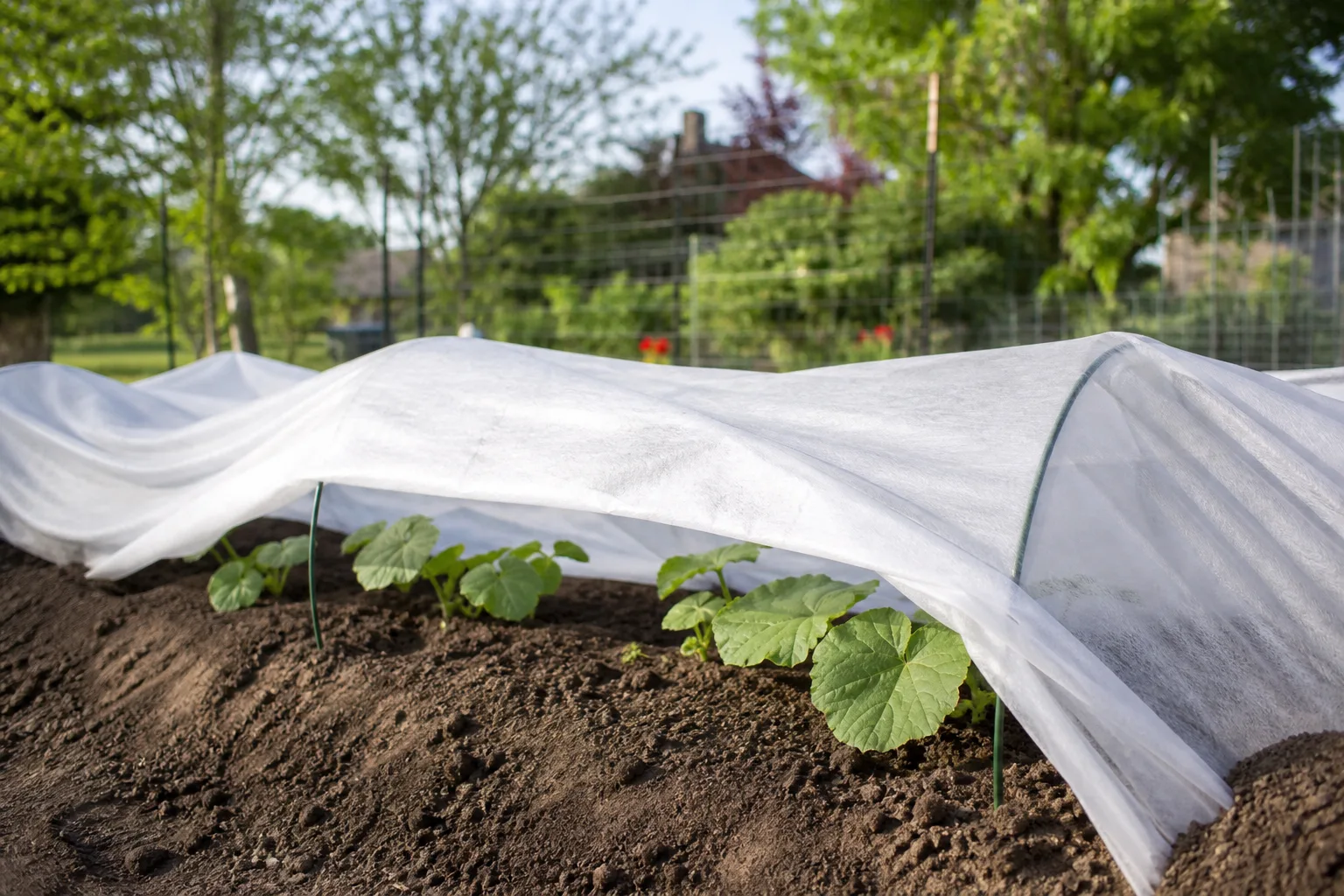
For young vegetable plants, use a floating row cover or insect netting before adult moths can lay eggs. Anchor the edges so moths cannot crawl underneath, and remove the cover when the crop flowers if pollinators need access. Row covers are a preventive barrier; they cannot undo eggs or larvae already trapped inside, so inspect plants before covering them.
If a confirmed caterpillar infestation is above your threshold, a product containing Bacillus thuringiensis var. kurstaki (Btk) can be a more targeted option than a broad-spectrum insecticide. The larvae must eat treated foliage, young caterpillars are generally the best target, and the product must be labeled for the crop and pest. Btk does not control aphids, whiteflies, spider mites, or adult beetles, and it is not a reason to spray every caterpillar in a pollinator garden.
5. Japanese Beetles: Skeletonized Leaves Above, Grubs Below
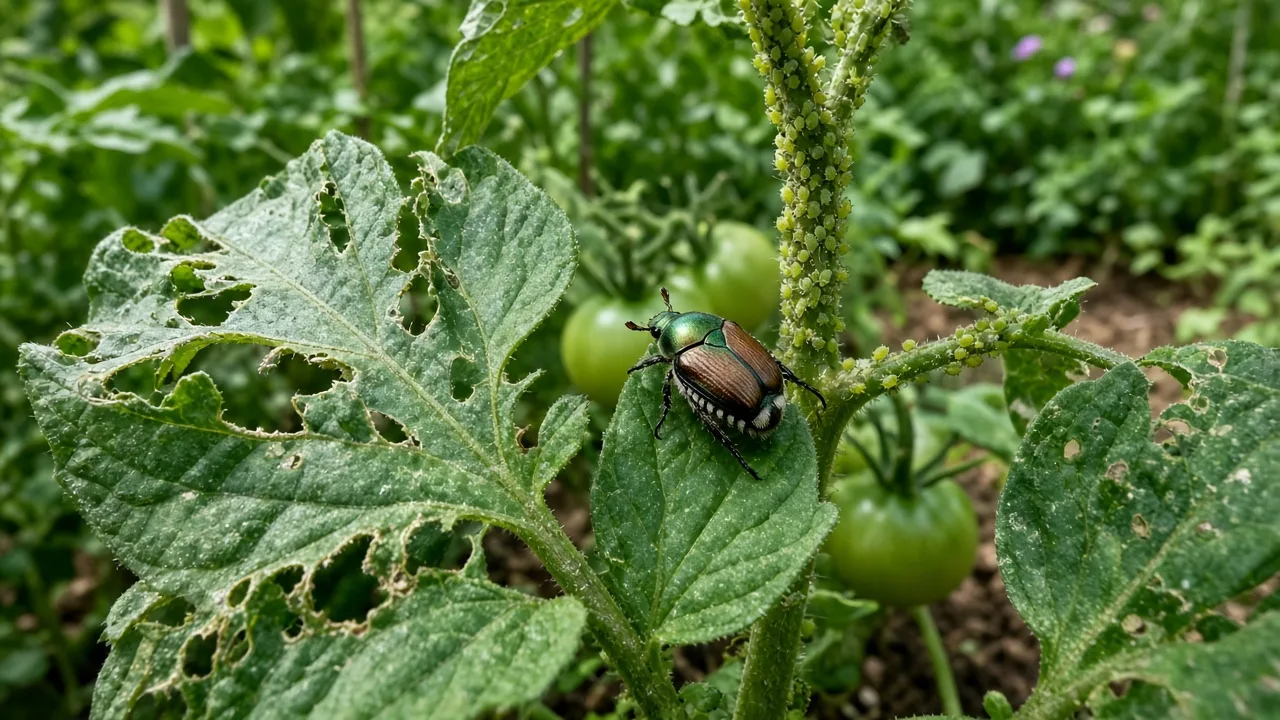
Japanese beetles are metallic green beetles with copper-colored wing covers. Adults chew leaves, flowers, and fruit, often leaving a lace-like skeleton of veins. They are especially conspicuous on roses, grapes, hibiscus, and other favored plants, but the exact host list and pressure vary by region.
Separate Adult Control From Grub Control
The adult and grub stages live in different places and require different decisions. Adults feed above ground and can fly in from surrounding yards. Females lay eggs in soil, and the C-shaped grubs feed on grass roots below ground. Penn State Extension describes adult emergence in mid-June to early July in Pennsylvania, but local weather and latitude shift that window.
When adults first appear, hand-pick them in the cool morning or evening and drop them into a container of soapy water. Cool temperatures make them less likely to fly, and removing adults before they feed and mate can reduce damage on a small planting. Shake a branch over a bucket rather than crushing beetles on flowers, where the movement may disturb pollinators.
Japanese beetle traps deserve special caution. Their floral scent and sex pheromone can attract beetles from outside the yard, and the trap may not capture every beetle it draws in. Penn State Extension reports that the traps were developed for monitoring and are not recommended as a control method because the plants can end up feeding the beetles the trap attracts.
Treating grubs will not provide instant protection from adult beetles already flying into the garden. Before using a lawn product, confirm that grubs are actually present, check whether the product and timing are labeled for that site, and consider whether the lawn damage justifies treatment. The same source notes that adult sprays do not provide ongoing protection, and systemic products can create pollinator concerns; never apply a product to flowering plants unless the label explicitly permits it and the application can be made safely.
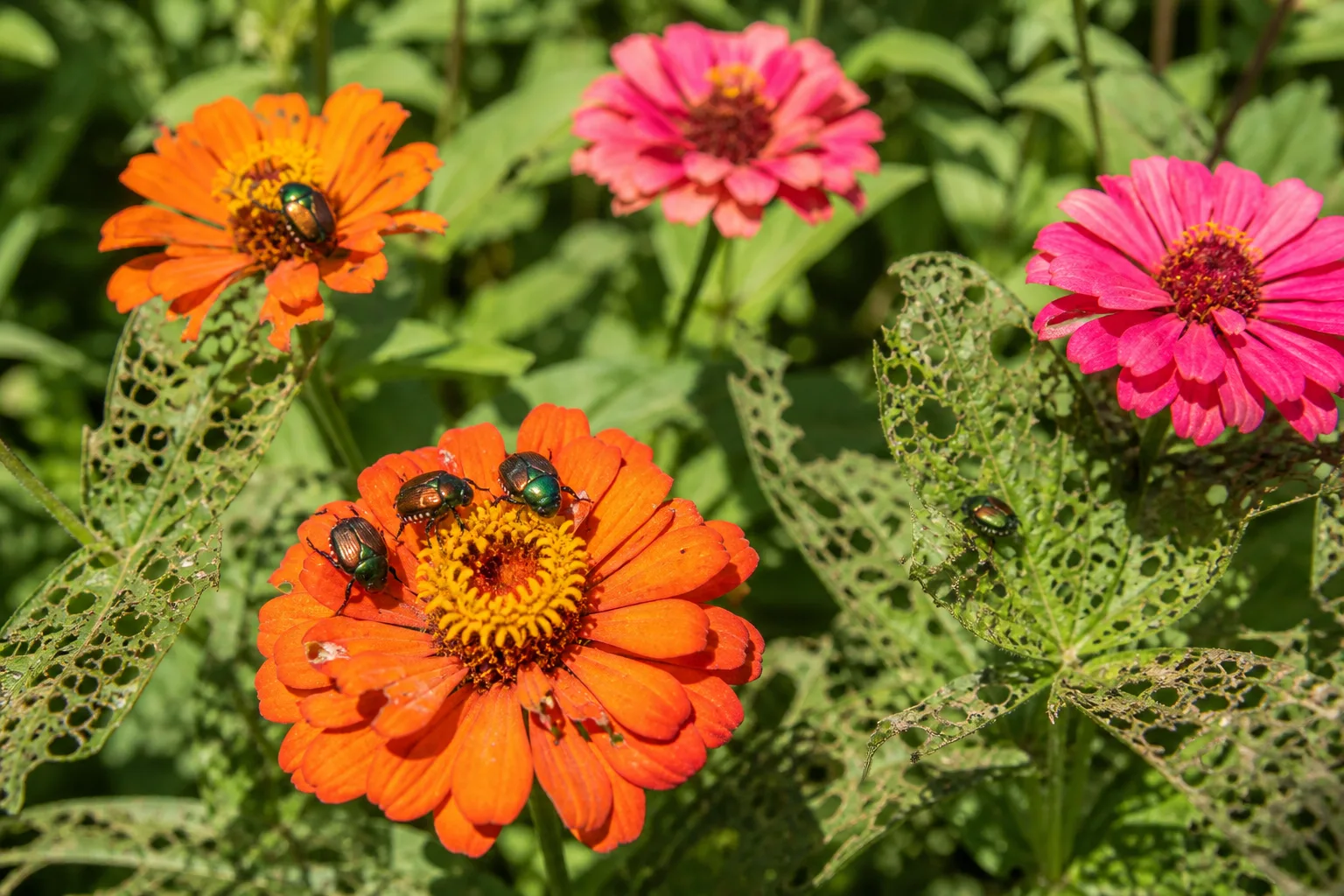
For repeat outbreaks, replace a few plants that are consistently destroyed with less-preferred choices rather than fighting the same planting every summer. This is not a guarantee of beetle-free gardening, but it can lower the workload and preserve flowers that would otherwise become a recurring food source.
Protect the Whole Yard With an IPM Routine
Pest control works better when the garden is not continually recreating the conditions that favor an outbreak. Rutgers Cooperative Extension’s IPM overview frames the homeowner’s goal as reducing pesticide use, improving garden resilience, and understanding the ecology of the landscape. That is a more durable target than killing every visible insect.
Reduce Plant Stress and Avoid Feeding an Outbreak
Water deeply enough to support the root zone, then let the surface and plant needs guide the next irrigation. Avoid swinging from severe drought to saturated soil, and do not use overhead watering as a substitute for checking whether the roots are actually dry. Adequate water helps plants withstand feeding, while dusty and drought-stressed conditions favor spider mites.
Apply fertilizer from a soil test or a clear crop need, not from a calendar habit. Excess nitrogen can push soft, lush growth that is especially attractive to aphids and can make a plant look “greener” while becoming more vulnerable. Keep mulch a few inches away from stems and trunks, remove diseased or heavily infested debris when it is a source of reinfestation, and keep weeds from forming a continuous bridge into the crop.
Choose plants suited to the site, spacing, and climate. A sun-loving plant struggling in shade or a drought-sensitive plant placed beside a hot wall will be harder to protect than a plant that is growing vigorously. Healthy does not mean invulnerable, but it gives the plant more foliage, reserves, and recovery time.
Use Barriers, Rotation, and Clean Starts
Floating row covers and insect netting are often more dependable than a repellent spray when the target pest is flying and the crop is young. Epic Gardening’s summer pest guidance emphasizes using row fabric early, then lifting it when flowering plants need pollinator access. Inspect seedlings before covering them so you do not create a protected nursery for pests already inside.
Rotate related vegetable families when you have enough space, especially when a pest spends part of its life in soil or crop residue. Spread similar host plants through a mixed bed when practical instead of creating one large, easy-to-find block. Rotation and interplanting will not stop a mobile generalist such as an aphid or spider mite, but they can slow specialist pests and make monitoring more manageable.
Inspect nursery plants above and below the leaves, around stems, and at the soil line before adding them to the garden. A single infested transplant can introduce whiteflies, aphids, or eggs when the rest of the bed is clean. Quarantine questionable plants until you can inspect them again rather than placing them directly beside a prized rose or a row of seedlings.
Preserve Beneficials and Make Treatments Earn Their Place
Beneficial insects are not a decorative extra; they are part of the control system. Lady beetle larvae and lacewing larvae feed on aphids, tiny parasitoid wasps attack caterpillars and aphids, and predatory mites can limit spider mites. Provide nectar and pollen, keep some non-damaging prey available, and resist the urge to clear every insect from the yard.
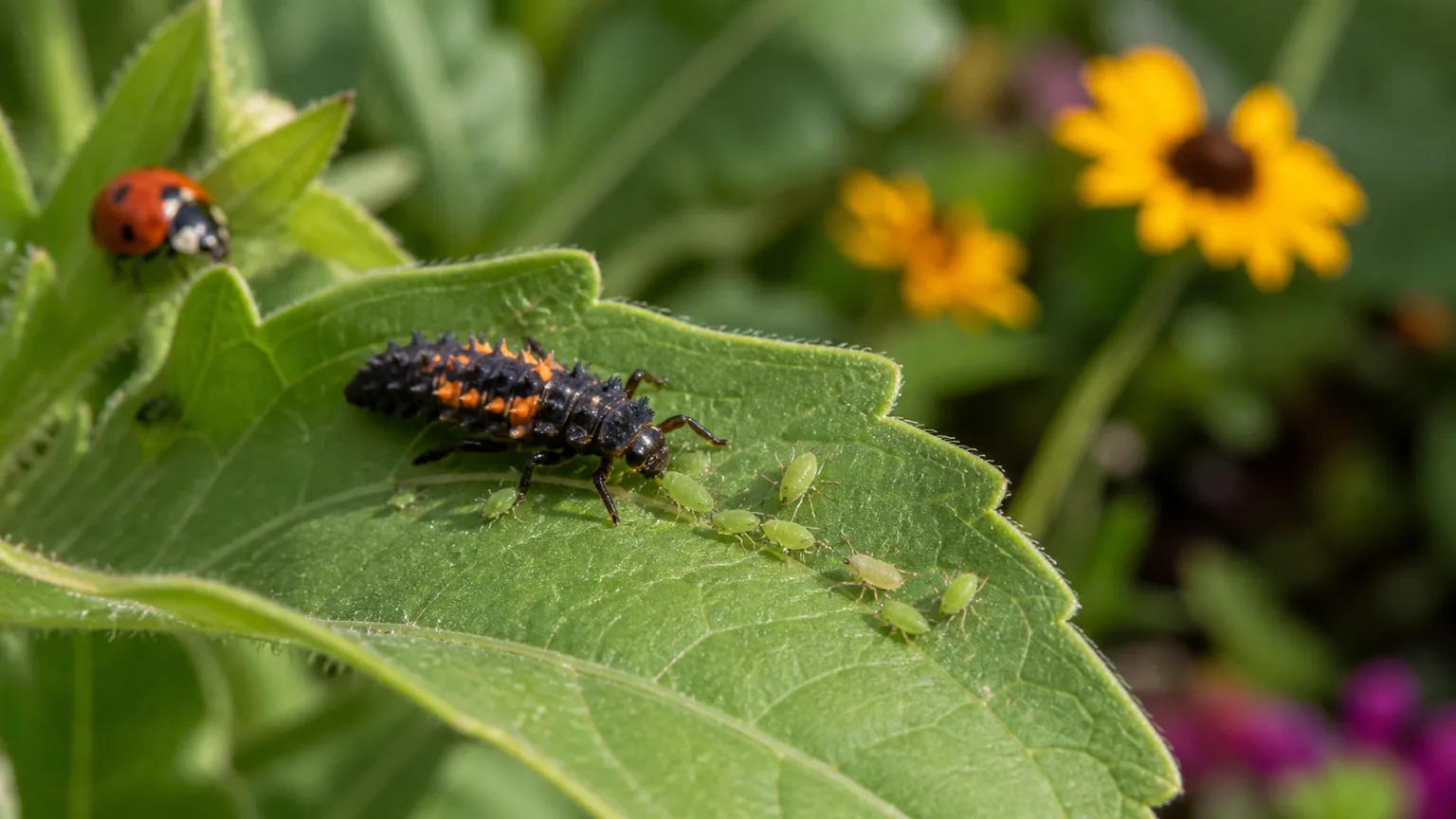
Do not assume purchased lady beetles will stay and solve an aphid problem. They may disperse quickly, and a garden without food, water, or shelter will not hold them. Conservation—fewer disruptive sprays, more plant diversity, and some tolerance for minor feeding—is usually a more realistic long-term strategy than releasing a bag of insects after the outbreak is already severe.
If a treatment still earns its place, identify the pest and read the entire label before opening the container. NC State Extension’s IPM guidance explains that the product must be labeled for the pest and the specific plant, and that users are legally required to follow label directions for amount and timing. The label also controls protective equipment, harvest intervals, re-entry, pollinator precautions, storage, and disposal.
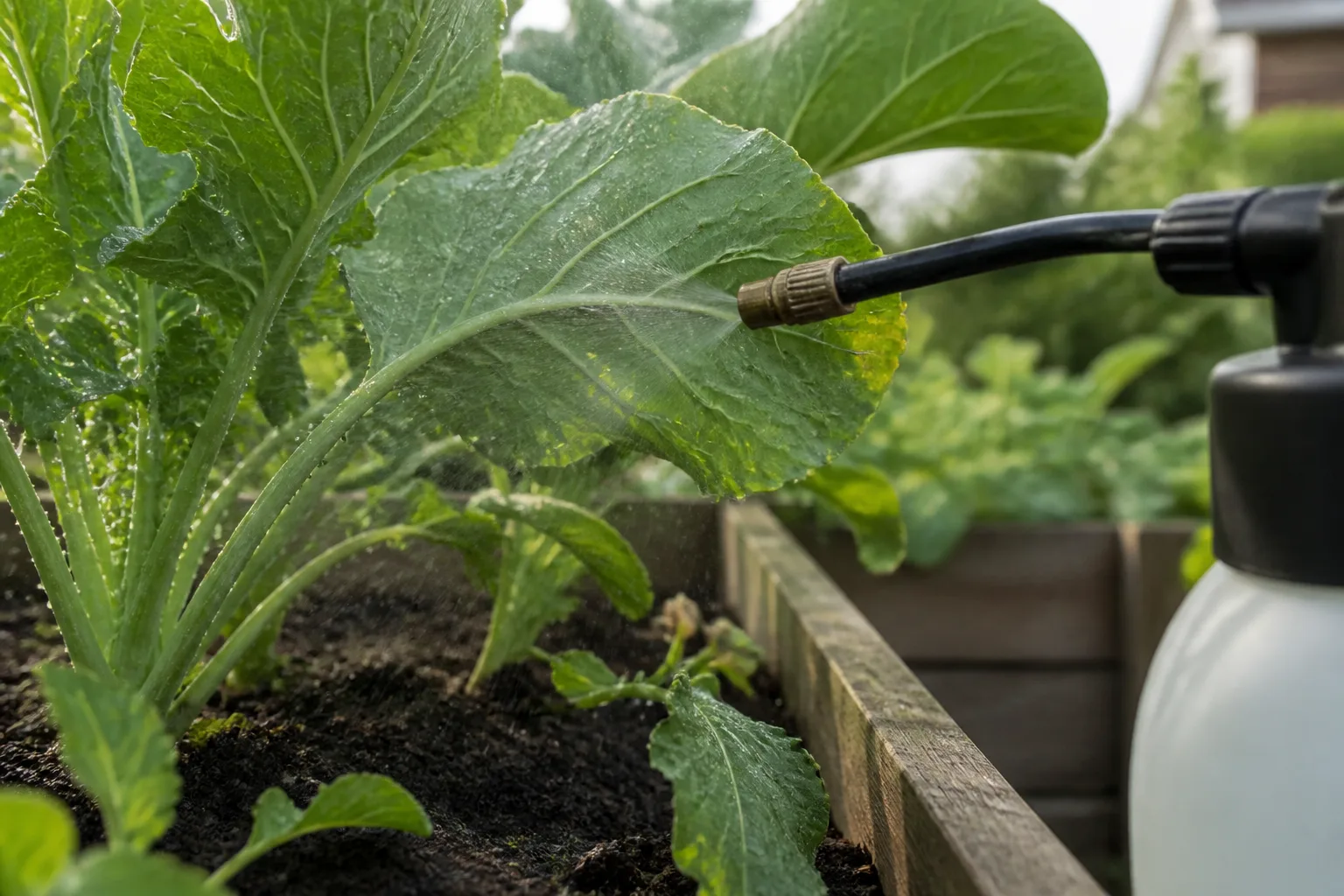
For soaps and oils, contact coverage is the point, so spraying the top of a leaf while missing the underside often produces a disappointing result. Do not apply to wilted plants, in extreme heat, or during conditions the label excludes. Avoid broad-spectrum products when a targeted option, a barrier, hand removal, or a water spray can meet the same goal with less collateral damage.
Your Weekly Summer Pest-Response Plan
Make one slow circuit of the yard every week, increasing to twice-weekly checks during rapid growth, a stretch of heat and drought, or an active outbreak. Spend extra time on new growth, leaf undersides, plants recently brought home, and crops that had pest pressure last season. Consistent observation turns “overnight” damage into a problem you can catch while the first response is still small.
Use this sequence when you find a suspect pest:
- Photograph and identify. Capture the pest, the damage, and the whole plant. Use a hand lens, white-paper test, or local extension diagnostic service if needed.
- Assess the plant. Decide whether the plant is stressed, still producing healthy growth, or approaching an unacceptable health, harvest, or aesthetic threshold.
- Choose the narrowest first move. Rinse aphids or mites, remove a few caterpillars, hand-pick Japanese beetles, remove a heavily infested leaf, or install a row cover before choosing a spray.
- Protect the helpers. Leave beneficial insects when damage is tolerable, avoid spraying flowers, and do not use a broad-spectrum product for a pest you have not confirmed.
- Recheck the trend. Look again in a few days for sap-feeders, more stippling, fresh frass, new holes, or additional beetles. A treatment that does not reduce damage after the label’s interval needs evaluation, not automatic repetition.
Keep a short record of weather, plant stage, pest stage, control used, and result. If the pest returns at the same time each year, that record can tell you when to cover seedlings, inspect nursery plants, adjust irrigation, or choose a less-susceptible cultivar. If you find severe defoliation in a tree, a pest you cannot identify, repeated failure after a properly labeled treatment, or a situation that requires reaching unsafe heights, contact a local Cooperative Extension office or licensed professional.
Conclusion: Identify First, Intervene Precisely
The safest way to protect a summer garden is not to eliminate every bug. It is to recognize the difference between aphid clusters, whitefly nymphs, spider-mite stippling, caterpillar chewing, and Japanese beetle skeletonizing, then match the response to the pest’s life stage and the plant’s ability to recover.
Start with scouting, water, hand removal, pruning, barriers, healthy growing conditions, and beneficial insects. Use soaps, oils, Btk, or other pesticides only when the damage justifies them and the product label fits the exact pest, plant, site, and weather. A weekly record and a calm follow-up check will protect more plants—and more of the useful life in your yard—than a stronger spray applied on guesswork.