Corms, Bulbs, Tubers, and Rhizomes Compared
Compare bulbs, corms, tubers, and rhizomes by anatomy, buds, examples, and planting. Learn why a dahlia “tuber” is a tuberous root.

A crocus corm, a tulip bulb, a potato, and a piece of ginger can all sit underground and help a plant return after a dormant period. Gardeners often call all of them “bulbs,” but their internal structures differ—and that difference tells you where buds form, how each plant multiplies, and whether you can divide the storage organ.
The quickest test is to look for what tissue stores food and where new growth buds sit. A true bulb is built from fleshy leaf scales around a compact basal plate; a corm is a solid, swollen stem; a stem tuber has buds or eyes across its surface; and a rhizome is a stem that grows horizontally. The familiar dahlia “tuber” needs one extra distinction: it is a tuberous root, so a piece of root without part of the crown and a viable bud will not grow.
The Fastest Way to Tell Them Apart
If you have a loose underground plant part in hand, look for its shape and growth points before cutting or planting it. A layered cross-section points to a true bulb, a firm solid interior points to a corm, scattered eyes suggest a stem tuber, and a lengthwise stem with nodes suggests a rhizome.
| Structure | What stores most of the food? | Easy clue | Familiar example |
|---|---|---|---|
| True bulb | Modified fleshy leaves attached to a short stem | Scales or layers surrounding a basal plate | Onion, tulip, daffodil |
| Corm | A compact, swollen stem | Solid interior, usually upright with a growing point at the top | Crocus, gladiolus |
| Stem tuber | Enlarged stem tissue | Buds, or “eyes,” can occur across the surface | Potato |
| Tuberous root | Enlarged root tissue | No nodes; shoots come from the crown end | Dahlia, sweet potato |
| Rhizome | Horizontal stem | Elongated, with nodes and buds along its length | Ginger, canna, iris |
The table gives you a first pass, not permission to ignore the plant’s name or instructions. Some structures look alike, and garden catalogs use “bulb” or “tuber” more loosely than botanists do. Use visible anatomy to understand what you have, then use species-specific guidance to set depth, timing, and storage conditions.
What These Underground Storage Organs Have in Common
A geophyte is a perennial plant that survives an unfavorable season with a specialized underground or ground-level storage organ. These structures hold resources that support shoots and roots when conditions allow growth again; they can also house buds that help the plant reproduce vegetatively. “Geophyte” is the broad ecological term, while bulb, corm, tuber, and rhizome describe different anatomical forms.
That shared job can make the categories seem interchangeable. They are not: a swollen root has no stem nodes, a rhizome has distinct nodes and internodes, and a true bulb stores much of its reserve in leaf tissue. The University of Florida IFAS Extension’s guide to bulbs and other bulb-like plants separates true bulbs, corms, stem tubers, rhizomes, and tuberous roots by those structural traits.
A useful gardening consequence follows: the storage organ’s name alone does not tell you whether it will tolerate frost or how deep it belongs. Hardiness, flowering season, soil moisture, and planting depth depend on the species and local conditions. Anatomy helps with identification and propagation, but it is only the first part of the care decision.
A True Bulb Is Built From Modified Leaves
Cut an onion vertically and the rings you see are fleshy, modified leaves called scales. In a true bulb, those scales attach to a very short stem at the base, the basal plate. Roots grow from the underside of that plate, while the shoot emerges from a bud at the top.
This is why a bulb has an orientation: the basal plate belongs down, and the growing tip generally points up. The scales wrap around a developing shoot and provide stored food. A papery tunic, when present, protects the outside from drying, but not every true bulb has one. Onions, garlic, daffodils, and many tulips are tunicate bulbs; lilies have overlapping, fleshy scales without the same dry papery coat.
The scales are the giveaway, not the silhouette. A rounded corm may look bulb-like from the outside, but slicing it reveals solid stem tissue rather than onion-like layers. Conversely, a lily bulb can look loose and scaly rather than like a smooth onion, yet it is still a true bulb because its storage tissue is modified leaves.
Bulbs often make daughter bulbs or offsets near the basal plate. Those offsets can be separated when they have formed enough to handle, usually while the plant is dormant or after its foliage has died back. Do not pull apart a bulb that is still actively growing just to confirm its type; the leaves are refilling the storage scales for the next cycle.
A Corm Is Solid, Swollen Stem Tissue
A corm is a short, upright underground stem that has swollen to store food. Unlike a true bulb, it is solid inside rather than composed of layers. It commonly has a protective tunic, a basal region that produces roots, and a growing point toward the top; the stem tissue itself is the main storage tissue.
Crocus, freesia, and gladiolus are familiar corm growers. Their flowers may make the plant look like a “spring bulb” or summer bulb in everyday language, but that seasonal grouping does not change the anatomy. Penn State Extension includes crocus, freesia, and gladiolus as examples of corm plants and notes that cormels can develop into new plants.
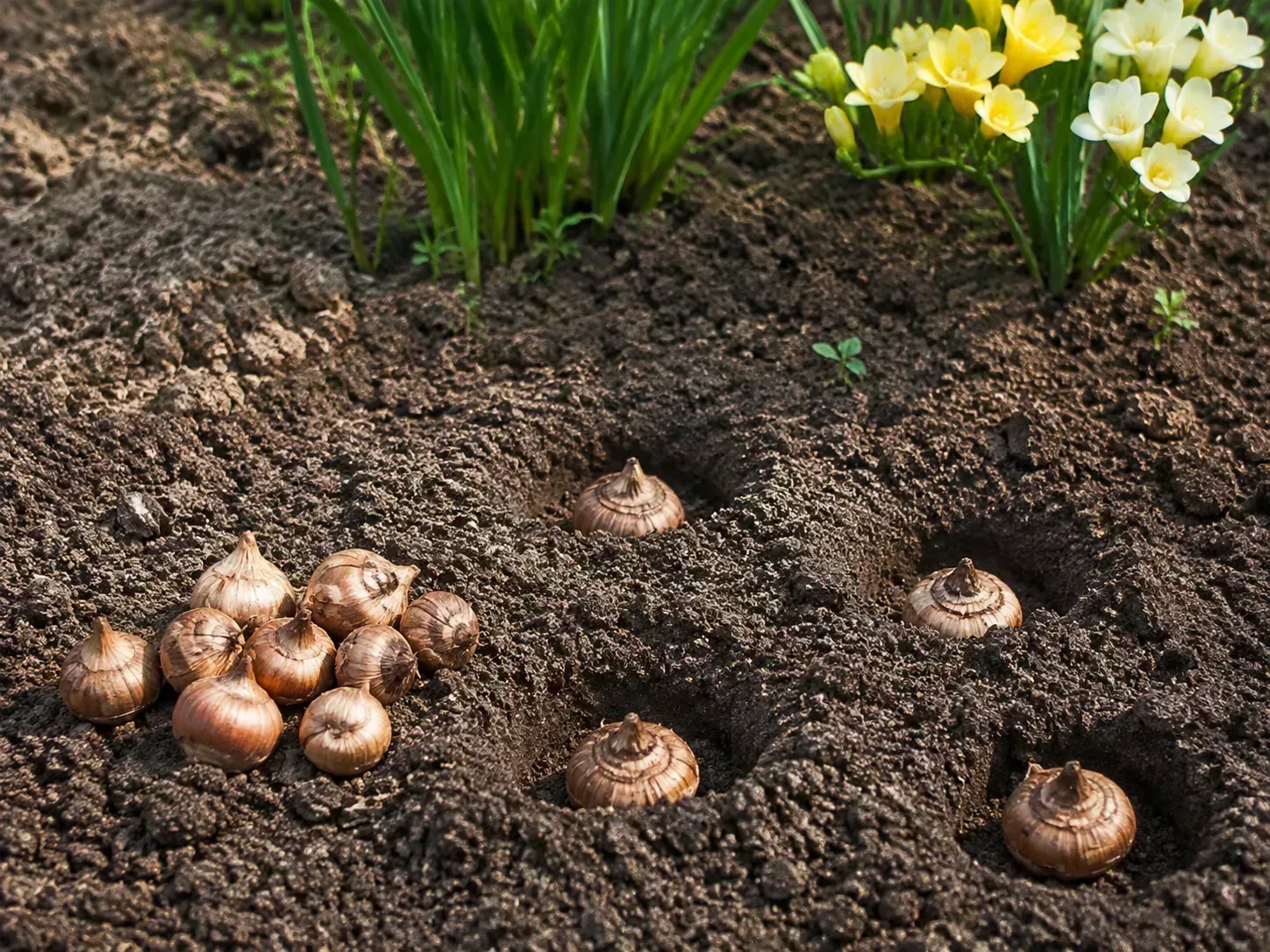
Many corms renew themselves rather than simply growing larger year after year. The old corm supplies the shoot, then a new corm forms as the plant grows; tiny cormels may develop alongside it. This renewal pattern explains why dividing a corm into arbitrary slices is unreliable: a slice may lack a functioning bud or the organized base that roots and shoots depend on. Gardener’s Path’s overview of bulb types also describes the replacement corm and cormels, while illustrating that storage and cold-hardiness needs vary across these plant groups.
When you lift a corm-bearing plant, wait until the foliage has yellowed or died back unless the species’ instructions say otherwise. The leaves are still feeding the replacement corm while they remain green. Separate healthy cormels from the parent when they are large enough to handle, and keep the new pieces labeled because young cormels may need more than one season to reach flowering size.
Tubers: Separate Stem Tubers From Tuberous Roots
In gardening, “tuber” is often used for any plump underground storage piece. Botanically, however, a stem tuber and a tuberous root are different organs. Both store food, but their buds and attachment points behave differently, so the difference matters most when you want to divide or propagate them.
Potato is a stem tuber
A potato is an enlarged underground stem. Its “eyes” are buds associated with nodes, not decorative dimples; shoots can grow from these buds, which is why a seed-potato piece needs at least one viable eye to produce a plant. The eyes are spread across the tuber rather than restricted to one crown.
Stem tubers are not all edible potatoes, and not all garden plants commonly called “tubers” share the potato’s anatomy. The University of Florida IFAS Extension describes a stem tuber as lacking the basal plate characteristic of a corm and identifies potato among its examples. That is a more reliable clue than judging by whether the organ is round or lumpy.
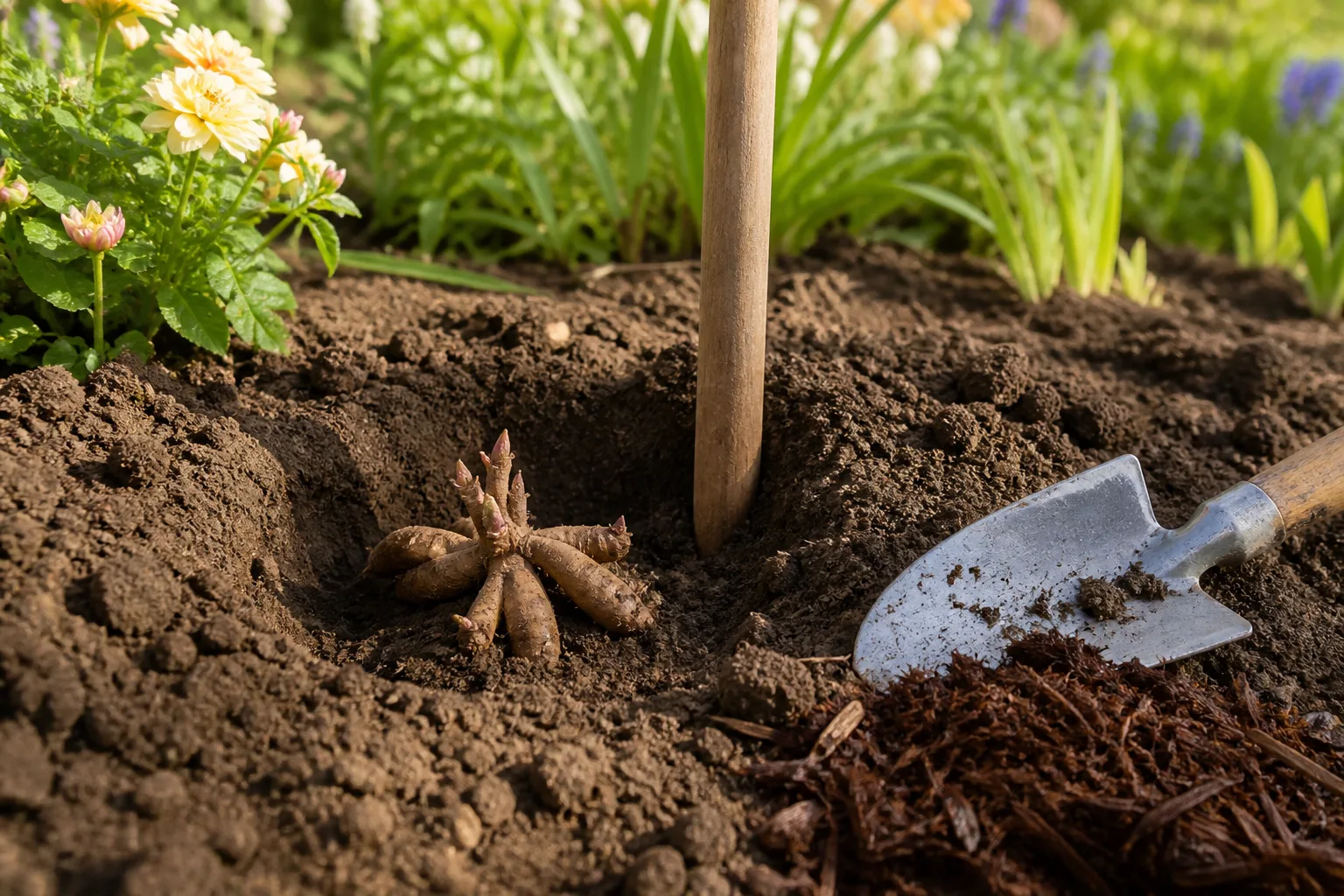
Dahlia storage organs are tuberous roots
A dahlia’s familiar “tubers” are tuberous roots, not potato-like stem tubers. The fleshy roots store food, but they do not carry eyes along their length. New growth comes from buds at the crown, where the roots connect to the old stem.
That detail changes division. A plump dahlia root by itself may look healthy yet fail to sprout if it has no piece of crown with a viable bud attached. Divide the clump so each piece retains a sound storage root and a bud-bearing section of crown; a cut root segment without that connection is not a complete propagule. The same basic caution applies to other tuberous-root plants, although their growth points and division methods are species-specific.
Sweet potato and cassava are also storage roots rather than stem tubers. Their crop propagation methods vary, so do not assume a dahlia division technique applies to food crops. The practical diagnostic is the same: roots lack stem nodes and internodes, while the crown or stem-root junction is where buds and shoots are found.
A Rhizome Is a Horizontal Stem
A rhizome is a modified stem that grows horizontally at or below the soil surface. It has nodes and internodes; roots emerge from the underside, while buds along the rhizome can send shoots upward. This sideways growth is the easiest field clue: a rhizome has a direction of travel rather than the compact, upright form of a corm or the rounded body of a bulb.
Ginger, canna, bamboo, and many irises grow from rhizomes. The ginger sold as a culinary “root” is actually a rhizome, and its buds are the small points from which new shoots can emerge. Bearded iris rhizomes are often positioned close to the soil surface, while other rhizomatous species grow deeper; do not bury every rhizome the same way.
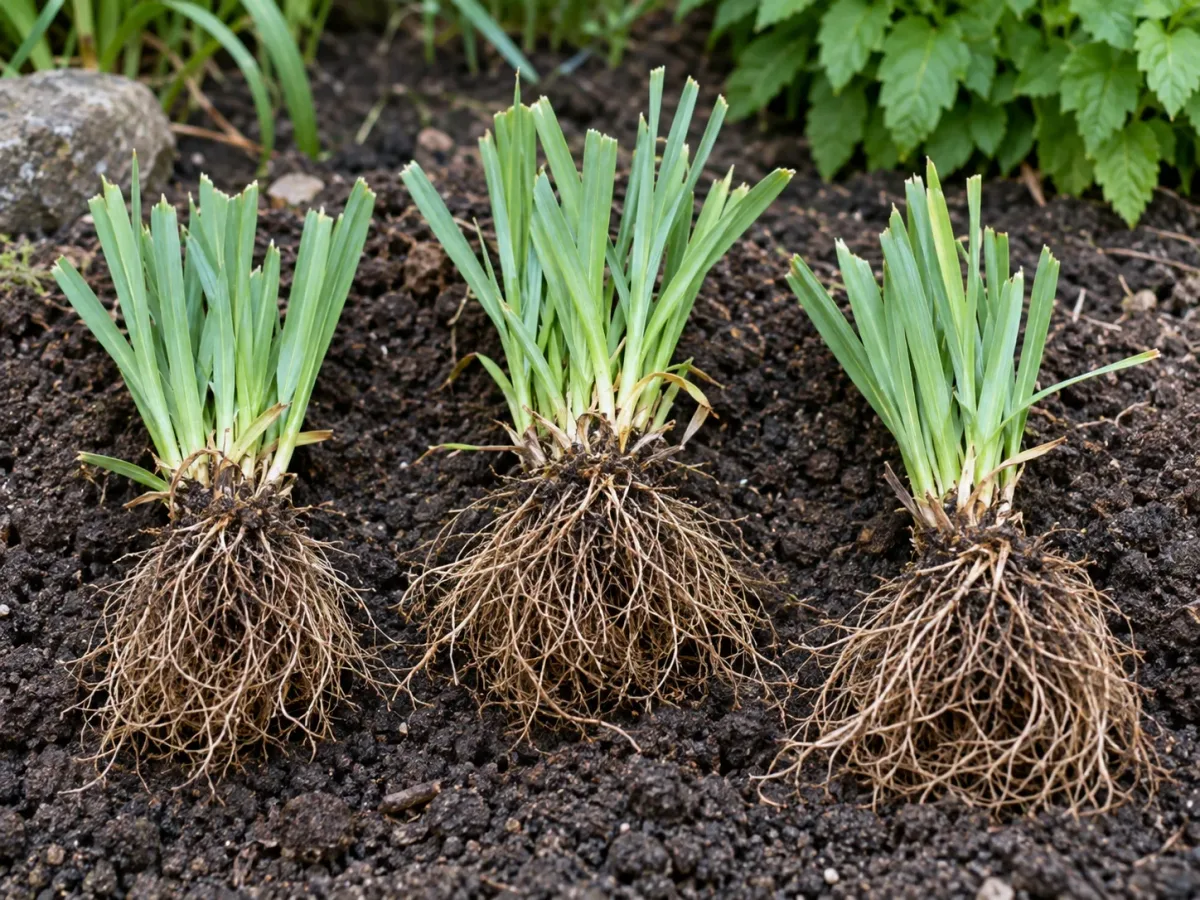
Rhizomes are also a propagation and spacing clue. A division needs a viable bud or shoot point, and some species spread much farther or faster than others. Mint and bamboo can travel aggressively in favorable conditions, while a clumping iris behaves differently; identify the plant before deciding whether it belongs in an open bed, a contained area, or a pot.
A rhizome is not simply a root that happens to run sideways. A root lacks stem nodes and buds along its length, even if it branches. That distinction helps you understand why rhizome fragments may grow when they contain a node and bud, while randomly cut storage roots generally need a crown or other active growing tissue to regenerate.
Compare the Four Structures at a Glance
| Feature | True bulb | Corm | Stem tuber | Rhizome |
|---|---|---|---|---|
| Main storage tissue | Modified leaves or scales | Solid swollen stem | Swollen stem | Horizontal stem |
| Typical form | Compact, rounded | Compact, usually upright | Rounded or irregular | Elongated, growing sideways |
| Bud location | Central growing point inside scales | Top and sometimes along the stem | Multiple surface eyes | At nodes along the stem |
| Roots emerge from | Basal plate | Basal region | From the tuber near buds | Underside of nodes |
| Familiar examples | Onion, tulip, daffodil | Crocus, gladiolus, freesia | Potato | Ginger, iris, canna |
| Common division route | Bulblets or offsets | New corms or cormels | Pieces with a viable eye | Sections with viable nodes and buds |
A dahlia tuberous root is not in the table’s “stem tuber” column, even though gardeners commonly call it a tuber. It stores food in a root and depends on a bud-bearing crown for new growth. If you remember only one nuance beyond the four basic categories, remember that a potato eye and a dahlia crown are not interchangeable propagation structures.
Common Plants and Their Storage Organs
| Plant | Botanical storage structure | What that means when you handle it |
|---|---|---|
| Onion or garlic | True bulb | Look for scales around a basal plate; cloves or offsets can be separated according to species. |
| Tulip or daffodil | True bulb | Plant with the basal plate down; retain green foliage after bloom until it yellows. |
| Crocus or freesia | Corm | Look for a solid, compact organ; allow the foliage to replenish the replacement corm. |
| Gladiolus | Corm | The new corm replaces the old one; cormels may be grown on separately. |
| Potato | Stem tuber | Bud-bearing eyes are distributed over the surface. |
| Dahlia | Tuberous roots attached to a crown | A divided piece needs a crown bud, not just a swollen root. |
| Ginger | Rhizome | Buds sit along a horizontal stem; a piece for propagation needs a viable bud. |
| Bearded iris | Rhizome | The rhizome spreads laterally and is planted shallowly according to iris-specific guidance. |
This list is useful, but common names can hide variation among species. For example, “iris” can refer to bulbous, rhizomatous, or other growth forms, so do not assume every plant in a broad genus has the same storage organ. Check the species or cultivar description if the label gives more than a common name.
What Each Structure Means for Propagation
The safest propagation question is not “Can I cut this in half?” It is “Where are the viable buds, and what tissue must stay attached to them?” Follow the plant’s specific guidance, use a clean sharp knife when division is appropriate, and discard soft or rotting material rather than saving it as planting stock.
A true bulb usually multiplies through daughter bulbs or bulblets near the basal plate. Separate offsets after the plant has finished its growing cycle and the foliage has died back; small offsets may take a few seasons to reach flowering size. Do not cut across the basal plate, because it anchors the scales and is the point where roots form.
A corm typically forms a replacement corm and may produce cormels. Let the parent plant finish growing before lifting it, then separate firm offsets and replant them at the proper time for that species. Treat a corm as one intact storage organ unless reliable species-specific advice recommends another method; the presence of a solid center does not mean any slice can make a new plant.
A stem tuber can often be divided into pieces if each piece carries a living bud or eye. Potatoes illustrate the principle, but crop disease and local seed-potato guidance also matter. For a dahlia, the rule changes: preserve a piece of the crown with a bud and attach a storage root to that division. A root with no crown bud is stored food without a visible point of new growth.
Rhizomes can be divided through the stem, provided each section has a healthy bud or shoot and enough roots to re-establish. Division is also a way to manage crowding, but timing varies with the species. A small piece of rhizome is not automatically harmless: for vigorous or invasive plants, follow local disposal guidance so fragments do not re-root in a compost pile or another bed.
Planting Orientation and Depth Depend on Anatomy
Anatomy gives you clues about orientation, but it does not supply one universal planting depth. Many true bulbs and corms have a basal plate or root-producing end down and a growing point up. Potato seed pieces are commonly positioned with eyes facing upward, while rhizomes lie horizontally and need to be planted at the depth recommended for their species.
If the growing point is hard to find
Do not force a guess by slicing the organ open. Look for a flatter root-producing base, a pointed shoot tip, old root scars, a crown, nodes, or visible buds; then check the supplier’s planting directions or a trusted extension guide for that plant. If a small loose organ still has no clear orientation, planting it on its side in well-drained soil is sometimes a practical fallback for certain bulbs and corms, but it is not a substitute for species-specific instructions.
Depth matters because it affects temperature, moisture, anchoring, and the distance a shoot must travel to reach light. Penn State Extension gives a general rule for many spring bulbs—planting at roughly two to three times the bulb’s height—but its same guidance notes that summer-flowering types have varied requirements. The Penn State Extension guide to bulbs, corms, rhizomes, and tubers therefore supports using the plant’s instructions rather than applying that spring-bulb rule to every underground storage organ.
Soil drainage is another cross-category issue. A storage organ sitting in saturated ground can rot, even if it is correctly oriented and at a sensible depth. In heavy soil, improve the planting site or use a raised bed or container with free drainage, but do not bury an iris rhizome just because another bulb plant needs a deeper hole.
Dormancy, Winter Hardiness, and Storage
The storage organ helps a plant survive a difficult season, but it does not guarantee that the plant is hardy where you live. A cold-hardy daffodil bulb can remain in the ground in regions where a tender dahlia needs lifting before freezing weather; both store energy underground, but their species have different temperature tolerances and seasonal cycles.
Use the plant’s hardiness range, local climate, and the timing of its active growth to decide whether it can stay in the bed. In places with wet winters, drainage can be as important as the lowest temperature. Some plants that tolerate cold may still decline if their storage organs sit in waterlogged soil, while a species that survives in one climate may need protection or lifting in another.
Storage requirements also differ. Do not assume every dormant organ should be washed, dried, or packed identically; some need dry, ventilated conditions, while others are more vulnerable to drying or require a particular temperature range. After lifting, label each type and cultivar, remove diseased material, and follow a reliable species-specific storage guide. Keep a record of the site and planting depth so that an organ that fails to return is not misidentified as a failed bulb.
Identify an Unknown Underground Structure Safely
Start aboveground whenever possible. The leaves, flowers, growth season, and location can often narrow down the plant without disturbing its roots, and an intact plant is easier to identify than an isolated piece. Photograph the whole plant and its leaf arrangement before you do any digging.
If you have permission to inspect an already exposed or dormant organ, use this sequence:
- Look for layers. Fleshy scales surrounding a compact base indicate a true bulb.
- Check whether it is solid and compact. A solid, rounded organ with a basal root area and a top growing point may be a corm.
- Find the buds. Eyes spread over an enlarged stem point toward a stem tuber; buds grouped at a crown with swollen roots point toward a tuberous root.
- Trace the direction of growth. A lateral stem with nodes and roots beneath it is a rhizome; a true root lacks nodes and internodes.
- Confirm the species. Botanical structure narrows the options, but an identification app, extension service, or knowledgeable local garden organization can help with an uncertain plant.
Do not dig up an established plant simply to satisfy curiosity if it is growing well. Digging can sever feeder roots, detach a bud, or expose a storage organ to cold and drying, while a photo and plant label may answer the question without damage. If the plant is a potentially invasive runner, identify it before moving or composting any pieces.
Mistakes That Lead to Failed Growth
Calling everything a bulb can lead to the wrong division technique. Cutting a corm into sections, detaching a dahlia root from its crown, or slicing a potato without preserving a viable eye can leave you with a piece that stores food but cannot make a shoot. Identify the growing points first, then divide only if that kind of organ and plant are known to tolerate division.
Another common error is using shape alone. A bulb may be teardrop-shaped, a corm may be rounded, and a potato is irregular; these silhouettes overlap. If you need to know what the organ is, look at its structure—scales, solid stem, eyes, crown, or nodes—and use the plant’s name to verify the likely category.
The opposite mistake is treating the four categories as a planting calendar. Not all bulbs are planted in fall, not every corm needs lifting, and the word “rhizome” does not tell you whether a plant is hardy or invasive. Garden Express’s practical overview of bulbs, corms, rhizomes, tubers, and stolons separates storage structures by form and explains that stolons or runners are a related but distinct way plants spread; use that distinction to think about a plant’s growth habit, then confirm local timing with regional guidance.
Finally, avoid cutting into an unknown organ to “see the layers” when a surface clue will do. A cut can damage the only bud or introduce decay, and a single specimen may not show all the features clearly. Start with the plant label, visible growth points, and the origin of roots; make a careful cut only when the plant is already being divided and the method is appropriate.
Conclusion
A true bulb stores most of its reserve in modified leaf scales, a corm stores food in a solid swollen stem, a stem tuber such as a potato carries buds across its surface, and a rhizome is a horizontal stem with nodes. Dahlia “tubers” are the important exception: they are tuberous roots that need a bud-bearing crown to grow.
For a practical identification, check the tissue, root attachment, and location of buds rather than relying on the broad garden word “bulb.” Then use that anatomy to understand how the plant propagates, while following species-specific directions for planting depth, dormancy, and winter storage. That combination—structure first, plant-specific instructions second—prevents most of the avoidable mistakes.