9 Creepy Plants for Halloween and How to Grow Them
Explore creepy plants for Halloween, from living stones to corpse flowers, with growing needs, seasonal timing, toxicity cautions, and safer display ideas.
A Halloween display can feel strange without plastic props: some plants look like stones, eyes, or little jaws, while others carry unsettling names or bloom with an odor that draws a crowd. But “grow for Halloween” covers very different projects. A small succulent can sit on a bright windowsill all year; a shade perennial may show its berries in autumn; a tropical corpse flower is a greenhouse commitment with a bloom that cannot be scheduled for October.
This list follows the eight actual plants in the familiar Halloween lineup, then includes mushrooms as a ninth growing curiosity—with an important correction: mushrooms are fungi, not plants. The useful question is not only which specimen looks creepiest, but whether it suits your climate, available light, household, and patience. Some are easy to display safely; others are best admired in a botanical garden or replaced with a photograph or artificial prop.
How to choose a creepy plant that will stay healthy after October
Start with the plant’s real season, not the calendar. Many “spooky” plants bloom in spring or summer, and flowering in response to a holiday date is not something you can reliably force. If you need something that looks striking on October 31, buy a healthy, already-established plant or choose a species whose foliage or fruit is naturally present then; do not buy dormant bulbs or seeds expecting a fast Halloween transformation.
Next, match the growing environment before you shop. Lithops and Venus flytraps both need strong light, but they want very different moisture and soil conditions. A bat flower wants warmth and humidity, while white baneberry belongs in a moist, shaded outdoor bed. Grouping plants by “creepy” appearance is fun for a display; grouping them by care requirements is what prevents the display from becoming a row of struggling plants.
Finally, treat safety and spread as part of the plant choice. A poisonous berry-bearing perennial may be a poor fit for a path where children or pets play, and a self-seeding wildflower may not belong near natural areas. If a plant presents a hazard, the safest Halloween decoration may be a photo, a labeled botanical-garden visit, or a convincing artificial stem rather than a live specimen.
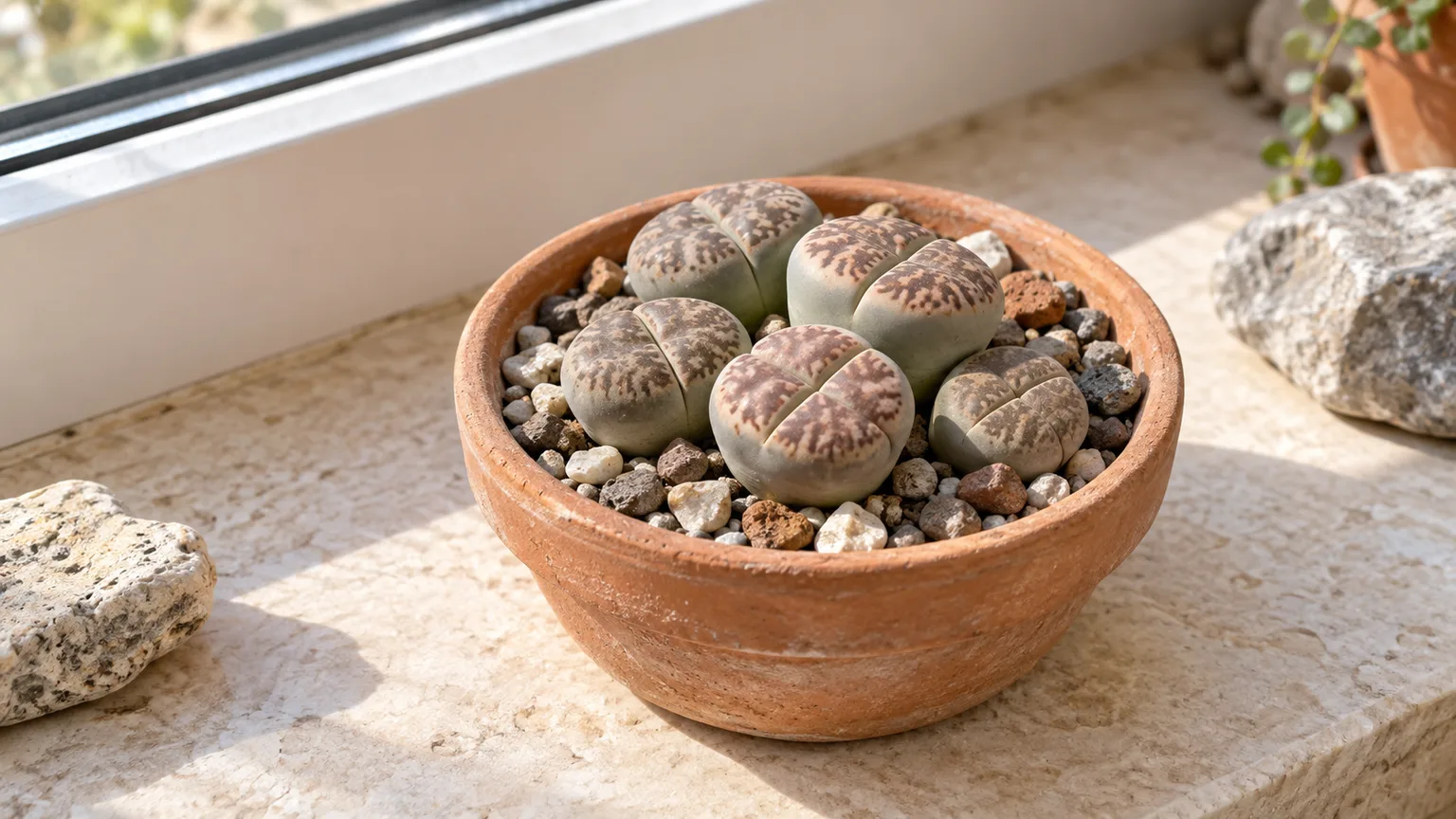
1. Living Stones (Lithops spp.): tiny plants with a brain-like look
Lithops are small southern African succulents whose paired, fleshy leaves sit close to the soil. Their mottled tops can resemble pebbles, brains, or a tiny pair of eyes peering from gravel, which makes them one of the easiest plants here to display on a desk or sunny shelf. They stay compact, but they are not toys: their soft leaf bodies bruise, split, or rot when handled or watered carelessly.
Give a lithops pot bright light, fast drainage, and a gritty mineral-heavy mix in a container with a drainage hole. Do not water on a weekly houseplant schedule. Lithops move through a seasonal leaf-replacement cycle in which the new pair draws moisture from the old leaves; adding water while that old pair is still being absorbed can leave the plant swollen or rotting. The Royal Horticultural Society’s Lithops profile describes the nearly stemless plant as a pair of fleshy leaves with translucent markings, a structure that helps explain why its leaf-replacement cycle matters.
A healthy lithops is a long-term miniature, not a quick seasonal purchase to color or decorate. Skip the scrape’s suggestion to add red food dye: dyeing a living leaf offers no horticultural benefit and turns a plant into a disposable prop. Use red gravel or a small Halloween ornament beside the pot instead, keeping the crown clear and the plant in the light it needs.
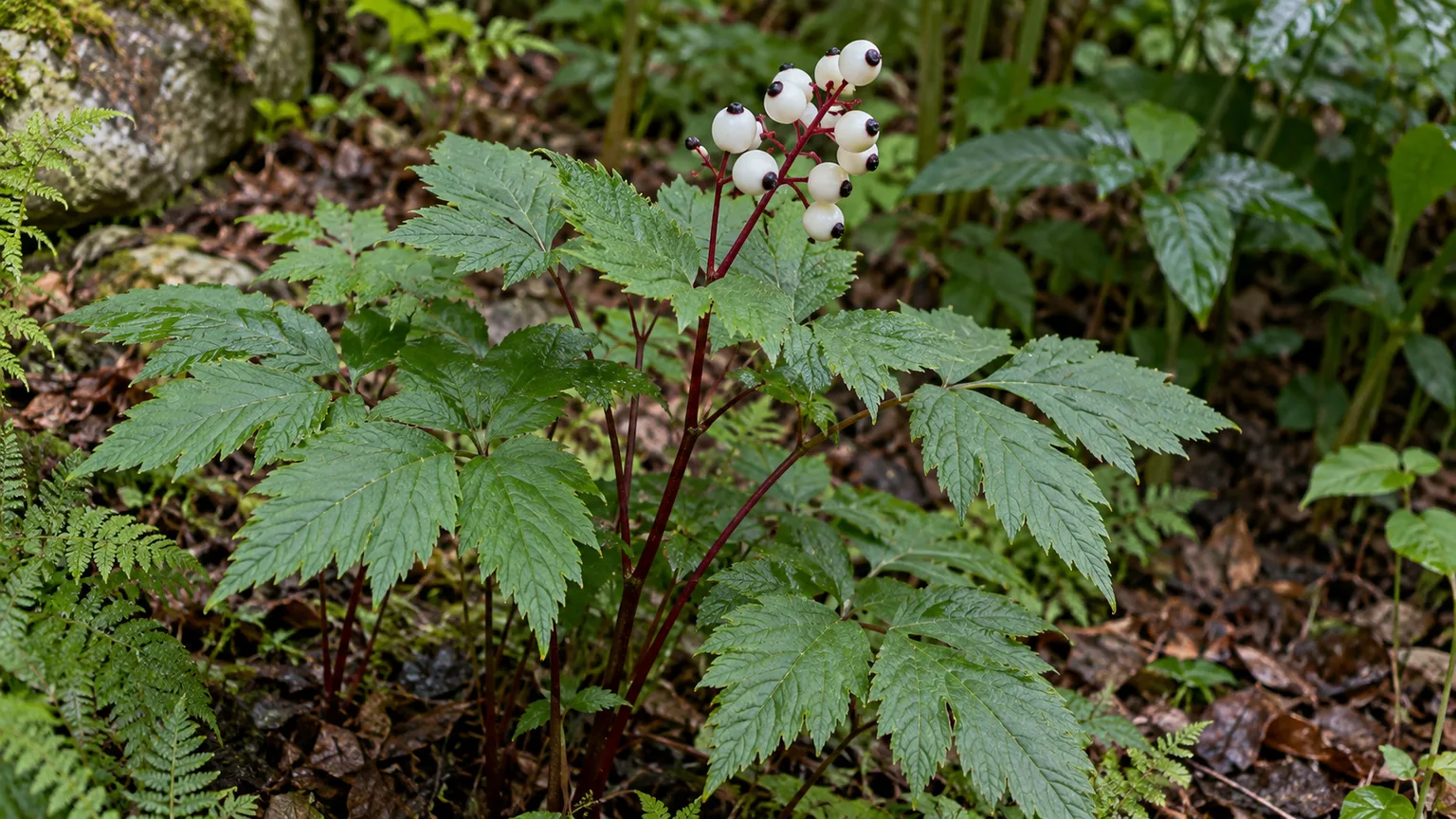
2. Doll’s Eye (Actaea pachypoda): striking berries with a serious warning
White baneberry, or Doll’s Eye, is a woodland perennial native to eastern North America. Its late-season white berries have dark stigma marks and sit on thickening red stalks, so the cluster can look uncannily like a string of staring eyes. A shady, humus-rich bed with steady moisture and good drainage suits the plant better than a hot, exposed border; its white spring flowers are modest, while the berries provide the Halloween-season drama.
This is the most important safety decision in the list. NC State Extension identifies all parts of white baneberry as poisonous, especially the berries and roots, and recommends caution where children or pets have access. The Missouri Botanical Garden’s Plant Finder likewise notes the extreme danger of eating the berries. Do not use cut stems in a table arrangement, do not let children handle the fruit, and do not grow it beside a play area simply because it is a native woodland plant.
If it is appropriate for your property, obtain nursery-propagated stock and place it where the plant can thrive without inviting contact. It tolerates deep or partial shade and prefers moist, organically rich, well-drained soil; its clump can reach roughly one to three feet tall. Birds disperse the seeds, which is part of the plant’s ecology, so monitor seedlings if you need to keep it within a deliberate shade-garden boundary. When the site or household is not suitable, imitate the white-and-red look with artificial berries instead.
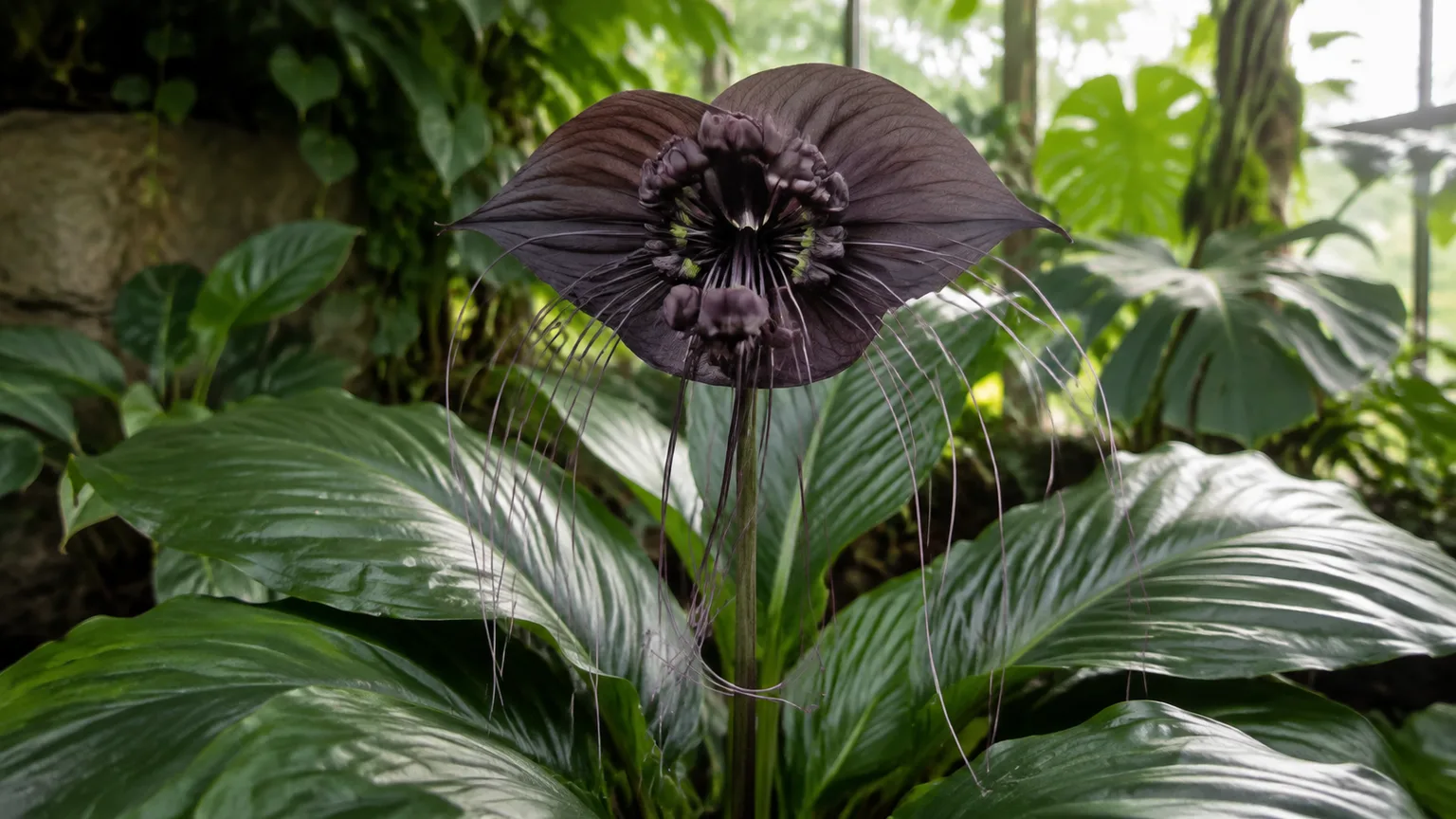
3. Black Bat Flower (Tacca chantrieri): a tropical conservatory plant
The black bat flower earns its name through an unusual inflorescence: dark maroon-purple bracts frame smaller flowers, and long whisker-like bracteoles hang below. It is a real tropical understory plant, not a hardy October garden annual. The Royal Horticultural Society’s plant profile describes the genus as tropical and recognizes the bat-like flower form; the Gardens of Golden Gate Park also describes its need for bright indirect light, rich drained soil, moisture, and high humidity in its curator’s notes.
For most North American growers, a warm indoor spot or greenhouse is more realistic than leaving the plant outside. Give it bright filtered light, a humid atmosphere, and an evenly moist but freely draining medium; keep it away from cold drafts, hot vents, and direct summer sun. The balance matters: dry air and cold can stall it, but a saturated pot can damage the rhizome. This is an intermediate-to-advanced plant, not a no-maintenance prop.
Its flowers are spectacular when they appear, but an established plant may not be in bloom on Halloween, and a new purchase may take time to settle. The trusted houseplant site Guide to Houseplants likewise emphasizes bright indirect light and steady moisture rather than treating the bat flower as a disposable seasonal accessory. Buy a healthy, cultivated specimen only if you can provide the year-round conditions; otherwise, use the plant’s image as inspiration and choose a hardier local display plant.
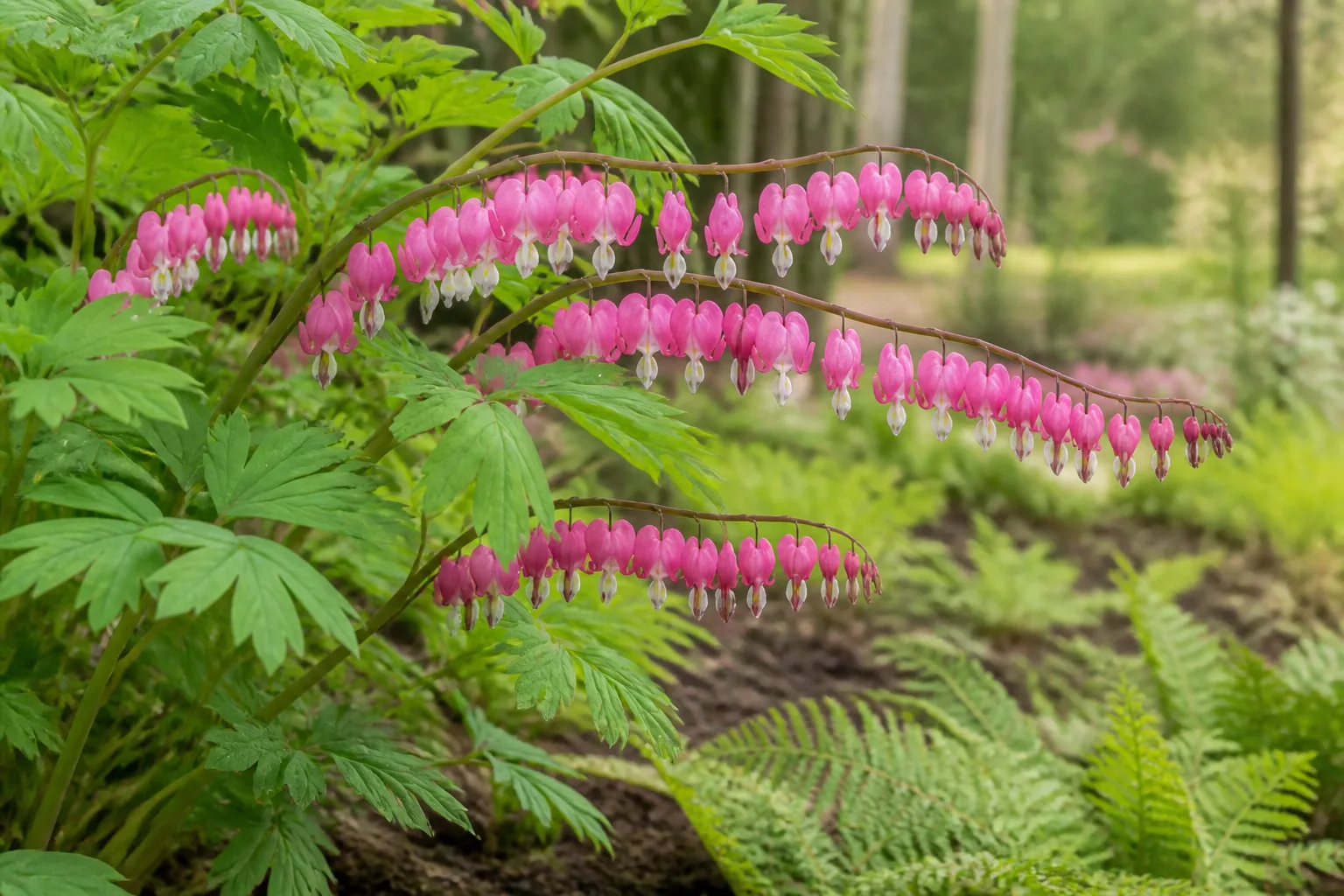
4. Bleeding Heart (Lamprocapnos spectabilis): a spring-only spectacle
The familiar bleeding heart is an herbaceous perennial with arching stems of pink or white heart-shaped flowers, each finished with a drop-like inner petal. It belongs on this list for its shape, not because it is an October bloomer. Flowers arrive in spring to early summer, then the foliage commonly yellows and disappears as the plant enters summer dormancy, especially in warm climates.
Plant it in rich, moist but well-drained soil with morning sun and afternoon shade, or a cooler shaded site. Think about what will cover the empty space later: ferns, hostas, or another shade perennial can fill in as the bleeding heart rests. A spring photograph or dried pressed flower will serve a Halloween theme better than trying to force a dormant clump into bloom. NC State Extension’s profile details this spring-to-early-summer cycle and warns that all parts are poisonous if ingested; the foliage can also irritate skin, so gloves are sensible when dividing or handling it.
The old botanical name Dicentra spectabilis still appears on nursery labels and garden references. Do not confuse this East Asian garden plant with the North American native fringed bleeding heart, Dicentra eximia, which has a different growth habit and a longer flowering period. Either way, choose based on the climate and garden role first, then enjoy the uncanny heart shape as a bonus rather than counting on a timed Halloween flower.
5. Queen Anne’s Lace (Daucus carota): eerie umbels, risky lookalikes
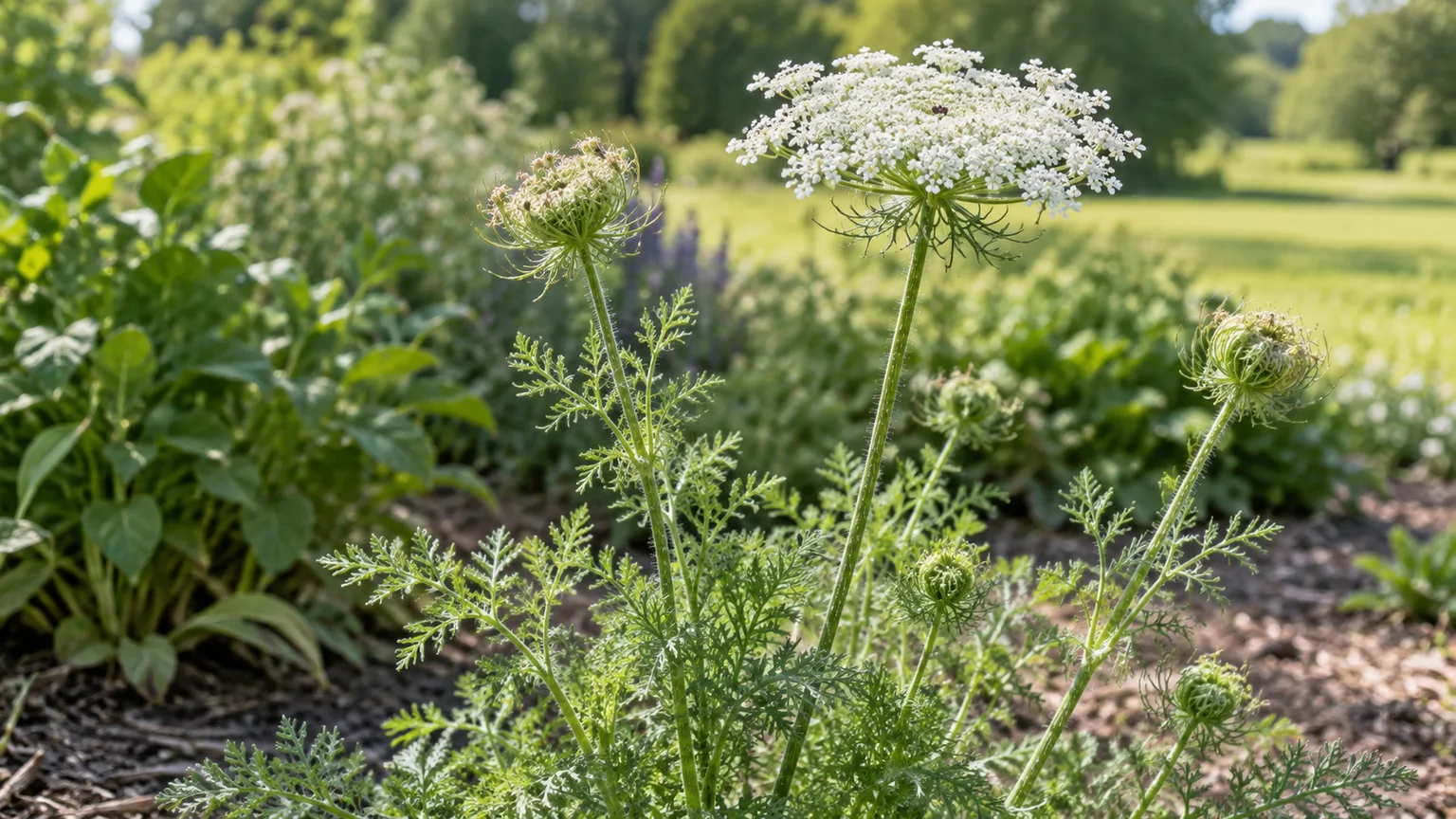
Queen Anne’s lace is the common name for wild carrot, Daucus carota, a biennial with ferny first-year foliage and flat white flower clusters in its second year. A single dark floret sometimes appears near the center of an umbel, but that detail is not dependable enough to identify the plant. Its open, lace-like flower heads can be beautiful in a naturalistic garden, yet wild carrot self-seeds readily: Penn State Extension notes that an individual plant can produce thousands of seeds and may need control in landscape beds.
Use this plant only when you can identify it confidently and local guidance supports growing it. Penn State Extension’s wild-carrot guide describes the hairy stems of Queen Anne’s lace and contrasts them with poison hemlock, which has smooth stems and purple blotches. Poison hemlock is poisonous to people and animals; Penn State’s identification guidance cautions that stem markings can be faint on young rosettes. A flower head or a single stem feature is not enough to make a safe identification.
Do not dig a roadside plant and bring it home, and do not use wild-carrot foliage as an edible garnish. If you are uncertain, leave the plant alone and ask a local extension office for identification rather than touching or moving it. Gardeners who want the airy white-flower effect can choose a locally appropriate ornamental alternative that is not a roadside volunteer; where Queen Anne’s lace is allowed, use a contained bed and remove seed heads before they disperse.
6. Venus Flytrap (Dionaea muscipula): a native bog plant, not a toy
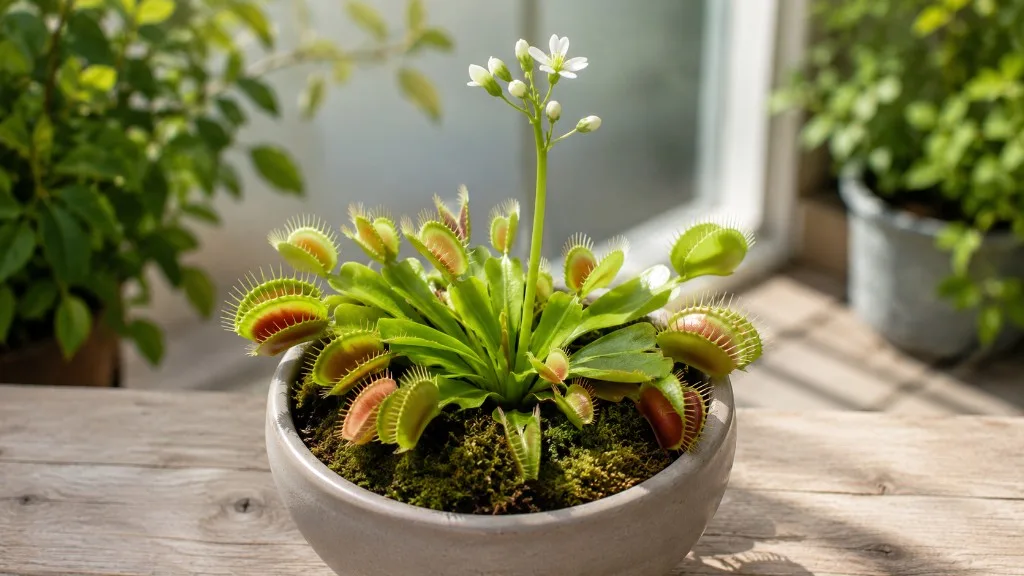
A Venus flytrap’s toothed traps snap shut when their trigger hairs receive repeated stimulation. That movement looks theatrical, but the plant is a small, green perennial from wet, sunny, nutrient-poor habitats in the Carolinas—not a miniature animal that needs a steady diet of hand-fed bugs. Insects provide supplemental nutrients; photosynthesis supplies the sugars that power the plant.
For a healthy indoor plant, provide strong light, an acidic low-nutrient carnivorous-plant medium, and rainwater, distilled water, or reverse-osmosis water. Ordinary potting soil, fertilizer, and mineral-rich tap water can cause trouble. A plant outdoors may catch its own prey; an indoor plant can survive without an insect meal, so do not force traps shut for entertainment or put meat into them. The Royal Horticultural Society’s Venus flytrap care guide and our practical feeding guide explain why feeding is secondary to light and water quality.
Expect a winter slowdown or dormancy rather than a year-round novelty display. Buy nursery-grown plants instead of collecting wild specimens, and let the trap cycle work normally; repeatedly triggering it wastes the plant’s limited energy. If you want a genuinely creepy Halloween plant that fits on a bright indoor shelf, this one is more manageable than the corpse flower—but it still needs specialized care.
7. Voodoo Lily (Amorphophallus konjac): a corm with a brief odor
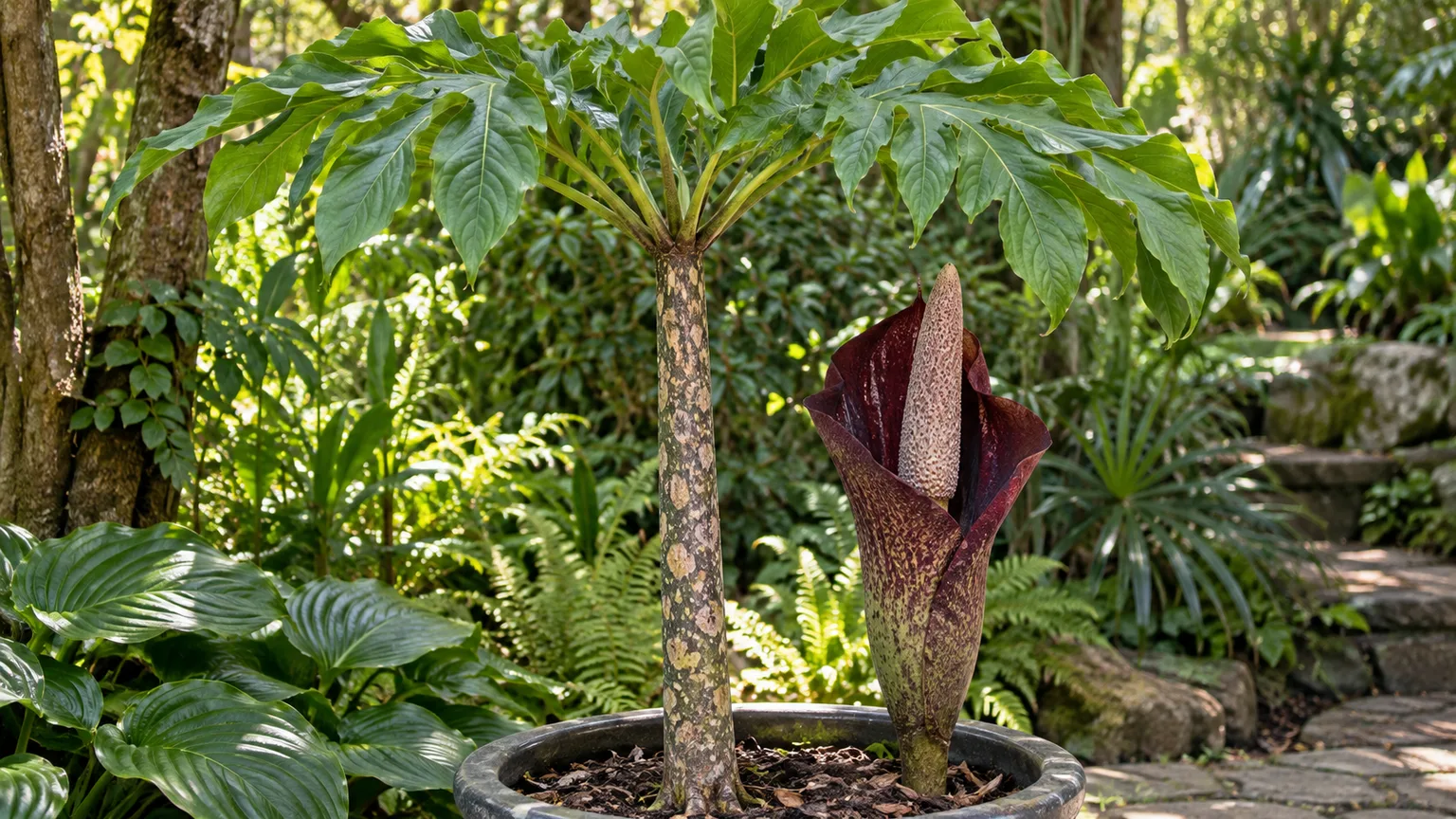
“Voodoo lily” is a common name used for more than one aroid, so check the botanical label before you buy. This section means Amorphophallus konjac, whose unusual bloom has a dark spathe around a central spadix; the inflorescence can produce an unpleasant odor that attracts carrion-associated pollinators. It is distinct from Amorphophallus titanum, the giant Titan arum described next, even though both belong to the same genus and share some common-name confusion.
The plant grows from an underground corm, produces one large leaf or a flowering stalk in a growth cycle, then rests after the top growth dies back. NC State Extension recommends a warm growing season—roughly 68 to 77°F, with temperatures above 60°F—plus dappled shade and moist, well-drained, humus-rich soil. The leaf and flower are frost-sensitive even though the corm is hardier; in a cold climate, grow it in a container and protect the dormant corm according to local winter conditions. Reduce watering as growth ends rather than leaving the resting corm in wet soil. The NC State Extension entry for Amorphophallus konjac is a better starting point than relying on a seller’s dramatic common name.
A voodoo lily is a long-term collector’s plant, not a guaranteed annual Halloween scent machine. Its bloom date and frequency depend on the plant’s age and condition, and the smell is temporary. Give the flower space away from dining and gathering areas if odor would bother your household, and confirm that the name on the corm matches the species you intend to grow. The raw corm is toxic because of calcium oxalate crystals; do not eat it or let children handle it as a novelty. Wear gloves when repotting, and wash your hands and tools afterward.
8. Corpse Flower (Amorphophallus titanum): a botanical-garden event
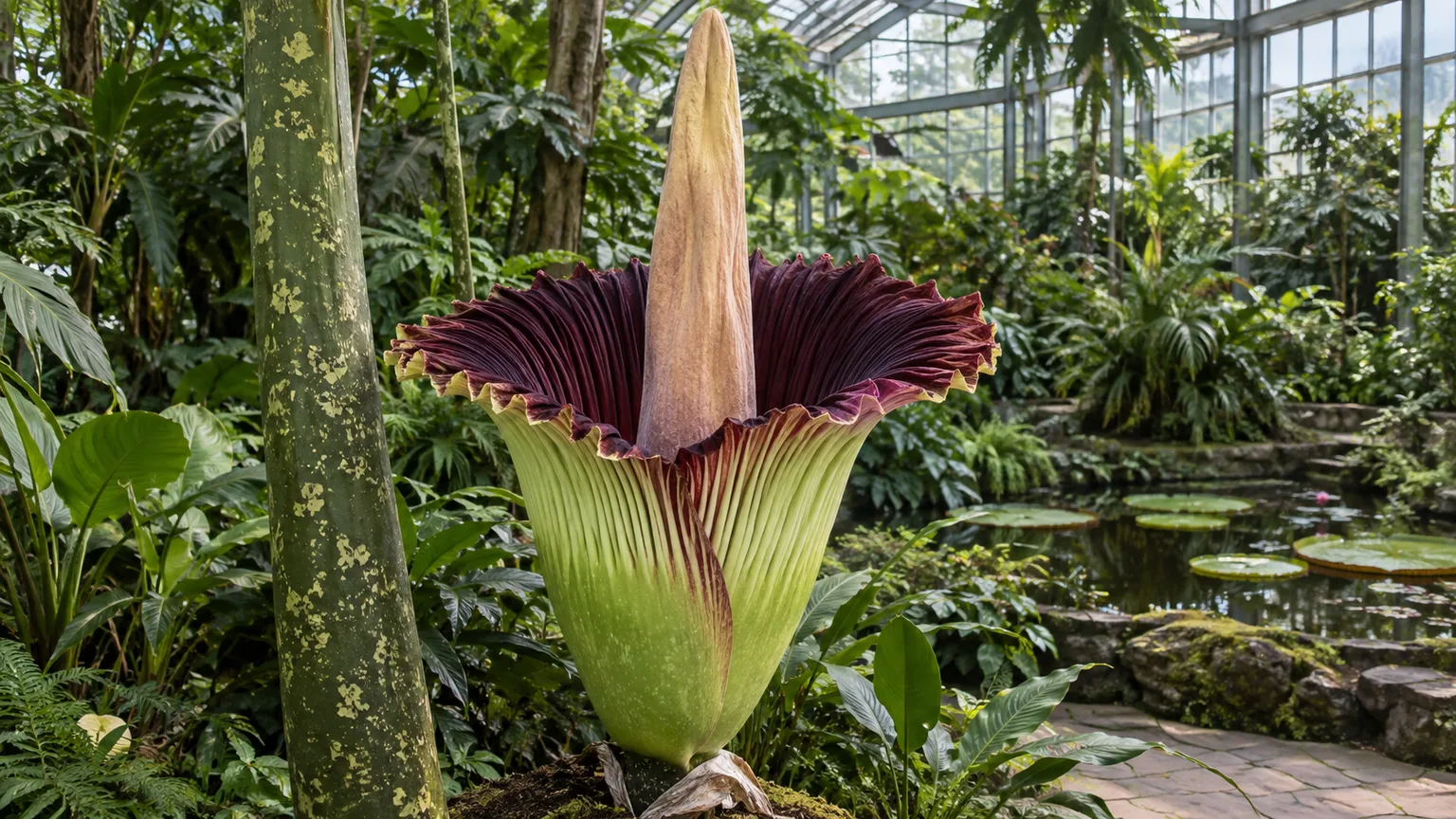
The corpse flower is Amorphophallus titanum, also called the Titan arum. Its towering inflorescence has a central spadix and a surrounding spathe; during a short bloom, the plant releases a smell often compared with rotting meat. The odor is part of its pollination strategy, not a constant feature of its leafy growth. It is also not the same species as the smaller voodoo lily commonly sold as A. konjac.
Growing one well is a specialist greenhouse project. This tropical plant needs considerable space, stable warmth and humidity, and years of care before a possible flowering event. The University of Washington’s greenhouse account describes raising its corms for more than six years and explains why the showy structure is technically an inflorescence made up of many small flowers. Its botanical-garden overview makes the practical point: the extraordinary smell lasts only a short time, and the bloom itself may last just a few days.
For almost every home gardener, visiting a botanical garden is the sensible way to see one in flower. Follow the garden’s bloom alerts and check visiting hours, because the window is brief and the event cannot be booked to match Halloween. If you want a large, dramatic plant at home, choose a more manageable aroid and enjoy a corpse-flower display as a public garden experience instead.
9. Mushrooms: the fascinating fungi exception
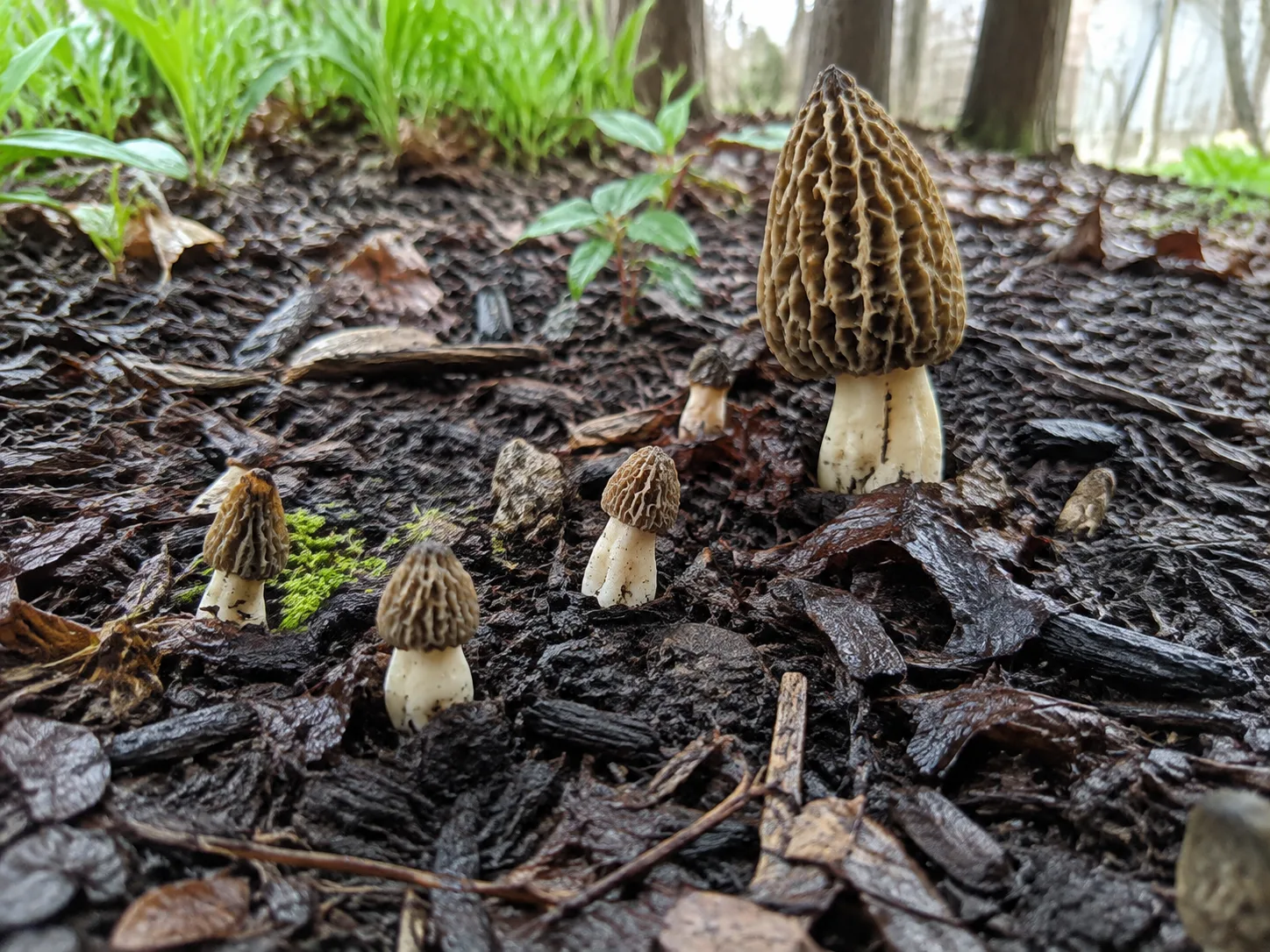
Mushrooms can look like little brains, umbrellas, or alien eggs emerging from leaf litter, so they fit the Halloween mood. They are not plants, though: a mushroom is the visible reproductive structure of a fungus, while much of the organism grows as an underground or substrate-bound network. That distinction matters if you are trying to choose a “plant” to grow in a pot or bed.
Morels are especially tempting because their honeycomb caps look strange and they are edible when correctly identified and properly prepared. But they are notoriously difficult to establish reliably, and false morels can cause serious poisoning; WebMD’s false-morel safety reference explains why an uncertain specimen is not worth the risk. A backyard bed is a slow experiment rather than a guaranteed seasonal decoration; our morel-growing guide covers that project in detail. Do not eat a wild mushroom based on an online photo, and do not put unknown specimens where children or pets can sample them.
If you want mushrooms for an indoor autumn project, consider a contained, commercially prepared edible-mushroom kit and follow its instructions in a place where curious children and animals cannot reach it. If mushrooms appear spontaneously in a lawn or planter, do not treat their appearance as a plant disease or as proof that the soil is unsafe; they often feed on buried organic matter. Remove them only if access is a concern, and never serve a wild specimen without expert identification.
Which creepy growers fit a windowsill, patio, or garden bed?
For an indoor windowsill with strong light, Lithops and a nursery-grown Venus flytrap are compact options, but their water needs are opposite: Lithops need restrained seasonal watering, while a flytrap needs consistently wet, low-mineral media. A bat flower belongs indoors only if you can maintain warmth and humidity; it is not a substitute for an ordinary low-maintenance houseplant. The Amorphophallus corms need more space and careful seasonal storage, and the corpse flower is realistically a conservatory specimen.
For a shaded garden, bleeding heart and white baneberry are the strongest landscape fits when their site and safety requirements suit the household. Bleeding heart gives a brief spring flower display, while white baneberry’s berries are more likely to look seasonal in late summer and autumn. The second is poisonous, so a safer site matters more than the fact that it is native or visually distinctive.
Queen Anne’s lace is a conditional choice because it can seed freely and resembles a toxic wild plant. Before buying it, check local weed and invasive-plant guidance, choose a known nursery source, and keep it away from wild areas. If there is any doubt about identification, spread, or household access, select another plant with an airy white flower instead.
| Your growing situation | Better-fitting choices | Main trade-off |
|---|---|---|
| Bright indoor shelf | Lithops; Venus flytrap | Both need specific, very different watering routines. |
| Warm, humid room or greenhouse | Black bat flower | Humidity and warmth are requirements, not optional styling. |
| Shady, moist garden bed | Bleeding heart; white baneberry | Bleeding heart is a spring show; baneberry berries are poisonous. |
| Contained seasonal bed | Queen Anne’s lace only where allowed | Self-seeds and can be confused with poison hemlock. |
| Conservatory visit | Corpse flower | The bloom is rare, brief, and not timed for Halloween. |
How to build a Halloween display without stressing the plants
Let the pot or garden setting do the decorating. Use a matte black cachepot, a layer of clean gravel, a small paper bat, or a removable sign beside the plant rather than painting leaves, dyeing living tissue, gluing decorations onto a flower, or packing the pot with glitter. Keep the drainage holes open and leave the crown and soil surface visible so you can monitor moisture and pests.
Build the display around care groups, not a mixed planting of incompatible roots. A lithops and Venus flytrap can share a shelf but should not share a pot, soil mix, or watering tray. Likewise, a warm, humid Tacca should not sit beside a desert succulent simply because their colors look good together. Use separate containers and move the décor rather than moving a tender plant into a drafty window for a photo.
For an outdoor bed, use plants that belong in your region and keep the composition useful after the holiday. Shade perennials can share a woodland-style border with ferns; pots can hold tender tropicals that come indoors before cold weather. A seasonal display is more sustainable when the plant keeps a role after October, rather than being bought to bloom once and discarded.
Safety: toxic berries, wild lookalikes, pets, and children
Treat a plant label as part of the decoration. White baneberry is poisonous if eaten, and the North Carolina State profile identifies bleeding heart as poisonous if ingested and notes that its foliage may irritate skin. Put either plant beyond reach of children and pets, use gloves when handling or dividing them, and wash tools afterward. If the household cannot reliably maintain that separation, choose a non-toxic visual substitute rather than relying on a warning tag.
Queen Anne’s lace demands a different kind of caution: misidentification. Poison hemlock can resemble wild carrot, especially before the flowering stems make their features easier to compare. The Penn State guidance describes hairy stems on Queen Anne’s lace versus smooth, often purple-blotched stems on poison hemlock, but a novice should not use one clue to identify a plant. Do not harvest, transplant, or taste an uncertain roadside plant; ask a local extension service for help.
Keep carnivorous plants and tropical aroids away from curious hands as well. Do not trigger flytrap leaves for entertainment, and do not encourage children to touch an unfamiliar flower, corm, berry, or mushroom. Photograph or label a plant from a safe distance, and contact a poison-control center or veterinarian promptly if someone or a pet eats an unknown plant; have a clear photo and the container label ready.
Conclusion
The most satisfying creepy plants are the ones you can keep healthy after the decorations come down. Lithops, a nursery-grown flytrap, and a black bat flower suit different indoor conditions; bleeding heart and white baneberry belong in thoughtfully chosen shade gardens; Queen Anne’s lace needs regional and identification caution. The voodoo lily can reward a patient collector, while the Titan arum is best seen in a botanical garden, and mushrooms belong in a separate fungi conversation. Choose for your space and household first, then let the plant’s natural strangeness make the Halloween display.



