Does Mint Deter Squirrels? What Actually Works
Does mint deter squirrels? Learn why a mint plant or peppermint scent is not a lasting fix, then protect gardens, pots, fruit, and feeders with better tactics.
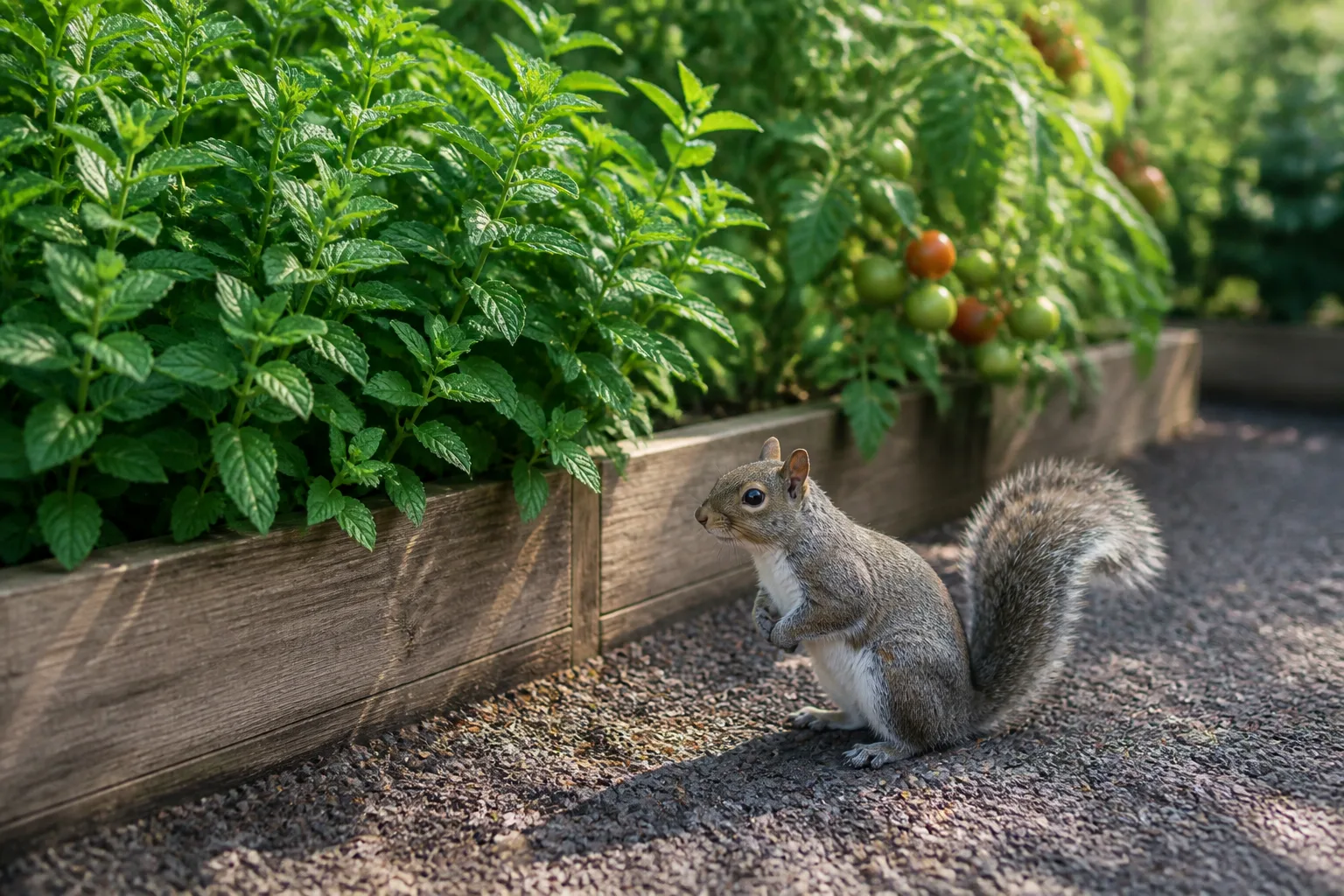
Quick answer: mint is not a dependable squirrel barrier
Planting mint may make a garden smell less attractive for a short time, but it will not reliably keep squirrels away from vegetables, pots, fruit, bulbs, or birdseed. A squirrel that is hungry, already accustomed to the area, or following an easy food route can simply cross the mint and continue feeding.
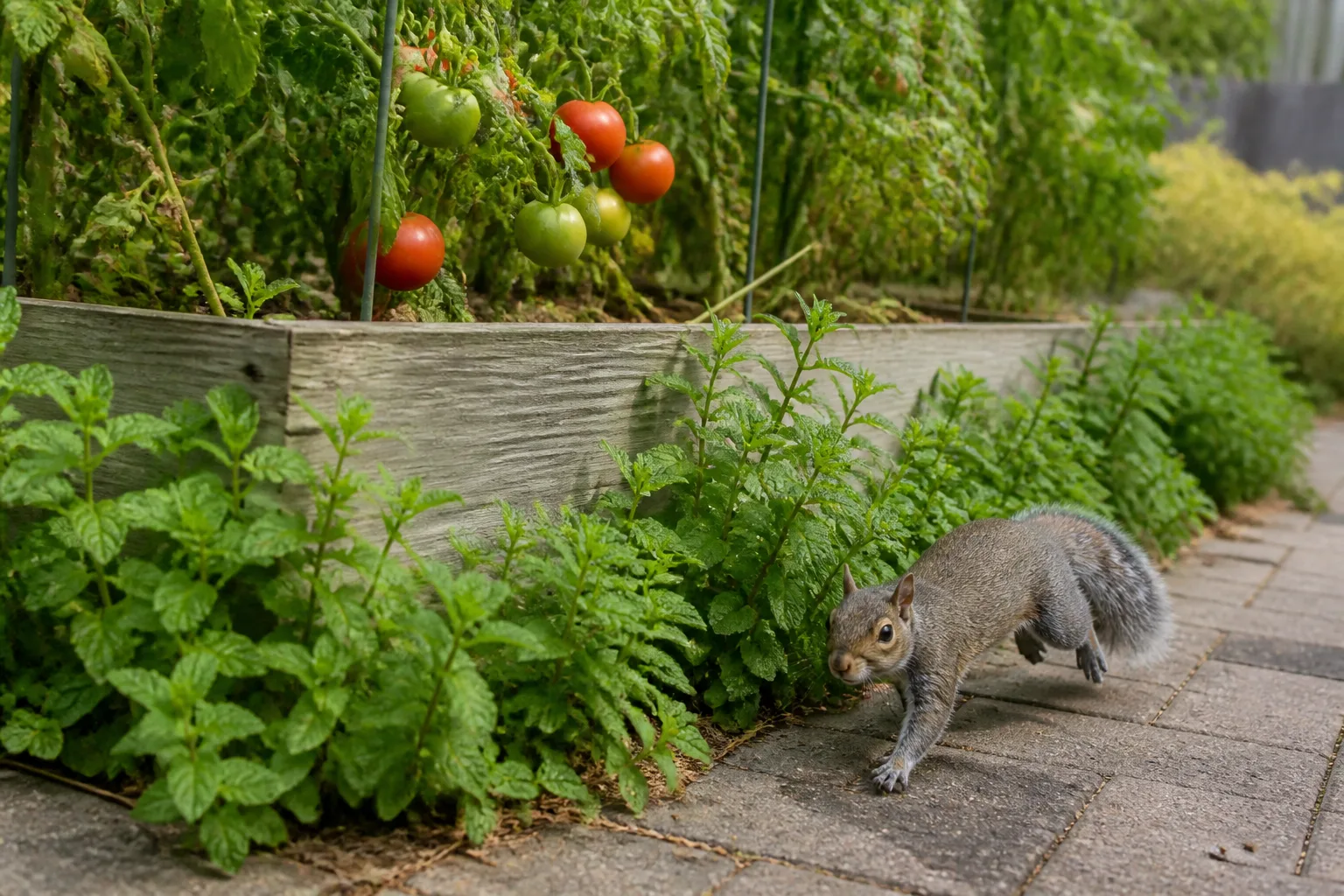
That does not make mint useless. It is a productive herb, and its strong aroma can be one small part of a broader plan, but wildlife-control guidance puts the dependable work on physical exclusion, food-source management, and properly used repellents. UF/IFAS explains that animals become accustomed to deterrents and may ignore them when the protected food, water, or shelter is especially valuable (UF/IFAS wildlife deterrent guidance).
If squirrels are digging in one pot, cover that pot. If they are stripping fruit from a tree, block access to the fruit or trunk. If they are emptying a feeder, redesign the feeder station. Matching the fix to the food source is more effective than spreading a strong-smelling plant around the entire yard.
Why mint seems like it should work
Mint contains aromatic oils that people notice immediately when leaves are crushed or brushed. That makes it easy to assume that a squirrel will treat a mint border as a “keep out” sign, especially when online advice groups mint with peppermint oil, garlic, coffee, or hot pepper.
The missing piece is motivation. A smell can make an animal pause, change direction, or investigate from farther away, but a mild sensory annoyance is not the same as an impenetrable barrier. UF/IFAS separates odor repellents from taste repellents and notes that success depends on food availability, wildlife abundance, prior feeding habits, and reapplication; that is a very different standard from claiming that mint permanently repels squirrels.
Smell can alter behavior, not override hunger
Repellents work best before an animal has established a feeding routine. Once a squirrel has learned that a particular planter contains ripe tomatoes or that a feeder is refilled every morning, the reward can outweigh an unpleasant smell. Scent also fades outdoors through wind, rain, heat, and the simple fact that the animal becomes familiar with it.
This is why a mint plant can appear successful for a few days without solving the problem. The squirrel may have been exploring, the food may not yet have been ripe, or the new planting may briefly have changed the route; none of those observations proves that mint will protect the crop when pressure increases.
The mint plant and mint oil are different tests
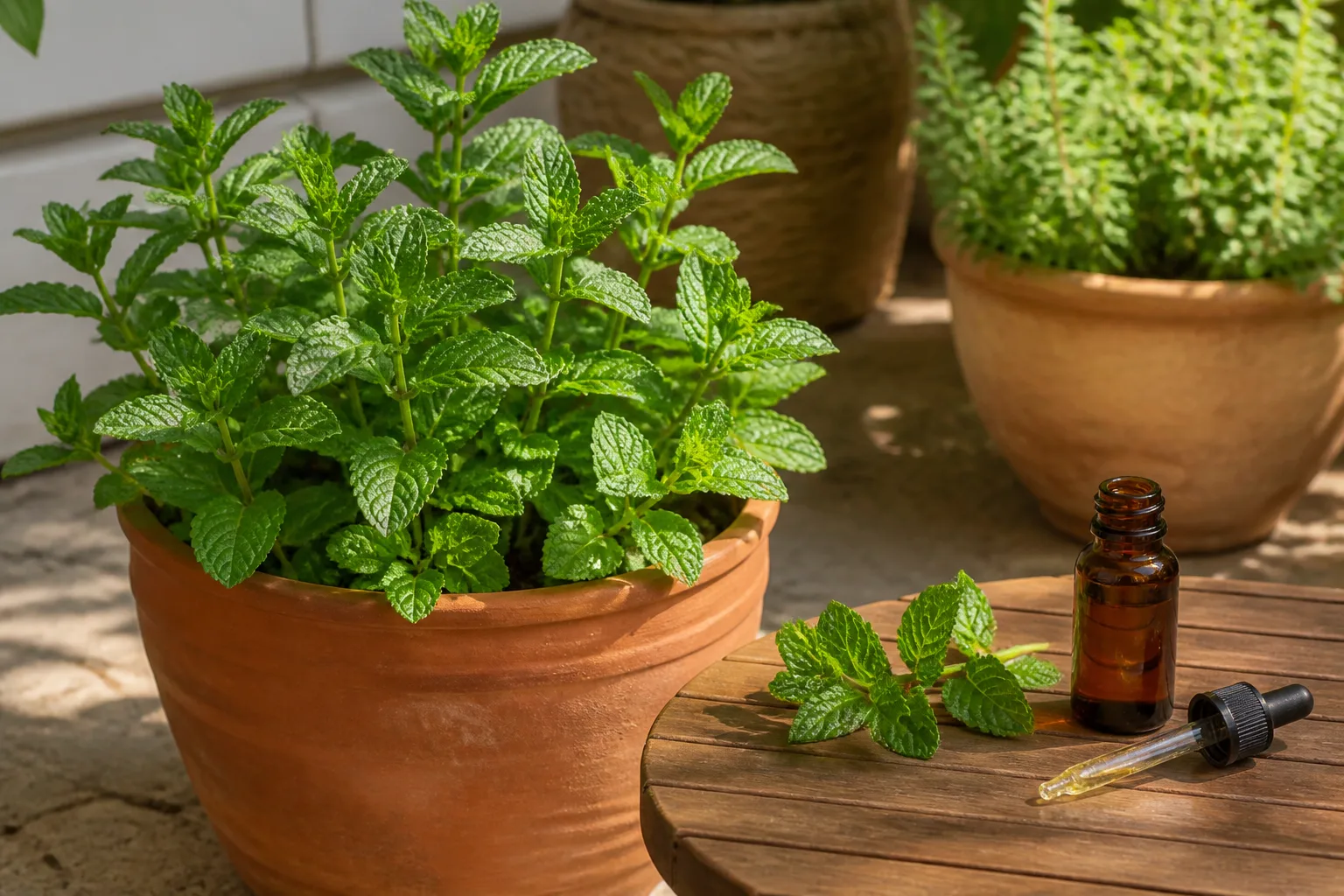
A living mint plant releases a changing, diluted aroma across a growing area. Peppermint oil or another concentrated product is a different material with different exposure, persistence, plant-safety, pet-safety, and labeling questions; do not treat “mint” and “mint oil” as interchangeable.
There is also a gardening cost to planting mint only as a deterrent. Common mint spreads through underground runners and can outcompete nearby plants, so both the RHS and BBC Gardeners’ World recommend containing it in a pot or otherwise controlling its spread (RHS mint-growing guide, BBC Gardeners’ World mint profile). Grow it because you want the herb, not because you expect it to fence out wildlife.
If you want to test whether the smell changes squirrel activity, use the experiment as a low-stakes observation around a non-edible edge, and keep a barrier over the crop that matters. Never spray homemade oil mixtures on edible leaves or fruit without a product label that specifically allows that use; leaf burn and residue are not worthwhile trade-offs for a doubtful result.
Diagnose the kind of squirrel problem first
Squirrels cause several different kinds of damage, and each one needs a different first move. A squirrel digging for a buried nut is not the same problem as a squirrel eating a strawberry, climbing to a feeder, gnawing a tree, or entering an attic.
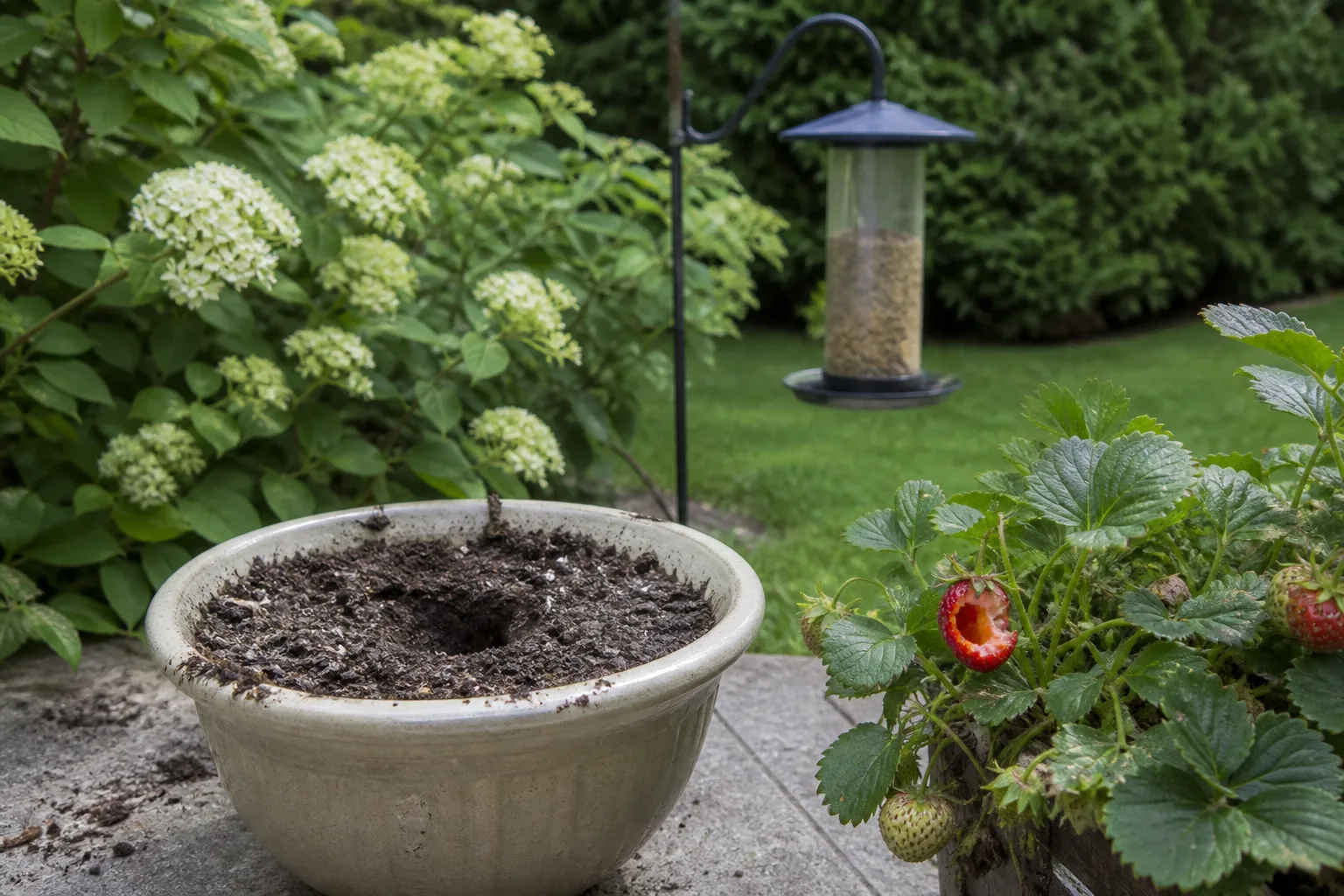
Garden digging versus feeding damage versus feeder raids
Small, shallow holes in loose potting mix may be caching or searching behavior. Squirrels can also dig up newly planted bulbs, disturb seedbeds, bite ripening fruit, clip twigs, chew bark, and take seed from feeders; Penn State Extension describes their diet as seasonal and opportunistic, with fruit, berries, succulent plant material, cultivated crops, and grains becoming important when available (Penn State Extension tree squirrel guide).
Use the pattern to choose the response. A pot with scattered soil needs a mesh cover or a less exposed location; a missing tomato or strawberry needs a cage that keeps the animal away from the fruit; an emptied feeder needs distance and a baffle; and a tree with gnawed bark needs trunk protection rather than a scented border.
| What you see | Likely pressure point | Best first action |
|---|---|---|
| Loose soil and small holes in pots | Caching or searching | Cover the soil with secured mesh and remove loose attractants nearby. |
| Bulbs lifted soon after planting | Digging for underground food | Lay half-inch mesh over the bed before the final soil or mulch layer. |
| Fruit or vegetable bites | Accessible food | Build a rigid cage or netted enclosure that keeps foliage and fruit away from the mesh. |
| Seed disappearing from a feeder | Easy, repeated food source | Move the station away from jump points and add a properly sized baffle or weight-activated feeder. |
| Bark stripped or twigs clipped | Tree access or seasonal feeding | Use a trunk collar or protect the affected branches; do not rely on mint. |
When the problem is a building or utility route
Squirrel activity near an attic, roofline, chimney, vent, or electrical route is not a garden-repellent problem. Squirrels can enlarge small openings, damage insulation, and chew wiring; if you hear movement indoors or find gnawed entry points, focus on safe exclusion and inspection rather than putting oil or herbs near the opening.
Never seal an active opening until you know no animal is inside, and do not approach electrical lines. The Internet Center for Wildlife Damage Management recommends site evaluation, temporary monitoring of openings, secure repairs, and professional handling where young may be present (tree squirrel prevention and control guidance).
Build a protection plan around the food source
Think of squirrel control as a chain with three links: remove or reduce the reward, block the route, and add a temporary behavior-changing layer. Mint belongs, at most, in the third category, and even there it is a weak, inconsistent option compared with a labeled product or a physical interruption.
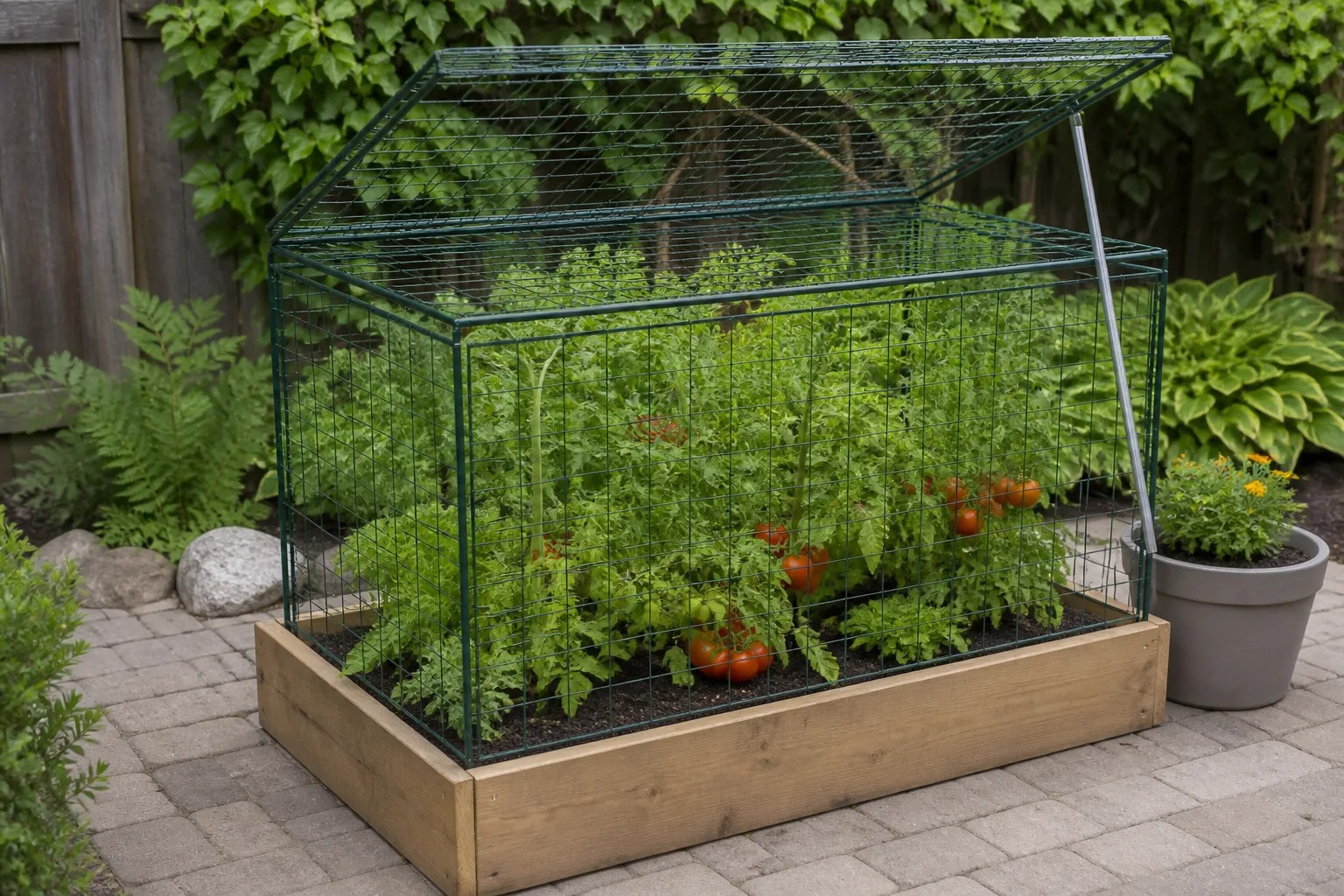
Start with the smallest high-value area
Protecting one raised bed or a group of patio pots is usually more realistic than trying to make an entire yard inaccessible. Measure the area, list the exact crop or item being lost, and choose a cover that can be opened for watering, harvesting, and inspection without leaving a gap.
Install the protection before the next predictable damage event. A cover added after squirrels have learned that seedlings or fruit are available may need a few days of close inspection because the animals will test corners, seams, and any place where the frame meets the ground. Check the setup at different times of day, especially early morning, and look for fresh soil, chewed mesh, bent fasteners, or seed scattered outside the protected area. Those clues tell you whether the problem is a lifting edge, a jump from nearby vegetation, or a food source you have not removed.
It also helps to separate the garden into “must protect” and “acceptable to share” areas. A single cage around a favorite tomato plant may be more durable and easier to maintain than a large enclosure that is opened and left unsecured. Keep a simple note of when you close the cover, when damage appears, and what weather occurred between checks. That short record can show whether a motion sprinkler or scent is changing behavior or merely coinciding with a lull in ripening fruit.
Also look for the reason the squirrel keeps returning. Fallen fruit, spilled seed, open compost, pet food, and an easy water source can make a barrier work harder than it should. Penn State and wildlife-management guidance both emphasize habitat modification and exclusion because reducing access and opportunity changes the behavior at its source.
Do not overreact to minor lawn divots caused by nut caching. If the turf heals and no valuable planting is being damaged, tolerance may be the most humane and least labor-intensive choice. Escalate when there is repeated crop loss, trunk girdling, structural entry, or damage that a simple cover cannot contain.
Physical barriers that beat scent alone
A physical barrier works by changing access, not by asking the squirrel to make a good decision. It is the most dependable choice for a high-value crop because hunger, weather, and habituation do not make a mesh cage disappear.
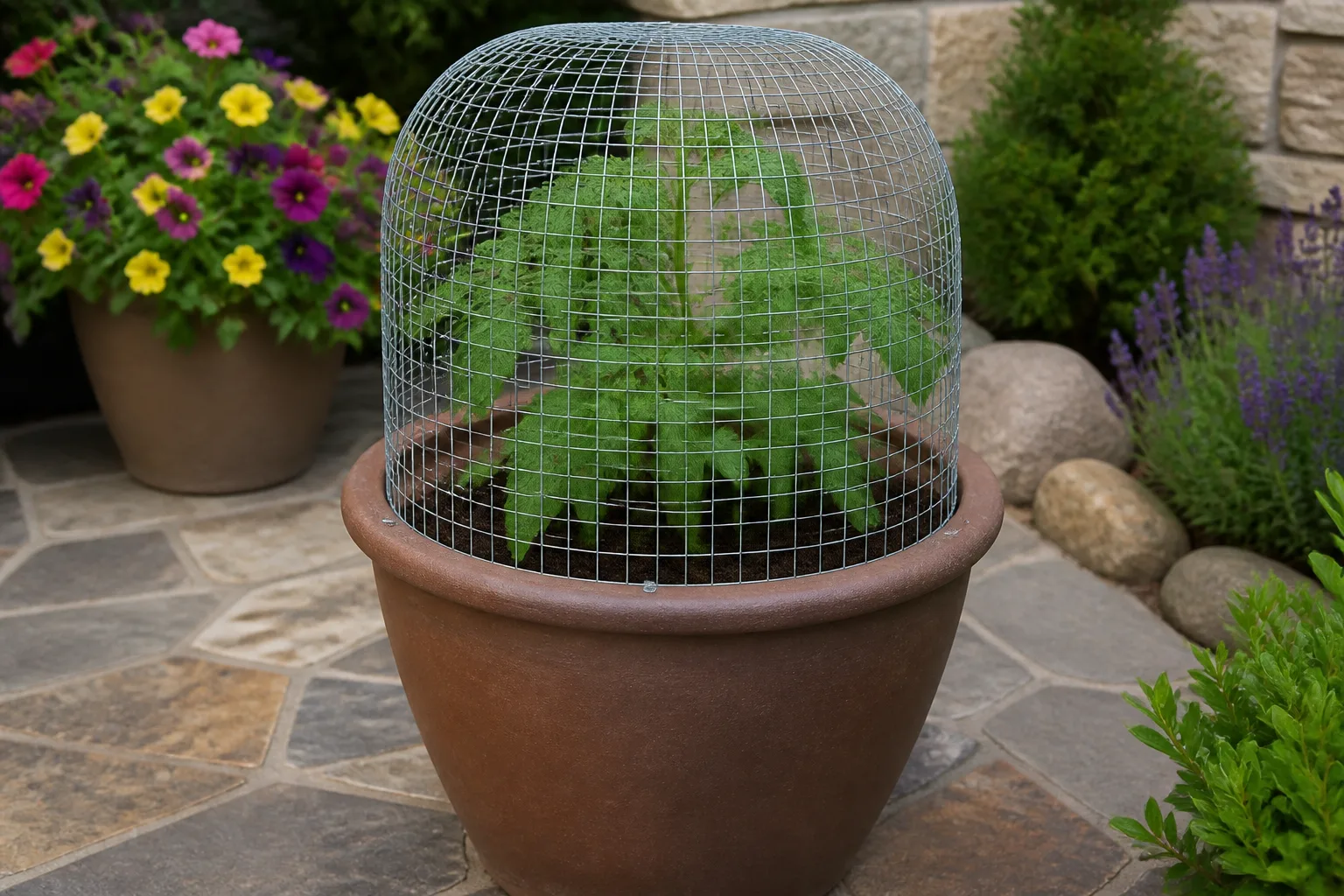
Protect potted plants and raised beds
For a single pot, use rigid wire mesh or hardware cloth shaped into a lid or cage and anchor it so the squirrel cannot lift an edge. Leave enough room for the plant to grow, keep the mesh from pressing against tender foliage, and use a door or removable section so you can water and harvest without dismantling the whole setup.
For a raised bed, build the mesh over a simple frame rather than laying loose chicken wire directly on the plants. Smaller openings are harder for squirrels to reach through, but the cover must also be strong enough not to sag onto the crop and secure enough that a squirrel cannot pry up a corner. Inspect after wind, rain, and every harvest.
Choose the opening size for the animal and the crop, not just for convenience. Half-inch hardware cloth is useful where you need to stop a squirrel from reaching through or digging into a bed, while larger chicken-wire openings may be adequate for a temporary overhead shield when the edges are locked down and the protected plant is not carrying small fruit. A rigid frame also keeps leaves from touching the cover, which reduces the chance that a squirrel can pull foliage or fruit through the mesh. Make the access panel obvious and easy to close; a barrier that is awkward to open is more likely to be left unsecured during the exact part of the season when protection matters most.
For patio containers, check the underside as well as the top. A squirrel may push from below if the pot sits on a light stand, or use a nearby railing as a launch point. Set the cage on the pot rim or a stable base, fasten it with clips that can tolerate watering, and leave room for the plant to move in wind. After heavy rain, inspect for soil washed away from the edge because a newly exposed gap can be easier to exploit than the original opening.
UF/IFAS specifically recommends half-inch mesh laid horizontally above bulbs and extended at least a foot beyond the edge of the bed. For an above-ground enclosure, treat that measurement as a starting point rather than a universal fence height: the correct size depends on what you are protecting, whether the squirrel can climb the frame, and whether there are nearby launch points.
Shield bulbs, fruit, and young trees
Bulbs are vulnerable when the soil is freshly disturbed. Plant them at the correct depth, firm the soil, then place half-inch hardware cloth or chicken wire over the bed before adding the final layer of soil or mulch; the shoots can grow through the openings while the digging animal meets a physical obstacle. K-State Extension gives the same basic protection sequence for newly planted bulbs (K-State landscape protection guidance).
Small fruit trees and shrubs can be covered with netting on a frame during the short harvest window. The net should enclose the canopy rather than lie directly on the fruit, and its bottom edge must be secured; loose netting can trap birds or other wildlife, so choose a visible, durable mesh and check it often.
For a tree trunk or feeder pole, a smooth metal collar or commercial baffle can interrupt climbing. Nebraska Extension notes that gray squirrels can jump about 8 feet sideways, 4 feet upward, and 15 feet downward, so a collar is useful only when the tree or pole is isolated from nearby branches, roofs, fences, and other launch points (Nebraska Extension squirrel control guide).
Do not fasten a tight metal band around a growing trunk or leave it in place without inspection. A collar needs room for growth and should be checked seasonally; if squirrels can simply jump around it, move the protection to the crop or redesign the whole access route.
Make bird feeders harder to reach
Bird feeders create a concentrated, predictable food source, which is why a scent border around the garden often fails while a feeder remains easy to raid. The goal is not to find a smell that squirrels dislike; it is to make the feeder physically inconvenient for a squirrel while keeping it usable for the birds you want to attract.
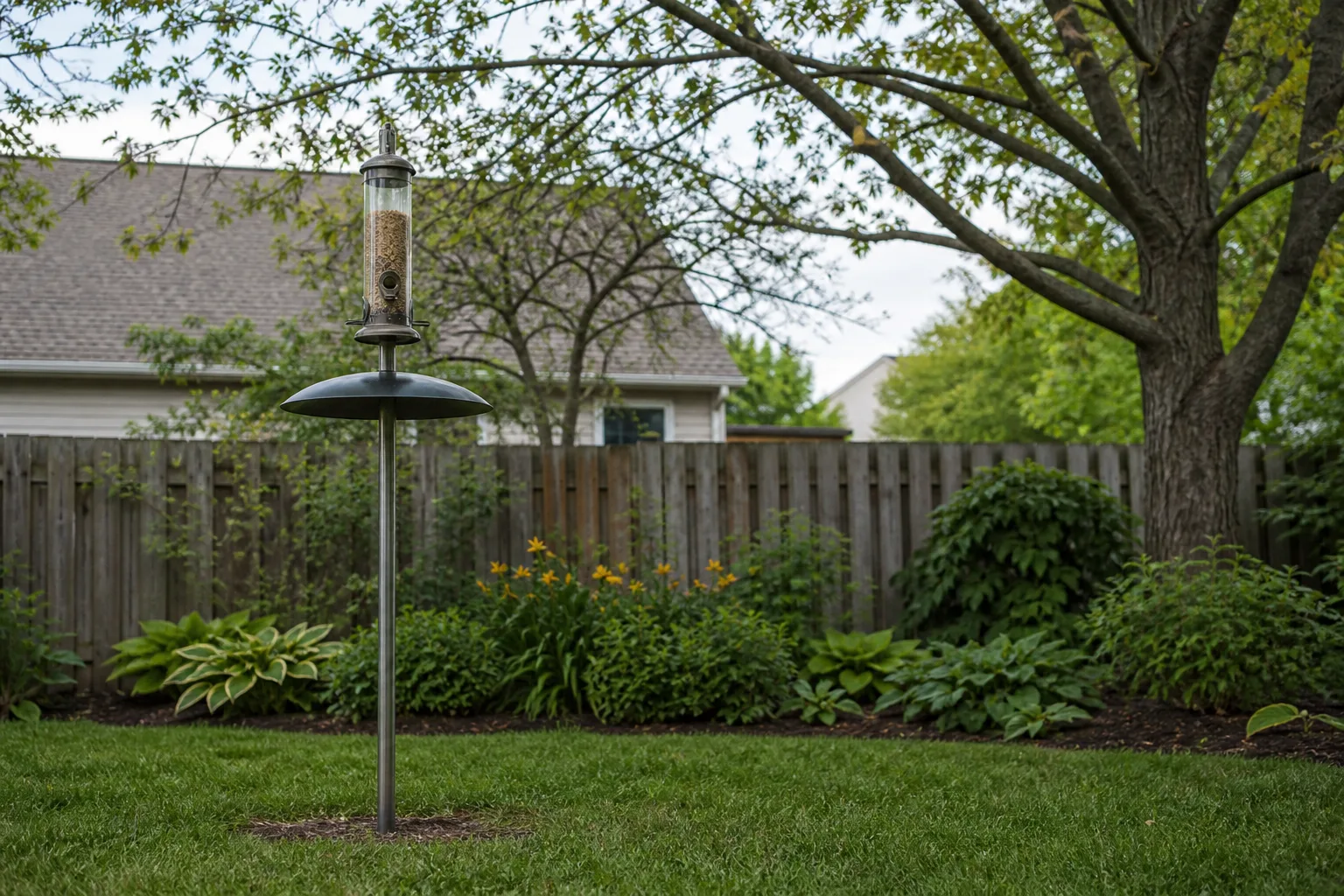
Use distance, baffles, and feeder design together
Start with placement. Nebraska Extension recommends putting a feeder at least 5 feet off the ground and 10 feet from branches or other structures from which a squirrel could leap; a baffle cannot compensate for a feeder that is effectively a short jump from a tree or roof.
Use a wide, correctly installed baffle on a smooth pole, then consider a weight-activated feeder or a cage that excludes larger animals. Long Beach Animal Care Services also describes caged feeders and rotating dome baffles as practical options, while warning that some squirrels learn to collect spilled seed below the feeder (Long Beach squirrel guidance).
Keep the ground beneath the feeder reasonably clean so fallen seed does not become a second feeding station. Changing to a seed squirrels are less interested in may reduce pressure, but it is a supporting choice, not a guarantee; persistent squirrels may still investigate, and the feeder design and location remain the main controls.
Expect to adjust the station after observing it in use. A baffle that spins freely may work differently from one that catches on a pole, and a feeder that is secure in calm weather can swing close enough to a branch in a strong wind. Recheck the distance after pruning, seasonal leaf drop, or moving a pot, bench, or fence nearby. If birds scatter more seed than they eat, use a catch tray or a feeder style that limits waste, but keep the tray accessible for cleaning. Reducing the reward below the feeder matters because a squirrel can ignore the elevated feeder and still be reinforced by the food on the ground.
Avoid greasing a pole. Sticky substances can transfer to birds, collect dirt, and create a messy surface that needs constant renewal. Avoid putting anything on electrical wires or utility poles yourself; route changes near electricity belong to the utility company or a qualified professional.
Use motion sprinklers and repellents as supporting layers
A motion-activated sprinkler can interrupt a squirrel’s approach, especially when the animal is using a predictable path to a bed or feeder. Aim the sensor across the approach, test its detection zone, and keep the spray from eroding soil, soaking a building, or triggering constantly on pets and people.
Treat the sprinkler as a short-term learning layer. UF/IFAS notes that surprise tactics can lose effectiveness and may need to be moved, rotated, or combined with other methods; if the squirrel simply changes its approach, the barrier still has to close the new route.
Use a short observation period to decide whether the layer is earning its place. Note the number of visits, the approach direction, and whether the squirrel avoids the wet zone or simply circles around it. Move the sensor only when you can do so without spraying doors, walkways, or neighboring plants, and turn it off during maintenance. If activity returns as soon as the water stops, the sprinkler has shown that it can interrupt a route, not that it can replace a cover or baffle.
Commercial repellents can be appropriate in limited situations, but read the label before applying anything to a plant, fruit tree, feeder, deck, or edible crop. Wildlife-control guidance distinguishes odor products from taste products and repeatedly warns that performance depends on the animal, the food pressure, the weather, and the reapplication schedule; the label also determines where the product may legally be used.
Capsaicin products are not the same as cayenne sprinkled casually over a garden. A labeled taste repellent may reduce feeding on a permitted plant or surface, but an improvised powder can blow into eyes, contact skin, contaminate harvests, or affect non-target animals. Do not use mothballs, toxicants, ultrasonic devices, or homemade chemical mixtures as a shortcut; ICWDM states that no toxicants are registered for tree squirrel control, and UF/IFAS warns against several ineffective or environmentally harmful outdoor tactics.
A caution about deliberate diversion
Offering squirrels a separate food source can sometimes reduce pressure at a bird feeder or make coexistence feel easier, but it is not a reliable way to protect a crop. Nebraska Extension cautions that feeding can encourage squirrels to fill nearby nesting areas and invade structures, while local wildlife guidance presents diversion as one possible compromise; the conflicting trade-off is exactly why it should not be an automatic recommendation.
If you choose to try diversion, keep it well away from the protected crop and building, use only food appropriate to local wildlife guidance, clean up spilled food, and observe whether visits increase rather than decrease. Stop if the setup attracts more squirrels, creates conflict with neighbors, concentrates animals near pets, or makes the feeder and garden harder to manage.
The kinder default is to protect the food you want to keep and allow incidental squirrel activity where it causes no meaningful damage. You do not need to make the whole yard squirrel-free to save a bed of vegetables or keep a bird feeder functional.
What not to use, and when to call for help
Do not use mint as permission to leave a vulnerable crop uncovered. Do not surround a bed with a low, loose fence and assume the job is finished, leave bird netting unattended, place a trap where children or pets can reach it, or seal a hole while a squirrel may still be inside.
Trapping and relocation are not simple do-it-yourself solutions. Rules differ by state and municipality, some species have special protections, and a female with young can create a serious welfare problem if the entry point is sealed too early. For an attic, chimney, wall cavity, electrical route, repeated structural entry, or severe tree damage, contact a local wildlife-control professional or extension office for species- and law-specific guidance.
You can judge a garden fix by its result rather than by the strength of its smell. If fresh damage continues after a few days, look for the unprotected edge, the nearby launch point, the spill below the feeder, or the food source that is still rewarding the visit, then upgrade the physical protection before adding more scent.
Conclusion
Mint may be pleasant for people and briefly noticeable to squirrels, but it is not a reliable long-term deterrent. Keep it in a container if you want to grow it, and treat any change in squirrel activity as temporary unless a real barrier confirms that access has been blocked.
The practical sequence is simple: identify what the squirrel is taking, protect that item with mesh, netting, a cage, or a properly placed baffle, reduce spills and attractants, and use a motion sprinkler or labeled repellent only as a supporting layer. That approach saves the crop without requiring you to turn the entire yard into a battle zone.