14 Essential Oils for Repelling Ants: What Works
Learn which essential oils repel ants, how long they last, how to use them safely, and why bait, cleaning, and sealing matter for lasting control.
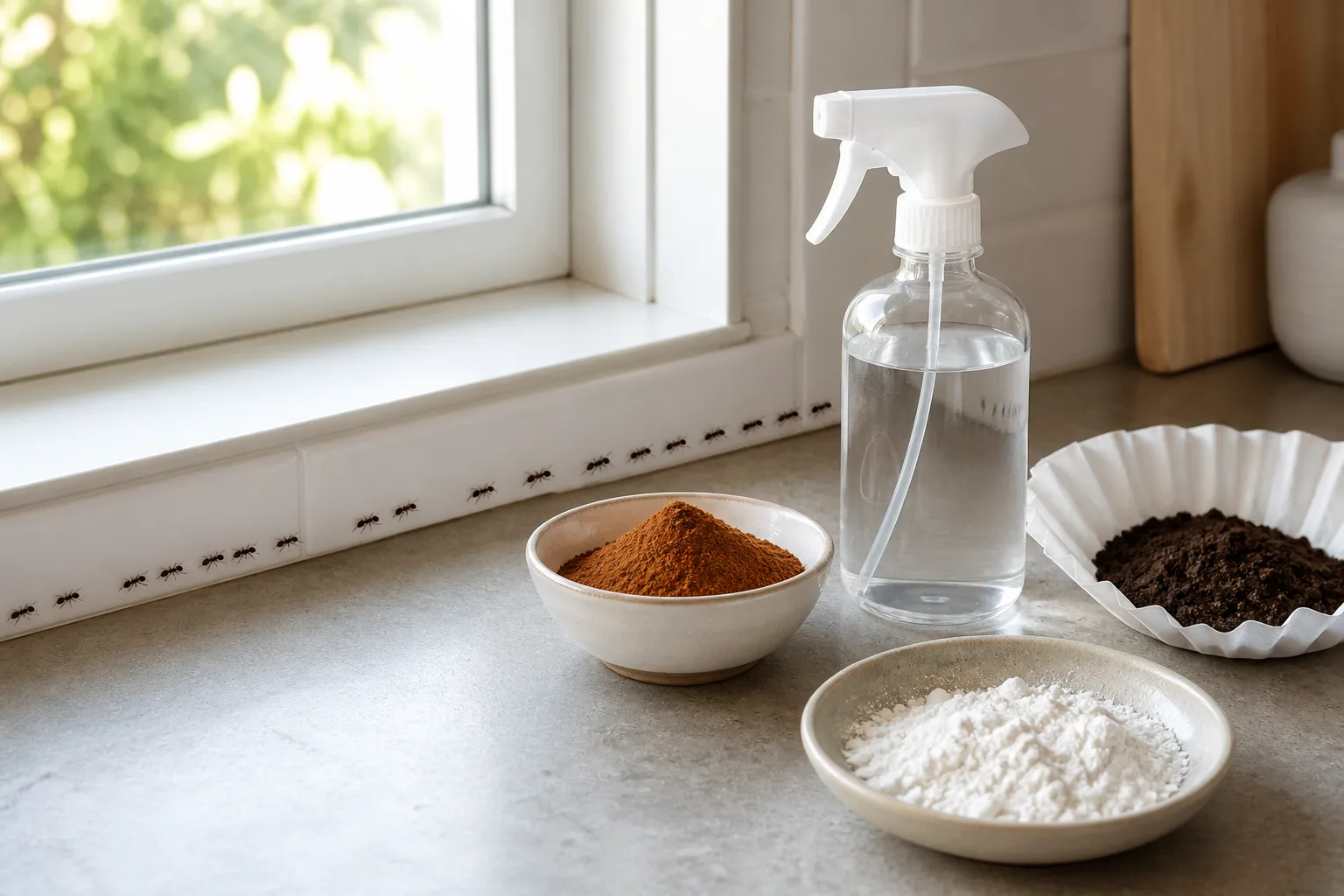
If you want a quick answer, start with peppermint or spearmint oil on a small, non-food-contact section of an ant route. Citronella, lemon, and some citrus compounds also have evidence behind them. But essential oils are usually better at making a treated path unattractive than at eliminating the nest that keeps sending workers back.
That distinction is the part most oil lists miss. In laboratory tests, a barrier can look impressive because ants avoid it or exposed workers die. In a kitchen, patio, or garden, the odor fades, the trail moves around the barrier, or a new group finds the same food from another entrance. Use an oil as a temporary trail-management tool, then remove the food and water source, close the entry, and switch to bait or professional integrated pest management if the colony persists.
The honest answer: oils repel trails better than colonies
Ants do not march randomly. A successful forager can lay a pheromone trail that helps other workers follow the route to food or water. A strong volatile odor may interfere with that route, which is why mint and citrus can appear to “erase” an ant trail. The effect is a boundary, not a wall: ants can wait, cross once the smell weakens, or establish a detour.
The best direct evidence is still narrower than the phrase “essential oils work.” A USDA Agricultural Research Service study found that basil, citronella, lemon, peppermint, and tea tree oils deterred Argentine ants and red imported fire ants from crossing treated barriers under laboratory conditions. Eucalyptus oil did not prevent movement at the tested rates, a useful reminder that a pleasant, powerful smell is not proof of ant repellency.
The same study found that citronella caused complete mortality of exposed Argentine ants after 24 hours and about half mortality in exposed red imported fire ants. Those were continuous-exposure assays, not a recommendation to pour concentrated oil on a mound or spray it around a home. A worker dying on a treated surface is not the same as an oil reaching the queen, brood, or nest chambers.
Which essential oil should you try first?
Start with peppermint or spearmint indoors
Peppermint is the most sensible first trial for a short indoor trail because both laboratory work and practical guidance point in the same direction. A 2024 University of Georgia study found that 1% peppermint oil was the most deterrent of the common home remedies tested against Argentine ants in its preferred harborage. A University of Maine study also found that 10% spearmint and peppermint treatments repelled European red ant colonies from treated pots in laboratory and limited field trials.
Those studies do not establish one universal household recipe. The oils were tested against particular ant species, concentrations, surfaces, and exposure times, and a pot dip is not the same as a line wiped on a baseboard. Treat peppermint and spearmint as good candidates for a small, controlled test—not as a guarantee that every ant species will avoid every sprayed surface.
Choose citrus for a short-lived, food-area-friendly scent barrier
Lemon and orange oils are useful when you want a bright scent and a temporary route disruption, but “citrus” is not a single active ingredient. Lemon and orange oils vary with extraction method and composition; compounds such as d-limonene can be important, while a bottle labelled “citrus blend” may contain several oils at unknown proportions.
Orange oil has more ant-specific evidence than many listicles suggest. In a peer-reviewed study of red imported fire ants, grapefruit essential oil showed fumigant activity and altered worker walking and gripping behavior. That is interesting research, but fumigation in a controlled test is not permission to fill an occupied room with vapor. For a home, use a labelled product if you need a pesticide claim, and keep any DIY use limited to a small, ventilated, non-food-contact spot.
Reserve strong oils for controlled, non-food-contact spots
Clove, cinnamon, tea tree, lemongrass, and some woody oils can be biologically active, but stronger activity also means stronger odor, greater surface risk, and more reason to keep the treatment away from skin, children, pets, and food. Concentrated essential oils are not automatically safer because they come from plants.
The EPA’s pesticide-labeling guidance specifically warns that “natural” or renewable language can mislead people into treating a product as safer than other pesticides. If a commercial product claims to repel or kill ants, use it only for the pests, surfaces, and rates on its label. A bottle of fragrance oil is not the same thing as a tested, labelled pesticide formulation.
The 14 oils, ranked by use case and evidence
The order below is practical, not a universal scientific league table. Evidence changes with ant species, oil chemistry, concentration, surface, temperature, wind, and whether researchers measured avoidance, knockdown, or colony movement. “Best use” means the job the oil is most defensible for—not a promise of permanent control.
Mint and citronella oils: the strongest first tests
| Oil | Why it may help | Best use | Important limit |
|---|---|---|---|
| Peppermint | Strong volatile menthol-rich aroma; repeatedly tested as a barrier or harborage deterrent. | A small indoor trail or entry-point test after cleaning. | Fades quickly and may only redirect the route; keep concentrated oil away from pets. |
| Spearmint | The University of Maine field comparison found treated pots were not colonized during its limited trials. | Outdoor pots, patio edges, or a short-term trail boundary. | The study used a 10% pot treatment, not a universal home spray recipe. |
| Citronella | In USDA assays it deterred both Argentine and fire ants and was the strongest contact-toxicity result among the six oils tested. | A labelled product or tightly controlled outdoor barrier. | Strong activity in a lab does not make it a safe indoor fog, and the smell is short-lived. |
| Tea tree | Deterred both ant species in USDA barrier tests and showed some toxicity to exposed Argentine ants. | A non-food-contact entry seam only when people and animals cannot touch it. | It has a narrow safety margin around pets, especially in concentrated form. |
Peppermint and spearmint are the most reasonable oils to compare first because they answer the same practical need without requiring a complicated blend. Test one at a time so you can tell whether the route changed because of the oil, better cleaning, a weather shift, or a new food source.
Citrus, spice, and woody oils: useful but conditional
| Oil | Why it may help | Best use | Important limit |
|---|---|---|---|
| Lemon | Lemon oil and d-limonene can interfere with odor-guided foraging; USDA tests found lemon barriers deterred both species tested. | A brief outdoor or non-food-contact boundary near an entry. | Citrus oils can irritate skin and damage some finishes; “lemon-scented” is not the same as lemon essential oil. |
| Orange | Citrus compounds have shown fumigant or contact activity in fire-ant research. | A labelled outdoor or crack-and-crevice product, or a cautious spot test. | Do not apply concentrated oil to food-prep surfaces, skin, pets, or plant foliage. |
| Clove | Eugenol is biologically active; peer-reviewed fire-ant research and other ant assays support repellency or toxicity under test conditions. | A contained, non-food-contact treatment when no child or pet can reach it. | It is irritating and potent; do not assume stronger is better. |
| Cinnamon | Cinnamon oil has shown repellency in ant olfactometer and barrier research, and spice compounds can be strongly bioactive. | A short-lived boundary on a sealed, washable outdoor surface. | Cinnamon oil can irritate skin and may damage finishes; ground cinnamon is not an equivalent test. |
| Lemongrass | Its citral-rich aroma is strongly repellent to several insects, and ant studies have found activity under laboratory conditions. | A labelled product or outdoor edge where the odor can dissipate. | Evidence is more species- and formulation-dependent than the marketing suggests. |
| Cedarwood | Cedarwood oil and cedrol have been studied for arthropod activity and can make a treated route less attractive. | A contained outdoor perimeter test away from pollinator activity. | Cedar products are not interchangeable, and cedar odor alone is not colony control. |
For clove and cinnamon, avoid the common leap from “toxic to an exposed insect” to “safe and effective to spray everywhere.” Both oils can be unpleasant or harmful on skin, and neither should be used as a substitute for a registered bait when the nest is inside a wall or under a slab.
Floral and herbal oils: lower-confidence options
| Oil | Why it may help | Best use | Important limit |
|---|---|---|---|
| Patchouli | A study of three urban ant species found toxicity and repellency in laboratory exposure. | A contained test on a non-porous outdoor surface. | The study does not prove that a diluted home spray will control common kitchen ants. |
| Lavender | Its fragrance may make a route less attractive, and extension guidance lists it among oils that can be tried as a deterrent. | A mild scent barrier when the real goal is to redirect foragers. | It is not a dependable colony treatment and is not automatically pet-safe. |
| Thyme | Thymol and related compounds can be insect-active, and thyme oil appears in plant-based pest formulations. | A labelled product or very small outdoor trial. | Chemistry varies by chemotype; avoid guessing at concentration. |
| Eucalyptus | The strong odor is often recommended online, but it belongs on this list mainly because the evidence is mixed. | Only a labelled, species-appropriate formulation if you choose it. | USDA barrier tests found no movement deterrence at the tested rates, and eucalyptol is toxic to dogs, cats, and horses according to ASPCA. |
Lavender, thyme, patchouli, and eucalyptus are not useless by definition; they are simply weaker first recommendations for an ordinary indoor ant trail. If peppermint fails, switching to eucalyptus because it smells stronger is not an evidence-based escalation. First ask whether the food source, entry crack, ant species, or application surface is the real problem.
A safer way to test an essential oil on an ant trail
Prepare the surface and choose the smallest useful application
First remove the reason the ants are visiting. Wipe up sugar, grease, pet food, spilled drinks, and standing water; store pantry goods in sealed containers; and follow the trail to its entry point. UC IPM recommends vacuuming trails or wiping them with soapy water because this physically removes foragers and their scent trail without leaving a repellent residue.
Do not improvise a high-strength formula from a social-media recipe. Essential oil does not dissolve evenly in plain water, so a water-only spray can deliver an unpredictable dose in some squirts and almost none in others. A ready-to-use product with an ant claim and directions is the more reproducible option; if you experiment with a household oil, make a tiny amount, label the bottle, shake it before every use, and spot-test the surface first.
Keep any oil away from countertops where food is prepared, cutting boards, dishes, children’s hands, pet bowls, aquariums, and porous materials that can hold the odor. Do not spray into the air, use an oil diffuser as pest control, or apply an undiluted oil to skin, fur, plant leaves, or a nest.
Apply at the route, not across a food-prep area
Once the surface is clean and dry, treat the narrowest practical section of the route: a window-track edge, a sealed threshold, or a crack that you will later caulk. The goal is to make one route less useful while you finish exclusion, not to coat an entire room in fragrance.
Apply with ventilation and no flame or heat source nearby, especially if the product contains alcohol or another flammable carrier. Keep children and animals out until the surface is dry and the area is aired out. If the oil contacts skin, wash it off; if a person swallows it, Poison Control advises using webPOISONCONTROL or calling 1-800-222-1222 for immediate guidance.
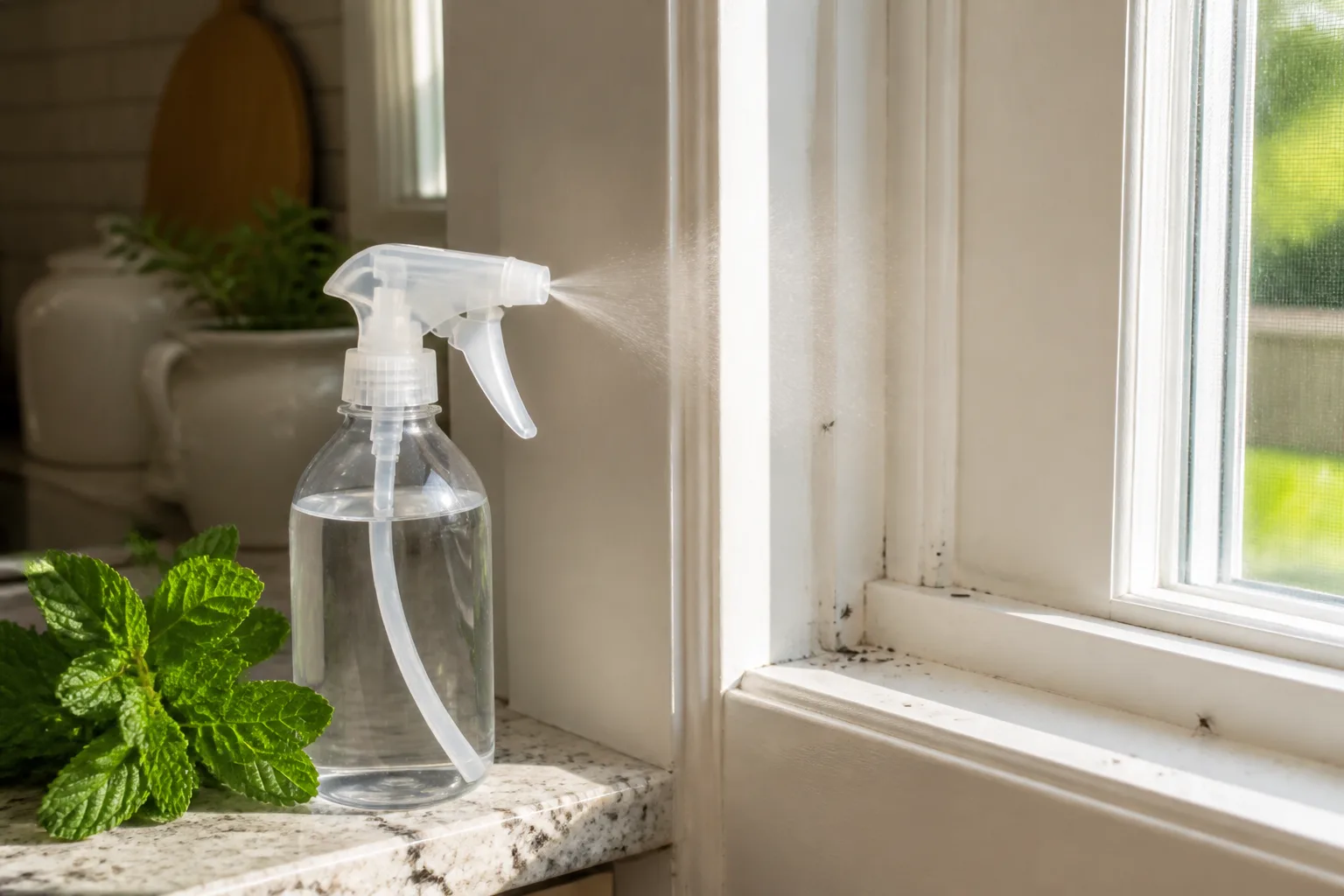
Cats, dogs, birds, rabbits, guinea pigs, and other small animals deserve extra caution. ASPCA guidance explains that concentrated oils can cause health problems through contact or ingestion, and birds have particularly sensitive respiratory tracts. Do not put oil directly on a pet, leave a treated cotton ball where an animal can chew it, or assume that a pleasant room fragrance is harmless.
Refresh only when the trail returns
Watch the treated route for the next day rather than reapplying on a timer. If ants return, do not simply double the drops. Re-clean the path, check whether the trail moved around the barrier, inspect for a second entry, and decide whether a bait station is now the better tool.
An oil can be doing exactly what it can do when the visible line disappears for several hours and reappears later. The correct response is not endless spraying; it is to close the gap or remove the colony’s food source. If you use bait, stop repellent spraying near the bait because a strong scent can make workers avoid the station or prevent them from carrying food back to the nest.
Why an oil works for a day and then fails
Essential oils are volatile. Heat, sunlight, airflow, rain, and an absorbent surface can all shorten the time a treated area smells different from its surroundings. Outdoor applications lose the advantage even faster because wind and moisture spread the compounds beyond the narrow trail.
The ant species matters too. Argentine ants may respond differently from pavement ants, odorous house ants, carpenter ants, or red imported fire ants. Even within one species, a hungry colony can take a risk that a well-fed colony avoids, and a route to water may be worth crossing when a route to crumbs is not.
The most common failure is treating the symptom while leaving the invitation. A sticky counter, leaking pipe, overwatered plant saucer, aphid-covered plant, overflowing bin, or gap beneath a door can keep the traffic going. University of Minnesota Extension describes bait as the best treatment for an indoor nest because workers can carry it into inaccessible areas; it also warns that spraying while baiting interferes with that process.
What actually ends an ant problem
Indoors: clean, seal, then bait if needed
Start with the low-risk sequence: remove food and water, wipe the trail, follow it to the entry, and seal cracks around windows, pipes, wires, and baseboards when the ants are no longer using the gap. Keep branches and vines from touching exterior walls, and fix damp spots under sinks or around doors. This is the part that prevents the next trail rather than simply changing its route. The Old Farmer’s Almanac’s household ant guidance likewise puts cleanup and finding the entry point ahead of any repellent shortcut.
If ants continue to forage indoors, use a labelled bait station or gel bait placed where children and pets cannot reach it. Different ants prefer different bait foods, and workers may need days or weeks to move enough bait through the colony. Resist the urge to spray the line at the same time; UC IPM’s ant guidance emphasizes that baits, sanitation, and exclusion work together, while routine indoor sprays often kill only visible foragers.
For winged ants emerging indoors, piles of sawdust-like debris, persistent activity from a wall or ceiling, or damage around damp wood, get an identification and inspection from a qualified pest professional. A fragrance barrier is not an adequate response to a nest inside a structure.
Outdoors and around plants: identify the reason ants are there
A few ants in a garden are not automatically a plant emergency. The Royal Horticultural Society notes that ants are important predators and part of garden biodiversity, although they may disturb soil or protect aphids and other honeydew-producing insects. If ants are concentrated on a plant, inspect leaf undersides and stems for aphids, scale, mealybugs, or whiteflies before blaming the ants themselves.
If the problem is a patio edge, doorway, or a plant pot that keeps attracting ants, remove the food source, reduce contact between foliage and structures, and use a contained bait or labelled treatment suited to the site. Avoid coating flowering plants with strong oils: they can burn foliage and may affect beneficial insects even when the label does not make that risk obvious.
Fire ants deserve a separate approach because stings, mound location, and local regulations change the risk. Essential-oil studies on red imported fire ants are useful for discovering candidate compounds, but many remain laboratory or formulation research. Do not disturb a mound with bare hands, children, or pets nearby; follow local extension guidance and the product label, or hire a professional for a large or hazardous infestation.

For a whole-home problem, think in layers: clean the invitation, erase the trail, seal the route, bait the colony, and escalate when the nest or species makes DIY control unreliable. Essential oil belongs in the second or third layer as a temporary boundary, not in place of the whole sequence.
Conclusion: use oils as a short-term boundary, not the whole plan
Peppermint and spearmint are the best first tests for many indoor trails, with citronella and selected citrus, clove, cinnamon, lemongrass, cedarwood, and patchouli options when the setting and safety controls fit. Tea tree, lavender, thyme, and eucalyptus need more caution and lower expectations, and eucalyptus is a particularly poor choice if you are relying only on smell because it failed to deter movement in the USDA barrier tests.
The useful question is not “Which oil kills ants instantly?” It is “What job can this oil safely do while I remove the reason ants are here?” Use a small, labelled, well-ventilated application on a non-food-contact surface, keep it away from animals and children, and give the trail a chance to disappear. If ants return, stop increasing the fragrance and move to cleaning, exclusion, bait, or professional identification—the steps that can reach the problem behind the trail.