5 Fall Plants for a Beautiful Autumn Garden
Plan a beautiful autumn garden with red hot poker, Japanese anemone, bittersweet, Russian sage, and New England aster—plus practical planting tips.
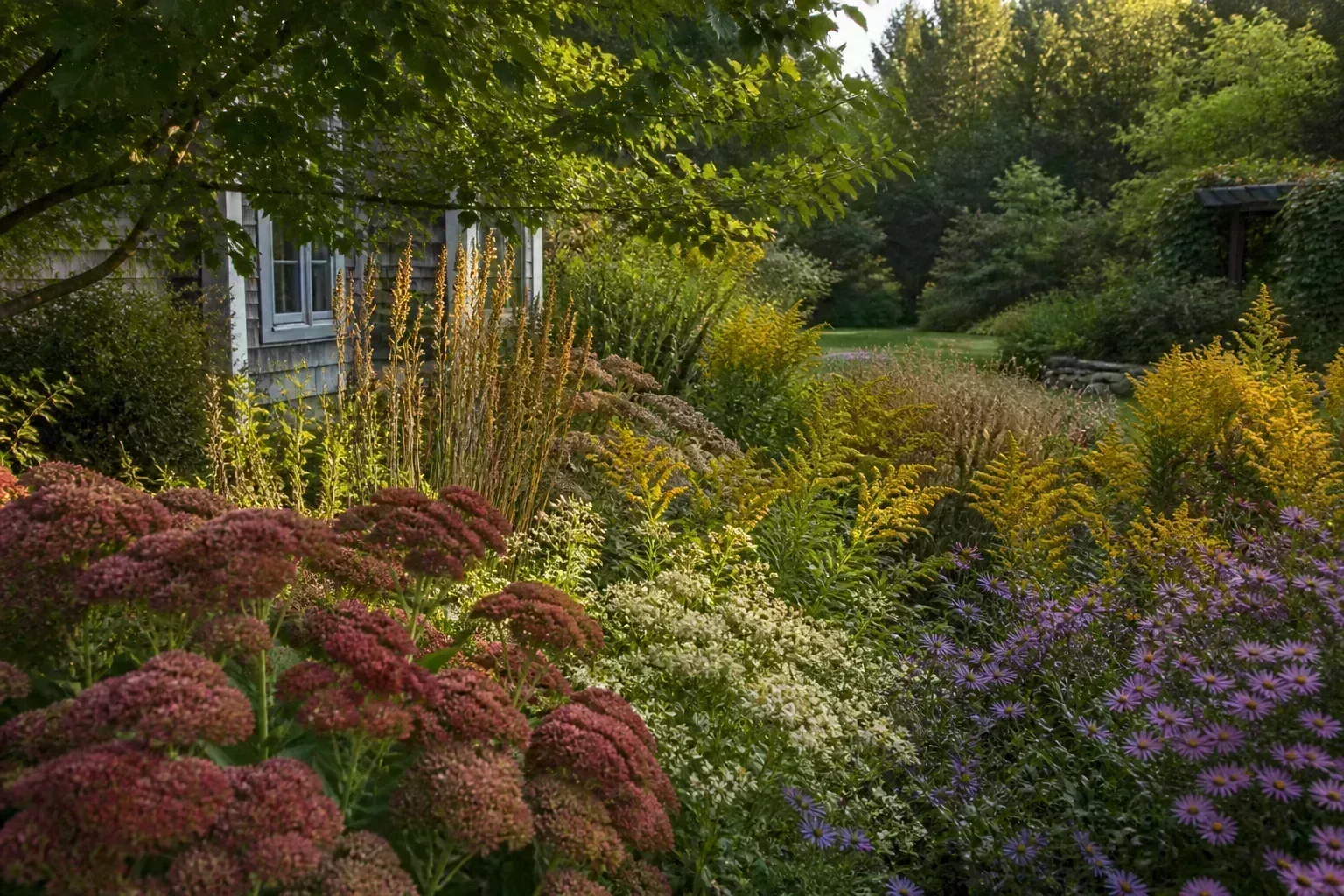
Autumn is not a consolation season for a garden. It is the moment when late flowers, seedheads, silver foliage, and berries can make the planting look more intentional than it did in midsummer. The trick is to choose plants that perform a specific job in your conditions rather than buying five colorful specimens and hoping they bloom together.
This shortlist covers five different kinds of fall interest: architectural flower spikes, luminous anemone blooms, long-lasting fruit, drought-tolerant haze, and a native pollinator perennial. Use the details below to match each one to light, drainage, available space, and the kind of autumn display you want. Bloom dates are approximate because day length, heat, latitude, and first frost move the calendar from garden to garden.
Why fall planting can give a garden a head start
Planting in early or mid-fall often gives roots time to grow while the soil is still warm, without asking a new plant to push a large flush of tender top growth through peak summer heat. Cooler air also reduces water loss from leaves. That is why a healthy nursery perennial can settle in well before its first full growing season.
Fall is not automatically the right planting window everywhere. A plant installed into frozen ground, standing water, or a dry site during a prolonged warm spell can fail just as easily as a spring planting. In cold regions, aim to plant several weeks before the ground usually freezes; in mild regions, the window may extend much later. The non-negotiables are workable soil, a root ball that can be watered deeply, and enough time for the plant to anchor before severe cold. The seasonal logic is also reflected in practical perennial guidance from Rural Sprout, which emphasizes that fall-blooming perennials can return and improve with age when the site suits them.
For a new planting, water the root zone thoroughly after backfilling, then check the soil beneath the mulch rather than watering by the calendar. A two- to three-inch mulch layer helps moderate temperature and slows evaporation, but it should sit around—not against—the crown or woody stems. Do not fertilize heavily in late fall; the goal is root establishment, not a soft flush that is vulnerable to cold.
Choose fall plants by garden job, not just flower color
Start with the space. A full-sun, fast-draining border can support red hot poker or Russian sage, while a bed with consistent moisture and afternoon shade is a better candidate for Japanese anemone. Aster can handle a more generous soil profile and is especially useful where pollinator value matters. American bittersweet is a different decision entirely: it is a large woody vine that needs a strong support and a plan for controlling its reach.
Then decide what should remain after the flowers fade. If you want a focal point visible from the street, choose the poker’s vertical spikes or bittersweet’s orange-and-red fruit. If you want a soft transition between shrubs and perennials, Russian sage supplies airy blue-violet color. If your late-season garden feels empty after summer annuals are removed, aster fills the gap with a dense cloud of small daisy-like flowers.
Finally, check the label for the cultivar’s mature size, not only the species description. ‘Purple Dome’ New England aster is a very different border partner from a six-foot selection. A compact red hot poker may work at the front of a bed, while a tall cultivar belongs behind lower plants. The best fall garden looks layered because height, texture, and bloom timing were planned together.
1. Red hot poker (Kniphofia)
Red hot poker earns its place when a garden needs a strong vertical exclamation point. The dense flower spikes rise above strap-like foliage in combinations of red, orange, yellow, cream, or green, and many hybrids flower from summer into fall. The plant is a clump-forming perennial rather than a short-lived seasonal accent, so it can become a repeatable part of the border once established.
Its strongest use is near the middle or back of a sunny bed, where the spikes can be seen above lower autumn flowers. It also pairs well with blue flowers, ornamental grasses, and plants with rounded seedheads. The warm flower colors are effective in a fall palette, but the foliage gives the plant value even when a particular spike has finished.
Give red hot poker sharp drainage and room for its crown
Choose a site with full sun and soil that drains freely, especially through winter. Red hot poker dislikes a wet crown more than it dislikes an occasional dry spell. Heavy clay is not an automatic veto, but a low pocket that stays saturated after rain is a poor site; plant on a gentle rise or improve the planting area so water moves away from the crown.
Set the plant at the same depth it occupied in its container. Burying the crown under extra soil or a thick mulch layer can trap moisture around the growth point. Space it according to the mature width on the tag, leaving enough room for air to move between clumps. Crowding may look tidy at installation and become a foliage-and-disease problem later.
Water slowly enough to wet the whole root ball and surrounding soil. The plant needs more attention while it is rooting than it will after establishment, but drought tolerance is not the same as a no-water rule. Regular moisture during active growth usually supports better flowering than repeated severe dry-downs, particularly in sandy soil or exposed sites.
Keep first-winter care simple
Do not cut the foliage into a tight bundle simply because the bed looks untidy. In cold or wet climates, the leaves can help shelter the crown, and a loose tie may be preferable to aggressive fall pruning. Remove damaged or collapsed foliage when spring growth begins, and clear winter debris if it is matting over the crown.
The common failure pattern is combining poor drainage with late-season overwatering. If the plant looks stressed after rain, do not respond by adding more water or fertilizer. Check whether the crown is sitting in a depression, whether the mulch is too deep, and whether the soil has stayed saturated. A better site fixes more problems than a stronger feed.
2. Honorine Jobert Japanese anemone
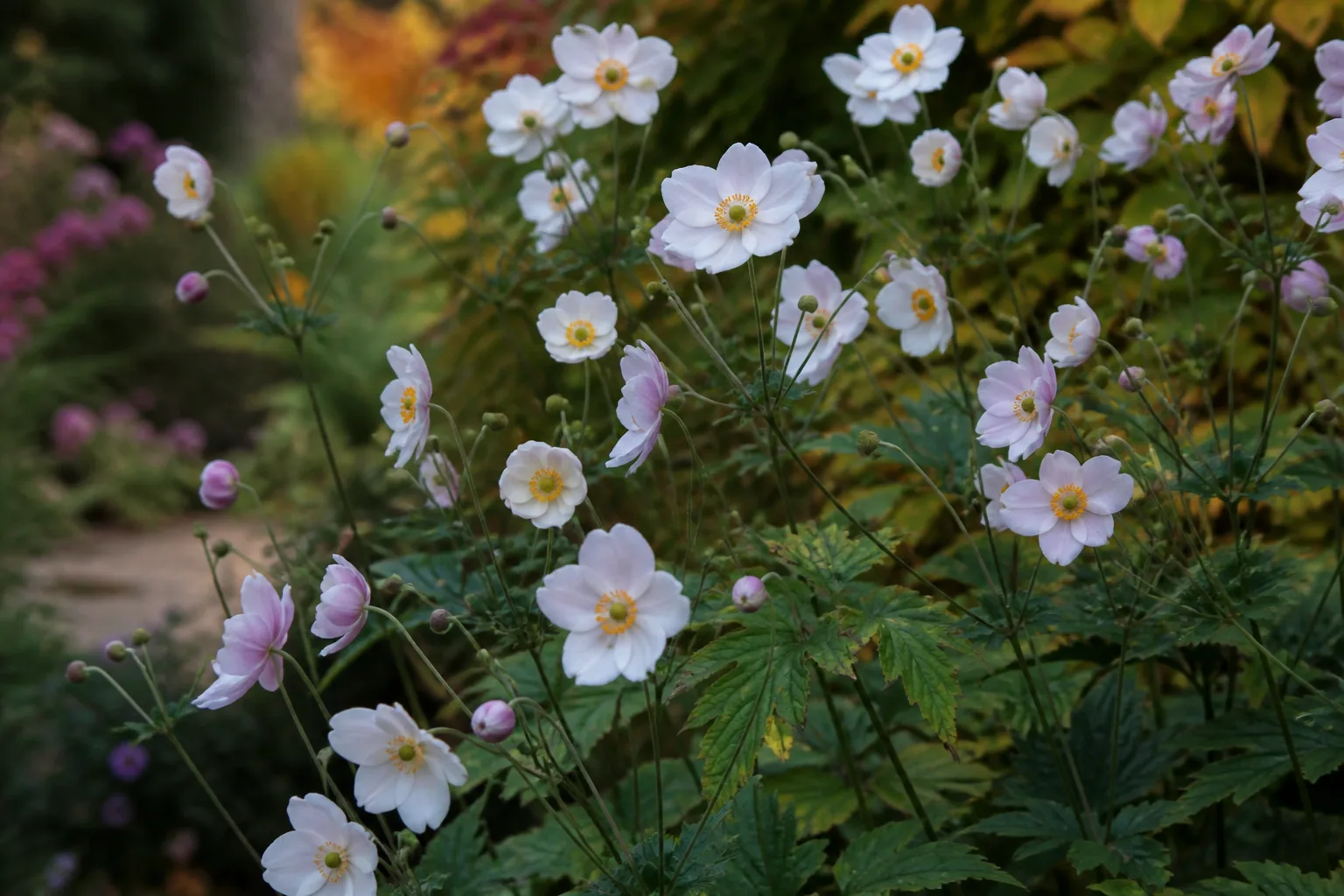
Honorine Jobert is the white-flowered Japanese anemone often used to brighten a late-summer or fall border. Its single, pale flowers sit on wiry stems above divided foliage, giving it a lighter, almost floating appearance than a dense mound of mums. The flowers are especially useful in a partly shaded garden where the afternoon light is too harsh for many late bloomers.
This is a plant for gardeners who want motion and a naturalistic feel, not a perfectly clipped edge. The stems sway, the flowers open over a period of weeks, and the plant can knit into neighboring perennials. Give it room to look graceful. The white blooms also work as a visual bridge between deep purple asters, grasses, burgundy foliage, and the first yellow leaves of shrubs.
Plant it where late-season light is gentle
Give Japanese anemone rich, moisture-retentive but well-drained soil. Morning sun and afternoon shade are a useful default in hot-summer areas; in cooler climates it can take more sun if the roots do not dry out. A location that receives fierce reflected heat from a west-facing wall can scorch foliage and shorten the display.
Fall planting is possible when the plant has time to root before hard frost, but spring is often the safer choice in very cold areas or where nursery plants arrive late. Whichever season you choose, keep the root zone evenly moist while the plant establishes. A layer of compost worked into the surface and a moderate mulch layer can help, but do not bury the crown.
Contain the spread before it becomes a border problem
Japanese anemone can expand by underground growth and gradually form a broad colony. That is an advantage in a cottage-style or woodland-edge border, where a loose drift is welcome. It is less helpful beside a narrow path or a small shrub that cannot compete with spreading roots.
Place it where expansion has somewhere to go, and inspect the edge of the clump each spring. Pull or dig out unwanted shoots while they are small rather than waiting until roots have threaded through neighboring plants. Dividing an overgrown clump is possible, but it is disruptive; choosing the right location at the start is easier.
Avoid judging the plant too quickly after installation. Japanese anemone can sulk during its first season, especially if moved while in flower. Consistent moisture, patience, and protection from the hottest afternoon exposure usually matter more than frequent feeding. Once established, it can provide the late color that a shaded border often lacks.
3. American bittersweet (Celastrus scandens)
American bittersweet is the choice for a garden that needs fall and winter interest after flowers have faded. This native North American woody vine carries inconspicuous flowers, yellowing foliage, and showy fruit capsules that open to expose scarlet seeds. It can cover a fence or trellis, but it is not a small decorative climber to tuck beside a doorway.
The plant’s fruit is also the reason you must shop carefully. American bittersweet is frequently confused with Asian bittersweet, Celastrus orbiculatus, an aggressive introduced vine. North Carolina Extension notes that the native’s leaf tips taper to a point, while the invasive look-alike has more rounded leaf tips; the safest approach is to buy from a reputable native-plant nursery with the scientific name on the label. Never collect an unidentified bittersweet vine from a roadside or woodland edge.
Buy the right plant and plan for fruit
American bittersweet is primarily dioecious, which means male and female flowers are usually on separate plants. A female plant cannot produce its signature berries without pollen from a compatible male nearby. Ask the nursery how the plants were propagated and whether a male and female are available; do not assume that two unlabeled vines will solve the problem. Tennessee Smart Yards also flags the plant’s rapid, tangling growth and the need for both sexes when fruit is the goal.
NC State Extension reports that one male is generally needed for several females, although home gardeners should prioritize a confirmed compatible pair over a precise ratio. If berries are your main goal, place the male close enough for pollination but not so close that both plants become an unmanageable tangle. The fruit is attractive to birds, yet the plant is harmful if eaten, so use care around children and pets and avoid using loose fruit in a household where it may be mistaken for something edible.
Full sun gives the best fruit display, while partial shade is tolerated. The soil should drain well and should not stay waterlogged. Because the vine grows quickly, a fertile, irrigated site may produce more growth than the support can handle. That is not a reason to starve the plant; it is a reason to plan pruning and support before planting.
Give the vine a real support
Use a stout trellis, fence, arbor, or other structure that can carry a mature woody vine. Do not encourage it to climb a living tree. Twining stems can wrap around branches and trunks, and an unchecked vine can smother or girdle smaller shrubs. If you have no structure, allow it to sprawl only where it can be monitored and will not root or scramble into neighboring plants.
Prune in late winter or early spring to remove damaged, crossing, or badly placed stems and to keep the vine within its allotted space. Tie or guide young stems early, before they become stiff. The objective is not a perfectly flat wall; it is a stable framework that lets the fruiting stems remain visible.
4. Russian sage (Salvia yangii)
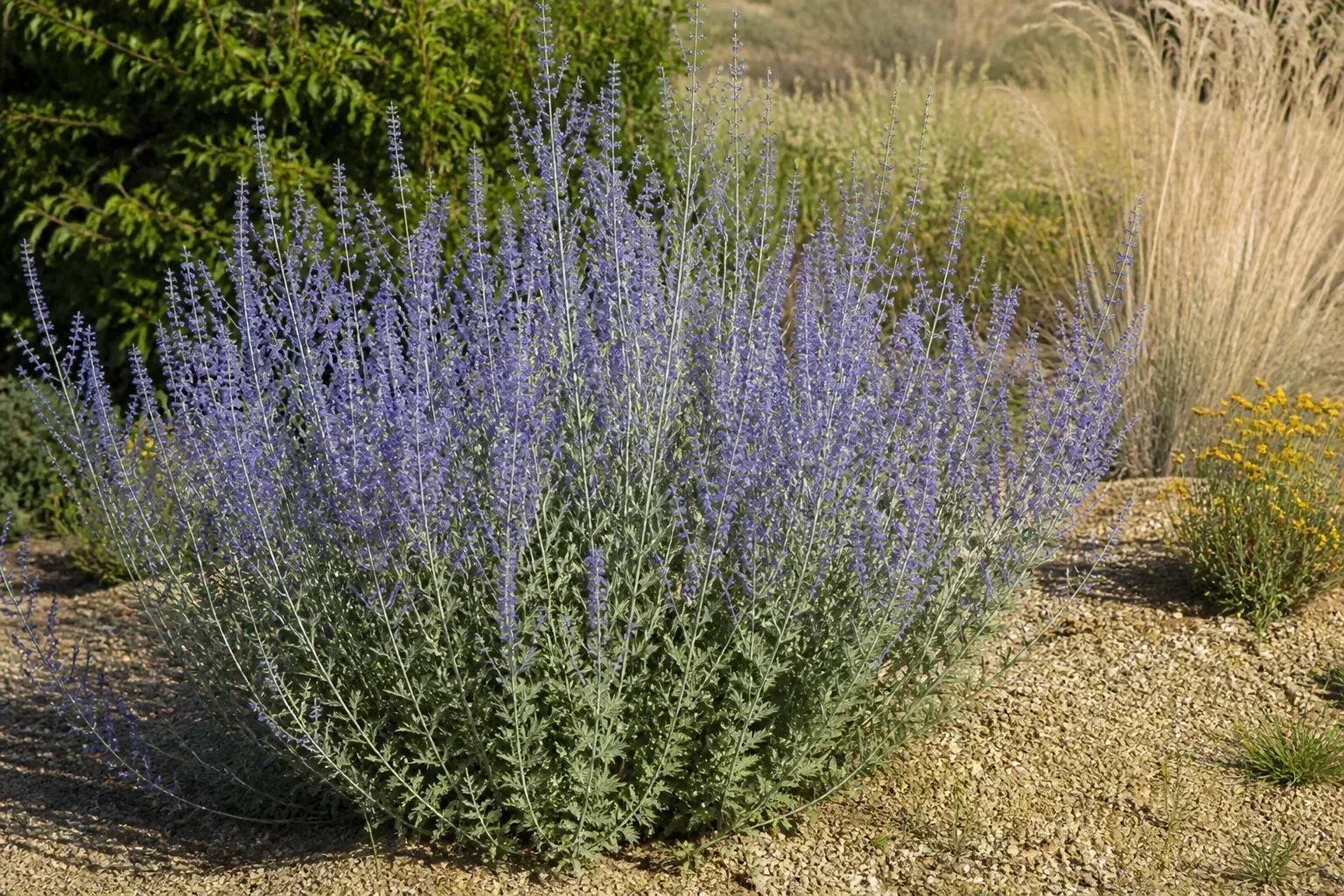
Russian sage, now commonly treated botanically as Salvia yangii and formerly sold as Perovskia atriplicifolia, brings a cool blue-violet haze to a season dominated by gold, rust, and red. Its fine, silvery stems and aromatic foliage create a textural pause between broad-leaved perennials. It is particularly effective in gravel gardens, sunny borders, and dry slopes where moisture-loving plants struggle.
Think of it as an airy structural plant rather than a dense flowering mound. Several plants grouped together make a stronger visual statement than one isolated stem, and the open habit lets shorter plants show through. It can also soften the edge of a hardscape without requiring the rich, moisture-holding soil that many traditional perennials prefer.
Let sun and drainage do the work
Give Russian sage full sun and well-drained soil. The most common mistake is placing it in a damp bed because the plant looks delicate. Its feathery appearance does not indicate a thirst for constant moisture; saturated soil and low light are more likely to produce weak, floppy growth than a long-lived, upright plant.
Water new plants deeply when the root zone begins to dry, then extend the interval as roots move into the surrounding soil. Do not keep the soil continuously wet. Avoid frequent high-nitrogen fertilizer, which can encourage lush stems at the expense of the compact, silvery texture that makes the plant useful.
In late winter or early spring, cut the old stems back according to the cultivar’s instructions, leaving a short framework if recommended. Fall pruning is not necessary for the plant’s survival and removes stems that can give the winter border shape. If the plant flops, diagnose the site first: too much shade, excess fertility, rich wet soil, or insufficient spacing are more useful clues than simply cutting it shorter.
5. New England aster (Symphyotrichum novae-angliae)
New England aster is the workhorse of this group when late flowers and wildlife value are priorities. It is a native eastern North American perennial with purple, pink, or rose flowers and yellow centers, generally blooming from late summer into fall. NC State Extension describes plants ranging from about three to six feet tall, while Penn State Extension lists a bloom period of August through October and notes that cultivars offer different heights and flower colors.
The scale is important. Species-sized plants can be magnificent in a meadow-style planting and awkward at the front of a narrow border. Use a shorter cultivar where you need a defined edge, or place taller plants behind grasses and lower perennials so a little looseness reads as layered rather than untidy.
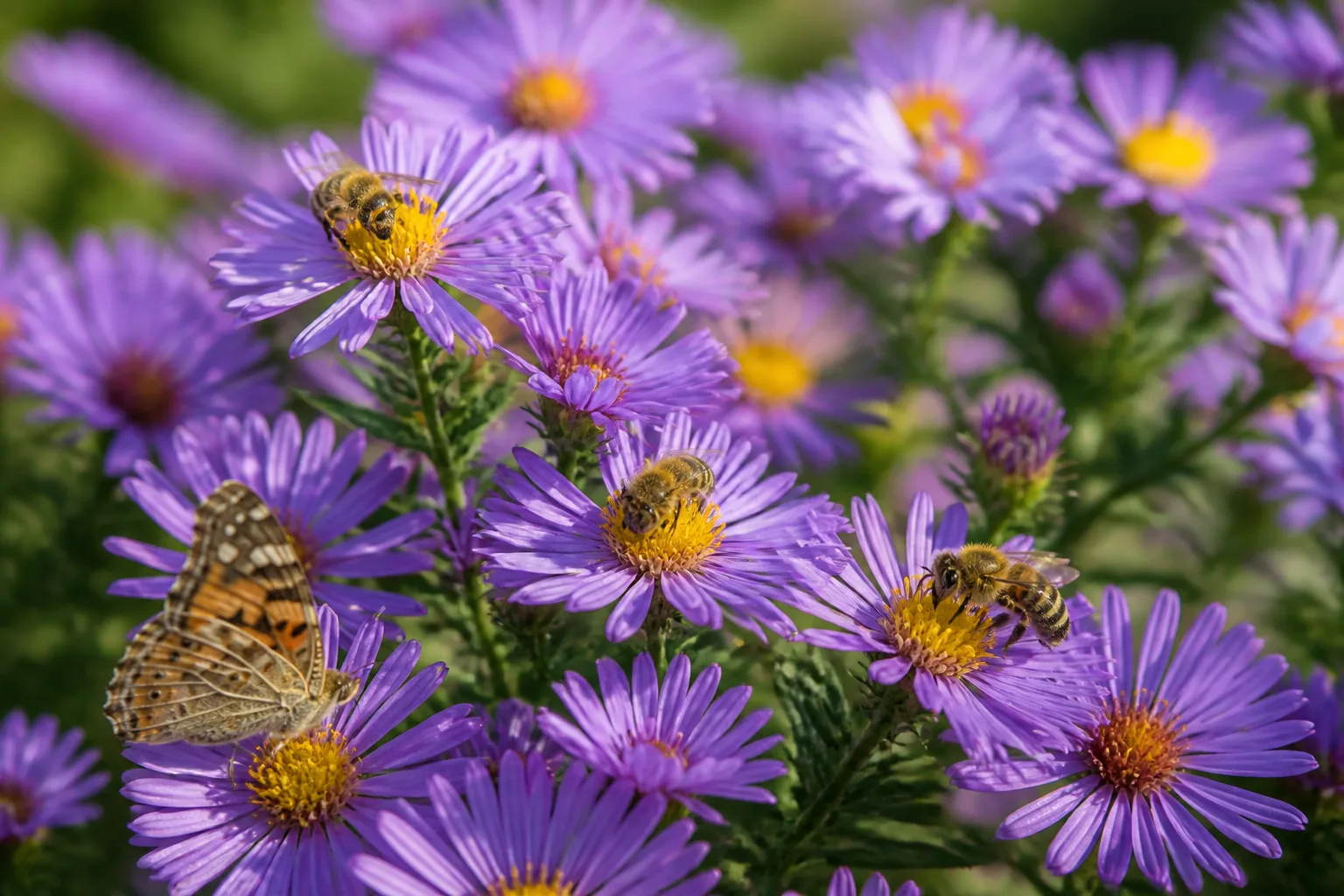
New England aster supplies nectar to late-season bees and butterflies, and its seeds can feed birds after flowering. Penn State Extension also identifies it as a host plant for Pearl Crescent and checkerspot butterflies and an important food source for migrating monarchs. These benefits are strongest when the plant is part of a varied planting with other bloom periods, shelter, and no routine broad-spectrum insecticide use. A detailed horticultural perspective from What Grows There likewise treats New England aster as a dependable late-season garden choice rather than a one-week color burst.
Make aster sturdy and healthy
Plant aster in full sun to partial shade with moist, fertile, well-drained soil. It tolerates clay and can work in a rain-garden setting, but “moist” does not mean permanently flooded. Good airflow matters because dense foliage and damp leaves can invite powdery mildew and other leaf problems. Avoid squeezing tall plants between a wall and a hedge where air cannot move.
If you want a shorter, bushier plant, pinch or trim the growing tips in late spring or early summer, before buds form. A June cutback can reduce flopping, but timing matters: trimming too late may delay flowers. Tall cultivars may still need a discreet support ring, especially after heavy rain. Deadheading can extend the tidy flowering phase, while leaving the final seedheads gives the winter garden texture and wildlife food.
The practical lesson is to accept some seasonal imperfection. Aster foliage can look tired by the end of a hot summer, and the plant may need staking. Those drawbacks are manageable when the planting is designed for the flower display and wildlife value rather than judged as a perfect green mound in September.
Build a fall border that carries into winter
The five plants work best as a sequence rather than a collection. Put red hot poker where vertical spikes can rise above the middle layer. Use Japanese anemone in the gentler light at the edge of a shrub or beneath an open canopy. Let Russian sage occupy the dry, sunny transition. Place New England aster where its height can be supported by neighbors, and reserve American bittersweet for the back of the garden on a structure.
Color is only one layer of the design. Pair blue-violet Russian sage and asters with the poker’s hot colors; use Honorine Jobert’s white flowers to brighten shade; and let bittersweet take over the visual work after leaf fall. Grasses, seedheads, evergreen shrubs, and exposed stems keep the border from collapsing when frost ends the flowers.
Spacing is the quiet difference between a professional-looking planting and a crowded one. At installation, the bed may look sparse. Resist filling every gap with extra plants. Mulch the open soil, water the root zones, and let the perennials reach their intended size. If you need immediate fullness, use temporary annuals that can be removed without disturbing the new roots.
First-year planting checklist for fall perennials
Use this sequence for almost any new fall planting:
- Confirm the site. Measure hours of direct sun, watch where water collects after rain, and check the mature height and width on the plant label.
- Prepare the soil modestly. Remove competing weeds, loosen the root zone, and add compost only when the soil needs organic matter. Do not create a rich pocket that drains differently from the surrounding bed.
- Inspect the roots. Tease circling roots gently and cut only damaged or tightly girdling sections. Keep the root ball from drying while you work.
- Plant at the correct depth. The crown and soil line should match the nursery depth. Set vines and crowns carefully; extra soil is not extra protection.
- Water once, deeply. Fill the planting basin, allow the water to soak in, and repeat if the root ball was very dry. This removes large air gaps without turning the site into a pond.
- Mulch with clearance. Use a moderate layer over the root zone, leaving a visible gap around crowns and stems.
- Monitor through the season. Check below the surface when rainfall is light, and reduce watering when the ground is cooling and the plant has lost leaves.
- Delay major pruning. Leave sturdy stems and seedheads through winter unless they are diseased or creating a safety problem; do the structural cutback at the plant’s appropriate spring window.
Common mistakes with fall plants
The first is choosing by photograph. A plant can look perfect in a nursery pot and still be wrong for a wet clay hollow, a reflected-heat corner, or a bed too small for its mature spread. Site mismatch is especially costly with American bittersweet, which can become a serious maintenance problem if planted without a support and pruning plan.
The second is treating all five plants as equally drought tolerant. Russian sage and established red hot poker may handle dry conditions better than Japanese anemone or New England aster, but every new plant needs water while roots establish. Water deeply and adjust to soil and weather; do not copy a fixed weekly schedule across different beds.
The third is over-cleaning in fall. Removing every stem, leaf, and seedhead can expose crowns, erase winter texture, and remove food for birds. Cut back plants when disease, ice damage, or access requires it, but let healthy structure remain when it adds value.
The fourth is ignoring plant identity. “Bittersweet” on a casual label is not enough; look for Celastrus scandens. Likewise, compare cultivars of asters and red hot poker by mature size, not the generic species image. A small amount of label-reading prevents years of correction.
Conclusion
The best fall plants do more than produce a late flush of color. They give a garden a reason to remain interesting as the season changes: red hot poker supplies height, Japanese anemone brightens gentle shade, American bittersweet carries berries into winter, Russian sage cools a hot palette, and New England aster keeps pollinators supplied when many summer flowers are finished.
Choose the plant that fits the site first, then give it enough space, correct planting depth, and careful first-year water. If you build the border around bloom sequence, texture, and winter structure, autumn becomes a designed season rather than the moment the garden starts to disappear.



