10 Fast-Growing Flowering Trees to Grow
Compare 10 fast-growing flowering trees by bloom season, size, climate, wildlife value, and maintenance before you plant.
A fast-growing flowering tree can change a young landscape quickly, but “fast” is not the same as “best.” A tree that adds several feet of shoots in a good season may also become too large for a small yard, need more water while establishing, or develop weak structure if it is poorly selected and pruned. The most satisfying choice is the one whose mature canopy, bloom season, and climate range fit your site.
The ten choices below include true trees, a vine trained into a tree form, and a tropical shrub sold as a standard. That distinction matters. Check the botanical name and the expected mature size on the nursery tag, then compare it with your soil, winter temperatures, overhead wires, paving, and available root space.
What fast growth really means for a flowering tree
Growth rate is an estimate, not a guarantee. Young trees often spend their first year producing roots and adapting to the site; a tree that looks slow above ground may be establishing normally. Water stress, compacted soil, shade, transplant damage, and competition from turf can reduce growth dramatically.
The U.S. Forest Service explains that tree growth depends on interacting site factors, while the USDA Plant Hardiness Zone Map helps match perennial plants to average winter extremes. Use both ideas together: a vigorous species still fails when planted outside its climate or in the wrong soil.
Choose by site before choosing by bloom color
Start with four questions. How many hours of direct sun reach the planting spot? Does water drain away within a day after rain? How wide can the canopy become without touching the house or wires? Can you provide regular deep watering during the first growing season?
For a small yard, serviceberry and eastern redbud are usually easier to place than tulip tree or catalpa. For hot summers, crape myrtle or bottlebrush may be better than a cool-climate favorite. For a wet, spacious site, catalpa can be useful. If the soil stays saturated, improve drainage or choose a plant adapted to it rather than hoping fertilizer will solve the problem.
Eastern redbud
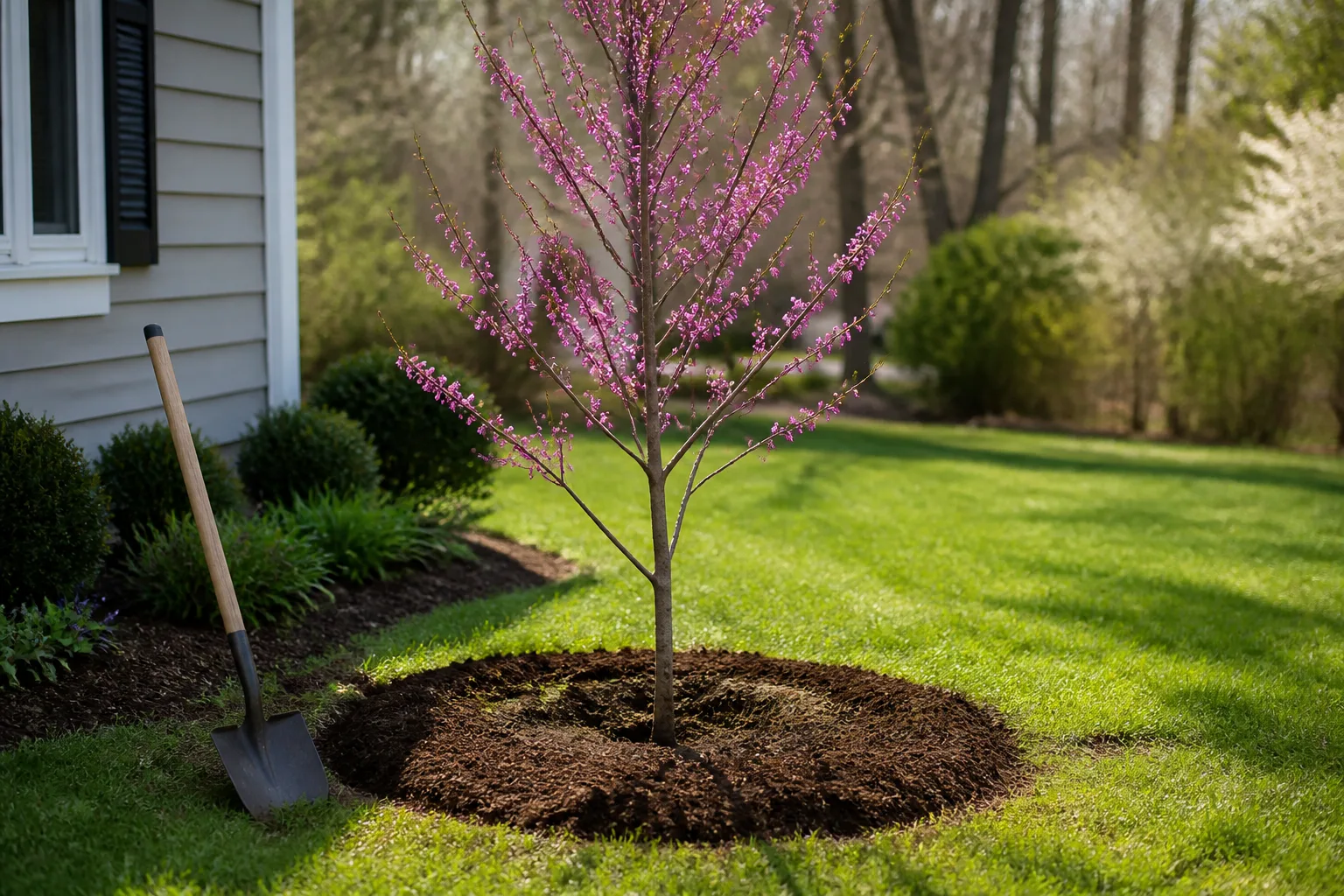
Eastern redbud (Cercis canadensis) is one of the strongest all-around choices for a modest yard. Clusters of pink to purple flowers appear on bare branches in early spring, including along older wood and sometimes the trunk. Heart-shaped leaves follow, and the rounded canopy provides light shade without the scale of a forest tree.
Redbud prefers sun for the heaviest bloom but tolerates some afternoon shade. Give it well-drained soil and room for a broad, often multi-stemmed form. A young tree may put on roughly 1 to 2 feet in favorable conditions, but drought, root disturbance, and lawn competition slow it. NC State Extension’s redbud profile is a useful regional reference for habit and site selection.
Choose redbud when you want early color, a manageable native tree, and pollinator value. Avoid planting it in a narrow strip between pavement and a wall where roots and canopy will be forced into conflict. Remove crossing or rubbing stems while young, but do not strip out the natural branching habit.
Serviceberry
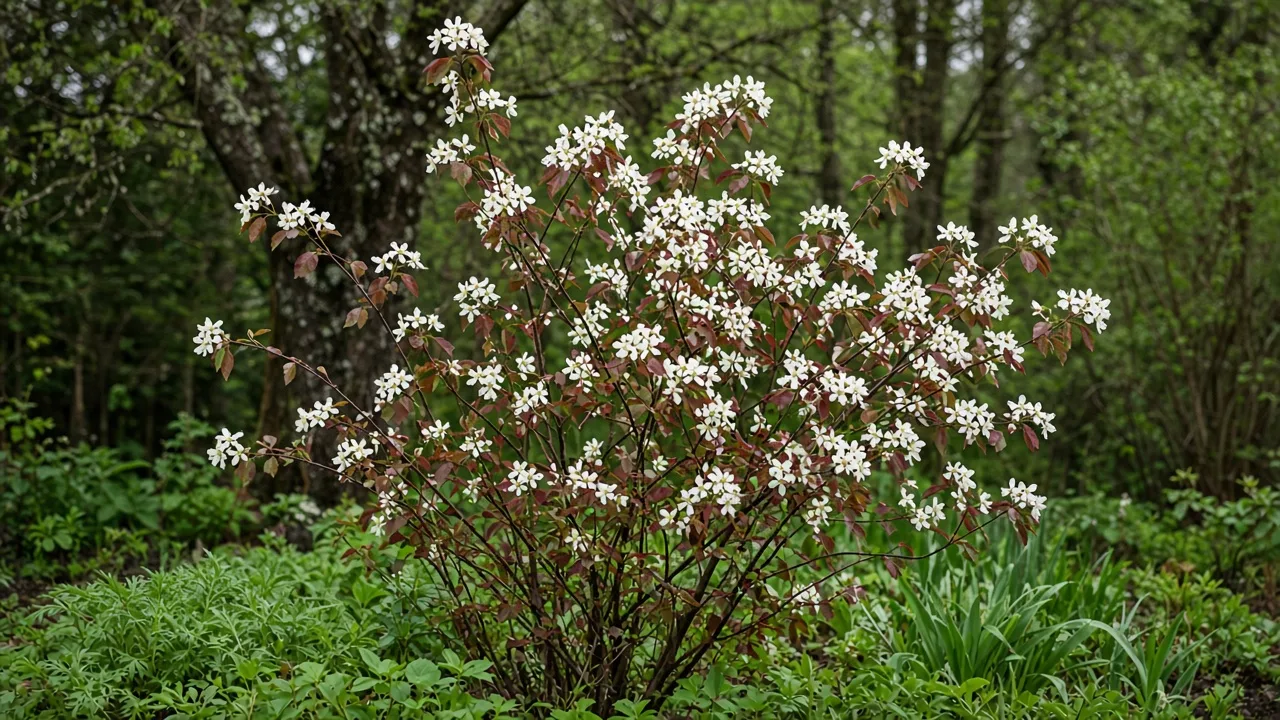
Serviceberry (Amelanchier species) earns its place by offering more than flowers. White spring blossoms attract early pollinators, edible-looking berries feed birds, and fall foliage can turn orange or red. Several species remain small enough for a lawn edge, patio view, or woodland-style garden.
The best site is sun to light shade with evenly moist, well-drained soil. Serviceberries dislike repeated drought and reflected heat, so mulch the root zone and water during prolonged dry weather. Mature size varies widely by species, from a multi-stemmed shrub to a small tree; confirm the exact selection rather than buying by the common name alone.
Choose serviceberry when wildlife, four-season interest, and moderate scale matter more than the fastest possible canopy. It is also a good answer for gardeners who want spring bloom without committing to a very large shade tree.
Ohio buckeye
Ohio buckeye (Aesculus glabra) produces upright yellow-green flower clusters in spring and develops a dense canopy with strong autumn color. It can grow into a substantial tree, so it belongs in a large yard or park-like setting rather than beneath wires or beside a foundation.
Give it rich, moist soil and sun to partial shade. Young trees need consistent moisture while roots establish, especially during hot summers. The glossy buckeyes are ornamental but not edible; keep children and pets from treating the seeds as food. Missouri Botanical Garden’s plant record provides a helpful overview of its mature habit.
Choose Ohio buckeye for native character, shade, and fall color when you have space. Do not select it simply because it grows quickly; its eventual height and spread are the deciding facts.
Tulip tree
Tulip tree (Liriodendron tulipifera) is a tall, straight-growing hardwood with unusual yellow-green, tulip-shaped flowers and golden fall leaves. It can add height faster than many ornamental trees, but that speed comes with a very large mature footprint.
Plant it in full sun or light shade, deep well-drained soil, and a location where branches can develop without constant conflict. It is a poor choice for a small courtyard, under utility lines, or beside a narrow driveway. The U.S. Forest Service tree guide documents its ecology and scale.
Choose tulip tree when you want a long-lived canopy tree and have room to let it become one. Water deeply during establishment, protect the trunk from mower damage, and avoid topping it to control height; topping creates weak regrowth instead of a sound structure.
Yoshino cherry
Yoshino cherry (Prunus × yedoensis) makes a dramatic spring display of pale pink to nearly white, lightly fragrant flowers. It grows at a moderate-to-fast rate and can become a broad small-to-medium tree, often reaching roughly 20 to 30 feet tall with a similar or greater spread depending on conditions.
Full sun and good drainage produce the best flowering. Plant it where air can move through the canopy and where fallen petals and fruit, if produced, will not create a maintenance problem over a pool or narrow entrance. Flowering cherries are valued for their display, not for extreme drought tolerance or a trouble-free lifespan in every site.
Choose Yoshino cherry when a short, high-impact spring bloom is more important than flowers all summer. Buy from a reputable nursery, inspect the trunk for damage, and do not bury the root flare when planting.
Wisteria trained as a tree
Wisteria is a woody vine, not a naturally compact tree. American wisteria (Wisteria frutescens) or Kentucky wisteria (Wisteria macrostachya) can be trained onto a sturdy standard, while some imported wisterias are invasive or dangerously vigorous in parts of the country. Fragrant hanging flower clusters are the reward, but the support system and pruning are non-negotiable.
Use a strong trunk or post, keep the plant away from gutters and siding, and tie the main stem until it reaches the desired height. Prune side shoots several times during the growing season and shorten the framework in winter according to the cultivar’s needs. The American Horticultural Society’s invasive plant guidance and your local extension service can help you check regional risk.
Choose a trained wisteria only if you enjoy regular pruning. It is a poor “plant it and forget it” choice, and it should never be allowed to climb an unreinforced tree.
Bottlebrush tree
Bottlebrush (Callistemon species, now often classified within Melaleuca) produces vivid red brush-like flowers that attract nectar-feeding wildlife. It is best suited to warm climates, including much of the southern United States and mild coastal areas. In cooler regions it may be grown as a container standard and protected from freezes, but that is a seasonal project rather than a hardy landscape tree.
Give it full sun, sharp drainage, and moderate water once established. Avoid constantly wet soil and protect young plants from cold snaps. Prune lightly after flowering to maintain shape; repeated shearing can remove the wood that carries future flowers.
Choose bottlebrush for a warm, sunny site where a long flowering season is realistic. Verify the species’ hardiness and mature size instead of relying on a generic label.
Catalpa
Catalpa (Catalpa speciosa or C. bignonioides) is a fast-growing shade tree with large heart-shaped leaves, white late-spring or summer flowers, and long bean-like seed pods. Its flowers are valuable because they arrive after many spring bloomers have finished, but the large leaves and pods can create significant cleanup.
Catalpa wants space, sun to partial shade, and soil that holds moisture without remaining waterlogged. Young trees can make vigorous shoots, so establish one strong central leader and remove competing stems early. Do not plant it beside a small patio, septic field, or overhead line. The Morton Arboretum’s catalpa profile covers its distinctive growth and landscape considerations.
Choose catalpa when summer shade and late flowers outweigh tidiness. Skip it when you need a small, tidy ornamental.
Crape myrtle
Crape myrtle (Lagerstroemia species and hybrids) is a warm-climate favorite for summer flowers, attractive bark, and a long bloom window. Cultivars range from compact shrubs to small trees, so it is possible to fit one into a tighter garden—if you match the cultivar to the space.
Full sun is essential for reliable flowering. Good drainage, a deep root zone, and regular water during establishment help it grow quickly. Choose a cultivar with a mature height below the available clearance; do not buy a tall variety and plan to keep it short by cutting every branch back to stubs. This practice, often called topping, weakens the tree and ruins its natural structure.
Use selective thinning and removal of suckers instead. Clemson Extension’s crape myrtle guidance explains why cultivar choice and proper pruning matter.
Tropical hibiscus trained as a tree
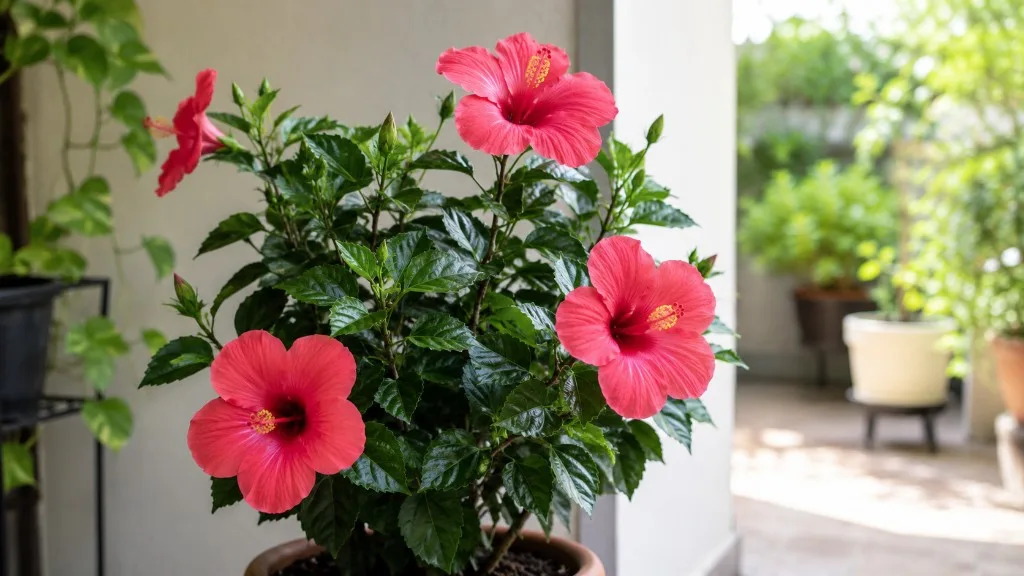
Tropical hibiscus (Hibiscus rosa-sinensis) is a fast-growing shrub commonly trained into a patio tree. Its large flowers can appear in red, pink, orange, yellow, or white, often from summer into fall. It is not frost hardy, however, and the “tree” form depends on repeated training rather than permanent woody architecture.
Give it full sun, fertile but well-drained potting mix, steady moisture, and regular feeding during active growth. In a cold climate, grow it in a container and move it indoors before temperatures fall sharply; reduce watering in lower winter light. Inspect for aphids, whiteflies, and spider mites before bringing it inside.
Choose tropical hibiscus when you want portable summer color and can provide winter protection. Choose a hardy hibiscus instead if you need a plant that remains outdoors through freezing winters, though hardy hibiscus is generally a perennial rather than a woody tree.
Compare bloom season, size, and maintenance
| Tree or trained form | Main bloom window | Best fit | Main caution |
|---|---|---|---|
| Eastern redbud | Early spring | Small to medium yard | Broad, naturally multi-stemmed canopy |
| Serviceberry | Early spring | Small yard or wildlife garden | Needs even moisture |
| Ohio buckeye | Spring | Large yard, shade planting | Large mature size and seeds |
| Tulip tree | Late spring | Spacious property | Too large for tight sites |
| Yoshino cherry | Spring | Focal spring display | Short bloom window, drainage needs |
| Wisteria standard | Spring to early summer | Sheltered, hands-on garden | Requires strong support and pruning |
| Bottlebrush | Spring to summer | Warm climate | Frost sensitivity |
| Catalpa | Late spring to summer | Large, moist site | Leaves and pods are messy |
| Crape myrtle | Summer | Warm sunny garden | Never top the tree |
| Tropical hibiscus standard | Summer to fall | Container or frost-free climate | Must be protected from cold |
Planting and first-year establishment
Plant during the locally recommended dormant or mild season, not during a heat wave. Dig a hole two to three times the width of the root ball but no deeper than the root ball. Set the root flare level with, or slightly above, the surrounding soil. Backfill with the soil you removed unless a soil test or local extension recommendation says otherwise.
Water slowly and deeply after planting, then check the root zone before watering again. A newly planted tree may need attention several times a week in hot, dry weather, while heavy clay or rain may require less. Keep a 2- to 3-inch mulch ring over the root zone, but pull mulch away from the trunk. Stake only when wind or a loose root ball makes it necessary, and remove supports once the tree can stand on its own.
Do not fertilize heavily to force growth. Extra nitrogen can produce lush shoots at the expense of roots, flowers, and structural strength. Protect the trunk from lawn equipment, and inspect the tree after storms for split leaders, rubbing ties, and broken branches.
Mistakes that delay flowering
The most common mistake is choosing by a photograph and ignoring mature size. The second is planting in shade and expecting a sun-loving tree to bloom heavily. Other frequent problems include burying the root flare, watering the leaves instead of the root zone, keeping mulch against the trunk, and pruning at the wrong time.
Remember that many spring-flowering trees set next year’s flower buds on older wood. Hard pruning at the wrong season can remove those buds. When in doubt, remove dead, damaged, crossing, or poorly attached branches first, and consult an extension service for the species and region.
If a tree is growing but not flowering, check light, age, winter injury, drought, excessive nitrogen, and pruning history before adding more fertilizer. If the leaves wilt repeatedly, inspect the root zone and drainage. A tree that is too large for its site cannot be made safe by annual topping; replacement is sometimes the responsible answer.
Conclusion: choose the tree you can keep in bounds
For most small yards, start with serviceberry or eastern redbud. For a large property, tulip tree, catalpa, or Ohio buckeye can deliver a faster canopy. Choose Yoshino cherry for a concentrated spring show, crape myrtle for summer flowers in a warm climate, bottlebrush for mild regions, and tropical hibiscus when a container and winter plan are part of the design. Treat wisteria as a pruning commitment, not a shortcut to a tree.
The best fast-growing flowering tree is not the one with the biggest annual-growth claim. It is the one that has enough root room, enough light, a climate it can tolerate, and a mature canopy you will still be happy to live with ten years from now.