How to Grow and Care for Basil Indoors
Indoor basil needs six hours of real sun or a grow light, warm nights above 50°F, and regular harvests. This guide covers setup, feeding, bolting, and troubleshooting.
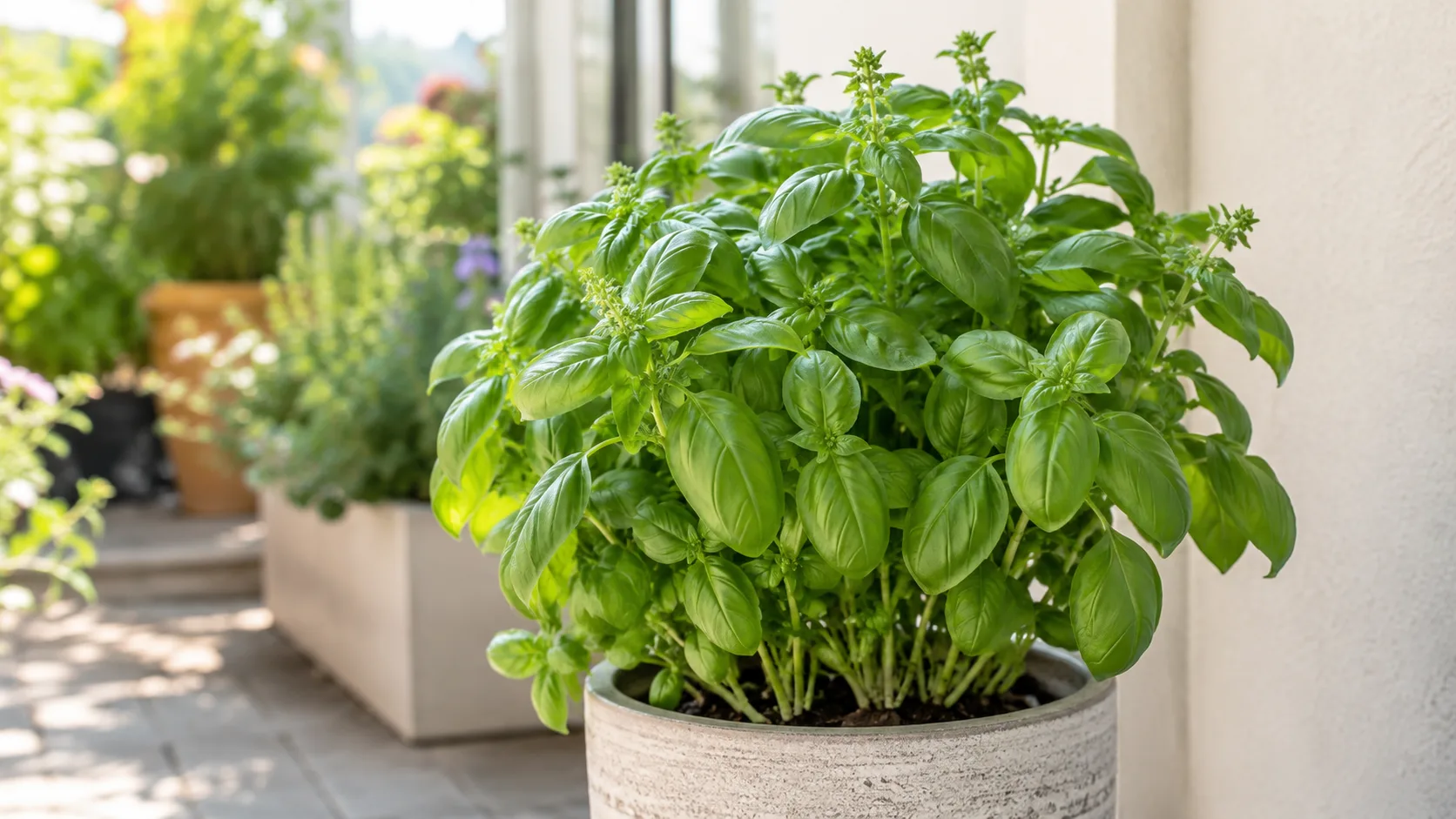
A pot of basil on the kitchen counter is one of the most satisfying indoor projects—until the leaves yellow, the stems stretch toward the glass, or the whole plant collapses in a week. Basil (Ocimum basilicum) can grow indoors year-round, but it is not a forgiving houseplant like a pothos. It wants strong light, warm nights, steady moisture, and regular harvests. Give it dim corners, cold windowsills, or crowded supermarket pots, and it will fail fast.
This guide covers the full indoor cycle: choosing a bright window or grow light, starting from seed, cuttings, or a grocery pot, watering without root rot, feeding lightly, preventing bolting, moving plants outside for summer, and fixing the problems that kill most indoor basil. For outdoor culture and variety depth, see our basil growing guide. For species-specific watering and light, visit the basil care hub, watering page, and light page.
Can You Grow Basil Indoors Year-Round?
Yes. Indoor basil is a kitchen crop, not a permanent houseplant. You can keep fresh leaves available through winter by starting new plants every few months, propagating cuttings from a strong mother plant, or bringing outdoor pots inside before cold nights arrive. The goal is continuous harvest, not one basil that lives forever on the sill.
Basil is native to warm regions and behaves like a warm-season annual in most homes. It grows fast when light and temperature align, bolts toward seed when stressed or as days lengthen, and declines after flowering. Penn State Extension notes that basil cannot survive temperatures below about 50°F and should not sit on cold winter windowsills where glass chills the leaves at night. (Penn State Extension)
That cold threshold is why “year-round” indoors means active management: resowing, propagating, or protecting plants from drafty glass—not planting once and forgetting it.
Indoor Basil at a Glance
Use this table as a setup checklist before you buy pots or lights.
| Factor | Indoor target |
|---|---|
| Light | 6+ hours direct sun or 12–16 hours under grow lights |
| Day temperature | 65–70°F room average |
| Night temperature | Above 50°F; avoid cold window glass in winter |
| Water | Moist, never waterlogged; check top inch before watering |
| Soil | Well-drained potting mix; pH roughly 6.0–7.5 |
| Container | Drainage holes; 6–8 inches minimum for one mature plant |
| Fertilizer | Dilute liquid feed every 2 weeks during active growth |
| Lifespan | 2–4 months per plant; plan succession or cuttings |
| Harvest | Start at 6+ leaf sets; pinch flowers immediately |
Basil belongs to the mint family (Lamiaceae). It shares mint’s love of moisture but is far less tolerant of low light and cold soil than many other kitchen herbs listed in our herbs to grow indoors guide.
What Indoor Basil Actually Needs
Indoor failure usually traces to one mismatch: you treated basil like a low-light houseplant, kept soil soggy, or bought a lush grocery pot that was never meant to last. Fix the environment first; varietal choice second.
Light: Sunny Windows vs Grow Lights
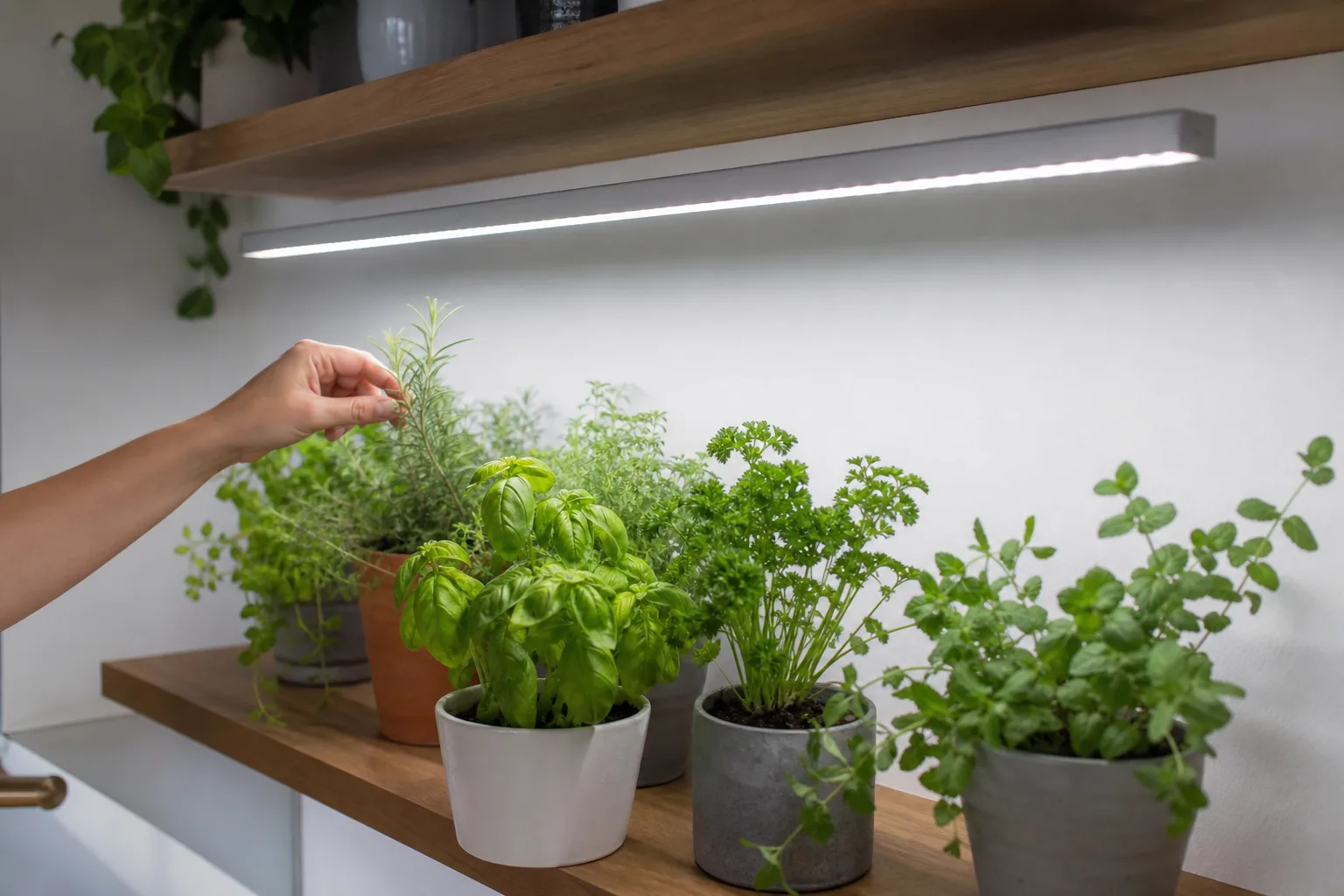
Light is the non-negotiable input. Basil is a full-sun herb outdoors. Indoors, give it at least six hours of direct sun on a bright south-, southwest-, or west-facing window. A north window or a room with only ambient daylight is not enough for sweet basil to stay compact and flavorful.
What looks “bright” to human eyes is often weak for basil. Stems stretch, internodes lengthen, and leaves stay small and pale—classic leggy basil. Epic Gardening describes this as the plant reaching toward inadequate window light until thin stems cannot support themselves. (Epic Gardening)
Grow lights solve the problem when your best window still produces weak growth. Penn State Extension recommends placing herbs 6 to 12 inches below two 40-watt cool white fluorescent bulbs for 14 to 16 hours daily when natural sun is insufficient. (Penn State Extension) LED shop lights or dedicated herb fixtures work too; keep intensity high and distance consistent. Our grow lights guide covers hang height and daily photoperiod without turning your kitchen into a greenhouse.
Rotate pots every few days on a windowsill so all sides receive light and growth stays even. If leaves touch hot glass in summer, pull the pot back slightly or add sheer curtain diffusion.
Temperature and Draft Protection
Basil thrives in warm rooms. Penn State Extension suggests daytime temperatures around 65–70°F and cooler nights near 55–60°F for most herbs—but basil is the exception that cannot tolerate cold glass. (Penn State Extension) Leaves blacken and growth stalls when nights drop below about 50°F, which happens quickly on an uninsulated winter sill.
Keep basil away from:
- Open winter windows that blow cold air across leaves
- Air-conditioning vents that blast cold dry air in summer
- Single-pane glass on freezing nights (move the pot inward overnight)
Warm kitchens often work well in winter because ambient heat offsets chill near the window. If the sill is cold, set the pot on a small stand or tray an inch above the glass.
Humidity and Air Circulation
Basil does not need tropical humidity, but forced-air heating can dry leaf edges in winter. Penn State Extension suggests grouping containers to raise local humidity or setting pots on a pan of moist pebbles so evaporation surrounds the plant without soaking roots. (Penn State Extension)
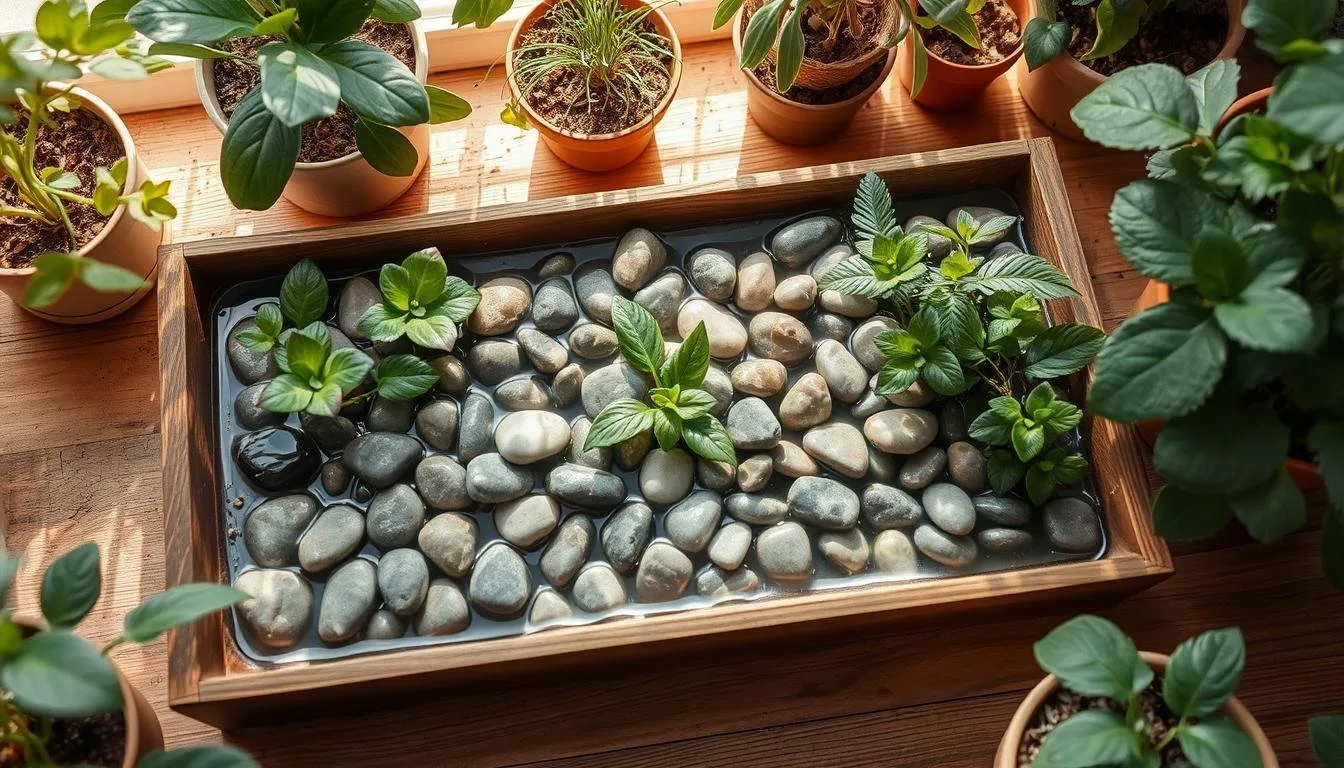
Avoid misting as your main strategy. Wet foliage in a crowded windowsill invites fungal issues. Pebble trays or a nearby humidifier add moisture to the air without leaving leaves damp for hours.
Air circulation still matters. Crowded stems trap humidity and encourage mildew. Space plants so air moves between them, and do not pack eight seedlings into one decorative pot—more on that below.
How to Start Basil Indoors
You have four realistic paths: seed, grocery-store rescue, cuttings, or moving an outdoor plant inside. Each has a different timeline and failure mode.
From Seed
Starting basil from seed is inexpensive and gives you the healthiest long-term plants. Sow in a shallow tray or small pots filled with moist, well-drained seed-starting mix. Basil germinates fastest in warm soil—Gardening Know How notes sprouting in about five days at roughly 80°F, with slower emergence in cooler rooms. (Gardening Know How) A heat mat under the tray speeds germination in winter.
Cover seeds lightly, keep mix evenly damp (not flooded), and provide strong light immediately after emergence. Leggy seedlings start on day one if they sit in a dim room. Transplant into individual 4- to 6-inch pots once seedlings have two to three true leaves and roots fill the cell.
Succession sowing keeps harvest steady: plant a new batch every three to four weeks indoors so a fresh plant replaces one that is bolting or woody.
From Grocery Store Pots (Thinning Is Required)
Supermarket basil looks full because six to ten seedlings share one small pot. That density works for a week of harvest, then roots compete, airflow collapses, and the mass wilts together. Epic Gardening identifies overcrowding as one of the top reasons indoor basil dies after purchase. (Epic Gardening)
To rescue grocery basil:
- Water lightly, then gently slide the root mass out of the pot.
- Tease apart clusters into individual stems with roots attached.
- Pot each stem (or pair) into its own 4- to 6-inch container with fresh potting mix.
- Trim top growth by one-third to balance roots lost during division.
- Place under bright light; avoid direct hot sun for 48 hours while plants settle.
You may lose a few stems, but the survivors grow faster than the original crowded pot ever would.
From Cuttings and Water Starts
Basil roots easily from stem cuttings—useful when outdoor plants are too big to move inside or when a windowsill plant is aging but still healthy at the base. Cut a 4- to 6-inch stem just below a leaf node, remove lower leaves so nothing sits underwater, and place the stem in a glass of clean water or moist potting mix.
Gardening Know How notes that roots typically form in water within a week or two; transplant into soil once roots reach about an inch long. (Gardening Know How) Change water every few days to limit rot. Dip cut ends in rooting hormone if you like, but sweet basil often roots without it.
Water propagation is a bridge, not a permanent system. Long-term basil grows better in draining soil with oxygen around roots.
Bringing Outdoor Plants Inside
Before frost, you can pot up outdoor basil or move container plants to a bright indoor station. Inspect every stem and leaf underside for aphids, spider mites, and whiteflies—pests hitch indoors on outdoor plants. Rinse foliage with plain water and quarantine the pot for a week away from other herbs.
Choose a pot size that fits the root mass. Outdoor plants may need trimming to fit a windowsill, but do not remove more than one-third of top growth at once. Acclimate to lower light gradually over several days if the outdoor plant was in full sun and your indoor spot is only moderately bright.
Containers, Soil, and Drainage
Basil needs drainage holes and a mix that holds moisture without staying saturated. A 4-inch pot suits a young seedling; a single mature sweet basil plant does better in a 6- to 8-inch pot with volume to buffer drying. Epic Gardening notes that tiny pots dry out in a day on a warm sill, stressing basil repeatedly. (Epic Gardening)
Use quality potting mix, not garden soil from the yard. Garden soil compacts in containers and suffocates roots. Penn State Extension emphasizes containers with drainage holes and potting mix that drains freely. (Penn State Extension)
Decorative cachepots without holes are fine as outer covers only. Grow basil in a draining inner pot and empty the saucer after watering. Our herbs in pots vs ground guide explains why separate pots beat mixed herb planters for basil’s moisture needs.
Amending mix with a tablespoon of compost per pot adds organic matter. Basil prefers pH between roughly 6.0 and 7.5; Gardening Know How recommends occasional pH awareness when growth slows despite good care. (Gardening Know How)
Watering Indoor Basil Without Root Rot
Basil wants steady moisture, not a swamp. Penn State Extension warns that basil should never dry out completely indoors, while Mediterranean herbs like thyme need dry cycles. (Penn State Extension) The practical rule: water when the top inch of mix feels dry, then water thoroughly until a little drains from the holes.
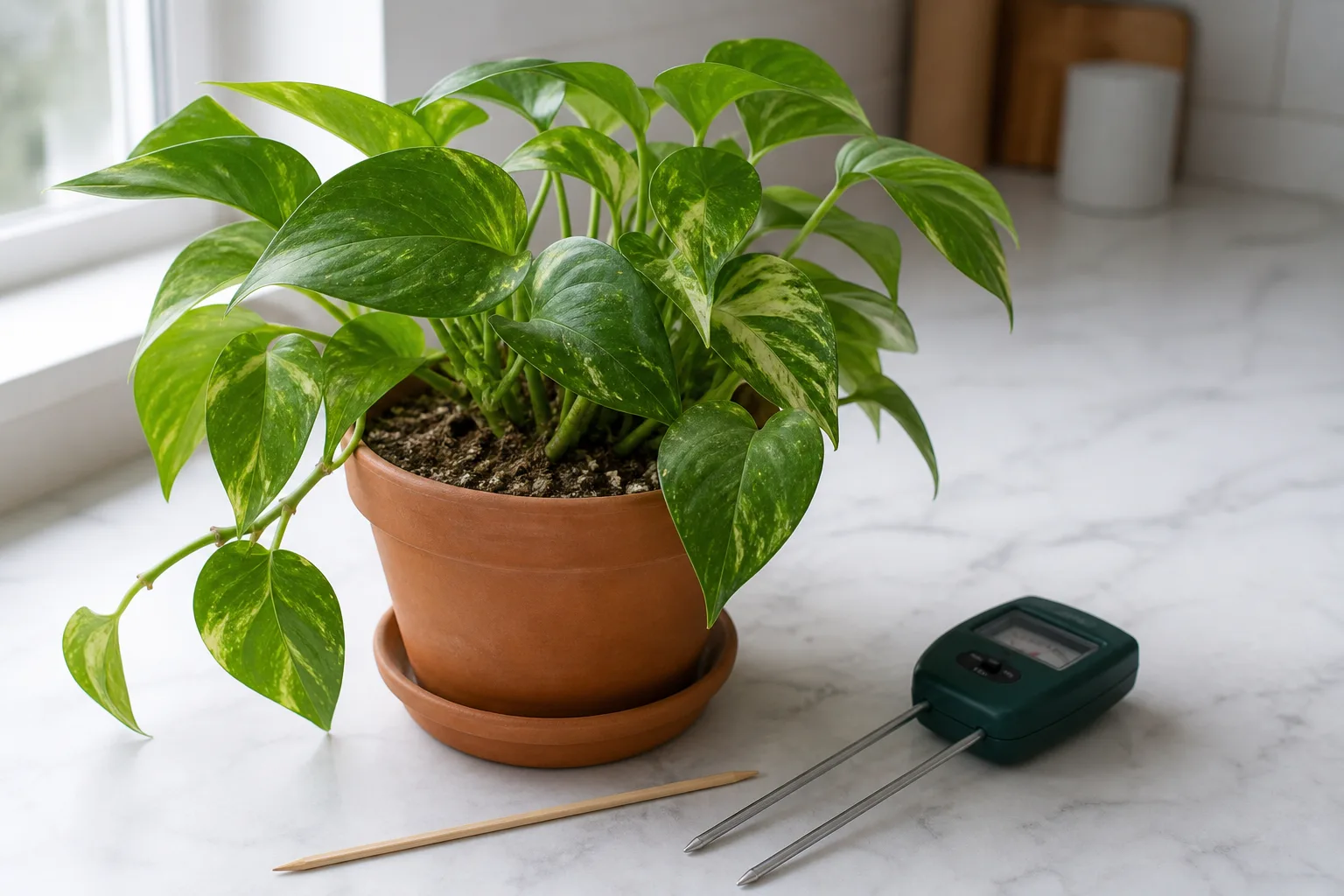
Push a finger into the soil away from the stem. If the surface is dry but the core is still wet, wait. If the top inch is dry and the pot feels light, soak the root zone. Empty the saucer within 30 minutes.
Wilting with wet soil signals overwatering or poor drainage—not thirst. Yellow lower leaves and sour-smelling mix often follow. Epic Gardening distinguishes this from underwatering, where the whole plant droops and dry soil pulls away from the pot edge. (Epic Gardening)
For a full moisture calendar across pots, seedlings, and seasons, see how often to water basil. Indoor basil on a heated sill in a small pot may need checking daily; a large pot in a cool room may go several days.
Feeding Basil Indoors
Basil harvested weekly depletes a small pot quickly. Penn State Extension recommends a low dose of water-soluble fertilizer every two weeks during active growth, noting that over-fertilizing can dull aroma and taste. (Penn State Extension)
Use half the label strength of a balanced liquid feed (for example 5-10-5 or similar) or a diluted organic fish/seaweed product. Gardening Know How similarly advises half-strength applications a couple of times per season for flavor-focused plants. (Gardening Know How)
Skip fertilizer on newly transplanted or divided plants for two weeks. If leaves look deep green but flavor weakens, cut feeding frequency—excess nitrogen pushes soft growth.
Flush the pot occasionally by watering heavily and letting excess run through if white crust (salt buildup) appears on the mix surface.
Pruning, Pinching, and Harvesting for Bushy Plants
Basil responds to cutting with more branches. Harvesting is pruning. Start once the plant has at least six leaf sets. Snip stems just above a leaf pair; two new shoots emerge from that node.
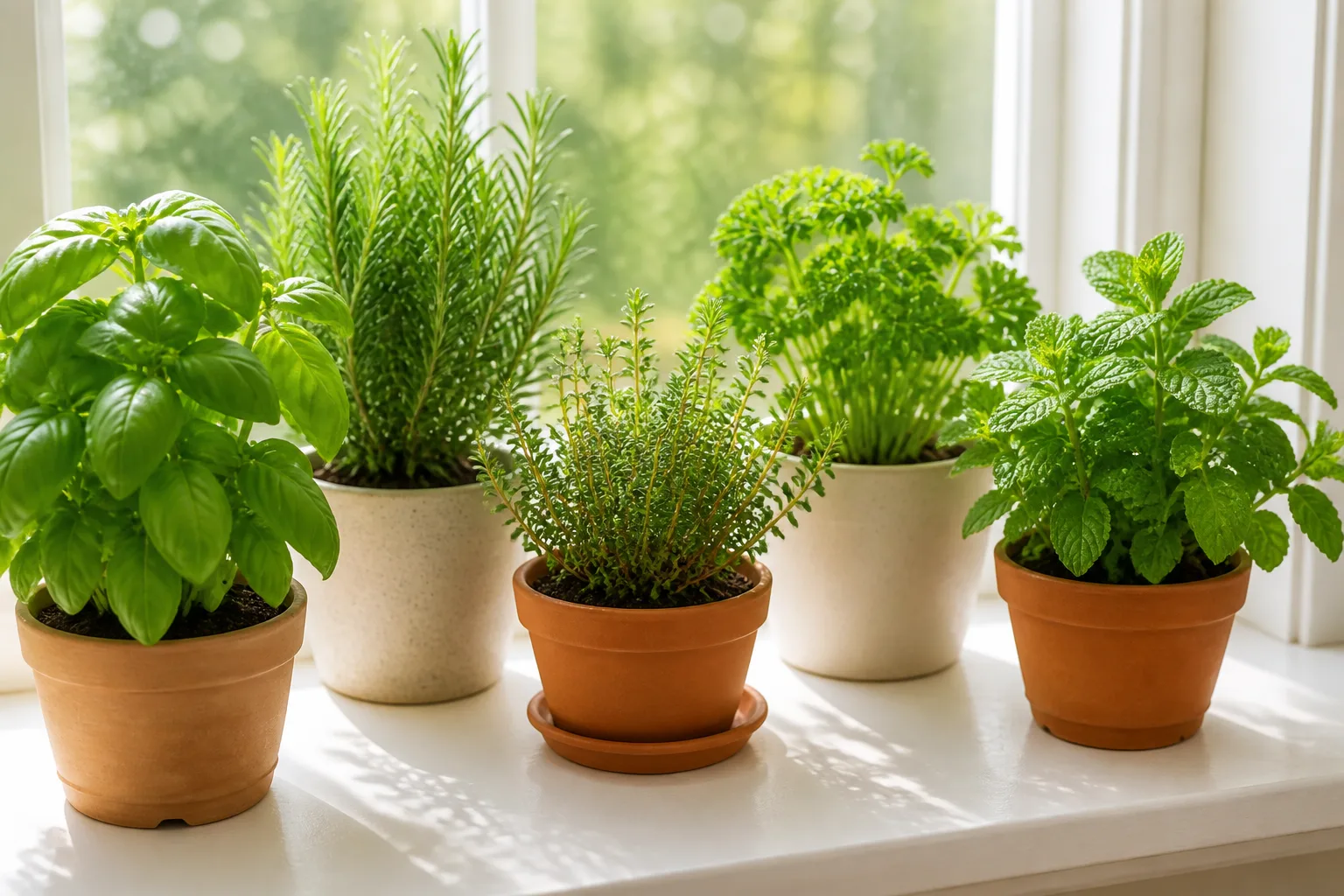
Remove flower buds immediately when they appear at stem tips. Flowering shifts the plant toward seed production; leaves often become tougher and less sweet. Pinching buds redirects energy into foliage and extends the productive window indoors.
Harvest from the top down, taking up to one-third of the plant at a time. Never strip all leaves from a young plant. Regular weekly cuts keep windowsill basil compact instead of tall and bare at the base.
If stems become woody and flavor drops, start fresh seed or cuttings rather than fighting an aging plant.
Best Basil Varieties for Indoor Growing
Standard Genovese basil grows well indoors with enough light, but compact, bolt-resistant cultivars last longer on a sill:
- ‘Spicy Globe’ — small, rounded habit; slow to flower
- ‘Everleaf’ / ‘Emerald Towers’ — bred for extended leaf production before bolting
- ‘Pesto Perpetuo’ — variegated, flavorful, slower to bolt than many sweet basils
- Greek basil — naturally smaller leaves; fits tight windowsills
- Thai basil — stronger anise flavor; tolerates indoor culture with strong light
Large-leaved Genovese still works if you harvest aggressively and resow often. Purple basils add color but often want the same light intensity as green types.
Match variety to use: sweet basil for pesto and Italian dishes, Thai basil for stir-fries, lemon basil for fish and tea. Our outdoor basil guide covers more variety notes and downy mildew–resistant seed lines if you also garden outside.
Moving Basil Outdoors for Summer
Indoor basil often thrives on a warm patio once nights stay above 50°F. Moving out increases light, speeds growth, and frees sill space—but shock kills plants if you skip acclimation.
Hardening Off and Summer Container Care
Gradually expose indoor plants to outdoor conditions over 7 to 10 days:
- First 2–3 days: shaded porch or dappled light, a few hours daily
- Next days: morning sun, then afternoon sun if temperatures are moderate
- Full sun only after leaves show no scorch
Outdoor pots dry faster than indoor pots. Check daily in heat. Wind and sun can triple water use compared to a kitchen counter.
When to Bring Basil Back Inside
Bring basil inside when night temperatures fall toward 50°F, not after the first frost. Cold-sensitive basil blackens below that mark. If days are still warm but nights cool, move pots in overnight and out again during the day for a week or two.
Re-inspect for pests before placing plants near indoor herbs. Trim leggy growth to fit the light station and expect a brief adjustment period as light drops.
Troubleshooting Common Indoor Basil Problems
| Symptom | Likely cause | Fix |
|---|---|---|
| Leggy, pale stems | Too little light | Grow light 12–16 hrs or brighter window; harvest tops |
| Yellow lower leaves, wet soil | Overwatering / poor drainage | Improve drainage; let mix dry slightly before rewetting |
| Sudden wilt, dry soil | Underwatering | Soak root zone; upsize pot if soil dries daily |
| Blackened leaves on sill | Cold glass or sub-50°F nights | Move inward overnight; insulate from glass |
| Small leaves, weak flavor | Low light or excess fertilizer | Increase light; reduce feed strength |
| Flower spikes | Normal maturity or stress | Pinch buds; sow successor plant |
| Sticky leaves, curled tips | Aphids | Rinse; isolate; repeat checks weekly |
| Tiny flies on soil | Fungus gnats from wet mix | Let surface dry; yellow sticky traps |
Downy mildew and serious fungal issues are less common indoors than outdoors because air is drier, but crowded pots still invite problems. Space plants and avoid wetting foliage at night.
If multiple stems in one pot collapse together after a week, assume overcrowding—not mysterious “basil disease.” Divide and repot.
Conclusion
Growing basil indoors works when you treat it like a sun-loving, warm-season kitchen crop rather than a decorative houseplant. Give it six hours of real sun or strong supplemental light, keep nights above 50°F, water when the top inch dries, feed lightly, harvest weekly, and pinch every flower bud. Start seed on a schedule, thin grocery-store pots, or root cuttings so a fresh plant replaces each one that bolts.
Expect each plant to run its course in a few months indoors—that is normal. The win is steady leaves on the counter, not a single eternal basil. Set up light and pots correctly once, then resow or propagate on a rhythm. Your pesto window stays open all year.