How to Grow and Care for Desert Rose Plants
Learn desert rose care for bright sun, fast-draining soil, seasonal watering, safer overwintering, and the signs that separate normal leaf drop from rot.
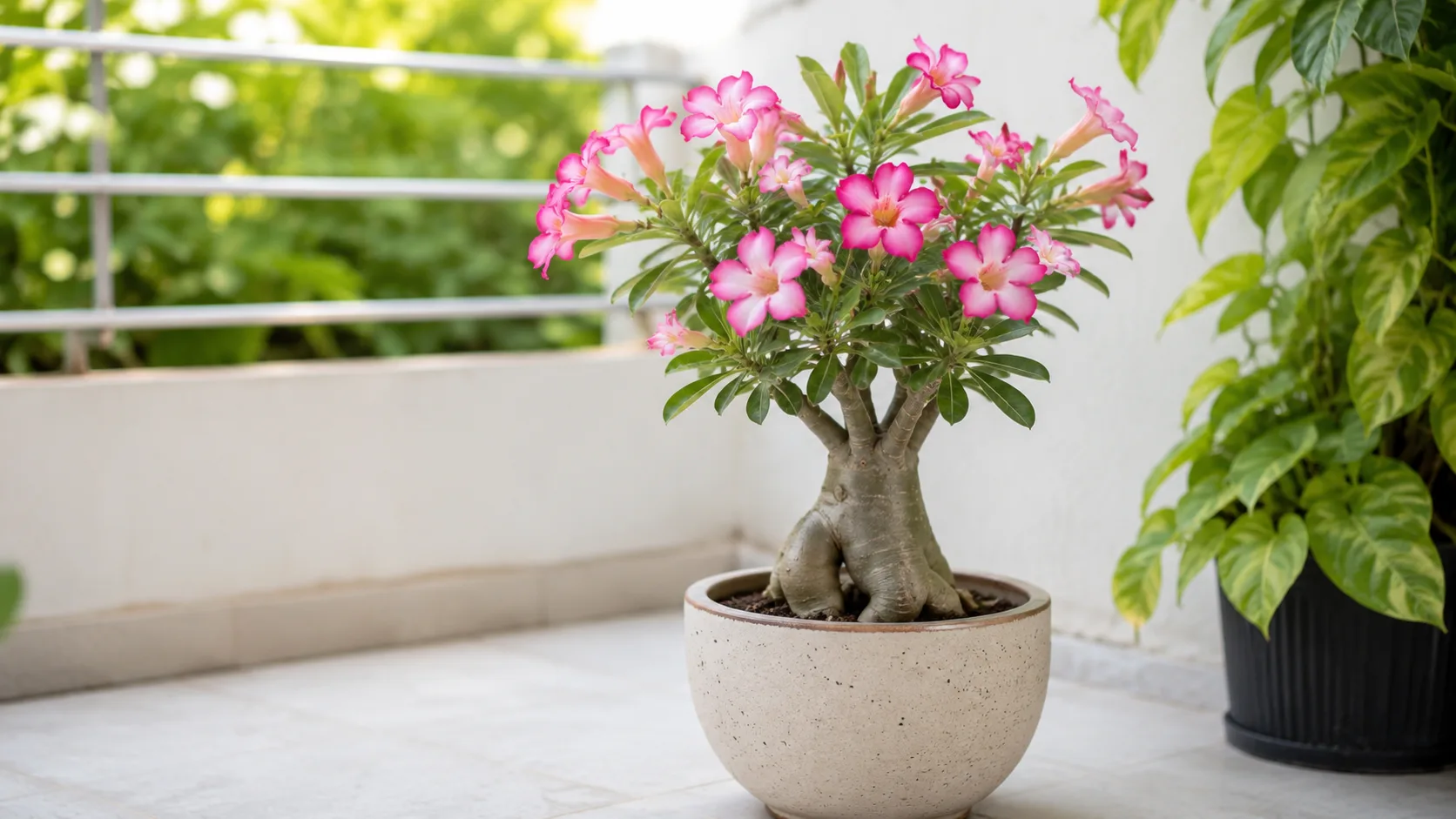
Desert rose care changes when the nights begin to cool. A plant that can take deep watering in hot, bright weather may need almost none when growth slows, the pot stays damp, and leaves begin to fall. The swollen base stores water, so its appearance, the soil, and the temperature together tell you more than a weekly calendar.
Desert rose, or Adenium obesum, is a warm-climate succulent shrub grown for its thick caudex and trumpet-shaped flowers. Give it strong light, a warm growing season, and a potting mix that drains freely. Then adjust water as growth changes: soak and drain while it is actively growing, and protect the roots from cold, wet soil during its seasonal rest. NC State Extension describes its succulent stems, dry-season adaptation, and need for sharp drainage; UF/IFAS notes that six or more hours of bright light supports profuse flowering.
What makes desert rose different
The thick, swollen trunk base is a caudex, a water-storage structure that helps desert rose tolerate dry intervals. It is not a signal that the plant wants to stay bone-dry while it is making leaves and flowers; rather, it gives the plant a reserve while the roots sit in a fast-draining medium. When the soil stays wet in cool conditions, the same water-storing tissue can become vulnerable to rot.
The species belongs to the dogbane family, Apocynaceae, and is native to dry regions of sub-Saharan Africa and the Arabian Peninsula. Garden centers often sell A. obesum or hybrids with varied flower forms and colors. Some are grafted to preserve a named flower type, while seed-grown plants can vary. NC State Extension describes the plant as a succulent perennial with a swollen caudex, while Logee’s explains how hybrid varieties are commonly grafted to preserve flower traits.
Treat this plant as a warm-season container specimen in places with cold winters. In frost-free regions it can grow outdoors year-round, but a pot gives you more control over rainfall, drainage, and winter temperature. Indoors, it can survive in a sunny window, though a dim room usually produces leaves rather than reliable flowers.
When choosing a nursery plant, look for a caudex that feels firm rather than spongy, stems without blackened soft patches, and a pot that drains freely. A plant with a few dropped leaves is not automatically unhealthy, especially if it has recently moved or the season is changing. Check the label for the botanical name, and ask whether a colorful cultivar is grafted; a shoot emerging from below a graft may belong to the rootstock rather than the flowering variety you bought.
Choose a growing location that gets real sun
Desert rose is not a low-light houseplant. For reliable flowering, count the hours of direct light reaching the leaves, not how bright the room feels from across the floor. UF/IFAS recommends six or more hours of bright light daily; if the plant stretches, produces sparse foliage, or fails to bloom, light is a better first check than adding fertilizer.
Indoor light and outdoor acclimation
Put an indoor plant close to an unobstructed south- or west-facing window, adjusting for your hemisphere and the actual path of the sun. A plant set several feet back may receive only reflected room light. If natural sun is limited, a strong plant light can help maintain compact growth, but a small desk lamp is unlikely to replace several hours of direct sun.
Outside, choose a sunny patio or garden position after frost risk has passed. A plant that spent winter in a dim room should not go straight into intense afternoon sun; leaves can scorch before the plant adjusts. Joy Us Garden describes moving a desert rose from indoor winter storage through bright shade and then morning sun before stronger exposure. Use that gradual approach over roughly one to two weeks, extending it if the leaves bleach or develop dry patches.
Turn the pot occasionally if one side faces the window all season; this helps keep new growth from leaning toward the brightest pane. If you use a grow light, keep it close enough to provide useful intensity but far enough away that leaves do not heat or bleach. Check the plant itself over the next few weeks: compact stems and healthy new leaves are better feedback than the lamp’s wattage or the room’s brightness.
Build a root zone that dries quickly
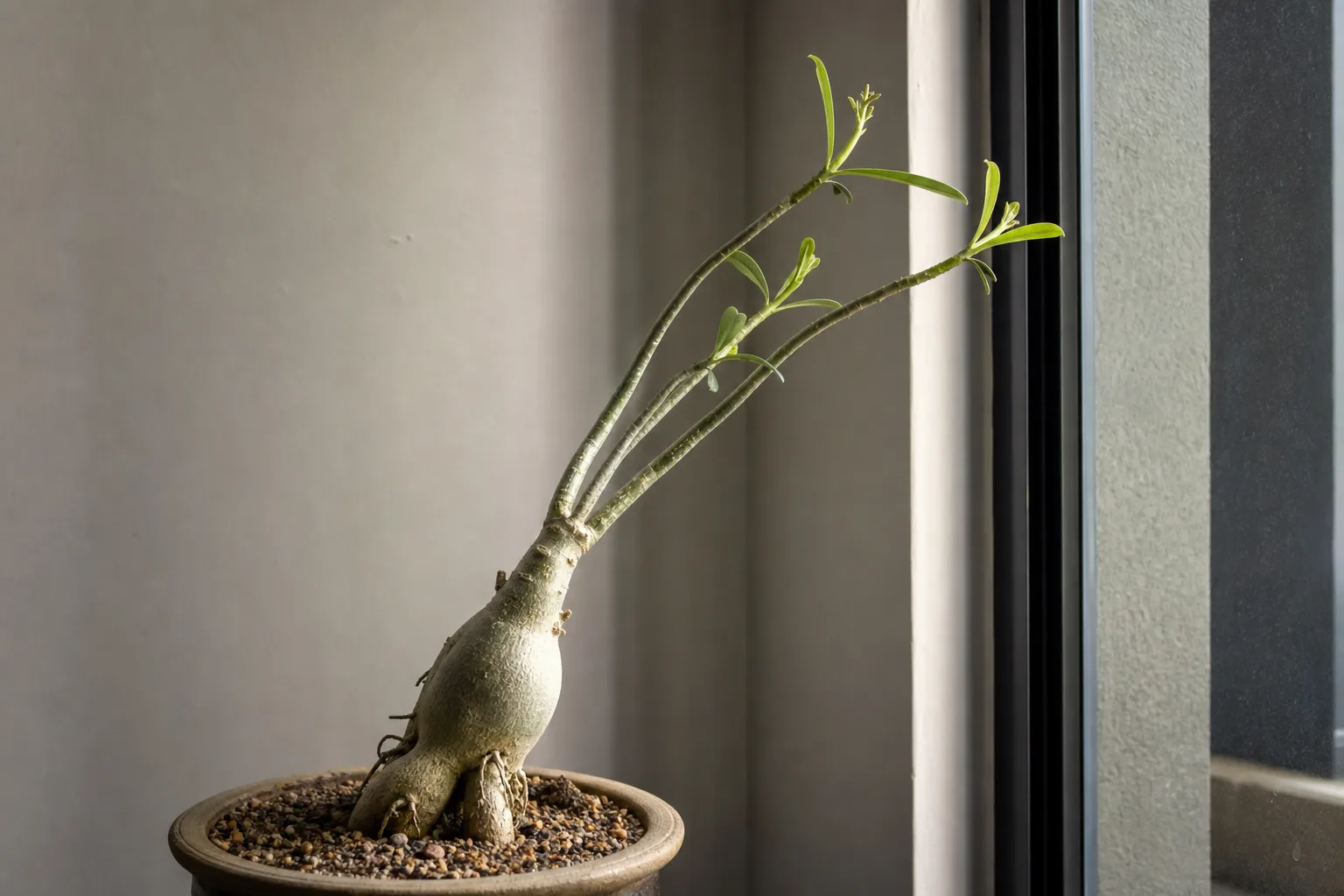
Roots need both moisture and oxygen. A dense, peat-heavy mix can remain wet around the roots long after the surface looks dry, especially in a cool room or a glazed pot.
Use a coarse cactus or succulent mix and amend it with mineral material such as pumice or perlite if water drains slowly. The goal is not to make a mix that repels water; it is to let a thorough watering pass through and let the root zone dry at a pace that matches your conditions.
Pick the pot and potting mix together
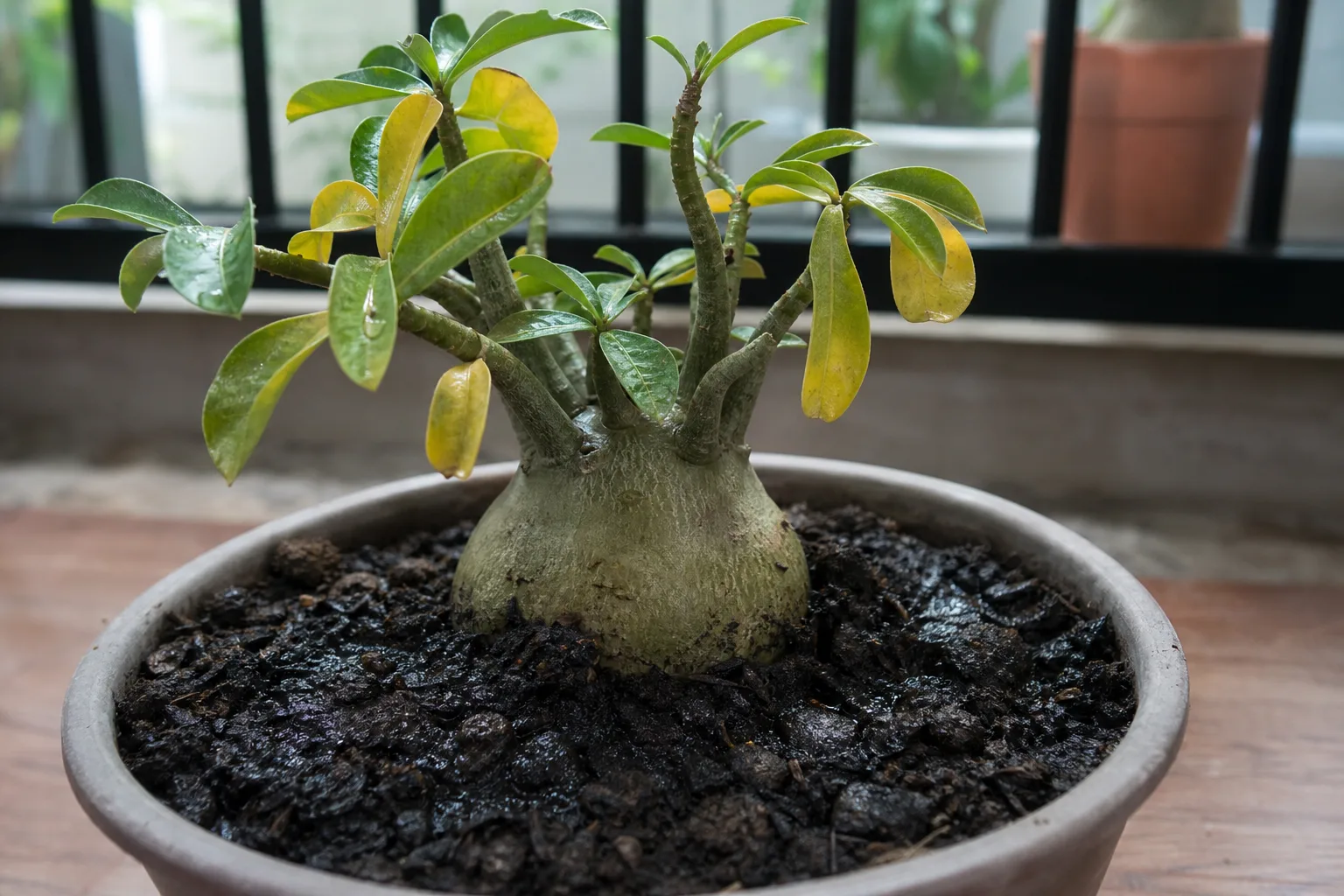
Use a container with open drainage holes. Terracotta often helps beginners because its porous sides dry faster than plastic or glazed ceramic, but the material does not compensate for blocked holes or a mix that holds water. Choose a pot only modestly larger than the root ball; a very large volume of damp soil can outlast the plant’s ability to use it.
Avoid standing the nursery pot in runoff. Empty the saucer or cachepot after watering, and check that the drainage holes are not sealed against a flat surface.
If a previously reliable mix now dries much more slowly, it may have compacted or broken down. Refresh it when you repot rather than trying to fix a persistently soggy root zone with extra sun alone.
The caudex can be raised slightly above the mix when repotting an established specimen, but do not expose roots that have been growing below the soil simply to create a sculptural look. Exposed roots dry and sunburn more easily than the hardened trunk. Make cosmetic root exposure a slow, separate project for a healthy plant in active growth; the first priority for a new owner is a stable, well-drained root system.
Water according to warmth and growth
There is no dependable “every seven days” rule for desert rose. The same pot dries at very different speeds on a hot patio, beside an air conditioner, or in a cool, cloudy room.
Check the medium several centimeters below the surface, note how heavy the pot feels, and look for active growth. Water only when the root zone has dried and the plant is warm enough to use the moisture.
Active growth
When new leaves and stems are growing in warm, bright conditions, water thoroughly until excess drains from the pot. Then let the mix dry before watering again. A quick splash at the surface can leave the deeper root ball dry, while frequent small drinks can keep some areas damp; a full soak followed by a real dry-down is easier to judge.
A small terracotta pot in summer sun may need water much sooner than a large plastic pot indoors. If the pot still feels heavy or a wooden skewer pulled from the root zone is damp, wait. A firm caudex with healthy leaves is a useful reassurance; slight wrinkles during a hot, actively growing spell may mean it is using stored water, but do not respond before checking the soil and temperature.
You can learn the dry-down of your own setup by lifting the pot just after watering and again when the mix is dry. The change in weight is often easier to judge than a moisture meter in a gritty blend, where readings can vary with mineral content and probe contact. Record the date if it helps, but use the record to learn your plant’s pattern—not as an instruction to water on that same date next week.
Cool-season slowdown
As daylight shortens and nights cool, reduce watering with the plant’s growth. If it drops leaves and stops growing, keep the medium nearly dry; a leafless plant in cool conditions cannot use water as quickly as it did in summer. Avoid a large soak when cool weather is approaching, especially if the mix is still damp.
Warm homes create an edge case. If the plant stays warm, leafy, and visibly active under a bright window or grow light, it may not enter a complete rest. Water less often than in summer, but do not force it to remain dry for months simply because the calendar says winter.
Wait for the root zone to dry, then water modestly and let it drain. If growth has stopped and leaves have fallen, use a much drier routine.
Manage temperature and seasonal transitions
Desert rose prefers warmth and has little tolerance for frost. NC State Extension recommends moving it indoors when nighttime temperatures reach about 55°F and reducing water if leaves fall. UF/IFAS notes sensitivity below 40°F, while Logee’s cautions that temperatures below 50°F may cause damage. These numbers describe different levels of risk; do not wait for near-freezing weather to protect a container plant.
Use a conservative trigger: move the pot to a bright, frost-free place when nighttime lows approach 50–55°F, then let observed growth and soil dry-down guide watering. A single brief cool night is not the same as repeated cold exposure, but cold roots plus wet mix are a poor combination. Keep the plant away from a drafty window, an unheated garage that can approach freezing, and a heater that blasts hot air over one side.
This seasonal cue works in either hemisphere: follow local night temperatures, not a fixed month. In a warm climate where the plant keeps growing outdoors, maintain drainage and water as the mix dries. Where winters are cool, prepare the indoor spot before the first cold front rather than moving a stressed plant at the last minute.
Before bringing a patio plant indoors, inspect the leaf undersides, branch joints, and the soil surface for hitchhiking pests. Remove dead foliage and debris, wash the outside of the pot, and keep the newcomer separate from a crowded houseplant shelf while you watch for scale or other insects. Moving indoors also reduces airflow and slows evaporation, so do not carry over a summer patio watering interval as if the conditions had stayed the same.
Feed for steady growth and flowering
Fertilizer supports active growth; it does not compensate for insufficient sun, cold roots, or compacted soil. Feed only when the plant is producing new growth in warm conditions. A balanced or flowering-plant fertilizer diluted according to its label is a sensible starting point, and a lower-strength application is safer than repeatedly applying a strong dose to a plant that is not growing.
Stop feeding when growth slows for the cool season. Fertilizer salts can accumulate in a small pot, especially if you feed heavily but rarely water through the medium. If you see a crust on the surface or leaf-edge damage after feeding, pause fertilizer and review the label rate and drainage. Logee’s advises feeding during active growth and stopping during dormancy; avoid using a high-phosphorus product as a shortcut for a plant that lacks light.
Encourage blooms without forcing the plant
Flowering depends on a combination of maturity, strong light, warmth, and a plant that is actively growing. UF/IFAS states that six hours or more of bright light helps maintain profuse flowering.
If your plant is healthy but flowerless, first check how much direct sun reaches it and whether it has a long enough warm growing period. A recently repotted, pruned, or stressed plant may spend its energy rebuilding roots and branches before it blooms again.
Pruning can encourage branching, and new growth is where flowers form. Still, a hard cut removes foliage and can delay flowers while the plant recovers.
Give a young plant time to establish; for an older specimen, shape selectively during warm active growth rather than cutting it back just before winter. Don’t keep feeding in an attempt to force buds when the plant has stopped growing.
Prune and propagate with a clear goal
Prune to remove dead or crossing stems, reduce awkward length, or encourage a more balanced shape. Use sharp, clean shears and wear gloves.
The white sap can irritate skin or eyes, so avoid touching your face, keep children and pets away from the work area, and clean the tools afterward. Cut just above a node or branch junction, thinking about the direction the next shoot should take.
A light trim is easier to recover from than a severe cut. Joy Us Garden shares a grower’s example of shortening long branches in spring and summer, then waiting to see how new shoots develop before trimming again. That is a useful principle: make a few considered cuts, then let the plant respond. Avoid heavy pruning when the plant is dormant or cold, when healing and regrowth are slower.
Propagation has two routes. Stem cuttings can produce a new plant that resembles the parent, but they may not develop the same broad caudex as a seed-grown specimen. Seed-grown plants can form a more natural swollen base, but seedlings vary and may not reproduce a hybrid’s exact flower color.
If taking a cutting, choose healthy new-season growth, use a clean tool, let the cut surface dry and callus in a warm, airy place, and root it in a very free-draining medium. Keep it warm and only lightly moist until roots form; daily watering is unnecessary and increases rot risk.
Choose the method based on what you want to preserve. A cutting is the practical choice for multiplying a plant you already like, while seed gives you the chance to raise a new specimen with a different trunk and flower outcome.
Commercially grafted plants exist because a named hybrid’s flower traits may not come true from seed; Logee’s describes grafting as a way to preserve distinctive hybrid flowers. Keep labels with seedlings and cuttings so you do not mistake a rootstock shoot for the cultivar.
Repot without burying or injuring the caudex
Repot when roots fill the container, the medium has degraded, or drainage has become unreliable—not simply because a year has passed. Spring or the start of active growth is a practical time because warmth helps the plant resume growth after disturbance.
Move up one pot size, preserve the root ball where possible, and avoid setting the caudex below the soil line. Burying the swollen base can keep it damp and hide early softening.
If the plant is only slightly root-bound and the mix still drains well, leaving it in the same pot can keep growth compact. Do not choose a much deeper container just because the exposed caudex looks large; size the new pot for the roots and keep enough room for a small amount of fresh mix around them. A plant that tips over may need a heavier pot or temporary support, not a large reservoir of unused wet soil.
If roots are damaged or cut during repotting, allow the disturbed areas to dry before a full watering. Use fresh, open mix and a pot with working holes.
After the move, keep the plant warm and in bright light, but give it time to settle before feeding or forcing intense midday sun. A brief pause in flowering after repotting is not a problem if the caudex remains firm and new growth eventually resumes.
Diagnose common desert rose problems
Begin with three checks before reaching for a spray bottle or fertilizer: Is the mix wet, is the caudex firm, and has the weather changed? These separate the most urgent problem—rot—from seasonal rest and light stress. Inspect leaf undersides and stem joints for pests, especially when a plant has spent months indoors.
Seasonal leaf drop or root rot?
Some leaf drop as the weather cools can be part of the plant’s seasonal slowdown. A firm caudex, dry medium, and cool-season timing point toward rest. Keep the plant frost-free and reduce water rather than trying to preserve every leaf with extra moisture.
Soft, dark, or foul-smelling tissue with a damp or sour mix is more concerning. Stop watering and inspect the roots and caudex; remove only clearly rotten material with a clean blade, then let healthy tissue dry before replanting in fresh, free-draining medium.
Rot can continue inside the swollen base, so a plant that keeps softening needs close attention rather than repeated watering. If the caudex is firm and the mix is dry, don’t dig it up just because it is leafless.
No flowers, pests, or weak growth
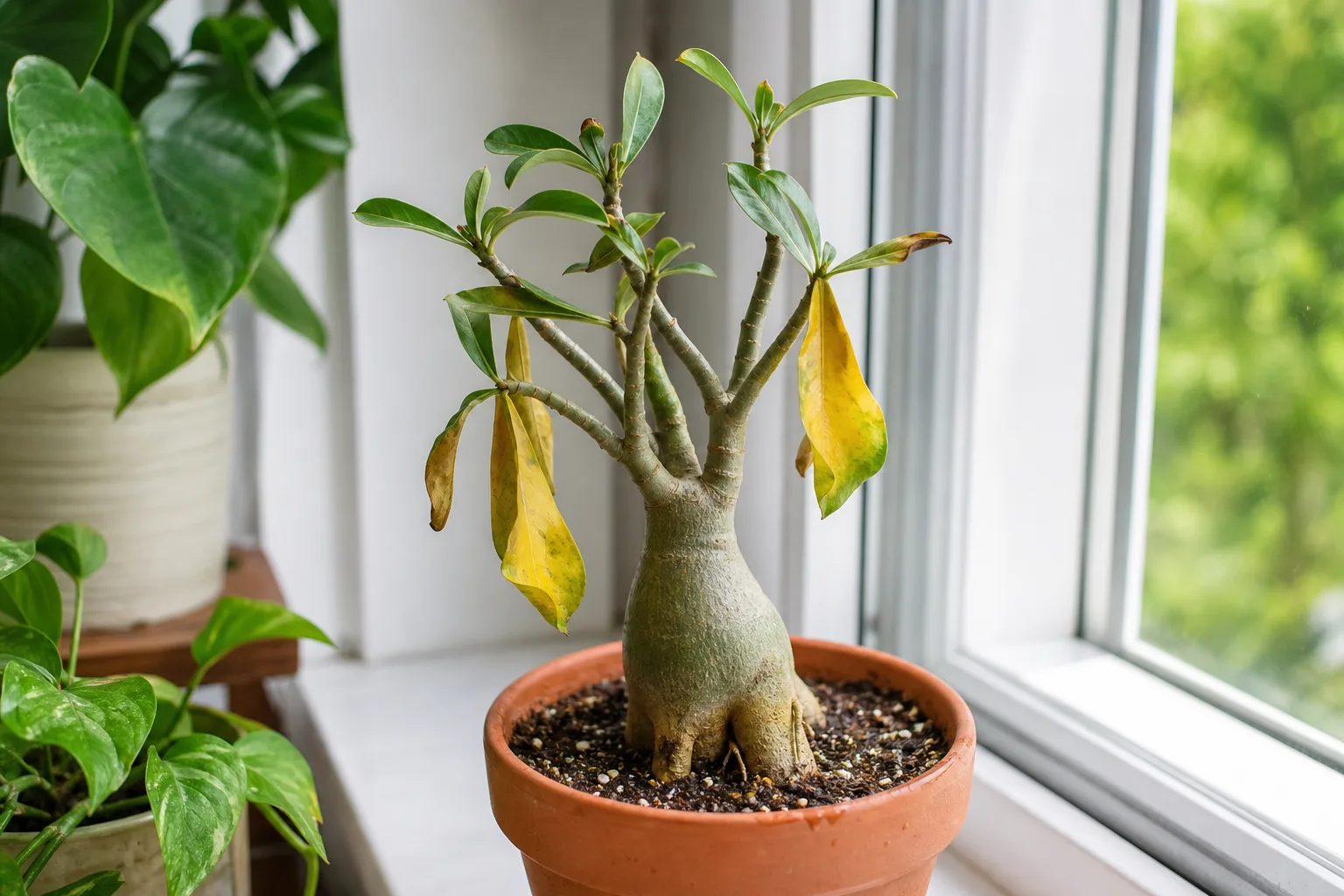
A plant that grows long, widely spaced stems is often reaching for light. Move it closer to direct sun gradually; abrupt exposure can scorch leaves.
If it produces foliage but no flowers, confirm it receives at least six hours of bright light, is warm during active growth, and is not being overfed with nitrogen-heavy fertilizer. Shade and cool conditions are more likely causes than a lack of bloom fertilizer.
UF/IFAS flags scale insects and oleander caterpillars as outdoor problems. Check stems and leaf clusters, especially on patio plants, and identify the pest before treatment. Remove isolated pests by hand or follow the label on a product registered for that pest and plant; never increase the dose or mix products to “make it stronger.” If the plant declines despite a dry, draining mix and better light, ask a local extension service to help identify the cause.
Protect pets and people from toxic sap
Desert rose is not a pet-safe plant. The ASPCA lists Adenium obesum as toxic to dogs, cats, and horses; its toxic principle is cardiac glycosides, and reported signs include vomiting, diarrhea, appetite loss, depression, irregular heartbeat, and death. Keep the plant and fallen leaves away from animals that chew greenery.
The milky sap can also cause a rash or eye irritation, according to NC State Extension. Wear gloves when pruning, repotting, or taking cuttings, wash your hands and tools afterward, and do not touch your face while working. If a pet may have chewed the plant, contact a veterinarian or ASPCA Animal Poison Control promptly rather than waiting for symptoms.
Conclusion
Successful desert rose care depends on matching water to warmth and growth. Give the plant strong light, a draining pot and mix, and thorough watering only while it is actively growing and the root zone has dried. As nights cool, move it to frost-free shelter before temperatures fall too far, then reduce water when growth slows or leaves drop.
Use the plant’s condition to resolve uncertainty: firm caudex plus dry mix and seasonal leaf loss usually calls for patience; soft tissue with wet soil calls for immediate rot inspection. Feed and prune only when the plant can regrow, acclimate it before returning it to outdoor sun, and keep it away from pets because the sap is toxic. That seasonal rhythm is more dependable than any fixed watering calendar.