How to Grow Blueberries in Containers Successfully
Use the right pot, pH, and blueberry variety to grow fruit on a patio or balcony. Learn how to water, feed, pollinate, prune, and overwinter a container shrub.
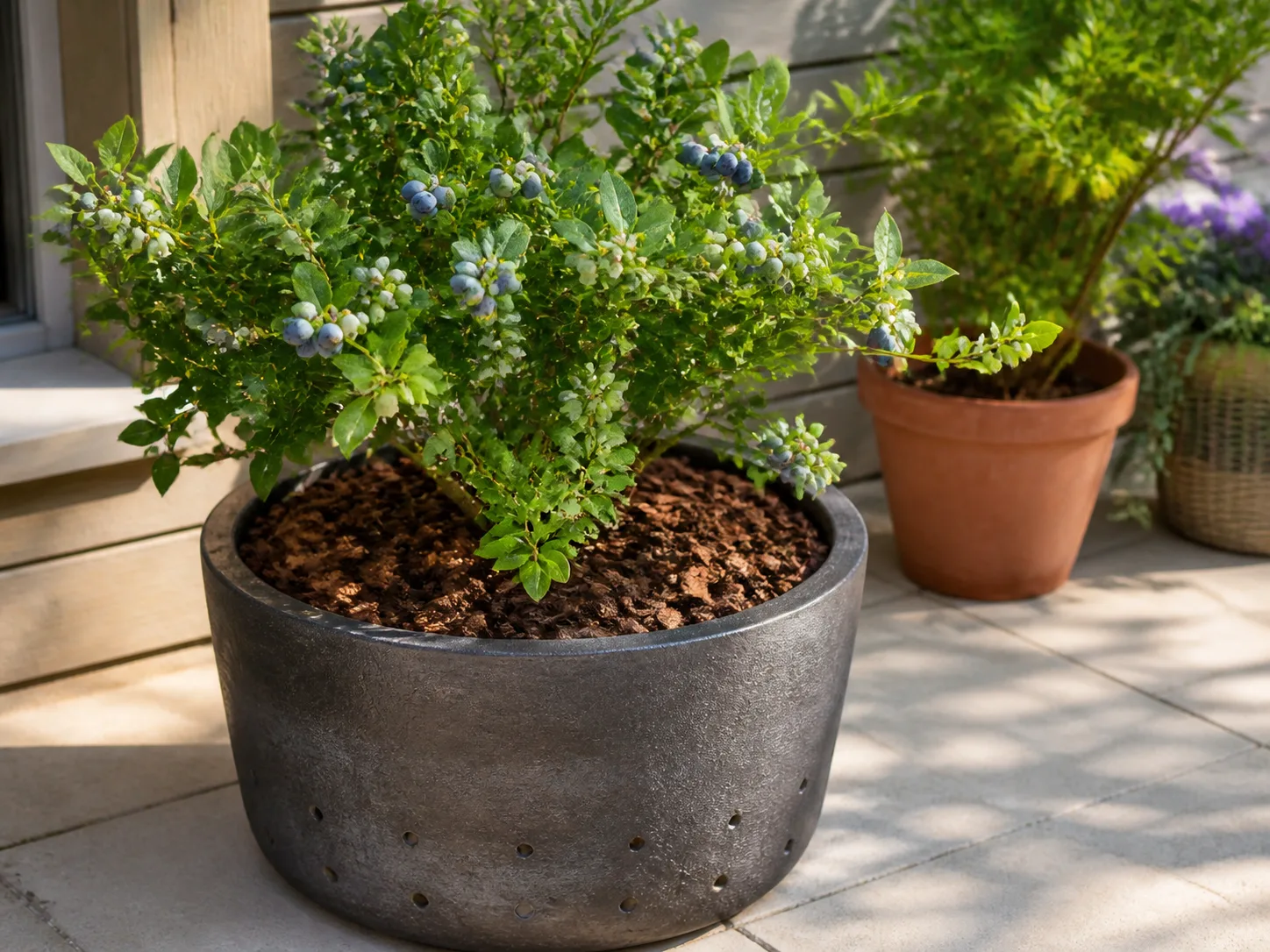
Yes, blueberries can thrive in a pot, and a container can make the plant easier to grow if your garden soil is alkaline, heavy, or poorly drained. The trade-off is that a pot gives the shallow root system less room to buffer heat, cold, and missed watering. A productive container starts with three choices made before planting: a climate-matched cultivar, an acidic but airy growing mix, and a pot large enough to hold moisture between waterings.
Think of the pot as a small, controlled root zone rather than a portable version of a garden bed. You can move it into better sun or winter shelter, but you must also keep its pH, moisture, and temperature from swinging too far. If you want to grow blueberries but cannot prepare acidic ground, this is often a practical route; if you already have suitable, well-drained soil, an in-ground bush is less demanding in midsummer and winter.
Is a container the right solution for your blueberry?
Container culture is useful when soil pH is high, clay holds water too long, a patio is your only sunny growing space, or you need to protect a young plant from wildlife. The University of Wisconsin–Madison Division of Extension describes containers as a way to give blueberries an acidic soilless medium when changing native soil is impractical. That control is valuable because blueberries have fine, shallow roots and do not adapt well to a root zone that alternates between waterlogged and bone dry.
The container does not remove the need for sunlight or cold-season dormancy. A balcony that gets only a few hours of direct light may keep a bush alive without giving it enough energy for a useful crop, and a warm indoor room is not a suitable winter home for a dormant shrub. If the plant will live outside, check that your balcony or deck can support a heavy, watered pot and that you have somewhere to protect it from winter exposure.
For more context on soil preparation and blueberry types in a garden bed, see our broader blueberry growing guide. The container advice below focuses on the extra constraints created by a pot.
Choose a cultivar that fits your climate and pot
Buy a named, nursery-grown cultivar rather than starting with seed if your goal is edible fruit. Seedlings are genetically variable and take longer to become productive; a named plant lets you plan around its mature size, cold hardiness, chill requirement, and pollination needs. Ask a local nursery or Extension office which cultivars fruit reliably in your region, especially if you garden in a hot-summer or mild-winter climate.
Compact half-high, dwarf, and lowbush types are usually easier to keep in a pot than a full-size highbush or vigorous rabbiteye. For cold regions, cultivars such as ‘Northblue,’ ‘Northland,’ ‘Polaris,’ ‘Chippewa,’ or ‘North Country’ are common half-high choices, but their suitability still depends on your local winters. ‘Top Hat’ is a much smaller type that can fit a more modest space, while ‘Sunshine Blue’ is a compact, lower-chill option described by Epic Gardening for mild growing regions. These names are starting points, not universal recommendations: use the tag and regional advice to confirm mature spread and chill hours.
Match mature size and chill needs before buying
Chill hours are the hours a plant experiences within a cool temperature range while dormant; each cultivar has its own requirement. If a plant needs more winter chill than your area provides, it may leaf or flower unevenly and crop poorly. Conversely, a variety selected for warmer regions may not tolerate the sustained cold of a northern winter, particularly when its roots sit above ground in a pot.
| Growing situation | A useful starting point | What to verify |
|---|---|---|
| Cold-winter patio | Half-high types such as ‘Northblue’ or ‘Polaris’ | Cold hardiness, chill requirement, and winter pot protection |
| Mild-winter region | Compact southern highbush such as ‘Sunshine Blue’ | Local performance, heat tolerance, and low-chill requirement |
| Warm, humid region | A regionally recommended rabbiteye or southern highbush | Whether a second compatible cultivar is needed |
| Very small patio | A true dwarf such as ‘Top Hat’ | Mature width and realistic crop size |
Do not choose solely by a hardiness-zone number. That number estimates survival in winter; it does not tell you whether the cultivar receives enough chill, handles summer heat, or fits the space. If your spot is windy or reflected heat bakes the balcony, select a more compact cultivar and plan to shield the pot from afternoon heat.
Pick a container that can support a mature shrub
Use one plant per pot and choose the largest container you can safely move and maintain. A five-gallon nursery bucket can work as a temporary home for a young plant, but it dries quickly and leaves little room for the mature root system. For a long-term container, aim for roughly 16 to 24 inches across and about 18 to 24 inches deep, adjusting upward for a large cultivar; the University of Wisconsin–Madison Division of Extension suggests moving established plants into a 16- or 20-inch pot or barrel, while experienced grower Dorothy Stainbrook at Farm to Jar favors a larger tub.
Width matters because blueberry roots spread through the upper part of the medium, but adequate depth adds useful moisture reserve and stability. A broad, heavy container is less likely to tip in wind and is easier to keep evenly moist than a small, deep nursery pot. Make sure several drainage holes remain open, raise the pot slightly on feet or bricks, and empty any saucer after watering so roots are never left standing in runoff.
Choose a durable, frost-resistant material with enough volume to buffer temperature swings. A light-colored resin pot, wood half-barrel, or substantial glazed planter can work if it drains freely. Dark plastic exposed to afternoon sun heats rapidly; the Wisconsin Extension specifically cautions against black containers because they increase heat and moisture loss. Terracotta can work but often dries faster through its porous walls, so it demands closer monitoring.
Build an acidic, airy potting mix
Blueberries need an acidic root zone so they can access nutrients, especially iron. Extension recommendations vary slightly: Wisconsin Extension gives a target of pH 4.5 to 5.0, while Kansas State Research and Extension gives 4.8 to 5.2. Aim for the overlap—about 4.8 to 5.0—and do not assume that a bag labeled “acid-loving” will remain in range indefinitely.
For the simplest setup, use a fresh, well-draining potting mix formulated for azaleas, rhododendrons, or blueberries, and check the package for pH and fertilizer details. Avoid garden soil: it compacts in a pot and can introduce a pH or drainage problem you were trying to avoid. A peat-free or coir-based product may be suitable, but coir and bark products vary, so verify the finished mix rather than assuming every ingredient is acidic.
If you are blending your own, Wisconsin Extension describes a one-to-one mix of sphagnum peat moss and shredded pine bark. Its alternative recipe combines two parts coir, two parts peat, and one part perlite. These are soilless recipes, not garden-bed formulas; mix them thoroughly so water does not run down a dry layer or bypass the root ball. A loose, slightly springy medium that drains after watering is more useful than a dense mix that stays wet for days.
Test the growing medium before planting and retest if growth declines or leaves begin yellowing. A basic pH kit can help, but follow its directions for soilless mixes and collect a representative sample from several spots. Do not add elemental sulfur, iron sulfate, vinegar, or another acidifier by guesswork: a small pot can swing out of range quickly, and the right amount depends on the medium and water. If your water is hard or leaves mineral deposits on pots, ask your local Extension service about water alkalinity; pH and alkalinity are related but not interchangeable measurements.
Plant one bush per pot at its original depth
Plant in spring once the potting medium is workable, or in fall where winters are mild and the plant has time to settle before hard freezes. If you garden in a cold climate, spring gives a new root ball more time to establish before winter. Start with a healthy nursery plant whose roots are moist and intact; do not leave a small plant in its shipping pot through a hot season while waiting for the “perfect” planter.
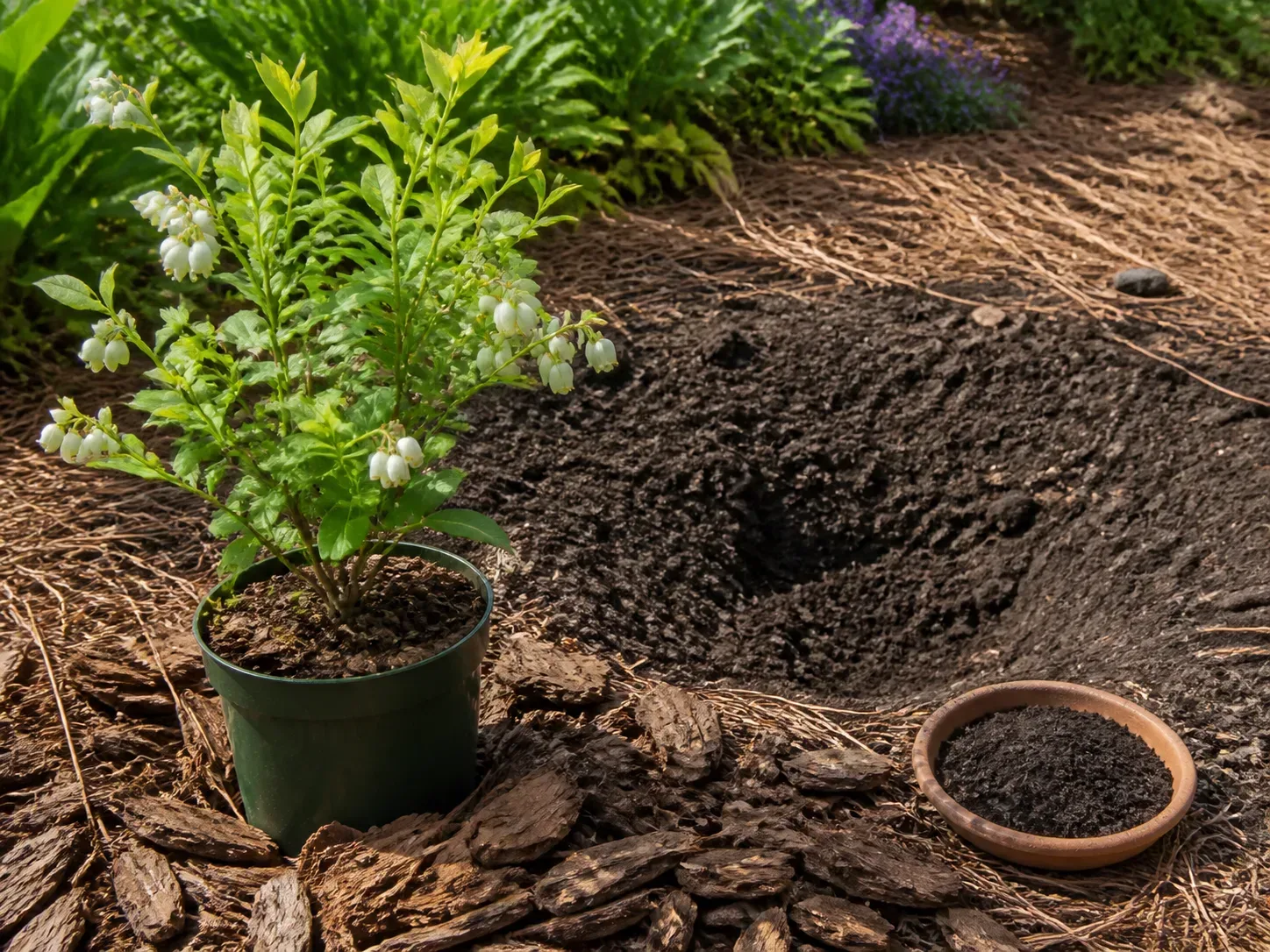
Pre-moisten the mix, set the bush so the top of its root ball sits level with the surrounding medium, and backfill without packing the mix hard. Keep the stem base at the same depth it had in the nursery container. Water slowly until moisture reaches the full root ball and excess runs through the drainage holes, then top up only if settling exposed roots.
Finish with a thin layer of pine bark or another clean, coarse organic mulch to slow evaporation. Leave a small open collar around the crown so the stem bases are not buried under wet material. Set the container where it will stay before it becomes heavy; moving a large, saturated barrel across a balcony is harder than arranging the spot first.
Give the pot sun without overheating the roots
Aim for at least six hours of direct sun daily for reliable fruiting. More sun can support stronger growth in a cool-summer region, but hot climates may benefit from light afternoon shade during extreme heat. Morning sun with protection from late-day reflected heat is a reasonable compromise when a container sits next to a south- or west-facing wall.
Do not move a fruiting bush into deep shade simply because the leaves look stressed. Check the root zone first: hot pot sides, dry mix, and wind can cause wilting even when the canopy has adequate light. A plant may tolerate partial shade but often produces less fruit, so use shade to reduce heat stress at the hottest part of the day rather than leaving the bush in a dim location all season.
Water by checking the root ball, not the calendar
Blueberries need consistent moisture, but “keep moist” does not mean leave the pot wet. Check the mix one or two inches below the surface with a finger or a wooden skewer; if it is beginning to dry at root depth, water slowly until the entire root ball is moist and excess drains away. If it is still cool and damp, wait and check again rather than adding water because a calendar says so.
Container size, wind, temperature, plant size, and rainfall all change how often you water. A young bush in a small pot on a hot deck may need a daily check, while a large barrel in mild weather can go longer. Leaves can divert rain away from the center of the pot, so rainfall does not prove the root ball received water; check the mix after a storm.
When the medium has dried enough to pull away from the pot, water in two slow passes. The first pass wets the surface; after a short pause, the second helps re-wet the root zone instead of rushing down a gap at the side. If water drains immediately while the center stays dry, the mix may have become hydrophobic or root-bound; rewet the root ball gradually and plan to refresh the medium if the problem returns.
Water quality also matters. Rainwater is a useful choice when tap or well water is alkaline or leaves mineral deposits; Wisconsin Extension notes that rainwater is often less hard than well water. Do not try to correct water with a recipe copied from another garden; test it or get local advice before changing its chemistry.
Fertilize lightly and monitor pH
Blueberries are sensitive to excess fertilizer salts, and a concentrated dose can injure roots faster in a small container than in a garden bed. Use a fertilizer labeled for acid-loving plants and follow its rate for container shrubs. If the potting mix already contains slow-release fertilizer, wait until the label’s feeding interval ends rather than adding another layer immediately.
A cautious spring feeding as growth resumes is a useful starting point. Wisconsin Extension describes a light slow-release product with supplemental liquid fertilizer during active growth, but that is not a reason to feed every pot on the same schedule; use the product label, the plant’s vigor, and the mix’s existing nutrient charge. Stop routine feeding by midsummer in cold climates so tender late growth is not encouraged before winter.
If growth is pale or weak, test moisture and pH before increasing fertilizer. Yellow leaves can reflect nutrient lockout at a pH that is too high, while brown edges or sudden wilt after feeding can point to salt injury or a dry root ball. More fertilizer will not repair either cause. Flush excess salts only when drainage is reliable, then allow the pot to drain completely.
Plan for pollination and the first crop
Many blueberry cultivars can set some fruit on their own, but a second compatible cultivar that blooms at the same time can improve pollination and often increases berry size or yield. Rabbiteye blueberries are a notable group for which multiple compatible varieties are important. Check the nursery label instead of treating “blueberries need two plants” as a universal rule.
If space allows, group compatible pots within the same patio area so bees can visit both plants. Do not crowd the containers so tightly that foliage stays wet or you cannot reach the fruit. If you can grow only one bush, choose a self-fruitful cultivar known to crop in your region and accept that the harvest may be lighter than it would be with a compatible partner.
A young nursery plant may carry a few berries before it is ready for a substantial harvest. The Farm to Jar grower describes picking modest amounts from a two-year-old plant, with yields increasing over later seasons; that is an example, not a promise for every cultivar or patio. If your plant is a small liner or looks weak after transplanting, removing some early flower clusters is a sensible way to favor establishment. For a robust plant, leaving a light first crop is a reasonable trade-off; do not strip every bloom automatically.
Keep container care on a seasonal rhythm
In spring, uncover overwintered pots gradually, check drainage holes, and inspect the mix before feeding. Prune only while the plant is dormant, then move the pot into its full-sun position as growth starts. If you have two cultivars, note whether their bloom periods overlap; a long gap between flowering windows will limit cross-pollination even when the plants sit side by side.
During flowering and fruit fill, keep moisture steady and avoid moving the container repeatedly. Water stress at this stage can reduce fruit size and quality, while a saucer full of water can suffocate roots. Keep the surface mulched, remove weeds or seedlings from the pot, and check the underside of leaves and young stems when you water.
As fruit begins to color, decide how much you are willing to share with birds. Harvesting frequently and keeping pots near your daily path can help, but netting on a frame may be needed where birds take the crop before it ripens. Use a frame or tensioned support so the net stays away from branches, inspect it often, and remove it when it is no longer needed.
After harvest, continue watering while the plant is actively growing; do not let it dry out simply because the berries are gone. In late summer, avoid strong fertilizer that would push a flush of soft new growth. As the plant enters dormancy, prepare the pot’s winter location before the first hard freeze rather than waiting until the root ball is frozen.
Protect roots through winter
A cultivar that survives winter in the ground may still suffer in an exposed pot. Garden soil buffers temperature swings, while a container’s roots are surrounded by cold air and can freeze during repeated freeze-thaw cycles. The colder and windier your location, the more important it is to insulate the pot or move it to shelter without putting the dormant plant in a heated room.
Choose a method that keeps the plant cold and dormant while moderating the pot’s exposure. In-ground burial is effective where drainage is good: sink the container to its rim in a protected spot, then mulch the surface after the ground cools. You can also surround the pot with straw or mulch, place it in an unheated garage or shed, or cluster it against a sheltered wall. Wisconsin Extension recommends burying containers in cold regions and adding a substantial straw mulch; Kansas State Research and Extension also suggests burying or moving pots to an unheated attached garage.
Check the pot occasionally during winter. Dormant blueberries use less water, but the medium should not dry to dust; water lightly on a thawed day if the root ball is dry and make sure excess drains. Do not keep it saturated, let the pot sit in a water-filled saucer, or move it into a warm living room. In spring, return it to sun gradually and remove insulation after the harshest weather has passed.
Prune to renew the bush, not to shape it
Leave a newly planted bush mostly alone while it establishes. Remove broken or dead branches, but avoid shearing the shrub into a tight ball; that removes fruiting wood without solving the plant’s underlying needs. Blueberries flower and fruit on established wood, so pruning is a renewal process rather than a routine size-control haircut.
Begin more deliberate pruning once the bush is several years old, usually while it is dormant in late winter or early spring. First remove dead, damaged, low, or crossing branches. Then identify a few of the oldest, thickest canes and cut them near the base to make room for vigorous younger canes. A small potted plant may need only a few cuts, while a crowded mature bush may need more; do not remove a third of the plant just to meet a quota.
Use clean, sharp pruners and step back between cuts. If the pot is too small for the shrub, hard pruning will not create lasting space; repot into an appropriately sized container or replace a large cultivar with a compact one. A healthy bush should retain a mix of younger and mature stems rather than a handful of clipped stubs.
Harvest only after berries turn sweet
The harvest date depends on cultivar and climate, so watch the berries instead of relying on a calendar. Fruit often turns blue before it is fully sweet. Leave fully colored berries on the bush several more days, then taste one; ripe berries taste sweet and release with a gentle roll rather than a hard tug.
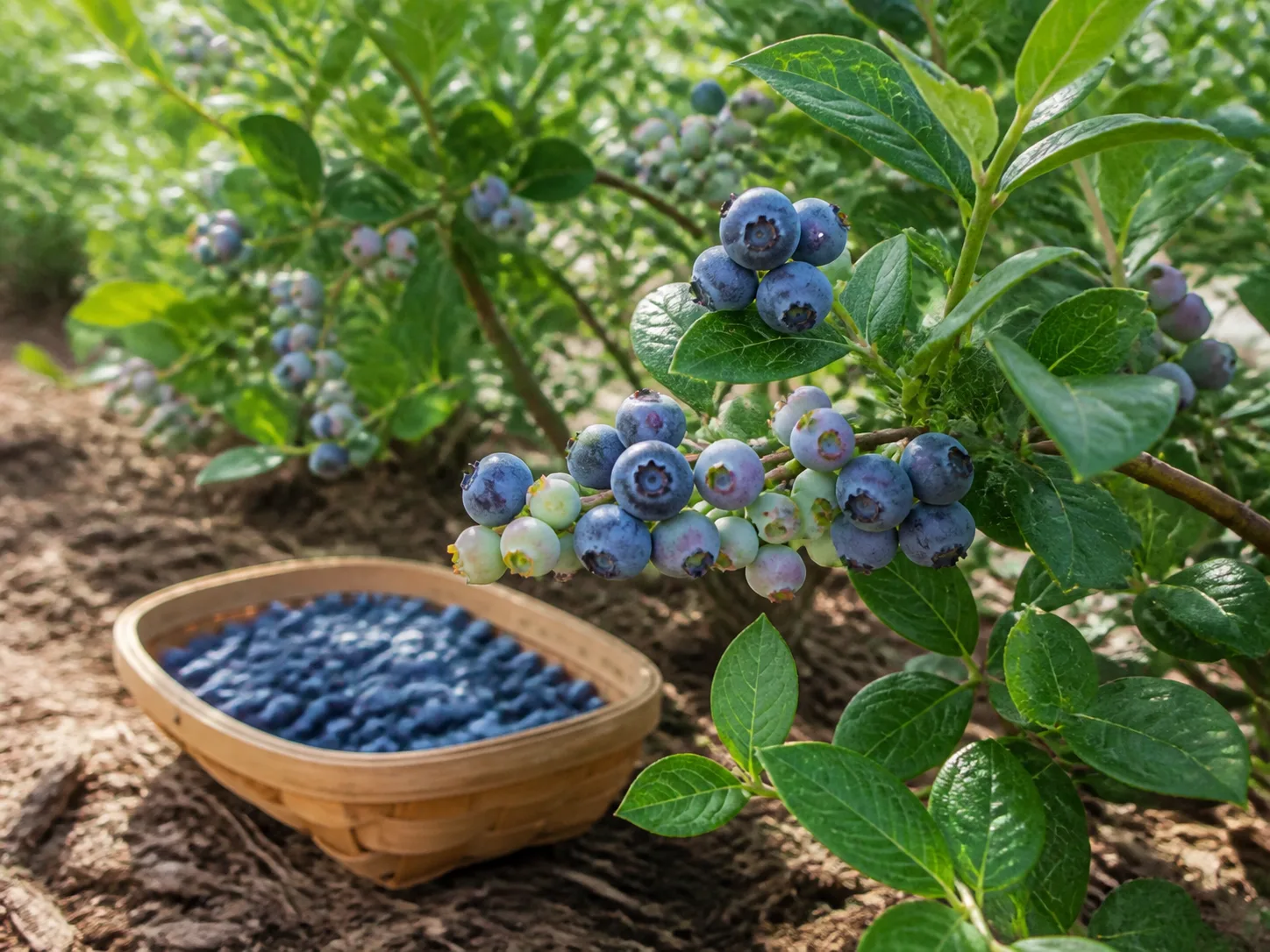
Pick in several passes as clusters ripen at different speeds. Hold a shallow bowl under the cluster and use your fingertips to roll ripe fruit free, leaving firm green or reddish berries attached. Epic Gardening notes that cultivars differ in ripening window, which is one reason matching bloom time and harvest season matters when you choose more than one plant.
Refrigerate the berries promptly and keep them unwashed until use. Wash only the portion you are about to eat, since extra moisture can shorten storage life. For a small container harvest, freezing the surplus is usually more useful than trying to pick every berry at the same stage.
Troubleshoot yellow leaves, weak growth, and low fruit
When a potted blueberry looks wrong, check the root environment before reaching for a spray or fertilizer. Note whether symptoms affect new leaves or old leaves, feel the mix below the surface, confirm that drainage holes are open, and test pH if yellowing persists. A single symptom rarely identifies the cause by itself.
Yellow leaves: check pH before adding fertilizer
Yellow leaves with green veins on newer growth can occur when pH is too high and the plant cannot access iron. Test the medium; if it is above the blueberry range, use a measured correction recommended for the mix or replace some or all of the medium at the next suitable repotting. Do not pour vinegar into the pot or add iron without confirming the problem.
If the pH is in range, consider waterlogging, drought, root crowding, or excess fertilizer. A pot that stays wet for days needs better drainage or a more open mix; a pot that dries completely between waterings needs a larger moisture reserve or more frequent checks. Roots that smell sour or look dark and mushy are a different problem from a dry, light root ball.
Flowers without berries: check bloom overlap and conditions
A bush can flower but set little fruit if its cultivar needs a pollination partner, the partner blooms at a different time, or bees cannot reach flowers. Next, review sun exposure and water during flowering and fruit set. A plant that grew in deep shade or dried out repeatedly can flower without building a useful crop.
Also check whether you pruned off flowering wood during dormancy. If the plant is young, the small crop may reflect its age rather than a care failure; avoid compensating with heavy fertilizer. For a confirmed pollination gap, add a compatible cultivar only if you can meet both plants’ mature space and winter needs.
Declining roots: separate drought, soggy mix, and winter injury
Sudden wilt on a hot afternoon can indicate a dry root ball, but wilt in wet mix points toward poor aeration or root damage. Lift the pot only if it is safe and compare its weight with a well-watered container; check below the top layer because peat-based mixes can look moist at the surface while the center dries out. If water drains slowly, clear the holes and assess whether the medium has collapsed or become compacted.
Weak growth after winter may mean the root ball froze or the pot dried while dormant. Wait for growth to reveal the extent of damage, then prune only dead wood and correct the winter setup before the next cold season. For insects, fruitworms, leaf spots, or suspicious dieback, identify the issue through a local Extension service before applying a treatment; if a pesticide is needed, use only a product labeled for edible blueberries and follow its label, including pollinator precautions.
Conclusion
Growing blueberries in containers works best when you treat pot size, acidity, and moisture as one system. Choose a cultivar whose chill requirement and mature size fit your climate, give it a roomy pot with open drainage and an acidic soilless mix, and keep the root ball evenly moist without leaving it in standing water.
After setup, most of the work is observation: check the medium before watering, feed by the label rather than by habit, protect the exposed roots in winter, and wait to harvest until berries taste sweet. Those habits make a patio blueberry more reliable than a small pot and a fixed watering schedule ever will.