Hardneck vs. Softneck Garlic: Differences for Gardeners
Learn whether hardneck or softneck garlic fits your winter, kitchen, and storage plans, with practical planting, scape, harvest, and curing advice.
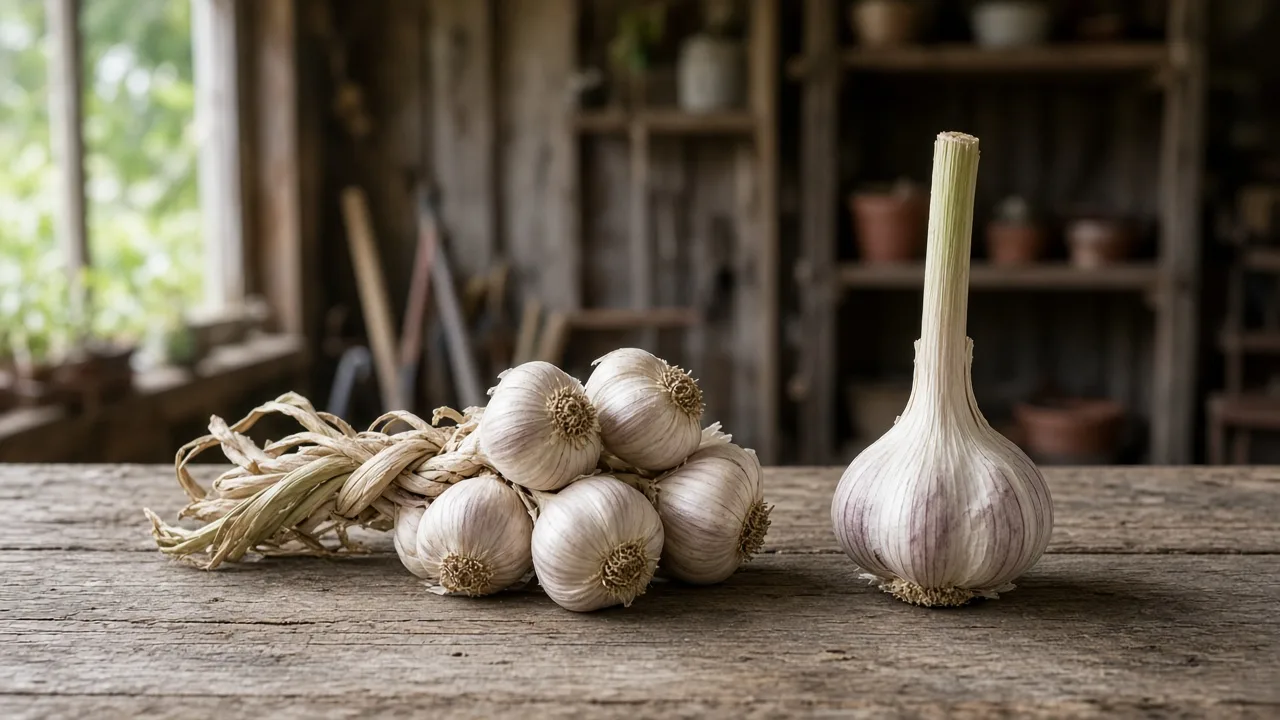
If you are deciding between hardneck and softneck garlic, start with your winter, not the label on the bulb. Hardneck garlic usually fits gardens with a real cold season and rewards you with large cloves, complex flavor, and edible scapes. Softneck garlic is the safer starting point for mild-winter gardens and for anyone who values many cloves, flexible stems, and a longer storage window.
Neither type is universally better. The right choice is the one that can receive the cold exposure it needs, finish its bulb before summer heat or wet weather becomes a problem, and match the way you cook. A gardener in a cold region may grow both, while a gardener in a warm region may need a warm-climate softneck or a carefully selected hardneck that has been pre-chilled.
The short answer: choose by climate, kitchen, and storage
Think of garlic as a crop with three linked decisions: climate fit, culinary fit, and storage fit. Hardneck varieties are the better default for cold-winter regions because their growth cycle is more dependent on winter chilling. Softnecks are usually more forgiving where winters are short or mild and are often the better choice when you want bulbs to last well into the following year.
| Feature | Hardneck garlic | Softneck garlic |
|---|---|---|
| Center of mature bulb | Stiff central stalk | Soft central stem or no obvious woody core |
| Cloves | Fewer, usually larger cloves in one ring | More cloves in layers, often with mixed sizes |
| Scapes | Produces a curly edible scape | Usually does not produce a scape |
| Flavor | Often bolder and more complex, but variety matters | Often milder and more even, but variety matters |
| Climate tendency | Best default for cold winters | Best default for mild winters and warmer regions |
| Storage tendency | Shorter; cure carefully and use first | Longer when well cured and kept dry |
| Stem after harvest | Stiff, difficult to braid | Flexible and easy to braid |
These are tendencies, not promises. A variety’s genetics, the size of the planted clove, soil drainage, harvest timing, and curing conditions can matter as much as the broad type. University extension guidance from West Virginia University makes the practical distinction especially clear: hardnecks are easier to peel and softnecks store and braid better, but both need a well-drained, sunny bed.
How to tell hardneck and softneck garlic apart
The most reliable test is to cut or break open a mature bulb. A hardneck bulb has a firm central stalk that continues into the center of the head; the cloves form around it in one fairly neat circle. A softneck bulb has a flexible neck made from leaf bases, and the cloves usually fill several concentric layers around a less rigid center.
From the outside, the distinction is less certain. A softneck may have a thicker, more compact-looking head, while a hardneck often has a prominent neck and fewer, plumper cloves, but wrapper color and bulb shape vary widely among cultivars. If you bought an unlabeled farmers-market bulb, the inside structure is more useful than color alone.
The names describe the mature stalk, not the texture of every wrapper. Hardneck wrappers are often thinner and easier to peel, while softneck heads usually carry more layers of protective skin. That extra packaging is one reason softnecks tend to travel and store well, although a damaged or poorly cured bulb of either type can rot quickly.
Garlic’s diversity also explains why no single visual rule works perfectly. A 2023 genome study in Nature Communications through PubMed Central describes cultivated garlic as a clonally propagated crop with substantial variation in bolting and flowering-related traits. For gardeners, the takeaway is simple: use the named cultivar and local performance notes when available, rather than treating a type label as a complete growing prescription.
Hardneck garlic: where it shines and where it struggles
Hardneck garlic, commonly grouped under Allium sativum subsp. ophioscorodon, sends a stiff central stalk through the bulb. It is often the most satisfying type for a gardener who enjoys tasting different cultivars because individual varieties can have noticeably different heat, sweetness, richness, or raw pungency.
Its main garden advantage is cold-season performance. Hardneck cloves generally need a substantial period of cool conditions to make a well-formed bulb, so they are a strong choice for regions with cold winters. In return, you usually get fewer but larger cloves, easier peeling, and a scape harvest before the bulbs are ready.
The trade-off is storage. Hardneck wrappers are commonly less dense than softneck wrappers, and the bulbs often deteriorate sooner once cured. Practical gardening sources commonly place hardneck storage around four to six months under good conditions, but your harvest may last less or more depending on cultivar, curing, temperature, humidity, and whether the bulb was bruised while being lifted. Plan to eat the hardnecks first and reserve the longest-keeping softnecks for the back half of the year.
Hardneck scapes: what to do and when
The scape is a round, solid flower stalk that emerges from the center of a hardneck plant in late spring or early summer. It often makes one or two graceful loops before the tip straightens and develops a bulbil-filled flower head. That stalk is not a sign that the plant has failed; it is one of the reasons many gardeners deliberately grow hardneck garlic.
Harvest the scape while it is still tender and curled. Cut or snap it above the upper leaves, and use it like a mild garlic-green in pesto, compound butter, stir-fries, or a quick sauté. Epic Gardening’s comparison notes that leaving scapes to mature can divert resources from bulb development; the most useful timing cue is the curl stage, not a fixed calendar date.
Removing scapes is a yield decision, not a moral rule. If you want larger, more uniform bulbs, remove most scapes. If you want bulbils for experimentation or a small seed-propagation project, leave one or two stalks and accept that those plants may produce smaller bulbs and that bulbils take longer to reach harvestable size.
Hardneck cloves are usually arranged in a single ring around the central stalk. The count may be roughly four to twelve per bulb, with the largest cloves often giving you the easiest peeling and the strongest starting plants. A small bulb with small cloves is not automatically a bad cultivar, but it is a poor source of planting stock if you are trying to improve bulb size.
That large-clove format changes how you cook. One hardneck clove may provide as much usable garlic as several small inner softneck cloves, and its skin often slips off with less fiddling. The flavor can be more assertive when raw, but cooking, cultivar, harvest maturity, and storage all affect the final taste, so choose from a sample bulb before planting a large bed.
Softneck garlic: where it shines and where it struggles
Softneck garlic, commonly grouped under Allium sativum subsp. sativum, keeps a flexible neck instead of forming the same stiff central stalk. It is the type most often associated with supermarket garlic because it handles shipping and storage efficiently, though grocery bulbs are not necessarily the best seed for your garden.
Softnecks are a good fit when winter is mild, when you want a dependable supply of many cloves, or when you enjoy arranging cured bulbs into braids. They generally need less prolonged chilling than hardnecks to form bulbs, but “needs less cold” does not mean “needs no seasonal signal.” Warm-region growers should still select varieties recommended for their area and plant during the coolest suitable part of the year.
The common weakness is clove size and peeling. A softneck bulb may contain many cloves, including small inner cloves that are awkward to peel one at a time. That is a real advantage for recipes that use a lot of minced garlic, but less convenient if you want to roast a few giant cloves or peel quickly for preserving.
Why softnecks braid and store well
After curing, softneck leaves remain flexible enough to weave into a braid. Braiding is useful because it keeps whole bulbs off a damp surface, allows air to move around them, and makes it easy to use the oldest bulbs first. Braid only fully cured, sound bulbs, and hang the braid in a dry, dark, ventilated place rather than treating it as a decorative object above a hot stove.
Storage life is softneck’s strongest practical advantage. Under ideal conditions, well-cured softnecks may keep for six to twelve months, while other extension guidance gives shorter room-temperature ranges; the difference reflects cultivar and storage environment rather than a guarantee. Savvy Gardening and Gardening Know How both emphasize the same pattern: softnecks usually outlast hardnecks because their cloves are enclosed by more layers of skin.
Softneck clove layout and kitchen trade-offs
Softneck cloves grow in several layers. The outer cloves are often the largest and easiest to use, while the inner cloves can be smaller and more irregular. If you are saving seed, select large, healthy cloves from the outside or middle of the best bulbs rather than planting every leftover tiny clove.
Softneck flavor is often described as mild, sweet, or buttery, but it is not flavorless. Cultivar, soil, water stress, harvest timing, and storage change the profile. Choose softneck when you want a steady all-purpose garlic, and choose a named variety with a stronger flavor if you like the storage and braiding benefits but do not want bland bulbs.
Hardneck vs. softneck by growing condition
The most helpful climate question is not “What is my USDA zone?” It is “Will this planting stock receive the chill and growing season it needs, without sitting in wet soil?” Zones are a useful starting point, but a coastal pocket, high-elevation bed, winter container, or unusually warm city can behave differently from the regional label.
Cold winters and northern gardens
In a cold-winter garden, hardneck is usually the first type to try. Plant cloves in fall while the soil is workable, give them time to root before the ground freezes, and cover the bed with clean straw or leaf mulch to buffer temperature swings. Wisconsin Extension reports that earlier fall planting can establish well and does not necessarily reduce the next year’s yield, so do not delay solely because a small shoot appears before winter.
Softnecks can still work in some northern gardens, especially cold-tolerant cultivars, protected raised beds, or sites with reliable snow cover. They may overwinter less consistently than a suitable hardneck, so grow a small trial rather than committing the whole bed. In the coldest sites, a hardneck such as a Porcelain, Rocambole, or Purple Stripe type is a more logical starting point than a generic softneck.
Mild winters, hot summers, and warm climates
In a mild-winter or hot-summer region, softneck is usually the safer default because it can form bulbs with less winter chilling. Planting date becomes especially important: the cloves need enough cool-season growth to establish, but they should not be forced through a long, hot season after bulbing has finished.
Hardneck is not automatically impossible in a warm climate. Some gardeners pre-chill planting cloves in a refrigerator for several weeks, then plant them in the coolest part of the local season, but the response depends on cultivar and on whether the cloves stay healthy and dry. Treat this as an experiment with a small quantity, not a promise that any hardneck will perform like it does in a northern garden; Epic Gardening describes cold exposure as the central warm-climate challenge.
Warm climates also make drainage and harvest timing less forgiving. A bed that stays saturated through a mild winter can lose bulbs to rot, while a late harvest can expose cloves to heat and cause wrappers to split. Use a raised or slightly mounded bed when needed, and follow cultivar-specific local planting windows rather than copying a mid-October date from a cold region.
Choose a variety, not just a type
“Hardneck” and “softneck” are broad families, not two individual varieties. Once you have chosen the family that fits your winter, look for a named cultivar with a reliable record in your region. A seed supplier’s description should tell you the type, expected harvest window, approximate storage behavior, flavor notes, and the climates where the stock has been selected.
For hardnecks, Porcelain types are known for large cloves and strong cold tolerance; Rocamboles are often valued for rich flavor and easy peeling; Purple Stripe types are popular for colorful wrappers and distinctive taste. Examples such as ‘Music,’ ‘German Extra Hardy,’ and ‘Chesnok Red’ are useful starting points, but the best one is the one that has performed in a climate like yours.
For softnecks, Artichoke and Silverskin groups are common choices for many-cloved heads and long storage. ‘Inchelium Red,’ ‘California White,’ and ‘Silver White’ are familiar examples, but a softneck listed for a southern or mild-winter region may outperform a famous northern cultivar in your garden. The USDA Agricultural Research Service’s garlic collection illustrates how much diversity exists even among accessions classified by flowering behavior, so do not assume a short list captures every good option.
Elephant garlic belongs in a separate box. It produces very large, mild bulbs but is a leek relative rather than true Allium sativum, as Gardening Know How explains. Buy it because you want elephant garlic, not because a seller has loosely placed it under hardneck garlic.
Planting either type for a reliable crop
The planting method is broadly the same for both types. What changes most is the cultivar and the climate window, not whether the clove is hardneck or softneck.
Seed garlic, clove size, and bed preparation
Buy planting garlic from a reputable seed source, local grower, or extension-recommended supplier. Grocery garlic may be a poor regional match, may have been treated to delay sprouting, or may have traveled through conditions that reduce planting quality. Keep bulbs whole until planting day, then separate the cloves gently without peeling away their papery wrappers.
Choose firm, disease-free bulbs and plant the largest sound cloves. The clove is the plant’s food reserve for establishment, so a thin or damaged clove has less margin for error and usually makes a smaller plant. Save the best bulbs from your own harvest only after checking that they cured cleanly and show no soft rot, staining, or insect damage.
Prepare a sunny bed with loose, well-drained soil and plenty of organic matter. WVU Extension gives a useful soil target of roughly pH 6.0 to 7.0 and notes that garlic performs best in deep, well-drained soil; a soil test is more reliable than adding lime or fertilizer by guesswork. Avoid a bed that recently held onions, leeks, shallots, or garlic when disease pressure has been a problem, and do not place garlic where irrigation or winter rain leaves puddles.
Depth, spacing, mulch, water, and feeding
Set each clove with the flat basal plate down and the pointed tip up. Plant roughly two to four inches deep, adjusting for soil texture, winter exposure, and the mulch layer, and space cloves about four to six inches apart so bulbs can size without competing heavily. The guidance from NC State Cooperative Extension uses about one to two inches of planting depth and four inches between plants for its regional conditions, which is a good reminder that local recommendations outrank one universal number.
Water the bed after planting and keep it evenly moist while roots establish, but never turn the bed into a saturated trench. A two- to four-inch layer of clean straw or leaf mulch helps suppress weeds, conserve moisture, and protect cloves from temperature swings. In spring, pull or thin the mulch enough for the soil to warm and new leaves to grow, then return it around the plants if weeds begin to compete.
Garlic is a poor competitor against weeds because it spends so long in the ground. Keep the bed clean with shallow hand weeding rather than cultivating deeply near the bulbs. Feed according to a soil test and local extension advice; nitrogen is most useful early, while heavy late nitrogen can encourage leaves when the plant should be sizing its bulb. Stop routine watering as harvest approaches, especially in wet climates, so wrappers can dry and bulbs are less exposed to rot.
Harvesting, curing, and storing each type
Hardneck and softneck garlic follow the same broad harvest-to-storage sequence, but their leaf cues and final handling differ slightly. Do not pull by the leaves; loosen the soil with a fork and lift from underneath so you do not tear the wrappers or break the neck.
Read the leaves before you lift a bulb
Calendar dates are only rough guides because planting date and cultivar change the schedule. Start checking when the lower leaves turn yellow or brown while several upper leaves remain green. NC State Extension uses about 30 percent yellowing as a regional harvest cue, while WVU Extension describes a stage in which about half the leaves have died and bent down; both point to the same principle: harvest when the bulb is mature but still protected by several intact wrappers.
If you wait too long, the cloves may separate inside the bulb and the wrappers can split, reducing storage life. If you harvest too early, the bulbs may be smaller and the wrappers may not have finished forming. When uncertain, lift one test plant, brush away soil, and inspect the bulb; it is better to sacrifice one sample than to guess across the whole bed.
Hardneck scapes are harvested weeks before the bulb. Their appearance does not tell you that the bulb is ready, so keep watching the leaves after scape harvest. Softnecks generally lack that intermediate cue, which makes leaf color and a sample bulb more important.
Cure first, then choose a storage method
Cure freshly lifted garlic with the leaves and roots attached. Shake off loose soil without washing the bulbs, then place or hang them in a dry, shaded, well-ventilated space where air can move around every plant. Wisconsin Extension recommends about 10 to 14 days in suitable conditions, while other extension guidance uses several weeks; thick bulbs, humid weather, and dense bundles take longer.
The cure is complete when the outer skin is dry and brittle, the neck has tightened, and the roots feel dry rather than fresh. Trim the roots and cut the stalk only then. Do not cure garlic in direct sun, in a sealed plastic bin, or in a damp shed where condensation can settle on the bulbs.
Store whole, cured bulbs in darkness with good air circulation. A mesh bag, open basket, paper bag, or softneck braid works better than a sealed container. Keep the garlic away from a hot stove, sink splash, and humid refrigerator drawer; temperature and humidity swings can encourage sprouting or mold. WVU Extension also advises avoiding freezing and direct sunlight.
Use hardnecks first because their shorter storage window makes them more vulnerable to shriveling and rot. Keep softnecks whole until you need a clove, since breaking a bulb apart exposes it and shortens its useful life. Label braids or storage bins with the cultivar and harvest date, then use the oldest bulbs first rather than waiting for visible sprouting.
Fix common disappointments before next season
Small bulbs do not automatically mean you chose the wrong type. First ask whether the planted cloves were small, whether weeds competed, whether the bed drained, whether the plants received enough early nutrition, and whether harvest came too soon. If the leaves grew well but bulbs stayed small, compare the harvest date and bulb wrapper development; if the leaves were weak from the beginning, investigate seed quality, soil, water, and disease.
No scapes on a hardneck can have several explanations. The plant may be a weakly bolting cultivar, the winter may not have supplied the expected chill, or the scape may still be developing. Conversely, an occasional flowering stalk on a softneck does not necessarily mean the label is wrong; stress and cultivar variation can blur the family traits. Check the bulb’s center after harvest and record the result.
Bulbs that rot in storage usually point back to one of three earlier problems: poor drainage in the bed, bruising during harvest, or incomplete curing. Separate and discard soft or moldy bulbs, improve airflow, and do not save damaged bulbs as seed. If wrappers split before harvest, check whether the crop stayed in the ground too long or experienced a sudden shift from wet soil to heat.
Finally, do not judge a type from one disappointing season. Garlic is planted for months, and weather can overwhelm a good cultivar. Grow two or three named varieties in labeled rows, keep simple notes on planting and harvest dates, and save the largest healthy bulbs from the line that performed best in your own soil.
Conclusion
Hardneck garlic is the strong choice when your garden has cold winters and your kitchen values large, easy-to-peel cloves, complex flavor, and a scape harvest. Softneck garlic is the practical choice when winters are mild, you want many cloves per bulb, you plan to braid the harvest, or you need garlic to store for much of the year.
Choose the type that fits your climate first, then choose a named variety that fits your taste and storage plan. Plant large healthy cloves in a sunny, well-drained bed, mulch against temperature swings, harvest by leaf cues, cure with the leaves attached, and store the cured bulbs dry, dark, and airy. That sequence matters more than any simple “hardneck versus softneck” winner—and it gives you the information to make a better choice for next season too.



