Hinoki Cypress Care: Planting, Pruning, and Cultivars
Hinoki cypress ranges from dwarf accents to large trees. Compare cultivar sizes, light and soil needs, watering, pruning, container care, and browning causes.
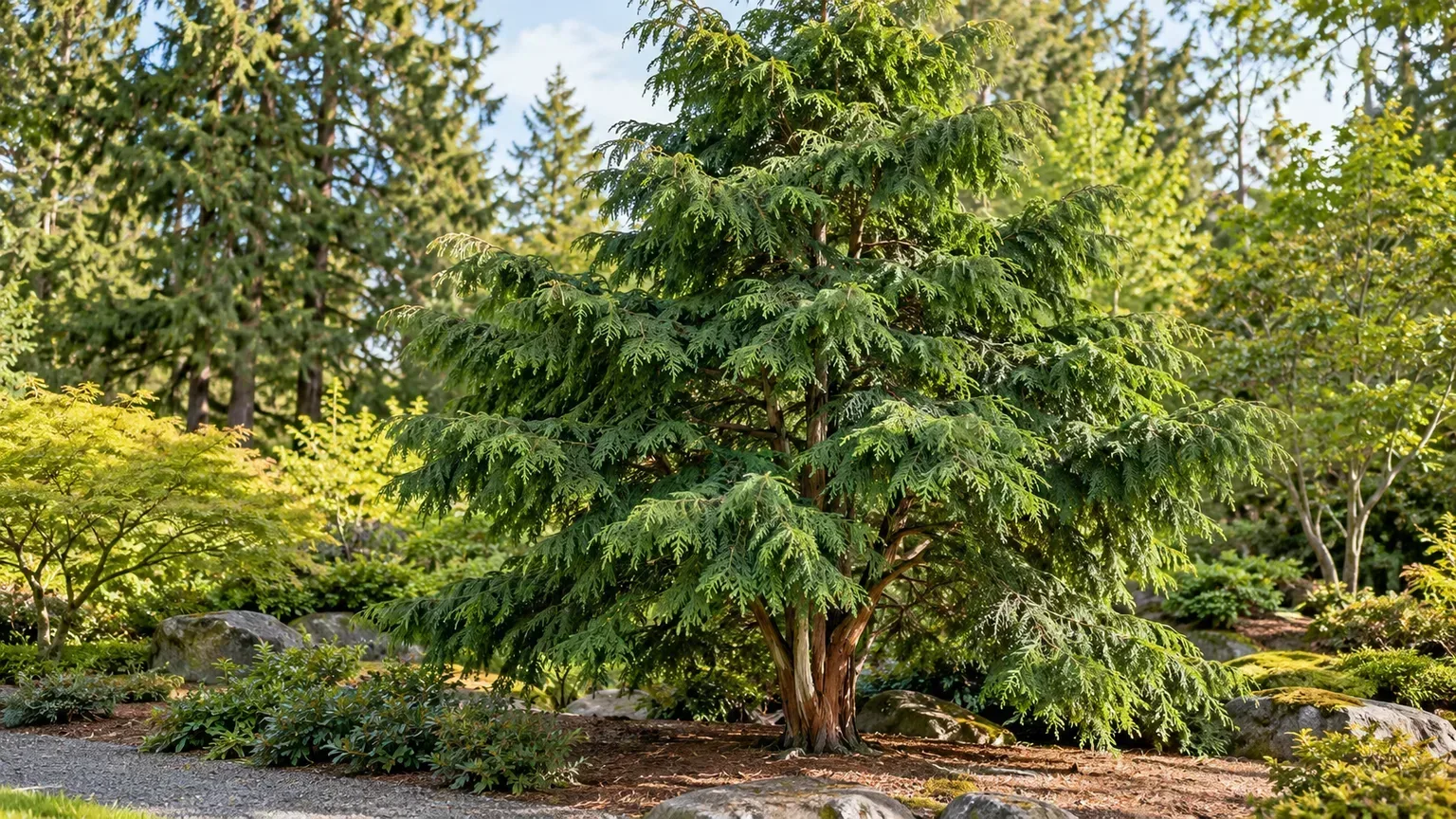
A Hinoki cypress can be a compact, sculptural accent or a tree that eventually dominates a small yard. The difference is usually the cultivar, not a special pruning trick. Before buying one, identify the cultivar name and its mature width; then give it bright light, soil that drains, and steady moisture while its roots establish.
The species is Chamaecyparis obtusa, an evergreen conifer native to Japan. Its soft, flattened sprays, gently drooping branch tips, and reddish-brown peeling bark make it easy to recognize once mature. The advice below applies to landscape planting and compact cultivars grown in containers, with the important caveat that their eventual size and cold tolerance are not interchangeable.
What Hinoki Cypress Is—and What It Is Not
Despite its common name, Hinoki cypress is a false cypress, not a member of the true-cypress genus Cupressus. It belongs to the cypress family, Cupressaceae, and is also sold as Hinoki falsecypress or Japanese cypress. Its scale-like leaves overlap in flattened, fern-like fans; the undersides may show pale markings, and crushing a small piece of foliage releases a resinous, cedar-like scent. NC State Extension describes the species as a broad, softly pyramidal tree with horizontal branches, while the Missouri Botanical Garden notes the drooping tips and shredding bark that become more noticeable with age.
Those attractive traits do not tell you how large the nursery plant will become. The straight species can reach roughly 50 to 75 feet tall in cultivation, according to NC State Extension and an archived UF/IFAS Extension profile; some trees in the native range grow larger. Garden cultivars span a much wider range, from tiny rock-garden plants to trees several dozen feet tall. The name on the pot therefore matters more than a generic “Hinoki cypress” label.
Choose a Cultivar by Mature Footprint
Start with the space, not the foliage color. Measure the planting bed’s width and look above it for roof eaves, wires, windows, and neighboring trees. Then compare those measurements with the cultivar’s mature height and spread, not the size of the plant at purchase or its “growth in ten years.” A narrow specimen may fit a foundation bed for a decade and still become too broad to maintain without cutting into old wood.
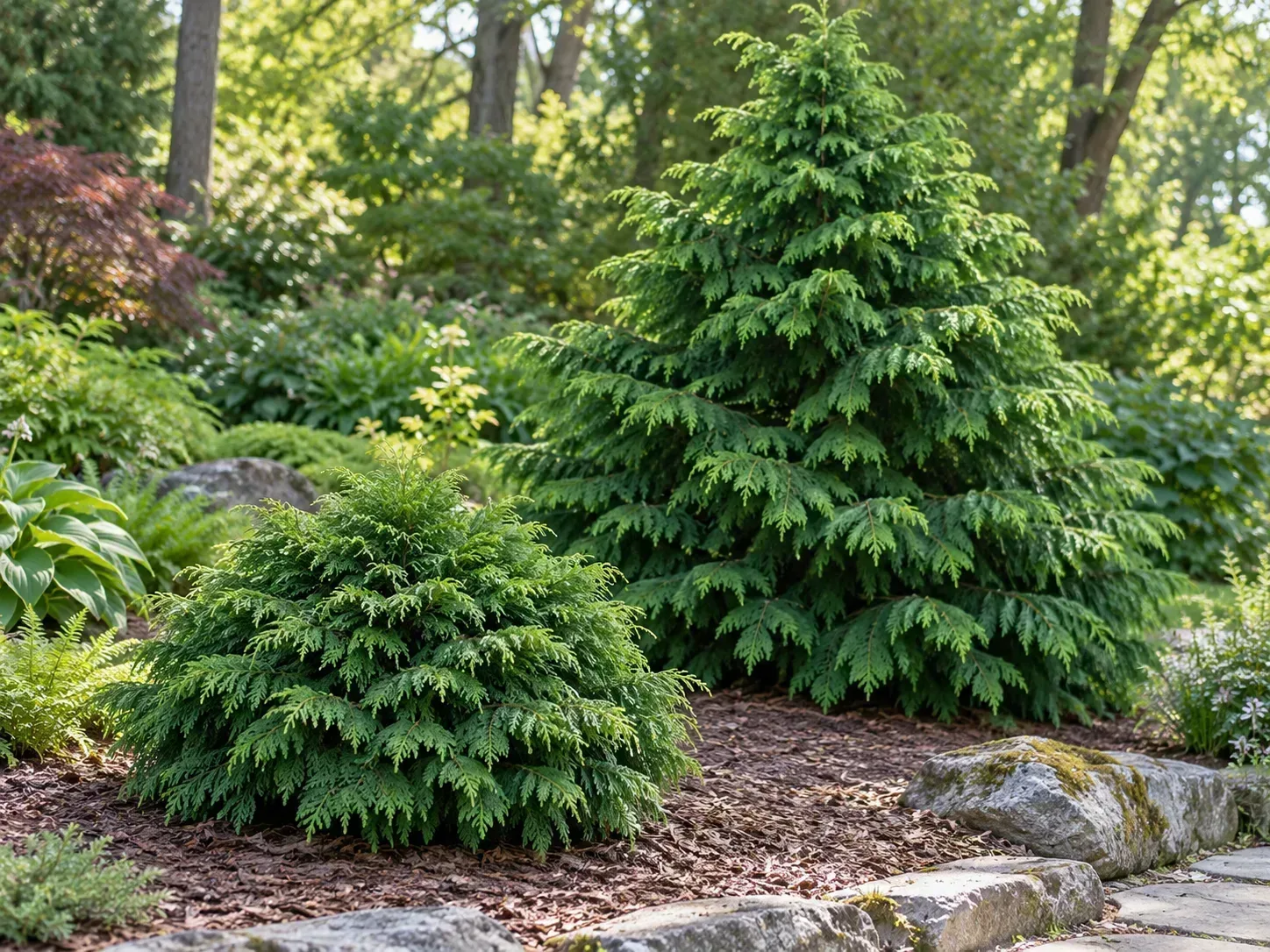
For a compact garden, dwarf selections such as ‘Nana,’ ‘Nana Gracilis,’ and ‘Kosteri’ are more realistic than the straight species; even “dwarf” does not mean permanently miniature. ‘Nana Gracilis’ develops a dense, rounded-to-conical form, while the upright ‘Gracilis’ is taller and narrower. ‘Fernspray Gold’ is valued for fern-like branching and yellow-green outer sprays; gold cultivars such as ‘Aurea’ or ‘Crippsii’ add color but may need protection from harsh afternoon exposure in hot sites. NC State Extension’s cultivar list is a useful reminder that forms and dimensions vary substantially within the species, and Fine Gardening describes ‘Aurea’ as a slow-growing specimen with golden outer foliage and green interior growth.
Read the Cultivar Tag Before Buying
Ask the nursery for the plant’s full cultivar name, expected mature height and width, local hardiness range, and whether the dimensions describe ten-year growth or mature growth. A tag saying “slow growing” describes pace, not the final destination. A slow tree can still become too large for a narrow foundation strip when given 20 years.
Treat hardiness zones as a screening tool rather than a guarantee. Many references place the species in Zones 4 through 8, while the exact cultivar, local heat, winter wind, drainage, and exposure can change how well it performs. If a retailer gives a narrower range than a general species profile, follow the cultivar-specific label and ask a local extension office or knowledgeable nursery about your region. For a long-lived woody plant, it is cheaper to choose a smaller cultivar now than to remove a poorly sited tree later.
Find a Site With Light, Air, and Long-Term Room
Choose a position with full sun to partial shade and good air movement. Full sun generally supports denser foliage, while light afternoon shade can reduce heat stress in hot-summer climates or protect golden forms from scorching. Deep shade can leave the plant thin and can keep soil wet for longer, which makes a poorly drained site even less forgiving. The Missouri Botanical Garden recommends full sun to part shade and shelter from strong wind; NC State Extension likewise notes that the species prefers sun but tolerates some shade.
Do not plant in a low pocket where water stands after rain, beside a downspout that keeps the root zone saturated, or in a wind tunnel between buildings. Hinoki cypress likes consistent soil moisture but not waterlogged roots. In exposed winter locations, wind can dry evergreen foliage while the root zone is frozen, so a site sheltered from prevailing winds is useful, especially for young plants and container specimens.
Allow room for the mature width, not just the trunk. Keep the canopy away from walls and walkways so branches can develop naturally and air can move around the plant. If the spot is too tight for the cultivar’s mature spread, choose a genuinely narrower cultivar or relocate the planting; shearing the sides every year will not turn a naturally broad tree into a healthy formal hedge.
Prepare Soil and Plant at the Correct Depth
Hinoki cypress grows best in fertile soil that holds some moisture yet drains freely. A slightly acidic to neutral soil is suitable; Gardener’s Path gives pH 5.0 to 6.0 as a useful target, while Fine Gardening describes the preference as neutral to slightly acidic. Do not try to force a particular pH with sulfur or acidifying fertilizer before a soil test. A test can identify whether acidity or nutrient availability is actually a problem.
Check drainage before planting by observing the site after a heavy rain or digging a small test hole and seeing whether water lingers. If the area stays saturated, choose another location or build a broad raised bed with a suitable soil profile rather than adding a little gravel to the bottom of a planting hole. Gravel does not fix a high water table or compacted subsoil. Avoid enriching only the backfill in a small hole: roots eventually grow outward into the native soil, so a sharp change in texture can make water movement less predictable.
A Planting Sequence That Prevents Common Failures
Plant in cool weather when the ground is workable, typically fall or spring in regions where either season allows roots to settle before severe heat or freezing. Water the nursery pot before planting. Dig a broad hole about two to three times the root ball’s width but no deeper than the root ball, loosen circling roots at the edge, and set the tree so its root flare sits at or slightly above finished grade. Backfill with the soil you removed, firming gently to close large air pockets without compacting it into a hard basin.
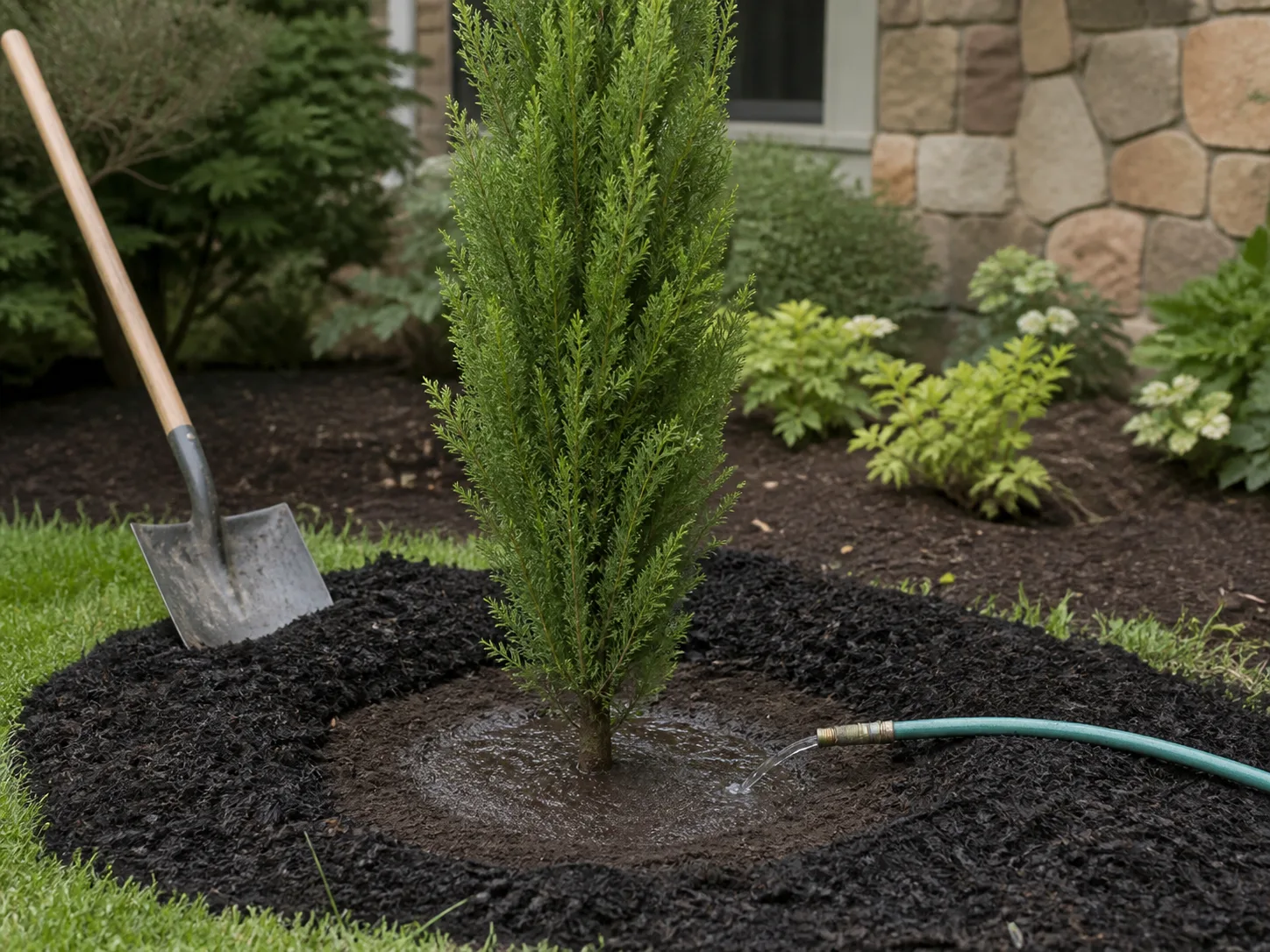
Water thoroughly to settle the soil and check that the plant remains upright and at the original depth. Spread a 2- to 3-inch layer of organic mulch over the root zone, keeping it several inches away from the trunk. Do not pile mulch against the bark or bury the root flare. Because NC State Extension notes that Hinoki cypress can be difficult to transplant, make the site decision carefully and avoid repeatedly moving an established tree.
Water for Root Establishment, Not by Calendar
For the first growing season, check the root ball and nearby soil frequently. Water slowly and deeply when the upper few inches begin to dry, making sure the original container root ball receives water as well as the surrounding backfill. A light sprinkle that wets only the surface does little for roots, while daily watering in heavy soil can suffocate them. During heat, wind, or drought, inspect more often; after cool rain, wait and check again rather than following a rigid weekly schedule.
In the second season, stretch the interval between watering as roots extend. Once established, a landscape Hinoki cypress usually needs supplemental water only during prolonged dry spells, but “drought tolerant” does not mean that a young tree can be left dry. Water the soil at the root zone, not the foliage, and stop if the soil is already soggy. Gardener’s Path recommends moisture checks for young trees and notes that established plants tolerate some drought; the practical signal is the soil condition, not a fixed number of days.
Fertilizer and Mulch: Less Is Often Better
A healthy Hinoki cypress in reasonably fertile soil rarely needs routine feeding. Excess nitrogen can push soft growth, distort the plant’s natural shape, and create a reason to prune more often. If growth is weak or foliage color is poor, first inspect drainage, planting depth, sun exposure, watering, root competition, and signs of pests. Yellow needles alone do not prove a nutrient deficiency.
If a soil test identifies a nutrient shortfall, use a fertilizer labeled for landscape trees and follow its rate and timing directions. Do not add an acidifying product simply because the plant is called a cypress or because one branch is yellow. Maintain a loose mulch layer over the root zone to moderate soil temperature and reduce moisture swings; replenish it only as it decomposes, and keep it clear of the trunk.
Prune Lightly; Protect the Green Outer Shell
Prune to remove dead, broken, or rubbing branches and to correct a small structural problem while the plant is young. Use clean, sharp bypass pruners for small stems and make each cut just outside the branch collar; do not leave long stubs or cut flush against the trunk. If one leader forks and you want a single upright form, select the better-positioned leader early and remove the competing one while it is still small.
The most important limit is the brown, leafless interior. Many conifers, including Hinoki cypress, do not reliably push new growth from bare old wood. Shorten a branch only where green foliage remains beyond the cut. Removing the soft outer shell to reduce the overall size can expose dead-looking interiors that do not refill, leaving permanent holes. This is why cultivar selection and spacing are more effective than trying to control a mature tree with shears.
Use selective hand pruning rather than repeatedly clipping every branch tip into a flat hedge. If the tree has outgrown its intended space, consult a certified arborist before attempting major cuts, especially if it is tall or near a structure. Major renovation may not be possible without sacrificing the natural form; replacement with a better-sized cultivar can be the safer landscape decision.
Grow Dwarf Cultivars in Pots or as Bonsai
Compact Hinoki cultivars can grow in containers, but a pot does not make their care effortless. Choose a heavy container with several unobstructed drainage holes and enough volume to buffer moisture and temperature changes. Use a well-draining, high-quality potting mix for woody container plants, and set the root flare just above the surface. Do not use garden soil alone in a pot; it can compact and hold water too long.
Check containers more often than in-ground plants, because wind and sun can dry them quickly, but never water by reflex if the mix is still wet. Keep the pot outdoors in bright light, and protect its roots from severe winter cold by moving it to a sheltered, unheated space or insulating the container when needed. A sheltered porch or cold frame should remain bright and cool rather than warm enough to prompt tender growth during winter.
Hinoki cypress is also used for bonsai, particularly compact or naturally irregular cultivars. Bonsai care requires specialized root, wiring, watering, and pruning decisions; a miniature specimen still depends on disciplined drainage and careful protection from temperature swings. Avoid treating a landscape-grown tree as a bonsai by simply cutting back its roots or top without a species-appropriate training plan.
Protect Young Trees From Winter and Summer Stress
A newly planted evergreen can lose moisture through its foliage in winter even when the ground is too cold for roots to replace it. Water deeply before the soil freezes if autumn has been dry, maintain mulch over the root zone, and use a wind-sheltered site. In cold, exposed locations, a temporary burlap screen can reduce drying wind; do not wrap the foliage tightly in plastic or leave a dark cover on the tree for long periods.
In hot climates, prioritize root-zone moisture and afternoon protection during establishment. Mulch helps buffer temperature, but it cannot compensate for poor drainage or daily overwatering. After an unusually hot or cold spell, wait for the next flush of growth before deciding that a branch is dead; scratch-test a small twig, check whether buds remain viable, and avoid fertilizing a stressed tree in an attempt to force recovery.
Diagnose Yellowing and Browning Before You Treat
Start by noting where the color change begins, how quickly it is spreading, and whether the soil is dry or wet. A gradual change on shaded inner foliage differs from crisp new tips or browning that advances across whole branches. Check the trunk and root flare for buried bark, inspect the root zone for standing water or a cracked, dry root ball, and look closely for fine webbing, scale bumps, or bagworm cases before selecting a treatment.
Common causes include normal interior foliage turnover, drought during establishment, chronically saturated soil, root damage from planting too deeply, sun or wind exposure, winter desiccation, pests, and fungal disease. Alkaline soil can interfere with iron availability and contribute to chlorosis, but it should be confirmed with a soil test rather than guessed from a photo. Correct the underlying condition first: restore appropriate watering, improve drainage or the planting site, reduce exposure, or ask an extension office or arborist to inspect progressive dieback.
Separate Normal Inner Shedding From Dead Tips
Evergreens replace older foliage; some older interior scales may yellow and drop while the outer growth remains green. That pattern is usually less concerning than expanding browning at branch ends, whole-branch dieback, or a tree that stays wet at the roots. Compare several parts of the canopy and look for healthy buds and supple green tissue rather than judging one small cluster.
If browning keeps advancing, take clear photos of the entire plant and the affected branch, note recent weather and watering, and bring a sample to your local extension service if possible. Do not respond to every color change with fertilizer, fungicide, or extra water. A treatment aimed at the wrong cause can worsen root stress and delay the diagnosis.
Identify Pests and Diseases Worth Acting On
Inspect the foliage periodically, especially during dry weather and when nearby conifers show symptoms. Juniper scale can cause yellowing or mottled foliage; look for small, immobile scale covers attached to twigs and leaves. Bagworms carry cone-shaped cases made from plant material, which can be picked off and destroyed when few are present. NC State Extension and the Missouri Botanical Garden also list bagworms, root rot, and blight among potential problems for the species.
Fungal problems become more likely when foliage stays wet or roots remain waterlogged. Water at ground level in the morning if overhead irrigation is unavoidable, remove clearly dead material, and improve air movement without stripping the canopy. Root rot is mainly a site and drainage problem, so spraying the foliage will not repair saturated soil. Identify the pest or disease before using a pesticide, then follow the product label and local rules; when the tree is valuable or symptoms are widespread, ask a licensed arborist or extension diagnostic clinic for help.
Propagate Cuttings With Realistic Expectations
Cultivar names matter here too: seedlings from a named cultivar may not resemble the parent, so vegetative propagation is the better choice when you want to preserve its form or foliage color. Fine Gardening recommends rooting semi-ripe cuttings in late summer; timing and success vary with shoot maturity, humidity, temperature, and the cultivar. Expect this to be a patient project rather than a guaranteed shortcut to a landscape-sized plant.
Take several healthy, nonflowering shoots from the current season’s growth, remove the lowest foliage, and place the cut ends into a sterile, airy propagation medium. A clean pot, bottom heat if available, bright indirect light, and a clear cover can help maintain even humidity; ventilate the cover so persistent condensation does not encourage rot. Keep the medium damp but not saturated, and leave cuttings undisturbed while roots form. Pot up only after a cutting resists a gentle tug or shows roots at the drainage holes, then harden it gradually before outdoor planting.
Use Hinoki Cypress as a Screen or Focal Point
A large species tree can make a long-lived specimen where there is genuine room for its mature height and width. In most residential gardens, a compact cultivar is easier to place as a focal point, in a rock garden, or near an entry where its layered foliage can be seen up close. Use the nursery’s mature dimensions and allow for the plant to broaden rather than crowding it against a wall.
For privacy, choose a cultivar whose mature width and growth habit fit the screen, then space plants according to their expected spread rather than packing them tightly for instant coverage. A row of dense plants can take years to fill in, and tight spacing can reduce airflow and make maintenance difficult. Hinoki cypress can be an elegant screen element, but it is not a universally narrow hedge plant; if the available strip is small, compare a naturally columnar species before buying.
Conclusion
The simplest way to grow Hinoki cypress well is to make the irreversible decisions carefully: choose the right cultivar, give it the mature space it needs, and plant it in soil that drains. Water a new tree according to what its root zone is doing, keep fertilizer optional until there is evidence it is needed, and prune only where green foliage remains. Those choices prevent more problems than routine spraying, frequent feeding, or aggressive shaping ever will. If you are unsure whether the plant is a compact cultivar or the full-size species, confirm the name and expected mature spread before it goes into the ground.



