7 Common Houseplant Pests and How to Treat Them
Identify seven common houseplant pests by their clues, then use the right first response, treatment, repeat schedule, and summer prevention plan.
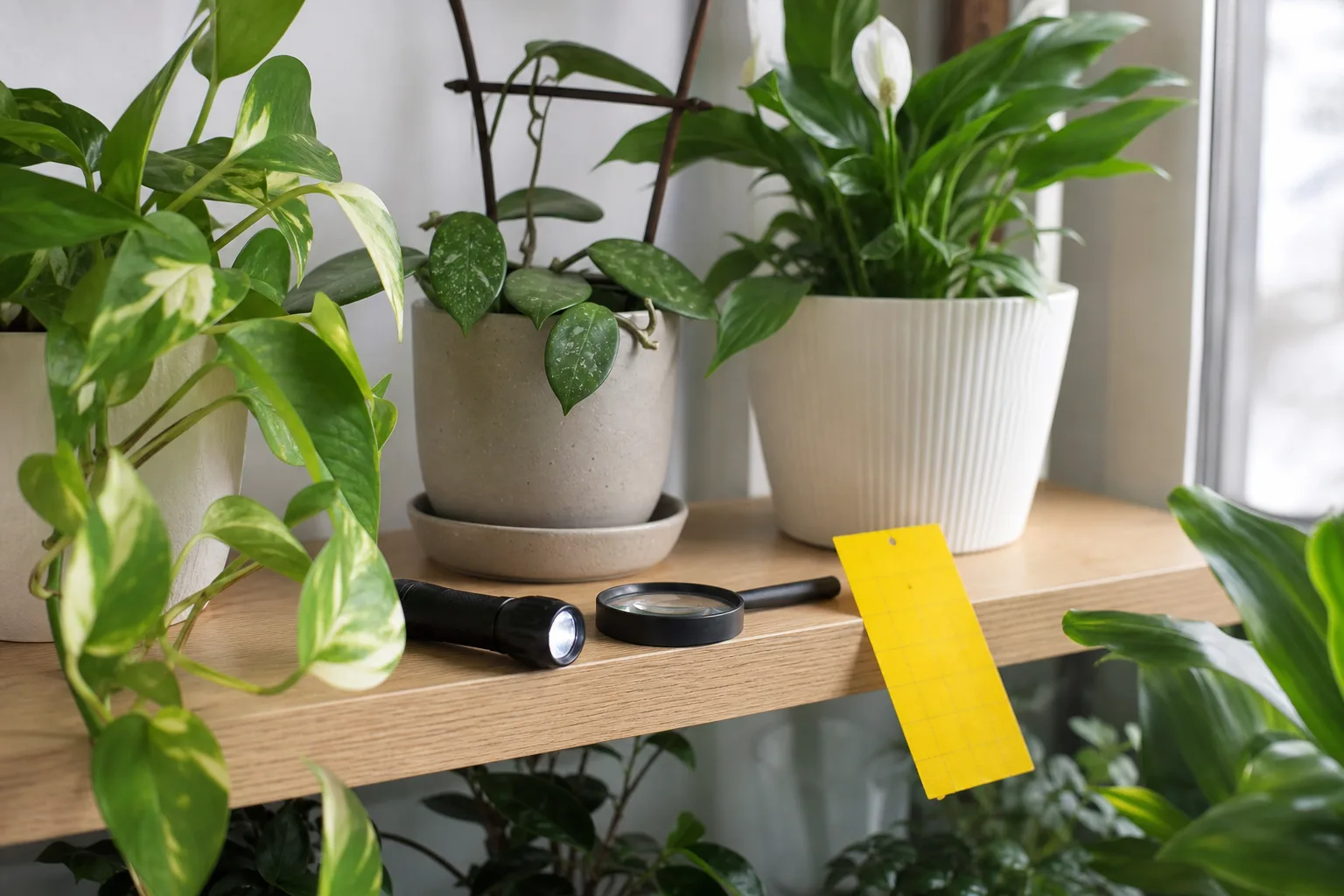
Houseplant pests rarely announce themselves with a single dramatic clue. More often, you notice a sticky leaf, a few silver streaks, tiny flies at the soil, or new growth that suddenly looks wrong. Summer makes these discoveries more likely because warm rooms speed pest development, patio plants pick up visitors outdoors, and every move between the house and balcony creates another chance for hitchhikers to spread.
The most useful response is not to reach for the strongest spray. It is to identify where the pest is feeding, isolate the plant, remove what you can, and repeat the right treatment long enough to catch the next life stage. This guide covers aphids, spider mites, fungus gnats, thrips, scale, whiteflies, and mealybugs, then turns the identification into a practical control plan.
Start With Triage: Inspect, Isolate, and Confirm
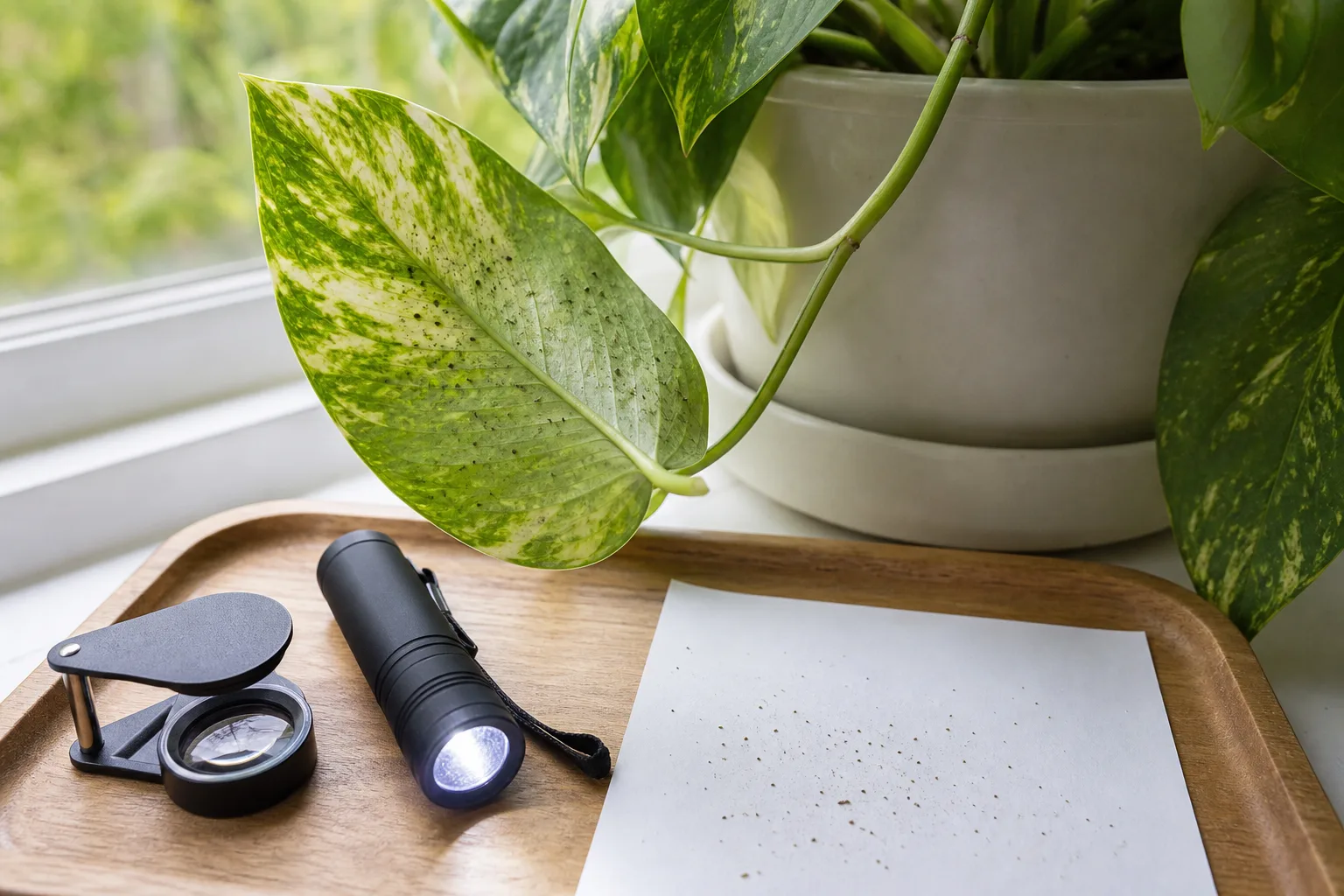
Move a suspect plant away from the rest of your collection before you do anything else. Put it somewhere with good light and a washable surface, but not beside another plant, and check the pot, saucer, soil surface, leaf undersides, petioles, stem joints, and newest growth. A phone camera in macro mode or a 10X hand lens makes tiny pests and shed skins much easier to see. Gardening Know How recommends checking those locations because indoor pests are often too small to identify from across the room (Gardening Know How).
Do not diagnose from leaf color alone. Yellowing can come from roots, light, temperature, nutrition, or sap-feeding pests; brown tips can follow drought, salts, low humidity, or chemical injury. Look for a combination of symptom plus location plus a live pest or pest evidence. If you find nothing, wipe one leaf clean, photograph the damage, and recheck in two or three days rather than spraying blindly.
Once you have a likely diagnosis, inspect every plant that touched the pot, shared a shelf, or went outdoors with it. Keep the suspect plant isolated for at least three weeks after the last sign of activity, with a weekly inspection. That window is especially important for new plants and for warm-weather plants coming back inside. Colorado State University Extension advises a separate quarantine area for at least three weeks because many infestations arrive on recently purchased or gifted plants (Colorado State University Extension).
Quick Houseplant Pest Identification Table
Use this table to choose your first inspection target. It is a shortcut for narrowing the field, not a substitute for seeing the pest: several problems can produce yellow leaves, and several pests can share a plant.
| What you notice first | Most likely pest | Look next | Best first move |
|---|---|---|---|
| Green, black, yellow, or pink clusters on shoot tips | Aphids | New growth, flower buds, honeydew, white shed skins | Rinse firmly and isolate |
| Fine stippling, dull bronze color, or delicate webbing | Spider mites | Leaf undersides and leaf-vein angles | Wash both leaf surfaces; improve the plant’s environment |
| Tiny black flies lifting from damp potting mix | Fungus gnats | Larvae in the upper soil and standing water in saucers | Let suitable soil dry; add yellow traps for monitoring |
| Silver scratches, streaks, or black specks | Thrips | New leaves, flowers, creases, and nearby pots | Isolate, rinse, and plan repeated coverage |
| Tan, gray, or brown bumps stuck to stems | Scale | Veins, petioles, and woody joints; sticky residue if soft scale | Remove individual bumps, then treat crawlers |
| White mothlike insects fly up when foliage moves | Whiteflies | Immobile pale nymphs under leaves | Vacuum or trap adults; wash and treat leaf undersides |
| White cottony tufts in leaf axils or roots | Mealybugs | Stem joints, pot rim, roots, and hidden crevices | Dab visible insects and isolate immediately |
Sticky Leaves Are a Clue, Not a Diagnosis
The shiny film is usually honeydew, a sugary waste left by sap-feeding aphids, soft scale, whiteflies, or mealybugs. It may collect on leaves below the feeding site, pot rims, shelves, and floors, and black sooty mold can grow on the residue. Sticky foliage without live insects can also come from plant sap or nectar, so clean a small area and keep looking before you decide which pest you have. RHS describes honeydew and sooty mold as characteristic companions of many scale infestations (RHS).
Aphids: Clusters on Tender New Growth
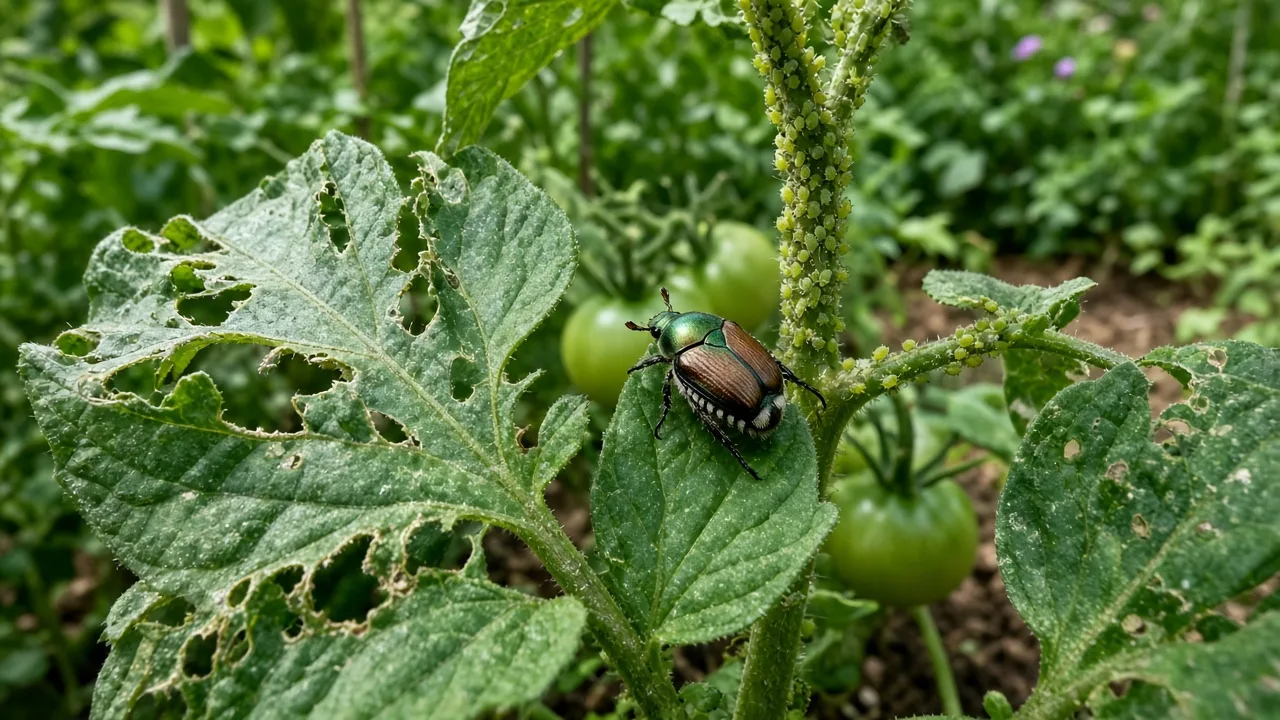
Aphids are soft-bodied, pear-shaped insects, usually around 2–4 millimeters long, although their color varies from green to black, pink, yellow, brown, or gray. They gather on shoot tips, flower buds, and the undersides of young leaves because that tissue is easy to pierce. Nymphs look like smaller adults, and pale shed skins may collect around a colony. A magnifier can reveal two short tubes, called cornicles, at the rear of the body.
The damage follows the plant’s newest growth: curled, puckered, distorted, or stunted leaves; weakened shoots; and sticky honeydew. Aphids can reproduce quickly in warm indoor conditions, and some species produce live young without mating. UAF Extension notes that indoor aphid generations can complete in less than two weeks under favorable conditions (UAF Extension). That is why a rinse that looks successful on Monday can be followed by a fresh colony the next weekend.
Start with a firm stream of lukewarm water aimed at the tops and undersides of leaves, while protecting the potting mix from eroding. Crush or remove clusters that remain in a leaf axil, then let the foliage dry in bright, indirect light. If aphids return, use a commercial insecticidal soap labeled for houseplants and aphids, wetting the insects directly. Contact sprays do not keep killing after they dry, so repeat according to the label and recheck new growth between applications.
Spider Mites: Stippling, Webbing, and Dry Air
Spider mites are arachnids, not insects, and the adults can be nearly impossible to see without magnification. Their first calling card is a fine peppering of pale dots, often beginning near the underside of leaf veins. As feeding continues, a leaf can turn gray, yellow, or bronze, then drop. Fine webbing around leaf stems or shoot tips is the confirmation clue people usually notice last.
Hold a white sheet of paper under a suspect leaf and tap the leaf gently. Moving specks on the paper support a mite diagnosis; use a lens to confirm if possible. Check plants beside sunny windows, radiators, or hot vents especially carefully. Warm, dry conditions favor spider-mite outbreaks, but raising humidity is not a cure by itself and should never replace washing and treatment.
For a sturdy plant, rinse every leaf surface with a strong but plant-safe stream, concentrating on undersides and tight leaf joints. Repeat inspections and washes over several weeks. If you use insecticidal soap or horticultural oil, choose a product labeled for mites and houseplants, test a small area first, and never apply oil or soap to drought-stressed foliage, full sun, or a plant that is already heat-stressed. Mite eggs and protected adults can survive a partial spray, so the goal is repeated, thorough coverage rather than one dramatic soaking.
Fungus Gnats: Tiny Flies at the Soil Line
Fungus gnats look like tiny dark flies with long legs and antennae. Adults often run across the soil or drift near a window when the pot is disturbed. They are mostly a nuisance at low numbers; the concern is the larval stage, which lives in moist potting mix and feeds on fungi, decaying material, and sometimes roots. Seedlings, cuttings, and plants with already-damaged roots have less margin for error than mature plants.
The pattern is usually clear: recurring flies plus potting mix that stays wet for too long. Probe the upper layer of soil with a stick or spoon and use a hand lens to look for slender, pale larvae with dark heads. Also check whether a saucer is holding water. Clemson Cooperative Extension identifies overwatering and moist organic potting soil as the usual indoor setup for fungus gnats (Clemson Cooperative Extension).
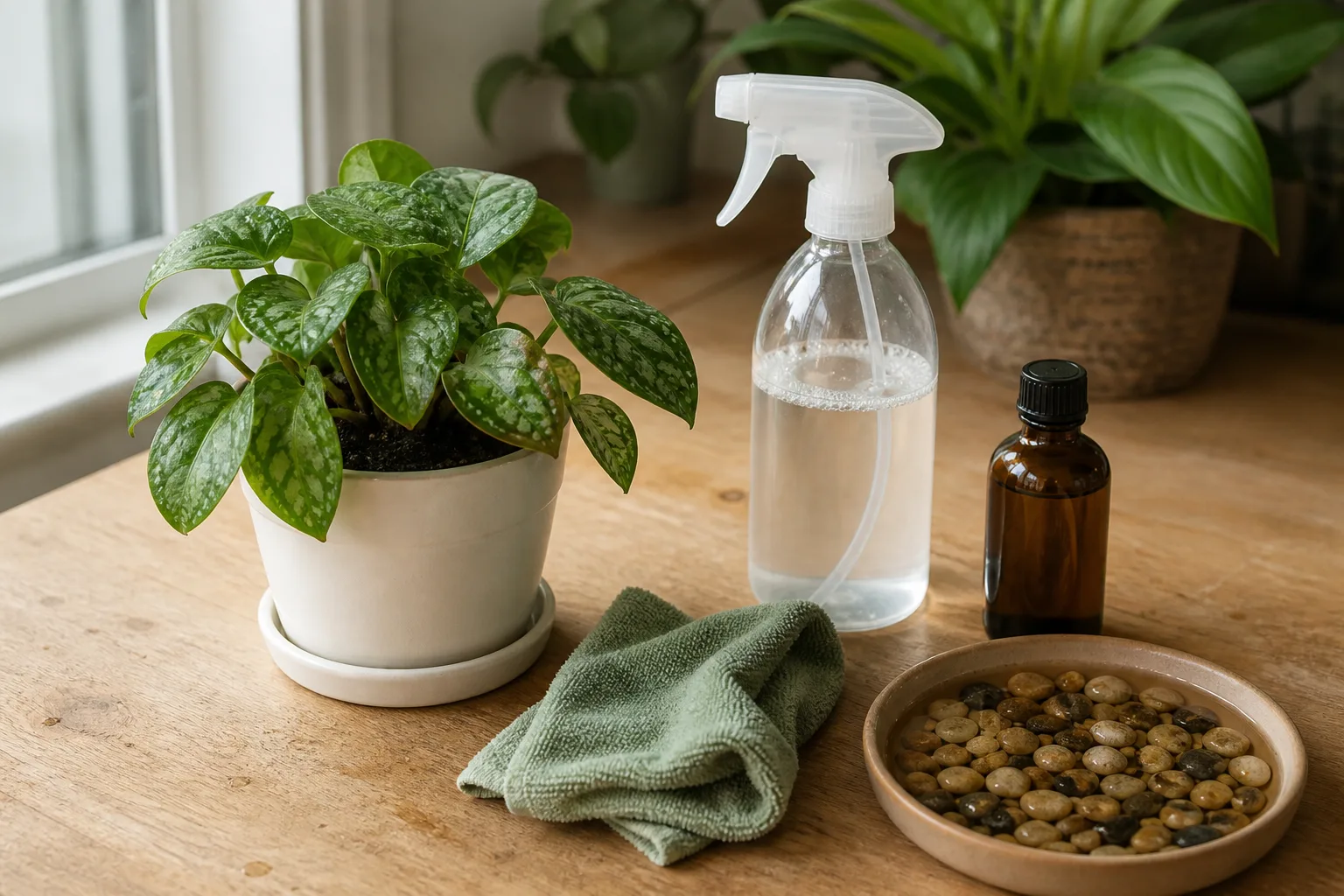
Let the mix dry to the depth that your plant can tolerate before watering again; do not force a moisture-sensitive fern or seedling through a drought just to copy a succulent’s schedule. Empty saucers promptly, remove dead leaves from the soil surface, and use yellow sticky cards just above the pot to catch adults and show whether numbers are falling. Traps do not reach larvae. For an established infestation, a product containing Bacillus thuringiensis subspecies israelensis (Bti) can be applied as a soil treatment if the label lists fungus gnat larvae and houseplants. Follow that product’s directions and continue monitoring rather than assuming one application ended the cycle.
Thrips: Silver Scarring and Black Specks
Thrips are slender insects often shorter than 1.5 millimeters, so the damage is easier to spot than the pest. Their rasping, sucking feeding leaves irregular silver or bronze streaks, scuffed patches, distorted new leaves, and tiny black fecal spots. They hide in leaf creases, flowers, developing buds, and the protected folds of new growth. A pale insect that darts away from a flower or a dark sliver moving across a leaf is worth investigating with a lens.
Thrips are difficult because different life stages occupy different places. Some feed on foliage while others drop into potting mix to pupate, and eggs are inserted into plant tissue where surface sprays cannot reach them. Colorado State University Extension notes that some thrips can complete a life cycle in about two weeks under favorable conditions and that soil-dwelling stages complicate management (Colorado State University Extension).
Remove badly scarred leaves when the plant can spare them, rinse the remaining foliage, and keep the plant separated from the collection. A labeled insecticidal soap or oil may help with exposed stages, but persistent outbreaks often require a product specifically labeled for thrips, the plant, and the intended application site. Never assume a product approved for outdoor ornamentals is approved for indoor use. If the plant spends summer outside, spray only where the label permits and protect pollinators and nearby waterways.
Scale Insects: Bumps That Do Not Move
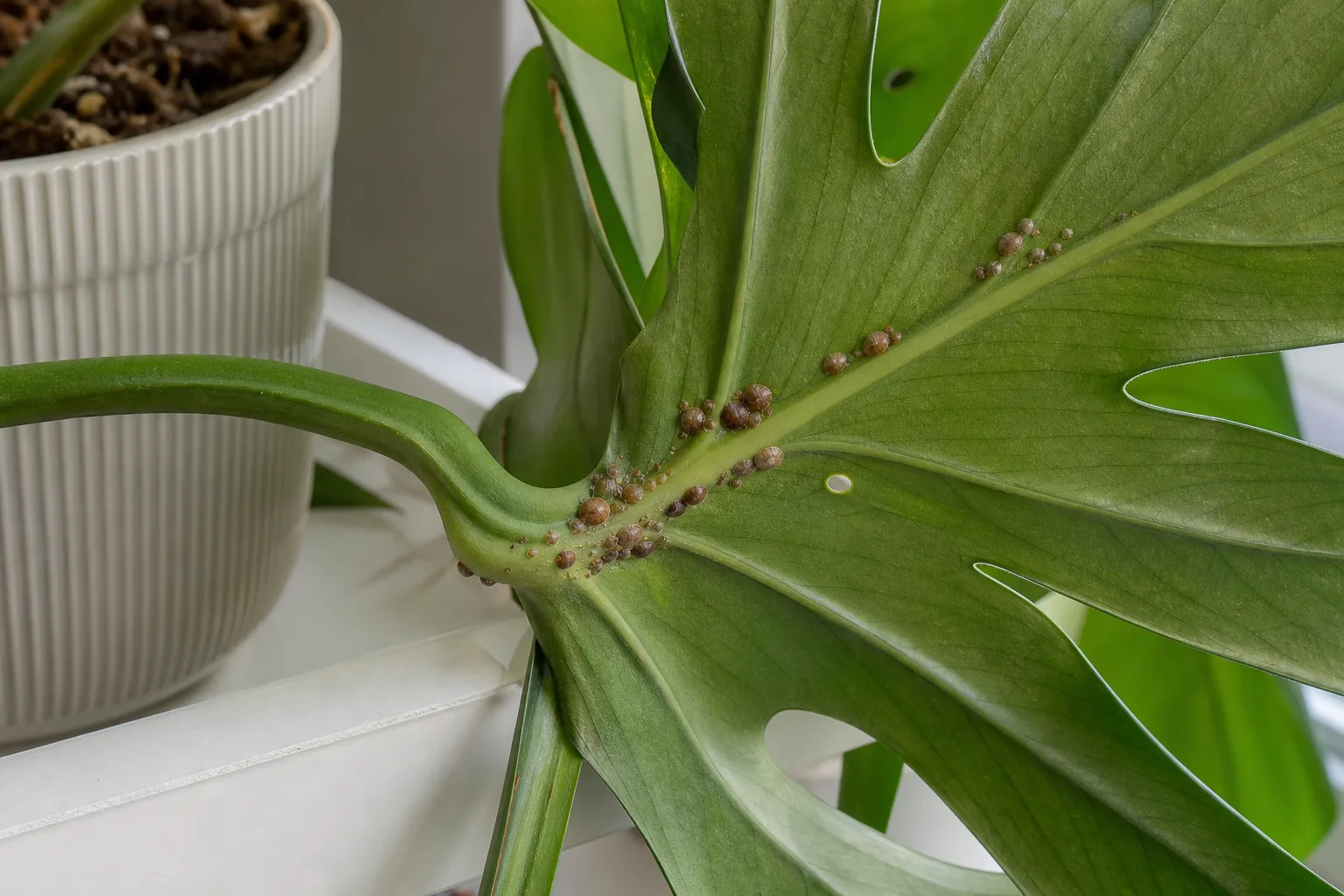
Scale looks like a pest only after you know what to distrust. The insects may appear as fixed tan, brown, gray, or pale bumps on stems, veins, petioles, and leaf undersides. Adult females settle and barely move, so a plant can decline for weeks while the owner assumes the marks are part of the stem. Soft scale produces honeydew; armored scale generally does not, which means a sticky shelf supports soft scale more strongly than armored scale.
Gently scrape one bump with a fingernail or blunt tool. If it lifts, inspect the underside for a soft body rather than assuming you removed harmless debris. Young mobile crawlers are more exposed and easier to control than mature, protected scale. RHS advises tolerating light populations on vigorous plants where practical, while removing visible adults and egg masses when found. Its scale guidance also distinguishes the shell-like covering from the insect beneath it (RHS).
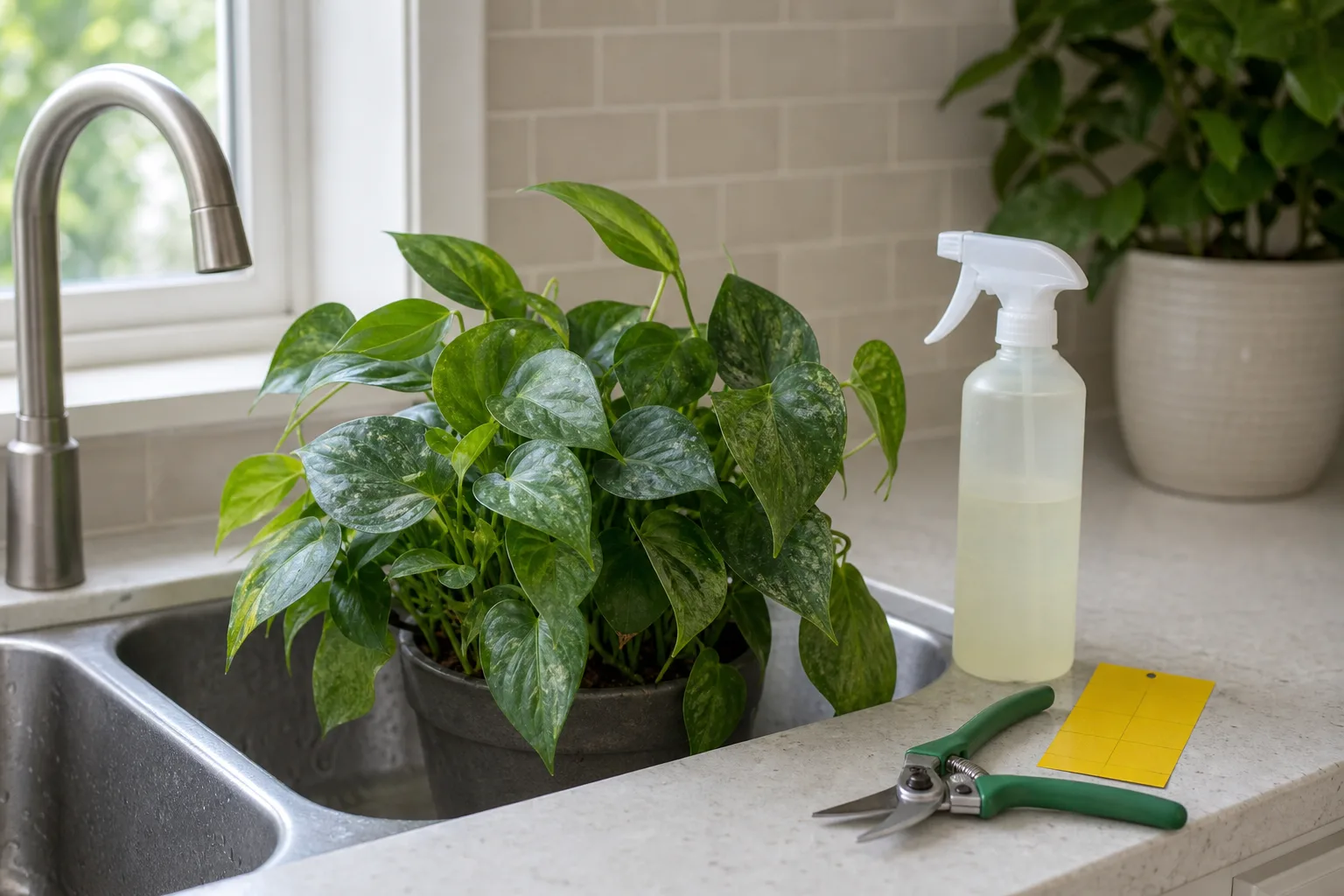
For a small outbreak, remove each visible scale insect with a cotton swab or tool, bag the debris, and wipe sticky residue from leaves after the insects are controlled. A horticultural oil labeled for the plant and scale can improve coverage, but it must reach stems and crevices and may injure sensitive foliage. Repeat inspections over the following weeks because settled adults, crawlers, and eggs are not all exposed at the same time. Broadly spraying a plant once rarely matches the pest’s life cycle.
Whiteflies: A Cloud From the Leaf Undersides
Tap or move an infested plant and tiny white mothlike adults may lift off in a cloud. That flight response is the fastest clue, but adult whiteflies are only one part of the population. Immature whiteflies settle on leaf undersides as flat, pale, scale-like nymphs and do most of the feeding. Yellowing, reduced vigor, leaf drop, honeydew, and sooty mold can follow a heavy infestation.
Place yellow sticky cards near—but not pressed against—the plant to monitor adult activity. A small handheld vacuum can remove adults when they are sluggish, and a gentle rinse can dislodge some stages. Then use a labeled insecticidal soap, horticultural oil, or other approved product with careful underside coverage. UAF Extension describes yellow cards as monitoring and trapping tools while cautioning that adult flight makes whiteflies harder to control (UAF Extension).
Expect to repeat. A trap can tell you that adults are still emerging, but it cannot kill eggs or every nymph hidden under a leaf. If a spray fails, check whether you actually wet the underside and whether the product lists whiteflies and the plant. Persistent outbreaks on a weak plant may justify a labeled systemic option, but that decision carries greater exposure and environmental trade-offs and should follow the label exactly.
Mealybugs: Cottony Clusters in Hidden Joints
Mealybugs are slow-moving, oval insects covered in white wax, often gathered where a leaf joins a stem, around nodes, on flowers, or in dense new growth. The cottony material can be mistaken for plant fuzz until it moves. Look for honeydew, black sooty mold, yellowing, slowed growth, and a plant that seems to lose vigor without a clear watering cause.
Do not stop at the visible foliage. Some mealybugs feed on roots, so a plant that repeatedly declines after the leaves look clean deserves an examination of the root ball. UAF Extension notes that above-ground symptoms can coexist with below-ground mealybug activity (UAF Extension).
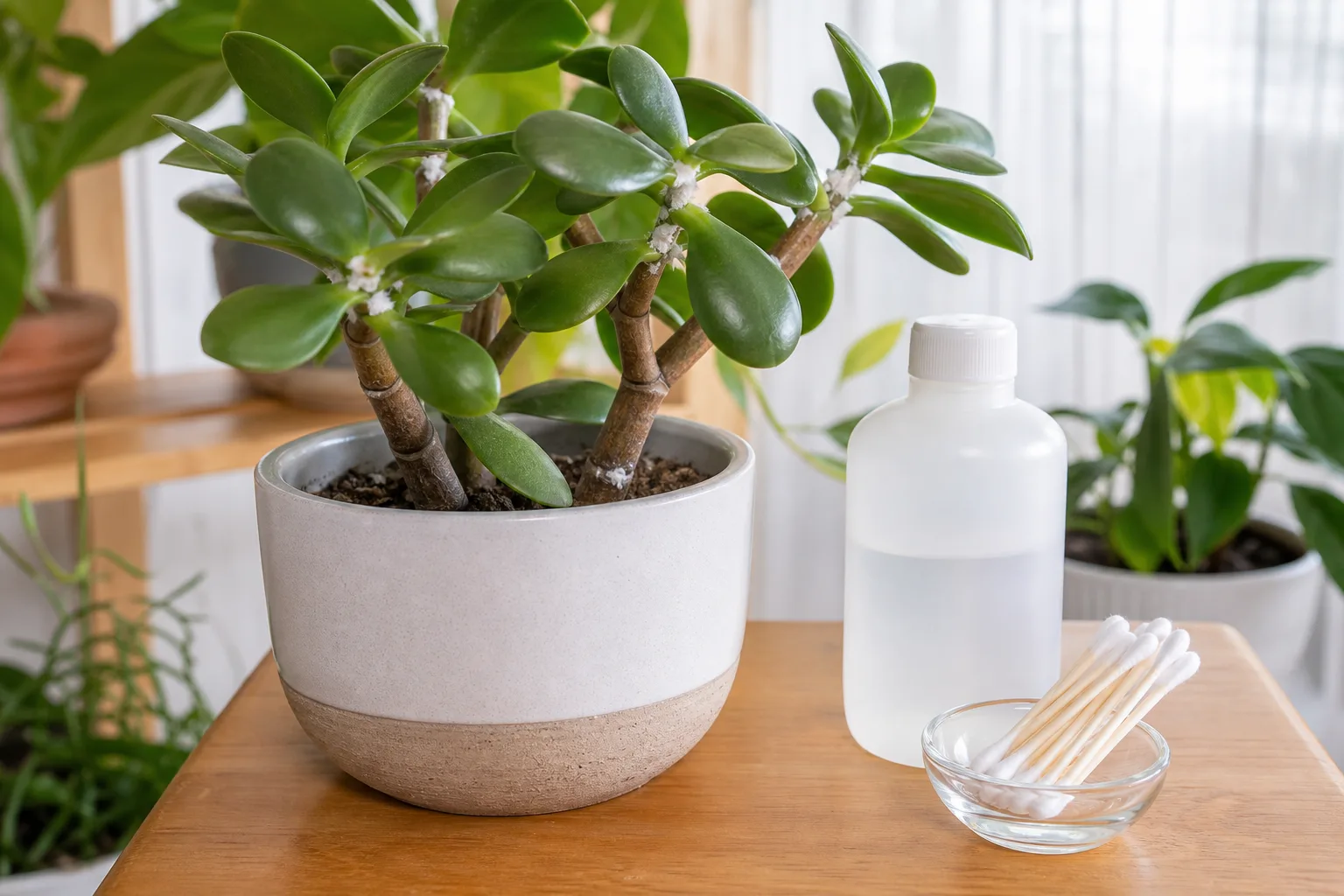
For a light infestation, dab individual insects with a cotton swab used sparingly with rubbing alcohol, keeping the liquid on the pest rather than soaking the leaf. Test a hidden area first because alcohol can burn foliage. Follow with a labeled insecticidal soap or horticultural oil if appropriate for the plant, and inspect every axil at each visit. Alcohol and soap are contact actions; they do not provide a protective shield after drying, and they will miss root-feeding stages. A plant that keeps producing colonies after careful repeated treatment may be a poor risk to keep beside a valuable collection.
The Houseplant Pest Treatment Ladder
Once the pest is identified, use the least disruptive step that can plausibly reach it. A sensible order is: isolate; physically remove or rinse; correct the environment; apply a labeled contact product if needed; then consider a more persistent or systemic option only when the label, plant, site, and pest all match. Clemson Cooperative Extension recommends isolation first and emphasizes that choosing a pesticide requires accurate pest identification because one product does not control every pest or life stage (Clemson Cooperative Extension).
Contact Sprays Need Complete Coverage
Insecticidal soaps and many horticultural oils work when they contact an exposed pest. They are not magic leaf coatings. If the insects sit under leaves, in flowers, inside curled growth, or beneath a scale covering, a spray that wets only the upper surface can look ineffective even when the product itself is suitable.
Use a product labeled for houseplants, the target pest, and the application site. Do not substitute a strongly scented household dish detergent for plant-formulated insecticidal soap; detergents can strip the leaf surface and cause injury, especially on tender, waxy, hairy, or drought-stressed foliage. Test a small section first and wait at least 48 hours before treating the full plant if the label permits. Apply in mild conditions and out of direct sun, then let leaves dry before returning the plant indoors if it was treated outside.
Neem products, oils, pyrethrins, and soaps are not interchangeable. The active ingredient, formulation, pest, plant, and legal use can differ by product and location. Colorado State University Extension stresses that a pesticide label specifies approved uses, rates, hazards, and precautions; the label is the governing instruction (Colorado State University Extension).
Soil and Root Pests Need a Different Tool
A foliar spray cannot solve a larva in the potting mix or a mealybug on roots. For fungus gnats, moisture management, sanitation, sticky cards, and a labeled Bti soil treatment target the soil-dwelling stage. For root mealybugs, a foliar wipe can create a false sense of victory while the source remains below ground. Thrips can also involve the soil, which is why a leaf-only campaign may stall.
Do not repot every plant just because one gnat flies past. Repotting adds root disturbance and can spread contaminated soil if you work across the collection. Reserve it for a root-zone diagnosis, severe soil contamination, or a plant that needs a fresh, well-drained mix for another reason. Use a clean pot and fresh commercial potting mix; never recycle suspect soil into another container.
When to Escalate or Discard
Review progress after each treatment cycle using the same method: inspect the same leaf undersides, count live pests rather than dead marks, check traps, and photograph new growth. If live pests are falling and no fresh damage appears, continue the schedule. If nothing changes after two or three properly executed cycles, stop adding more product and ask what you missed: wrong pest, poor coverage, untreated soil, reinfesting neighbors, or plant injury mistaken for pest damage.
Escalation can mean a labeled product with a different mode of action, a professional diagnosis, or a biological control suited to the room’s temperature and humidity. It can also mean discarding a severely infested plant. That is not a moral verdict on your care; it is a collection-protection decision. A rare plant with a small isolated outbreak may justify weeks of labor. A common plant that is collapsing, repeatedly reinfesting its neighbors, or harboring a root pest may not.
A Summer Prevention Routine That Holds Up
Prevention is mostly a repeatable inspection habit, not a promise that pests will never arrive. Once a week, look at new growth, leaf undersides, petioles, stem joints, and the soil surface. Wipe dust from broad leaves with a clean, damp cloth when the plant tolerates it; the cleaning itself is less important than using the moment to look closely. Empty standing water, remove dead foliage, and keep plants in conditions that support vigorous growth without overwatering.
When you buy or receive a plant, inspect it before it joins the collection. Check the underside of leaves, the pot rim, drainage holes, and the outside of the root ball if you can do so without damaging it. Keep the plant apart for three weeks, inspect weekly, and do not share pruning tools, saucers, or untreated cuttings during that period. A beautiful new plant is still the most common way a hidden scale crawler, mealybug, or whitefly enters a room.
Moving Plants Outdoors and Back Indoors
Summer air can help some plants grow vigorously, but outdoor placement also exposes them to aphids, thrips, scale crawlers, caterpillars, and soil pests. Raise containers off the ground where practical, keep foliage from touching crowded plants, and inspect after rain or strong wind. Do not assume a plant is clean because it looked healthy on the balcony yesterday.
Before bringing a plant indoors, examine it in bright light, wash sturdy foliage, check the saucer and drainage holes, and inspect the soil surface. Treat only if you find a target pest and the product is labeled for the plant and site. Then return it to quarantine rather than placing it straight beside your collection. RHS seasonal guidance likewise recommends careful pest checks when plants move between outdoor and indoor spaces, with attention to leaf undersides and sheltered plant structures (RHS seasonal guidance).
Common Pest-Control Mistakes to Avoid
- Spraying before identifying: A mite problem, a nutrient problem, and thrips damage can look similar. The wrong product adds stress without solving the cause.
- Treating only the visible side: Most sap feeders hide underneath leaves, in leaf axils, or inside flowers. Turn the foliage and adjust your coverage.
- Stopping after one clean-looking day: Contact products kill what they touch. Eggs, crawlers, larvae, and soil stages can emerge later.
- Using sticky cards as the whole plan: Traps are excellent monitors for flying adults, but they do not clear pests living on leaves or in soil.
- Overwatering a wilted plant: Spider-mite damage can make foliage look thirsty, while fungus gnats are favored by persistently wet mix. Check roots and soil before watering again.
- Using yard pesticides in the living room: Indoor approval is not automatic. Read the label for the exact plant, pest, site, protective equipment, re-entry, and disposal directions.
- Moving the plant back too soon: A plant can look clean while new nymphs or crawlers are still emerging. Keep inspecting through the quarantine window.
Conclusion
The seven houseplant pests in this guide leave different calling cards: aphids cluster on soft new growth, spider mites stipple and web, fungus gnats breed in damp soil, thrips scar leaves silver, scale sits like bumps, whiteflies rise from leaf undersides, and mealybugs hide in cottony joints. Learn those locations and you are already ahead of the most expensive mistake—treating the wrong problem.
The durable summer plan is simple: isolate the suspect, confirm the pest, rinse or remove what you can, match the treatment to the pest’s hiding place, and repeat while monitoring fresh growth. Quarantine new and returning plants for at least three weeks, keep soil moisture appropriate to the plant, and discard only when the labor and spread risk no longer make sense. A calm, scheduled response beats a frantic bottle swap every time.