How Long Do Carrots Take to Grow From Seed?
Most carrots mature in 55–80 days after emergence. Use this practical timeline, slow-growth fixes, and harvest checklist to know when to pull.
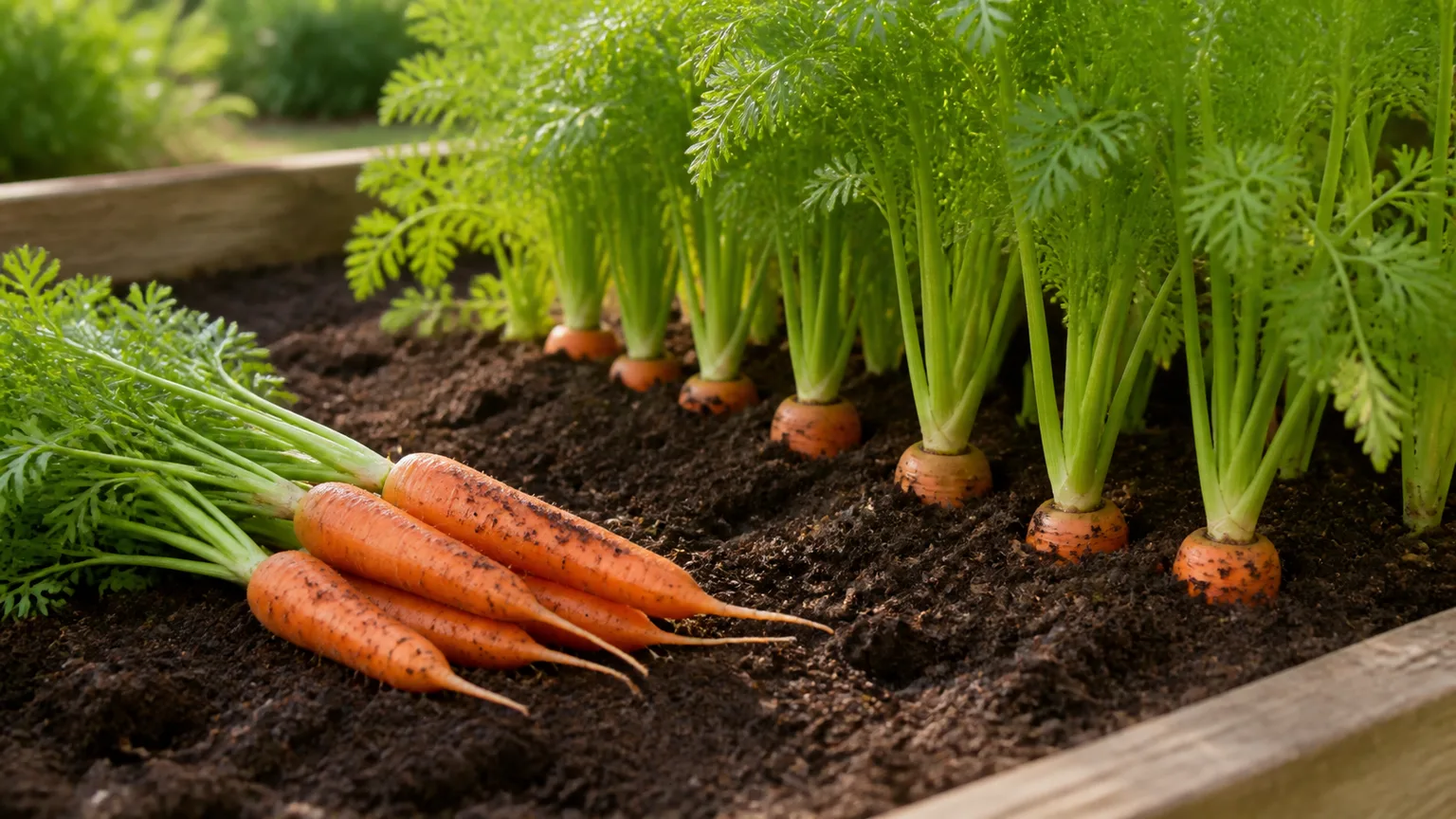
Most carrots take 55 to 80 days after they emerge to reach a useful harvest size. Because carrot seed can take one to three weeks to germinate, the full time from sowing to pulling is often closer to 70 to 100 days. Small, round, or baby types can finish sooner, while long storage carrots may need 75 to 90 days or more.
That range is a planning tool, not a mandatory harvest date. The number on the seed packet depends on the variety, the size it is meant to reach, and whether the company counts from sowing or emergence. Start checking when the packet’s window opens, then confirm with the root’s shoulder, its expected diameter or length, and one careful test pull.
The South Dakota State University Extension carrot guide uses the familiar 55-to-80-day maturity range, while BBC Gardeners’ World Magazine notes that some crops take up to three months and that early and late types do not finish together. Those estimates fit the practical rule for home gardens: count from sowing, but let the root—not the calendar alone—decide when to harvest.
The quick answer: most carrots need 55 to 80 days after emergence
If you sowed a standard orange carrot directly in loose soil, mark the sowing date and expect a slow beginning followed by a longer underground sizing period. Germination may take 7 to 21 days, especially when the soil is cool or the seedbed dries at the surface. After the seedlings emerge, many ordinary carrots need another 55 to 80 days to reach the size printed on the packet.
Use the shorter end of the range for baby or round-rooted varieties and for a crop grown in mild, steady weather. Use the longer end for large Nantes, Danvers, Chantenay, or storage types, for early spring sowings in cold soil, or for a bed that repeatedly dries out. A carrot can be edible before it reaches full size, so “ready” may mean harvestable for a meal rather than finished at its maximum potential.
The carrot timeline from sowing to harvest
Carrots are deceptively quiet crops. The leafy top is visible, but most of the crop’s progress happens below the surface, so a simple stage-by-stage timeline is more useful than guessing from foliage height.
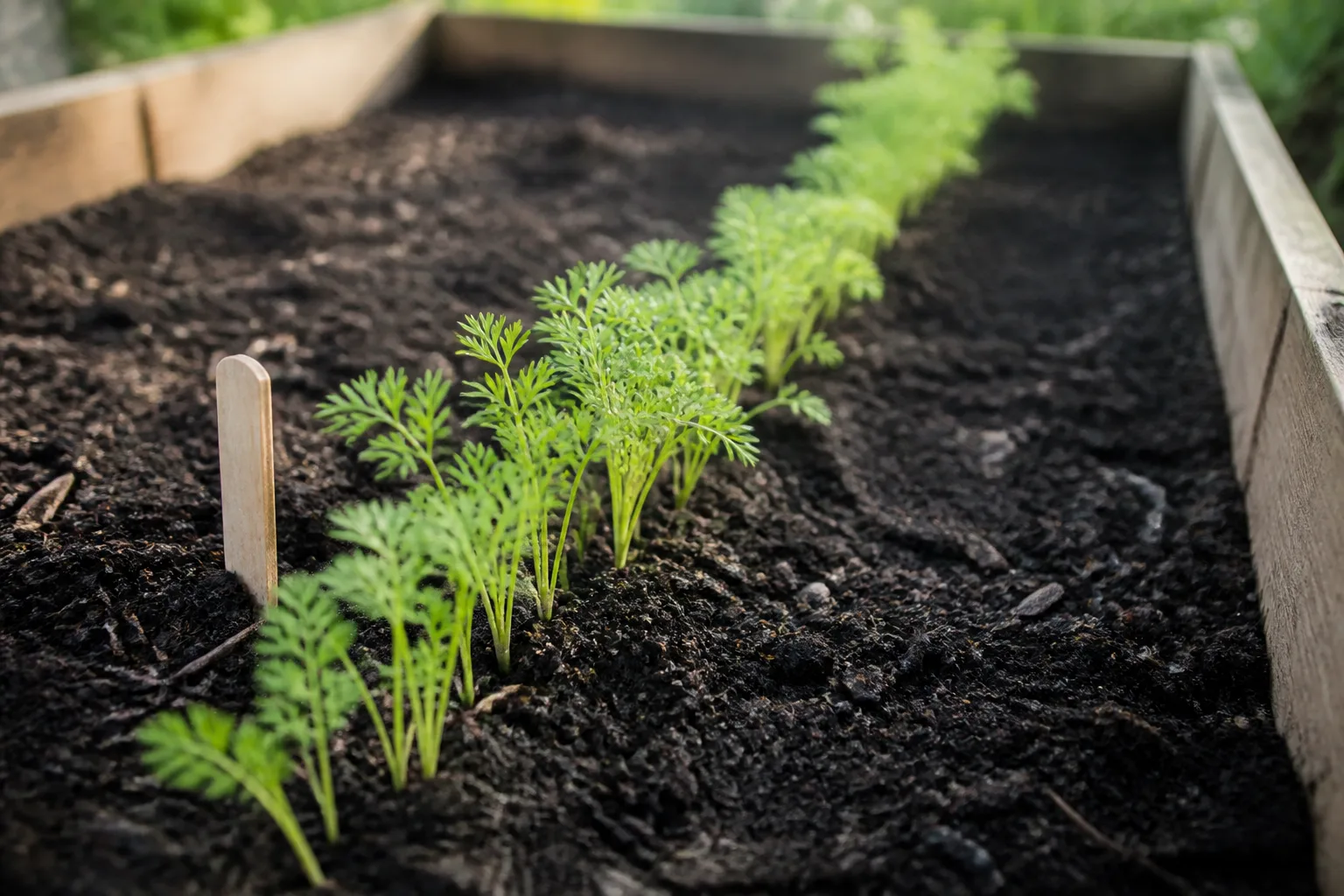
Germination and the first true leaves
During the first two to three weeks, the priority is not fertilizer or deep watering; it is keeping the seed zone evenly moist until the seedlings emerge. Sow carrot seed directly where it will grow because young carrot roots are easily disturbed by transplanting. Cover the seed lightly with fine soil and water gently enough that the row does not wash into a trench.
The University of Minnesota Extension guidance on carrots and parsnips emphasizes careful seedbed preparation and consistent moisture during establishment. If the soil crusts after rain or dries hard between waterings, emergence can be patchy, and the surviving plants will not all share the same harvest date.
Once the first true leaves appear, remove weeds while they are tiny. Carrot seedlings are poor competitors, and a weed that seems insignificant at the beginning can take enough moisture and light to delay root sizing. Thin gradually if the seedlings are crowded, taking care not to bruise the remaining foliage.
Root building beneath the soil
After emergence, the plant builds leaves that collect energy and a taproot that thickens and lengthens. This is the longest part of the crop’s timeline, and it is where soil texture, moisture, spacing, and temperature have the greatest effect.
The leaves do not need to be 12 inches tall before you investigate the root. A tall, lush top can simply mean the plant has plenty of nitrogen or is competing with its neighbors. Conversely, a modest top can still support a good carrot when the plant is growing in cool weather or a shallow container. Brush soil away from one plant rather than digging up the entire row to see whether the shoulder is developing.
USDA Agricultural Research Service research identifies drought, heat, saline soil or water, root-knot nematodes, leaf blight, and cavity spot among the challenges that affect carrot production. A home garden does not need commercial-scale management, but the principle is useful: stress that slows leaf growth or damages roots can also extend the time to a worthwhile harvest.
The harvest window
Carrots usually become harvestable over a window rather than on one date. Once the earliest roots approach the packet’s expected diameter or length, inspect the row every few days and pull the largest first. That leaves smaller roots room to size up and gives you fresher, sweeter carrots instead of one oversized batch.
Cool weather can improve flavor, but a mature carrot should not be left in soil that is about to freeze solid. In a mild climate, you can often lift roots as needed; in a cold or wet garden, harvest before the ground becomes difficult to work and store the undamaged roots in a cool, humid place.
Choose the carrot type before you count the days
The phrase “a carrot takes 70 days” is too broad to plan a real crop. The intended root size and shape determine how much underground growth is required.
Baby and round carrots finish fastest
Baby carrots and small round varieties are the best choice when you want a quick harvest or have shallow soil. They may be usable in roughly 50 to 60 days from sowing in good conditions, although the seed packet is the authority for the cultivar you bought. Small roots are also more forgiving in containers because they do not need as much depth.
Harvest these types young if you want tender texture. Waiting for a tiny carrot to become much larger can make it more fibrous without adding much useful flavor. For a short season, it is usually smarter to choose an early variety than to try to force a long-rooted carrot to mature faster.
Standard and long storage carrots need more time
Standard orange carrots often fall in the 60-to-80-day range after emergence, while large, long, or storage varieties can run to 75 to 90 days or beyond. The bigger the expected root, the more important it is to prepare a deep, stone-free bed; a carrot cannot make a straight, full-length root in compacted soil simply because the calendar says it is mature.
Read the packet for the expected length as well as the days to maturity. A long carrot may be ready when its shoulder is still narrow but the root has reached its listed length below the soil. A round carrot may be ready when the top is only an inch or two across. Variety name, root shape, and harvest size are a better guide than a universal diameter rule.
The growing conditions that keep carrots on schedule
The fastest reliable carrot is not the one fed the most. It is the one that never has to stop growing because the soil is hard, dry, waterlogged, crowded, or too hot.
Loose, deep soil matters more than rich soil
Carrots grow best in loose, well-drained soil that stays moist without holding standing water. Remove stones and break up compacted layers before sowing. A raised bed or container is useful when native soil is heavy, but the container must be deep enough for the variety; choose a round or short carrot if you have limited depth.
Avoid adding a large amount of fresh manure or high-nitrogen fertilizer immediately before planting. Too much available nitrogen can produce impressive foliage while the root remains thin, and very rich or lumpy soil can encourage forking. Finished compost worked into poor soil is a safer improvement, followed by a soil-test-led fertilizer plan if the bed is genuinely deficient.
Even moisture and cool-season temperatures
Keep the seedbed evenly moist through germination, then water deeply enough to wet the developing root zone whenever the soil begins to dry. The goal is consistent moisture, not a daily shallow splash. Repeated dry-then-saturated cycles can slow growth, crack roots, and make texture less crisp.
Carrots are cool-season vegetables. Sow in spring when the soil can be worked and in late summer when the crop will mature during cooler fall weather. If a hot spell arrives, use mulch to reduce evaporation and, where practical, light afternoon shade or a breathable row cover to reduce stress. Do not keep a mature crop waiting through a prolonged heat wave in the hope that more leaves will fix a root that has already started to bolt.
Spacing and fertilizer determine root size
Thin seedlings to the spacing on the packet once you can distinguish the plants. A common home-garden range is about 2 to 3 inches between standard carrots, with more room for large varieties and less for some baby types. Crowding forces roots to compete for the same narrow band of soil and often produces small, forked, or twisted carrots.
Weed carefully around the row, because carrot roots sit close enough to the surface that deep cultivation can damage them. If you use a fertilizer, apply only what the soil and the product label call for. Extra feeding will not compensate for inadequate depth, poor drainage, or inconsistent water.
The harvest signs that tell you to pull
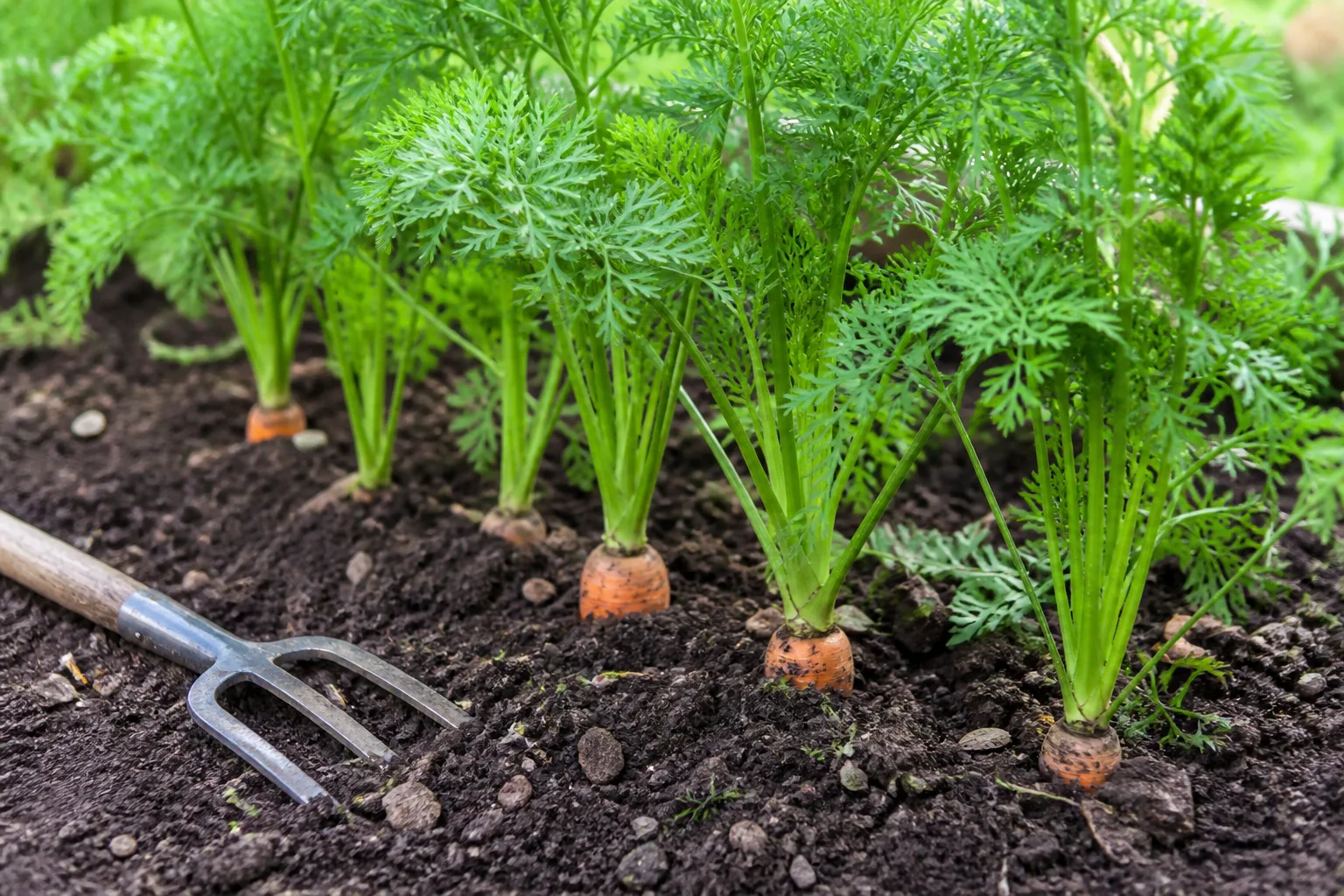
Use several clues together. The leaves alone cannot tell you whether the edible root has reached the intended size.
Read the shoulder and the expected size
The shoulder is the top of the root where it meets the foliage. Some carrots push enough of the shoulder above the soil that you can see its color and width. Orange, purple, yellow, or white shoulders can all be useful clues, but color by itself is not a maturity test because the cultivar determines the final color.
Gently brush away a little soil beside one plant and compare the root with the packet’s expected diameter or length. The familiar “about 1 inch wide” rule works for many young standard carrots, but it is not right for every variety. A baby carrot may be ready at a smaller size, while a storage carrot may need a broader shoulder and a longer root to reach its best texture.
Healthy green foliage is reassuring, but tall tops are not proof of a finished root. If the top is lush and the shoulder is still pencil-thin, give the crop more time while checking crowding, nitrogen, moisture, and soil depth.
Use one test carrot to make the final call
When the calendar and the visible shoulder disagree, pull one carrot. Water the bed the day before if the soil is dry, then loosen the soil beside the root with a narrow garden fork or trowel. Pull from the base of the foliage rather than yanking the leaves from dry, compacted soil.
Inspect the test carrot for size, firmness, color, and texture. If it is crisp and close to the packet’s target, harvest the largest neighbors and leave smaller plants in place. If it is tiny but healthy, correct the growing condition and wait. If it is woody, split, soft, tunneled, or flowering, harvest what is usable and re-sow during a cooler, better-timed window.
Troubleshoot a crop that is late, small, or misshapen
Big tops and small roots: Crowding, too much nitrogen, low light, or a compacted root zone are the usual suspects. Thin the row, stop high-nitrogen feeding, and check whether a hard layer is preventing the root from expanding.
Slow or uneven growth: Patchy emergence often begins with a dry seedbed or a crusted surface. Uneven moisture, cold soil, weeds, and inconsistent seed depth can keep plants at different stages. Water the row consistently, weed gently, and use the individual root’s size rather than a single row-wide harvest date.
Forked or twisted carrots: Stones, clods, shallow soil, fresh manure, and root damage can make the taproot divide. Improve the bed before the next sowing; trying to straighten a carrot after it has forked will only break it.
Cracked roots: Cracking often follows a sudden surge of water after the soil has been dry. Keep moisture steadier and harvest roots that are already at a good size instead of leaving them through repeated wet-dry swings.
Tunnels or rusty damage: Insect feeding can disfigure roots and slow the crop. Fine mesh or a securely anchored row cover is a physical option; crop rotation and careful sanitation can also reduce recurring pressure. If the foliage is badly damaged or the root is tunneled throughout, do not wait for more days to repair an unusable carrot.
Flowering or bolting: A carrot that flowers early has moved into reproduction, often after heat or stress. The root usually becomes tough and less appealing. Harvest any usable roots and plan the next sowing for a cooler window rather than trying to rescue a flowering plant with more fertilizer.
Harvest, store, and succession-sow carrots for a longer season

Harvest when the soil is moist but not muddy. Loosen long roots with a fork before pulling so they do not snap. Twist or cut off the green tops soon after harvest; the foliage continues to draw moisture from the root and can make it soften faster. Brush off loose soil, let the roots dry briefly, and refrigerate them in a bag or container that limits moisture loss.
Use damaged, cracked, or tunneled roots first. Store only firm, intact carrots for longer keeping, and do not seal warm, wet roots into a container. In cold climates, lift the crop before the ground freezes solid. In mild areas with workable soil, some storage carrots can remain in the bed under a protective mulch, but check local weather and pest pressure rather than assuming the crop can stay indefinitely.
For a steady supply, do not sow the entire packet on one day. Plant short rows every two to three weeks during the suitable spring or fall window, adjusting the final sowing so the roots have time to mature before hard frost. Succession sowing spreads the harvest, makes a test pull less risky, and means one delayed row does not leave you without carrots.
Conclusion: count the days, then trust the root
Plan on roughly 70 to 100 days from carrot seed to harvest for many home-garden crops, with the mature-root portion often taking about 55 to 80 days after emergence. Small and round varieties can finish sooner; large storage carrots may need longer. Your seed packet gives the first estimate, but soil, weather, spacing, and moisture decide how closely the crop follows it.
When the checking window arrives, look for the shoulder, compare the root with the variety’s expected size, and pull one test carrot. If it is crisp and full, harvest the largest roots. If it is small, fix the growing condition; if it is damaged or bolting, harvest what you can and use the next sowing to reset the timing. That combination of calendar awareness and direct inspection is how you pick carrots at their best instead of waiting for a number to make the decision for you.



