How to Prune Rosemary: Timing, Tools, and Safe Cuts
Learn when to prune rosemary, how much to remove, where to cut green stems, and what to do with woody or frost-damaged plants before the season changes.
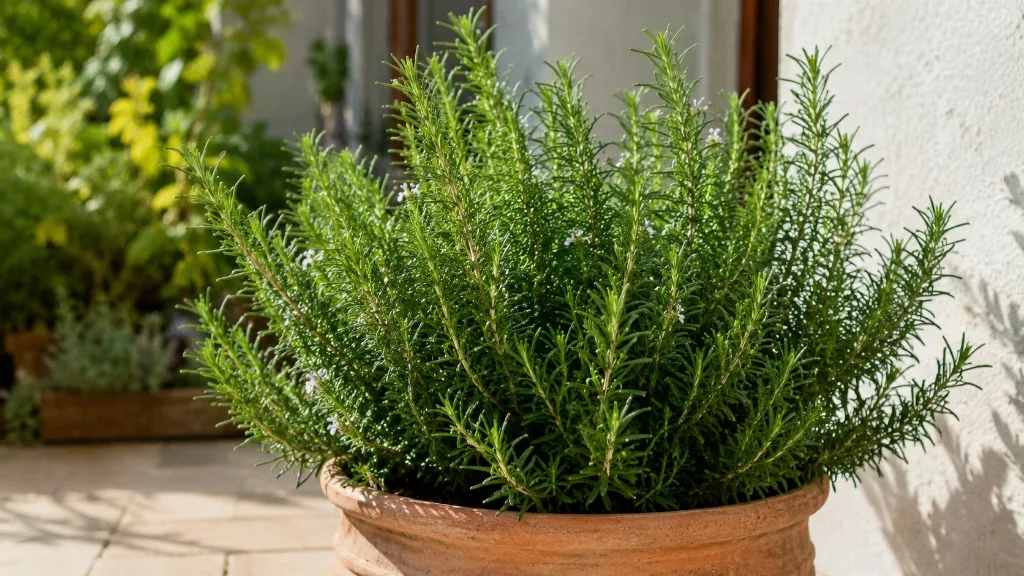
If you want rosemary to stay compact and leafy, make the main shaping cut after its biggest flowering flush, while enough mild growing weather remains for new shoots to develop. For routine pruning, work in the green, flexible part of the stems and leave leafy growth below each cut. A small harvest is different: you can snip a few sprigs whenever the plant is established and actively growing.
The hard question is usually not how to hold the shears; it is how far back you can safely go. Rosemary is an evergreen shrub with a woody framework, and old bare stems do not reliably behave like soft new tips. Before cutting, decide whether you are harvesting, tidying, reducing size, or trying to renovate a neglected plant. Those jobs call for different amounts of pruning and sometimes different timing.
Quick answer: prune after the main flowering flush
For most established outdoor rosemary, schedule the annual shape-up after the main flowers fade in spring or early summer. That timing lets you see the shrub’s structure and gives fresh shoots time to mature before cold weather. In the United States, the calendar can range from early spring in mild climates to late spring or early summer where winters are colder; use the local frost pattern and the plant’s bloom cycle as your guide.
Rosemary may flower in winter in a warm region, or bloom more than once in a long season. If flowering is important for pollinators or you enjoy the blossoms, wait until the main flush has finished rather than shearing the plant as soon as you see buds. You can still take a few culinary sprigs along the way; just avoid turning frequent harvesting into a large structural cut on a plant that is not growing strongly.
The Royal Horticultural Society recommends a light annual trim after flowering, and BBC Gardeners’ World also advises cutting back after flowering to limit straggly growth. NC State Extension notes that severe pruning after bloom can be an option for denser foliage. These recommendations apply to different conditions and levels of pruning. The conservative default is light shaping; reserve a more substantial reduction for a vigorous, established shrub in a favorable growing window, and do not assume a bare old branch will sprout.
What pruning does for rosemary
A well-timed trim keeps a shrub from becoming lopsided, sprawling into a path, or shading its own interior. It also gives you usable leaves and can encourage branching when the cut is made above a living node on a leafy stem. The goal is a balanced plant with enough foliage left to keep growing, not a perfectly clipped ball at any cost.
Pruning cannot reverse every sign of age. Rosemary naturally develops a woody base as it matures, and a sparse center may reflect age, low light, root stress, or years without selective cuts. Trimming only the outside can make the shell denser while the inside stays bare, so inspect the plant’s structure before making another pass.
How new growth responds to a cut
Rosemary carries leaves in pairs along its stems, and a leaf joint is a useful place to make a selective cut. When a healthy leafy tip is shortened just above a node or a side shoot, buds below the cut may branch and fill in. That response is strongest on young, actively growing stems; it is not a promise that a dormant, leafless trunk will produce a new canopy.
Think of the plant in three zones. The bright, flexible tips are current growth; the older green or gray-green stems are firmer but still carry leaves; the central and basal stems are hard, brown, and often leafless. Routine shaping belongs mainly in the first two zones, with the amount depending on how much green growth remains below your chosen cut.
When to prune by climate and plant condition
“After flowering” is a better starting point than a fixed month, but it is not the only condition to check. Look at the forecast, the plant’s vigor, and how long the growing season will last. A cut that is sensible in a mild coastal garden may leave a rosemary shrub exposed in a cold-winter region or stressed in the hottest part of a dry summer.
If a branch is broken or clearly dead, remove it when you notice it rather than waiting for the annual shape-up. For elective pruning, choose a mild, dry day when the plant is not wilted and the soil is not waterlogged. Delay major work on a recently transplanted, drought-stressed, frost-damaged, or pest-weakened rosemary until you have corrected the underlying stress.
Mild-winter and warm-climate timing
In regions where rosemary grows through winter, it may flower early or intermittently. Wait until the dominant bloom period has passed, then shape the plant during a stretch of moderate weather. If summers are extremely hot, avoid a hard trim at the start of a heat wave; a plant with less leaf area can be less able to cope with heat and drying wind.
Light clipping for harvest can continue outside that main session. UC IPM says to trim sprigs from the longest branch tips and notes that regular harvesting or pruning encourages new growth. Keep each harvest proportional: take from several sides, and do not repeatedly strip the same branch or remove most of the plant’s new growth before it has established.
Cold-winter timing and frost risk
Where winter freezes are common, do the main trim after the danger of hard frost has passed and after the plant has finished its principal bloom. Finish early enough that regrowth can firm up before autumn cold returns. The precise interval varies with region, cultivar, and weather; a local extension calendar can help when your microclimate is unusual.
Avoid a substantial fall or winter haircut. Fresh tips made late in the year may not have time to mature before a freeze, and reducing the leafy canopy does not make the shrub more winterproof. If frost has already damaged rosemary, wait until you can distinguish dead tissue from live stems, then remove damage back to living growth once severe cold has eased.
Tools and checks before the first cut
For a young plant or sprig harvest, clean garden scissors or sharp bypass pruners are usually enough. Use hand pruners for individual stems and loppers only for branches too thick for the pruner’s cutting capacity; do not force a small tool until it crushes or tears the stem. A hedge trimmer can make a formal hedge faster, but it creates many cut ends at once and is less precise around woody growth.
Wipe soil and plant residue from blades before you start, and use sharp tools that leave smooth cuts. If you are removing diseased growth or moving between plants with a known disease problem, clean the blades between plants using an appropriate tool-disinfecting method. Wear gloves if the shrub is dense or the branches scratch, and keep your free hand behind the cutting edge.
Before cutting, step back and identify the intended final outline. Mark mentally which branches are too tall, crossing, dead, or blocking access, and check that each shortening cut will leave foliage below it. If you cannot see a leafy side shoot beneath the cut, do not make that cut as routine shaping.
How to prune rosemary step by step
Start with a light pass rather than taking the shrub down all at once. Move around the plant as you work, checking its shape from several angles. When you remove one branch, pause and see whether the plant already looks balanced; rosemary often needs fewer cuts than a gardener expects.
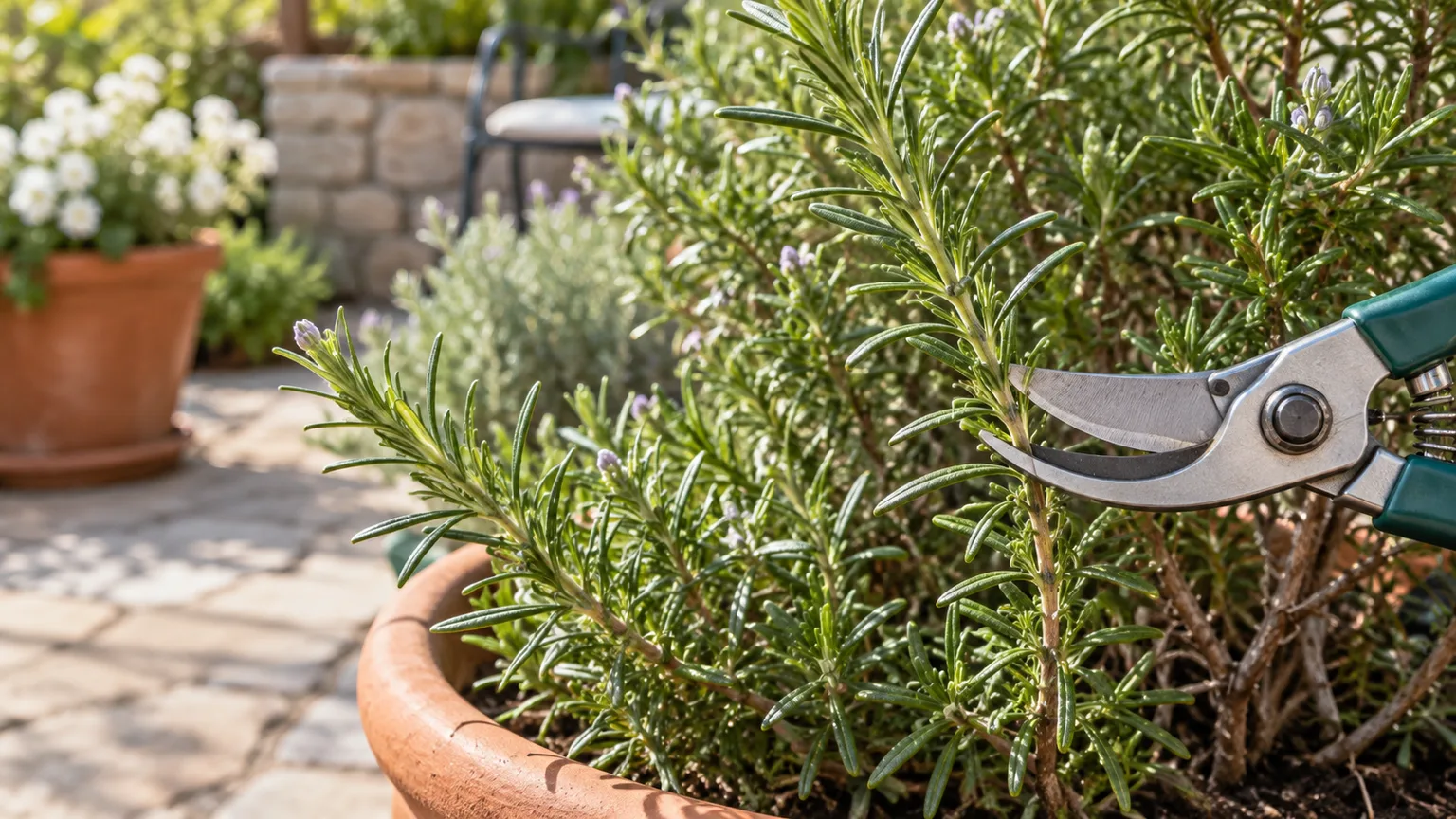
Read the plant’s shape before cutting
Look for the outline you want to keep and find branches that are out of proportion with it. Upright rosemary can be kept as a rounded shrub or a loose hedge; trailing varieties should keep their natural arch instead of being forced into a tight upright ball. Remove only the branches that interfere with the plant’s form, nearby plants, a walkway, or airflow through the center.
Then separate dead or damaged growth from living branches. A brittle brown branch with no leaves and no flexible green tissue may be dead, but a woody stem that still supports leafy shoots can be part of the plant’s healthy framework. If you are unsure whether a branch is alive, scratch a tiny patch of bark on a hidden section: living tissue below is usually green, while dry brown tissue suggests dieback. Do not scrape widely or use this as a reason to cut into the trunk.
Shorten healthy stems above leafy growth
Choose a long, leafy stem and follow it inward until you find a healthy side shoot or a pair of leaves pointing in a useful direction. Make a clean cut just above that point, angled slightly away from the bud so water does not sit directly on it. That gives the remaining shoot a clear path and keeps the cut in growth capable of continuing.
Remove a little at a time from multiple sides rather than taking a large chunk from one spot. For a routine trim, shortening tips by a few inches may be enough; the right amount depends on how much green stem the plant has and whether the goal is harvest, density, or size control. The UC IPM rosemary guide specifically recommends trimming the longest growing branch tips and says regular pruning or harvest encourages new growth.
Remove dead, damaged, or crossing stems
Take out snapped, diseased, or fully dead material first so it does not distract from the shape. Cut a broken stem just below the split, where the remaining tissue is sound. If the whole branch is dead, remove it at its point of origin without injuring the living stem or scraping the plant’s crown.
A few branches that rub against each other or grow into the center can be thinned selectively. This is different from shearing every outer tip to the same length: selective thinning lets light and air enter the shrub and prevents a dense green shell from concealing an empty interior. If you see discoloration or lesions rather than ordinary old bark, pause and identify the cause before spreading cuts through the plant.
How much rosemary can you cut at once?
For routine shaping, use about one-third of the leafy canopy as a cautious upper limit for one session, especially if you do not know the plant’s cultivar or pruning history. That is a practical safeguard, not a universal threshold. A healthy, established shrub may tolerate more after flowering in a suitable climate, while a young or stressed rosemary may need only tip pruning or no elective cut at all.
Count what you remove across the whole shrub, not branch by branch. Taking one-third from every long stem could remove far more than one-third of the total canopy. A useful visual check is to pause when the plant has a thinner outline but still looks leafy and green throughout; if it begins to look skeletal, stop and let it respond before deciding whether another session is needed.
Some horticultural guidance differs on renovation. NC State Extension says rosemary can tolerate heavy pruning and describes severe pruning after bloom as an option for dense growth, while RHS advises light annual trimming and says old straggly plants often do not recover from heavy pruning. Epic Gardening’s rosemary pruning guide offers the more conservative rule of removing no more than one-third at once and keeping cuts above the woody framework. For home gardens, use the lighter approach unless you have a vigorous plant, know your season, and can accept that a hard cut may fail.
Pruning young rosemary versus established shrubs
Young rosemary needs shaping more than size reduction. Once it is established and producing several leafy shoots, pinch or clip the tips to encourage branching and prevent one stem from dominating. Do not keep pinching a newly planted transplant before it has rooted in and begun steady growth; establishment comes first.
An established shrub can take a broader shape correction because it has more branches and stored resources, but select cuts still matter. Shorten the tallest stems back to leafy side shoots, remove a few inward-growing branches, and leave enough green growth spread around the framework. If a large plant has become uneven, divide the job over two growing seasons instead of exposing a large amount of old wood in one afternoon.
Topiary and hedges require repeated light trimming, not occasional severe cutting. Use a loose shape that leaves the lower parts slightly wider than the upper parts so sunlight reaches the base. Upright rosemary cultivars are better candidates for a hedge than sprawling, prostrate types; choose the plant’s natural habit as your starting point.
Can you cut rosemary back into old wood?
Treat leafless old wood as a warning zone, especially on an older shrub. Many rosemary stems do not reliably push new leafy shoots from bare sections, so a cut deep into a woody branch can leave a permanent gap or kill that branch. The RHS advises avoiding old wood and says very straggly older plants are often better replaced; that is the safest rule for routine pruning.
There is a qualified exception: NC State Extension lists rosemary as tolerant of heavy pruning and says a severe post-bloom cut can encourage dense foliage. That does not mean every cultivar, climate, or aging shrub will respond the same way. If a healthy, vigorous shrub is so overgrown that you are considering a hard renovation, make a limited test cut on one branch just above a visible leafy shoot, wait through active growth, and do not repeat the cut if it fails to resprout.
For a plant that is mostly bare wood, propagation is often a better insurance policy than a drastic haircut. Take several healthy semi-ripe cuttings from green, nonflowering stems before making larger cuts, root them in suitable conditions, and keep the parent plant if it still has healthy foliage. If the parent declines, you will already have young replacements underway.
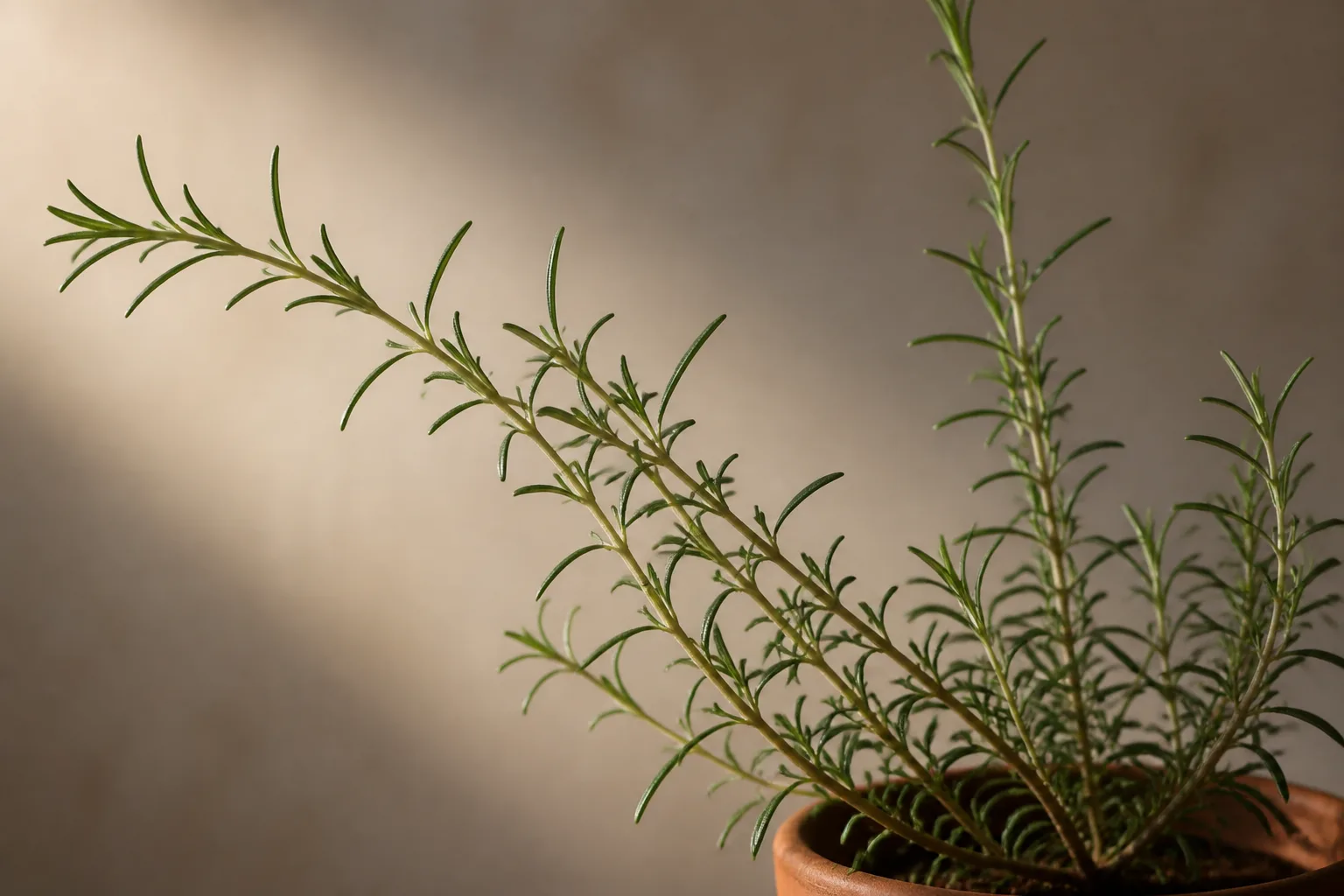
Potted, indoor, and trailing rosemary
Potted rosemary follows the same cut-placement rules, but its limited root space makes recovery more dependent on light, drainage, and watering. Rotate the pot so one side does not stretch toward a window, and remove only enough growth to balance the canopy. If roots are crowded or the compost stays wet, solve those problems before interpreting slow regrowth as a pruning issue.
Rosemary kept indoors often grows more slowly and can become thin if light is inadequate. Do not prune a weak indoor plant hard simply because it looks leggy; first improve its access to bright light and check for a healthy root system. When it resumes vigorous growth, trim a few long tips at a time and watch how it responds over several weeks.
Trailing rosemary has a naturally cascading shape. Lightly shorten stems that drag on the ground or extend beyond a container, making each cut above a leafy shoot, but preserve enough arching growth to keep the cultivar’s form. Avoid turning a prostrate variety into a formal sphere by repeatedly shearing the top and leaving a shaded, bare center.
Common pruning mistakes and how to recover
The most damaging mistake is cutting back to the point where no green leaves or side shoots remain. Other common problems include pruning just before frost, removing all flowers before pollinators can use them, taking too much foliage from a stressed plant, and using dull shears that crush stems. A second mistake is assuming a brown woody base is unhealthy when it may simply be the normal framework of an older evergreen shrub.
If you have already removed too much, stop cutting and give the plant steady conditions. Keep the root zone appropriately watered without leaving it soggy, protect it from severe cold or heat, and do not add heavy fertilizer in an attempt to force rapid shoots. Watch for new growth through the active season; dead sections can be removed later once you can confirm where living tissue ends.
What to do if rosemary looks bare after pruning
A few exposed stems do not tell you immediately whether the plant is lost. Check whether the remaining branches are flexible and carry living leaves, and look for buds or green side shoots as temperatures rise. If the plant still has healthy foliage, wait rather than making further cuts; repeated corrective trimming can turn a recoverable shape problem into a loss of canopy.
If a bare branch stays dry and leafless while the rest of the plant grows, remove that branch back to a living junction. If most of the shrub remains bare through a full growing period, or cuts into old wood never produce new shoots, plan to replace it and take cuttings from any healthy growth you still have. Rosemary is evergreen and can be harvested through much of the year; the RHS notes that soft new growth in late spring and summer is particularly useful for harvest, so preserve that growth while the replacement establishes.
Conclusion
Prune rosemary after its main flowering flush, when mild growing weather remains, and make routine cuts in leafy green growth above a node or side shoot. Remove dead and broken stems first, then shorten long branches gradually while preserving enough foliage for the plant to keep growing. A light annual trim is the dependable approach for most gardeners; severe renovation is a risk-based exception, not a requirement.
If your rosemary has become a bare, woody shrub, do not assume that a hard cut will bring it back. Make a small test only on a healthy established plant in a favorable season, and take cuttings before a major renovation so you have a backup. That combination—good timing, visible leafy cut points, and a willingness to stop—is what keeps rosemary useful and attractive for years.



