Salvia Care Guide - Grow Ornamental Garden Salvias
Salvia spp. (ornamental garden salvias)
Learn how to grow ornamental salvia in sun and well-drained soil, then match watering, pruning, and winter care to the species. Scarlet sage and hardy perennial salvias have different needs.
Salvia Care Guide: Growing Ornamental Garden Salvias
Start with wateringThe most common care mistake for SalviaWatering guide →Salvia care essentials
Light
Full sun for the strongest flowering in most garden salvias
Water
There is no single watering schedule for the genus. Scarlet sage (Salvia splendens) prefers moist, well-drained soil and is not drought tolerant; established woodland sage (Salvia nemorosa) tolerates drier soil. Check the plant label, water newly planted salvias while they establish, and keep container soil from staying saturated.
Soil
Use a freely draining bed or container mix. Many ornamental salvias flower best in sun and tolerate a range of soils, but moisture needs differ: scarlet sage prefers moist, well-drained soil, while woodland sage tolerates dry, sandy or gravelly soil once established.
Humidity
Temperature
Fertilizer
About Salvia
Salvia is native to Varies by species. Scarlet sage (Salvia splendens) is native to Brazil; woodland sage (Salvia nemorosa) is native to Europe and west-central Asia., typically reaches Varies widely by species and cultivar. Salvia splendens is about 1–3 ft tall and 8–10 in wide; Salvia nemorosa can reach about 3 ft tall and 2 ft wide. indoors, with variable by species and cultivar; there is no single growth rate for the ornamental genus. growth. Salvia has a ornamental salvias include annual bedding plants, tender perennials, herbaceous perennials, and shrubs or subshrubs, depending on the species. growth habit and part of the Lamiaceae family. It is also known as Ornamental sage, Flowering sage, and Scarlet sage (Salvia splendens).
| Detail | Information |
|---|---|
| Also known as | Ornamental sage, Flowering sage, Scarlet sage (Salvia splendens) |
| Native region | Varies by species. Scarlet sage (Salvia splendens) is native to Brazil; woodland sage (Salvia nemorosa) is native to Europe and west-central Asia. |
| Mature size | Varies widely by species and cultivar. Salvia splendens is about 1–3 ft tall and 8–10 in wide; Salvia nemorosa can reach about 3 ft tall and 2 ft wide. |
| Growth rate | Variable by species and cultivar; there is no single growth rate for the ornamental genus. |
| Growth habit | Ornamental Salvias Include Annual Bedding Plants, Tender Perennials, Herbaceous Perennials, And Shrubs Or Subshrubs, Depending On The Species. |
| Scientific name | Salvia spp. (ornamental garden salvias) |
| Family | Lamiaceae |
How to care for Salvia?
How much light does Salvia need?
Full sun for the strongest flowering in most garden salvias. Partial shade. Dappled sunlight. direct sun
- Full sun for the strongest flowering in most garden salvias - Full sun for the strongest flowering in most garden salvias.
- Partial shade - Partial shade.
- Dappled sunlight - Dappled sunlight.
- direct sun - direct sun.
When should you water Salvia?
There is no single watering schedule for the genus. Scarlet sage (Salvia splendens) prefers moist, well-drained soil and is not drought tolerant; established woodland sage (Salvia nemorosa) tolerates drier soil. Check the plant label, water newly planted salvias while they establish, and keep container soil from staying saturated.
- Feel the upper inch of soil before watering. If it is dry - Check the plant label, water newly planted salvias while they establish, and keep container soil from staying saturated.
- water the root zone thoroughly and let excess drain from the pot or bed. Do not leave a container standing in water - Check the plant label, water newly planted salvias while they establish, and keep container soil from staying saturated.
- Drain excess water - There is no single watering schedule for the genus.
What soil works best for Salvia?
Use a freely draining bed or container mix. Many ornamental salvias flower best in sun and tolerate a range of soils, but moisture needs differ: scarlet sage prefers moist, well-drained soil, while woodland sage tolerates dry, sandy or gravelly soil once established.
- For containers, use a quality potting mix with open drainage holes. - Use a freely draining bed or container mix.
- For dry-tolerant perennial types - Many ornamental salvias flower best in sun and tolerate a range of soils, but moisture needs differ: scarlet sage prefers moist, well-drained soil, while woodland sage tolerates dry, sandy or gravelly soil once established.
- avoid dense mixes that stay wet after watering
Grower notes for Salvia
Check the species name before choosing a care routine
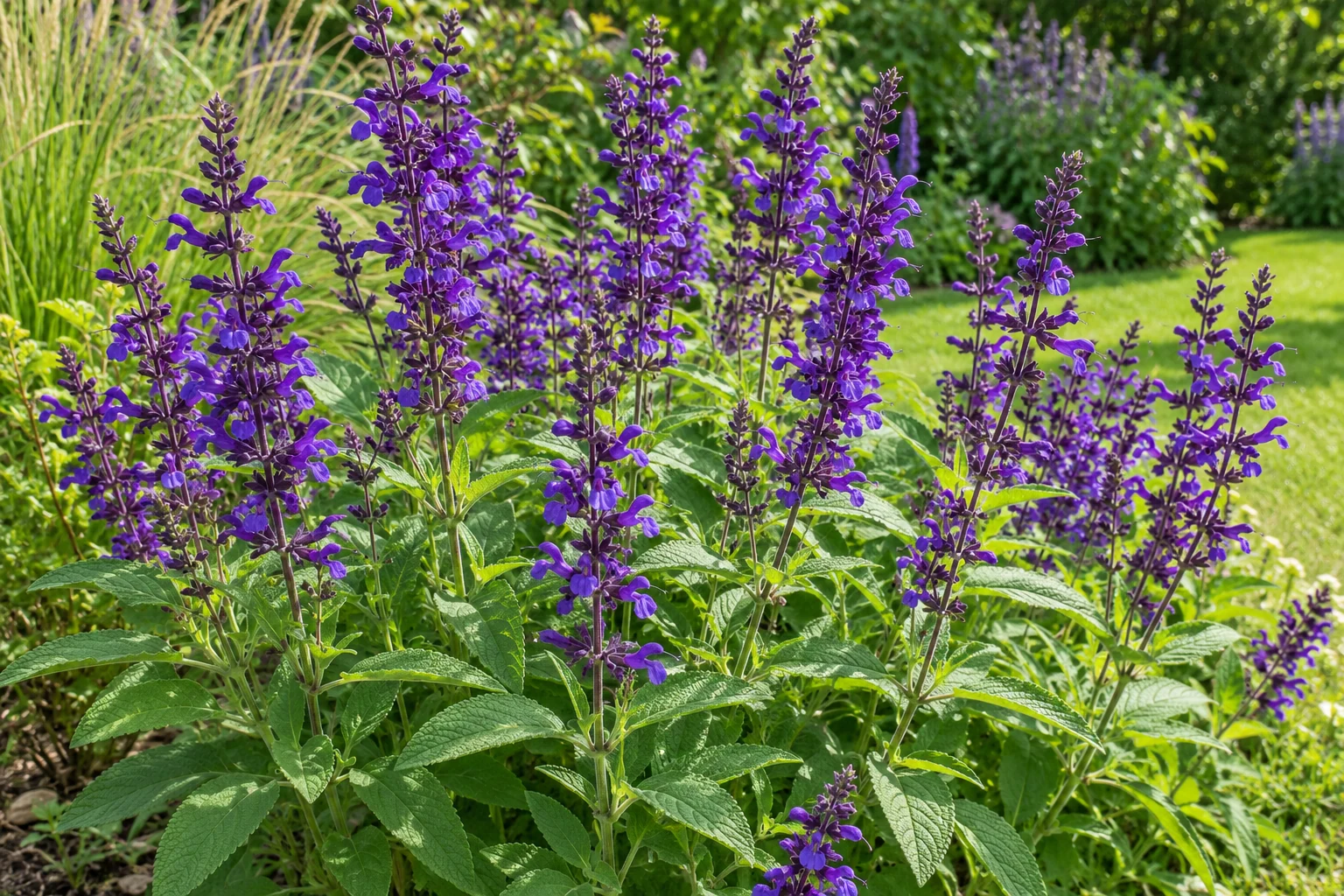
Salvia is a genus of more than 1,000 species, not one uniform garden plant. This hub focuses on ornamental flowering salvias such as scarlet sage (Salvia splendens) and woodland sage (Salvia nemorosa). It does not use the culinary-sage profile for every salvia; read the nursery label before applying a hardiness or watering schedule.
Annual bedding salvias and hardy perennials behave differently
Salvia splendens is a tender perennial often grown as a warm-season bedding annual. Salvia nemorosa is a clump-forming herbaceous perennial that can tolerate drier soil. Their winter survival, mature size, and moisture needs are not interchangeable, so choose a type suited to your climate and space.
Give most flowering salvias plenty of light and drainage
Full sun and well-drained soil support strong flowering across many garden salvias. Scarlet sage can also tolerate partial shade, but it needs more consistent moisture than established woodland sage. If a container stays wet, improve drainage before adding more water or fertilizer.
Match watering to the plant, not the genus name
Check soil moisture before watering. Do not let Salvia splendens dry out for long periods, while established Salvia nemorosa can tolerate dry spells. A pot in hot weather may need more frequent checks than a garden clump, but neither type should sit in waterlogged soil.
Remove spent spikes when you want another flush of flowers
Cut back faded flower spikes on suitable types to tidy the plant and encourage rebloom. For hardy perennial salvias, leave the basal foliage intact when trimming finished stems; follow the cultivar's growth habit rather than cutting every plant back at the same time.
Do not assume every salvia is a pollinator plant
Some salvias attract bees, butterflies, or hummingbirds, but NC State Extension notes that many bedding cultivars of Salvia splendens have no nectar. Check cultivar information if pollinator value is a main reason for planting one.
Is ornamental salvia safe for pets?
Pet safety has not been verified across ornamental Salvia species. ASPCA's non-toxic Sage listing identifies Salvia officinalis, the culinary herb; it does not classify Salvia splendens or ornamental hybrids. Prevent pets from chewing ornamental salvias until you confirm species-specific guidance.
Do not transfer ASPCA's non-toxic classification for Salvia officinalis to scarlet sage or other ornamental salvias. A secondary gardening overview flags possible pet harm for some ornamental types, but I did not find an exact-species veterinary classification for the garden group. Keep pets from chewing the plant and contact a veterinarian if ingestion occurs.
Watering Salvia
For Salvia, feel the upper inch of soil before watering. If it is dry, water the root zone thoroughly and let excess drain from the pot or bed. Do not leave a container standing in water. and water check the root zone instead of watering on a fixed calendar. In warm, dry weather, check bedding salvias and containers more often; established drought-tolerant perennial types may need less supplemental water. Adjust to the identified species, rainfall, and drainage. Newly planted salvias need closer moisture checks until established. Increase checks during hot, dry spells for tender bedding types such as Salvia splendens; established woodland sage can tolerate drier conditions. Reduce supplemental water when growth slows or rain keeps the soil moist.
| Detail | Information |
|---|---|
| How often | Check the root zone instead of watering on a fixed calendar. In warm, dry weather, check bedding salvias and containers more often; established drought-tolerant perennial types may need less supplemental water. Adjust to the identified species, rainfall, and drainage. |
| How to check | Feel the upper inch of soil before watering. If it is dry, water the root zone thoroughly and let excess drain from the pot or bed. Do not leave a container standing in water. |
| Seasonal changes | Newly planted salvias need closer moisture checks until established. Increase checks during hot, dry spells for tender bedding types such as Salvia splendens; established woodland sage can tolerate drier conditions. Reduce supplemental water when growth slows or rain keeps the soil moist. |
Signs of overwatering
- The root zone remains wet for long periods or the container drains poorly.
- Lower leaves yellow while the soil stays wet.
- The plant wilts despite saturated soil; check drainage and roots before watering again.
Signs of underwatering
- Leaves wilt while the root zone is dry, especially on Salvia splendens.
- Container mix dries rapidly during warm weather.
- New growth stalls during a prolonged dry spell; confirm the species before changing the schedule.
Soil & potting for Salvia
Use a mix of For containers, use a quality potting mix with open drainage holes., For dry-tolerant perennial types, avoid dense mixes that stay wet after watering. for Salvia. Good drainage is important across the group; avoid waterlogged beds and pots. Target soil pH around There is no single pH target for the genus; follow the identified species or cultivar. Repot there is no genus-wide interval. In frost-prone climates, tender bedding salvias are usually grown as annuals and replanted seasonally. Move overwintered perennial salvias to a larger pot only when roots crowd the container or the mix dries unusually quickly., ideally in repot container-grown perennial salvias in spring as growth resumes. Plant tender bedding types outdoors after frost danger has passed.
| Detail | Information |
|---|---|
| Recommended mix | For containers, use a quality potting mix with open drainage holes., For dry-tolerant perennial types, avoid dense mixes that stay wet after watering. |
| Drainage | Good drainage is important across the group; avoid waterlogged beds and pots. |
| Soil pH | There is no single pH target for the genus; follow the identified species or cultivar. |
| Repotting frequency | There is no genus-wide interval. In frost-prone climates, tender bedding salvias are usually grown as annuals and replanted seasonally. Move overwintered perennial salvias to a larger pot only when roots crowd the container or the mix dries unusually quickly. |
| Best season to repot | Repot container-grown perennial salvias in spring as growth resumes. Plant tender bedding types outdoors after frost danger has passed. |
Signs it needs repotting
- Roots circle the pot or emerge through its drainage holes.
- The container dries unusually fast even after thorough watering.
- The root ball fills the pot and new growth is crowded or unstable.