How to Create an Art Gallery Full of Plants at Home
Create an art gallery full of plants at home with a focal-point formula, light map, layered display plan, and maintenance rules that protect your plants.
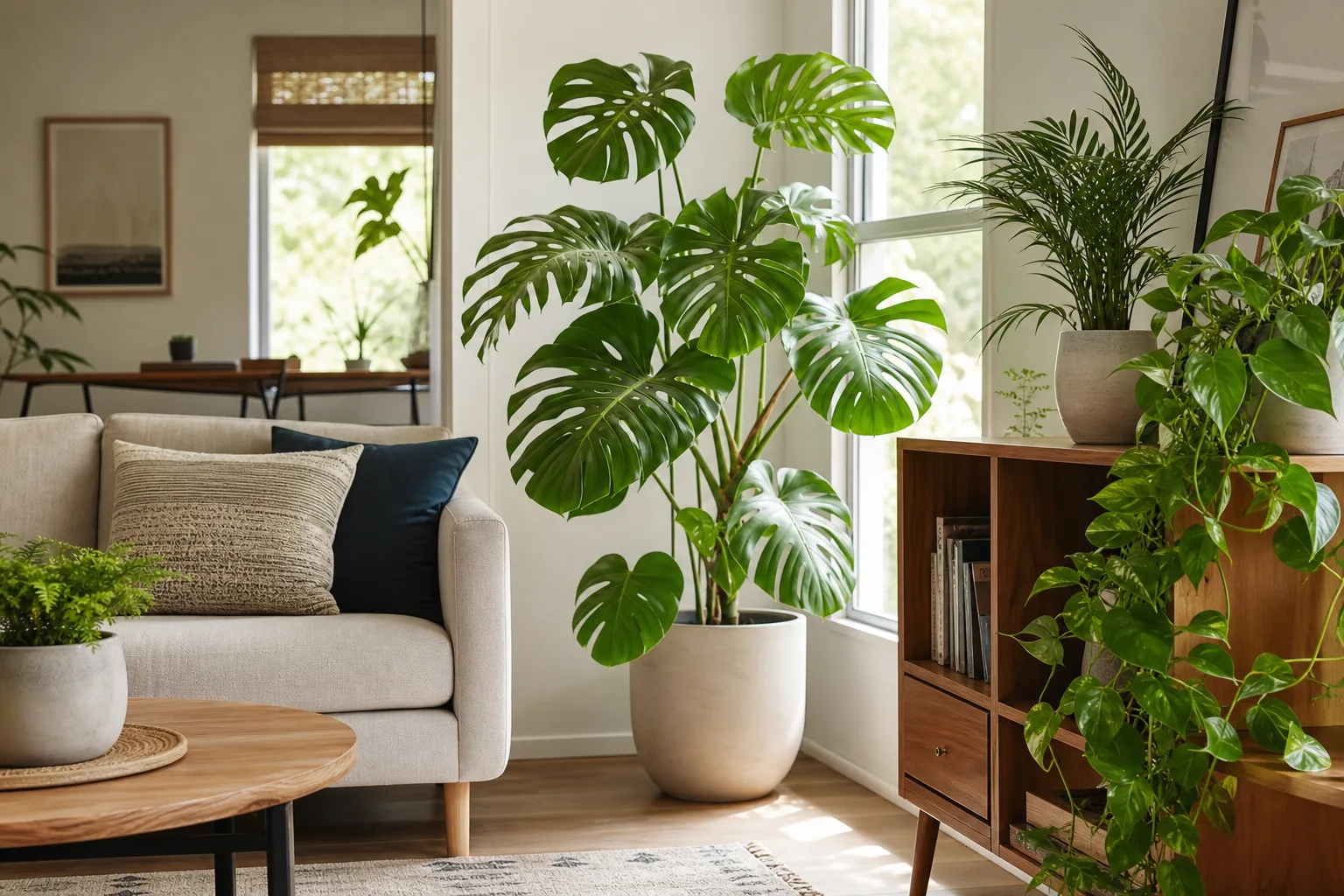
Shyama Golden’s Los Angeles apartment is memorable because the plants do not sit around the art as decoration. They make the room feel like another part of the work: big leaves establish a visual rhythm, patterned foliage echoes painted surfaces, and unusual containers behave like small sculptures. The profile’s collection of more than 50 plants is generous, but the more useful lesson is how deliberately the greenery is composed.
Golden’s own artist statement describes a world of vine-covered trees, theatrical characters, and shifting identities. That botanical language helps explain why her home feels coherent rather than merely crowded: plants are not an afterthought in the room’s story. You can read the artist’s description of that work in her own studio statement, then borrow the design principles without trying to reproduce her exact collection.
The goal is not to buy 50 plants and hope the room becomes magical. It is to make four choices in order: select one living focal point, map the light, build layers around the anchor, and make watering easy enough that the display stays healthy. The result can be maximalist, restrained, colorful, or almost monochrome; the underlying structure is the same.
What Shyama Golden’s Home Gets Right
Plants are artwork and infrastructure
In a conventional room, a plant fills an empty corner after the furniture is arranged. In a plant gallery, the plant helps determine the composition in the first place. A broad-leaved specimen can interrupt a long blank wall, a trailing vine can pull the eye from a high shelf toward a chair, and an airy plant can soften the hard line of a frame without hiding the picture.
That is what makes Golden’s approach feel more like an installation than a plant shelf. The greenery is doing visual work and practical work at once: it creates height, hides awkward transitions, establishes a color field, and changes as it grows. The living quality matters. A painting holds its form; a plant leans toward the window, drops an old leaf, and slowly edits the room.
Before you shop, look at your room as a set of visual problems. Is the sofa backed by a blank wall? Does a low bookcase need height? Is a window surrounded by hard edges? A plant should solve one of those problems, not simply occupy the first available surface.
Why scale beats quantity
One substantial plant usually creates more presence than six tiny plants spread across unrelated surfaces. A large Alocasia, rubber plant, or peace lily gives the eye a clear place to land; smaller plants then act as supporting marks around it. This is the same reason a gallery does not hang every artwork at the same size and spacing.
Scale also makes care more honest. A large pot is not automatically easy—it may be heavy, slower to dry, and harder to move—but it is easier to inspect than a dozen tiny pots hidden behind books and lamps. A useful starting formula is one anchor, two supporting plants, and one trailing or fine-textured accent. Add another cluster only after you know the first one receives enough light and can be watered without moving half the room.
Choose One Living Focal Point First
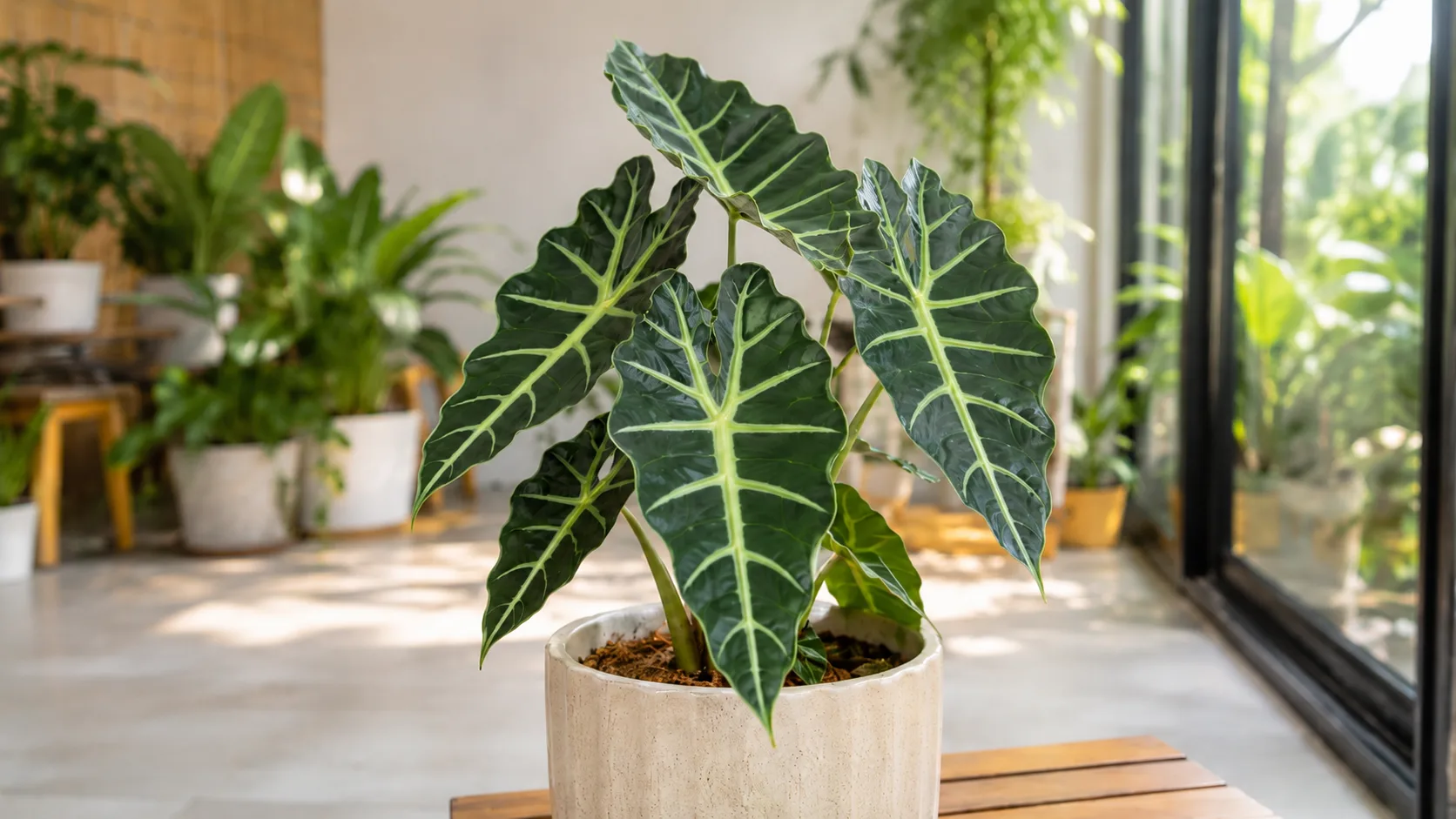
Choose the anchor by silhouette and conditions, not by the plant’s internet popularity. An Alocasia ‘Regal Shields’ has large shield-like leaves and immediate drama, which is why it works as a visual centerpiece. The Royal Horticultural Society’s alocasia guide also makes the trade-off clear: these tropicals prefer warmth, humidity, and bright but indirect light, and can become dormant in cooler, drier winter conditions.
That combination makes a statement Alocasia a good choice for a bright living room or a filtered south-facing window—not for a dark corner chosen only because the pot fits. If your conditions are less forgiving, a rubber plant can provide a similarly strong upright shape with a different care rhythm. North Carolina Extension describes Ficus elastica as a glossy, erect houseplant that prefers bright indirect light or partial shade, good drainage, and protection from cold drafts; its rubber plant profile is a useful reality check before you buy a large specimen.
Balance drama with quieter foliage
A gallery effect collapses when every plant demands to be the star. Pair a large, high-contrast leaf with a quieter mass of green, then add one plant whose movement is different. For example, place a dark Alocasia beside a medium rubber plant and let a pothos trail below the shelf line; the three plants read as a composition because their shapes are not competing in the same way.
You can make the same decision with the plants already in your home. Keep the plant with the biggest leaves as the anchor. Move plants with plain, dense foliage behind or beside it. Reserve highly variegated or strongly patterned plants for the middle ground, where their details can be seen up close without making the whole room visually noisy.
Build a Palette From Leaf Shape, Not Just Color
Green is not one color, and foliage is not one texture. The easiest way to make a mixed collection feel intentional is to repeat a few shapes: one broad leaf, one narrow or cut leaf, one patterned leaf, and one cascading form. You can keep the pots neutral and still get a richly layered room because the leaves provide the contrast.
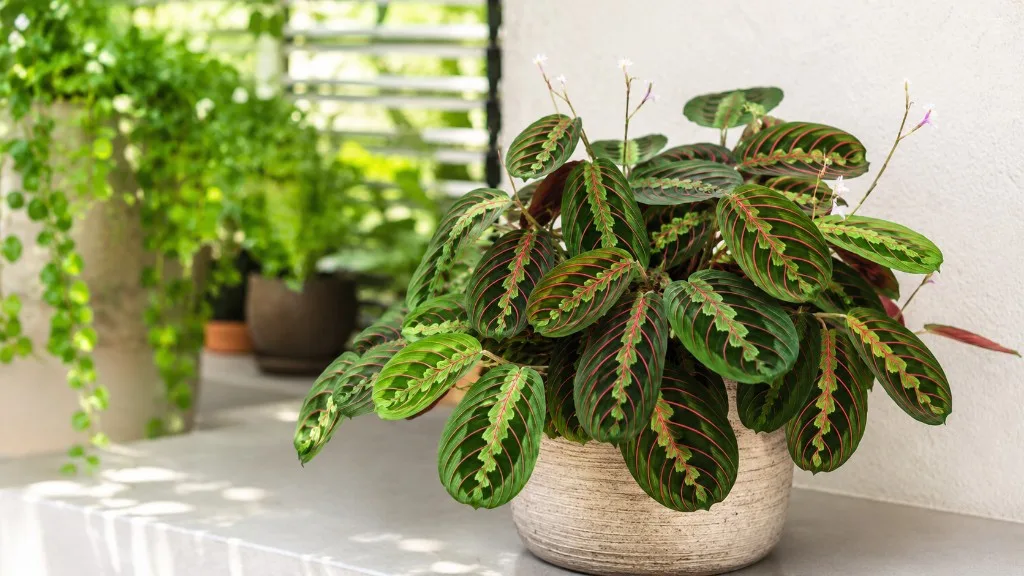
Patterned foliage is especially useful when the art already contains lines, faces, or botanical motifs. A lemon lime maranta supplies fine veins and a low, spreading habit rather than another towering silhouette. North Carolina Extension notes that Maranta leuconeura has patterned leaves that move between day and night, prefers bright indirect light, and dislikes direct sun and low humidity. In a home gallery, that movement is a feature—but only if the plant is placed where its details can be seen.
Patterned leaves and fine texture
Use patterned or finely divided leaves as close-view plants. They belong on a shelf, side table, or low stand where a visitor can notice the markings, not behind a giant sofa where the pattern disappears. False aralia is a strong example of this role: its narrow, serrated leaflets create a lace-like texture that contrasts with the solid, shield-shaped leaves of an Alocasia.
False aralia is now generally listed as Plerandra elegantissima, with older plant labels using Dizygotheca or Schefflera elegantissima. The North Carolina Extension profile identifies it as a specimen houseplant that wants high humidity and moist but well-drained soil. That makes it visually useful in a plant grouping, but less forgiving than a plain-leaved anchor if the room is dry or the watering routine is erratic.
Fine texture can also come from a fern, a palm, or a trailing plant. Put those forms where they can break up a heavy block of foliage. Think of them as punctuation: enough to create movement, not so much that every edge becomes a loose fringe.
Map Light Before You Fill the Room
Light is the invisible frame around every plant display. A room may look bright to a person and still be too dim for a plant several feet from the window. The University of Minnesota Extension lighting guide separates low, medium, and high light and notes that insufficient light produces stretched stems, pale growth, leaf drop, and loss of variegation. The University of Missouri Extension guide likewise emphasizes that large windows provide the strongest growing conditions and that distance from the glass matters.
This is why a south-facing bedroom window can be valuable in a plant-heavy home, but it is not a universal permission slip. Sheer curtains, nearby buildings, trees, window tint, and the season all change the light. A plant curtain can look beautiful while starving the leaves behind it if the arrangement is too dense.
A five-minute light audit
Do this before buying a new plant or moving a large one:
- Mark every window, skylight, glass door, radiator, and air-conditioning vent on a simple room sketch.
- Watch the room at morning, midday, and late afternoon. Note where the sun lands directly and where the light stays bright but diffused.
- Choose one bright zone for plants that need strong growth and one softer zone for plants that tolerate lower light.
- Leave the floor and shelf space closest to the window for the plants that actually need it; do not spend that premium space on a low-light plant just because its pot matches.
- Recheck the arrangement when the season changes. A plant that worked beside a summer window may need to move back from the glass in winter if cold drafts or a heater become the bigger risk.
If the display must sit far from a window, use a grow light as part of the design rather than hiding it as an emergency fix. A slim, warm-white LED above a shelf can become architectural, while a plant slowly stretching toward a distant window will make the whole installation look tired.
Layer Plants Like a Gallery Installation
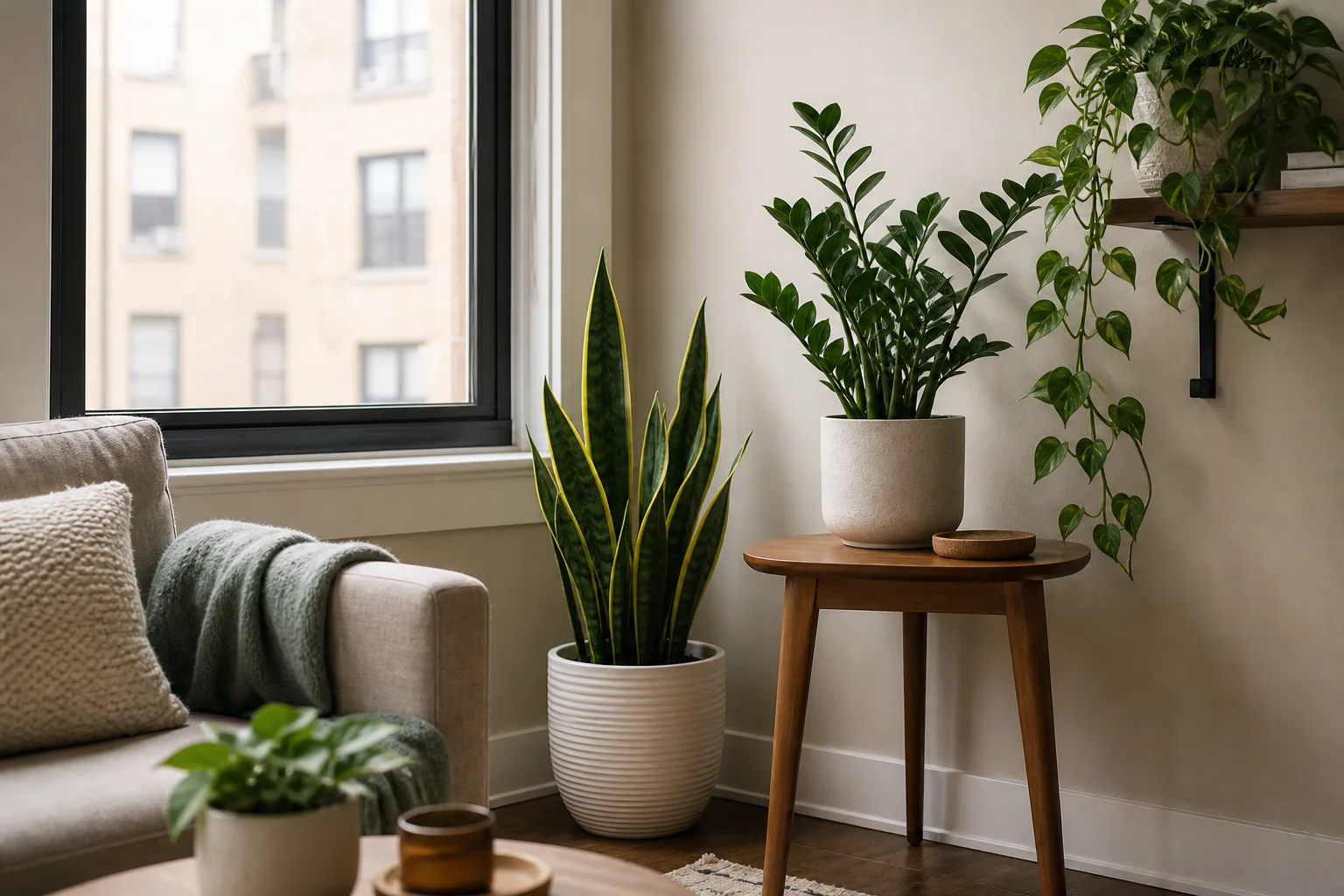
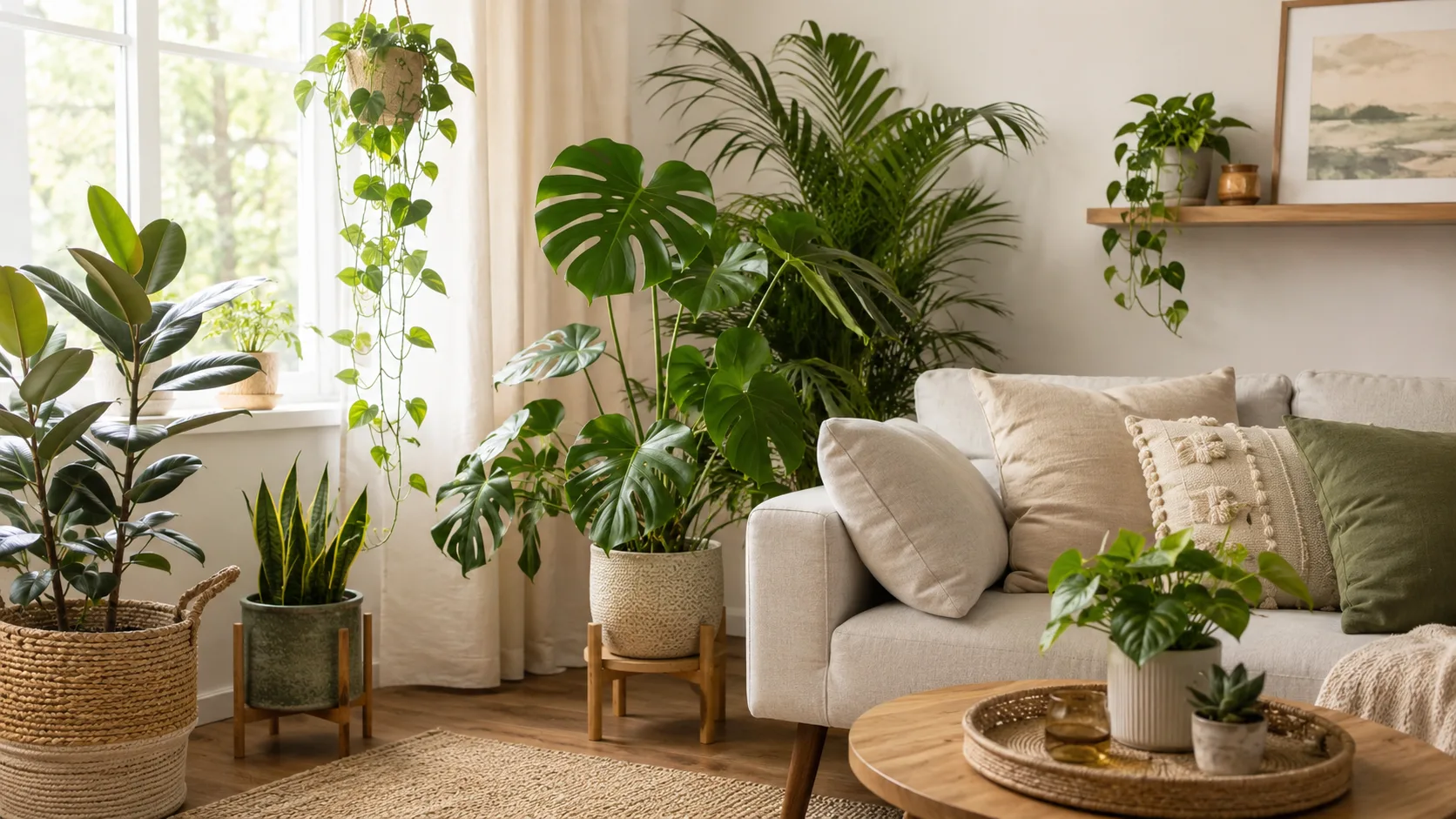
Once the light zones are clear, arrange plants in layers rather than a single row. Start with the tallest or broadest anchor. Add a medium plant that fills the gap at knee or waist height. Finish with a low plant, a trailing vine, or a fine-textured plant that changes the edge of the arrangement.
The best clusters usually contain three to five plants, but the number matters less than the relationship. Group plants when they share a light band and a similar watering rhythm. Split them when one needs to dry almost completely while its neighbor wants evenly moist soil. A beautiful grouping that forces you to water every pot on the same day is still a bad grouping.
Vary height, depth, and sightlines
Use a plant stand, pedestal, shelf, or sturdy side table to create a second level. Place a large pot slightly behind the front edge of the grouping, then bring a smaller pot forward so the leaves overlap without blocking every stem. Let one plant rise above the furniture and let another move down toward the floor; the eye reads the changing line as intentional depth.
Leave breathing room around the most sculptural leaves. Negative space is not wasted space—it is what lets a dramatic plant read as an object. If every leaf touches the next plant, the display becomes a green wall with no focal point. Step back several feet and check whether you can identify the anchor in one glance.
Containers should support this hierarchy. Similar finishes create calm when the foliage is varied; one distinctive ceramic or sculptural cachepot can mark the anchor. Avoid buying a complete matching set unless the plants have very different silhouettes, because identical pots and identical heights can make a living collection look like a row of office plants.
Give Each Room a Different Plant Job
The strongest plant-filled homes do not repeat the same arrangement in every room. They let the room’s light, traffic, and mood determine the plant role.
Living room, bedroom, and window zones
In the living room, use the largest plant where it can be seen from the doorway or seating area without blocking a walkway. A tall rubber plant or large Alocasia can anchor a low sofa, while a pothos or fern softens a shelf. Keep the plant far enough from the furniture that leaves do not rub against upholstery and pots can be removed for watering.
In the bedroom, favor calmer shapes and plants that tolerate the room’s actual light. A rubber plant can provide an upright, architectural form, while a peace lily or prayer plant supplies softer foliage if the room is bright enough. Do not use a bedroom as a dumping ground for plants that need more light; stretched growth will eventually make the display look sparse.
At a bright window, reserve the best positions for plants that need them. Move lower-light plants to the sides or farther back, and turn pots periodically so growth does not lean in one direction. For a south-facing window, filter harsh direct sun for plants with thin or delicate leaves. The RHS’s houseplant selection advice is useful here because it treats light, humidity, and temperature as room-specific constraints rather than a universal plant list.
Bathrooms can support humidity-loving plants only when they also have usable light and airflow. Steam does not make a windowless bathroom a growing space. Penn State Extension explains that misting raises humidity only until the water evaporates and that bathrooms often lack the light plants need; its humidity guidance is a good reason to treat bathroom placement as conditional, not magical.
Watering and Maintenance That Stay Out of Sight
The visual trick behind a good plant gallery is not hiding neglect. It is hiding the workflows that make care easy. Keep a narrow tray, towel, watering can, scissors, and moisture-check tool near the collection so a small task does not require dismantling the room.
Water by plant and pot, not by the calendar. Check the soil, lift the pot when possible, and learn how much lighter it feels when it is ready. Large Alocasias and peace lilies may prefer more even moisture than a rubber plant, but neither wants a cachepot full of runoff. A peace lily can droop dramatically when dry and recover after watering; use that signal as a prompt to check the soil, not as a reason to repeat a damaging drought-and-flood cycle.
For shelves and furniture, use a nursery pot with drainage inside a decorative cachepot. Remove the inner pot for thorough watering when you can, let it drain fully, and empty the outer pot before returning it. This is less photogenic than pouring water into a sealed decorative pot, but it prevents the hidden water line that slowly damages roots and wood. Penn State’s repotting guidance also recommends choosing containers that complement the plant while preserving practical drainage.
Group care by microclimate, not by visual grouping alone. Water the bright-window cluster when it dries, check the slower bedroom cluster later, and inspect high-humidity plants for pests and wet leaves. Once a week, rotate plants, wipe large leaves, check the underside of foliage, and remove anything dead or diseased. That short inspection keeps the display from becoming a beautiful blind spot.
What Usually Breaks the Gallery Effect
The first failure is filling every gap. A gallery needs pauses between objects; a room needs paths for people and access for a watering can. If you cannot reach a pot without moving three others, the arrangement is over capacity even if it looks full in a photograph.
The second is styling for color before light. A variegated plant placed in a dim corner may lose its contrast, and a sun-loving plant forced into a dark shelf may stretch toward the nearest window. Choose the light zone first, then pick the leaf color and pot finish that work there.
The third is mixing incompatible care rhythms. A peace lily, prayer plant, rubber plant, and cactus can look excellent together for one afternoon, but their water needs are not interchangeable. Keep the visual grouping and the care grouping separate in your mind: plants can share a composition without sharing a saucer or a watering day.
The fourth is using heavy or fragile containers where they cannot be safely moved. A large wet pot on a narrow shelf is a maintenance problem and a fall hazard. Check the furniture’s load capacity, keep water away from artwork and outlets, and choose a lighter nursery pot inside the decorative vessel when the plant will need regular handling.
The final failure is copying a mood instead of a system. Golden’s home feels personal because the plants relate to her art and her attention. Your version will feel more convincing when it reflects your own palette—perhaps dark leaves and warm ceramics, or fine foliage against pale walls—while still obeying light, airflow, drainage, and access.
A One-Day Plan for Your Own Plant Gallery
You can reset a single room without buying anything. Start by photographing the room from the doorway and from the main seat. Circle the surfaces that need height, softness, or a stronger focal point. Remove plants that are crowded, struggling, or blocking a route.
Next, make three groups: anchors, supporting plants, and plants that need a new location. Put the anchor in the brightest suitable position, not necessarily the emptiest corner. Build one cluster with a tall plant, a medium plant, and a low or trailing plant. Keep a clear patch of wall or furniture around the anchor so its silhouette remains readable.
Then check the practical layer. Can every pot drain? Can you lift it? Is water protected from the floor and nearby art? Are any leaves touching a heater, cold window, or busy walkway? Solve those problems before adding decorative objects.
Finish by standing across the room and looking for three things: a focal point, a repeated leaf shape or color, and a visual pause. If you can see all three, the room will already feel more curated. If you cannot, move one plant rather than buying another.
Conclusion
An art gallery full of plants is built through editing. Start with one statement plant, give it the light and space it needs, then add contrasting leaf shapes, varied heights, and a few quieter companions. Use containers to frame the foliage, leave negative space around the best forms, and keep the watering setup practical enough that care never becomes an obstacle.
Shyama Golden’s apartment works as inspiration because the greenery is personal, theatrical, and alive. The part worth copying is not a particular plant count or a single dramatic corner. It is the decision to let plants shape the room’s composition—and to give every beautiful choice the conditions it needs to keep growing.



